



Community hub
1990 ATP Tour
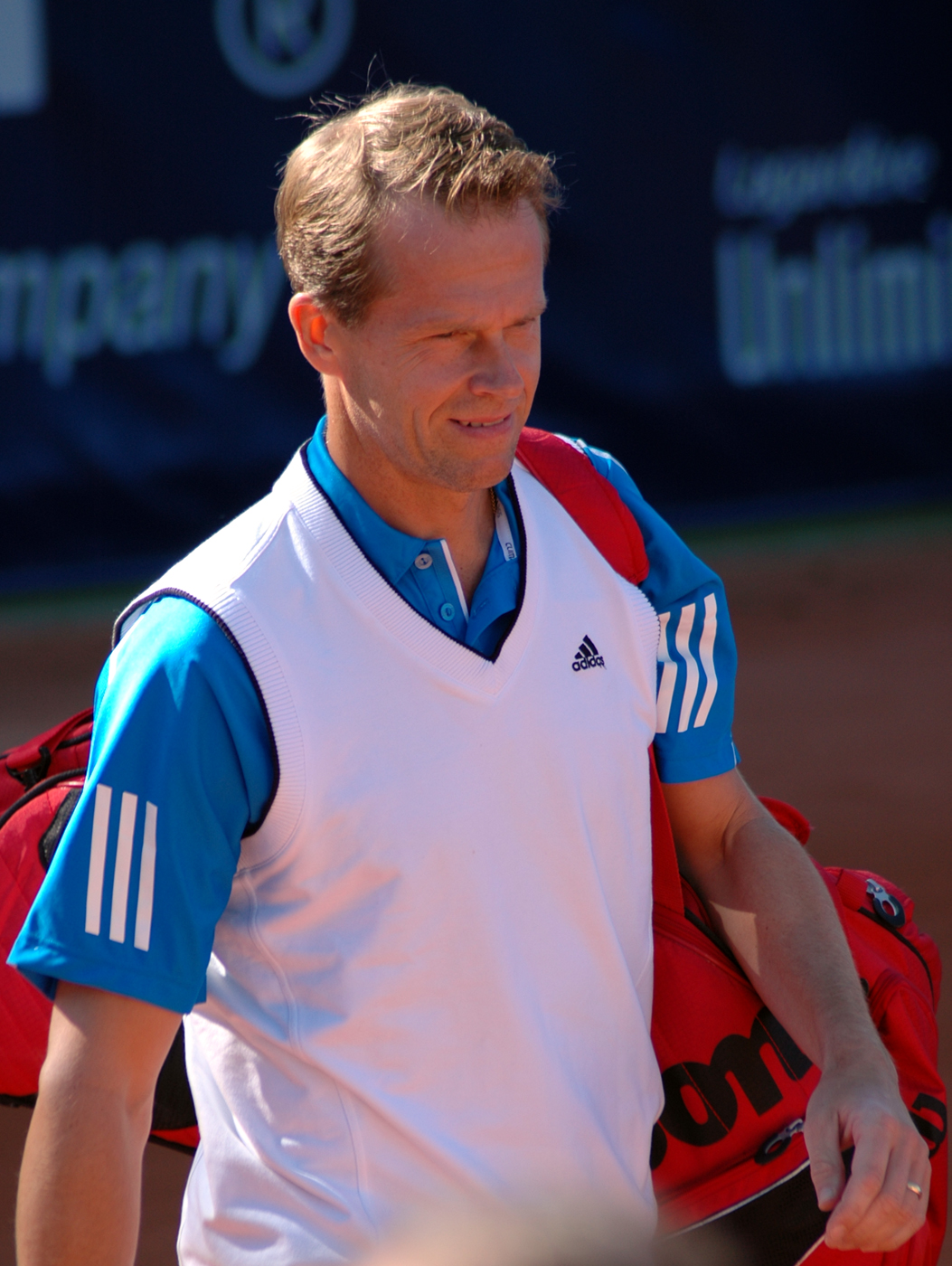
View on Wikipedia Stefan Edberg finished the year ranked world No. 1 for the first time in his career. He won seven titles during the season, including a major at the Wimbledon Championships. He also won three ATP Championship Series, Single Week events, and finished runner-up at another major, the Australian Open. | |
| Details | |
|---|---|
| Duration | January 1, 1990 – November 19, 1990 |
| Edition | 1st |
| Tournaments | 80 |
| Categories | Grand Slam (4) ATP Tour World Championships Grand Slam Cup ATP Championship Series, Single-Week (9) ATP Championship Series (12) ATP World Series (53) |
| Achievements (singles) | |
| Most titles |  Stefan Edberg (7) Stefan Edberg (7) |
| Most finals | Stefan Edberg (12) |
| Prize money leader |  Pete Sampras ($2,875,406) Pete Sampras ($2,875,406) |
| Points leader | Stefan Edberg (3889) |
| Awards | |
| Player of the year | Stefan Edberg |
| Doubles team of the year | |
| Most improved player of the year | Pete Sampras |
| Newcomer of the year |  Fabrice Santoro Fabrice Santoro |
| Comeback player of the year |  Thomas Muster Thomas Muster |
← 1989 1991 → | |

The 1990 IBM ATP Tour was the first season of the ATP Tour, the newly formed single world tennis circuit which came in replacing the two dual tours the ITF Grand Prix Circuit and WCT Circuit. It was the elite tour for professional tennis organized by the Association of Tennis Professionals. In 1990 the IBM ATP Tour included the four Grand Slam tournaments (organized by the International Tennis Federation (ITF)), the ATP Tour World Championships, the ATP Championship Series, Single-Week, the ATP Championship Series and the ATP World Series.[1] The World Team Cup, Davis Cup (organized by the ITF) and Grand Slam Cup (organized by the ITF) are included in this calendar but did not count towards the Tour.
Schedule
[edit]This is the complete schedule of events on the 1990 IBM ATP Tour, with player progression documented from the quarterfinals stage.
- Key
| Grand Slam |
| ATP Tour World Championships |
| ATP Championship Series, Single-Week |
| ATP Championship Series |
| ATP World Series |
| Team Events |
January
[edit]


February
[edit]


March
[edit]April
[edit]

May
[edit]June
[edit]July
[edit]


August
[edit]
September
[edit]
October
[edit]

November
[edit]December
[edit]| Week | Tournament | Champions | Runners-up | Semifinalists | Quarterfinalists |
|---|---|---|---|---|---|
| 10 Dec | Compaq Grand Slam Cup Munich, Germany Grand Slam Cup Carpet (i) – $6,000,000 – 16S Singles |
Pete Sampras 6–3, 6–4, 6–2 |
Brad Gilbert |
Michael Chang David Wheaton |
Henri Leconte Goran Ivanišević Aaron Krickstein Goran Ivanišević Aaron Krickstein Ivan Lendl Ivan Lendl
|
ATP rankings
[edit]
|
| ||||||||||||||||||||||||||||||||||||||||||||||||||||||||||||||||||||||||||||||||||||||||||||||||||||||||||||||||||||||||||||||||||||||||||||||||||||||||||||||||||||||||||||||||||||||||||||||||||||||||||||||||||||||||||||||||||||||||||||||||||


- ^ a b West Germany prior to 3 October 1990.
Statistical information
[edit]List of players and titles won, alphabetically by last name:
 Andre Agassi – San Francisco, Miami Masters, Washington, D.C., Season-Ending Championships (4)
 Ronald Agénor – Genova, Berlin (2)
 Juan Aguilera – Nice, Hamburg Masters (2)
 Pieter Aldrich – Newport (1)
 Alex Antonitsch – Seoul (1)
- Jordi Arrese – San Remo, Prague (2)
 Boris Becker – Brussels, Stuttgart, Indianapolis, Sydney Indoors, Stockholm Masters (5)
 Pat Cash – Hong Kong (1)
- Michael Chang – Canada Masters (1)
 Andrei Cherkasov – Moscow (1)
- Andrei Chesnokov – Monte Carlo Masters, Tel Aviv (2)
- Francisco Clavet – Hilversum (1)
 Stefan Edberg – Indian Wells Masters, Tokyo, Wimbledon, Los Angeles, Cincinnati Masters, Long Island, Paris Masters (7)
 Franco Davín – Palermo (1)
- Scott Davis – Auckland (1)
 Guy Forget – Bordeaux (1)
- Richard Fromberg – Bologna, Båstad (2)
- Brad Gilbert – Rotterdam, Orlando, Brisbane (3)
 Andrés Gómez – Barcelona, Madrid, French Open (3)
 Jakob Hlasek – Wembley (1)
 Goran Ivanišević – Stuttgart (1)
- Martín Jaite – Guarujá, Gstaad (2)
- Anders Järryd – Vienna (1)
- Kelly Jones – Singapore (1)
 Mark Koevermans – Athens (1)
 Ramesh Krishnan – Schenectady (1)
- Magnus Larsson – Florence (1)
 Ivan Lendl – Australian Open, Milan, Toronto, London, Tokyo Indoors (5)
 Amos Mansdorf – Rosmalen (1)
 Luiz Mattar – Rio de Janeiro (1)
- John McEnroe – Basel (1)
- Thomas Muster – Adelaide, Casablanca, Rome Masters (3)
- Yannick Noah – Sydney (1)
- Karel Nováček – Munich (1)
- Horacio de la Peña – Kitzbühel (1)
- Guillermo Pérez Roldán – San Marino (1)
- Goran Prpić – Umag (1)
- Marc Rosset – Lyon (1)
- Derrick Rostagno – New Haven (1)
- Pete Sampras – Philadelphia, Manchester, US Open, Grand Slam Cup (4)
- Emilio Sánchez – Wellington, Estoril (2)
- Horst Skoff – Geneva (1)
- Michael Stich – Memphis (1)
- Jonas Svensson – Toulouse (1)
- Robbie Weiss – São Paulo (1)
- David Wheaton – Kiawah Island (1)
- Mats Wilander – Itaparica (1)

The following players won their first title:
See also
[edit]References
[edit]- ^ John Barrett, ed. (1991). The International Tennis Federation : World of Tennis 1991. London: Collins Willow. pp. 111–117. ISBN 9780002184038.
- ^ "ATP Year-end top 20". ATP. Retrieved 15 September 2023.
External links
[edit]1990 ATP Tour
View on GrokipediaOverview
Format and Categories
The 1990 ATP Tour marked the official start of the modern ATP era since 1990, hailed as the dawn of a new era—the culmination of a ‘players’ revolt’ backed by figures such as Hamilton Jordan and players like Mats Wilander and Tim Mayotte—to wrest control from tournament organizers. Spanning from December 26, 1989, to November 19, 1990, the tour established a centralized framework under the Association of Tennis Professionals (ATP), streamlining scheduling, rankings, and governance for players worldwide.[12][11] The season encompassed 76 tournaments structured into distinct categories to balance prestige, competition level, and geographic reach. These included the four Grand Slam events—the Australian Open, French Open, Wimbledon, and US Open—where winners received 400 ranking points; the ATP Tour World Championships, a season-ending event for the top 8 ranked players that awarded 400 points to the champion; and the newly introduced Grand Slam Cup, an ITF-organized year-end bonus tournament for the top 12 players based on their Grand Slam results, awarding 400 points to the winner. Complementing these were 21 ATP Championship Series events, offering 300 points to winners; and 49 World Series events, capped at 150 points for victors. This tiered system ensured a progression from entry-level professional competitions to elite showdowns, fostering broad participation while rewarding excellence at the highest levels.[2][9] Rankings operated under a "best 14" system, where a player's total points derived from their top 14 results over the preceding 52 weeks, promoting sustained performance across the calendar. Updates occurred immediately following each tournament's completion, providing real-time reflections of form and achievement without reliance on averages or minimum event requirements from prior eras.[11] Events spanned multiple surfaces—hard courts for speed and bounce, clay for endurance and topspin rallies, grass for fast-paced serve-and-volley play, and indoor carpet for controlled, quicker conditions—accommodating diverse player strengths and global appeal. Prize money distribution emphasized higher categories, with Grand Slams and Championship Series events offering the largest purses to draw elite fields, while World Series tournaments provided accessible opportunities for emerging talent and total tour earnings reaching approximately $38 million across all levels.[9]Key Achievements
The 1990 ATP Tour marked a transformative year with Stefan Edberg emerging as the dominant force, concluding the season as the world No. 1 after ascending to the top ranking on August 13 following his victory at the Cincinnati Masters. Edberg captured seven singles titles, including his second Wimbledon crown where he defeated Boris Becker in a five-set final, showcasing his serve-and-volley prowess on grass. His consistent excellence across surfaces earned him the ATP Player of the Year award, recognizing his leadership in the inaugural unified ATP Tour era.[1][13][4] Pete Sampras, at just 19 years old, burst onto the scene by securing his maiden Grand Slam title at the US Open, defeating Andre Agassi 6–4, 6–3, 6–2 in the final to become the youngest men's champion in the tournament's history. This breakthrough propelled Sampras to lead the tour in prize money earnings with $2,875,406, largely boosted by his subsequent win at the newly introduced Grand Slam Cup, where he pocketed a record $2 million winner's check. Alongside Agassi's triumph at the ATP Tour World Championships—defeating Edberg 5–7, 7–6(5), 7–5, 6–2 in the final—these achievements highlighted the rise of American talents challenging the established European hierarchy.[14][15][16] Notable upsets added intrigue to the season, such as Andrés Gómez's stunning victory over heavily favored Agassi in the French Open final, 6-3, 2-6, 6-4, 6-4, marking Ecuador's first Grand Slam singles title and denying Agassi a career Grand Slam opportunity on clay. Earlier, Ivan Lendl claimed his second consecutive Australian Open title when Edberg retired injured in the final at 4-6, 7-6(3), 5-2, though Lendl's own back injury later sidelined him for much of the year. These moments underscored the tour's competitiveness amid physical demands.[7][17] The season's milestones included the debut of the unified ATP Tour, consolidating previous circuits into a single global structure to streamline scheduling and rankings. Additionally, the Grand Slam Cup was introduced as an end-of-year event organized by the ITF, qualifying the top 12 players based solely on their performances across the four Grand Slams, offering unprecedented prize money to reward major excellence.[1][18]Schedule
January
The January portion of the 1990 ATP Tour marked the start of the season with a series of outdoor tournaments in the Southern Hemisphere, primarily on hard courts but including one grass-court event, serving as key warm-up competitions ahead of the Australian Open Grand Slam. These events, categorized under the World Series tier except for the Grand Slam, featured a mix of established stars and emerging players vying for early-season points and prize money. The schedule emphasized Australia's hard-court swing, with additional stops in New Zealand, reflecting the tour's focus on acclimating players to summer conditions in the region.[9] The season opener was the Australian Men's Hardcourt Championships in Adelaide, Australia, held from January 1 to 7 on hard courts at the Memorial Drive Tennis Centre. Third-seeded Thomas Muster of Austria claimed the singles title, defeating Carl-Uwe Steeb of West Germany 6–2, 6–4 in the final, marking Muster's first title of the year and showcasing his baseline prowess on the faster surface. In doubles, Andrew Castle of Great Britain and Nduka Odizor of Nigeria won the championship, overcoming Alexander Mronz of West Germany and Michiel Schapers of the Netherlands 6–4, 6–2; this victory was Castle's only doubles title of 1990. The tournament offered a total prize money of approximately A$225,000, drawing solid attendance amid early summer warmth.[9][19] Concurrent with the later stages of Adelaide were two World Series events starting January 8: the Benson and Hedges Championships in Auckland, New Zealand, on hard courts at the Auckland International Tennis Centre, and the New South Wales Open in Sydney, Australia, on grass courts at the White City Stadium. In Auckland, American Scott Davis secured the singles crown, beating Czech Karel Nováček 6–4, 7–6(5), 6–3 in the final, highlighting Davis's serve-and-volley effectiveness on the medium-paced hard courts. Doubles went to Kelly Jones and Robert Van't Hof of the United States, who defeated Grant Connell and Glenn Michibata of Canada 6–4, 7–6. The event's prize money totaled around $157,500. Meanwhile, in Sydney, French veteran Yannick Noah triumphed in singles, edging Steeb 5–7, 6–3, 6–4 in a rain-affected final that tested endurance on the slick grass surface, one of the few remaining grass events on the tour at the time. The doubles title was captured by Pat Cash and Mark Kratzmann of Australia, defeating Darren Cahill and Simon Leitch 6–4, 6–4. Sydney's purse was valued at about A$200,000, with the grass setup providing a contrast to the hard-court prep elsewhere.[9][20] The month's pinnacle was the Australian Open, a Grand Slam held from January 15 to 28 in Melbourne at Flinders Park on Rebound Ace hard courts, the first major of the year under the new ATP Tour structure. Ivan Lendl of Czechoslovakia defended his title successfully, defeating Sweden's Stefan Edberg 4–6, 7–6(7–3), 5–2 ret. in the final after Edberg retired due to injury; this marked Lendl's second straight Australian Open win and his eighth Grand Slam singles title overall. The semifinals featured Lendl overcoming 12th-seeded Noah 6–2, 7–5, 6–1, while Edberg upset former champion Mats Wilander of Sweden 6–4, 6–1, 6–4. Quarterfinalists included Alexander Cherkasov (Soviet Union), Mikael Pernfors (Sweden), and Henri Leconte (France), with notable upsets like Noah's straight-sets victory over John McEnroe, who was disqualified earlier in the tournament for misconduct amid the grueling conditions. In doubles, South Africans Pieter Aldrich and Danie Visser prevailed over Connell and Michibata 3–6, 7–6(7–3), 7–6(7–2) in a tense final. The tournament distributed a record A$1.462 million in total prize money for the time, with Lendl earning A$320,000 as singles champion, and attracted over 300,000 spectators despite the heat.[6][21][22] Extreme heat defined much of January's play, particularly in Australia, where temperatures exceeded 40°C (104°F) in Adelaide and Brisbane early in the month, leading to heat exhaustion cases and delayed matches. At the Australian Open in Melbourne, daytime highs often surpassed 35°C (95°F) with high humidity, prompting the introduction of shade structures and ice treatments for players; the conditions contributed to Edberg's retirement and tested endurance, as noted in contemporary reports on the tour's adaptation to Southern Hemisphere summers. These environmental factors underscored the physical demands of the early-season schedule.[23][24]| Tournament | Dates | Location | Surface | Category | Singles Winner/Finalist | Doubles Winners/Finalists | Prize Money (Total) |
|---|---|---|---|---|---|---|---|
| Adelaide | Jan 1–7 | Adelaide, Australia | Hard | World Series | Thomas Muster def. Carl-Uwe Steeb | Andrew Castle/Nduka Odizor def. Alexander Mronz/Michiel Schapers | A$225,000 |
| Auckland | Jan 8–14 | Auckland, New Zealand | Hard | World Series | Scott Davis def. Karel Nováček | Kelly Jones/Robert Van't Hof def. Grant Connell/Glenn Michibata | $157,500 |
| Sydney | Jan 8–14 | Sydney, Australia | Grass | World Series | Yannick Noah def. Carl-Uwe Steeb | Pat Cash/Mark Kratzmann def. Darren Cahill/Simon Leitch | A$200,000 |
| Australian Open | Jan 15–28 | Melbourne, Australia | Hard | Grand Slam | Ivan Lendl def. Stefan Edberg | Pieter Aldrich/Danie Visser def. Grant Connell/Glenn Michibata | A$1,462,000 |
February
February marked a shift in the 1990 ATP Tour toward the indoor season, with most events played on fast carpet surfaces in Europe and North America, providing players an opportunity to adapt from the Australian summer hard courts to the winter indoor swing. The month featured five main draw tournaments across World Series and Championship Series categories, highlighting the dominance of top-ranked players like Ivan Lendl and Boris Becker while showcasing emerging talents and occasional surprises. These events contributed to early momentum building toward the clay court season, with January champions such as Lendl carrying form into February successes.[9] The Stella Artois Indoor in Milan, Italy, from February 5 to 11, served as a World Series event on indoor carpet, drawing a strong field including world No. 1 Lendl. Lendl captured the singles title by defeating Alexander Volkov in the final, securing his third consecutive win at the tournament and reinforcing his status as a carpet specialist. In doubles, Italian wild cards Omar Camporese and Diego Nargiso upset the seeded pair of John McEnroe and his partner to claim the title, marking a notable home-country achievement.[9][25] Concurrent with Milan, the Volvo San Francisco in the United States, also February 5 to 11 on indoor carpet as a World Series event, saw second-seeded Andre Agassi dominate the singles draw. Agassi defeated unseeded American Todd Witsken in the final 6-1, 6-3, showcasing his powerful baseline game on the quick surface and earning his second title of the year. The doubles crown went to Americans Kelly Jones and Robert Van't Hof, who prevailed in a competitive field.[9][26] The following week, Championship Series events elevated the competition. In Toronto, Canada, the SkyDome World Tennis Tournament from February 12 to 18 on indoor carpet saw Lendl extend his winning streak, defeating Tim Mayotte 6-3, 6-0 in the final for his second title in as many weeks. The doubles event was won by Patrick Galbraith and David Macpherson, the American-Australian pair securing their first joint victory of the season. Meanwhile, in Brussels, Belgium, the Belgian Indoor Championships from February 12 to 18 on indoor carpet featured Boris Becker claiming the singles title over Carl-Uwe Steeb 7-5, 6-2, 6-2, demonstrating his serving prowess in a straight-sets win. Doubles honors went to Emilio Sánchez and Slobodan Živojinović, who defeated Goran Ivanišević and Balázs Taróczy 7-5, 6-3.[9] Closing the month's schedule, the U.S. National Indoor in Memphis, Tennessee, from February 26 to March 4 on indoor hard courts as a World Series event, produced several upsets that shook the seeded players. Top seed Stefan Edberg fell to Gary Muller in the second round, while third seed Andrei Chesnokov was stunned by Michael Stich 6-3, 6-1 in the quarterfinals. Unseeded Stich, in his breakthrough performance, went on to win the singles title against Wally Masur 6-7(5), 6-4, 7-6(3), marking his first ATP title. In doubles, Darren Cahill and Mark Kratzmann captured the championship. These results underscored the unpredictable nature of the hard indoor surface and set the stage for the transition to outdoor events.[9][27][28]March
The March segment of the 1990 ATP Tour marked the shift from the indoor season to the outdoor hard court swing in North America, building on the momentum from February's carpet events such as the U.S. Pro Indoor in Philadelphia, where Pete Sampras claimed his first ATP singles title by defeating Andrés Gómez in the final, while Rick Leach and Jim Pugh secured the doubles crown.[9] This transition highlighted the tour's progression toward warmer climates and faster surfaces, setting the stage for high-stakes competitions that showcased emerging American talent alongside European stars. The month's centerpiece was the Newsweek Champions Cup, a Championship Series Single-Week event held from March 5 to 11 on hard courts at the Indian Wells Tennis Garden in California. Stefan Edberg, seeded second, dominated the draw to win the singles title, defeating top-seeded Andre Agassi in a four-set final (6–4, 5–7, 7–6(7–1), 7–6(8–6)), marking his first victory at the tournament and reinforcing his status as a versatile all-court player.[9] In doubles, Boris Becker and Guy Forget partnered to triumph over Jim Grabb and Patrick McEnroe in the final (4–6, 6–4, 6–3), with their victory underscoring Becker's adaptability across surfaces early in the season.[9] The event drew strong fields, including Ivan Lendl and John McEnroe, and distributed $1.2 million in prize money, emphasizing its prestige within the tour's tiered structure. The Lipton International Players Championships followed from March 16 to 25 on hard courts in Key Biscayne, Florida, another Championship Series Single-Week tournament with over $1.5 million in prizes. Andre Agassi, the sixth seed, exacted revenge on Edberg in the singles final (6–1, 6–4, 0–6, 6–2), capturing his maiden Masters 1000 title and establishing early dominance on North American hard courts that would define much of his career.[9] Leach and Pugh repeated their doubles success from Philadelphia, defeating Marcelo Filippini and Agustín Moreno in the final (6–2, 6–3), becoming the first pair to win consecutive high-profile titles that spring.[9] Agassi's run, which included upsets over Lendl and Thomas Muster, propelled him toward a career-high ranking and highlighted the growing rivalry with Edberg. Smaller World Series events rounded out the month, including the concluding days of the Memphis Indoor Championships (spanning late February to March 4 on hard courts), where Michael Stich won his first ATP singles title against Wally Masur in the final, and Darren Cahill/Mark Kratzmann took doubles over Robert Seguso/Paul Annacone.[9] These tournaments provided crucial ranking points for mid-tier players while serving as tune-ups for the elite ahead of the clay court season. Overall, March solidified the ATP Tour's inaugural year's emphasis on diverse surfaces and intense rivalries, with Edberg's Indian Wells triumph and Agassi's Miami breakthrough as pivotal highlights.April
April marked the beginning of the European clay court season on the 1990 ATP Tour, with several high-profile events in Portugal, Spain, and Monaco showcasing specialists on the slower surface, while hard court tournaments continued in the United States as a carryover from March's schedule.[9] The month featured a mix of World Series and Championship Series events, highlighting emerging talents and established players adapting to clay's demands for longer rallies and strategic baseline play. The Estoril Open, a World Series event on clay held from April 2–8, was won in singles by Emilio Sánchez of Spain, who defeated Franco Davín in the final 6–7, 6–1, 6–4; Sánchez also partnered with countryman Sergio Casal to claim the doubles title, beating Omar Camporese and Paolo Canè 6–3, 6–7, 6–3.[9] This victory underscored the strong Spanish presence early in the clay swing, with Sánchez leveraging his all-court game to secure his second title of the year. The Barcelona Open, elevated to Championship Series status and played on clay from April 9–15, saw Andrés Gómez of Ecuador capture the singles crown, overcoming Guillermo Pérez Roldán in a three-set final 6–3, 7–6, 6–2.[29] In doubles, Casal and Sánchez repeated their success from Estoril, defeating Javier Sánchez and Andrés Gómez 7–6, 7–6 to win their second consecutive title together that month. The event drew a strong field of clay courters, emphasizing endurance on the red dirt. The Monte Carlo Masters, a prestigious Championship Series clay tournament from April 23–29, was claimed in singles by Andrei Chesnokov of the Soviet Union, who upset Thomas Muster in the final 6–1, 7–6, 6–1, marking his first Masters 1000 title and highlighting the rise of Eastern European players.[30] Doubles went to Petr Korda of Czechoslovakia and Tomáš Šmíd, who defeated Tomás Carbonell and Libor Pimek 3–6, 7–6, 6–2 in the championship match.[31] In the United States, the Verizon Tennis Challenge in Atlanta, a World Series hard court event from April 16–22, was dominated by American Brad Gilbert, who defeated compatriot Kevin Curren 6–1, 6–3 in the singles final, showcasing strong home performances from players like Curren and Scott Davis in the draw.[32] Similarly, the Mita Lite Orlando Open on hard courts, held April 16–22, was won by Gilbert in singles, beating Christo van Rensburg 6–1, 6–2, reinforcing American strength on faster surfaces ahead of the spring hard court circuit's conclusion.[33] These U.S. events provided crucial ranking points for North American players transitioning toward the grass season.May
The month of May 1990 marked the intensification of the ATP Tour's clay-court season, building on the European swing that began in April with events like Monte Carlo and Barcelona, as players honed their skills on the slower surface in preparation for the French Open. Key tournaments during this period included the ATP Masters 1000 events in Hamburg and Rome, alongside the World Series stop in Bologna, all contested on clay and showcasing rising stars and veterans adapting to the demanding rallies typical of the surface. These competitions highlighted the depth of the field, with upsets and strong performances setting the stage for the Grand Slam climax at Roland Garros.[9] The German Open in Hamburg, held from May 7 to 13, served as an early highlight of the month. Spaniard Juan Aguilera claimed the singles title, defeating top seed and world No. 2 Boris Becker in a stunning final, 6-1, 6-0, 7-6(9-7), marking Aguilera's first ATP Masters 1000 victory and his only title of the year. In doubles, Sergi Bruguera and Jim Courier partnered to win their maiden Grand Prix title together, overcoming Udo Riglewski and Michael Stich 7-5, 6-2 in the championship match. The event underscored the clay specialists' edge, with Aguilera's defensive play neutralizing Becker's power on the Am Rothenbaum courts. Shifting to Rome for the Italian Open from May 14 to 20, Austrian Thomas Muster dominated the singles draw en route to his second title of the year, crushing Andrei Chesnokov 6-1, 6-3, 6-1 in the final and extending his clay winning streak to 19 matches. Muster's aggressive baseline game thrived on the Foro Italico's red clay, propelling him into the top 10 rankings. The doubles crown went to Spanish siblings Sergio Casal and Emilio Sánchez, who edged Jim Courier and Martin Davis 7-6, 7-5, securing their third joint title and bolstering Spain's strong presence in European clay events. The Bologna International from May 21 to 27 provided additional momentum heading into the Grand Slam. Australian Richard Fromberg, then ranked outside the top 50, upset higher seeds to capture the singles trophy, defeating Filip Dewulf 6-4, 6-3 in the final for his first ATP Tour victory. In doubles, Argentine Gustavo Luza and German Udo Riglewski triumphed over Jérôme Potier and Jim Pugh 7-6, 4-6, 6-1, with Luza earning his third career doubles title. This World Series event emphasized the tour's global reach, drawing a mix of established players and emerging talents on Bologna's outdoor clay. The French Open, spanning May 28 to June 10 at Roland Garros in Paris, crowned the month's clay-court narrative with Ecuadorian Andrés Gómez pulling off a major upset in the men's singles final. At age 30, Gómez defeated heavy favorite and unseeded Andre Agassi 6-3, 2-6, 6-4, 6-4, becoming the first Ecuadorian Grand Slam champion and the oldest French Open winner in 18 years since Andrés Gimeno in 1972.[34] Gómez's victory, fueled by his topspin-heavy game and endurance in five-set battles earlier in the tournament, denied Agassi a career Grand Slam opportunity at the time.[35] In doubles, Sergio Casal and Emilio Sánchez repeated their Rome success, defeating Goran Ivanišević and Petr Korda 6-3, 7-6, 6-3 to claim their first Grand Slam title as a pair and Spain's first men's doubles major since 1978. The tournament distributed $2.7 million in prize money and drew over 300,000 spectators, solidifying its status as the pinnacle of clay tennis.[36]June
June marked the start of the grass-court season on the 1990 ATP Tour, a significant shift from the clay-court dominance of the preceding months, as players adapted to the faster, lower-bouncing surface that favored serve-and-volley tactics and quick adjustments in movement. This transition posed challenges for many competitors coming off the French Open, requiring rapid changes in strategy to prepare for Wimbledon. The month featured three key events: the inaugural Rosmalen Grass Court Championships in the Netherlands, the Manchester Open in Great Britain, and the prestigious Wimbledon Championships in London. The Rosmalen Grass Court Championships, held from June 11 to 17 on outdoor grass as part of the ATP World Series category with a $225,000 prize purse, served as an early tune-up for the grass season. Unseeded Israeli Amos Mansdorf claimed the singles title, defeating American Richey Reneberg 6-4, 6-4 in the final, marking Mansdorf's second career ATP singles victory.[37] In doubles, Swiss Jakob Hlasek and German Michael Stich partnered to win the title, overcoming Americans Jim Grabb and Patrick McEnroe 7-6, 6-3, showcasing strong net play on the slick surface. The Manchester Open, another ATP World Series grass-court event from June 18 to 24 with a matching $225,000 purse, highlighted emerging talent. American Pete Sampras, seeded second, secured his first grass-court singles title—and his second ATP title overall—by beating Israeli Gilad Bloom 7-6(11-9), 7-6(7-3) in the final, relying on his powerful serve to navigate tight tiebreaks. The doubles crown went to Australians Mark Kratzmann and Jason Stoltenberg, who demonstrated effective grass-court teamwork in their victory. The highlight of June was the Wimbledon Championships, the Grand Slam event running from June 25 to July 8 on outdoor grass, drawing a record prize money of $2,917,000 and featuring 128 singles entrants. Sweden's Stefan Edberg captured the men's singles title, defeating defending champion Boris Becker of Germany 6-2, 6-2, 3-6, 3-6, 6-4 in a five-set final that tested endurance and precision. Edberg's baseline solidity and net approaches proved decisive in the decider, while Becker's serve-volley prowess shone through in forcing the match to five sets with aggressive play.[38] In men's doubles, Americans Rick Leach and Jim Pugh defended their title successfully, edging South Africans Pieter Aldrich and Danie Visser 7-6(7-5), 7-6(7-5) in an all-tiebreak final that underscored the importance of serving accuracy on grass.[39] These results highlighted the grass season's emphasis on power and volleying, setting the stage for further hard-court action later in the year.July
July marked a transitional period in the 1990 ATP Tour schedule following the grass-court dominance of Wimbledon in June, with tournaments shifting to a mix of clay and hard courts to prepare players for the summer hard-court swing. The month featured five key events across Europe and North America, including two Championship Series tournaments that offered significant ranking points and prize money. These competitions highlighted emerging talents and established stars adapting to varied surfaces post-Wimbledon.[9] The Swiss Open in Gstaad, a World Series event on clay from July 9-15, saw Argentine Martin Jaite claim his second career singles title by defeating Spaniard Sergi Bruguera 6-4, 6-1, 4-6, 6-1 in the final. In doubles, Spaniards Sergio Casal and Emilio Sánchez secured the title, overcoming Sweden's Magnus Gustafsson and Henrik Holm 6-4, 6-2, marking their fourth joint victory of the year. The tournament, held at an altitude of over 3,000 feet, tested players' endurance on the slow clay surface.[40] Concurrent with Gstaad, the Hall of Fame Open in Newport, Rhode Island—a World Series grass-court event from July 9-15—provided a final opportunity to capitalize on grass momentum from Wimbledon. South Africa's Pieter Aldrich won the singles, rallying past Australia's Darren Cahill 7-6(7-5), 1-6, 6-1 in the final for his first title of the season. Doubles went to Australians Darren Cahill and Mark Kratzmann, who defeated Americans Todd Nelson and Bryan Shelton 6-4, 7-6 in the championship match.[41] Shifting to hard courts, the Legg Mason Tennis Classic in Washington, D.C., a Championship Series event from July 16-22, was captured by American Andre Agassi, who defeated fellow American Jimmy Connors 6-2, 6-2 in the final to earn his fourth title of the year. The doubles crown was taken by Canadians Grant Connell and Glenn Michibata, beating Americans Robert Seguso and Marc Roe 6-3, 6-7(3-7), 6-4. Agassi's win solidified his status as a hard-court specialist ahead of the U.S. hard-court season.[42] The Mercedes Cup in Stuttgart, Germany, another Championship Series clay-court tournament from July 16-22, featured Croatian Goran Ivanišević defeating American Todd Martin 7-6(7-5), 6-2, 6-3 for his first career singles title. In doubles, South Africans Pieter Aldrich and Danie Visser prevailed over Swedes Jan Gunnarsson and Ulf Tukesson 7-6, 6-3, continuing their strong partnership with a third title of the season. The event's red clay favored baseline players in the European summer heat.[43] Closing the month, the Volvo Tennis Los Angeles, a World Series hard-court event starting July 30 and extending into August, was won by Sweden's Stefan Edberg, who overcame American Michael Chang 7-6(7-4), 2-6, 7-6(7-3) in the final despite a mid-match foot injury. Americans Scott Davis and David Pate claimed the doubles title, defeating Sweden's Peter Lundgren and Kenya's Paul Wekesa 6-3, 7-6. Edberg's victory boosted his year-end No. 1 aspirations on a surface suited to his serve-and-volley style.[44]August
August on the 1990 ATP Tour shifted focus to the North American hard court season, with Championship Series events providing essential preparation for the US Open later in the month. These tournaments emphasized baseline play and endurance on faster surfaces, drawing top-ranked players amid a non-Olympic year that kept the emphasis on individual titles and rankings momentum. The Thriftway ATP Championships in Cincinnati, a Championship Series Single-Week event held from August 6 to 12 on outdoor hard courts in Mason, Ohio, showcased Stefan Edberg's peak form. As the second seed, Edberg cruised through the draw, dropping just one set before dismantling defending champion Brad Gilbert 6-1, 6-1 in the final—a repeat of their 1989 showdown but with far greater dominance. The 52-minute victory not only secured Edberg's second title of the year but also elevated him to world No. 1 in the ATP rankings for the first time, a milestone achieved through his precise serve-volley game and 28 aces across the tournament. In doubles, Australian pair Darren Cahill and Mark Kratzmann captured the crown, edging Neil Broad and Gary Muller 6-2, 7-6(5-3) in the championship match after navigating a competitive field that included several American teams. The event's $1.475 million prize money underscored its status as a premier stop, with Edberg's performance signaling his readiness for major contention.[45][46] The GTE U.S. Men's Hard Court Championships in Indianapolis followed immediately, running August 13 to 19 on outdoor hard courts and offering $825,000 in prize money as another Championship Series highlight. Top seed Boris Becker, seeking to rebound from a Wimbledon semifinal exit, powered to the singles title with a straight-sets 6-3, 6-4 win over Peter Lundgren in the final. Becker's aggressive baseline returns and powerful serve yielded 12 aces in the decider, marking his second Indianapolis triumph after 1988 and bolstering his hard court record ahead of the US Open. The doubles final featured American Scott Davis and David Pate prevailing over Canadian duo Grant Connell and Glenn Michibata 7-6(7-4), 7-6(7-5) in a tiebreak-heavy battle that highlighted their net play and resilience. Notable upsets in the singles draw included 12th-seeded Pete Sampras ousting Andre Agassi in the quarterfinals, injecting youth into the competition.[47][48] Straddling late July and early August, the World Series event in Los Angeles (July 30 to August 5) further intensified the hard court buildup, with Stefan Edberg emerging victorious in singles by defeating Michael Chang 7-6(7-4), 2-6, 7-6(7-3) in the final. This title, Edberg's third of the season, reinforced his transition to the top of the rankings. Doubles went to Scott Davis and David Pate, who upset the top-seeded team 6-4, 6-4. Smaller World Series stops like Prague (August 6-12), won by Jordi Arrese in singles, added depth but were overshadowed by the marquee events. Overall, August's schedule fostered rivalries among the elite, with Edberg and Becker's successes setting the tone for the US Open hard courts.[9]September
September marked the conclusion of the outdoor hard court season on the 1990 ATP Tour, highlighted by the US Open, one of the four Grand Slam tournaments. The event, held from August 27 to September 9 in New York City on hard courts, featured intense competition among top players, with emerging talents challenging established stars. Pete Sampras, then 19 years old, captured his first Grand Slam title by defeating compatriot Andre Agassi in the men's singles final, 6–4, 6–3, 6–2.[8] This victory made Sampras the youngest US Open men's singles champion since 1920, at 19 years and 28 days, signaling his breakthrough as a major force in professional tennis.[49] In the doubles competition, South Africans Pieter Aldrich and Danie Visser won the title, defeating Americans Scott Davis and David Pate, 6–2, 7–6, 7–6.[50] Following the US Open, three ATP World Series events took place later in the month, transitioning toward the indoor season. In Bordeaux, France, from September 10 to 16 on clay courts, Frenchman Guy Forget claimed the singles title with a 6–4, 6–4, 6–3 victory over Ronald Agenor of Haiti.[9] The doubles crown went to Spaniard Tomás Carbonell and Czechoslovakia's Libor Pimek, who overcame Mansour Bahrami and Yannick Noah of France, 6–3, 6–7, 6–4.[51] The Swiss Indoors in Basel, held from September 24 to 30 on indoor hard courts, saw American John McEnroe secure the singles championship, rallying to beat Goran Ivanišević of Yugoslavia 6–7(4–7), 4–6, 7–6(7–3), 6–3, 6–4 in a five-set final.[9] In doubles, West Germany's Eric Jelen and Carl-Uwe Steeb triumphed over Switzerland's Jakob Hlasek and Marc Rosset, 6–4, 6–3. Concluding the month's schedule, the Queensland Open in Brisbane, Australia, from September 24 to 30 on outdoor hard courts, was won in singles by American Brad Gilbert, who defeated Aaron Krickstein 6–3, 6–1.[9] Australians Jason Stoltenberg and Todd Woodbridge captured the doubles title, edging out compatriots Broderick Dyke and Peter Lundgren 6–4, 6–4. These tournaments underscored the diverse surfaces and global reach of the ATP Tour as players prepared for the indoor events ahead.October
October marked the transition to the indoor season on the 1990 ATP Tour, with a series of carpet-court tournaments in Europe and elsewhere serving as crucial preparation for the year-end World Championships. Following the demanding outdoor hard-court events of September and the recovery period after the US Open, top players shifted focus to fast indoor surfaces that favored aggressive, serve-and-volley styles. The month featured three Championship Series events—Vienna, Stockholm, and Paris—where battles among the top eight players intensified the race for qualification to the November finals in Frankfurt. These tournaments highlighted the dominance of established stars like Boris Becker and Stefan Edberg, while also showcasing emerging talents securing points in the ATP Rankings.[9] The Vienna Open, held from October 15 to 21 on indoor carpet, was won in singles by Anders Järryd, who defeated Martin Damm in the final, 6-3, 6-4, 6-2. This victory marked Järryd's second title of the year and boosted his standing among the mid-tier contenders vying for year-end spots. In doubles, Udo Riglewski and Michael Stich claimed the title, overcoming Jan Gunnarsson and Magnus Gustafsson 6-4, 6-4, strengthening the German duo's reputation on fast courts. The event drew a strong field, including top-10 players like Ivan Lendl and Pete Sampras, underscoring its role in fine-tuning strategies for the indoor swing.[9] Stockholm Open, from October 22 to 28 on indoor carpet, saw Boris Becker capture the singles crown, overpowering world No. 1 Stefan Edberg in a decisive final, 6-4, 6-0, 6-3. Becker's dominant performance, which included straight-set wins over Goran Ivanišević and Pete Sampras en route, propelled him closer to a top seed for the World Championships and affirmed his prowess on Scandinavian courts. The doubles title went to Guy Forget and Jakob Hlasek, who defeated Omar Camporese and Diego Nargiso 6-3, 7-6. Hosted in Edberg's home country, the tournament amplified the rivalry between the two leading players of the season, with Becker's win shifting momentum in the race for the year-end No. 1 ranking.[9][52] The BNP Paribas Open in Paris, a Championship Series Single-Week event from October 29 to November 4 on indoor carpet, concluded the month's major action with Stefan Edberg securing the singles title by default after Boris Becker retired injured at 6-3, 1-0 in the final. Edberg's path included victories over Andre Agassi and Guy Forget, helping him solidify his position as the season's top performer with seven titles overall. In doubles, Scott Davis and David Pate triumphed, beating Jakob Hlasek and John McEnroe 6-4, 6-4, adding to the American pair's successful indoor campaign. As the final tune-up before the World Championships, Paris intensified the qualification stakes, with the top eight—Edberg, Becker, Agassi, Lendl, Sampras, Chang, Courier, and Stich—earning their spots through cumulative performances across the indoor events.[9] Smaller World Series events complemented the schedule, such as the Berlin Open (October 8-14, clay), where Ronald Agenor won singles over Alexander Volkov 4-6, 6-4, 6-2, and Pieter Aldrich and Danie Visser took doubles. The Tel Aviv Open (October 8-14, hard) saw Andrei Chesnokov claim the singles title, defeating Amos Mansdorf in the final, while the Sao Paulo Grand Prix (October 22-28, carpet) featured Robbie Weiss defeating Jaime Yzaga 3-6, 7-6, 6-3 in the singles final. These tournaments provided opportunities for rising players to gain momentum, though the spotlight remained on the elite indoor clashes that defined the month's competitive narrative.[9]November
November 1990 marked the conclusion of the ATP Tour's regular season with several indoor tournaments leading into the year-end championships. From November 5 to 11, the Kremlin Cup in Moscow showcased emerging Soviet talent, with Andrei Cherkasov claiming his first ATP singles title by defeating Tim Mayotte 6-2, 6-1 in the final.[9] In doubles, the Dutch duo of Jan Davids and Paul Haarhuis upset the third-seeded team of John Fitzgerald and Anders Jarryd to win 7-6, 7-6.[53] The highlight of November was the ATP Tour World Championships, split between singles in Frankfurt, Germany, and doubles in Gold Coast, Australia. The singles event, held from November 12 to 18 on indoor carpet at the Festhalle Frankfurt, gathered the top eight players in a round-robin format divided into two groups of four, followed by semifinals and a final.[54] Group A included world No. 1 Stefan Edberg, Ivan Lendl, Pete Sampras, and Michael Chang, while Group B featured Boris Becker, Andre Agassi, Andres Gomez, and Michael Stich. Edberg topped Group A undefeated, and Agassi led Group B after victories over Becker, Gomez, and Stich.[16] In the semifinals, Agassi overcame Sampras 6-2, 7-5, setting up a final against Edberg. Agassi, seeking redemption after losing the US Open final to Sampras earlier in the year, dominated the final with a 6-3, 6-3, 7-6(7-4) victory, securing his first year-end championship and biggest title to date.[16] The doubles World Championships, from November 19 to 25 on hard courts in Gold Coast, followed a similar round-robin structure for the top eight teams. The French-Swiss pair of Guy Forget and Jakob Hlasek, in their first season as partners, emerged victorious, defeating the Spanish duo of Sergio Casal and Emilio Sánchez 6-4, 7-6(7-5), 5-7, 6-4 in the final.[55] This win highlighted the growing international depth in doubles play at the elite level.[56]December
The 1990 ATP Tour officially concluded on November 19 following the ATP Tour World Championships in Frankfurt, Germany, marking the end of the mandatory events calendar that began the previous December.[57] However, select bonus competitions extended player activity into December, including national team representation and a high-stakes invitational tournament. These year-end activities provided opportunities for top performers to compete for significant prize money outside the standard tour structure.[58] The Davis Cup final, organized by the International Tennis Federation, took place from November 30 to December 2 at the Suncoast Dome in St. Petersburg, Florida, on clay courts, pitting the United States against Australia in a best-of-five match series.[59] The United States secured a 3-2 victory to claim the title, with key contributions from Andre Agassi, who won his singles match against Richard Fromberg 6-2, 6-2, 6-3 on December 1, and the doubles team of Rick Leach and Jim Pugh, who defeated Pat Cash and John Fitzgerald 6-2, 6-4, 6-4 earlier that day.[59] Michael Chang also played a pivotal role by winning his singles rubber against Darren Cahill 6-2, 6-3, 6-1 on December 2, helping the U.S. team clinch the decisive point.[59] This triumph marked the United States' 30th Davis Cup title and highlighted the integration of ATP-ranked players in international team play at the season's close.[59] The inaugural Grand Slam Cup, a non-ATP event featuring the top eight performers from the year's Grand Slams based on prize money earned, was held from December 11 to 16 in Munich, Germany, on indoor carpet courts.[60] Pete Sampras, seeded fifth and ranked No. 9, emerged as the singles champion after defeating Brad Gilbert 6-3, 6-4, 6-2 in the final on December 16, earning a record $2 million prize—the largest single payout in tennis history at the time.[61] Sampras advanced through the draw by beating Goran Ivanišević in the quarterfinals and Ivan Lendl in the semifinals, showcasing his emerging dominance on fast indoor surfaces.[61] The tournament underscored the growing commercialization of elite tennis, with total prize money exceeding $6 million distributed among participants.[61] No major ATP-sanctioned exhibitions or team events occurred in December beyond these highlights, allowing players to reflect on a season defined by intense competition across 78 tournaments worldwide.[9]Grand Slams
Australian Open
The 1990 Australian Open, the first Grand Slam of the year, was held from January 15 to 28 at Flinders Park in Melbourne, Australia, on outdoor hard courts. The tournament featured a total prize money purse of $1,462,000, reflecting its growing status among the majors. As part of the ATP Tour, it drew a strong field of top players, with the men's singles draw consisting of 128 competitors, including 16 seeds. The event marked the continuation of the tournament's shift to hard courts since 1988, providing a fast-paced surface that favored baseline power and serve-and-volley play. In the men's singles, defending champion and world No. 1 Ivan Lendl successfully retained his title, defeating Stefan Edberg in the final 4–6, 7–6(7–3), 5–2 after Edberg retired due to a torn abdominal muscle. Lendl, seeking to solidify his dominance, navigated a challenging top half of the draw; notable matches included a straight-sets quarterfinal victory over Mats Wilander (6–4, 6–3, 7–5) and a semifinal win against Michael Chang (6–2, 6–2, 3–6, 6–3), where he overcame a brief lapse in the third set. The bottom half saw Edberg, the 1985 and 1987 champion, advance convincingly, highlighted by a dominant semifinal thrashing of compatriot Wilander (6–1, 6–1, 6–2), though the final's tension arose from Edberg's visible discomfort after serving for the second set, leading to his withdrawal in the third. A major controversy unfolded in the fourth round when third seed John McEnroe was defaulted for verbal abuse toward the umpire during his match against Mikael Pernfors, the first such disqualification in a Grand Slam since 1963 and altering the draw as Pernfors advanced to face Lendl, whom he lost to 6–4, 6–1, 6–2. This victory marked Lendl's eighth and final Grand Slam singles title, capping a remarkable career run at the Australian Open where he won back-to-back titles in 1989 and 1990.[6] The men's doubles title was claimed by South Africans Pieter Aldrich and Danie Visser, who defeated Canadians Grant Connell and Glenn Michibata 6–4, 4–6, 6–1, 6–4 in the final, securing their only Grand Slam as a pair. The tournament attracted substantial attendance, including a record single-day crowd of 21,028 during the round of 16, underscoring its rising popularity in Australia. Qualification played a limited role, with eight qualifiers entering the main draw but none advancing beyond the second round, while wildcards granted to local talents like Mark Woodforde provided opportunities for emerging Australian players without significantly impacting the later stages.French Open
The 1990 French Open took place from May 28 to June 10 at Stade Roland-Garros in Paris, France, on outdoor red clay courts, with a total prize money purse of $2,700,000.[62][9] As the second Grand Slam of the year, it capped a month of intensive clay court tuning for players during May tournaments like Rome and Hamburg. The slow, grippy surface demanded exceptional endurance and defensive prowess, often resulting in prolonged baseline rallies that could extend points for over 20 shots, favoring tactically patient competitors over aggressive baseliners.[63] In men's singles, 30-year-old Ecuadorian Andrés Gómez, seeded fourth and a career journeyman on clay, claimed his sole Grand Slam title by upsetting American third seed Andre Agassi in the final, 6–3, 2–6, 6–4, 6–4.[9][7] Agassi, then 20, reached his first major final after a breakthrough run that included straight-set victories over Alexander Volkov and Jonas Svensson, plus a comeback from one set down against Jim Courier in the fourth round, but faltered against Gómez's relentless retrieving and left-handed spin in the four-set match lasting 2 hours and 45 minutes.[64][65] The tournament opened with seismic upsets, as world No. 1 Stefan Edberg lost in five sets to Jimmy Connors and No. 2 Boris Becker fell in straight sets to Christian Bergström, both in the first round, underscoring the event's unpredictability on clay.[7] Intermittent rain delays, including a one-hour postponement in Agassi's quarterfinal, further amplified the physical toll, with muddy conditions slowing play and extending recovery times between points.[64] The men's doubles title went to Spanish brothers-in-arms Sergio Casal and Emilio Sánchez, who defeated Yugoslav-Czech pair Goran Ivanišević and Petr Korda 7–5, 6–3 in the final, all matches played as best-of-three sets.[66] In juniors, Italian Andrea Gaudenzi won the boys' singles, edging Swede Thomas Enqvist 2–6, 7–6(7–5), 6–4, while the mixed doubles crown was captured by Mexican Jorge Lozano and Spaniard Arantxa Sánchez Vicario, who beat Australians Nicole Provis and Danie Visser 7–6(7–5), 7–6(10–8).[67][68]Wimbledon
The 1990 Wimbledon Championships, the third Grand Slam of the year, took place from 25 June to 8 July at the All England Lawn Tennis and Croquet Club in London, England, on outdoor grass courts, upholding the tournament's tradition as the premier event on the fastest surface in professional tennis.[69] The total prize money reached £3,819,730, with the men's singles champion earning £230,000.[70] Players arrived after grass-court tune-ups in June, such as the Stella Artois Championships at Queen's Club, where Ivan Lendl defeated Boris Becker in the final to build momentum for the All England Club. The event featured classic serve-and-volley play emblematic of Wimbledon's grass heritage, though rain interruptions disrupted the schedule, including a four-hour delay during the men's quarterfinals between Goran Ivanišević and Kevin Curren on 5 July. In the men's singles, third-seeded Stefan Edberg of Sweden claimed his second Wimbledon title and third overall Grand Slam title by defeating second-seeded defending champion Boris Becker of Germany in the final, 6–2, 6–2, 3–6, 6–4, on 8 July. The match, played under overcast skies on Centre Court, showcased Edberg's masterful serve-volley game, as he dominated early with precise net approaches and powerful serves, breaking Becker twice in each of the first two sets before the German rallied to force a decider; Edberg sealed the victory with a composed performance in the fifth set, winning 77 of 109 points on serve. En route, Edberg eliminated top-seeded world No. 1 Ivan Lendl in the semifinals, 6–1, 7–6(2), 6–3, ending Lendl's long pursuit of a Wimbledon crown after he had skipped the French Open to focus on grass preparation. Becker advanced by beating Ivanišević in the other semifinal, 6–7(8), 6–3, 6–2, 6–3, setting up a rematch of the previous two finals. No major seeding controversies arose, though Lendl's semifinal exit highlighted the challenges for baseline players adapting to grass. The men's doubles title was won by Americans Rick Leach and Jim Pugh, who defeated South Africans Pieter Aldrich and Danie Visser in the final, 7–6(7–5), 7–6(7–4), 7–6(7–5), without dropping a set in the championship match on 7 July.[71] Leach and Pugh, seeded first, relied on strong serving and net play to navigate a competitive draw, marking Pugh's second Wimbledon doubles crown and Leach's first. Centre Court hosted pivotal moments, including Edberg's semifinal dominance over Lendl amid light drizzle and the final's intense baseline-to-net exchanges between Edberg and Becker, underscoring Wimbledon's enduring emphasis on grass-court artistry despite variable English summer weather.US Open
The 1990 US Open men's tournament took place from August 27 to September 9 at the USTA National Tennis Center in Flushing Meadows, New York, on DecoTurf hard courts.[72] The event offered a total prize money purse of $2,554,250 for the men's competitions, reflecting the growing financial stature of Grand Slam tournaments in the ATP Tour era.[72] Known for its vibrant night sessions under the lights, the US Open drew enthusiastic crowds that amplified the electric atmosphere, particularly in high-stakes matches on the main show courts.[73] In the singles final, 19-year-old Pete Sampras defeated Andre Agassi 6-4, 6-3, 6-2 to claim his first Grand Slam title and become the youngest US Open men's champion in the Open Era.[73] Sampras, seeded 12th, showcased his powerful serve, firing 12 aces and winning 92% of first-serve points (35 of 38), which overwhelmed Agassi's baseline game reliant on speed and precision returns.[8] This victory marked a breakthrough for Sampras, propelling him from outside the top 20 into the year-end top 5 in ATP rankings, signaling the rise of serve-dominated play on hard courts.[73] The men's doubles title was won by South Africans Pieter Aldrich and Danie Visser, who defeated Americans Paul Annacone and David Wheaton 6-2, 7-6(7-1), 6-2 in the final.[74] Their strong serving and net play proved decisive, capping a tournament that highlighted the competitive depth following a series of preparatory hard court events in August.[73] Sampras's success also contributed to the broader rankings momentum that season, with Stefan Edberg solidifying his position at No. 1 by year's end.[1]Awards
Player of the Year
The 1990 ATP Player of the Year award was presented to Stefan Edberg for his exceptional season, highlighted by achieving the year-end world No. 1 ranking, capturing seven singles titles including Wimbledon, and delivering consistent high-level performance across surfaces.[13][1] This accolade, recognizing the top overall performer, was determined based on the end-of-year ATP Rankings, which evaluate cumulative results from tournaments throughout the season to identify the dominant player.[75][13] As the first such award under the newly unified ATP Tour structure, it underscored Edberg's pivotal role in the circuit's inaugural year, where he posted a 70-15 win-loss record at the tour level.[76][1] Edberg's campaign featured resilience after an early final defeat at the Australian Open, followed by a perfect 7-0 record in subsequent finals, including triumphs at the ATP Masters 1000 events in Paris and Cincinnati, as well as Long Island, Los Angeles, Basel, Stockholm, and Wimbledon.[77]Other Honors
The 1990 ATP Tour featured several awards recognizing exceptional performances beyond the premier Player of the Year honor, including categories for improvement, emerging talent, resilience, doubles excellence, and sportsmanship. These awards were determined through a combination of nominations from the International Tennis Writers' Association (ITWA) for certain categories and voting by ATP players, with presentations occurring at the year-end ATP Tour World Championships in Frankfurt, Germany.[13] Pete Sampras received the Most Improved Player of the Year award for his dramatic rise, highlighted by his victory at the US Open—where he became the youngest men's singles champion in tournament history at age 19 by defeating Andre Agassi in the final—and amassing a tour-leading $2,875,406 in prize money.[73][78] Fabrice Santoro was named Newcomer of the Year, acknowledging his breakthrough after turning professional in 1989, including strong performances in Challenger events that paved the way for his debut on the ATP main tour and a year-end ranking inside the top 100.[13][79] Thomas Muster earned the Comeback Player of the Year award following a severe leg injury from a 1989 car accident that sidelined him for months; he staged a remarkable recovery, winning four titles including the hard-court event in Adelaide and clay-court titles at Monte Carlo, Rome, and Casablanca, and reaching the semifinals at the French Open.[13][80][81] Pieter Aldrich and Danie Visser were honored as Doubles Team of the Year for their dominant partnership, which included Grand Slam victories at the Australian Open and US Open, four total titles, and finishing as the year-end world No. 1 doubles team.[13][82] Stefan Edberg received the Stefan Edberg Sportsmanship Award for exemplifying fair play and grace throughout a season that saw him claim the year-end No. 1 ranking.[13]Rankings
Year-Start Rankings
The ATP rankings at the start of 1990 reflected the transition to a new points system, where players' positions were determined by their best 14 results from the previous 52 weeks, replacing the prior average-based system used through 1989. This change, implemented by the newly restructured ATP Tour, aimed to better reward consistent performance across fewer but higher-impact events while simplifying the calculation process. Ivan Lendl entered the year as the clear world No. 1, carrying momentum from his dominant 1989 season that included victories at the Australian Open and US Open, positioning him as the favorite for another strong campaign.[11] The top 10 rankings as of mid-January 1990 (prior to the Australian Open) highlighted Lendl's lead, with a significant points gap over his closest rivals, underscoring his reliability on hard courts and indoors from the prior year. Boris Becker and Stefan Edberg, ranked second and third, represented potent threats with their grass-court prowess and all-surface versatility, setting up intense rivalries early in the season. Emerging American talents like Andre Agassi (No. 8) and Michael Chang (No. 6) signaled a youth movement, bringing explosive baseline games that would challenge the established order throughout 1990.[83]| Rank | Player | Country | Points |
|---|---|---|---|
| 1 | Ivan Lendl | TCH | 2913 |
| 2 | Boris Becker | GER | 2320 |
| 3 | Stefan Edberg | SWE | 2111 |
| 4 | Brad Gilbert | USA | 1398 |
| 5 | John McEnroe | USA | 1354 |
| 6 | Michael Chang | USA | 1328 |
| 7 | Aaron Krickstein | USA | 1227 |
| 8 | Andre Agassi | USA | 1160 |
| 9 | Jay Berger | USA | 1039 |
| 10 | Alberto Mancini | ARG | 1024 |
Year-End Rankings
The 1990 ATP Tour year-end rankings, finalized on December 24, were calculated using a player's best 14 tournament results from the season, marking the debut of this "best-of" system introduced by the newly formed ATP Tour.[11] This method emphasized consistent performance across a broader range of events compared to prior average-based calculations. A total of 350 players were ranked based on their accumulated points.[84] Stefan Edberg secured the year-end No. 1 position with 3,889 points, having overtaken Ivan Lendl on August 13 following his Cincinnati Masters victory, ending Lendl's extended reign at the top.[1] Boris Becker finished a close second, while Lendl held third despite the shift. Among the notable movements, 19-year-old Pete Sampras vaulted into the top 5 at No. 5 after capturing his first Grand Slam title at the US Open, where he entered as the 12th seed.[8] The top 10 rankings are as follows:| Rank | Player | Country | Points |
|---|---|---|---|
| 1 | Stefan Edberg | SWE | 3889 |
| 2 | Boris Becker | GER | 3528 |
| 3 | Ivan Lendl | TCH | 2581 |
| 4 | Andre Agassi | USA | 2398 |
| 5 | Pete Sampras | USA | 1888 |
| 6 | Andres Gomez | ECU | 1680 |
| 7 | Thomas Muster | AUT | 1654 |
| 8 | Emilio Sanchez | ESP | 1564 |
| 9 | Goran Ivanisevic | YUG | 1514 |
| 10 | Brad Gilbert | USA | 1451 |
Number One Players
Ivan Lendl entered the 1990 ATP Tour season as the world No. 1, having held the top ranking since reclaiming it in late 1989 after a brief interruption. He maintained this position for the first 32 weeks of the year, a period marked by his victory at the Australian Open in January, where he defeated Stefan Edberg in the final to secure his eighth and final Grand Slam singles title. Lendl's dominance during this time was supported by consistent performances across various surfaces, though injuries and inconsistent results in the latter half of the season began to erode his lead.[86] The shift at the top occurred on August 13, 1990, when Stefan Edberg ascended to No. 1 following his victory at the Cincinnati Masters, ending Lendl's 80-week consecutive reign at the summit. Edberg's rise was propelled by key triumphs earlier in the year, including the Indian Wells Masters in March and Wimbledon in July, which significantly boosted his ranking points under the new ATP Tour's "best of 14" system introduced that season. These wins showcased Edberg's serve-and-volley prowess on fast surfaces, allowing him to close the gap on Lendl.[4][1] Edberg held the No. 1 ranking for the remaining 20 weeks of 1990, with no further changes at the top spot during the year. His stability was reinforced by additional titles in Basel and Stockholm, culminating in him finishing the season as year-end No. 1 for the first time in his career. This marked the only transition in the world No. 1 position for the inaugural ATP Tour season.[1]Statistics
Title Leaders
In the 1990 ATP Tour, Stefan Edberg led the circuit in singles titles with seven victories, showcasing his versatility across surfaces and contributing to his ascent to the world No. 1 ranking that August.[77] His triumphs included major events such as Wimbledon on grass, the Indian Wells Masters on hard courts, the Cincinnati Masters on hard courts, the Paris Indoor Masters on carpet, Long Island on hard, Los Angeles on hard, and Basel on hard.[77] Edberg's haul highlighted his dominance in high-profile tournaments, with two ATP Championship Series titles underscoring his consistency in the restructured professional calendar's inaugural year.[4] Boris Becker secured five titles, tying for second on the leaderboard and reinforcing his status as a power player with strong indoor performances.[87] His wins encompassed the Stockholm Open on carpet, Sydney Indoor on hard, Indianapolis on hard, Stuttgart Indoor on carpet, and the Brussels Indoor on carpet.[87] Andre Agassi and Pete Sampras each claimed four titles, marking breakthrough seasons for both Americans in a year defined by emerging talents.[88][89] Agassi's successes were the San Francisco Open on carpet, Miami Masters on hard, Washington on hard, and the ATP Tour World Championships on carpet.[88] Sampras captured the U.S. Pro Indoor on carpet, Manchester Open on grass, US Open on hard, and Grand Slam Cup on carpet.[89] The Grand Slam events featured four different champions, reflecting the depth of the field: Ivan Lendl at the Australian Open, Andres Gomez at the French Open, Edberg at Wimbledon, and Sampras at the US Open. In the ATP Championship Series, Edberg claimed two of the nine events (Indian Wells and Cincinnati), while Agassi won Miami, contributing to the category's competitive spread.[77][88]| Player | Titles Won | Notable Victories |
|---|---|---|
| Stefan Edberg | 7 | Wimbledon, Indian Wells Masters, Cincinnati Masters |
| Boris Becker | 5 | Stockholm Open, Indianapolis, Stuttgart Indoor |
| Andre Agassi | 4 | Miami Masters, ATP Tour World Championships, Washington |
| Pete Sampras | 4 | US Open, Grand Slam Cup, U.S. Pro Indoor |
Prize Money Leaders
Pete Sampras led the 1990 ATP Tour in prize money earnings, amassing a total of $2,875,406, largely propelled by his US Open victory ($350,000 winner's prize) and his triumph at the inaugural Grand Slam Cup ($2,000,000 winner's prize), marking the highest single payday in tennis history at the time.[15] Stefan Edberg finished second with $2,069,689, bolstered by seven titles including Wimbledon (approximately $380,000 winner's prize).[76] [90] Andre Agassi ranked third at $1,739,965, highlighted by wins at the Miami Masters and the ATP Tour World Championships.[91] The full top 10 earners reflected the tour's emphasis on high-stakes events, with Grand Slams accounting for approximately 30% of the leading players' totals, underscoring their pivotal role in financial success. Title wins across the season further amplified earnings, as deeper runs in mandatory Championship Series and other events provided substantial bonuses. Below is the complete list of the top 10 prize money leaders for 1990:| Rank | Player | Prize Money (USD) |
|---|---|---|
| 1 | Pete Sampras | 2,875,406 |
| 2 | Stefan Edberg | 2,069,689 |
| 3 | Andre Agassi | 1,739,965 |
| 4 | Brad Gilbert | 1,551,768 |
| 5 | Boris Becker | 1,513,769 |
| 6 | Ivan Lendl | 1,416,520 |
| 7 | Goran Ivanisevic | 922,794 |
| 8 | Andres Gomez | 921,216 |
| 9 | Michael Chang | 863,015 |
| 10 | Thomas Muster | 696,785 |
Match Win Leaders
Boris Becker emerged as the match win leader of the 1990 ATP Tour, securing 71 victories against 15 defeats for an 82.5% win rate in 86 total singles matches. His dominance was evident across surfaces, including strong grass-court performances at Queen's Club and Wimbledon, where he reached the final, contributing to five titles.[92] Stefan Edberg finished second with 70 wins against 15 losses for an 82.4% win rate across 85 matches. Edberg's efficiency at the net and serve-volley game allowed him to dispatch opponents swiftly, culminating in seven titles and the year-end world No. 1 ranking.[76] Ivan Lendl amassed 54 wins against 12 losses for an 81.8% win rate in 66 matches before a severe back injury sidelined him after early successes, including five titles and the Australian Open. His absence underscored how injuries could drastically reduce a player's volume of victories in an otherwise strong campaign.[93] Andre Agassi recorded 45 wins against 12 losses for a 78.9% win rate in 57 matches, bolstered by a robust hard court record that saw him reach finals at events like the French Open and US Open, though he fell short in both. Agassi's aggressive baseline style yielded consistent results on faster surfaces, contributing to four titles.[91] These leaders exemplified the physical demands of the 1990 tour, where total matches played varied due to injuries like Lendl's, yet high win rates separated the elite from the field. Becker's league-leading total set a benchmark for consistency in the inaugural ATP Tour season.| Player | Wins | Losses | Win % | Total Matches |
|---|---|---|---|---|
| Boris Becker | 71 | 15 | 82.5% | 86 |
| Stefan Edberg | 70 | 15 | 82.4% | 85 |
| Ivan Lendl | 54 | 12 | 81.8% | 66 |
| Andre Agassi | 45 | 12 | 78.9% | 57 |