Hubbry Logo
search
logo
528630

Abortive initiation

logo
Community Hub0 Subscribers
Read side by side
from Wikipedia
Abortive cycling by T7 RNA polymerase

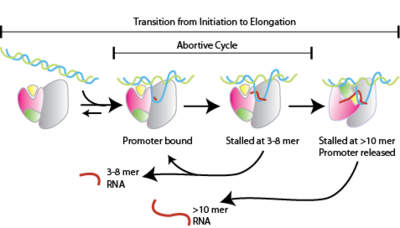
Abortive initiation, also known as abortive transcription, is an early process of genetic transcription in which RNA polymerase binds to a DNA promoter and enters into cycles of synthesis of short mRNA transcripts which are released before the transcription complex leaves the promoter. This process occurs in both eukaryotes and prokaryotes. Abortive initiation is typically studied in the T3 and T7 RNA polymerases in bacteriophages and in E. coli.

Overall process

[edit]

Abortive initiation occurs prior to promoter clearance.[1]

  1. RNA polymerase binds to promoter DNA to form an RNA polymerase-promoter closed complex
  2. RNA polymerase then unwinds one turn of DNA surrounding the transcription start site to yield an RNA polymerase-promoter open complex
  3. RNA polymerase enters into abortive cycles of synthesis and releases short RNA products (contains less than 10 nucleotides)
  4. RNA polymerase escapes the promoter and enters into the elongation step of transcription

Mechanism

[edit]

Abortive initiation is a normal process of transcription and occurs both in vitro and in vivo.[2] After each nucleotide-addition step in initial transcription, RNA polymerase, stochastically, can proceed on the pathway toward promoter escape (productive initiation) or can release the RNA product and revert to the RNA polymerase-promoter open complex (abortive initiation). During this early stage of transcription, RNA polymerase enters a phase during which dissociation of the transcription complex energetically competes with the elongation process. Abortive cycling is not caused by strong binding between the initiation complex and the promoter.[3]

DNA scrunching

[edit]
DNA scrunching mechanism. During initial transcription, RNA polymerase (RNAP) remains stationary on the promoter and unwinds and reels in downstream DNA.

For many years, the mechanism by which RNA polymerase moves along the DNA strand during abortive initiation remained elusive. It had been observed that RNA polymerase did not escape from the promoter during transcription initiation, so it was unknown how the enzyme could read the DNA strand to transcribe it without moving downstream. Within the last decade, studies have revealed that abortive initiation involves DNA scrunching, in which RNA polymerase remains stationary while it unwinds and pulls downstream DNA into the transcription complex to pass the nucleotides through the polymerase active site, thereby transcribing the DNA without moving. This causes the unwound DNA to accumulate within the enzyme, hence the name DNA "scrunching". In abortive initiation, RNA polymerase re-winds and ejects the downstream portion of the unwound DNA, releasing the RNA, and reverting to the RNA polymerase-promoter open complex; in contrast, in productive initiation, RNA polymerase re-winds and ejects the upstream portion of the unwound DNA, breaking RNA polymerase-promoter interactions, escaping the promoter, and forming a transcription elongation complex.[1][4]

A 2006 paper that demonstrated the involvement of DNA scrunching in initial transcription proposed the idea that the stress incurred during DNA scrunching provides the driving force for both abortive initiation and productive initiation.[4] A companion paper published the same year confirmed that detectable DNA scrunching occurs in 80% of transcription cycles, and is actually estimated to be 100%, given the limitation of the ability to detect rapid scrunching (20% of scrunches have a duration of less than 1 second).[1]

A 2016 paper showed that DNA scrunching also occurs before RNA synthesis during transcription start site selection.[5]

Function

[edit]

There are no widely accepted functions for the resulting truncated RNA transcripts. However, a study in 1981 found evidence that there was a relationship between the number of abortive transcripts produced and the time until long RNA strands are successfully produced. When RNA polymerase undergoes abortive transcription in the presence of ATP, UTP, and GTP, a complex is formed that has a much lower capacity for abortive recycling and a much higher rate of synthesis of the full-length RNA transcript.[6] A study in 2010 found evidence that these truncated transcripts inhibit termination of RNA synthesis by a RNA hairpin-dependent intrinsic terminator.[7]

See also

[edit]

References

[edit]
Revisions and contributorsEdit on WikipediaRead on Wikipedia
from Grokipedia
Abortive initiation, also known as abortive transcription, is an initial phase of gene transcription in which RNA polymerase binds to a promoter on DNA and synthesizes short RNA transcripts, typically 2–15 nucleotides in length, that are repeatedly produced and released without the enzyme transitioning into the stable elongation phase.[1] This non-productive process is a universal feature of transcription in both prokaryotes and eukaryotes, serving as a checkpoint before productive RNA synthesis.[2] In prokaryotes, such as Escherichia coli, abortive initiation involves the RNA polymerase holoenzyme, including the σ⁷⁰ factor, forming an open complex at the promoter and initiating short RNA chains near the transcription start site.[3] The mechanism features DNA scrunching, where the polymerase remains stationary while unwinding and pulling downstream DNA into itself, building torsional stress (approximately 1.0 kcal/mol per translocation step) to facilitate promoter escape.[3] Pausing at specific initial transcribing complexes, such as ITC₆ on promoters like lacUV5, directs the enzyme toward one of three pathways: productive elongation, abortive release, or scrunching/unscrunching cycles, with only 20–30% of complexes achieving escape.[4] Factors like GreA and GreB enhance efficiency by cleaving backtracked RNA, reducing abortive events and promoting clearance.[5] In eukaryotes, abortive initiation occurs with RNA polymerase II (Pol II) in the preinitiation complex, assembled with general transcription factors (e.g., TFIIA, TFIIB, TFIID, TFIIE, TFIIF, TFIIH), and produces even shorter transcripts (often 2–3 nt initially).[6] Promoter escape requires TFIIH-mediated phosphorylation of serine 5 on the Pol II C-terminal domain (CTD), enabling release of initiation factors and progression, though transcripts up to 8–40 nt may still be aborted.[1] This process is influenced by promoter sequences, the initially transcribed region, and regulatory proteins, often leading to pausing 20–50 bp downstream, analogous to bacterial mechanisms but coupled to mRNA processing events like capping.[6] The biological significance of abortive initiation lies in its role as an obligatory step that ensures promoter clearance, generates nanoRNAs (2–8 nt) capable of priming further transcription, and acts as a regulatory checkpoint to fine-tune gene expression.[2] In vivo, it limits the rate of productive transcription, with only 30–50% of open complexes escaping to full-length RNA synthesis, and has implications for cellular processes, including potential as biomarkers in cancers like ovarian (e.g., via MUC16 gene regulation).[3][2]

Background Concepts

Transcription Initiation Fundamentals

Transcription initiation is the first stage of gene expression, where RNA polymerase (RNAP) binds to promoter DNA and begins synthesizing RNA. In bacteria, the process begins with the formation of the RNAP holoenzyme, which consists of the core enzyme—comprising two α subunits, one β subunit, one β' subunit, and one ω subunit—associated with a sigma (σ) factor.[7] The primary housekeeping σ factor in Escherichia coli, σ70, enables specific recognition of promoter sequences, such as the -10 and -35 elements.[8] The holoenzyme first binds to the promoter to form the closed promoter complex (RPc), in which the DNA remains double-stranded.[9] This complex then undergoes isomerization to the open promoter complex (RPo), involving spontaneous separation of the DNA strands over approximately 14 base pairs around the transcription start site, without requiring ATP hydrolysis for σ70-dependent promoters.[9] Initial RNA synthesis follows, with the formation of the first phosphodiester bonds powered by the hydrolysis of nucleoside triphosphates (NTPs) to release pyrophosphate.[10] The transition to elongation occurs upon promoter clearance, where the σ factor typically dissociates, allowing the core RNAP to proceed processively.[10] In eukaryotes, transcription initiation by RNA polymerase II (Pol II) is more complex, requiring the assembly of a preinitiation complex (PIC) at core promoters.[11] This involves general transcription factors (GTFs), including TFIID (which contains the TATA-binding protein, TBP, and TBP-associated factors, TAFs), TFIIA, TFIIB, TFIIF (which associates with Pol II), TFIIE, and TFIIH. The process starts with TFIID binding to promoter elements like the TATA box, followed by recruitment of TFIIA and TFIIB to stabilize the complex.[12] TFIIF then delivers Pol II, and TFIIE and TFIIH complete the PIC. Unlike bacterial σ70 promoters, eukaryotic open complex formation requires ATP hydrolysis by the XPB helicase subunit of TFIIH to unwind the DNA.[13] Initial phosphodiester bond formation similarly relies on NTP hydrolysis, leading to the synthesis of short transcripts before promoter escape and entry into elongation, marked by phosphorylation of the Pol II C-terminal domain.[11] Recent cryo-EM structures (as of 2024) have elucidated PIC assembly at near-atomic resolution, revealing TFIIH positioning for promoter melting.[14] The energy landscape of initiation underscores its thermodynamic challenges: in bacteria, binding affinity drives open complex stability for most promoters, while NTP hydrolysis provides the free energy (approximately -7 kcal/mol per bond) for polymerization.[9] In eukaryotes, the additional ATP-dependent unwinding by TFIIH, involving XPB translocation that unwinds approximately 2 base pairs per ATP hydrolyzed, ensures precise start-site selection amid nucleosomal barriers.[15] Successful promoter escape represents the culmination of initiation, enabling stable elongation after initial unstable synthesis phases.[11] The foundational understanding of transcription initiation emerged from in vitro reconstitution experiments in the 1960s and 1970s, pioneered by Michael Chamberlin and colleagues using purified E. coli RNAP and synthetic templates to dissect promoter binding, open complex formation, and early RNA synthesis. These studies, building on the 1959–1960 discovery of RNAP activity, established the core mechanisms conserved across domains of life.[16] Parallel work in eukaryotic systems during the same era identified Pol II and its GTF dependencies, laying the groundwork for modern structural and biochemical analyses.[11]

Promoter Structure and Recognition

In bacterial transcription, promoter architecture for σ⁷⁰-dependent promoters typically features a -10 box with the consensus sequence TATAAT and a -35 box with TTGACA, which are recognized by the σ⁷⁰ subunit of RNA polymerase holoenzyme (RNAP).[17] These hexameric elements are spaced approximately 17 base pairs apart, facilitating specific binding that initiates transcription at the downstream start site.[17] Upstream (UP) elements, often AT-rich sequences located upstream of the -35 box, enhance binding affinity by interacting with the α subunit of RNAP core enzyme, particularly in strong promoters like those of ribosomal genes.[17] In eukaryotes, core promoter elements include the TATA box (consensus TATAAA) located about 25-35 base pairs upstream of the transcription start site (TSS), which is bound by the TATA-binding protein (TBP) subunit of the transcription factor IID (TFIID) complex.[18] The initiator (Inr) element, encompassing the TSS (consensus YYANWYY in metazoans), and the downstream promoter element (DPE; consensus RGWYVT in Drosophila), located 20-30 base pairs downstream, are recognized cooperatively by TAF subunits of TFIID, enabling precise positioning of RNA polymerase II. These elements function in various combinations, with TATA-less promoters relying more on Inr and DPE for TFIID recruitment.[18] The initial recognition process begins with formation of a closed complex, where RNAP or the preinitiation complex binds double-stranded promoter DNA without strand separation, followed by isomerization to an open complex involving localized melting of 14-17 base pairs to form the transcription bubble around the TSS.[19] In bacteria, this isomerization is driven by σ⁷⁰ interactions and occurs on a timescale of seconds to minutes depending on promoter strength and temperature.[20] The sigma factor plays a key role in stabilizing the initial closed complex through sequence-specific contacts.[17] Experimental evidence for these recognition events comes from DNase I footprinting, which reveals protected DNA regions spanning ~50-70 base pairs in the closed complex and extended footprints in the open complex, indicating RNAP wrapping of upstream and downstream DNA.[20] KMnO₄ probing complements this by detecting hypersensitive thymine residues in single-stranded regions of the open complex bubble, confirming strand separation at the -10 to +2 positions in bacterial promoters.[20] These assays demonstrate dynamic conformational changes during isomerization, with hypersensitive sites marking distortion points.[20] Archaeal promoters exhibit architecture similar to bacterial ones, featuring a TATA box ~25-35 base pairs upstream of the TSS, recognized by TBP, with adjacent BRE elements bound by transcription factor B (TFB), a homolog of eukaryotic TFIIB and bacterial σ factors.[21] This TBP-TFB duo recruits archaeal RNAP to form an initiation complex analogous to bacterial holoenzyme binding, though with closer evolutionary ties to eukaryotic mechanisms.[22]

Process Description

Stages of Abortive Initiation

Abortive initiation in bacterial transcription consists of a repetitive cycle in which the RNA polymerase holoenzyme (RNAP), stably bound to the promoter DNA in the open promoter complex (RPO), synthesizes short RNA transcripts of 2 to 15 nucleotides and releases them without dissociating from the promoter or advancing to elongation. This process enables multiple attempts at promoter clearance until the enzyme successfully transitions to productive initiation, where a longer transcript is extended and the polymerase moves downstream. The cycle is particularly prominent in vitro and contributes to the overall efficiency of transcription start site selection.[23] The key stages of abortive initiation begin with the stabilization of the open complex, where RNAP unwinds the promoter DNA to expose the template strand for initial nucleotide binding. Following this, the first phosphodiester bond is formed rapidly through the incorporation of the initiating nucleotides (iNTPs) opposite the +1 and +2 template positions, typically yielding a di- or trinucleotide product. Iterative elongation then occurs, with subsequent NTPs adding to the growing RNA chain up to abortive lengths, accompanied by repeated release events that reset the complex without polymerase translocation. Finally, the short RNA dissociates from the RNAP active site, allowing the enzyme to remain promoter-bound and recommence synthesis from the start site.[24] Transcript lengths during abortive initiation are predominantly 2 to 10 nucleotides in bacterial systems, with distributions varying by promoter strength; stronger promoters tend to produce fewer and shorter abortive products, while weaker ones extend to 10-15 nt before release. DNA scrunching, where downstream DNA is pulled into the enzyme to accommodate synthesis, facilitates this iterative extension without initial polymerase movement.[23][24] In vitro observations reveal high abortive-to-productive ratios, often exceeding 20:1, reflecting the inefficiency of promoter escape in purified systems; for instance, the T5 N25 promoter exhibits an approximately 30:1 ratio under standard conditions, while weaker promoters can approach 100:1. These ratios are quantified by separating and measuring labeled abortive oligonucleotides versus full-length runoff transcripts in gel-based assays. Pausing occurs at promoter-proximal initial transcribing complexes, such as ITC₆, serving as a checkpoint that directs the enzyme toward productive elongation, abortive release, or scrunching/unscrunching cycles, with retention of the sigma factor until successful escape; productive initiation involves stable extension beyond 8-15 nt and transition to the elongation complex.[4][24] In eukaryotes, abortive initiation with RNA polymerase II (Pol II) involves the preinitiation complex with general transcription factors, producing short transcripts (2–3 nt initially, up to 8–40 nt), where promoter escape requires TFIIH-mediated phosphorylation of the Pol II C-terminal domain (CTD) serine 5. Archaeal systems exhibit similar patterns to bacterial, with multi-subunit polymerases undergoing iterative short RNA synthesis and release.[1]

Characteristics of Abortive Transcripts

Abortive transcripts are short, non-processive RNAs typically ranging from 2 to 15 nucleotides in length, synthesized during the initial stages of transcription initiation and released without progression to elongation.[25] These RNAs retain a 5'-triphosphate group, characteristic of de novo RNA synthesis, and their sequences are directly dictated by the template strand of the promoter region from positions +1 to +15.[26] In bacterial systems such as Escherichia coli, these transcripts are primarily non-coding, though nanoRNAs may have regulatory roles such as priming further transcription, distinguishing them from the longer, stable RNAs formed during promoter escape.[2][27] The production of abortive transcripts exhibits significant heterogeneity in length and composition, arising from mechanisms such as polymerase slippage or nucleotide misincorporation during early synthesis cycles.[28] This variability results in a distribution of transcript sizes, often peaking around 8-10 nucleotides, with occasional extensions up to 15-19 nucleotides in certain promoter contexts.[2] Moreover, abortive transcripts display higher error rates compared to those generated during elongative transcription, reflecting the lower fidelity of the initial RNA polymerase-promoter complex before stable hybridization and conformational maturation.[29] Detection and quantification of abortive transcripts commonly rely on techniques that exploit their small size and chemical properties. High-resolution gel electrophoresis, such as 20% polyacrylamide gels, enables separation of these short RNAs based on length, often visualized through radiolabeling with [γ-³²P]ATP to highlight initiating dinucleotides or short oligomers.[5] For purification and precise analysis, high-performance liquid chromatography (HPLC) is employed, allowing isolation from longer products and assessment of sequence purity.[30] In vivo detection has advanced with hybridization-based methods using locked nucleic acid probes, confirming the presence of these transcripts in cellular contexts.[25] In terms of yield, abortive transcripts can vastly outnumber productive ones, with ratios often exceeding 20:1 and reaching up to several hundred-fold more abortive products per initiation event in certain promoter systems, underscoring the inefficiency of early transcription phases.[27] This disparity arises from repeated synthesis-release cycles before promoter clearance, as observed in E. coli RNA polymerase assays.[27] The phenomenon of abortive transcript production is evolutionarily conserved across domains of life, occurring in bacteria, eukaryotes, and archaea with comparable short lengths of 2-15 nucleotides.[31] In eukaryotes, such as with RNA polymerase II, similar short RNAs are released during pre-initiation, while archaeal systems mirror bacterial patterns in multi-subunit polymerase behavior.[32] This conservation highlights a fundamental aspect of transcription initiation machinery.[33]

Molecular Mechanism

Initial RNA Synthesis and Release

In abortive initiation, RNA synthesis begins de novo within the RNA polymerase (RNAP) active site, where the enzyme forms the first phosphodiester bond between two nucleoside triphosphates (NTPs) to produce a dinucleotide (pN1pN2) without requiring a primer.[34] This initial nucleotidyl transfer reaction positions the 3'-OH of the first nucleotide in the active site, enabling subsequent NTP binding and catalysis.[23] The process relies on the open promoter complex, where the DNA template strand is exposed in the active site cleft, allowing the initiating NTPs to align based on promoter sequence complementarity. Following dinucleotide formation, RNAP iteratively extends the nascent RNA chain by adding one or two nucleotides per catalytic cycle, producing short transcripts typically 2-15 nucleotides long.[23] This stepwise elongation occurs through repeated nucleotidyl transfer reactions, but the short RNA-DNA hybrid (fewer than 8-9 base pairs) forms weak interactions with the RNAP, lacking the stability needed for promoter clearance.[35] Release of these abortive transcripts is triggered by dissociation at the unstable RNA-DNA hybrid interface, allowing the RNAP to revert to the open complex for reinitiation without involving NTP hydrolysis or energy expenditure beyond bond formation.[34] The kinetics of abortive synthesis are notably slower than those of elongation, with rates of approximately 1-10 s⁻¹ for nucleotide addition and release cycles, compared to 50-100 s⁻¹ during stable elongation.[36] This rate limitation arises from the dynamic positioning of short RNAs in the active site, where the trigger loop must repeatedly fold to facilitate catalysis but fails to lock the complex in place.[34] Promoter sequence variations significantly influence abortive release by modulating RNA-DNA hybrid stability; for instance, sequences with weaker initial binding in the initial transcribed sequence (ITS) increase the yield of abortive products.[23] Certain mutations, such as those enhancing consensus elements in the -10 region, can elevate abortive yields by delaying the formation of a stable hybrid, thereby prolonging iterative cycling.[36] DNA scrunching briefly aids NTP access during these early cycles.

DNA Scrunching Dynamics

During abortive initiation, DNA scrunching refers to the compaction of downstream DNA into the RNA polymerase (RNAP) channel, whereby the enzyme remains stationary and bound to the promoter while unwinding and pulling approximately 13-15 bp of downstream DNA into itself, thereby shortening the DNA path by roughly 1 bp per nucleotide added to the growing RNA chain.[37] This process enables multiple cycles of short RNA synthesis and release without RNAP translocation along the DNA.[3] Structural studies using cryo-electron microscopy (cryo-EM) and Förster resonance energy transfer (FRET) have elucidated the conformational dynamics of scrunching, revealing progressive DNA bending and extrusion of single-stranded regions into RNAP's secondary channel as the transcription bubble expands.[38] For instance, cryo-EM structures of bacterial initial transcribing complexes demonstrate bubble enlargement from an initial ~13 nt to accommodate 5-9 nt RNAs, with the downstream DNA strands compacting around regulatory elements like the σ finger.[38] Complementary FRET experiments detect stepwise compaction, with distance reductions between labeled DNA positions per nucleotide incorporated, reflecting the elastic deformation and localized bending that stores mechanical stress within the complex.[39] The energetics of scrunching involve elastic energy accumulation from DNA deformation, estimated at ~1.0 kcal/mol per nucleotide added, which is offset by the stabilizing free energy of RNA-DNA hybrid formation (~1-2 kcal/mol per base pair) and requires no external input beyond NTP hydrolysis.[3] In the "scrunched" state, this tension builds cyclically with RNA extension, promoting hybrid instability and abortive release; upon release, the DNA relaxes to an "unscrunched" configuration, relieving stress and priming the complex for subsequent initiation rounds.[37] Variations in the model include branched pathways where scrunched intermediates either abort or proceed to escape, depending on promoter-specific stability.[3] Single-molecule assays, particularly optical tweezers experiments on E. coli RNAP, have validated these dynamics by directly observing reversible DNA tether shortening (~0.34 nm per base pair pulled) and low-force extensions (<1 pN) during scrunching cycles, confirming the mechanism's role in maintaining promoter association throughout abortive synthesis.[37]

Biological Roles

Contribution to Transcription Fidelity

Abortive initiation enhances transcription fidelity by enabling multiple cycles of short RNA synthesis and release, which serve as a proofreading mechanism to discard mismatched or erroneous transcripts before committing to productive elongation. In bacterial systems like Escherichia coli, RNA polymerase (RNAP) can enter a branched pathway during initiation, where misincorporation of nucleotides leads to the formation of unstable complexes that preferentially release abortive products, thereby preventing the propagation of errors into full-length transcripts.[40] This process is facilitated by the short RNA-DNA hybrid in initial transcribing complexes, which provides weaker stability and allows for rapid dissociation of incorrect initiations, with misincorporation rates notably higher during initiation than in elongation owing to limited interactions in the nascent hybrid.[41] The distribution of abortive transcripts directly informs transcription start site (TSS) selection, as these short RNAs (typically 2–15 nucleotides) reflect the preferred +1 positions utilized by RNAP at the promoter. By repeatedly sampling potential start sites through abortive cycling, RNAP refines precise TSS usage, minimizing off-target initiations and ensuring accurate alignment with promoter elements. This mechanism ties briefly to promoter recognition accuracy, where sequence-specific interactions guide initial positioning before fidelity checks via abortive release.[3] Evidence from RNAP mutants supports this role; for instance, mutations in the σ⁷⁰ subunit (region 3) that diminish abortive cycling lead to elevated initiation errors and reduced overall transcription accuracy, as fewer proofreading opportunities allow faulty starts to persist.[40] Biologically, abortive initiation curbs non-productive transcription at weak or cryptic promoters by increasing the ratio of abortive to productive products, thereby conserving cellular resources and suppressing spurious gene expression. Abortive transcripts, or nanoRNAs (2–8 nt), also play regulatory roles by inhibiting further transcription initiation or acting as primers, and as of 2024, show potential as biomarkers for cancers including ovarian (via MUC16), pancreatic, breast, lung, and liver, where differential expression correlates with disease progression and prognosis.[2]

Influence on Promoter Escape and Elongation

Abortive initiation facilitates the transition to productive transcription by iteratively synthesizing short RNA transcripts that incrementally stabilize the transcription complex, enabling promoter escape. In bacterial systems, this process culminates after the synthesis of RNAs approximately 10-15 nucleotides long, at which point the RNA-DNA hybrid extends to about 9 base pairs, providing sufficient stability to release the accumulated DNA scrunch tension and propel the RNA polymerase (RNAP) forward. This scrunch release disrupts initial promoter interactions, allowing the complex to clear the promoter and enter elongation.[17][3] Promoter clearance during escape involves the dissociation of the sigma factor, typically occurring between +10 and +20 nucleotides of RNA synthesis, which frees the RNA exit channel and permits stable elongation. This sigma release is triggered by displacement within the RNAP core, marking the shift from initiation-specific contacts to elongation-competent conformation. In Escherichia coli, structural studies confirm that sigma70 dissociation correlates with hybrid formation and scrunch resolution around this length threshold.[17][3] Several regulatory factors modulate escape efficiency, including nucleoside triphosphate (NTP) concentrations; elevated NTP levels accelerate RNA extension, reducing abortive cycling and favoring productive escape by minimizing pauses during hybrid buildup. Downstream pausing elements, such as -10-like sequences, can impede this transition by retaining sigma and promoting backtracking, though high NTPs counteract such barriers. Quantitative kinetic models portray abortive cycles as a stepwise mechanism akin to a ratchet, where repeated initiations build hybrid strength until escape probability surpasses 50%, often after 5-20 cycles depending on promoter stability.[3][42] This phenomenon is more pronounced in bacteria, where abortive initiation dominates the early phase. In eukaryotes, abortive synthesis is shorter (typically 2–3 nucleotides) and less iterative, relying on additional factors such as the Mediator complex to stabilize the preinitiation complex and promote Pol II clearance into elongation. This distinction reflects the greater complexity of eukaryotic regulation, where Mediator interactions with activators enhance escape at specific promoters.[42]

References

User Avatar
No comments yet.