Hubbry Logo
search
logo
Aevum
Aevum
current hub
1017370

Aevum

logo
Community Hub0 Subscribers
Read side by side
from Wikipedia
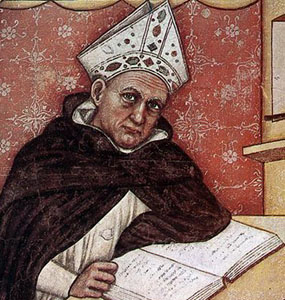
Saint Albert the Great

In scholastic philosophy, the aevum (also called aeviternity) is the temporal mode of existence experienced by angels and by the saints in heaven. In some ways, it is a state that logically lies between the eternity (timelessness) of God and the temporal experience of material beings. It is sometimes referred to as "improper eternity"[1] or "participated eternity".[2]

Etymology

[edit]

The word aevum is Latin, originally signifying "age", "aeon", or "everlasting time".[3] It comes from the Greek term "αἰών" meaning eternity in the atemporal sense.[2] Before the 13th century, the term aevum was used synonymously with eternity.[2] The word aeviternity comes from the Medieval Latin neologism aeviternitas.[citation needed]

History

[edit]

Both Plato and Aristotle recognized two modes of duration: Time and Eternity.[4] Plato said that the soul must be in time while Aristotle said that the soul must be in eternity.[4] The Neoplatonist philosopher Simplicius of Cilicia, said there must be a third mode to describe celestial bodies and souls which are everlasting but still change.[4]

In his exegesis of the Book of Genesis, Augustine of Hippo also recognized a mode of duration distinct from time and eternity. In Augustine's view, Heaven and earth, taken to mean formless matter, were created before time, and thus had existence in a participated eternity.[2]

In the beginning of the 13th century, independently of direct influence from Simplicius, a doctrine of three measures of duration was developing at the University of Paris.[4] These were known as eternity, sempiternity (or perpetuity), and time.[4] In the Summa attributed to Alexander of Hales, this middle measure of duration was used to describe angels, souls, and celestial spheres, all of which have a beginning but no end.[4]

The concept of the aevum, using the term as distinct from eternity, dates back at least to Albertus Magnus's first systematic study of time, De quattuor coaequaevis.[1] In contrast to the concept of sempiternity, Albertus notes that even if something has no beginning and no end, its mode of duration would be distinct from the eternity of God.[4] To Albertus, eternity is pure actuality while aevum is always actual, but only the actuality of some potency.[4]

A description of aevum is found in the Summa theologica of Thomas Aquinas. Aquinas identifies the aevum as the measure of the existence of beings that "recede less from permanence of being, forasmuch as their being neither consists in change, nor is the subject of change; nevertheless they have change annexed to them either actually, or potentially". As examples, he cites the heavenly bodies (which, in medieval science, were considered changeless in their nature, though variable in their position.[4]) and the angels, which "have an unchangeable being as regards their nature with changeableness as regards choice".[5]

At the end of the 13th century, in De mensuris, Theodoric of Freiberg, further developed the philosophy of time. Theodoric distinguishes five measures of duration: [4]

  1. Superaetenitas - the measure of divine being; beyond eternity
  2. Aeternitas - the measure of the being of divine intelligences "if such beings exist"
  3. Aevum - the measure of angelic beings, which have a beginning, an everlasting existence, with no change in their substance but change in their accidents
  4. Aeviternitas - the measure of celestial bodies, which have a beginning and are everlasting but inferior in perfection to angels
  5. Time - the measure of beings with limited period of existence

In the 14th century, both Berthold of Moosburg and William of Ockham rejected the concept of aevum. Berthold held that there were only two measures of duration: eternity and time.[4] William did not even believe eternity could be properly called a measure and held that time was the only measure of duration.[4]

Contemporary philosophy

[edit]

Frank Sheed, in his book Theology and Sanity, said that the aevum is also the measure of existence for the saints in heaven:

"Aeviternity is the proper sphere of every created spirit, and therefore of the human soul... At death, [the body's] distracting relation to matter's time ceases to affect the soul, so that it can experience its proper aeviternity."[6]

See also

[edit]

References

[edit]
Revisions and contributorsEdit on WikipediaRead on Wikipedia
from Grokipedia
In scholastic philosophy, aevum (also known as aeviternity) denotes the intermediate mode of duration between temporal time and divine eternity, specifically characterizing the existence of angels, saints in heaven, and certain celestial bodies that possess immutable substance yet undergo limited change.[1] This concept distinguishes aevum from the successive "before and after" of human time, which measures mutable and changing things, and from eternity, which is the wholly simultaneous and boundless possession of unending life attributed solely to God.[1] As articulated by Thomas Aquinas in his Summa Theologica (Prima Pars, Question 10, Article 5), aevum serves as a mean between these extremes, allowing for a duration that is primarily simultaneous within itself but capable of annexing succession in its affections or operations, such as the intellectual acts of angels.[1] The term originates from the Latin aevum, a second-declension noun meaning "lifetime," "age," "period of existence," or "eternity," often evoking neverending time or the span of a generation.[2] In classical Latin usage, it frequently appears in phrases like in aevum ("for all time") or flos aevi ("bloom of life"), underscoring its association with enduring yet bounded existence.[2] Medieval thinkers adapted this root to theological ends, building on earlier Neoplatonic influences to refine distinctions in divine and created being; for instance, Albertus Magnus explored aevum within his systematic treatment of time (aeternitas, aevum, tempus), viewing it as the participatory eternity shared by incorruptible creatures.[3] Aquinas further elaborated that while time applies to the successive nature of spiritual creatures' wills and intellects, aevum measures their essential permanence, rejecting the notion that angelic existence is strictly temporal like corporeal motion.[1] He addressed potential objections, such as whether aevum implies infinite succession (which it does not, as it remains oriented toward simultaneity) or equates to time (which Augustine had suggested for spiritual affections, but Aquinas differentiated based on substance).[1] This framework influenced later scholastic debates; for example, John Duns Scotus and William of Ockham critiqued or modified aevum, with Ockham denying it as a distinct measure and aligning angelic duration more closely with time.[4] Despite such variations, aevum remains a cornerstone of medieval metaphysics, encapsulating the tension between change and immutability in the created order.[3]

Core Concepts

Definition

In scholastic philosophy and theology, aevum, also known as aeviternity, denotes a distinct mode of duration that serves as an intermediate state between the atemporal eternity (aeternitas) of God and the successive time (tempus) experienced by mutable, corporeal beings.[1] This mode characterizes the existence of incorporeal spiritual substances, such as angels, and certain incorruptible corporeal entities, such as heavenly bodies, whose being is immutable in substance yet susceptible to non-substantial changes, like intellectual acts or affections, without the full succession of material motion.[1] Key attributes of aevum include its everlasting nature, possessing a beginning in creation but no end, thus extending infinitely into the future while lacking the boundless "before" of divine eternity.[1] Unlike time, which is divisible and measures continuous change through "before" and "after," aevum is indivisible in its simultaneous wholeness, yet it accommodates change in accidental or potential aspects, such as the succession of thoughts in an angel's mind, without altering the underlying permanence of its substance.[1] This allows for a form of progression that is more unified than temporal flow but less absolute than eternal simultaneity. Thomas Aquinas provides the seminal formulation of aevum in his Summa Theologica (I, q. 10, a. 5), defining it as "the measure of those things which have immobility mixed with their movability; or of those things to which it belongs to be moved with a motion that is not continuous, but successive and discrete."[1] He elaborates that aevum applies to beings "that recede less from the permanence of being, forasmuch as their being neither consists in change, nor is the subject of change; nevertheless they have change annexed to them either actually, or potentially."[1] This Thomistic view positions aevum as a participated form of eternity, wherein creatures share in divine immutability to a limited degree, receiving eternity not essentially but through divine communication, distinct from the uncreated eternity of God.[1] Aevum is further distinguished from sempiternity, which refers to infinite duration within the successive framework of time, encompassing all moments from past to future without end but with full temporal division.[5] In contrast, aevum represents an "improper eternity" or participated eternity, emphasizing its derivative and hierarchical participation in the divine, rather than mere endless temporality.[3]

Relation to Time and Eternity

In the triadic schema of durations, aeternitas represents the timeless and simultaneous whole of divine life, aevum denotes an everlasting duration that is non-successive for incorporeal beings, and tempus signifies the successive measure of change in corporeal entities.[1] This hierarchy positions aevum as an intermediate mode, distinct from the fully static possession of eternity and the flowing progression of time.[6] Ontologically, aevum functions as the mean between the immutable essence of the divine and the mutable flux of created time, enabling a form of perpetuity that accommodates permanence without inherent succession.[1] It measures existences that possess unchangeable being yet allow for potential or actual variations, thus bridging the absolute immutability of eternity and the inherent changeability of time.[6] The distinctions draw from Boethius's conception of eternity as the "complete and simultaneous possession of endless life" (tota simul), which contrasts with Aristotle's definition of time as the "number of motion according to before and after," with aevum serving to connect these poles by introducing a stable yet not fully instantaneous duration.[1] This bridging underscores aevum's role in mediating between divine atemporality and temporal motion. Analogically, aevum embodies a permanence that avoids the total stasis of eternity while eschewing the continuous flow of time.[6] This representation highlights its unique status as a measured everlastingness suited to entities beyond corporeal transience.

Etymology and Terminology

Linguistic Origins

The term aevum derives from the Proto-Indo-European root h₂eyu-, which conveys notions of vital force, lifetime, or long duration. In classical Latin, it primarily denoted "age," "era," or "lifetime," often evoking a span of existence with implications of continuity or perpetuity.[7] This Latin usage was influenced by the Greek word αἰών (aiōn), signifying an indefinite period, age, or eternity, with the semantic overlap transmitted through Neoplatonic texts that bridged Hellenistic philosophy and Latin traditions.[8] In medieval scholastic Latin, the compound neologism aeviternitas emerged in the 13th century to describe an intermediate mode of duration, distinct from both temporal flux and divine eternity; prior to this, aevum was often synonymous with aeternum, lacking the refined distinction.[9] Semantically, aevum shifted from a broad sense of "everlasting time" in patristic writings—where it paralleled biblical translations of aiōn to indicate prolonged or unending periods—to a more precise philosophical category by the early 13th century, delineating the perpetual yet successive existence of incorporeal beings.[9]

Historical Evolution of Terms

In pre-scholastic philosophy, the term "aevum" was often used interchangeably with concepts of eternity, particularly in the works of Boethius and early medieval thinkers from the 6th to 12th centuries, where it denoted an unbounded duration without the later distinctions from time. Boethius, in his Consolation of Philosophy, described eternity as the "complete possession all at once of illimitable life," drawing on the Latin root aevum to evoke endless age, though without yet separating it as an intermediate mode.[10] This usage persisted among early medieval authors, such as in patristic commentaries, treating aevum as synonymous with divine timelessness rather than a distinct angelic measure.[3] The 13th century marked a pivotal shift in scholastic discourse, with Albertus Magnus coining the term "aeviternitas" to specify the duration of angelic beings, distinguishing it from both divine eternity and human time. In his De quattuor coaequaevis, Albertus systematically outlined four coequal modes of duration, positioning aeviternitas as the measure for incorporeal substances that possess unchanging essence but undergo successive acts of intellect and will.[3] Thomas Aquinas further refined this in the Summa Theologica, defining the aevum (or aeviternity) as an intermediate measure between eternity—characterized by total simultaneity and immutability—and time, which involves numbered succession; it applies to spiritual creatures like angels, whose being is permanent yet admits limited change without corruption.[11] Aquinas emphasized that aeviternity is "indivisible in itself" but allows for "before and after" in its acts, thus bridging the immutable divine aeternitas and the mutable tempus.[12] Related terms emerged to clarify these distinctions, with sempiternitas denoting everlasting duration within time—having a beginning but no end, as in the case of the created world—contrasted against aevum, which transcends temporal succession while remaining created and successive in acts.[13] Theodoric of Freiberg, in his De mensuris, outlined a fourfold schema of durations: aeternitas for God, sempiternitas for celestial bodies, aevum for angels, and tempus for mutable sublunary things, integrating Neoplatonic influences to emphasize graded modes of existence.[13] By the 14th century, nominalist critiques led to a decline in the specialized terminology, as thinkers like William of Ockham reduced durations to two fundamental modes—eternity for God and time for all creatures—dismissing aevum and aeviternitas as superfluous distinctions that complicated ontology without necessity. Ockham argued that angelic existence, like all created being, falls under time, rejecting intermediate measures to align with his principle of parsimony and avoid multiplying entities beyond scriptural warrant.[14] This marginalization reflected broader nominalist skepticism toward scholastic subtleties, confining aevum to less prominent theological discussions thereafter.

Historical Development

Ancient and Patristic Foundations

In ancient Greek philosophy, the foundations for distinguishing modes of duration emerged from contrasts between timeless being and temporal change. Plato posited the Forms as eternal and immutable in a suprasensible realm, while the sensible world undergoes perpetual becoming within time, which he described in the Timaeus as a "moving image of eternity" created alongside the cosmos to imitate the unchanging life of the divine. Aristotle refined this framework in Physics Book IV, defining time as "a number of motion in respect of the 'before' and 'after'" and thus applicable only to the mutable physical domain, whereas eternity characterizes the divine as perfectly immutable and devoid of successive change. Neoplatonists built upon these ideas by proposing an intermediate mode of duration to account for incorporeal entities that endure indefinitely yet experience change, drawing from thinkers like Proclus and Damascius. This concept emphasized perpetual existence without the full immutability of the divine or the flux of corporeal time. These views influenced the synthesis of pagan philosophy with Christian theology, providing a conceptual precursor for later discussions of angelic and spiritual temporality. Patristic thinkers adapted these philosophical bases to affirm God's transcendent eternity against created time. Augustine of Hippo, in Confessions Book XI, argued that God's eternity involves no past or future but an undivided present, distinct from the time He created ex nihilo alongside the world, where distention and succession mark human experience. Boethius, synthesizing Neoplatonic elements in The Consolation of Philosophy Book V, Prose 6, defined eternity as "the whole and perfect possession of interminable life at a single moment," portraying divine knowledge as simultaneous and extra-temporal, thereby resolving apparent conflicts between providence and free will. Early medieval writers echoed these distinctions in nascent Christian historiography, employing "aevum" more loosely for extended epochs. Isidore of Seville, in Etymologies Book V, Chapters 38-39, derived "aevum" from Greek aiōn to signify a perpetual age without known beginning or end, applying it to the six biblical ages of the world—from Adam to Noah (2,252 years), Noah to Abraham (1,042 years), Abraham to David (941 years), David to the Babylonian captivity (473 years), the captivity to Christ's birth (587 years), and the current age from Christ onward.[15] Carolingian scholars, such as those in the court of Charlemagne, extended this usage in chronicles and computistical texts to denote vast historical or cosmic periods, laying groundwork for more precise scholastic elaborations.

Medieval Scholastic Formulations

In the 13th century, scholastic philosophers at the University of Paris formalized the concept of aevum as a distinct mode of duration intermediate between eternity and time, primarily to account for the existence of spiritual substances like angels. This articulation built upon earlier patristic ideas but integrated them into a systematic metaphysical framework, emphasizing aevum as a measure suited to incorporeal beings capable of change without corruption. Key texts from this period, such as Albertus Magnus's De quattuor coaequaevis, established aevum as the proper duration for such entities, distinguishing it from the immutable eternity of God and the successive flow of corporeal time.[16] Albertus Magnus, in his treatise De quattuor coaequaevis (On the Four Coeternals), posited aevum as the measure of duration for spiritual substances that experience intrinsic change—such as alterations in will or knowledge—yet remain free from corruption or decay. He described these coeternals as sharing eternity with God but measured by aevum due to their created nature, which allows for a form of succession without the flux of material time. This formulation underscored aevum's role in preserving the immutability of spiritual essences while accommodating their dynamic operations.[16] Thomas Aquinas further refined this doctrine in Summa Theologica (I, q. 10, a. 5–6), defining aevum (or aeviternity) as the measure for angels, whose essence is unchanging but whose acts of will and intellect are successive. Unlike eternity, which is simultaneously whole and without succession, or time, which involves continuous flow, aevum permits discrete changes in angelic cognition and volition without implying corruption. Aquinas also identified the angels' "day"—as referenced in Scripture (e.g., "one day" in Genesis)—as the basic unit of this aeviternal duration, a single, indivisible act encompassing their intellectual operations. He affirmed a single aevum common to all such beings, rooted in their participation in divine eternity.[1] Debates at the University of Paris from circa 1230 to 1270 intensified these distinctions, particularly in response to Aristotelian influences that risked conflating all durations into a single temporal framework. The 1277 condemnations by Bishop Stephen Tempier explicitly rejected propositions limiting divine power over creation, including views that denied the possibility of multiple durations beyond time and eternity; this affirmed the legitimacy of aevum and similar modes as expressions of God's omnipotence to ordain diverse existences. These controversies spurred scholastics to clarify aevum as one among several durations tailored to different ontological levels.[17] Theodoric of Freiberg (also known as Dietrich of Freiberg) expanded this schema in his De mensuris (On Measures), proposing five distinct measures of duration corresponding to a hierarchical universe: superaeternitas for divine being, aeternitas for divine intelligences, aevum for celestial intelligences (such as angels), sempiternitas for souls with beginning but no end, and tempus for corruptible bodies. In this system, aevum specifically measures the enduring yet changeable existence of celestial intelligences, bridging the immutable higher realms and the transient lower ones, while emphasizing their role in cosmic causation.[13]

Late Medieval and Renaissance Critiques

In the late medieval period, nominalist philosophers, particularly William of Ockham and his followers, mounted significant critiques against the scholastic concept of aevum as a distinct mode of duration. Ockham, in line with his broader reductionist ontology, rejected aevum as an unnecessary entity, arguing that it could be collapsed into the binary distinction between eternity and time without loss of explanatory power. In his theological works, such as the Reportatio and Quodlibeta, Ockham denied any reality to aevum, viewing angelic existence as measured by ordinary time rather than a separate intermediary duration, thereby applying his razor to eliminate what he saw as superfluous metaphysical categories.[18] This nominalist approach influenced later thinkers like Adam Wodeham and Robert Holcot, who further diminished aevum by emphasizing empirical and linguistic analyses over speculative hierarchies of being. Berthold of Moosburg offered a partial defense of aevum within a Neoplatonic framework but ultimately subordinated it to eternity, aligning with Proclus's Elements of Theology. In his Expositio super Elementationem theologicam Procli, Berthold acknowledged the rationality of multiple measures of duration, including aevum for angels, but invoked Platonic authority to assert that only two fundamental measures exist: eternity for divine and intellectual realities and time for mutable beings. He thus integrated aevum as a derivative aspect of eternity, reducing its independence and prioritizing a unified hierarchical emanation over the high medieval triadic scheme of eternity-aevum-time. During the Renaissance, humanist philosophers shifted toward a stricter Aristotelian conception of time, further eroding aevum's prominence. By the fifteenth century, aevum had largely faded from mainstream philosophical discourse amid the rise of humanism and nominalism, though it persisted in Thomistic theology as a safeguard for angelic incorruptibility. This decline marked a broader paradigm shift away from Neoplatonic intermediaries toward simplified dualities of time and eternity, influencing early modern thought.[18]

Theological and Metaphysical Applications

Angelic and Incorporeal Beings

In Thomistic theology, angels exist in aevum, a mode of duration that serves as an intermediate between divine eternity and human time, characterized by unchanging substantial being yet allowing for successive acts of intellect and will. This aeviternity measures the angels' perpetual existence without the continuous flow of temporal succession inherent in bodily motion, enabling their operations to occur in discrete, instantaneous moments rather than a linear progression. As Thomas Aquinas explains, the angel's substance remains immutable, but its intellectual and volitional activities introduce a form of "before" and "after" compatible with aevum, distinct from the simultaneity of eternity.[1] Aevum also applies to other incorporeal beings, such as the heavenly bodies, which share in aeviternal perpetuity. For instance, celestial entities like stars possess unchangeable substantial forms but undergo change in place through their orbital motions, measured not by time's divisible nows but by aevum's indivisible wholeness with annexed succession. This framework underscores the created order's hierarchy, where incorporeal substances participate in unending duration without the corruptibility of temporal flux.[1] Changes within aevum, particularly intellectual mutations such as angelic choices or shifts in understanding, transpire without reliance on bodily time, thereby preserving the immutability of the angels' essence. Aquinas posits that an angel's knowledge is typically instantaneous within a single act, yet when engaging multiple intelligible species or volitional deliberations, a succession of discrete acts emerges, forming the "aeviternal days" of angelic life. These operations occur in spiritual instants, free from material impediments, allowing for rapid, non-discursive cognition.[19] Theologically, aevum facilitates the angels' intimate participation in divine eternity while accommodating their created freedom, bridging the infinite simplicity of God with finite mutability. This mode of existence affirms the angels' role as intermediaries in the cosmic order, exercising intellect and will in harmony with providence yet capable of deliberate orientation toward or away from the divine good, as seen in the primordial choice of the fallen angels. By this measure, aevum highlights the dignity of created spirits, eternally sustained yet dynamically responsive to eternal truth.[1]

Human Souls and Eschatology

Upon death, the human soul separates from the body and enters a state of aeviternity (aevum), a mode of duration intermediate between the successive flow of corporeal time and the immutable simultaneity of divine eternity, thereby becoming free from measurement by physical change or motion.[1] This transition aligns with Thomas Aquinas's view that spiritual substances like the human soul, while capable of successive intellectual and volitional acts, are not bound by the temporal succession inherent to bodily existence.[1] Immediately following separation, the soul undergoes particular judgment, wherein its eternal destiny—heaven, purgatory, or hell—is provisionally determined based on its merits, without delay imposed by earthly chronology.[20] For the souls of the saints destined for heaven, this aeviternal state facilitates direct participation in the beatific vision, the intuitive knowledge of God's essence that constitutes ultimate beatitude, allowing the soul to share in divine timelessness while preserving its distinct personal identity and operations of intellect and will.[1] Unlike the pure eternity of God, this aeternitas participata (participated eternity) accommodates the soul's created nature, enabling perpetual enjoyment of God without succession in the act of vision itself, though peripheral acts may involve aeviternal discreteness. In contrast, souls in purgatory undergo purification within an aeviternal framework, where processes unfold in "days" or discrete moments analogous to time but unbound by corporeal clocks or measurable intervals, emphasizing a continuity of suffering or happiness suited to incorporeal duration. Regarding unbaptized infants, traditional scholastic views proposed a limbo of natural felicity, but the Catholic Church has not defined this, and a 2007 document from the International Theological Commission affirms hope for their salvation through God's mercy.[21] Aquinas describes purgatorial cleansing as involving both the pain of delayed beatific vision and sensory punishment, measured not by earthly time but by the soul's spiritual progression toward readiness for heavenly union.[22] Eschatological fulfillment occurs at the general resurrection, when souls reunite with their glorified bodies, re-entering a form of temporal existence transformed to align with aevum-like perpetuity: the risen body, impassible and agile, adapts to the soul's immortal mode, sustaining unending bodily actions without corruption or necessary succession, thus bridging the aeviternal soul with eternal beatitude in the new creation.[23] This bodily glorification perfects the human person, allowing the elect to experience divine life holistically, while the damned endure perpetual torment in a similarly adapted, unending state.[24]

Modern and Contemporary Interpretations

Philosophical Revivals

In the 20th and 21st centuries, the medieval concept of aevum—an intermediate duration between transitory time and immutable eternity—has seen philosophical revivals in metaphysics and phenomenology, often reframed to address modern questions of temporality, becoming, and relationality without reliance on scholastic angelology. These re-engagements draw on historical foundations but innovate to grapple with existential, analytic, and process-oriented concerns about time's structure. As of November 2025, however, there have been limited major new philosophical developments engaging directly with aevum. Existentialist philosophy echoes aevum through Martin Heidegger's analysis of temporality in Being and Time (1927), where he explores ecstatic time as an intermediate horizon beyond linear chronology, indirectly reviving notions of durations that transcend everyday clock-time while remaining oriented toward human finitude. In his later works, such as Introduction to Metaphysics (1935), Heidegger conceives aion as a non-linear mode of presencing that mediates between momentary existence and abiding being.[25][26] In analytic philosophy, discussions of eternity have analogically invoked aevum to resolve debates on atemporal relations, particularly in Eleonore Stump and Norman Kretzmann's seminal paper "Eternity" (1981). This framework has influenced subsequent analytic metaphysics by providing tools for reconciling timelessness with relational dynamics.[27] Process theology, rooted in Alfred North Whitehead's metaphysics, parallels aevum through the concept of concrescence in Process and Reality (1929), where eternal objects—timeless potentials—integrate into the temporal becoming of actual occasions, suggesting an intermediate realm of creative advance that bridges static eternity and flux. This aevum-like structure underscores Whitehead's vision of reality as a process of ingression, where unchanging forms participate in evolving durations without succumbing to mere succession.[28] Recent metaphysical interpretations continue this revival, as seen in Eleonore Stump's Aquinas (2003), which reinterprets aevum to illuminate personal eternal relations in a contemporary context, emphasizing Aquinas's ideas on simultaneous causation and beatific vision while adapting them beyond medieval cosmology to address human-divine interaction in timeless love. Stump's analysis highlights aevum as a measure of sempiternal existence for incorporeal intellects, updated to support phenomenological accounts of eternal presence in personal narratives.[29]

Theological and Cultural Extensions

In modern Catholic theology, the concept of aevum has been adapted to describe the mode of existence for the souls of saints, emphasizing a form of duration that transcends successive time while allowing for spiritual acts. Frank Sheed, in his 1946 work Theology and Sanity, portrays aevum—or aeveternity—as the proper duration for incorporeal beings like angels and separated human souls, characterized by substantial immutability but accidental changes in a "discontinuous time" distinct from the flowing time of material bodies.[30] This aligns with the idea of "time without succession," where the soul experiences instantaneous or non-sequential fulfillment in the beatific vision, free from the linear progression of earthly time.[30] In ecumenical contexts, particularly Eastern Orthodox theology, aevum-like notions appear in discussions of deification (theosis), where created beings participate in divine life through an "ever-moving rest." Vladimir Lossky, in The Mystical Theology of the Eastern Church (1944), draws on patristic sources like Maximus the Confessor to describe this as a dynamic stability in union with God, an eternal motion without temporal flux that mirrors the angelic mode of existence and extends to the deified soul.[31] This concept underscores the Orthodox emphasis on personal transfiguration, where time is transcended in perpetual enjoyment of the divine energies, bridging created and uncreated realities. Lossky explicitly references aevum as a timeless mode for angelic existence, described as "motionless time."[31] Culturally, aevum inspires literary depictions of timeless realms in 20th-century fiction, evoking intermediate states between temporal worlds and divine eternity. In C.S. Lewis's The Chronicles of Narnia (1950–1956), Aslan's Country represents an aeviternal domain where redeemed souls enter "further up and further in," a boundless reality beyond Narnia's successive time, filled with simultaneous joy and renewal that implies non-successive duration.[32] Similarly, Philip Pullman's His Dark Materials trilogy (1995–2000) explores intermediate temporal layers across parallel worlds, with the subtle knife enabling cuts between realms of varying time flows, philosophically probing liminal existences akin to aevum in their evasion of strict linearity.[33] Interfaith parallels to aevum emerge in comparisons with Jewish concepts of spiritual durations, highlighting shared ideas of non-human temporal modes. Jewish Kabbalah's olam (worlds) denotes layered durations for spiritual entities, such as the four worlds from Atzilut to Assiyah, where higher realms approach aevum's perpetual stability, contrasting earthly time while facilitating ascent toward the infinite. These analogies, noted in comparative theological studies, illustrate aevum's resonance across Abrahamic traditions in conceptualizing incorporeal existence.

References

User Avatar
No comments yet.