Hubbry Logo
search
logo
806743

Akbarism

logo
Community Hub0 Subscribers
Read side by side
from Wikipedia
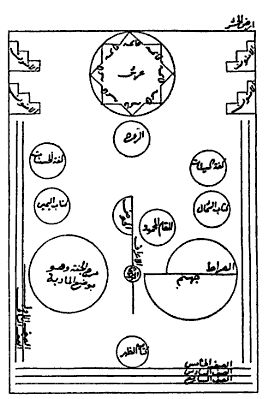
Diagram of "Plain of Assembly" (Ard al-Hashr) on the Day of Judgment, from autograph manuscript of Futuhat al-Makkiyya, ca. 1238 (photo: after Futuhat al-Makkiyya, Cairo edition, 1911)

Akbari Sufism or Akbarism (Arabic: أكبرية: Akbariyya) is a branch of Sufi metaphysics based on the teachings of Ibn Arabi, an Andalusian Sufi who was a gnostic and philosopher. The word is derived from Ibn Arabi's nickname, "Shaykh al-Akbar," meaning "the greatest master." 'Akbariyya' or 'Akbaris' have never been used to indicate a specific Sufi group or society. It is now used to refer to all historical or contemporary Sufi metaphysicians and Sufis influenced by Ibn Arabi's doctrine of Wahdat al-wujud. It is not to be confused with Al Akbariyya, a secret Sufi society founded by Swedish Sufi 'Abdu l-Hadi Aguéli.

Wahdat al-Wujud

[edit]

Wahdat al-Wajud (Arabic: وحدة الوجود Persian: وحدت وجود) meaning the "unity of being" is a Sufi philosophy emphasizing that "there is no true existence except the Ultimate Truth (God)", that is, that the only truth within the universe is God, and that all things exist within God only.

Ibn Arabi is most often characterized in Islamic texts as the originator of this doctrine. However, it is not found in his works. The first to employ this term was Ibn Sabin.

Ibn Arabi's disciple and stepson Sadr al-Din al-Qunawi used this term in his own works and explained it using philosophical terms.

Academic study

[edit]

Europe and United States

[edit]

In the 20th century there has been a focus on the Akbari School in academic circles and universities. Viewed in a historical context, increased government support for the study of the Muslim world and Islamic languages emerged in the United States after the Second World War where many students were attracted to Islam and religious studies during the 1970s.

The greatest growth in American scholarship on Sufism took place during the 1970s. Alexander Knysh notes that, "In the decades after World War Two the majority of Western experts in Sufism were no longer based in Europe, but in North America."[citation needed] Henri Corbin (d. 1978) and Fritz Meier (d. 1998), who were prominent among these experts, made important contributions to the study of Islamic mysticism. Other important names were Miguel Asín Palacios (d. 1944) and Louis Massignon (d. 1962), who made contributions to Ibn Arabi studies. Palacios discovered some Akbarian elements in Dante's Divine Comedy. Massignon studied the famous Sufi Al-Hallaj saying "Ana l-Haq" (I am the Truth).

Seyyed Hossein Nasr and his students and academic disciples have come to play an important role in certain subfields of Sufi studies. The influence of Nasr and other Traditionalist writers like Rene Guenon and Frithjof Schuon on Sufi studies can be seen in the interpretation of the works of Ibn Arabi and the Akbari school by such scholars as Titus Burckhardt, Martin Lings, James Morris, William Chittick, Sachiko Murata, and others. These names are both mostly practitioners of Sufism and scholars studying Sufism.[1]

Turkey

[edit]

Turkey is situated where Ibn Arabi's most prominent disciple, successor and stepson Sadr al-Din al-Qunawi, and other important commentators on Arabi's works lived in the past. Dawūd al-Qayṣarī, who was invited to Iznik by Orhan Ghazi to be the director and teacher for the first Ottoman university (madrasa), was the disciple of Kamāl al-Dīn al-Qāshānī, himself a disciple of Sadr al-Dīn al-Qūnawī. This means that the official teaching itself was set in motion by a great master of the Akbari school. Not only Sufis but also Ottoman sultans, politicians and intellectuals had been deeply impressed by Ibn Arabi and his disciples and interpreters.[2] Seyyed Muhammad Nur al-Arabi was also impressed by Ibn Arabi's doctrine, though that continued to decrease until the Modern Era. In the 20th century the last important commentator of Fusûs was Ahmed Avni Konuk (d. 1938). He was a mawlawî and composer of Turkish music.

Studies on Sufism, especially Akbari works, were not very common until the first Ph.D. thesis was written by Mahmud Erol Kılıc in Marmara University's Faculty of Theology titled "Ibn 'Arabi's Ontology" (in Turkish, "Muhyiddin İbn Arabi'de Varlık ve Varlık Mertebeleri") in 1995. Academic studies on Akbari metaphysics and philosophy began to rise after studies on this topic were conducted by Turkish scholars such as Mustafa Tahralı and Mahmud Erol Kılıc.

In terms of Akbari studies, the most important event to take place was the translation of Ibn Arabi's magnum opus,"Futuhat-ı Makkiyya", to Turkish. Turkish scholar Ekrem Demirli translated the work in 18 volumes between 2006 and 2012. This particular translation was the first complete translation to another language. Demirli's work also includes translating Sadr al-Din al-Qunawi's corpus to Turkish and writing a PhD thesis on him in 2004, writing a commentary on Fusus al-Hikam by Ibn Arabi, and writing a book titled İslam Metafiziğinde Tanrı ve İnsan (God and Human in Islamic Metaphysics), [Istanbul: Kabalcı, 2009 (ISBN 9759971623)].

There are many Akbari works in Ottoman Turkish that are yet to be studied by scholars.

List of some Akbaris

[edit]

There have been many Akbari Sufis, metaphysicians and philosophers. While Ibn Arabi never founded a Tarikah himself,[3] he created a majority of the philosophy around it with his Wahdat al-Wujud. The Sufis listed below were members of different orders, but following the concept of Wahdat al-Wujud.

  1. Sadr al-Din al-Qunawi (d. 1274) - student and stepson of Ibn ‘Arabī. Lived in Konya the same time as Mawlānā Jalāl-ad-Dīn Rumi
  2. Fakhr al-Din Iraqi (1213–1289)
  3. Sa'id al-Din Farghani (d. 1300)
  4. Mahmud Shabistari (1288–1340)
  5. Dawūd al-Qayṣarī (d. 1351)
  6. Ḥaydar Āmūlī (d. 1385)
  7. Abd-al-karim Jili (d. 1428)
  8. Mulla Shams ad-Din al-Fanari (1350–1431)
  9. Shah Ni'matullah Wali (1330–1431)
  10. Abdurrahman Jami (1414–1492)
  11. Idris Bitlisi (d. 1520)
  12. ʿAbd al-Wahhāb ibn Aḥmad al-Shaʿrānī(1493–1565)
  13. Mulla Sadra (1571–1641)
  14. Abd al-Ghani al-Nabulsi (1641–1731)
  15. Ismail Hakki Bursevi (1652–1725)
  16. Ahmad ibn Ajiba (1747–1809)
  17. Abd al-Qadir al-Jaza'iri (1808–1883)
  18. Ahmad al-Alawi (1869–1934)
  19. Abd al-Wahid Yahya (René Guénon) (1886–1951)
  20. Mustafa 'Abd al-'Aziz (1911–1974)
  21. Abdel-Halim Mahmoud (1910–1978)
  22. Javad Nurbakhsh (1926–2008)

References

[edit]

Further reading

[edit]
[edit]
Revisions and contributorsEdit on WikipediaRead on Wikipedia
from Grokipedia
Akbarism, also known as Akbari Sufism or the Akbariyya, is a prominent school of Islamic metaphysics and mysticism derived from the teachings of the Andalusian Sufi philosopher and mystic Muhyiddin Ibn Arabi (1165–1240 CE), honorifically titled Shaykh al-Akbar, or "the Greatest Master."[1] This tradition, which emerged in the 13th century, emphasizes the realization of divine unity through intellectual and spiritual insight rather than mere imitation of religious practices, positioning itself as a "school of realization" (mashrab al-tahqiq).[1] Unlike formal Sufi orders (tariqas), Akbarism functions primarily as a philosophical and hermeneutical approach to Islamic theology, influencing Sufi thought across the Muslim world without establishing a centralized lineage.[2] Central to Akbarism is the doctrine of wahdat al-wujud (unity of being), which asserts that all existence is a manifestation or self-disclosure of the singular divine Reality (al-Haqq), with creation serving as the locus of God's names and attributes rather than independent entities.[3] Ibn Arabi elaborated this in his seminal works, such as al-Futuhat al-Makkiyya (The Meccan Openings), an encyclopedic exposition of spiritual knowledge spanning thousands of pages, and Fusus al-Hikam (The Ringstones of the Wisdoms), which explores the inner wisdom of prophetic figures as reflections of divine realities.[1] Key concepts include the barzakh (isthmus), a mediating realm between opposites like God and creation; the a'yan thabita (immutable archetypes), eternal essences fixed in God's knowledge; and the al-insan al-kamil (Perfect Human), an ideal figure embodying the microcosmic reflection of divine unity.[4] These ideas integrate epistemology, ontology, and cosmology, viewing the human heart as the primary organ for perceiving both material and metaphysical truths, in contrast to rationalist dualisms.[4] The Akbari tradition was systematized by Ibn Arabi's disciple Sadr al-Din al-Qunawi (d. 1274 CE) and later commentators like Dawud al-Qaysari (d. 1350 CE) and Abd al-Karim al-Jili (d. c. 1424 CE), generating over 100 commentaries on his works and spreading rapidly across the Islamic world from Andalusia to Persia, the Ottoman Empire, and South Asia.[1][5] Its influence extends to broader Islamic philosophy, shaping responses to rationalist schools like the falasifa and inspiring cross-cultural dialogues, including parallels with Christian mystics like Meister Eckhart and Hindu Advaita Vedanta.[1] In modern contexts, Akbarism continues to inform liberal theological interpretations of religious pluralism and Sufi practice, underscoring the compatibility of mystical insight with ethical and interfaith engagement.[6]

Origins and Founder

Life and Background of Ibn Arabi

Muhyi al-Din Muhammad ibn Ali ibn Muhammad al-Hatimi al-Ta'i al-Andalusi, commonly known as Ibn ʿArabī, was born in 1165 in Murcia, Al-Andalus (present-day Spain), to a pious Arab family of modest means. His father served as a minor official in the administration, reflecting the family's integration into the socio-political fabric of the region. Raised in an environment steeped in Islamic piety, Ibn ʿArabī received his early education in Seville, where he studied under prominent scholars in the Maliki school of jurisprudence and the Ashʿari theological tradition, gaining a solid foundation in traditional Islamic sciences.[1][7][8] From a young age, Ibn ʿArabī experienced profound spiritual visions, beginning in his early teens with a visionary conversion that marked the onset of his mystical inclinations. Around 1180, during his time in Seville, he met the philosopher Averroes (Ibn Rushd), a pivotal encounter that highlighted the intellectual vibrancy of Andalusian scholarship, though their discussion reportedly left Ibn ʿArabī emphasizing the limits of rational inquiry in spiritual matters. His early spiritual formation drew brief influence from earlier Sufi figures like al-Hallaj, whose ecstatic expressions resonated with Ibn ʿArabī's developing mystical outlook. By his late teens, he embraced Sufism fully, transitioning from formal scholarly pursuits to an itinerant life as a Sufi teacher, guiding disciples through personal instruction and travel.[1][7][1] Ibn ʿArabī's travels commenced in the late 12th century, first to Tunis in North Africa, where he sought out Sufi masters amid the shifting dynamics of the Almohad Caliphate. In 1202–1203, he undertook the pilgrimage to Mecca, an experience rich with revelatory insights that deepened his mystical path. From there, he journeyed through Anatolia and Syria, engaging with diverse intellectual and spiritual communities, before settling in Damascus around 1223, where he spent his final years teaching and writing until his death on November 16, 1240. These peregrinations positioned him as a bridge between Western and Eastern Islamic worlds.[1][7][9] The socio-political context of Ibn ʿArabī's formative years was shaped by the Almohad Caliphate (1130–1269), which ruled Al-Andalus and North Africa with a reformist zeal that promoted unitary tawhid doctrine while fostering an intellectual environment blending Andalusian rationalism—exemplified by figures like Averroes—with burgeoning Eastern mystical traditions. This era's patronage of learning in cities like Seville allowed for the synthesis of philosophical rigor and Sufi introspection, influencing Ibn ʿArabī's evolution as a thinker who navigated both domains. His life thus embodied the caliphate's cosmopolitan yet tension-filled milieu, where orthodoxy and esotericism coexisted amid political consolidation.[1][7]

Initial Formulation of Akbari Ideas

The initial formulation of Akbari ideas emerged primarily during Ibn Arabi's Meccan period, where his intellectual output shifted from personal visionary experiences to a systematic metaphysical framework that integrated diverse Islamic and philosophical traditions. Upon arriving in Mecca around 1202 CE, following extensive travels from Andalusia through North Africa and the Levant, Ibn Arabi began composing his magnum opus, Al-Futuhat al-Makkiyya (The Meccan Revelations), a vast encyclopedic work spanning over 560 chapters and approximately 15,000 pages in modern editions. Dictated and revised over nearly four decades from 1203 to 1240 CE, it systematically explores Sufi sciences, including cosmology, spiritual psychology, jurisprudence, and the esoteric dimensions of Islamic rituals, presenting a comprehensive vision of divine self-disclosure through the cosmos. This text marked a pivotal evolution in his thought, transforming ecstatic revelations—such as his encounters with spiritual figures—into structured expositions of spiritual ascent, exemplified by the concept of maqam (station), which denotes progressive stages of realization in the seeker's journey toward divine unity.[1] Central to this synthesis was Ibn Arabi's integration of foundational Islamic sources with broader intellectual currents, forging a unique metaphysical paradigm that would define Akbarism. He drew extensively from Quranic exegesis and Hadith to ground his ideas in prophetic authority, while incorporating Neoplatonic elements—mediated through thinkers like al-Farabi and Avicenna—such as emanationist ontology and the hierarchy of being, adapting them to emphasize the perpetual manifestation of divine reality. Various Sufi traditions encountered through his early teachers in Seville and Tunis further shaped his emphasis on intuitive knowledge (kashf) and ethical purification, blending these with philosophical rigor to articulate a holistic understanding of existence. This fusion is evident in Al-Futuhat's treatment of the universe as a theophany, where every phenomenon reflects divine attributes, prioritizing conceptual depth over isolated doctrines.[1] A complementary work, Fusus al-Hikam (Bezels of Wisdom), composed in Damascus around 1229 CE, distilled these maturing ideas into a more concise format, comprising 27 chapters each centered on a prophet as a "jewel" embodying a facet of divine wisdom. Revealed to Ibn Arabi in a visionary encounter with the Prophet Muhammad, it elucidates the inner realities of prophethood and human perfection, serving as a capstone to his early systematic efforts by linking metaphysical principles to exemplary figures across Islamic history. Regarding authorship, over 800 works are attributed to Ibn Arabi, though his own lists indicate around 300, with a verified core corpus of approximately 85 authentic texts confirmed through manuscript analysis; many, including revisions to Al-Futuhat, underwent posthumous editing and compilation by disciples such as Sadr al-Din al-Qunawi, ensuring the preservation and dissemination of his framework.[10][1]

Core Doctrines

Wahdat al-Wujud

Wahdat al-Wujud, the cornerstone doctrine of Akbarism, asserts the oneness of existence wherein all phenomena constitute manifestations (tajalliyat) of the divine Essence. This unity maintains that nothing possesses independent reality apart from God, yet it avoids pantheistic annihilation of creation by viewing the cosmos as sustained through perpetual divine self-disclosure rather than inherent substance. In this framework, the apparent multiplicity of the world is illusory in its separation from the Divine, rooted instead in the singular reality of God's being.[11] The doctrine's metaphysical structure unfolds in a hierarchical ontology, with the Divine Names serving as primary loci for manifestation. At the pinnacle lies Absolute Unity (ahadiyyah), the unmanifest Essence transcending all attributes and distinctions, beyond human comprehension. This gives way to Unity in Singularity (wahidiyyah), where specific theophanies emerge through the Divine Names, introducing multiplicity—such as the attributes of mercy, justice, and power—while preserving the underlying oneness of existence. These levels ensure that creation reflects divine qualities without compromising the transcendence of the Essence.[12] Scripturally, Wahdat al-Wujud finds grounding in Quranic verses emphasizing divine pervasiveness and eternity, including 2:115 ("Wheresoever ye turn, there is the face of Allah"), which underscores God's omnipresence as the face of reality in all directions, and 28:88 ("Everything perishes but His face"), affirming that only the Divine endures amid apparent existents.[11] It is sharply distinguished from Wahdat al-Shuhud, or Unity of Witnessing, articulated by Ahmad Sirhindi, which prioritizes the mystical perceiver's experiential vision of unity over ontological merger, critiquing the former for potentially blurring Creator-creation boundaries.[13] The implications of Wahdat al-Wujud profoundly reject dualistic separations between the sacred and profane, positing that all existence arises solely through divine self-disclosure (tajalli), rendering the universe a mirror of God's infinite possibilities. This ontology facilitates mystical union via annihilation in the Divine (fana) followed by subsistence (baqa), achieved without incarnation or diminishment of God's otherness, thus harmonizing transcendence with immanence in the seeker's realization of unity.[11]

Key Concepts: The Perfect Human and Barzakh

In Ibn ʿArabī's metaphysical framework, the concept of al-insān al-kāmil (the Perfect Human) represents the pinnacle of human realization, embodying the full spectrum of divine attributes and serving as the microcosmic reflection of the divine macrocosm. This figure integrates all divine Names (al-asmāʾ al-ḥusnā), acting as a comprehensive mirror that manifests God's infinite qualities within the finite realm of creation.[14] As the ultimate archetype, Muhammad exemplifies the Perfect Human; in the Akbari tradition, this is associated with the ḥaqīqa muḥammadiyya (Muhammadan Reality), the primordial reality encompassing the light from which all prophetic guidance emanates.[14] In this role, the Perfect Human functions as God's vicegerent (khalīfa), overseeing the cosmic order and ensuring the harmony between the spiritual and material worlds, much like a seal that preserves the divine treasury of existence.[15] A foundational example of this archetype appears in Ibn ʿArabī's Fuṣūṣ al-ḥikam, where Adam is depicted as the first Perfect Human, created in the divine image to unite all realities and Names within himself, thereby establishing humanity's central position in the universe.[15] Through this embodiment, the Perfect Human mirrors the cosmic structure, with the human form corresponding to the hierarchical levels of being—from the elemental to the angelic—thus actualizing the potential for divine self-disclosure (tajallī) across all planes.[14] The notion of barzakh, or isthmus, delineates an intermediary realm that bridges the spiritual (rūḥānī) and material (jismānī) domains, preventing their direct convergence while enabling transformative interactions. Ibn ʿArabī describes the barzakh as a liminal space "that separates two things without ever becoming either of them," where abstract divine realities assume concrete forms without losing their transcendent essence.[16] This realm plays a crucial role in prophecy, as it is the locus where symbolic visions materialize as perceived realities, facilitating the prophet's reception of revelation. For instance, the Prophet Muhammad's Miʿrāj (ascension) unfolds as a barzakhi event, blending imaginal perceptions with sensible experiences to convey divine truths.[16] In al-Futūḥāt al-makkiyya, Ibn ʿArabī elaborates on the barzakh's function through discussions of angels and jinn, who inhabit this intermediary domain and interact with humans via imaginative faculties, underscoring its role in mediating between the unseen (ghayb) and the visible world.[16] Here, symbols and archetypes gain substantive presence, allowing for theophanies that guide spiritual ascent without collapsing the distinctions between creator and created. These ideas interconnect through the Perfect Human's position as the qutb (pole) of existence, the axial reality around which all spheres of being revolve, sustained by the creative power of imagination (khayāl).[17] Imagination serves as the divine faculty that links the sensible and intelligible worlds within the barzakh, enabling the Perfect Human to perceive and manifest the unity of existence by integrating dualities into a harmonious whole.[17] Thus, the qutb—often realized in the saintly heir to prophetic perfection—employs this imaginal bridge to actualize divine potential, ensuring the world's ongoing preservation and spiritual vitality.[17] Building briefly on the unity of waḥdat al-wujūd, these concepts illustrate how human perfection and metaphysical mediation manifest that ontological oneness in experiential terms.[14]

Transmission and Followers

Immediate Disciples and Transmission

The immediate disciples of Ibn Arabi played a pivotal role in preserving and disseminating his teachings in the decades following his death in 1240. Among them, Sadr al-Din al-Qunawi (d. 1274), Ibn Arabi's stepson and closest collaborator, emerged as the primary transmitter of Akbari thought to Anatolia and Persia.[18] Al-Qunawi, who inherited Ibn Arabi's library and personal notes, systematically organized and expounded upon his master's ideas, ensuring their integration into broader intellectual circles. Another key figure was 'Abd al-Razzaq al-Kashani (d. c. 1330), a Persian scholar who became a prominent commentator on Ibn Arabi's Fusus al-Hikam, providing detailed interpretations that clarified its esoteric dimensions for subsequent generations.[19] Transmission occurred through a combination of personal relocation, epistolary exchange, and communal instruction. Al-Qunawi relocated to Konya in Anatolia around 1251, where he engaged with Seljuk intellectuals, fostering discussions that embedded Akbari concepts within the region's philosophical discourse.[18] His correspondence with prominent scholars, such as Nasir al-Din al-Tusi (d. 1274), facilitated the spread to Persian intellectual centers; these letters addressed metaphysical questions, bridging Akbari mysticism with Avicennian philosophy and influencing Tusi's own works.[20] In Damascus, where Ibn Arabi had established teaching circles, al-Qunawi and other disciples continued oral transmissions through private sessions and public lectures, maintaining the experiential aspect of Akbari initiation amid the city's diverse scholarly community.[21] Early texts authored by these disciples were instrumental in codifying Akbari ideas. Al-Qunawi's Miftah al-Ghayb (Key to the Unseen), completed around 1260, synthesized Ibn Arabi's visionary insights with Avicennian metaphysical frameworks, presenting a structured epistemology that emphasized the unity of existence while appealing to philosophically inclined readers. Al-Kashani's commentary on the Fusus al-Hikam, written in the early 14th century, offered exegetical depth, elucidating symbolic language and prophetic wisdom to make the text accessible without diluting its profundity.[19] These works, circulated in manuscript form, served as foundational references for Akbari study. Geographically, the ideas spread from Damascus—via Ibn Arabi's established networks of students and scribes—to Anatolia through al-Qunawi's Konya-based activities, which influenced local madrasas and Sufi gatherings.[22] In Persia, al-Qunawi's exchanges with al-Tusi extended the reach to cities like Baghdad and Maragha, laying groundwork for later integrations in Shi'i and Sunni scholarship.[20] Initial contacts with Indian intellectual circles emerged in the late 13th century, likely through traveling Sufis and merchants carrying manuscripts along trade routes from Persia, though systematic adoption there intensified only in subsequent periods.[23]

Prominent Later Figures

Key systematizers of the Akbari tradition included Dawud al-Qaysari (d. 1350), whose commentary on the Fusus al-Hikam integrated Akbari metaphysics with philosophical traditions, and Abd al-Karim al-Jili (d. 1408), who expanded on concepts like the Perfect Human in works such as al-Insan al-Kamil.[1] One of the earliest prominent interpreters of Akbari thought in the post-Ibn ʿArabī era was Sayyid Ḥaydar Āmulī (d. 1385), a Persian Twelver Shiʿi scholar who sought to harmonize the master's metaphysics with Imāmī theology. In his commentary Naṣṣ al-nuṣūṣ on Ibn ʿArabī's Fuṣūṣ al-ḥikam, Āmulī emphasized the compatibility of waḥdat al-wujūd with Shiʿi doctrines of wilāya and imāma, arguing that true Sufism was inherently Shiʿi and that non-Shiʿi mystics had deviated from authentic gnosis.[24] His fusion elevated Akbari ideas within Shiʿi intellectual circles in Iran, portraying the Perfect Human (al-insān al-kāmil) as aligned with the role of the Imams.[25] In the Timurid cultural hub of Herat, ʿAbd al-Raḥmān Jāmī (d. 1492), a Naqshbandī poet and commentator, played a pivotal role in disseminating Akbari concepts to a broader Persianate audience. His treatise Lawāʾiḥ (Flashes) succinctly expounded waḥdat al-wujūd, presenting it as the essence of mystical realization through symbolic imagery and poetic insight, thereby making Ibn ʿArabī's complex ontology accessible beyond esoteric circles.[26] Jāmī's works bridged Akbari metaphysics with Naqshbandī sobriety, influencing Sufi literature across Central Asia and India.[27] A transitional figure linking Kubrawī traditions to Akbari reception in India was ʿAzīz Nasafī (d. ca. 1283), whose writings adapted Ibn ʿArabī's ideas of existence and the Perfect Human into Kubrawī visionary frameworks. In treatises like al-Insān al-kāmil, Nasafī simplified waḥdat al-wujūd and taḥqīq for post-Mongol Persianate contexts, emphasizing hierarchical levels of being that resonated in Indian Sufi orders such as the Kubrawiyya.[28] His prose facilitated the transmission of Akbari thought eastward, influencing Mughal-era mysticism.[29] In Mughal India, Aḥmad Sirhindī (d. 1624), a Naqshbandī scholar, engaged deeply with Akbari doctrines while offering a corrective critique. Through his Maktūbāt, Sirhindī proposed waḥdat al-shuhūd (unity of witness) as a refinement of waḥdat al-wujūd, asserting that existence manifests God's witness rather than identity, thus preserving divine transcendence amid perceived monistic excesses.[13] This intervention revitalized orthodox Sufism in South Asia, shaping Naqshbandī responses to Akbari universalism.[30] Among Ottoman exemplars, Ismāʿīl Anqarawī (d. 1631), a Mevlevī shaykh, exemplified Akbari influence in interpretive traditions. His commentary on Rūmī's Mathnawī integrated Ibn ʿArabī's metaphysical insights, using Akbari hermeneutics to elucidate Sufi texts and reflect the school's permeation into Ottoman mystical exegesis.[31] Anqarawī's work underscored the adaptability of Akbari thought in Anatolian Sufi orders.[32]

Influence and Reception

Spread in Sufi Orders and Islamic Regions

Akbarism, the metaphysical school derived from the teachings of Muhyi al-Din Ibn Arabi, integrated deeply into several prominent Sufi orders, facilitating its dissemination across the Islamic world. In the Shadhiliyya order, founded by Abu al-Hasan al-Shadhili (d. 1258) in the Maghrib, Akbari ideas were transmitted through the lineage of Sidi Abu Abdallah ibn Mashish (d. 1227), incorporating elements of his doctrine on divine unity into the order's spiritual practices.[33] The Shadhiliyya's emphasis on inner knowledge and theophany (tajalli) echoed Ibn Arabi's concepts, spreading these ideas through North Africa and into the eastern Islamic lands via disciples like Abu al-Abbas al-Mursi. Similarly, the Qadiriyya order, established by Abd al-Qadir al-Jilani (d. 1166) but evolving post-Ibn Arabi, absorbed Akbari metaphysics in its widespread branches, particularly in ethical and visionary dimensions of Sufi discipline, as seen in later commentaries that reconciled Jilani's sobriety with Ibn Arabi's imaginative cosmology.[34] The Naqshbandiyya, originating in Central Asia, reflected Ibn Arabi's influence in its early formulations, with figures like Ala al-Dawla al-Simnani (d. 1336) engaging critically yet productively with Akbari texts to refine the order's silent dhikr and heart-centered mysticism, aiding its expansion into India and beyond.[35] The Kubrawiyya order served as a crucial bridge for Akbarism to South Asia, with its founder Najm al-Din Kubra (d. 1221), a contemporary of Ibn Arabi, and his successors like Najm al-Din Razi (d. 1256) directly receiving and adapting Akbari doctrines on the imagination and divine manifestations in their visionary treatises.[36] This integration propelled Kubrawi missionaries, such as Sayyid Ali Hamadani (d. 1384), to Kashmir and northern India, where Akbari ideas merged with local esoteric traditions. In Anatolia under the Ottomans, Akbarism influenced the Mevlevi order through Rumi's (d. 1273) circle in Konya, where encounters with Ibn Arabi's followers fostered a poetic expression of unity of being (wahdat al-wujud), evident in the whirling rituals symbolizing cosmic theophany.[37] Ottoman scholars like Ismail Anqaravi (d. 1630) further embedded Akbari exegesis in Mevlevi literature, solidifying its role in Anatolian Sufism.[38] Pre-Safavid mystics like Haydar Amuli (d. ca. 1385) harmonized Ibn Arabi's ontology with Twelver Shi'ism, interpreting the Perfect Human (al-insan al-kamil) as aligned with Imami figures; this Shi'i Akbarism flourished in Safavid Persia (1501–1736), influencing philosophical poetry and theology to legitimize esoteric dimensions of Safavid rule.[39] In Mughal India, Akbarism contributed to syncretic movements, exemplified by Prince Dara Shikoh (d. 1659), who, as a patron of the Qadiriyya, commissioned translations of Ibn Arabi's works alongside Hindu texts, seeking a universal mysticism that blended Akbari theosophy with Vedantic ideas in treatises like the Majma al-Bahrayn.[40] Cultural adaptations of Akbarism extended to sub-Saharan Africa through the Qadiriyya, where orders in West Africa incorporated Ibn Arabi's notions of divine presence into communal rituals and resistance narratives against colonial powers.[41] In Southeast Asia, the Naqshbandiyya transmitted Akbari elements via networks from India, with Indonesian branches like the Khalidiyya adapting concepts of barzakh (the isthmus) to local animist contexts in Javanese mysticism.[42] Akbarism also permeated Islamic art and poetry, notably in Persian miniatures of the Timurid and Safavid periods, which depicted tajalli as luminous divine unveilings in scenes from the Futuhat al-Makkiyya, symbolizing the interplay of eternal archetypes and temporal forms.[43] By the 16th century, Akbarism formed a foundational pillar of perennial philosophy within Islam, inspiring syntheses across Sunni and Shi'i traditions and shaping a significant portion of Sufi intellectual output, as evidenced by commentaries from figures like Jami (d. 1492) that popularized Akbari hermeneutics in Persianate literature.[44] This legacy ensured its enduring role in fostering interfaith dialogues and mystical revivals throughout the Islamic regions.

Controversies and Criticisms

Akbarism, particularly its central doctrine of wahdat al-wujud (unity of being), faced significant theological opposition from literalist scholars who accused it of promoting hulul (divine incarnation in creation) and ittihad (essential union between God and creatures), interpretations seen as blurring the distinction between Creator and creation.[45] Prominent among these critics was the Hanbali scholar Ibn Taymiyyah (d. 1328), who condemned wahdat al-wujud as a form of shirk (polytheism) and kufr (unbelief), arguing that it equated God's essence with the existence of contingent beings, thereby negating divine transcendence.[45] In 14th-century Damascus, where Ibn Arabi had settled and died in 1240, several fatwas were issued against his writings by orthodox ulama, who viewed Akbari texts as heretical and sought to prohibit their circulation to protect Sunni orthodoxy.[46] These condemnations reflected broader tensions between mystical interpretations and exoteric jurisprudence, and ongoing scholarly disputes.[44] A notable response came from the 17th-century Indian Naqshbandi Sufi Ahmad Sirhindi (d. 1624), who reformulated Akbari ideas through his doctrine of wahdat al-shuhud (unity of witness), emphasizing the manifestation of divine unity in perception rather than essential oneness, to align mysticism with orthodox Sunni theology and avert charges of pantheism.[47] Internal debates within Islamic thought highlighted sectarian differences, such as Sunni literalists' rejections versus Shi'i appropriations; for instance, the 14th-century Twelver Shi'i thinker Haydar Amuli (d. ca. 1385) defended and reinterpreted wahdat al-wujud in Shi'i terms, integrating it with Imami concepts of walaya (guardianship) to affirm its compatibility with Twelver doctrine.[48] In 19th-century Arabia, the Wahhabi movement, influenced by Ibn Taymiyyah's critiques, explicitly rejected Akbari mysticism as idolatrous innovation, contributing to the suppression of Sufi orders and texts in the region during their expansions.[49] Defenses of Akbarism included rational arguments by Ibn Arabi's stepson and chief disciple, Sadr al-Din al-Qunawi (d. 1274), who employed philosophical reasoning from Avicennian and Illuminationist traditions to demonstrate the logical coherence of wahdat al-wujud, countering accusations by clarifying its basis in divine unity without implying literal incarnation or union.[50] These efforts portrayed Akbari thought as a profound mysticism often misunderstood as pantheism by detractors, preserving its transmission amid opposition.[45]

Modern Scholarship

Western Academic Studies

Western academic studies on Akbarism, the Sufi metaphysical tradition rooted in the teachings of Ibn ʿArabī (known as Shaykh al-Akbar), emerged prominently in the mid-20th century, focusing on philosophical and phenomenological interpretations that bridged Islamic esotericism with broader intellectual currents. French philosopher and Iranologist Henry Corbin (1903–1978) was a pioneering figure, whose work emphasized the role of creative imagination (khayāl) in Ibn ʿArabī's ontology, influencing phenomenological approaches to Sufi thought by portraying it as a theophanic process where the divine manifests through human perception.[51] Corbin's seminal analysis in Alone with the Alone: Creative Imagination in the Sufism of Ibn ʿArabī (originally published in French, 1958; English translation, 1998) highlighted how Ibn ʿArabī's doctrines transcend rational philosophy, fostering a Western appreciation of Akbarism as a visionary tradition.[51] Complementing this, Japanese scholar Toshihiko Izutsu (1914–1993) advanced comparative studies, notably in Sufism and Taoism: A Comparative Study of Key Philosophical Concepts (1966), where he dissected Ibn ʿArabī's concepts of existence (wujūd) and the Absolute, drawing parallels with Taoist ontology to underscore universal metaphysical structures. Building on these foundations, 20th- and 21st-century scholars have deepened textual and historical analyses of Akbarism. American Islamologist William C. Chittick has been instrumental through his translations and interpretations of key Akbari texts, such as his exegesis in The Sufi Path of Knowledge: Ibn al-ʿArabī's Metaphysics of Imagination (1989), which elucidates the Fuṣūṣ al-Ḥikam (Bezels of Wisdom) by exploring themes of divine self-disclosure and human perfection.[52] French scholar Michel Chodkiewicz contributed significantly to understanding the diffusion of Ibn ʿArabī's ideas in the 1980s and 1990s, as seen in his Seal of the Saints: Prophethood and Sainthood in the Doctrine of Ibn ʿArabī (French, 1986; English, 1993), which traces the global spread of Akbari thought via prophetic walāyah (sainthood).[53] Within the Traditionalist School, figures like Seyyed Hossein Nasr and Frithjof Schuon integrated Akbarism into perennial philosophy, viewing Ibn ʿArabī's wahdat al-wujūd as exemplifying a primordial metaphysical unity across religions; Nasr's Sufi Essays (1972) links Akbari esotericism to universal spiritual principles, while Schuon's Understanding Islam (1963) positions it within transcendent wisdom traditions. Methodologies in Western Akbarism studies emphasize hermeneutics and comparative religion, prioritizing interpretive depth over literalism to unpack Ibn ʿArabī's esoteric layers, with a particular focus on imagination as a bridge between sensible and intelligible realms—a theme central to Corbin's phenomenology.[51] These approaches often explore esotericism through interdisciplinary lenses, including psychology and philosophy, to reveal Akbarism's relevance to modern existential questions. Key publications include the Journal of the Muhyiddin Ibn ʿArabī Society (established 1982, with biannual issues since then), a peer-reviewed outlet that has hosted seminal articles on Akbari hermeneutics and comparative analyses, fostering a dedicated scholarly community.[54] Contemporary trends in Western scholarship include feminist reinterpretations that highlight the divine feminine in Ibn ʿArabī's cosmology, such as Sa'diyya Shaikh's Sufi Narratives of Intimacy: Ibn ʿArabī, Gender, and Sexuality (2012), which examines maternal metaphors and gender fluidity in Akbari theophanies to challenge patriarchal readings. Additionally, digital archives have revolutionized access, with projects like the Muhyiddin Ibn ʿArabī Society's Manuscript Archive (ongoing since the 1990s) providing digitized copies of over 100 rare manuscripts, enabling precise philological studies and global collaboration.[55] Recent developments as of 2025 include a special issue of the journal Religions (papers published 2022–2024) dedicated to Sufi thought in the light of Ibn ʿArabī's Akbarian tradition, edited by Pablo Beneito, featuring contributions on metaphysics and transmission, as well as funding awarded to the Muhyiddin Ibn ʿArabī Society for a two-year research project under the Program in the Study of Mysticism (PRISM) at Tampere University, Finland, focusing on Akbari texts.[56][57]

Studies in Turkey and the Islamic World

In Turkey, scholarship on Akbarism has experienced a notable revival since the mid-20th century, building on the Ottoman legacy of deep engagement with Ibn Arabi's thought while navigating the secular reforms initiated under Mustafa Kemal Atatürk in the 1920s, which initially suppressed Sufi institutions and practices.[58] Modern Turkish academics have focused on textual revival and contextual reinterpretation, with Ekrem Demirli emerging as a pivotal figure through his comprehensive Turkish translation of Ibn Arabi's al-Futuhat al-Makkiyya (The Meccan Revelations), completed in 18 volumes between 2006 and 2012, making the work accessible for contemporary study and emphasizing its metaphysical and ethical dimensions.[59] At Marmara University, the Faculty of Theology's Department of Sufism serves as a key hub for Ibn Arabi research, where scholars like Süleyman Derin explore themes such as the Perfect Human (al-insan al-kamil) in relation to Ottoman intellectual traditions, fostering interdisciplinary approaches that integrate historical transmission with modern philosophical inquiry.[60][61] In the Middle East and South Asia, Akbarism scholarship emphasizes cross-cultural links and contextual adaptations, particularly in Iranian Shi'i thought and the Mughal intellectual legacy. Mahmud Erol Kılıç, a prominent Turkish scholar fluent in Persian, has highlighted Turkish-Iranian connections in Ibn Arabi's metaphysics, examining how Akbari concepts like wahdat al-wujud (unity of being) influenced shared Sufi-Shi'i discourses on divine manifestation and spiritual authority.[62] In Iran, studies often center on the Perfect Human as a bridge to Twelver Shi'i imāmology, with scholars like Ibn Abi al-Jumhur Ahsa'i (d. 1501) adapting Ibn Arabi's framework to emphasize the imams' role as comprehensive loci of divine attributes, as analyzed in contemporary works that trace this influence in Shi'i eschatology and ethics.[63] South Asian research, particularly in India and Pakistan, revives Mughal-era Akbarism—referring to the integration of Ibn Arabi's ideas into the empire's syncretic religious policies under Emperor Akbar (r. 1556–1605)—with analyses showing how Akbari universalism shaped debates on orthodoxy, as seen in critiques by figures like Ahmad Sirhindi (d. 1624) that sought to balance Sufi esotericism with Sharīʿa adherence.[64] Key trends in this regional scholarship include a post-secular revival of Akbarism as a resource for ethical renewal, evident in conferences such as the International Symposium on "Mysticism in Islamic Civilization: The Influence of Ibn Arabi's School in the Balkans, Iran, and Turkey" held in 2024, which explored Akbari thought's role in fostering interfaith dialogue amid modern challenges.[65] In Turkey, this resurgence post-Atatürk has involved neo-spiritualist reinterpretations, including integrations with transpersonal psychology, where Ibn Arabi's archetypes of the soul are paralleled with Jungian concepts to address contemporary mental health and self-realization.[66][67] Publications underscore these trends, with Arabic editions of al-Futuhat al-Makkiyya produced in Damascus by publishers like Ninawa, providing critical texts that support ethical applications of Akbarism to issues like social justice in contemporary Islam.[68] In Pakistan, the Ibn al-Arabi Foundation has issued Urdu translations and commentaries, such as the multi-volume Rasāʾil (Epistles) and Fuṣūṣ al-ḥikam (Bezels of Wisdom), emphasizing Akbarism's relevance to moral philosophy and spiritual education in South Asian Muslim contexts.[69][70]

References

User Avatar
No comments yet.