
Recent from talks
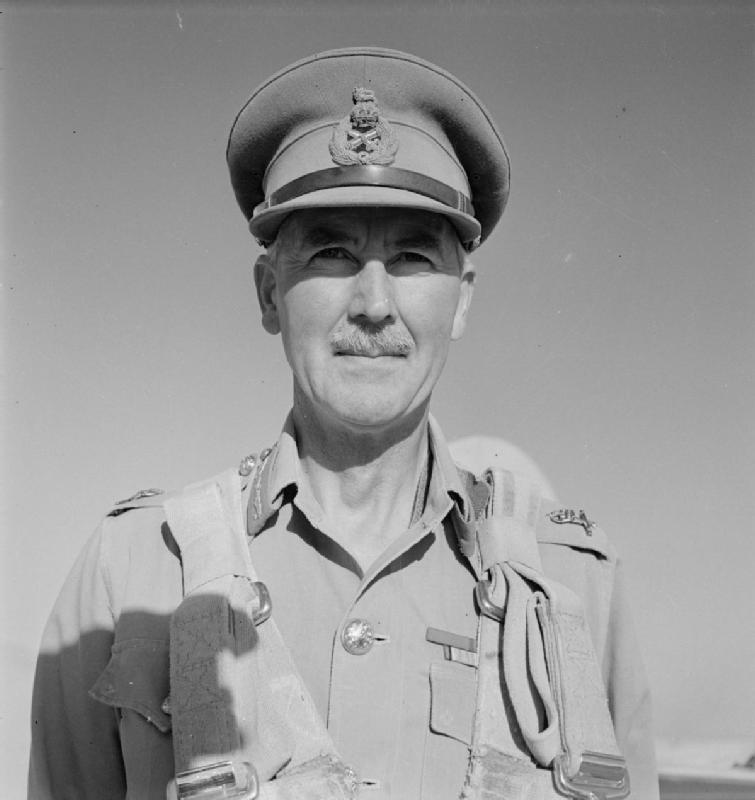
Alan Cunningham
Knowledge base stats:
Talk channels stats:
Members stats:
Alan Cunningham
Sir Alan Gordon Cunningham, GCMG, KCB, DSO, MC (1 May 1887 – 30 January 1983), was a senior officer of the British Army noted for his victories over Italian forces in the East African Campaign during the Second World War. He then commanded Eighth Army in the desert campaign, but was relieved of command during the Crusader battle against Erwin Rommel. Later he served as the seventh and last High Commissioner of Palestine. He was the younger brother of Admiral of the Fleet Lord Cunningham of Hyndhope.
Cunningham was born on 1 May 1887 in Dublin, Ireland, the third son of Scottish Professor Daniel John Cunningham and his wife Elizabeth Cumming Browne. He was educated at Cheltenham College and the Royal Military Academy, Woolwich before taking a commission in the Royal Artillery in 1906. In 1909, his father died unexpectedly and Cunningham applied to join the British Indian Army as he could no longer afford the life style of an officer in Britain. At the out break of the First World War, he was deployed to France with the Indian Expeditionary Force. However, in 1915 he was transferred back to the Royal Artillery, due to a shortage in trained officers. He was awarded a Military Cross in 1915 and the Distinguished Service Order in 1918, he was also awarded three Mention in dispatches during the War. He had served as a Howitzer Battery Commander and was the Artillery brigade major for 20th (Light) Division in June 1917. For two years after the war, he served as a staff officer in the Straits Settlements. He went on to have a number of regimental duty posts, including a tour in Egypt in 1925. He was promoted to Brevet Lieutenant Colonel whilst conducting the post of Chief Instructor at the Anti-Aircraft Wing at the Small Arms School in Netheravon, and was appointed Commanding Officer of 1st Medium Brigade Royal Artillery in Portsmouth in 1935.
After graduating from the Royal Naval College, Greenwich in 1925, followed by the Imperial Defence College in 1937, Cunningham was appointed as the Commander, Royal Artillery of the 1st Infantry Division. However, he never took up this post as he was promoted in 1938 to major-general and given the task of forming and commanding the 5th Anti-Aircraft Division. Cunningham's headquarters was in Reading and the division covered Bristol, Portsmouth and Southampton. This area of operation in South-West England was aligned with the RAF 10 Group.
After Dunkirk, Cunningham was moved from 5th Anti-Aircraft initially to reform the 4th (Infantry) Division, but this was quickly changed and he was ordered to form and train the 66th Infantry Division, in Manchester. He was the moved to Scotland to command the 9th (Highland) Infantry Division, and renamed it 51st (Highland) Infantry Division, when the majority of that Division was lost in the withdrawal from France. At 3 days notice he was informed that he was to take command of the East Africa Force in Kenya and was promoted to acting lieutenant general.
During the East African Campaign General Sir Archibald Wavell, the Commander-in-Chief of the British Middle East Command, directed Cunningham to retake British Somaliland and free Addis Ababa, Ethiopia from the Italians whilst forces under the command of Lieutenant-General Sir William Platt would attack from Sudan in the north through Eritrea. Cunningham commanded three divisions in East Africa Force, the 1st (South African) Division commanded by Major General George Brink, the 11th (African) Division commanded by Major General Harry Edward de Robillard Wetherall and the 12th (African) Division commanded by Major General Reade Godwin-Austen . Cunningham's offensive started with the Battle of the Juba prior to which he issued his famous order of the day 'Hit them. Hit them hard and hit them again'. The Indian Ocean port of Kismayu (Italian: Chisimaio) was quickly captured and Cunningham realized that the Italians had no depth to their defence. He therefore ordered a rapid advance to Mogadishu (Italian: Mogadiscio) by the 23rd Nigerian Brigade who covered 275 miles in only three days. When General Wavell asked Cunningham when he might capture Mogadishu, he simply replied 'got it'. The Italians were then pursued and fought a number of covering actions at the Marda Pass and the River Awash. On 6 April 1941, Cunningham's forces entered Addis Ababa having advanced 1,687 miles at an average rate of 75 miles a day. On the 5 May 1941, Cunningham believed that it was safe for Emperor Haile Selassie to return to Addis Ababa, five years after he was forced to flee from the Italian forces. On 11 May, the northernmost units of Cunningham's forces, under South African Brigadier Dan Pienaar linked with Platt's forces under Major-General Mosley Mayne to besiege Amba Alagi. On 20 May, Mayne took the surrender of the Duke of Aosta, at Amba Alagi. Cunningham continued to lead his forces in mopping-up operations against the 40,000 Italian troops in the Galla-Sidamo region. He was appointed a Knight Commander of the Order of the Bath and awarded another Mention in Dispatches for his actions in East Africa. For this campaign he was also awarded Order of the Brilliant Star of Zanzibar, 1st class and Order of Menelik II, 1st class by Emperor Haile Selassie and the Order of the Crown, 1st class by the King of Belgium.
His success in East Africa led to Cunningham's appointment to form, train, and command the new Eighth Army in North Africa in August 1941. The Eighth Army was to consist of two Corps, XIII Corps (United Kingdom) was mainly infantry and was to be commanded by Lieutenant General Godwin-Austen, whom Cunningham had commanded in East Africa. XXX Corps was to be armoured and commanded by Lieutenant General Vyvyan Pope, the British armoured expert. However, Pope was killed with his staff in a plane crash on 6 October 1941 and he was replaced by the inexperienced cavalry officer Major General Charles Willoughby-Norrie. Cunningham had to form and train the Eighth Army in time to lead General Sir Claude Auchinleck's Libyan Desert offensive which under pressure from Churchill was due to begin in early November, but actually began on 18 November. It was called Operation Crusader.
Cunningham's offensive achieved complete surprise and the Axis were slow to react. This resulted in Willoughby-Norrie convincing Cunningham to amend the plan and allow him to strike for Tobruk. This resulted in the destruction of the British armour as it engaged the Afrika Korps as brigades, rather than Cunningham's plan for a concentrated Eighth Army fighting what Pope had termed 'the Big Tank Battle'. due to the heavy losses, there was a chance that Rommel could break through to Egypt, and Cunningham sought strategic advice from Auchinleck to either continue the offensive or to defend and rebuild the tank formations. Auchinleck, who had access to secret Ultra intelligence, ordered Cunningham to continue and Cunningham issued orders that XIII Corps was to take up the offensive and relieve the Siege of Tobruk.
On 25 November, the Axis counterattack into Egypt during Crusader had been repulsed, Cunningham was dismissed by Auchinleck. His replacement was Auchinleck's deputy chief of the general staff, Major-General Neil Ritchie, who was chosen due to his familiarity with the Operation Crusader plan. The day after Ritchie took over, XIII Corps relieved Tobruk as planned by Cunningham. Auchinleck had been content when he left Cunningham and it is likely that he was convinced by Air Marshal Arthur Tedder to replace him during the flight back to Cairo. Auchinleck asked Cunningham to go into No. 64 Field Hospital for security reasons, asking him "to agree to being placed on the sick list and to go into hospital for a period. I know that this will be against all your instincts, and that you will hate doing it" and Cunningham agreed. However, he had no health issues apart from being tired after fighting for 9 days as he pointed out "like all the troops fighting in Libya". Once Cunningham was in hospital, Auchinleck wrote again to offer his "forgiveness in having inflicted this indignity on you … [I] know very well how you disliked having to pretend that you are sick, when you are not." Cunningham was then examined by a consultant Colonel Smallwood on the 29 November who wrote that he was "tired and showed signs of strain’ due to his ‘long and heavy responsibilities" which "had culminated in a period of about a week with practically no sleep", he concluded that,"since admission to hospital he has slept soundly each night… He is composed, and very alert and mentally active. There is no evidence of any “nervous breakdown."" However, whilst Cunningham was in isolated in hospital, the narrative of a nervous breakdown was spread and became the accepted story.
Hub AI
Alan Cunningham AI simulator
(@Alan Cunningham_simulator)
Alan Cunningham
Sir Alan Gordon Cunningham, GCMG, KCB, DSO, MC (1 May 1887 – 30 January 1983), was a senior officer of the British Army noted for his victories over Italian forces in the East African Campaign during the Second World War. He then commanded Eighth Army in the desert campaign, but was relieved of command during the Crusader battle against Erwin Rommel. Later he served as the seventh and last High Commissioner of Palestine. He was the younger brother of Admiral of the Fleet Lord Cunningham of Hyndhope.
Cunningham was born on 1 May 1887 in Dublin, Ireland, the third son of Scottish Professor Daniel John Cunningham and his wife Elizabeth Cumming Browne. He was educated at Cheltenham College and the Royal Military Academy, Woolwich before taking a commission in the Royal Artillery in 1906. In 1909, his father died unexpectedly and Cunningham applied to join the British Indian Army as he could no longer afford the life style of an officer in Britain. At the out break of the First World War, he was deployed to France with the Indian Expeditionary Force. However, in 1915 he was transferred back to the Royal Artillery, due to a shortage in trained officers. He was awarded a Military Cross in 1915 and the Distinguished Service Order in 1918, he was also awarded three Mention in dispatches during the War. He had served as a Howitzer Battery Commander and was the Artillery brigade major for 20th (Light) Division in June 1917. For two years after the war, he served as a staff officer in the Straits Settlements. He went on to have a number of regimental duty posts, including a tour in Egypt in 1925. He was promoted to Brevet Lieutenant Colonel whilst conducting the post of Chief Instructor at the Anti-Aircraft Wing at the Small Arms School in Netheravon, and was appointed Commanding Officer of 1st Medium Brigade Royal Artillery in Portsmouth in 1935.
After graduating from the Royal Naval College, Greenwich in 1925, followed by the Imperial Defence College in 1937, Cunningham was appointed as the Commander, Royal Artillery of the 1st Infantry Division. However, he never took up this post as he was promoted in 1938 to major-general and given the task of forming and commanding the 5th Anti-Aircraft Division. Cunningham's headquarters was in Reading and the division covered Bristol, Portsmouth and Southampton. This area of operation in South-West England was aligned with the RAF 10 Group.
After Dunkirk, Cunningham was moved from 5th Anti-Aircraft initially to reform the 4th (Infantry) Division, but this was quickly changed and he was ordered to form and train the 66th Infantry Division, in Manchester. He was the moved to Scotland to command the 9th (Highland) Infantry Division, and renamed it 51st (Highland) Infantry Division, when the majority of that Division was lost in the withdrawal from France. At 3 days notice he was informed that he was to take command of the East Africa Force in Kenya and was promoted to acting lieutenant general.
During the East African Campaign General Sir Archibald Wavell, the Commander-in-Chief of the British Middle East Command, directed Cunningham to retake British Somaliland and free Addis Ababa, Ethiopia from the Italians whilst forces under the command of Lieutenant-General Sir William Platt would attack from Sudan in the north through Eritrea. Cunningham commanded three divisions in East Africa Force, the 1st (South African) Division commanded by Major General George Brink, the 11th (African) Division commanded by Major General Harry Edward de Robillard Wetherall and the 12th (African) Division commanded by Major General Reade Godwin-Austen . Cunningham's offensive started with the Battle of the Juba prior to which he issued his famous order of the day 'Hit them. Hit them hard and hit them again'. The Indian Ocean port of Kismayu (Italian: Chisimaio) was quickly captured and Cunningham realized that the Italians had no depth to their defence. He therefore ordered a rapid advance to Mogadishu (Italian: Mogadiscio) by the 23rd Nigerian Brigade who covered 275 miles in only three days. When General Wavell asked Cunningham when he might capture Mogadishu, he simply replied 'got it'. The Italians were then pursued and fought a number of covering actions at the Marda Pass and the River Awash. On 6 April 1941, Cunningham's forces entered Addis Ababa having advanced 1,687 miles at an average rate of 75 miles a day. On the 5 May 1941, Cunningham believed that it was safe for Emperor Haile Selassie to return to Addis Ababa, five years after he was forced to flee from the Italian forces. On 11 May, the northernmost units of Cunningham's forces, under South African Brigadier Dan Pienaar linked with Platt's forces under Major-General Mosley Mayne to besiege Amba Alagi. On 20 May, Mayne took the surrender of the Duke of Aosta, at Amba Alagi. Cunningham continued to lead his forces in mopping-up operations against the 40,000 Italian troops in the Galla-Sidamo region. He was appointed a Knight Commander of the Order of the Bath and awarded another Mention in Dispatches for his actions in East Africa. For this campaign he was also awarded Order of the Brilliant Star of Zanzibar, 1st class and Order of Menelik II, 1st class by Emperor Haile Selassie and the Order of the Crown, 1st class by the King of Belgium.
His success in East Africa led to Cunningham's appointment to form, train, and command the new Eighth Army in North Africa in August 1941. The Eighth Army was to consist of two Corps, XIII Corps (United Kingdom) was mainly infantry and was to be commanded by Lieutenant General Godwin-Austen, whom Cunningham had commanded in East Africa. XXX Corps was to be armoured and commanded by Lieutenant General Vyvyan Pope, the British armoured expert. However, Pope was killed with his staff in a plane crash on 6 October 1941 and he was replaced by the inexperienced cavalry officer Major General Charles Willoughby-Norrie. Cunningham had to form and train the Eighth Army in time to lead General Sir Claude Auchinleck's Libyan Desert offensive which under pressure from Churchill was due to begin in early November, but actually began on 18 November. It was called Operation Crusader.
Cunningham's offensive achieved complete surprise and the Axis were slow to react. This resulted in Willoughby-Norrie convincing Cunningham to amend the plan and allow him to strike for Tobruk. This resulted in the destruction of the British armour as it engaged the Afrika Korps as brigades, rather than Cunningham's plan for a concentrated Eighth Army fighting what Pope had termed 'the Big Tank Battle'. due to the heavy losses, there was a chance that Rommel could break through to Egypt, and Cunningham sought strategic advice from Auchinleck to either continue the offensive or to defend and rebuild the tank formations. Auchinleck, who had access to secret Ultra intelligence, ordered Cunningham to continue and Cunningham issued orders that XIII Corps was to take up the offensive and relieve the Siege of Tobruk.
On 25 November, the Axis counterattack into Egypt during Crusader had been repulsed, Cunningham was dismissed by Auchinleck. His replacement was Auchinleck's deputy chief of the general staff, Major-General Neil Ritchie, who was chosen due to his familiarity with the Operation Crusader plan. The day after Ritchie took over, XIII Corps relieved Tobruk as planned by Cunningham. Auchinleck had been content when he left Cunningham and it is likely that he was convinced by Air Marshal Arthur Tedder to replace him during the flight back to Cairo. Auchinleck asked Cunningham to go into No. 64 Field Hospital for security reasons, asking him "to agree to being placed on the sick list and to go into hospital for a period. I know that this will be against all your instincts, and that you will hate doing it" and Cunningham agreed. However, he had no health issues apart from being tired after fighting for 9 days as he pointed out "like all the troops fighting in Libya". Once Cunningham was in hospital, Auchinleck wrote again to offer his "forgiveness in having inflicted this indignity on you … [I] know very well how you disliked having to pretend that you are sick, when you are not." Cunningham was then examined by a consultant Colonel Smallwood on the 29 November who wrote that he was "tired and showed signs of strain’ due to his ‘long and heavy responsibilities" which "had culminated in a period of about a week with practically no sleep", he concluded that,"since admission to hospital he has slept soundly each night… He is composed, and very alert and mentally active. There is no evidence of any “nervous breakdown."" However, whilst Cunningham was in isolated in hospital, the narrative of a nervous breakdown was spread and became the accepted story.
Recent media