


Community hub
Recent from talks
Contribute something
Nothing was collected or created yet.
Moose
View on Wikipedia
| Moose Temporal range:
| |
|---|---|

| |
| A bull (male) moose in Alaska, US | |
,_Potter_marsh,_Alaska,_Estados_Unidos,_2017-08-22,_DD_139.jpg)
| |
| A cow (female) moose in Alaska, US | |
Scientific classification 
| |
| Kingdom: | Animalia |
| Phylum: | Chordata |
| Class: | Mammalia |
| Order: | Artiodactyla |
| Family: | Cervidae |
| Subfamily: | Capreolinae |
| Tribe: | Alceini |
| Genus: | Alces |
| Species: | A. alces
|
| Binomial name | |
| Alces alces | |

| |
| native range | |
| Synonyms | |
| |


The moose (pl.: 'moose'; used in North America) or elk (pl.: 'elk' or 'elks'; used in Eurasia) (Alces alces) is the world's tallest, largest and heaviest extant species of deer and the only species in the genus Alces. It is also the tallest, and the second-largest, land animal in North America, falling short only to the American bison in body mass. Most adult male moose have broad, palmate ("open-hand shaped") antlers; other members of the deer family have pointed antlers with a dendritic ("twig-like") configuration. Moose inhabit the circumpolar boreal forests or temperate broadleaf and mixed forests of the Northern Hemisphere, thriving in cooler, temperate areas as well as subarctic climates.
Hunting shaped the relationship between moose and humans, both in Eurasia and North America. Prior to the early modern period (around 1600–1700), moose were one of many valuable sources of sustenance for certain North American Indians. Hunting and habitat loss have reduced the moose's range; this fragmentation has led to sightings of "urban moose" in some areas. The moose has been reintroduced to some of its former habitats. Currently, the greatest populations occur in Canada. Additionally, substantial numbers are found in Alaska, the northern states of the contiguous United States, Fennoscandia, the Baltic states, the Caucasus region, Poland, Eastern Europe, Mongolia, Kazakhstan, and Russia.
Predominantly a browser, the moose's diet consists of both terrestrial and aquatic vegetation, depending on the season, with branches, twigs and dead wood making up a large portion of their winter diet. Predators of moose include wolves, bears, humans, wolverines (rarely, though may take calves), and (rarely, if swimming in the ocean) orcas. Unlike most other deer species, moose do not form herds and are solitary animals, aside from calves who remain with their mother until the cow begins estrus again (typically 18 months after the birth of a calf). At this point, the cow chases her calf away. Although generally slow-moving and sedentary, moose can become defensively aggressive, and move very quickly if angered or startled. Their mating season in the autumn features energetic fights between males competing for a female.
Moose have played a prominent role in the culture of people in the Northern Hemisphere. Evidence suggests they were hunted by humans as far back as the most recent Ice Age.[3]
Taxonomy
[edit]Etymology
[edit]Alces alces is called a "moose" in North American English, but an "elk" in British English.[4] The word "elk" in North American English refers to a completely different species of deer, Cervus canadensis, also called the wapiti (from Algonquin). A mature male moose is called a bull, a mature female a cow, and an immature moose of either sex a calf.
In Classical Antiquity, the animal was known as ἄλκη (álkē)[5] in Greek and alces[6] in Latin, words probably borrowed from a Germanic language or another language of northern Europe.[4] By the 8th century, during the Early Middle Ages, the species was known in Old English: elch, elh, eolh, derived from the Proto-Germanic: *elho-, *elhon- and possibly connected with the Old Norse: elgr.[4] Later, in Middle English, the species became known as elk, elcke, or elke, also appearing in the Latinized form alke, with the alce borrowed directly from the Latin: alces.[4][7]
The word "elk" remained in usage because of English-speakers' familiarity with the species in Continental Europe; however, without any living animals around to serve as a reference, the meaning became rather vague, and by the 17th century "elk" had a meaning similar to "large deer".[8] Dictionaries of the 18th century simply described "elk" as a deer that was "as large as a horse".[9]
The word "moose" had first entered English by 1606[10] and is borrowed from the Algonquian languages (compare the Narragansett moos and Eastern Abenaki mos; according to early sources, these were likely derived from moosu, meaning 'he strips off'),[11] and possibly involved forms from multiple languages mutually reinforcing one another. The Proto-Algonquian form was *mo·swa.[12]
Description
[edit]
On average, an adult moose stands 1.4–2.1 m (4 ft 7 in – 6 ft 11 in) high at the shoulder, which is more than 30 centimetres (1 ft) higher than the next-largest deer on average, the wapiti.[13] The tail is short (6 cm to 8 cm in length) and vestigial in appearance; unlike other ungulates the moose tail is too short to swish away insects.[14] Males (or "bulls") normally weigh from 380 to 700 kg (838 to 1,543 lb) and females (or "cows") typically weigh 200 to 490 kg (441 to 1,080 lb), depending on racial or clinal as well as individual age or nutritional variations.[15][16] The head-and-body length is 2.4–3.1 m (7 ft 10 in – 10 ft 2 in), with the vestigial tail adding only a further 5–12 cm (2–4+1⁄2 in).[17] The largest of all the races is the Alaskan subspecies (A. a. gigas), which can stand over 2.1 m (6 ft 11 in) at the shoulder, has a span across the antlers of 1.8 m (5 ft 11 in) and averages 634.5 kg (1,399 lb) in males and 478 kg (1,054 lb) in females.[18] Typically, however, the antlers of a mature bull are between 1.2 and 1.5 m (3 ft 11 in and 4 ft 11 in). The largest confirmed size for this species was a bull shot at the Yukon River in September 1897 that weighed 820 kg (1,808 lb) and measured 2.33 m (7 ft 8 in) high at the shoulder.[19] There have been reported cases of even larger moose, including a bull killed in 2004 that weighed 1,043 kg (2,299 lb),[20] and a bull that reportedly scaled 1,180 kg (2,601 lb), but none are authenticated and some may not be considered reliable.[19]
Antlers
[edit]

Bull moose have antlers like other members of the deer family. The size and growth rate of antlers is determined by diet and age.[21] Size and symmetry in the number of antler points signals bull moose health and cows may select mates based on antler size and symmetry.[22] Bull moose use their antlers to display dominance, to discourage competition, and to spar or fight rivals.[21]
The male's antlers grow as cylindrical beams projecting on each side of the head at right angles to the midline of the skull, and then fork. The lower prong of this fork may be either simple, or divided into two or three tines, with some flattening. Most moose have antlers that are broad and palmate (flat) with tines (points) along the outer edge.[21] Within the ecologic range of the moose in Europe, northern populations display the palmate pattern of antlers, while the antlers of European moose residing the southerly portion of its range are typically of the cervina dendritic pattern and comparatively small, perhaps due to evolutionary pressures of hunting by humans, who prize the large palmate antlers. European moose with antlers intermediate between the palmate and the dendritic form are found in the middle of the north-south range.[23] Moose with antlers have more acute hearing than those without antlers; a study of trophy antlers using a microphone found that the palmate antler acts as a parabolic reflector, amplifying sound at the moose's ear.[24]
The antlers of mature Alaskan adult bull moose (5 to 12 years old) have a maximum spread greater than 200 centimeters (79 in). By the age of 13, moose antlers decline in size and symmetry. The widest spread recorded was 210 centimeters (83 in) across. An Alaskan moose also holds the record for the heaviest weight at 36 kilograms (79 lb).[21]
Antler beam diameter, not the number of tines, indicates age.[21] In North America, moose (A. a. americanus) antlers are usually larger than those of Eurasian moose and have two lobes on each side, like a butterfly. Eurasian moose antlers resemble a seashell, with a single lobe on each side.[21] In the North Siberian moose (A. a. bedfordiae), the posterior division of the main fork divides into three tines, with no distinct flattening. In the common moose (A. a. alces) this branch usually expands into a broad palmation, with one large tine at the base and a number of smaller snags on the free border. There is, however, a Scandinavian breed of the common moose in which the antlers are simpler and recall those of the East Siberian animals. The palmation appears to be more marked in North American moose than in the typical Scandinavian moose.

After the mating season males drop their antlers to conserve energy for the winter. A new set of antlers will then regrow in the spring. Antlers take three to five months to fully develop, making them one of the fastest growing animal organs. Antler growth is "nourished by an extensive system of blood vessels in the skin covering, which contains numerous hair follicles that give it a 'velvet' texture."[21] This requires intense grazing on a highly-nutritious diet. By September the velvet is removed by rubbing and thrashing which changes the colour of the antlers. Immature bulls may not shed their antlers for the winter, but retain them until the following spring. Birds, carnivores and rodents eat dropped antlers as they are full of protein and moose themselves will eat antler velvet for the nutrients.[21]
If a bull moose is castrated, either by accidental or chemical means, he will shed his current set of antlers within two weeks and then immediately begin to grow a new set of misshapen and deformed antlers that he will wear the rest of his life without ever shedding again; similarly deformed antlers can result from a deficiency of testosterone caused by cryptorchidism or old age.[25] These deformed antlers are composed of living bone which is still growing or able to grow, since testosterone is needed to stop antler growth;[26] they may take one of two forms. "Cactus antlers" or velericorn antlers[26] usually retain the approximate shape of a normal moose's antlers but have numerous pearl-shaped exostoses on their surface; being made of living bone, they are easily broken but can grow back. Perukes (US: /pəˈruːks/) are constantly growing, tumor-like antlers with a distinctive appearance similar to coral.[25] Like roe deer, moose are more likely to develop perukes, rather than cactus antlers, than the more developed cervine deer, but unlike roe deer, moose do not suffer fatal decalcification of the skull as a result of peruke growth,[27][26] but rather can support their continued growth until they become too large to be fully supplied with blood.[25] The distinctive-looking perukes (often referred to as "devil's antlers") are the source of several myths and legends among many groups of Inuit as well as several other tribes of indigenous peoples of North America.
In extremely rare circumstances, a cow moose may grow antlers. This is usually attributed to a hormone imbalance.[28]
Proboscis and olfaction
[edit]The moose proboscis is distinctive among living cervids due to its large size; it also features nares that can be sealed shut when the moose is browsing aquatic vegetation. The moose proboscis likely evolved as an adaptation to aquatic browsing, with loss of the rhinarium, and development of a superior olfactory column separate from an inferior respiratory column.[29] This separation contributes to the moose's keen sense of smell, which they employ to detect water sources, to find food under snow, and to detect mates or predators.[30][29]
Hooves
[edit]
As with all members of the order Artiodactyla (even-toed ungulates), moose feet have two large keratinized hooves corresponding to the third and fourth toe, with two small posterolateral dewclaws (vestigial digits), corresponding to the second and fifth toe. The hoof of the fourth digit is broader than that of the third digit, while the inner hoof of the third digit is longer than that of the fourth digit. This foot configuration may favor striding on soft ground.[31] The moose hoof splays under load, increasing surface area, which limits sinking of the moose foot into soft ground or snow, and which increases efficiency when swimming. The body weight per footprint surface area of the moose foot is intermediate between that of the pronghorn foot, (which have stiff feet lacking dewclaws—optimized for high-speed running) and the caribou foot (which are more rounded with large dewclaws, optimized for walking in deep snow). The moose's body weight per surface area of footprint is about twice that of the caribou.[32][33]
Skin and fur
[edit]Moose skin is typical of the deer family. Moose fur consists of four types of hair: eyelashes, whiskers, guard hairs and wool hairs. Hair length and hair density varies according to season, age, and body region.[34] The coat has two layers—a top layer of long guard hairs and a soft wooly undercoat. The guard hairs are hollow and filled with air for better insulation, which also helps them stay afloat when swimming.[35][36]
Dewlap
[edit]Both male and female moose have a dewlap or bell,[37] which is a fold of skin under the chin. Its exact function is unknown, but some morphologic analyses suggest a cooling (thermoregulatory) function.[38] Other theories include a fitness signal in mating, as a visual and olfactory signal, or as a dominance signal by males, as are the antlers.[39]
Ecology and biology
[edit]Diet
[edit]The moose is a browsing herbivore and is capable of consuming many types of plant or fruit. The average adult moose needs to consume 96 megajoules (23,000 kilocalories) per day to maintain its body weight.[40] Much of a moose's energy is derived from terrestrial vegetation, mainly consisting of forbs and other non-grasses, and fresh shoots from trees such as willow and birch. As these terrestrial plants are rather low in sodium, as much as half of its diet usually consists of aquatic plants, including lilies and pondweed,[41] which while lower in energy content, provide the moose with its sodium requirements.[42] In winter, moose are often drawn to roadways, to lick salt that is used as a snow and ice melter.[43] A typical moose, weighing 360 kg (794 lb), can eat up to 32 kg (71 lb) of food per day.[42]
Moose lack upper front teeth, but have eight sharp incisors on the lower jaw. They also have a tough tongue, lips and gums, which aid in the eating of woody vegetation. Moose have six pairs of large, flat molars and, ahead of those, six pairs of premolars, to grind up their food. A moose's upper lip is very sensitive, to help distinguish between fresh shoots and harder twigs, and is prehensile, for grasping their food. In the summer, moose may use this prehensile lip for grabbing branches and pulling, stripping the entire branch of leaves in a single mouthful, or for pulling forbs, like dandelions, or aquatic plants up by the base, roots and all.[44][45] A moose's diet often depends on its location, but they seem to prefer the new growths from deciduous trees with a high sugar content, such as white birch, trembling aspen and striped maple, among many others.[46] To reach high branches, a moose may bend small saplings down, using its prehensile lip, mouth or body. For larger trees a moose may stand erect and walk upright on its hind legs, allowing it to reach branches up to 4.26 meters (14 ft 0 in) or higher above the ground.[47][48] Moose may consume ferns from time to time.[49]
Moose are excellent swimmers and are known to wade into water to eat aquatic plants. This trait serves a second purpose in cooling down the moose on summer days and ridding itself of black flies. Moose are thus attracted to marshes and river banks during warmer months as both provide suitable vegetation to eat and water to wet themselves in. Moose have been known to dive over 5.5 metres (18 ft) to reach plants on lake bottoms,[50] and the complex snout may assist the moose in this type of feeding. Moose are the only deer that are capable of feeding underwater.[51] As an adaptation for feeding on plants underwater, the nose is equipped with fatty pads and muscles that close the nostrils when exposed to water pressure, preventing water from entering the nose.[52] Other species can pluck plants from the water too, but these need to raise their heads in order to swallow.


Moose are not grazing animals but browsers (concentrate selectors), and their diet varies on a continuum between soft-leaf browsing and browsing of lignified plant matter.[53] Like giraffes, moose carefully select foods with less fiber and more concentrations of nutrients. Thus, the moose's digestive system has evolved to accommodate this relatively low-fiber diet. Unlike most hooved, domesticated animals (ruminants), moose cannot digest hay, and feeding it to a moose can be fatal.[54][55] The moose's varied and complex diet is typically expensive for humans to provide, and free-range moose require a lot of forested hectarage for sustainable survival, which is one of the main reasons moose have never been widely domesticated.[citation needed]


Natural predators
[edit]
.jpg)
A full-grown moose has few enemies except Siberian tigers (Panthera tigris tigris) which regularly prey on adult moose,[56][57][58] but a pack of gray wolves (Canis lupus) can still pose a threat, especially to females with calves.[59] Brown bears (Ursus arctos)[18] are also known to prey on moose of various sizes and are the only predator besides the wolf to attack moose both in Eurasia and North America. In Western Russia, moose provide about 15% annual estimated dietary energy content for brown bears and are the most important food source for these predators during spring.[60] However, Brown bears are more likely to scavenge a wolf kill or to take young moose than to hunt adult moose on their own.[61][62][63] Black bears (Ursus americanus) and cougars (Puma concolor) can be significant predators of moose calves in May and June and can, in rare instances, prey on adults (mainly cows rather than the larger bulls).[64][65] Wolverines (Gulo gulo) are most likely to eat moose as carrion but have killed moose, including adults, when the large ungulates are weakened by harsh winter conditions.[66][67][68] Orcas (Orcinus orca) are the moose's only confirmed marine predator as they have been known to prey on moose and other deer swimming between islands out of North America's Northwest Coast. However, such kills are rare and a matter of opportunity, as moose are not a regular part of the orca diet.[69] There is at least one recorded instance of a moose being scavenged by a Greenland shark (Somniosus microcephalus).[70]

In some areas, moose are the primary source of food for wolves. Moose usually flee upon detecting wolves. Wolves usually follow moose at a distance of 100 to 400 meters (300 to 1,300 ft), occasionally at a distance of two to three kilometers (1 to 2 mi). Attacks from wolves against young moose may last seconds, though sometimes they can be drawn out for days with adults. Sometimes, wolves will chase moose into shallow streams or onto frozen rivers, where their mobility is greatly impeded. Moose will sometimes stand their ground and defend themselves by charging at the wolves or lashing out at them with their powerful hooves. Wolves typically kill moose by tearing at their haunches and perineum, causing massive blood loss. Occasionally, a wolf may immobilize a moose by biting its sensitive nose, the pain of which can paralyze a moose.[71] Wolf packs primarily target calves and elderly animals, but can and will take healthy, adult moose. Moose between the ages of two and eight are seldom killed by wolves.[72] Though moose are usually hunted by packs, there are cases in which single wolves have successfully killed healthy, fully-grown moose.[73][74]
Research into moose predation suggests that their response to perceived threats is learned rather than instinctual. In practical terms this means moose are more vulnerable in areas where wolf or bear populations were decimated in the past but are now rebounding. These same studies suggest, however, that moose learn quickly and adapt, fleeing an area if they hear or smell wolves, bears, or scavenger birds such as ravens.[75]
Moose are also subject to various diseases and forms of parasitism. In northern Europe, the moose botfly is a parasite whose range seems to be spreading.[76]
Parasites
[edit]Moose typically carry a heavy burden of parasites, both externally and internally. Parasitosis is an important cause of moose morbidity and mortality and also contributes to vulnerability to predators.[77] Ectoparasites of moose include the moose nose bot fly,[78] and winter ticks.[79] Endoparasites of moose include dog tapeworm, meningeal worm,[80] lungworm, and roundworm.
Social structure and reproduction
[edit]
Moose are mostly diurnal. They are generally solitary with the strongest bonds between mother and calf. Although moose rarely gather in groups, there may be several in close proximity during the mating season.
Rutting and mating occurs in September and October. During the rut, mature bulls will cease feeding completely for a period of approximately two weeks; this fasting behavior has been attributed to neurophysiological changes related to redeployment of olfaction for detection of moose urine and moose cows.[81] The males are polygynous and will seek several females to breed with. During this time both sexes will call to each other. Males produce heavy grunting sounds that can be heard from up to 500 metres (1,600 ft) away, while females produce wail-like sounds.[82] Males will fight for access to females. Initially, the males assess which of them is dominant and one bull may retreat, however, the interaction can escalate to a fight using their antlers.
Female moose have an eight-month gestation period, usually bearing one calf, or twins if food is plentiful,[83] in May or June.[84] Twinning can run as high as 30% to 40% with good nutrition[85] Newborn moose have fur with a reddish hue in contrast to the brown appearance of an adult. The young will stay with the mother until just before the next young are born. The lifespan of an average moose is about 15–25 years. Moose populations are stable at 25 calves for every 100 cows at 1 year of age. With availability of adequate nutrition, mild weather, and low predation, moose have a huge potential for population expansion.[85]
-
 (newborn)
Calves nursing in spring. -
 (3 months)
Calves stay near their mothers at all times. -
 (9 months)
This calf is almost ready to leave its mother. -
 (10–11 months)
This yearling was probably recently chased away by its pregnant mother.


Aggression
[edit]Moose are not typically aggressive towards humans, but will be aggressive when provoked or frightened. Moose attack more people than bears and wolves combined, but usually with only minor consequences. Moose injure more people than any other wild mammal; worldwide, only hippopotamuses injure more.[86] When harassed or startled by people or in the presence of a dog, moose may charge. Also, as with bears or most wild animals, moose accustomed to being fed by people may act aggressively when denied food. During the fall mating season, bulls may be aggressive toward humans. Cows are protective of young calves and will attack humans who come close, especially if they come between mother and calf. Moose are not territorial, do not view humans as food, and usually will not pursue humans who run away.[87]

Moose are unpredictable. They are most likely to attack if annoyed or harassed, or if approached too closely. A moose that has been harassed may vent its anger on anyone in the vicinity, and they often do not make distinctions between their tormentors and innocent passersby.[citation needed] Moose are very limber animals with highly flexible joints and sharp, pointed hooves, and are capable of kicking with both front and back legs. Moose can kick in all directions, including sideways. Thus, there is no safe side from which to approach. Moose often give warning signs prior to attacking, displaying aggression by means of body language. Maintained eye contact is usually the first sign of aggression, while laid-back ears or a lowered head is a sign of agitation. When the hairs on the back of the moose's neck and shoulders (hackles) stand up, a charge is usually imminent. The Anchorage Visitor Centers warn tourists that "...a moose with its hackles raised is a thing to fear."[88][89][90][91]
Moose cows are more likely to emit protest moans when courted by small males. This attracts the attention of large males, promotes male-male competition and violence, reduces harassment of cows by small males, and increases mating opportunities with large males.[92] This in turn means that the cow moose has at least a small degree of control over which bulls she mates with.[93]
Moose often show aggression to other animals as well, especially predators. Bears are common predators of moose calves and, rarely, adults. Alaskan moose have been reported to successfully fend off attacks from both black and brown bears. Moose have been known to stomp attacking wolves, which makes them less preferred as prey to the wolves. Moose are fully capable of killing bears and wolves. In one rare event, a female moose killed two adult male wolves.[94][95] A moose of either sex that is confronted by danger may let out a loud roar, more resembling that of a predator than a prey animal. European moose are often more aggressive than North American moose, such as the moose in Sweden, which often become very agitated at the sight of a predator. However, like all ungulates known to attack predators, the more aggressive individuals are always darker in color, with the darkest coloring usually in areas facing the opponent, thus serving as a natural warning to other animals.[51]
Habitat, range, and distribution
[edit]Habitat
[edit]
Moose require habitat with adequate edible plants (e.g., pond grasses, young trees and shrubs), cover from predators, and protection from extremely hot or cold weather. Moose travel among different habitats with the seasons to address these requirements.[96] Moose are cold-adapted mammals with thickened skin, dense, heat-retaining coat, and a low surface:volume ratio, which provides excellent cold tolerance but poor heat tolerance. Moose survive hot weather by accessing shade or cooling wind, or by immersion in cool water. In hot weather, moose are often found wading or swimming in lakes or ponds. When heat-stressed, moose may fail to adequately forage in summer and may not gain adequate body fat to survive the winter. Also, moose cows may not calve without adequate summer weight gain. Moose require access to both young forest for browsing and mature forest for shelter and cover. Forest disturbed by fire and logging promotes the growth of fodder for moose. Moose also require access to mineral licks, safe places for calving and aquatic feeding sites.[96]
Moose avoid areas with little or no snow as this increases the risk of predation by wolves and avoid areas with deep snow, as this impairs mobility. Thus, moose select habitat on the basis of trade-offs between risk of predation, food availability, and snow depth.[97] With reintroduction of bison into boreal forest, there was some concern that bison would compete with moose for winter habitat, and thereby worsen the population decline of moose. However, this does not appear to be a problem. Moose prefer sub-alpine shrublands in early winter, while bison prefer wet sedge valley meadowlands in early winter. In late winter, moose prefer river valleys with deciduous forest cover or alpine terrain above the tree line, while bison preferred wet sedge meadowlands or sunny southern grassy slopes.[98]
North America
[edit]After expanding for most of the 20th century, the moose population of North America has been in steep decline since the 1990s. Populations expanded greatly with improved habitat and protection, but now the moose population is declining rapidly.[99] This decline has been attributed to opening of roads and landscapes into the northern range of moose, allowing deer to become populous in areas where they were not previously common. This encroachment by deer on moose habitat brought moose into contact with previously unfamiliar pathogens, including brainworm and liver fluke, and these parasites are believed to have contributed to the population decline of moose.[100][101]
In North America, the moose range includes almost all of Canada (excluding the arctic and Vancouver Island), most of Alaska, northern and eastern North Dakota,[102] northern New England, the Adirondack Mountain region and Taconic highlands of northeast New York State,[103][104] the upper Rocky Mountains, northern Minnesota, northern Wisconsin, Michigan's Upper Peninsula, and Isle Royale in Lake Superior. In the West, moose populations extend across Canada (British Columbia and Alberta). Isolated groups have been verified as far south as the mountains of Utah and Colorado and as far west as the Lake Wenatchee area of the Washington Cascades.[105][106] In the northwestern US, the range includes Wyoming, Montana, Idaho, and smaller areas of Washington, and Oregon.[107] Moose have extended their range southwards in the western Rocky Mountains, with initial sightings in Yellowstone National Park in 1868, and then to the northern slope of the Uinta Mountains in Utah in the first half of the twentieth century.[108] This is the southernmost naturally established moose population in the United States.[108] In 1978, a few breeding pairs were reintroduced in western Colorado, and the state's moose population is now more than 2,400.[109]
In northeastern North America, the Eastern moose's history is very well documented: moose meat was a staple in the diet of indigenous peoples for centuries. The common name "moose" was brought into English from the word used by those who lived in present day coastal Rhode Island. The indigenous people often used moose hides for leather and its meat as an ingredient in pemmican, a type of dried jerky used as a source of sustenance in winter or on long journeys.[110]
The historical range of the subspecies extended from well into Quebec, the Maritimes, and Eastern Ontario south to include all of New England finally ending in the very northeastern tip of Pennsylvania in the west, cutting off somewhere near the mouth of the Hudson River in the south. The moose has been extinct in much of the eastern U.S. for as long as 150 years, due to colonial era overhunting and destruction of its habitat: Dutch, French, and British colonial sources all attest to its presence in the mid 17th century from Maine south to areas within 160 kilometers (100 mi) of present-day Manhattan. However, by the 1870s, only a handful of moose existed in this entire region in very remote pockets of forest; less than 20% of suitable habitat remained.[111]
Since the 1980s, however, moose populations have rebounded, thanks to regrowth of plentiful food sources,[111] abandonment of farmland, better land management, clean-up of pollution, and natural dispersal from the Canadian Maritimes and Quebec. South of the Canada–US border, Maine has most of the population with a 2012 headcount of about 76,000 moose.[112] Dispersals from Maine over the years have resulted in healthy, growing populations each in Vermont and New Hampshire, notably near bodies of water and as high up as 910 m (3,000 ft) above sea level in the mountains. In Massachusetts, moose had gone extinct by 1870, but re-colonized the state in the 1960s, with the population expanding from Vermont and New Hampshire; by 2010, the population was estimated at 850–950.[113] Moose reestablished populations in eastern New York and Connecticut and appeared headed south towards the Catskill Mountains, a former habitat.[114][115][116][117][118][119][120]
In the Midwest U.S., moose are primarily limited to the upper Great Lakes region, but strays, primarily immature males, have been found as far south as eastern Iowa.[121]
Moose were successfully introduced on Newfoundland in 1878 and 1904,[122] where they are now the dominant ungulate. However, they are not native to Newfoundland, and their negative impacts on flora and fauna, including endemic species, is well documented.[123][124] They have been somewhat less successfully on Anticosti Island in the Gulf of Saint Lawrence.[citation needed]
-
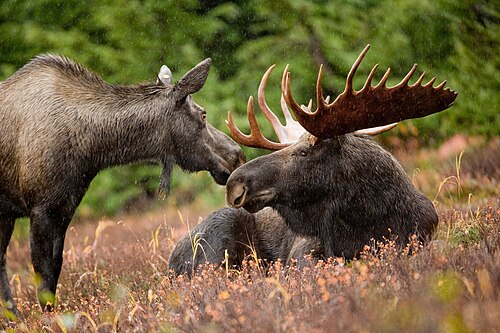 Cow and bull moose
 -
 Cow moose
 -
 Moose calf
.jpg)

.jpg)
Decline in population
[edit]Since the 1990s, moose populations have declined dramatically in much of temperate North America, although they remain stable in Arctic and subarctic regions.[125] The exact causes of specific die-offs are not determined, but most documented mortality events were due to wolf predation, bacterial infection due to injuries sustained from predators, and parasites from white-tailed deer to which moose have not developed a natural defense, such as liver flukes, brain worms and winter tick infestations.[99][126] Predation of moose calves by brown bear is also significant.[127] Landscape change from salvage logging of forest damage caused by the mountain pine beetle has resulted in greater foraging in logged areas by female moose, and this is the lead hypothesis as to why the moose population is declining in eastern North American forests, as this likely leads to increased predation.[128] An alternate hypotheses among biologists for generalized, non-hunting declines in moose populations at the southern extent of their range is increasing heat stress brought on by the rapid seasonal temperature upswings as a result of human-induced climate change.[129] Biologists studying moose populations typically use warm-season, heat-stress thresholds of between 14 and 24 °C (57 and 75 °F).[130] However, the minor average temperature increase of 0.83–1.11 °C (1.5–2 °F), over the last 100 years, has resulted in milder winters that induce favorable conditions for ticks, parasites and other invasive species to flourish within the southern range of moose habitat in North America.[129][131] The moose population in New Hampshire fell from 7,500 in the early 2000s to a 2014 estimate of 4,000 and in Vermont the numbers were down to 2,200[when?] from a high of 5,000 animals in 2005. Much of the decline has been attributed to the winter tick, which, between 2017 and 2019, accounted for 74% of all winter mortality and 91% of winter calf deaths in Vermont.[132] Moose with heavy tick infections will rub their fur down to the skin raw trying to get the ticks off, making them look white when their outer coat rubs off. Locals call them ghost moose.[133][134][135][136] Loss of the insulating winter coat through attempts to rid the moose of winter tick increases the risk of hypothermia in winter.[137]
Europe and Asia
[edit]_calf_Biebrzanski.jpg)
Biebrzański Park Narodowy, Poland

In Europe, moose are currently found in large numbers throughout Norway, Sweden, Finland, Latvia, Estonia, Poland, with more modest numbers in the southern Czech Republic, Belarus, and northern Ukraine. They are also widespread through Russia on up through the borders with Finland south towards the border with Estonia, Belarus and Ukraine and stretching far away eastwards to the Yenisei River in Siberia. The European moose was native to most temperate areas with suitable habitat on the continent and even Scotland from the end of the last Ice Age, as Europe had a mix of temperate boreal and deciduous forest. Up through Classical times, the species was certainly thriving in both Gaul and Magna Germania, as it appears in military and hunting accounts of the age. However, as the Roman era faded into medieval times, the beast slowly disappeared: soon after the reign of Charlemagne, the moose disappeared from France, where its range extended from Normandy in the north to the Pyrenees in the south. Farther east, it survived in Alsace and the Netherlands until the 9th century as the marshlands in the latter were drained and the forests were cleared away for feudal lands in the former. It was gone from Switzerland by the year 1000, from the western Czech Republic by 1300, from Mecklenburg in Germany by c. 1600, and from Hungary and the Caucasus since the 18th and 19th century, respectively.
By the early 20th century, the last strongholds of the European moose appeared to be in Fennoscandian areas and patchy tracts of Russia, with a few migrants found in what is now Estonia and Lithuania. The USSR and Poland managed to restore portions of the range within its borders (such as the 1951 reintroduction into Kampinos National Park and the later 1958 reintroduction in Belarus), but political complications limited the ability to reintroduce it to other portions of its range. Attempts in 1930 and again in 1967 in marshland north of Berlin were unsuccessful. At present in Poland, populations are recorded in the Biebrza river valley, Kampinos, and in Białowieża Forest. It has migrated into other parts of Eastern Europe and has been spotted in eastern and southern Germany.[138][139] Unsuccessful thus far in recolonizing these areas via natural dispersal from source populations in Poland, Belarus, Ukraine, Czech Republic, and Slovakia, it appears to be having more success migrating south into the Caucasus. It is listed under Appendix III of the Bern Convention.[140][141]
In 2008, two moose were reintroduced into the Scottish Highlands[142][143] in Alladale Wilderness Reserve.[144] The moose disappeared as a breeding species from Denmark about 4,500 years ago (in the last century, a very small number have lived for periods in Zealand without establishing a population after swimming across the Øresund from Sweden),[145] but in 2016–17 ten were introduced to Lille Vildmose from Sweden. In 2020, this population had increased to about 25 animals.[146]
The East Asian moose populations confine themselves mostly to the territory of Russia, with much smaller populations in Mongolia and Northeastern China. Moose populations are relatively stable in Siberia and increasing on the Kamchatka Peninsula. In Mongolia and China, where poaching took a great toll on moose, forcing them to near extinction, they are protected, but enforcement of the policy is weak and demand for traditional medicines derived from deer parts is high.[citation needed] In 1978, the Regional Hunting Department transported 45 young moose to the center of Kamchatka. These moose were brought from Chukotka, home to the largest moose on the planet. Kamchatka now regularly is responsible for the largest trophy moose shot around the world each season. As it is a fertile environment for moose, with a milder climate, less snow, and an abundance of food, moose quickly bred and settled along the valley of the Kamchatka River and many surrounding regions. The population in the past 20 years has risen to over 2,900 animals.
The size of the moose varies. Following Bergmann's rule, population in the south (A. a. cameloides) usually grow smaller, while moose in the north and northeast (A. a. buturlini) can match the imposing sizes of the Alaskan moose (A. a. gigas) and are prized by trophy hunters.
New Zealand
[edit]In 1900, an attempt to introduce moose into the Hokitika area failed; then in 1910 ten moose (four bulls and six cows) were introduced into Fiordland. This area is considered a less than suitable habitat, and subsequent low numbers of sightings and kills have led to some presumption of this population's failure.[147] The last proven sighting of a moose in New Zealand was in 1952.[148] However, a moose antler was found in 1972, and DNA tests showed that hair collected in 2002 was from a moose. There has been extensive searching, and while automated cameras failed to capture photographs, evidence was seen of bedding spots, browsing, and antler marks.[149]
Evolutionary history
[edit]


Moose are members of the subfamily Capreolinae. Members of the moose lineage extend back into the Pliocene-Early Pleistocene.[150] Some scientists group the moose and all its extinct relatives into one genus, Alces[151], while others, such as Augusto Azzaroli, restrict Alces to the living species, placing the fossil species into the genera Cervalces (stag moose) and Libralces.[150]
The earliest known species in the moose lineage is Libralces gallicus, which lived in the Pliocene-Early Pleistocene.[150] Libralces gallicus came from the warm savannas of Pliocene Europe, with the best-preserved skeletons being found in southern France. L. gallicus was 1.25 times larger than the Alaskan moose in linear dimensions, making it nearly twice as massive. L. gallicus had many striking differences from its modern descendants. It had a longer, narrower snout and a less-developed nasal cavity, more resembling that of a modern deer, lacking any sign of the modern moose-snout. Its face resembled that of the modern wapiti. However, the rest of its skull structure, skeletal structure and teeth bore strong resemblance to those features that are unmistakable in modern moose, indicating a similar diet. Its antlers consisted of a horizontal bar 2.5 m (8 ft 2 in) long, with no tines, ending in small palmations. Its skull and neck structure suggest an animal that fought using high-speed impacts, much like the Dall sheep, rather than locking and twisting antlers the way modern moose combat. Their long legs and bone structure suggest an animal that was adapted to running at high speeds over rough terrain.[152][153]
Libralces gallicus was followed by Cervalces carnutorum during the first half of the Early Pleistocene. Cervalces carnutorum was soon followed by a much larger species called Cervalces latifrons (broad-fronted stag-moose), which first appeared during the late Early Pleistocene.[154] Many fossils of Cervalces latifrons have been found across Eurasia. Like its descendants, it inhabited mostly northern latitudes, and was probably well-adapted to the cold. C. latifrons was the largest deer known to have ever existed, standing more than 2.1 m (6 ft 11 in) tall at the shoulders. This is bigger than even the Irish elk, which was 1.8 m (5 ft 11 in) tall at the shoulders. Its antlers were smaller than the Irish elk's, but comparable in size to those of L. gallicus. However, the antlers had a shorter horizontal bar and larger palmations, more resembling those of a modern moose.[152][153][155] Probably sometime in the Middle Pleistocene, Cervalces latifrons migrated into North America, giving rise to the stag moose (Cervalces scotti).[151] The modern moose is thought to have evolved from Cervalces latifrons at around the end of the Middle Pleistocene to the beginning of the Late Pleistocene, probably somewhere in East Asia, with the earliest fossils of the species in Europe dating to the early Late Pleistocene. The modern moose only arrived in North America around 15,000 years ago, at the end of the Late Pleistocene.[156]
Populations
[edit]North America:
- In Canada: There are an estimated 500,000 to 1,000,000 moose,[157] with 150,000 in Newfoundland in 2007 descended from just four that were introduced in the 1900s.[158]
- In United States: There are estimated to be around 300,000:
- Alaska: The state's Department of Fish and Game estimated 200,000 in 2011.[159]
- New England: The moose population is estimated at between 60,000–70,000 in Maine (the highest population of any state other than Alaska)[160] 3,000–4,000 in New Hampshire,[161] 2,100 in Vermont,[162] 1,000–1,500 in Massachusetts (in the western and central parts of that state),[163] and 100 in Connecticut[164]
- New York: In 2024, the New York Department of Environmental Conservation reported a surveyed population of 716 moose within Adirondack Park[165]
- Rocky Mountain states: Wyoming is said to have the largest share in its six-state region, and its Fish and Game Commission estimated 7,692 in 2009.[166]
- Upper Midwest: Michigan 2000 on Isle Royale (2019) and an estimated 433 (in its Upper Peninsula) in 2011,[167][168] Wisconsin, 20–40 (close to its border with Michigan) in 2003, Minnesota 5600 in its northeast in 2010,[169] and under 100 in its northwest in 2009;[170] North Dakota closed, due to low moose population, one of its moose-hunting geographic units in 2011, and issued 162 single-kill licenses to hunters, each restricted to one of the remaining nine units.[171]
Europe and Asia:
- Finland: In 2009, there was a summer population of 115,000.[172]
- Norway: In 2009, there were a winter population of around 120,000.[173] In 2015 31,131 moose were shot. In 1999, a record number of 39,422 moose were shot.[174]
- Latvia: in 2015, there were 21,000.[175]
- Estonia: 11,000 - 7,000[176]
- Lithuania: around 14,000 in 2016[177]
- Poland: 28,000[178]
- Czech Republic: maximum of 50[179]
- Russia: In 2007, there were approximately 600,000.[180]
- Sweden: Summer population is estimated to be 300,000–400,000. Around 100,000 are shot each fall.[181][182] About 10,000 are killed in traffic accidents yearly.[183]
Subspecies
[edit]| European elk
|
A. a. alces | Finland, Sweden, Norway, Latvia, Estonia and Russia. No longer present in central and western Europe except for Poland, Lithuania and Belarus, with a certain population in the Czech Republic, Slovakia and northern Ukraine, including Bohemia since the 1970s; recently sighted in eastern Germany (the range formerly included France, Switzerland and the Benelux nations). Population increasing and regaining territory. Males weigh about 320 to 475 kg (705 to 1,047 lb) and females weigh 275 to 375 kg (606 to 827 lb) in this mid-sized subspecies. Shoulder height ranges from 1.7 to 2.1 m (5 ft 7 in to 6 ft 11 in).[184] |
| Yakutia, Mid-Siberian or Lena elk[185]
|
A. a. pfizenmayeri | Eastern Siberia, Mongolia and Manchuria. Mostly found in the forests of eastern Russia. The most common elk subspecies in Asia. Its range goes from the Yenisei River in the west and most of Siberia. Its range excludes the ranges of the Chukotka and Ussuri elk to the east and northern Mongolia. Similar in size to the western moose of Canada and the United States. |
| Ussuri, Amur or Manchurian elk[185][186] | A. a. cameloides | Ranges from the Amur-Ussuri region of far eastern Russia, as well as the northeastern part of China. Ussuri elk are different from other elk subspecies in that their antler size is much smaller, or they lack antlers entirely. Even adult bulls' antlers are small and cervine, with little palmation. The smallest subspecies in both Eurasia and the world, with both males and females standing only 1.65 to 1.85 m (5 ft 5 in to 6 ft 1 in) at the shoulder and weighing between 200 and 350 kg (441 and 772 lb).[187] |
| Chukotka or East Siberian elk[185] | A. a. buturlini | Ranges from northeastern Siberia from the Alazeya River basin east to the Kolyma and Anadyr basins and south through the Koryak range and the Kamchatka Peninsula. The largest subspecies in Eurasia. Males can grow up to 2.15 m (7 ft 1 in) tall and weigh between 500 and 725 kg (1,102 and 1,598 lb); females are somewhat smaller. |
| Eastern moose
|
A. a. americana | Eastern Canada, including eastern Ontario, all of Quebec and the Atlantic Provinces and the northeastern United States, including Maine, New Hampshire, Vermont, Massachusetts, Rhode Island, Connecticut and northern New York near the Adirondack Mountains. Population increasing. This is a fairly small-bodied subspecies, females weighing an average of 270 kg (595 lb), males weighing an average of 365 kg (805 lb) and males standing up to approximately 2 m (6.6 ft) at the shoulder. |
| Western moose
|
A. a. andersoni | British Columbia to western Ontario, the eastern Yukon, the Northwest Territories, southwestern Nunavut, Michigan (the Upper Peninsula), northern Wisconsin, northern Minnesota and northeastern North Dakota. A middle-sized subspecies that weighs 340 to 420 kg (750 to 926 lb) in adult females and 450 to 500 kg (992 to 1,102 lb) in adult males on average.[188] |
| Alaskan moose
|
A. a. gigas | Alaska and the western Yukon. The largest subspecies in North America and the world and the largest living deer in the world; the largest one shot on record weighed 820 kg (1,808 lb), and was 2.33 m (7.6 ft) tall at the shoulder.[189] |
| Shiras' moose or Yellowstone moose
|
A. a. shirasi | Colorado, Idaho, Montana, Oregon, Utah, Washington and Wyoming.[190] The smallest subspecies in North America, weighing about 230 to 344 kg (507 to 758 lb) at maturity. |
| † Caucasian elk[191]
|
A. a. caucasicus | The Caucasus Mountains. Extinct due to habitat loss and overhunting. Its range would have included European Russia, Armenia, Georgia, Azerbaijan, Turkey and North and West Iran. |


Relationship with humans
[edit]History
[edit]

European rock drawings and cave paintings reveal that moose have been hunted since the Stone Age. Excavations in Alby, Sweden, adjacent to the Stora Alvaret have yielded moose antlers in wooden hut remains from 6000 BC, indicating some of the earliest moose hunting in northern Europe. In northern Scandinavia one can still find remains of trapping pits used for hunting moose. These pits, which can be up to 4 m × 7 m (13 ft × 23 ft) in area and 2 m (6 ft 7 in) deep, would have been camouflaged with branches and leaves.[citation needed] They would have had steep sides lined with planks, making it impossible for the moose to escape once it fell in. The pits are normally found in large groups, crossing the moose's regular paths and stretching over several kilometers. Remains of wooden fences designed to guide the animals toward the pits have been found in bogs and peat. In Norway, an early example of these trapping devices has been dated to around 3700 BC. Trapping elk in pits is an extremely effective hunting method. As early as the 16th century the Norwegian government tried to restrict their use, but the method was in use until the 19th century.[citation needed]
The earliest recorded description of the moose is in Julius Caesar's Commentarii de Bello Gallico, where it is described thus:
There are also [animals], which are called alces (moose). The shape of these, and the varied color of their skins, is much like roes, but in size they surpass them a little and are destitute of horns, and have legs without joints and ligatures; nor do they lie down for the purpose of rest, nor, if they have been thrown down by any accident, can they raise or lift themselves up. Trees serve as beds to them; they lean themselves against them, and thus reclining only slightly, they take their rest; when the huntsmen have discovered from the footsteps of these animals whither they are accustomed to betake themselves, they either undermine all the trees at the roots, or cut into them so far that the upper part of the trees may appear to be left standing. When they have leant upon them, according to their habit, they knock down by their weight the unsupported trees, and fall down themselves along with them.[192]
In book 8, chapter 16 of Pliny the Elder's Natural History from AD 77, the elk and an animal called achlis, which is presumably the same animal, are described thus:
... there is, also, the elk, which strongly resembles our steers, except that it is distinguished by the length of the ears and of the neck. There is also the achlis, which is produced in the land of Scandinavia; it has never been seen in this city, although we have had descriptions of it from many persons; it is not unlike the moose, but has no joints in the hind leg. Hence, it never lies down, but reclines against a tree while it sleeps; it can only be taken by previously cutting into the tree, and thus laying a trap for it, as otherwise, it would escape through its swiftness. Its upper lip is so extremely large, for which reason it is obliged to go backwards when grazing; otherwise, by moving onwards, the lip would get doubled up.[193]
As food
[edit]


Moose are hunted as a game species in many of the countries where they are found. Moose meat tastes, wrote Henry David Thoreau in The Maine Woods, "like tender beef, with perhaps more flavour; sometimes like veal". While the flesh has protein levels similar to those of other comparable red meats (e.g. beef, deer and wapiti), it has a low fat content, and the fat that is present consists of a higher proportion of polyunsaturated fats than saturated fats.[194]
Dr. Valerius Geist, who emigrated to Canada from the Soviet Union, wrote in his 1999 book Moose: Behaviour, Ecology, Conservation:
In Sweden, no fall menu is without a mouthwatering moose dish. The Swedes fence their highways to reduce moose fatalities and design moose-proof cars. Sweden is less than half as large as the Canadian province of British Columbia, but the annual take of moose in Sweden—upward of 150,000—is twice that of the total moose harvest in North America.
Boosting moose populations in Alaska for hunting purposes is one of the reasons given for allowing aerial or airborne methods to remove wolves in designated areas, e.g., Craig Medred: "A kill of 124 wolves would thus translate to [the survival of] 1488 moose or 2976 caribou or some combination thereof".[195] Some scientists believe that this artificial inflation of game populations is actually detrimental to both caribou and moose populations as well as the ecosystem as a whole. This is because studies have shown that when these game populations are artificially boosted, it leads to both habitat destruction and a crash in these populations.[citation needed]
Consumption of offal
[edit]Cadmium levels are high in Finnish moose liver and kidneys, with the result that consumption of these organs from moose more than one year old is prohibited in Finland.[196] As a result of a study reported in 1988, the Ontario Ministry of Natural Resources recommended against the consumption of moose and deer kidneys and livers. Levels of cadmium were found to be considerably higher than in Scandinavia.[197] The New Brunswick Department of Natural Resources advises hunters not to consume cervid offal.[198]
Cadmium intake has been found to be elevated amongst all consumers of moose meat, though the meat was found to contribute only slightly to the daily cadmium intake. However the consumption of moose liver or kidneys significantly increased cadmium intake, with the study revealing that heavy consumers of moose organs have a relatively narrow safety margin below the levels which would probably cause adverse health effects.[199]
Vehicle collisions
[edit]The center of mass of a moose is above the hood of most passenger cars. In a collision, the impact crushes the front roof beams and individuals in the front seats.[200] Collisions of this type are frequently fatal; seat belts and airbags offer little protection.[201] In collisions with higher vehicles (such as trucks), most of the deformation is to the front of the vehicle and the passenger compartment is largely spared. Moose collisions have prompted the development of a vehicle test referred to as the "moose test" (Swedish: Älgtest, German: Elchtest). A Massachusetts study found that moose–vehicular collisions had a very high human fatality rate and that such collisions caused the death of 3% of the Massachusetts moose population annually.[202]

Moose warning signs are used on roads in regions where there is a danger of collision with the animal. The triangular warning signs common in Sweden, Norway, and Finland have become coveted souvenirs among tourists traveling in these countries, causing road authorities so much expense that the moose signs have been replaced with imageless generic warning signs in some regions.[203]
In Ontario, Canada, an estimated 265 moose die each year as a result of collision with trains (as of 2019[update]). Moose–train collisions were more frequent in winters with above-average snowfall.[204] In January 2008, the Norwegian newspaper Aftenposten estimated that some 13,000 moose had died in collisions with Norwegian trains since 2000. The state agency in charge of railroad infrastructure (Jernbaneverket) plans to spend 80 million Norwegian kroner to reduce collision rate in the future by fencing the railways, clearing vegetation from near the tracks, and providing alternative snow-free feeding places for the animals elsewhere.[205]
In the Canadian province of New Brunswick, collisions between automobiles and moose are frequent enough that all new highways have fences to prevent moose from accessing the road, as has long been done in Finland, Norway, and Sweden. A demonstration project, Highway 7 between Fredericton and Saint John, which has one of the highest frequencies of moose collisions in the province, did not have these fences until 2008, although it was and continues to be extremely well signed.[206][207] Newfoundland and Labrador recommended that motorists use caution between dusk and dawn because that is when moose are most active and most difficult to see, increasing the risk of collisions.[208] Local moose sightings are often reported on radio stations so that motorists can take care while driving in particular areas. An electronic "moose detection system" was installed on two sections of the Trans-Canada Highway in Newfoundland in 2011, but the system proved unreliable and was removed in 2015.[209] As of 2024[update], the moose population in Newfoundland was increasing along with the number of road accidents.[210]
In Sweden, a road will not be fenced unless it experiences at least one moose accident per km per year.[211]
In eastern Germany, where the scarce population is slowly increasing, there were two road accidents involving moose since 2000.[140]
-
 Canadian road sign.
 -
 Finnish road sign.
 -
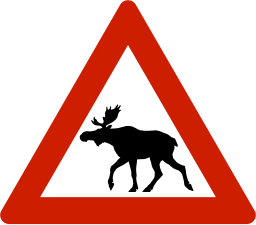 Norwegian road sign.
 -
 Swedish road sign.
 -
 Warning sign in Alaska where trees and brush are trimmed along high moose crossing areas so that moose can be seen as they approach the road.
 -
 Moose (A. a. gigas) crossing a road in Alaska.


Domestication
[edit]
Domestication of moose was investigated in the Soviet Union before World War II. Early experiments were inconclusive, but with the creation of a moose farm at Pechora-Ilych Nature Reserve in 1949, a small-scale moose domestication program was started, involving attempts at selective breeding of animals on the basis of their behavioural characteristics. Since 1963, the program has continued at Kostroma Moose Farm, which had a herd of 33 tame moose as of 2003. Although at this stage the farm is not expected to be a profit-making enterprise, it obtains some income from the sale of moose milk and from visiting tourist groups. Its main value, however, is seen in the opportunities it offers for the research in the physiology and behavior of the moose, as well as in the insights it provides into the general principles of animal domestication.
In Sweden, there was a debate in the late 18th century about the national value of using the moose as a domestic animal. Among other things, the moose was proposed to be used in postal distribution, and there was a suggestion to develop a moose-mounted cavalry. Such proposals remained unimplemented, mainly because the extensive hunting for moose that was deregulated in the 1790s nearly drove it to extinction. While there have been documented cases of individual moose (eg Älgen Stolta) being used for riding and/or pulling carts and sleds, Björklöf concludes no wide-scale usage has occurred outside fairy tales.[212]
Heraldry
[edit]As one of the Canadian national symbols, the moose occurs on several Canadian coats of arms, including Newfoundland and Labrador,[213] and Ontario.[214] Moose is also a common coat of arms in Europe as well; for example, in Finland, it appears on the coats of arms of Hirvensalmi and Mäntsälä municipalities.[215] The seals of Maine and Michigan feature moose as well.[216]

See also
[edit]- Älgen Stolta, a rare example of a domesticated moose
References
[edit]- ^ Hundertmark, K. (2016). "Alces alces". IUCN Red List of Threatened Species. 2016 e.T56003281A22157381. doi:10.2305/IUCN.UK.2016-1.RLTS.T56003281A22157381.en. Retrieved 19 November 2021.
- ^ "Alces alces". NatureServe Explorer. Archived from the original on 10 April 2024. Retrieved 17 April 2024.
- ^ Larsson, Thomas B.; Rosqvist, Gunhild; Ericsson, Göran; Heinerud, Jans (2012-08-13). "Climate Change, Moose and Humans in Northern Sweden 4000 cal. yr BP". Journal of Northern Studies. 6 (1): 9–30. doi:10.36368/jns.v6i1.693. ISSN 2004-4658.
- ^ a b c d "elk, n. 1". Oxford English Dictionary (2nd ed.). 1989 [1891]. Archived from the original on March 9, 2021. Retrieved January 15, 2021.
- ^ ἄλκη. Liddell, Henry George; Scott, Robert; A Greek–English Lexicon at the Perseus Project.
- ^ alces. Charlton T. Lewis and Charles Short. A Latin Dictionary on Perseus Project.
- ^ "alce, n.". Oxford English Dictionary (3rd ed.). 2012. Archived from the original on March 9, 2021. Retrieved January 15, 2021.
- ^ Mallory, J. P.; Adams, D. Q. (2006). The Oxford introduction to Proto-Indo-European and the Proto-Indo-European World. Oxford University Press. pp. 133–134.
- ^ Bailey, Nathan (1731). An Universal Etymological English Dictionary Royal Exchange. Page EL--EM.
- ^ "moose". Oxford English Dictionary (Online ed.). Oxford University Press. (Subscription or participating institution membership required.)
- ^ "moose". Oxford English Dictionary (Online ed.). Oxford University Press. Retrieved February 16, 2011. (Subscription or participating institution membership required.)
- ^ "moose". Dictionary.com Unabridged (Online). n.d. Retrieved October 25, 2011.
- ^ "Moose Facts from Maine". Jackman, Maine Chamber of Commerce. Archived from the original on September 3, 2009. Retrieved November 27, 2009.
- ^ Robinson, Bruce (2019). Mesothelioma. Boca Raton: CRC Press. ISBN 978-1-135-28597-5.
- ^ "Moose". Environment and Climate Change Newfoundland and Labrador. Archived from the original on January 2, 2008. Retrieved November 27, 2009.
- ^ Franzmann, A. W. (1981). Alces alces. Mammalian Species, 1-7.
- ^ Nowak, Ronald W., Walker's Mammals of the World. The Johns Hopkins University Press (1999), ISBN 978-0-8018-5789-8
- ^ a b Long, Nancy; Savikko, Kurt (August 7, 2009). "Moose: Wildlife Notebook Series". Alaska Department of Fish and Game. Archived from the original on November 30, 2009. Retrieved November 27, 2009.
- ^ a b Wood, The Guinness Book of Animal Facts and Feats. Sterling Pub Co Inc. (1983), ISBN 978-0-85112-235-9
- ^ "World Record Moose Hunting". moosehuntinginfo.com. Archived from the original on 1 March 2024. Retrieved 22 January 2024.
- ^ a b c d e f g h Rodgers, Art (2001), "Appearance and characteristics", Moose, Voyager Press, pp. 24–27, ISBN 978-0-89658-521-8
- ^ "Fluctuating asymmetry in the antlers of moose ( Alces alces ): does it signal male quality?". Proceedings of the Royal Society of London. Series B: Biological Sciences. 254 (1341): 251–255. 22 December 1993. doi:10.1098/rspb.1993.0154. ISSN 0962-8452. S2CID 129492491.
- ^ Nygrén, Tuire; Pusenius, Jyrki; Tiilikainend, Raisa; Korpelainen, Jan (2007). "Moose Antler Type Polymorphism: Age and Weight Dependent Phenotypes and Phenotype Frequencies in Space and Time" (PDF). Annales Zoologici Fennici. 44 (6): 445–61. JSTOR 23736846. Archived (PDF) from the original on October 12, 2021. Retrieved May 2, 2020.
- ^ Bubenik, George A.; Bubenik, Peter G. (2008). "Palmated antlers of moose may serve as a parabolic reflector of sounds". European Journal of Wildlife Research. 54 (3): 533–5. Bibcode:2008EJWR...54..533B. doi:10.1007/s10344-007-0165-4. S2CID 44737101. Archived from the original on 2020-03-14. Retrieved 2019-10-18.
- James Randerson (March 20, 2008). "Moose's sharp hearing is attributed to antlers". The Guardian.
- ^ a b c Franzmann, Albert W.; Schwartz, Charles C. (1997). Ecology and Management of the North American Moose. Smithsonian Institution Press. pp. 97–98. ISBN 1-56098-775-8.
- ^ a b c Bubenik, George A.; Bubenik, Anthony B. (1990). Horns, Pronghorns, and Antlers: Evolution, Morphology, Physiology, and Social Significance. Springer-Verlag. pp. 79–81. ISBN 978-1-4613-8968-2.
- ^ Geist, Valerius (1998) Deer of the World: Their Evolution, Behaviour, and Ecology. Archived September 23, 2021, at the Wayback Machine. Stackpole Books. p. 244.
- ^ It's a Bull Moose...No a Cow... Archived January 20, 2012, at the Wayback Machine Joe Viechnicki, KFSK – Petersburg 10-19-09
- ^ a b Pagano, Anthony Santino, Jeffrey T. Laitman, Kurt Albertine, and Samuel Marquez. "Evolution of the proboscis in the moose, Alces alces: Evidence from Morphology and Ecology." The FASEB Journal 33, no. 1_supplement (2019): 767-19.
- ^ Márquez, Samuel, Anthony S. Pagano, Carrie S. Mongle, Kurt H. Albertine, and Jeffrey T. Laitman. "The Nasal Complex of a Semiaquatic Artiodactyl, the Moose (Alces alces): Is it a Good Evolutionary Model for the Ancestors of Cetaceans?." The Anatomical Record 302, no. 5 (2019): 667-692.
- ^ Keller, Anna, Marcus Clauss, Evelyne Muggli, and Karl Nuss. "Even-toed but uneven in length: the digits of artiodactyls." Zoology 112, no. 4 (2009): 270-278.
- ^ Lundmark, Caroline. Morphological and behavioral adaptations of moose to climate, snow, and forage. Vol. 2008, no. 67. 2008.
- ^ Telfer, Edmund S., and John P. Kelsall. "Adaptation of some large North American mammals for survival in snow." Ecology 65, no. 6 (1984): 1828-1834.
- ^ Sokolov, V. E.; Chernova, O. F. (1987). "Morphology of the skin of moose (Alces alces L.)". Swedish Wildlife Research (Sweden). Archived from the original on 2022-11-30. Retrieved 2022-11-30.
- ^ "Big Game Hunting in Newfoundland". Newfoundland Big Game Hunting. January 17, 2016. Archived from the original on January 4, 2017. Retrieved June 4, 2018.
- ^ Sokolov, V.E.; Chernova, O.F. (1987). "Morphology of the skin of moose (Alces alces L.)". Swedish Wildlife Research. Suppl.: 367–375. Retrieved 4 November 2023.
- ^ "Moose". britannica.com. July 23, 1999. Archived from the original on October 2, 2018. Retrieved October 2, 2018.
- ^ Bro-Jørgensen, Jakob (December 2016). "Evolution of the ungulate dewlap: thermoregulation rather than sexual selection or predator deterrence?". Frontiers in Zoology. 13 (1) 33. doi:10.1186/s12983-016-0165-x. PMC 4949748. PMID 27437025.
- ^ "Alces alces, Giant of the Northern Forest". bioweb.uwlax.edu. Archived from the original on February 8, 2018. Retrieved October 2, 2018.
- ^ Report of the Cooperative Wildlife Research Unit Calendar Year 1971 (Report). Washington, D. C.: United States Department of the Interior Fish and Wildlife Service. 1972. Archived from the original on 16 July 2023. Retrieved 22 January 2024.
- ^ Moose diet Archived November 25, 2010, at the Wayback Machine Mooseworld. Retrieved on January 9, 2011.
- ^ a b Burton, Richard F. (1998). Biology by numbers: an encouragement to quantitative thinking. Cambridge University Press. pp. 84–85.
- ^ Harris, Patricia; Lyon, David (1999). Journey to New England. Patricia Harris-David Lyon. p. 398.
- ^ Rodgers, Art (2001), Moose, Voyager Press, p. 34, ISBN 978-0-89658-521-8
- ^ Promack, Jennie; Sanker, Thomas J. (1992). Seasons of the Moose. Gibbs Smith. p. 21.
- ^ "Moose diet". Mooseworld. Archived from the original on November 25, 2010. Retrieved January 9, 2011.
- ^ Dalrymple, Byron (1983). North American big-game animals. Stoeger Publishing. p. 84.
- ^ Farb, Peter (1966). The Land and Wildlife of North America. California State department of Education. p. 177.
- ^ Timmermann, H. R.; McNicol, J. G. (June 1988). "Moose Habitat Needs". The Forestry Chronicle. 64 (3): 238–245. doi:10.5558/tfc64238-3. ISSN 0015-7546.
- ^ Peterson, Randolph L. (1955). North American Moose. Toronto: University of Toronto. ISBN 0-8020-7021-3. Archived from the original on March 28, 2023. Retrieved August 28, 2020.
Water is definitely one of the preferred elements in the habitat of moose. When feeding on submerged aquatic vegetation they occasionally dive for plants in water over 18 feet deep.
{{cite book}}: ISBN / Date incompatibility (help) - ^ a b Geist, Valerius (1998). Deer of the World: Their Evolution, Behaviour, and Ecology. Stackpole Books. p. 237.
- ^ Sharp, David. "Researchers take a look at the moose's enigmatic nose". USA Today. Associated Press. Archived from the original on May 18, 2014. Retrieved May 18, 2014.
- ^ Berlioz, Emilie; Leduc, Charlotte; Hofman-Kamińska, Emilia; Bignon-Lau, Olivier; Kowalczyk, Rafał; Merceron, Gildas (15 January 2022). "Dental microwear foraging ecology of a large browsing ruminant in Northern Hemisphere: The European moose (Alces alces)". Palaeogeography, Palaeoclimatology, Palaeoecology. 586 110754. Bibcode:2022PPP...58610754B. doi:10.1016/j.palaeo.2021.110754. Retrieved 7 April 2025 – via Elsevier Science Direct.
- ^ Cheeke, Peter R.; Dierenfeld, Ellen Sue (2010). Comparative Animal Nutrition and Metabolism. CABI. p. 24.
- ^ Mowry, Tim (December 26, 2003). "Deadly diet of hay can bring down a moose". Fairbanks Daily News-Miner. Archived from the original on March 1, 2016 – via Juneau Empire.
- ^ Frasef, A. (2012). Feline Behaviour and Welfare. CABI. pp. 72–77. ISBN 978-1-84593-926-7.
- ^ Tigris Foundation dedicated to the survival of the Amur tiger and leopard in the wild : UK HOME Archived August 17, 2011, at the Wayback Machine. Tigrisfoundation.nl (November 13, 1999). Retrieved on 2011-01-09.
- ^ Hayward, M. W., Jędrzejewski, W., & Jedrzejewska, B. (2012). Prey preferences of the tiger Panthera tigris. Journal of Zoology, 286(3), 221-231.
- ^ Long, Nancy; Savikko, Kurt (December 17, 2007). "Wolf: Wildlife Notebook Series – Alaska Department of Fish and Game". Adfg.state.ak.us. Archived from the original on November 15, 2010. Retrieved November 27, 2009.
- ^ Ogurtsov, Sergey S.; Khapugin, Anatoliy A.; Zheltukhin, Anatoliy S.; Fedoseeva, Elena B.; Antropov, Alexander V.; Mar Delgado, María del; Penteriani, Vincenzo (11 January 2024). "Brown bear food habits in natural and human-modified landscapes in West-European Russia". Ursus. 2023 (34e11). doi:10.2192/URSUS-D-22-00007. S2CID 266933839.
- ^ Long, Nancy; Savikko, Kurt (August 7, 2009). "Brown Bear: Wildlife Notebook Series – Alaska Department of Fish and Game". Adfg.state.ak.us. Archived from the original on November 29, 2009. Retrieved November 27, 2009.
- ^ Opseth, O. (1998). Brown bear (Ursus arctos) diet and predation on moose (Alces alces) calves in the southern taiga zone in Sweden. Cand Sci Thesis, Norwegian University of Science and Technology, Trondheim.
- ^ Mattson, D. J. (1997). Use of ungulates by Yellowstone grizzly bears Ursus arctos. Biological Conservation, 81(1), 161-177.
- ^ Schwartz, Charles C. & Franzmann, Albert W. (1983). "Effects of Tree Crushing on Black Bear Predation on Moose Calves" (PDF). Bears: Their Biology and Management. 5. A Selection of Papers from the Fifth International Conference on Bear Research and Management, Madison, Wisconsin, USA, February 1980: 40–44. doi:10.2307/3872518. JSTOR 3872518. Archived (PDF) from the original on December 17, 2008. Retrieved December 10, 2008.
- ^ "Hinterland Who's Who – Cougar". Hww.ca. Archived from the original on September 26, 2010. Retrieved November 27, 2009.
- ^ "Wolverine Species Profile, Alaska Department of Fish and Game". www.adfg.alaska.gov. Archived from the original on 2022-04-16. Retrieved 2022-04-02.
- ^ Scrafford, Matthew A., and Mark S. Boyce. "Temporal patterns of wolverine (Gulo gulo luscus) foraging in the boreal forest." Journal of Mammalogy 99, no. 3 (2018): 693-701.
- ^ "Gulo gulo – The American Society of Mammalogists" (PDF). smith.edu. Archived from the original (PDF) on June 17, 2012. Retrieved June 22, 2012.
- ^ Baird, Robert W.; Baird, Robin W. (August 31, 2006). Killer Whales of the World: Natural History and Conservation. Voyageur Press. pp. 23–. ISBN 978-0-7603-2654-1. Archived from the original on July 21, 2011. Retrieved February 2, 2011.
- ^ "Moose-eating shark rescued in Newfoundland harbour". CBC Newfoundland & Labrador. Canadian Broatcasting Corporation. Archived from the original on May 23, 2016. Retrieved May 15, 2016.
- ^ Graves, Will (2007). Wolves in Russia: Anxiety throughout the ages. Calgary: Detselig Enterprises. p. 222. ISBN 978-1-55059-332-7. OCLC 80431846. Archived from the original on August 2, 2009.
- ^ "Watching Wolves On a Wild Ride By Les Line, National Wildlife Federation, December/January 2001, vol. 39 no. 1". Nwf.org:80. Archived from the original on March 8, 2008. Retrieved February 16, 2011.
- ^ "Alaska Science Forum, June 10, 2004 Are ravens responsible for wolf packs? Article #1702 by Ned Rozell". Gi.alaska.edu. June 10, 2004. Archived from the original on November 24, 2010. Retrieved February 16, 2011.
- ^ Carnivores of the World by Dr. Luke Hunter. Princeton University Press (2011), ISBN 978-0-691-15228-8
- ^ Berger, Joel; Swenson, Jon E.; Persson, Inga-Lill Recolonizing Carnivores and Naive Prey: Conservation Lessons from Pleistocene Extinctions. Science September 2, 2001
- ^ Jaenson, Thomas G.T. (2011). "Larver av nässtyngfluga i ögat - ovanligt men allvarligt problem. Fall av human oftalmomyiasis från Dalarna och sydöstra Finland redovisas (summary)". Läkartidningen. 108 (16). Archived from the original on September 27, 2011. Retrieved June 21, 2011.
Moose bot fly larvae are common parasites of moose (Alces alces) in north and central Sweden. Last year, however, C. ulrichii was on three occasions recorded for the first time from Småland, south Sweden.
- ^ Debow, Jacob; Blouin, Joshua; Rosenblatt, Elias; Alexander, Cedric; Gieder, Katherina; Cottrell, Walter; Murdoch, James; Donovan, Therese (September 2021). "Effects of Winter Ticks and Internal Parasites on Moose Survival in Vermont, USA". The Journal of Wildlife Management. 85 (7): 1423–1439. Bibcode:2021JWMan..85.1423D. doi:10.1002/jwmg.22101.
- ^ Rolandsen, Christer M.; Madslien, Knut; Ytrehus, Bjørnar; Hamnes, Inger Sofie; Solberg, Erling J.; Mysterud, Atle; Vikøren, Turid; Våge, Jørn; Hanssen, Oddvar; Miller, Andrea L. (August 2021). "Distribution, prevalence and intensity of moose nose bot fly (Cephenemyia ulrichii) larvae in moose (Alces alces) from Norway". International Journal for Parasitology: Parasites and Wildlife. 15: 120–126. Bibcode:2021IJPPW..15..120R. doi:10.1016/j.ijppaw.2021.04.012. hdl:10852/85965. PMC 8105593. PMID 33996444.
- ^ Ellingwood, Daniel D.; Pekins, Peter J.; Jones, Henry; Musante, Anthony R. (16 June 2020). "Evaluating moose Alces alces population response to infestation level of winter ticks Dermacentor albipictus". Wildlife Biology. 2020 (2): 1. Bibcode:2020WildB202000619E. doi:10.2981/wlb.00619. S2CID 220526796. Archived from the original on 17 May 2022. Retrieved 28 October 2021.
- ^ Wünschmann, Arno; Armien, Anibal G.; Butler, Erika; Schrage, Mike; Stromberg, Bert; Bender, Jeff B.; Firshman, Anna M.; Carstensen, Michelle (1 January 2015). "NECROPSY FINDINGS IN 62 OPPORTUNISTICALLY COLLECTED FREE-RANGING MOOSE (ALCES ALCES) FROM MINNESOTA, USA (2003–13)". Journal of Wildlife Diseases. 51 (1): 157–165. doi:10.7589/2014-02-037. PMID 25390764. S2CID 19770221.
- ^ Miquelle, Dale G. "Why don't bull moose eat during the rut?." Behavioral Ecology and Sociobiology 27, no. 2 (1990): 145-151.
- ^ DW Hartt, Data; Coordinator, Web. "Moose Reproduction". Archived from the original on April 24, 2008. Retrieved February 16, 2011.
- ^ Ruff, Sue (1999). The Smithsonian Book of North American Mammals. Washington: Smithsonian Institution Press. ISBN 978-1-56098-845-8.
- ^ "Moose". Minnesota DNR. Archived from the original on December 7, 2009. Retrieved November 11, 2009.
- ^ a b Crichton, Vince; A. T. Bergerud; James-Abra, Erin. "Moose". The Canadian Encyclopedia. Retrieved September 1, 2019.
- ^ Adventure Guide Inside Passage & Coastal Alaska By Ed Readicker-Henderson, Lynn Readicker-Henderson – Hunter Publishing 2006 Page 49
- ^ "What To Do About Aggressive Moose, Division of Wildlife Conservation, Alaska Department of Fish and Game". wildlife.alaska.gov. Archived from the original on November 5, 2009. Retrieved November 6, 2009.
- ^ Adventure Guide Alaska Highway By Ed Readicker-Henderson, Lynn Readicker-Henderson – Hunter Publishing 2006 Page 416
- ^ Explorer's Guide 50 Hikes Around Anchorage By Lisa Maloney – The Countryman Press 2010 Page 16
- ^ Field & Stream Aug 2002 – Page 75--77
- ^ Wilderness Camping & Hiking By Paul Tawrell – Exxa Nature 2007 Page 161
- ^ Bowyer, R. Terry; Rachlow, Janet L.; Stewart, Kelley M.; Van Ballenberghe, Victor (December 2011). "Vocalizations by Alaskan moose: female incitation of male aggression". Behavioral Ecology and Sociobiology. 65 (12): 2251–2260. Bibcode:2011BEcoS..65.2251B. doi:10.1007/s00265-011-1234-y. S2CID 20008798.
- ^ US Fed News Service, Female moose moans provoke bull fights, females have more choice in picking mates, concludes Idaho state university study March 8, 2011
- ^ v.106 (1992) – The Canadian field-naturalist. Vol. 106. 21 February 1992. Archived from the original on 22 August 2021. Retrieved 22 August 2021.
- ^ Weaver, J.L., C. Arvidson, and P. Wood. 1992. Two Wolves, Canis lupus, killed by a Moose, Alces alces, in Jasper National Park, Alberta. Canadian Field-Naturalist 106(1): 126-127.
- ^ a b Rines, Kristine. New Hampshire's moose population vs climate change (PDF) (Report). New Hampshire Fish and Game Department. Archived (PDF) from the original on May 16, 2018. Retrieved May 15, 2018.
- ^ Dussault, Christian, Jean‐Pierre Ouellet, Réhaume Courtois, Jean Huot, Laurier Breton, and Hélène Jolicoeur. "Linking moose habitat selection to limiting factors." Ecography 28, no. 5 (2005): 619-628.
- ^ Jung, Thomas S.; Czetwertynski, Sophie M.; Schmiegelow, Fiona K. A. (2018). "Boreal forest titans do not clash: low overlap in winter habitat selection by moose (Alces americanus) and reintroduced bison (Bison bison)". European Journal of Wildlife Research. 64 (3): 25. Bibcode:2018EJWR...64...25J. doi:10.1007/s10344-018-1184-z. S2CID 49315294.
- ^ a b Robbins, Jim (October 14, 2013). "Moose Die-Off Alarms Scientists". New York Times. Archived from the original on December 10, 2013. Retrieved December 6, 2013.
- ^ "Solved: Deer have direct role in death of Minnesota moose". Star Tribune. 7 November 2017. Archived from the original on April 20, 2019. Retrieved April 20, 2019.
- ^ "Moose population decline". 2 December 2014. Archived from the original on 2023-11-05. Retrieved 2023-11-05.
- ^ "Moose | North Dakota Game and Fish". gf.nd.gov. Archived from the original on 2023-11-05. Retrieved 2023-11-05.
- ^ Wattles, David W.; DeStefano, Stephen (13 January 2011). "STATUS AND MANAGEMENT OF MOOSE IN THE NORTHEASTERN UNITED STATES". Alces: A Journal Devoted to the Biology and Management of Moose. 47: 53–68. Archived from the original on 4 November 2023. Retrieved 4 November 2023.
- ^ "Moose - NYS Dept. of Environmental Conservation". www.dec.ny.gov. Archived from the original on 2023-09-13. Retrieved 2023-10-22.
- ^ "Utah Division of Wildlife Resources". Wildlife.utah.gov. April 28, 2006. Archived from the original on October 5, 2007. Retrieved November 27, 2009.
- ^ "Oregon moose population is booming". The Seattle Times. August 21, 2006. Archived from the original on April 17, 2010. Retrieved August 19, 2010.
- ^ "ODFW Oregon Conservation Strategy News". Dfw.state.or.us. Archived from the original on July 6, 2013. Retrieved June 27, 2013.
- ^ a b Wolfe, Michael L.; Hersey, Kent R.; Stoner, David C. (2010). "A History of Moose Management in Utah". Alces. 46: 37–52. Retrieved January 2, 2017.
- ^ Nadeau, M. Steven; DeCesare, Nicholas J.; Brimeyer, Douglas G.; Bergman, Eric J.; Harris, Richard B.; Hersey, Kent R.; Huebner, Kari K.; Matthews, Patrick E.; Thomas, Timothy P. (2017). "Status and trends of moose populations and hunting opportunity in the Western United States" (PDF). Washington Department of Fish and Wildlife.[permanent dead link]
- ^ Cappelloni, Nancy (November 2002). Cranberry Cooking for All Seasons. Spinner Publications. p. 14. ISBN 978-0-932027-71-9. Archived from the original on October 9, 2013. Retrieved June 25, 2011.
- ^ a b Wattles, David W. (2011). STATUS, MOVEMENTS, AND HABITAT USE OF MOOSE IN MASSACHUSETTS (PDF) (M.S. thesis). University of Massachusetts Amherst. Archived from the original on December 2, 2013. Retrieved November 22, 2013.
- ^ "Survey estimates Maine has 76,000 moose". The Portland Press Herald / Maine Sunday Telegram. September 7, 2012. Archived from the original on December 2, 2013. Retrieved November 9, 2012.
- ^ Wattles, David (2011). Status, Movements, and Habitat Use of Moose in Massachusetts. University of Massachusetts MS thesis. Archived from the original on December 2, 2013. Retrieved November 22, 2013.
- ^ Living With Moose Archived June 8, 2010, at the Wayback Machine. Mass.gov (September 20, 2007). Retrieved on 2011-01-09.
- ^ Maine Department of Inland Fisheries and Wildlife – Moose Hunting Permits Archived October 15, 2007, at the Wayback Machine. Maine.gov. Retrieved on January 9, 2011.
- ^ Connecticut Wildlife Sep/Oct 2004 Archived August 11, 2010, at the Wayback Machine. (PDF). Retrieved on January 9, 2011.
- ^ Moose are on the Loose - Connecticut Public Broadcasting Network Archived June 22, 2010, at the Wayback Machine. Cpbn.org. Retrieved on January 9, 2011.
- ^ Forests lure moose to Massachusetts Archived November 8, 2010, at the Wayback Machine. The Christian Science Monitor (February 14, 2007). Retrieved on 2011-01-09.
- ^ "Moose in a Mess? - Defenders of Wildlife". Archived from the original on August 4, 2010. Retrieved August 20, 2010.
- ^ "Moose". Dec.ny.gov. NYS Dept. of Environmental Conservation. July 6, 1999. Archived from the original on July 28, 2011. Retrieved January 9, 2011.
- ^ Franzman, Dave (December 5, 2013). "A Moose Still on the Loose in Eastern Iowa". KCRG News 9. Archived from the original on December 9, 2013. Retrieved December 6, 2013.
- ^ "tm Moose". Newfoundland Coastal Safari. Archived from the original on January 11, 2011. Retrieved February 6, 2011.
- ^ Parks Canada Agency, Government of Canada (21 November 2022). "Forests at Risk in Newfound and Labrador - Moose have become too numerous in Gros Morne". parks.canada.ca. Retrieved 18 July 2025.
- ^ McLaren, Brain E.; Roberts, Bruce A.; Djan-Chékar, Nathalie; Lewis, Keith P. (1 January 2004). "EFFECTS OF OVERABUNDANT MOOSE ON THE NEWFOUNDLAND LANDSCAPE". Alces. 40: 45–59. ISSN 2293-6629. Retrieved 18 July 2025.
- ^ "'Moose die-off' not seen in Yukon, where populations stable". cbc.ca. October 16, 2013. Archived from the original on December 30, 2014. Retrieved December 15, 2014.
- ^ credits Hari Sreenivasan (April 7, 2014). "What's devastating the wild moose population in New England?". PBS Newshour. Archived from the original on April 8, 2014. Retrieved April 8, 2014.
- ^ Brockman, Christopher J., William B. Collins, Jeffery M. Welker, Donald E. Spalinger, and Bruce W. Dale. "Determining kill rates of ungulate calves by brown bears using neck-mounted cameras." Wildlife Society Bulletin 41, no. 1 (2017): 88-97.
- ^ Francis, Alexandra L.; Procter, Chris; Kuzyk, Gerald; Fisher, Jason T. (January 2021). "Female Moose Prioritize Forage Over Mortality Risk in Harvested Landscapes". The Journal of Wildlife Management. 85 (1): 156–168. Bibcode:2021JWMan..85..156F. doi:10.1002/jwmg.21963. S2CID 226361594.
- ^ a b Cusick, Daniel (18 May 2012). "Rapid Climate Changes Turn North Woods into Moose Graveyard". Scientific American. Springer Nature. Archived from the original on 8 January 2018. Retrieved 8 January 2018.
- ^ McCann, N.P.; Moen, R.A.; Harris, T.R. (October 30, 2013). "Warm-season heat stress in moose (Alces alces)" (PDF). Canadian Journal of Zoology. 91 (12): 893–898. Bibcode:2013CaJZ...91..893M. doi:10.1139/cjz-2013-0175. Archived (PDF) from the original on November 13, 2018. Retrieved January 8, 2018.
- ^ Rempel, Robert S. (September 24, 2011). "Effects of climate change on moose populations: Exploring the response horizon through biometric and systems models". Ecological Modelling. 222 (18): 3355–3365. Bibcode:2011EcMod.222.3355R. doi:10.1016/j.ecolmodel.2011.07.012.
- ^ Debow, Jacob; Blouin, Joshua; Rosenblatt, Elias; Alexander, Cedric; Gieder, Katherina; Cottrell, Walter; Murdoch, James; Donovan, Therese (2021-08-02). "Effects of Winter Ticks and Internal Parasites on Moose Survival in Vermont, USA". The Journal of Wildlife Management. 85 (7): 1423–1439. Bibcode:2021JWMan..85.1423D. doi:10.1002/jwmg.22101. ISSN 0022-541X. S2CID 236985989.
- ^ Kusnetz, Nicholas (May 29, 2017). "Climate Change Is Killing New England's Moose. Can Hunters Save Them?". InsideClimate News. Archived from the original on May 20, 2018. Retrieved June 4, 2018.
- ^ "Ticks are killing 70 percent of moose calves across Maine, N.H." The Boston Globe. January 13, 2017. Archived from the original on June 22, 2018. Retrieved June 4, 2018.
- ^ "Moose in New England face grisly deaths from tick infestations". Pri.org. March 18, 2017. Archived from the original on May 20, 2018. Retrieved June 4, 2018.
- ^ MacQuarrie, Brian (January 13, 2017). "Ticks devastate Maine, N.H. moose populations". The Boston Globe. Archived from the original on 2024-07-29. Retrieved January 16, 2017.
- ^ Samuel, W. M. "Grooming by moose (Alces alces) infested with the winter tick, Dermacentor albipictus (Acari): a mechanism for premature loss of winter hair." Canadian Journal of Zoology 69, no. 5 (1991): 1255-1260.
- ^ Schnfeld, Fiona (2009). "Presence of moose (Alces alces) in Southeastern Germany". European Journal of Wildlife Research. 55 (4): 449. Bibcode:2009EJWR...55..449S. doi:10.1007/s10344-009-0272-5. S2CID 30772675.
- ^ "Elks Make a Dangerous Comeback in Germany". Spiegel. September 3, 2012. Archived from the original on December 25, 2012. Retrieved December 28, 2012.
- ^ a b Heikki Henttonen; Andreas Kranz; Michael Stubbe; Tiit Maran; Alexei Tikhonov (2007). "Alces alces ssp. alces (Europe assessment)". IUCN Red List of Threatened Species. 2007 e.T41782A10539156. Retrieved 7 July 2024.
- ^ "Wayward elk 'Knutschi' found dead – The Local Archived 2011-05-14 at the Wayback Machine". Thelocal.de. Retrieved on January 9, 2011.
- ^ "Re-Introducing Moose to the Glen – Moose – BBC". 24 April 2009. Archived from the original on 29 April 2009. Retrieved 27 November 2009 – via YouTube.
- ^ Cramb, Auslan; Eccleston, Paul (April 14, 2008). "Moose to roam free again in Scotland". The Telegraph. Archived from the original on January 27, 2010. Retrieved August 7, 2011.
- ^ "European Elk - Alces alces". Alladale Wilderness Reserve. Archived from the original on January 19, 2012. Retrieved August 7, 2011.
- ^ "Elg". Dansk Pattedyratlas. 2007. Archived from the original on 16 January 2023. Retrieved 16 January 2023.
- ^ "Elge formerer sig lystigt: Tre nye elgkalve i Vildmosen". Nordjyske. 2 June 2020. Archived from the original on 29 January 2023. Retrieved 16 January 2023.
- ^ Caroline King, ed. (1995). The handbook of New Zealand mammals. Auckland, New Zealand: Oxford University Press in association with the Mammal Society, New Zealand Branch. ISBN 978-0-19-558320-5.
- ^ "Deer and deer farming – Introduction and impact of deer". Te Ara – Encyclopedia of New Zealand. March 1, 2009. Archived from the original on December 4, 2011. Retrieved March 27, 2011.
- ^ "Hairs move NZ moose out of realm of Nessie". The New Zealand Herald. October 6, 2005. Archived from the original on November 5, 2020. Retrieved November 4, 2020.
- ^ a b c Breda, Marzia; Marchetti, Marco (March 2005). "Systematical and biochronological review of Plio-Pleistocene Alceini (Cervidae; Mammalia) from Eurasia". Quaternary Science Reviews. 24 (5–6): 775–805. Bibcode:2005QSRv...24..775B. doi:10.1016/j.quascirev.2004.05.005. Archived from the original on 2022-10-16. Retrieved 2023-06-15.
- ^ a b Niedziałkowska, Magdalena; Neumann, Wiebke; Borowik, Tomasz; Kołodziej-Sobocińska, Marta; Malmsten, Jonas; Arnemo, Jon M.; Ericsson, Göran (2020). "Moose Alces alces (Linnaeus, 1758)". In Hackländer, Klaus; Zachos, Frank E. (eds.). Handbook of the Mammals of Europe. Cham: Springer International Publishing. pp. 1–32. doi:10.1007/978-3-319-65038-8_23-1. ISBN 978-3-319-65038-8.
- ^ a b Deer of the world: their evolution, behaviour, and ecology By Valerius Geist - Page 244-250
- ^ a b Morphological Change in Quaternary Mammals of North America by Robert Allen Martin, Anthony D. Barnosky - Cambridge University Press 1993 Page 178-181
- ^ Charalampos Kevrekidis, Dimitris S. Kostopoulos (March 2017). "The southernmost occurrence of Cervalces latifrons (Johnson, 1874) (Artiodactyla: Cervidae) in Europe". doi:10.13140/RG.2.2.24751.53928 – via ResearchGate.
- ^ "Cervalces latifrons | Natural History Museum". Nhm.ac.uk. Archived from the original on November 2, 2012. Retrieved November 9, 2012.
- ^ Meiri, Meirav; Lister, Adrian; Kosintsev, Pavel; Zazula, Grant; Barnes, Ian (October 2020). "Population dynamics and range shifts of moose ( Alces alces ) during the Late Quaternary". Journal of Biogeography. 47 (10): 2223–2234. Bibcode:2020JBiog..47.2223M. doi:10.1111/jbi.13935. ISSN 0305-0270. S2CID 225467866.
- ^ "Hinterland Who's Who". Hww.ca. Archived from the original on April 24, 2013. Retrieved May 25, 2013.
- ^ "Newfoundland's 120,000 moose are descended from just four that were introduced a century ago". Canadacool.com. Archived from the original on July 24, 2011.
- ^ Interior Alaska Moose News (Fall 2011) , p. 6, "How Do Scandinavia and Alaska Compare?"
- ^ "Moose: Game Species: Hunting: Hunting & Trapping: Maine Dept of Inland Fisheries and Wildlife".
- ^ "Tracking New Hampshire's Moose Population Using Drones and Wildlife Cameras". 16 February 2023.
- ^ "Moose Management FAQs | Vermont Fish & Wildlife Department".
- ^ "New England Research Institute".
- ^ "Moose".
- ^ Mike Lynch, Adirondack moose population threatened but stable, Albany Times-Union (October 27, 2024).
- ^ "Wyoming moose numbers fall short" Archived April 30, 2017, at the Wayback Machine, Billings Gazette, May 28, 2009
- ^ Isle Royale: Wolf & Moose Populations Archived 2021-04-08 at the Wayback Machine, National Park Service
- ^ "DNRE Survey Results Indicate Approximately 433 Moose in Western Upper Peninsula". Michigan.gov. May 25, 2017. Archived from the original on October 29, 2013. Retrieved June 4, 2018.
- ^ "2010 Aerial Moose Survey" (PDF). Archived from the original (PDF) on August 8, 2017. Retrieved June 4, 2018.
- ^ "Moose Management and Research Plan Update" (PDF). Archived (PDF) from the original on November 13, 2018. Retrieved June 4, 2018.
- ^ "Big Game Hunting: Moose Season Information" Archived November 9, 2011, at the Wayback Machine, North Dakota Game and Fish Department
- ^ RiistaWeb Archived July 24, 2010, at the Wayback Machine. Riistaweb.riista.fi. Retrieved on January 9, 2011.
- ^ "Elgen truer skogen". Aftenposten (in Norwegian). Archived from the original on November 6, 2016. Retrieved September 19, 2016.
- ^ "Elgjakt, 2015/2016". Statistisk sentralbyrå. 18 March 2016. Archived from the original on December 1, 2017. Retrieved September 19, 2016.
- ^ "zm.gov.lv" (in Latvian). zm.gov.lv. Archived from the original on October 6, 2015. Retrieved October 6, 2015.
- ^ "Kuhu põdrad kadusid? Eesti ja Läti teadlased uurivad asja". Tartu Postimees October 2, 2024. Retrieved October 4, 2024. (in Estonian)
- ^ "Lietuvą pamėgo meškėnai, o rudiesiems lokiams vietos čia per mažai". lrt.lt. February 10, 2017. Archived from the original on January 10, 2019.
- ^ "Zespół Rewilding Oder Delta nastawia się na powrót łosia". 31 March 2021. Archived from the original on 15 December 2021. Retrieved 15 December 2021.
- ^ "Factsheet: Eurasian Elk (Elk, reindeer, roe deer (Cetartiodactyla Cervidae Capreolinae) > Alces alces)". Lhnet.org. Archived from the original on July 27, 2013. Retrieved June 27, 2013.
- ^ Baskin, Leonid M. (2009). "Status of Regional Moose Populations in European and Asiatic Russia". Alces. 45: 1–4. Archived from the original on February 26, 2018. Retrieved February 26, 2018.
- ^ Jägareförbundet, Svenska. "jagareforbundet.se". Svenska Jägareförbundet (in Swedish). jagareforbundet.se. Archived from the original on December 3, 2013. Retrieved December 1, 2013.
- ^ salenalgen.se Om älgar Archived June 20, 2012, at the Wayback Machine
- ^ "Så många djur dödas i trafiken varje år | SvD". Svenska Dagbladet. Svd.se. December 29, 2003. Archived from the original on September 25, 2018. Retrieved June 4, 2018.
- ^ Smith, A. T., Xie, Y., Hoffmann, R. S., Lunde, D., MacKinnon, J., Wilson, D. E., & Wozencraft, W. C. (Eds.). (2010). A guide to the mammals of China Archived September 19, 2015, at the Wayback Machine. Princeton University Press.
- ^ a b c "Asian Moose". Bear Creek Journal. Archived from the original on June 20, 2013. Retrieved June 27, 2013.
- ^ Kevin Jackson, 2009, Moose, Reaktion Books
- ^ Jackson, K. (2009). Moose. Reaktion Books.
- ^ "Moose in British Columbia" (PDF). Ministry of Environment, Lands and Parks, British Columbia. Archived (PDF) from the original on December 22, 2014. Retrieved August 18, 2014.
- ^ Franzmann, A. W., LeResche, R. E., Rausch, R. A., & Oldemeyer, J. L. (1978). Alaskan moose measurements and weights and measurement-weight relationships. Canadian Journal of Zoology, 56(2), 298-306.
- ^ "Moose Status and Hunting in Washington By Dana L. Base, Associate Wildlife Biologist August 2004". Archived from the original on June 21, 2007. Retrieved December 7, 2009.
- ^ Wrobel, Murray (November 18, 2006). Elsevier's Dictionary of Mammals. Elsevier. ISBN 978-0-08-048882-0.
- ^ Caesar, Julius; Hirtius, Aulus (1879). "XXVII". Caesar's Commentaries on the Gallic and civil wars. Harper & brothers. p. 154. ISBN 978-0-217-45287-8.
{{cite book}}: ISBN / Date incompatibility (help) - ^ John Bostock; Henry Thomas Riley (eds.). "Pliny the Elder, The Natural History". Archived from the original on 2012-07-13. Retrieved 2009-11-08.
- ^ "Moose, meat, raw (Alaska Native)". Nutrition Data. Archived from the original on May 21, 2008. Retrieved February 16, 2011.
- ^ "adn.com". Archived from the original on February 13, 2009.
- ^ "All-clear for Finnish foods". Food Quality News. 11 August 2003. Archived from the original on November 10, 2009. Retrieved November 6, 2009.
- ^ Glooschenko, V.; Downes, C.; Frank, R.; Braun, H.E.; Addison, E.M.; Hickie, J. (June 1988). "Cadmium levels in Ontario moose and deer in relation to soil sensitivity to acid precipitation". Science of the Total Environment. 71 (2): 173–186. Bibcode:1988ScTEn..71..173G. doi:10.1016/0048-9697(88)90165-9. PMID 3381081.
- ^ "Health and Wellness Public Health Advisory / Hunters and wildlife diseases (05/09/16)". No. NB 1188. www.gnb.ca. New Brunswick Chief Medical Officer of Health. September 16, 2005. Archived from the original on July 3, 2019. Retrieved July 3, 2019.
- ^ Vahteristo, L., Lyytikäinen, T., Venäläinen, E. R., Eskola, M., Lindfors, E., Pohjanvirta, R., & Maijala, R. (2003). Cadmium intake of moose hunters in Finland from consumption of moose meat, liver and kidney. Food Additives and Contamination, 20, 453–463.
- ^ "Archived copy" (PDF). Archived (PDF) from the original on March 11, 2012. Retrieved October 4, 2011.
{{cite web}}: CS1 maint: archived copy as title (link) - ^ Traffic Management for a Sustainable Environment Number 2, 2004, of Nordic Road & Transport Research. Annotations Sweden
- ^ Zeller, Katherine A.; Wattles, David W.; DeStefano, Stephen (2018). "Incorporating Road Crossing Data into Vehicle Collision Risk Models for Moose (Alces americanus) in Massachusetts, USA". Environmental Management. 62 (3): 518–528. Bibcode:2018EnMan..62..518Z. doi:10.1007/s00267-018-1058-x. ISSN 0364-152X. PMID 29744581. S2CID 13700403.
- ^ (in Swedish) "Älgsafari lockar tusentals turister[dead link]", Dagens Nyheter, August 12, 2007. Accessed November 6, 2009."
- ^ Hamr, Joe, Mike Hall, and Jesse N. Popp. "AN ASSESSMENT OF MOOSE AND ELK TRAIN COLLISIONS IN ONTARIO, CANADA." Alces: A Journal Devoted to the Biology and Management of Moose 55 (2019): 1-12.
- ^ "Railroad takes steps to reduce moose crashes". Aftenposten. January 28, 2008. Archived from the original on September 28, 2008.
- ^ Moose-Vehicle Collision Information Archived January 14, 2007, at the Wayback Machine, New Brunswick Department of Transportation
- ^ More wildlife fencing to be installed on Route 7 in 2008 Archived January 17, 2011, at the Wayback Machine, Communications New Brunswick, April 8, 2008
- ^ "Highway Driving Conditions – Department of Transportation and Works". www.roads.gov.nl.ca. Archived from the original on May 13, 2008. Retrieved November 6, 2009.
- ^ "Moose detection lights being removed, 'not effective' for N.L." CBC News. February 10, 2015. Archived from the original on November 23, 2015. Retrieved February 11, 2018.
- ^ Austen, Ian (October 5, 2024). "A Menace to Motorists, but the 'Noble' Moose Is Adopted by Newfoundland". The New York Times.
- ^ (in Swedish) Många viltolyckor – inget görs – Mellerud Archived July 19, 2011, at the Wayback Machine. www.ttela.se (December 21, 2010). Retrieved on 2011-01-09.
- ^ Björklöf, Sune. (1995). "Har älgar tämjts till kavalleri?" Archived July 14, 2011, at the Wayback Machine, Populär Historia, no 5. Visited May 17, 2010.
- ^ "The Newfoundland Quarterly, volume 057, no. 2 (June 1958) :: Newfoundland Quarterly". collections.mun.ca. Archived from the original on 2020-06-26. Retrieved 2021-04-14.
- ^ "Coat of arms of Ontario – Government of Ontario". Archived from the original on 2005-09-20. Retrieved 2021-04-14.
- ^ Suomen kunnallisvaakunat (in Finnish). Suomen Kunnallisliitto. 1982. ISBN 951-773-085-3.
- ^ "SOS - History of the Great Seal and Coat of Arms". www.michigan.gov. Archived from the original on 29 September 2021. Retrieved 29 September 2021.
Further reading
[edit]- Alces: A journal devoted to the biology and management of moose (Alces alces) Archived 2012-03-20 at the Wayback Machine Centre for Northern Forest Ecosystem Research.
- DuTemple, Lesley A. (February 1, 2000). North American Moose. Lerner Publications. ISBN 978-1-57505-426-1.
- Geist, Valerius; Francis, Michael H. (November 1999). Moose: Behavior, Ecology, Conservation. Voyageur Press (MN). ISBN 978-0-89658-422-8.
- Promack, Jennie; Sanker, Thomas J. (June 1, 1992). Seasons of the Moose. Gibbs Smith. ISBN 978-0-87905-455-7.
- Strong, Paul (May 1998). Wild Moose Country (illustrated ed.). Cowles Creative Publishing. ISBN 978-1-55971-638-3.
External links
[edit]


- "Alces alces". Integrated Taxonomic Information System.
- A moose in the National Nature Park "Losinyj Ostrov" ("Moose" or "Elk" Island) in Russia Archived 2013-07-23 at the Wayback Machine
- "North American Mammals: Alces alces". Archived from the original on 2016-01-22. Retrieved 2007-01-28. from the National Museum of Natural History
Game animals and shooting in North America | ||
|---|---|---|
| Game birds |  | |
| Waterfowl | ||
| Big game | ||
| Other quarry | ||
| See also | ||
| International | |
|---|---|
| National | |
| Other | |


