
Recent from talks
Hermitian manifold
Knowledge base stats:
Talk channels stats:
Members stats:
Hermitian manifold
In mathematics, and more specifically in differential geometry, a Hermitian manifold is the complex analogue of a Riemannian manifold. More precisely, a Hermitian manifold is a complex manifold with a smoothly varying Hermitian inner product on each (holomorphic) tangent space. One can also define a Hermitian manifold as a real manifold with a Riemannian metric that preserves a complex structure.
A complex structure is essentially an almost complex structure with an integrability condition, and this condition yields a unitary structure (U(n) structure) on the manifold. By dropping this condition, we get an almost Hermitian manifold.
On any almost Hermitian manifold, we can introduce a fundamental 2-form (or cosymplectic structure) that depends only on the chosen metric and the almost complex structure. This form is always non-degenerate. With the extra integrability condition that it is closed (i.e., it is a symplectic form), we get an almost Kähler structure. If both the almost complex structure and the fundamental form are integrable, then we have a Kähler structure.
A Hermitian metric on a complex vector bundle over a smooth manifold is a smoothly varying positive-definite Hermitian form on each fiber. Such a metric can be viewed as a smooth global section of the vector bundle such that for every point in , for all , in the fiber and for all nonzero in .


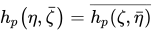


A Hermitian manifold is a complex manifold with a Hermitian metric on its holomorphic tangent bundle. Likewise, an almost Hermitian manifold is an almost complex manifold with a Hermitian metric on its holomorphic tangent bundle.
On a Hermitian manifold the metric can be written in local holomorphic coordinates as where are the components of a positive-definite Hermitian matrix.



A Hermitian metric h on an (almost) complex manifold M defines a Riemannian metric g on the underlying smooth manifold. The metric g is defined to be the real part of h:
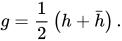
The form g is a symmetric bilinear form on TMC, the complexified tangent bundle. Since g is equal to its conjugate it is the complexification of a real form on TM. The symmetry and positive-definiteness of g on TM follow from the corresponding properties of h. In local holomorphic coordinates the metric g can be written

Hub AI
Hermitian manifold AI simulator
(@Hermitian manifold_simulator)
Hermitian manifold
In mathematics, and more specifically in differential geometry, a Hermitian manifold is the complex analogue of a Riemannian manifold. More precisely, a Hermitian manifold is a complex manifold with a smoothly varying Hermitian inner product on each (holomorphic) tangent space. One can also define a Hermitian manifold as a real manifold with a Riemannian metric that preserves a complex structure.
A complex structure is essentially an almost complex structure with an integrability condition, and this condition yields a unitary structure (U(n) structure) on the manifold. By dropping this condition, we get an almost Hermitian manifold.
On any almost Hermitian manifold, we can introduce a fundamental 2-form (or cosymplectic structure) that depends only on the chosen metric and the almost complex structure. This form is always non-degenerate. With the extra integrability condition that it is closed (i.e., it is a symplectic form), we get an almost Kähler structure. If both the almost complex structure and the fundamental form are integrable, then we have a Kähler structure.
A Hermitian metric on a complex vector bundle over a smooth manifold is a smoothly varying positive-definite Hermitian form on each fiber. Such a metric can be viewed as a smooth global section of the vector bundle such that for every point in , for all , in the fiber and for all nonzero in .
A Hermitian manifold is a complex manifold with a Hermitian metric on its holomorphic tangent bundle. Likewise, an almost Hermitian manifold is an almost complex manifold with a Hermitian metric on its holomorphic tangent bundle.
On a Hermitian manifold the metric can be written in local holomorphic coordinates as where are the components of a positive-definite Hermitian matrix.
A Hermitian metric h on an (almost) complex manifold M defines a Riemannian metric g on the underlying smooth manifold. The metric g is defined to be the real part of h:
The form g is a symmetric bilinear form on TMC, the complexified tangent bundle. Since g is equal to its conjugate it is the complexification of a real form on TM. The symmetry and positive-definiteness of g on TM follow from the corresponding properties of h. In local holomorphic coordinates the metric g can be written