Hubbry Logo
search
logo
506525

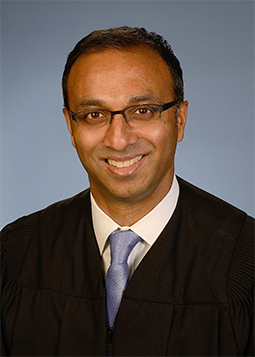
Amit Mehta

logo
Community Hub0 Subscribers
Read side by side
from Wikipedia

Amit Priyavadan Mehta (born 1971) is an American lawyer and jurist who serves as a United States district judge of the U.S. District Court for the District of Columbia. He was appointed in 2014 by President Barack Obama. In 2021, Mehta became a judge on the United States Foreign Intelligence Surveillance Court.

Key Information

Mehta presided over cases related to attack on the United States Capitol on January 6, 2021,[1] and the Google antitrust case.[2] In 2022, he rejected efforts by Donald Trump to dismiss lawsuits accusing the former President of legal responsibility in the attacks.[3]

Early life and education

[edit]

Mehta was born in 1971 in Patan, Gujarat, India.[4] At the age of one, Mehta immigrated with his parents, Priyavadan and Ragini Mehta, to the United States.[5] His mother worked as a laboratory technician, while his father worked as an engineer.[6] Mehta was raised in Reisterstown, Maryland, a suburb of Baltimore.[5] He graduated from Franklin High School in 1989.

Mehta graduated from Georgetown University in 1993 with a Bachelor of Arts degree in economics, graduating Phi Beta Kappa. From 1993 to 1994, Mehta worked as a paralegal at the law firm Patton Boggs (now Squire Patton Boggs). He then attended the University of Virginia School of Law, where he was an editor of the Virginia Journal of Social Policy & the Law. He graduated in 1997 with a Juris Doctor and Order of the Coif honors.

Early career

[edit]

After graduating from law school, Mehta spent a year as an associate at the law firm Latham & Watkins before leaving to be a law clerk to Judge Susan P. Graber of the United States Court of Appeals for the Ninth Circuit from 1998 to 1999. He was an associate at the law firm Zuckerman Spaeder, LLP from 1999 to 2002, then became a staff attorney at the Public Defender Service for the District of Columbia from 2002 to 2007.

From 2007 to 2014, he rejoined Zuckerman Spaeder, serving as partner from 2010 to 2014. He represented clients in civil and criminal matters before state and federal courts.[7][8][9] While in the private sector, he represented former Managing Director of the International Monetary Fund Dominique Strauss-Kahn.[2]

Federal judicial service

[edit]

Nomination

[edit]

On July 31, 2014, President Barack Obama nominated Mehta to serve as a United States District Judge of the United States District Court for the District of Columbia, to the seat vacated by Judge Ellen Segal Huvelle, who took senior status on June 3, 2014.[10] He received a hearing before the United States Senate Committee on the Judiciary on September 17, 2014.[11] On November 20, 2014, his nomination was reported out of committee by voice vote.[12] On December 13, 2014, Senate Majority Leader Harry Reid filed a motion to invoke cloture on the nomination.

On December 16, 2014, Reid withdrew his cloture motion on Mehta's nomination, and the Senate proceeded to vote to confirm Mehta in a voice vote.[13] He received his federal judicial commission on December 19, 2014.[9]

Tenure

[edit]
Judge Mehta in 2015

In May 2019, Mehta ruled that accounting firm Mazars had to provide its records of Donald Trump's accounts from before his presidency to the House Oversight Committee in response to their subpoena.[14] In a 41-page opinion, he asserted that Congress has the right to investigate potential illegal behavior by a president, including actions both before and after the president assumed office.[15] The ruling will be appealed by Trump's personal legal team.[15]

In July 2019, Mehta sided with the pharmaceutical firms Merck & Co., Eli Lilly and Company, and Amgen Inc. by blocking a Trump administration rule requiring drugmakers to put prices in television ads, a central part of the president's push to lower the cost of prescription medications. The goal of the rule was to increase transparency; Mehta ruled that requiring big pharmaceutical companies to disclose prices to consumers in television advertisements was something that could be done only by the Department of Health and Human Services if mandated by Congress.[16]

In 2020, Mehta became the presiding judge in the United States v. Google LLC antitrust case.[2] On June 1, 2021, Chief Justice John Roberts appointed Mehta to the United States Foreign Intelligence Surveillance Court.[17]

[edit]

Mehta has presided over several cases related to the January 6 United States Capitol attack. He has charge of the criminal prosecution of Oath Keepers founder Stewart Rhodes for seditious conspiracy.[1] He is also presiding over three civil lawsuits against Trump and multiple associates, in which several members of Congress and two police officers are suing for damages for physical and emotional injuries they allegedly incurred during the attacks.

On February 18, 2022, Mehta issued a lengthy opinion that rejected Trump's claim of "absolute immunity" from lawsuits, finding that his actions were not part of his presidential duties, and that there was plausible evidence to suggest he engaged in a conspiracy with organized groups to use any means, including violence, to overturn the results of the 2020 election. The opinion allows the case to proceed, with the plaintiffs demanding documents, depositions, and other evidence from Trump and members of the Oath Keepers and Proud Boys. Mehta dropped several other co-defendants from the suit, including Rudy Giuliani, Donald Trump Jr., and Representative Mo Brooks.[18]

On January 25, 2024, Mehta sentenced former Trump adviser, Peter Navarro, to four months in jail for contempt of Congress after defying a subpoena related to the congressional investigation into the January 6, 2021, US Capitol attack.[19]

Google antitrust case

[edit]

On August 5, 2024, Mehta ruled that Google is a monopoly and has violated antitrust laws.[20] In September 2025, he ruled that Google would not be required to divest of Chrome or Android, but would be barred from including Search in exclusive contracts and required to share certain search index and user interaction data with competitors.[21][22]

Personal life

[edit]

Mehta is as an avid fan of hip hop music.[4] In a 2015 copyright case regarding the similarity of two songs, Mehta noted in a footnote that he was "not a 'lay person' when it comes to hip-hop music and lyrics," and noted he has "listened to hip hop for decades". American rappers Jay-Z, Eminem, Kanye West and Canadian rapper Drake are among his favorite artists.[2]

See also

[edit]

References

[edit]
[edit]
Revisions and contributorsEdit on WikipediaRead on Wikipedia
from Grokipedia
Amit Priyavadan Mehta (born 1971) is an American jurist serving as a United States district judge for the United States District Court for the District of Columbia.[1] Born in Patan, Gujarat, India, Mehta immigrated to the United States with his family at the age of one and grew up in Reisterstown, Maryland.[2] He earned a B.A. in political science and economics from Georgetown University in 1993 and a J.D. from the University of Virginia School of Law in 1997.[2] Following law school, Mehta began his legal career as an associate at the Washington, D.C., law firm Zuckerman Spaeder LLP from 1997 to 2001, advancing to partner before transitioning to public service as an assistant federal public defender in the District of Columbia from 2002 to 2014.[3] Nominated by President Barack Obama in 2014, he was confirmed by the Senate on December 4 of that year and received his commission shortly thereafter, filling a vacancy created by the elevation of Thomas Griffith to the U.S. Court of Appeals.[1] Mehta has presided over numerous high-profile cases, including rulings related to the January 6, 2021, Capitol attack, the congressional subpoena of former President Donald Trump's financial records from Mazars USA, and the antitrust lawsuit United States v. Google LLC.[3] In the Google case, following a bench trial, Mehta determined in August 2024 that the company had unlawfully maintained monopoly power in general search services and text advertising through exclusive default agreements with device manufacturers and browsers.[4] In a subsequent remedies opinion issued in September 2025, he ordered Google to cease such exclusive deals and facilitate easier changes to default search engines but declined to impose a structural breakup of the company.[5] These decisions have drawn attention for their implications on Big Tech competition and regulatory enforcement, underscoring Mehta's role in shaping federal antitrust jurisprudence amid debates over market dominance and innovation incentives.[6]

Early life and education

Upbringing and family background

Amit Priyavadan Mehta was born in 1971 in Patan, Gujarat, India, to parents Priyavadan Mehta, an engineer, and Ragini Mehta.[2][7] At the age of one, Mehta immigrated to the United States with his family, settling in Reisterstown, Maryland, a suburb of Baltimore.[7][8] There, his mother worked as a laboratory technician, reflecting the family's adaptation to professional opportunities in suburban American life.[9] Mehta grew up in Reisterstown and attended Franklin High School, graduating in 1989.[8][10]

Academic training

Mehta earned a Bachelor of Arts degree in political science and economics from Georgetown University in 1993.[2] During his undergraduate studies, he was elected to Phi Beta Kappa and Alpha Sigma Nu honor societies and served as a George F. Baker Scholar in his senior year.[11] He had briefly attended James Madison University from 1989 to 1990 without obtaining a degree.[11] Mehta then pursued legal education at the University of Virginia School of Law, where he served as an editor for The Virginia Journal of Social Policy and the Law from 1996 to 1997.[11] He received his Juris Doctor degree in 1997 and was elected to the Order of the Coif, recognizing membership in the top ten percent of his class.[11] After graduating from the University of Virginia School of Law in 1997, Mehta began his legal career as an associate at the San Francisco office of Latham & Watkins LLP, where he worked from 1997 to 1998.[12] This initial associateship provided foundational exposure to complex litigation practices at a major international firm.[13] Mehta then served as a law clerk to Judge Susan P. Graber of the United States Court of Appeals for the Ninth Circuit from 1998 to 1999, gaining direct experience in appellate review and federal judicial decision-making.[13] The clerkship emphasized analytical rigor in evaluating legal arguments and precedents across diverse federal cases.[2] Following the clerkship, Mehta transitioned to Zuckerman Spaeder LLP in Washington, D.C., joining as an associate in 1999.[12] This move marked his entry into a boutique firm focused on high-stakes federal litigation, building on his prior experiences with an emphasis on trial and appellate advocacy.[2]

Litigation and firm experience

Mehta joined Zuckerman Spaeder LLP as an associate in 1999 following his clerkship, handling civil and criminal litigation matters during his initial tenure until 2002.[2] His early firm work included involvement in high-profile federal criminal defense, such as assisting in the representation of defendants in United States v. Welch and Johnson, a bribery case in the U.S. District Court for the District of Utah related to the Salt Lake City Olympic Committee's bid for the 2002 Winter Games, which resulted in acquittals on key counts.[11] This experience honed skills in trial strategy and federal court advocacy amid complex public corruption allegations.[14] After a period at the Federal Communications Commission, Mehta returned to Zuckerman Spaeder in 2007, advancing to partner in 2010 and continuing until his 2014 judicial nomination.[2] His practice emphasized white-collar criminal defense, complex commercial disputes, and appellate litigation, representing clients in enforcement actions involving financial fraud, antitrust violations, public corruption, and sanctions compliance.[15] These cases often spanned state and federal courts, developing expertise in investigations, civil litigation, and regulatory defense.[13] Mehta's firm tenure underscored a focus on trial and appellate work in high-stakes business and criminal contexts, contributing to his reputation as a litigator prior to the bench.[12]

Judicial appointment

Nomination under Obama

President Barack Obama nominated Amit Priyavadan Mehta to the United States District Court for the District of Columbia on July 31, 2014, to the seat vacated by Judge Ellen Segal Huvelle's assumption of senior status.[16] [1] The selection process involved recommendations from congressional figures, including D.C. Delegate Eleanor Holmes Norton, who had urged the administration to consider Mehta based on his litigation experience at Wilmer Cutler Pickering Hale and Dorr.[17] This nomination addressed one of several vacancies in the D.C. District Court, which by mid-2014 included at least three openings amid a broader backlog of 54 federal district court vacancies nationwide, prompting the Obama White House to prioritize experienced litigators for high-volume dockets involving administrative and constitutional disputes.[18] The American Bar Association's Standing Committee on the Federal Judiciary conducted a peer-reviewed evaluation of Mehta, rating him unanimously "well qualified" after assessing his intellectual capacity, professional experience, integrity, and temperament through confidential interviews with legal professionals.[3] This rating, the highest possible, followed standard background vetting by the Department of Justice and White House counsel, focusing on Mehta's decade-plus in complex civil litigation without noted ethical issues.[1] Obama's nomination of Mehta exemplified the administration's strategic emphasis on demographic diversity in judicial selections, particularly for influential courts like D.C.'s, where prior benches had limited representation from Asian Americans.[19] Over 60% of Obama's district court nominees were women or people of color, a marked increase from predecessors, driven by executive directives to expand the pool beyond traditional elite networks and reflect population demographics in appointments handling national policy cases.[20] Mehta, as the first Indian-American nominee to the D.C. District bench, fit this pattern, selected amid Democratic Senate majority control that enabled 250 confirmations of Obama's 270 district nominees by late 2014, contrasting with slower paces under divided government.[18] This approach prioritized representational goals alongside qualifications, influencing choices in a politically charged environment where the D.C. court oversees executive-branch challenges.[21]

Senate confirmation

Mehta's nomination advanced through the Senate Judiciary Committee following a hearing on September 17, 2014, where witnesses, including Representative Eleanor Holmes Norton, emphasized his qualifications and experience in civil litigation and public interest law, with no reported ideological disputes or significant opposition raised.[22][23] The committee voted to report the nomination favorably on November 20, 2014, by a vote of 10-8 along largely partisan lines, reflecting standard partisan divisions in judicial confirmations during the 113th Congress but without procedural blocks or holds targeting Mehta specifically.[3][22] On December 16, 2014, the full Senate confirmed Mehta by voice vote, indicating broad bipartisan acquiescence and minimal contention, as voice votes typically occur absent filibusters or demands for roll-call scrutiny.[22][3] Mehta received his judicial commission on December 22, 2014, formalizing his appointment to the United States District Court for the District of Columbia, after which he was sworn in shortly thereafter to commence service.[2][3]

Judicial service

Overview of tenure

Amit Mehta commenced his judicial service on the United States District Court for the District of Columbia following Senate confirmation on December 22, 2014.[2] His tenure involves adjudicating a diverse array of civil, criminal, and administrative matters in a district court that processes filings weighted heavily toward federal government-related disputes, reflecting the venue's centrality to executive branch operations in Washington, D.C.[24] The court's docket characteristically encompasses challenges to agency regulations, administrative procedures, and national security issues, stemming from its jurisdiction over suits against federal entities and the concentration of policy-making institutions nearby.[25] Mehta's caseload aligns with these patterns, contributing to the district's empirical output amid a national judiciary where D.C. ranks among the higher-volume districts for complex, government-involved litigation.[24] Over the ensuing decade, his opinions have addressed procedural and substantive questions across these domains, with appeals reflecting the contentious nature of such cases in this jurisdiction.[2]

January 6, 2021, Capitol events cases

U.S. District Judge Amit Mehta presided over trials and sentencings for multiple defendants charged in connection with the January 6, 2021, events at the U.S. Capitol, with a primary focus on members of the Oath Keepers militia group accused of seditious conspiracy and related offenses.[26] In December 2021, Mehta denied motions to dismiss seditious conspiracy charges against 17 Oath Keepers, ruling that prosecutors presented sufficient evidence of an agreement among defendants to use force to oppose the executive branch's authority in certifying the electoral vote, including plans for armed "quick reaction force" teams positioned outside Washington, D.C.[27] He rejected First Amendment defenses, determining that the charged conduct—such as coordinated entry into the Capitol and obstruction of proceedings—constituted unprotected overt acts rather than mere political expression.[28] In January 2023, a jury convicted Oath Keepers founder Stewart Rhodes and three associates of seditious conspiracy, among other charges, for plotting to disrupt Congress's certification of the 2020 election results.[26] Mehta admitted evidence including encrypted communications and witness testimony demonstrating premeditated opposition to the government's lawful functions, while excluding some defense-proffered materials deemed speculative or irrelevant to conspiracy elements.[29] During sentencings in May 2023, he imposed an 18-year term on Rhodes—the longest federal sentence for a January 6 defendant at the time—citing the gravity of undermining democratic processes and Rhodes's lack of remorse as factors elevating the penalty above standard guidelines for non-violent conspiracy, though below the 25 years sought by prosecutors.[30][31][32] Other Oath Keepers under Mehta received terms ranging from 8.5 years for Jessica Watkins to shorter periods for subordinates, generally aligning with or below U.S. Sentencing Guidelines ranges adjusted for leadership roles and obstruction enhancements, but exceeding averages for non-assault January 6 convictions (typically under 4 years).[33][34] Mehta's sentences drew scrutiny for variance from prosecutorial recommendations, prompting the Department of Justice to appeal Rhodes's and several co-defendants' terms in July 2023, arguing they failed to adequately reflect the offenses' national security implications.[35] Appellate courts have largely affirmed the underlying convictions in Oath Keepers cases, upholding Mehta's evidentiary rulings as supported by precedent on conspiracy proof beyond protected speech.[36] Comparative data across D.C. district judges show Mehta's penalties for seditious conspiracy leaders fell within the spectrum of 15-22 years imposed on similar figures, though below peaks for violent actors and consistent with guidelines variances granted for mitigation like absence of direct violence.[37][38]

Google antitrust litigation

In United States v. Google LLC (Case No. 1:20-cv-03010), a bench trial presided over by Judge Amit Mehta commenced on September 12, 2023, in the U.S. District Court for the District of Columbia, examining allegations that Alphabet Inc.'s Google maintained an unlawful monopoly in general search services and search text advertising markets under Section 2 of the Sherman Antitrust Act.[39] The U.S. Department of Justice, joined by multiple states, contended that Google's exclusive default search agreements with device manufacturers and browsers, including payments exceeding $20 billion annually to Apple Inc. for pre-installation and default placement on iOS devices and Safari, created formidable barriers to entry and preserved dominance.[40] Mehta's 277-page opinion on August 5, 2024, concluded that Google possessed monopoly power, evidenced by its approximately 90% share of U.S. general search queries and over 90% in search advertising, and had willfully maintained this through anticompetitive conduct rather than superior product quality or innovation.[41][42] Mehta rejected Google's defenses, including claims that its market position stemmed from consumer preference and superior technology, finding instead that default agreements distorted competition by foreclosing rivals from distribution channels essential for scale in search, where network effects amplify advantages in data accumulation and query processing.[41] Key evidence included internal Google documents acknowledging the "portfolio" of deals as critical to excluding competitors like Bing, alongside testimony on how billions in revenue-share payments to partners such as Apple, Samsung, and Mozilla deterred alternatives, even as Google's search quality improved.[43] The ruling emphasized that while Google innovated in areas like mobile search integration, its conduct suppressed potential entrants by denying them the data feedback loops necessary to challenge incumbency, without crediting rivals' failures solely to inferiority.[41] Following the liability finding, a remedies trial occurred in May 2025, where the DOJ proposed structural remedies including divestiture of the Chrome browser and Android operating system, alongside behavioral restrictions on exclusive deals.[44] On September 2, 2025, Mehta issued a remedies order mandating Google to share anonymized user query and click data, as well as periodic snapshots of its search index, with competitors for seven to ten years to facilitate rival development, while prohibiting exclusive default search agreements during that period.[45] He declined divestitures, reasoning that breakup risked unintended harms to innovation and efficiency without guaranteed pro-competitive effects, and permitted continued payments to partners like Apple under non-exclusive terms, subject to annual renegotiation and transparency requirements.[46][43] The decision directed parties to submit a final judgment by September 10, 2025, pending appeals.[46]

Emoluments and executive actions cases

In Trump v. Committee on Oversight and Reform, decided on May 20, 2019, Mehta upheld a congressional subpoena issued by the House Oversight Committee to Mazars USA LLP for eight years of President Trump's personal financial records, including those potentially relevant to Foreign and Domestic Emoluments Clause violations arising from foreign government patronage of Trump-owned properties such as the Trump International Hotel in Washington, D.C.[47][48] Trump had argued that the subpoena lacked a valid legislative purpose absent impeachment proceedings and that it violated separation-of-powers principles by intruding on executive functions, effectively claiming a form of absolute immunity from such oversight.[49] Mehta rejected these contentions, holding that Article I grants Congress broad investigative authority independent of impeachment, supported by historical precedents like the Church Committee's probes, and that the subpoena's focus on potential conflicts of interest—including emoluments from payments by foreign officials to Trump businesses—served legitimate legislative ends such as informing ethics legislation.[50][49] The ruling advanced the investigation by ordering compliance, emphasizing that presidential financial transparency aids in assessing undue influences without requiring proof of wrongdoing at the subpoena stage.[51] Trump appealed to the D.C. Circuit, which affirmed on November 8, 2019, reinforcing Mehta's analysis that the subpoena's purposes outweighed separation-of-powers concerns.[52] The Supreme Court vacated and remanded in Trump v. Mazars USA, LLP (June 2020), directing lower courts to apply heightened scrutiny to interbranch disputes involving a sitting president's papers, citing risks to executive function and potential for harassment. On remand, Mehta issued a narrowed order on August 11, 2021, permitting release of limited 2017–2018 records tied to specific Emoluments Clause inquiries, such as the Trump Organization's D.C. hotel lease under the General Services Administration and foreign emoluments like gifts or payments to Trump properties, but denying broader historical data lacking direct legislative nexus post-presidency.[53][54] He balanced congressional needs against Trump's privacy interests, noting the records could verify compliance with constitutional bans on accepting foreign "emoluments" without congressional consent, while dismissing claims of overbreadth for non-emoluments probes as moot after Trump's departure.[55] This approach rejected blanket immunity but imposed evidentiary thresholds, illustrating Mehta's emphasis on case-specific merits over categorical presidential exemptions in separation-of-powers disputes. In related executive action challenges, Mehta reviewed Trump administration immigration restrictions under the Immigration and Nationality Act. In Gomez v. Trump (September 2020), he upheld presidential proclamations invoking INA § 212(f) to suspend entry of certain immigrants amid the COVID-19 pandemic, finding statutory authority for such discretionary actions to protect U.S. interests, but faulted the State Department for delays in expedited processing of prior approvals, ordering corrective compliance without broader injunction.[56] These decisions reflected scrutiny of executive implementation while deferring to plenary powers absent clear legal overreach, consistent with precedents like Trump v. Hawaii (2018). No Supreme Court review followed in these matters.

Other rulings

In Citizens for Responsibility and Ethics in Washington v. U.S. Immigration and Customs Enforcement (filed 2020), Mehta ruled that ICE must produce data dictionaries detailing the contents of its Person Centric Query System and Electronic Health Records databases in response to a FOIA request seeking information on detention conditions during the COVID-19 pandemic, finding the agency's Vaughn index and withholdings under Exemptions 6 and 7(C) insufficient to justify non-disclosure without further specificity.[57] When ICE failed to fully comply by mid-2021, Mehta ordered agency officials to appear in court to explain the delays and partial productions, emphasizing that FOIA mandates timely and complete responses absent valid exemptions.[58] The D.C. Circuit later affirmed aspects of his enforcement approach in related FOIA compliance disputes, upholding his insistence on detailed justifications for redactions.[59] Mehta has also adjudicated administrative challenges involving federal grant terminations and regulatory withholdings. In Vera Institute of Justice v. U.S. Department of Justice (filed May 2025), he granted the government's motion to dismiss a suit alleging arbitrary termination of over $820 million in Office of Justice Programs grants under the Trump administration, concluding that plaintiffs did not adequately plead reliance interests or procedural violations under the Administrative Procedure Act, despite noting the decisions' potential to "harm communities" as "shameful" in execution.[60] In FOIA litigation like Bryan v. U.S. Department of Justice (2020), he sustained the DOJ's Exemption 7(A) withholdings of records related to ongoing investigations into civil rights matters, prioritizing law enforcement harms over disclosure.[61] In labor disputes, Mehta granted partial summary judgment in April 2025 to Washington, D.C., medical transport drivers suing Medical Transportation Management Inc. under the Fair Labor Standards Act, holding that the company's piece-rate pay system failed to compensate for all hours worked, including wait times, though denying claims on overtime calculations pending further evidence.[62] His administrative rulings exhibit a pattern of textual statutory interpretation, deferring to agencies on factual exemptions while rejecting unsubstantiated claims, with appeals courts reversing or affirming in roughly equal measure across his FOIA docket based on compliance specificity.[63]

Judicial approach and controversies

Methodological style in opinions

Mehta's judicial opinions demonstrate a consistent emphasis on exhaustive factual adjudication, beginning with comprehensive recitations of trial evidence before proceeding to legal analysis. This methodical structure prioritizes empirical underpinnings over abstract theorizing, as seen in his handling of voluminous records in technology-related disputes, where he meticulously weighs competing expert testimonies on market behaviors and economic impacts.[7] Such detail-oriented fact-finding serves to ground conclusions in verifiable data, reducing reliance on speculative inferences.[64] In reasoning through causal mechanisms, Mehta favors disaggregated examinations that trace effects from specific conduct, incorporating quantitative metrics like usage shares and revenue allocations alongside qualitative assessments of competitive foreclosure. This approach aligns with first-principles deconstruction of statutory elements, such as monopoly maintenance under antitrust law, by isolating variables like default agreements' influence on user lock-in without presuming broader policy outcomes.[65] His opinions recurrently invoke economic evidence, including econometric models and internal business documents, to validate or refute claims of anticompetitive harm, ensuring arguments build incrementally from observed patterns rather than imposed narratives.[6] Mehta adheres rigorously to textual statutory interpretation and binding precedents, frequently cross-referencing Supreme Court rulings like United States v. Microsoft to calibrate doctrinal applications without venturing into equitable expansions. This restraint manifests in explicit demarcations between adjudicative findings and remedial discretion, where he cautions against judicial overreach into regulatory domains, citing appellate guidance on tailoring relief to proven violations.[64] Critics from varied perspectives have noted this cautious methodology, praising its fidelity to evidentiary thresholds while questioning selective applications in causation standards, yet empirical reviews affirm its consistency across dockets in prioritizing precedential conformity over innovative extensions.[66][7]

Criticisms regarding antitrust remedies

Progressive antitrust advocates, including the American Economic Liberties Project, criticized Judge Mehta's remedies as insufficient to dismantle Google's monopoly, describing the decision as an "act of judicial cowardice" that permits the company to retain its dominance in search and emerging AI technologies.[67] They argued that the ordered bans on exclusive distribution agreements and data-sharing mandates fail to address how Google's integration of search with AI models, such as those powering Gemini, could entrench market power by limiting rivals' access to query data essential for training competitive alternatives.[68] Similarly, organizations like Public Knowledge contended that avoiding structural divestitures, such as selling Android or Chrome, undermines the ruling's potential to restore competition, urging legislative or appellate intervention to prevent perpetuation of anticompetitive practices.[69] Conservative and libertarian analysts, including those from the Information Technology and Innovation Foundation (ITIF), expressed skepticism about the remedies' foundation in the liability phase, highlighting overly lax standards for proving causation between Google's conduct and monopoly maintenance.[70] They contended that Mehta's approach relaxed traditional requirements for demonstrating but-for causation and broadened definitions of exclusionary conduct, potentially justifying remedies disproportionate to empirically verified harms, as evidenced by the rejection of DOJ proposals like browser divestiture in favor of behavioral fixes.[66] Critics like the Competitive Enterprise Institute viewed the government's pushed remedies—encompassing forced data portability and ad auction restrictions—as exceeding the case's scope, echoing concerns that such interventions risk stifling innovation without clear evidence of consumer harm.[71] Comparisons to the 1998-2001 United States v. Microsoft antitrust case underscore the relative restraint in Mehta's orders, where proposed structural breakup was averted via settlement in favor of conduct remedies like API sharing, yet Google's remedies impose lighter obligations without mandating interoperability protocols akin to Microsoft's final judgment.[72] Analysts note key differences, including Microsoft's bundling of Internet Explorer versus Google's default agreements, which lacked the same level of demonstrated foreclosure effects, potentially bolstering Google's appeal prospects on Ninth Circuit review where stricter evidentiary standards could overturn or narrow the remedies.[73] Both sides anticipate appeals, with progressives decrying the risk of dilution and skeptics warning against precedent for overbroad antitrust enforcement in dynamic tech markets.[74] Critiques of Judge Mehta's sentencing in January 6, 2021, Capitol breach cases, particularly those involving seditious conspiracy charges against Oath Keepers members, have centered on claims of disproportionate punishment and judicial overreach. Stewart Rhodes, the Oath Keepers founder, received an 18-year sentence on May 25, 2023—the longest imposed in any January 6 case at the time—for seditious conspiracy, despite not entering the Capitol building himself and engaging in no direct violence.[30][75] Rhodes and supporters argued the penalty reflected political targeting rather than criminal merit, emphasizing his lack of remorse stemmed from belief in a stolen election and portraying the sentence as retribution for opposing perceived electoral fraud.[76] Conservative commentators echoed this, viewing the terrorism enhancement applied by Mehta—first used in a January 6 prosecution—as inflating non-violent planning into an existential threat, especially given Rhodes' age of 58 and Yale Law School background.[75] Right-leaning arguments further highlighted entrapment-like elements, claiming federal informants within the Oath Keepers encouraged actions while the group focused on self-defense training absent direct incitement to riot.[77] Mehta's other sentences, such as eight years and six months for Jessica Watkins on January 6, 2025, and 14 months for Thomas Adams in June 2023, drew similar scrutiny for exceeding typical penalties for comparable offenses, with critics noting variances where D.C. judges like Mehta imposed harsher terms on felony convictions compared to misdemeanor cases handled by others.[33][78] Empirical analyses show overall January 6 sentences below prosecutors' recommendations in nearly all cases (about 75%) and federal guidelines in under 40%, yet seditious conspiracy outliers like Rhodes' stood out, fueling claims of selective severity amid D.C.'s 92% Democratic voting in 2020, which skeptics argue biases juries and judges toward viewing the events as an insurrection rather than protest escalation.[79][75] Defenses from left-leaning sources and Mehta's rationale emphasized the gravity of coordinated efforts to obstruct the electoral certification, with the judge deeming Rhodes an ongoing threat due to unrepentant views on election denialism.[80] Prosecutors sought 25 years for Rhodes, and while the Department of Justice appealed the 18-year term as insufficient in July 2023, appeals courts have upheld core seditious conspiracy findings in related cases, affirming evidence of premeditated opposition to government transfer of power.[35] Broader discourse notes politicization risks, as Mehta's 2014 Obama appointment aligns with D.C.'s institutional leanings, potentially amplifying perceptions of uneven application where non-violent coordinators face decades while some violent actors receive probation; however, data indicates no systemic reversal on appeal for conspiracy convictions, supporting claims of evidentiary validity over bias allegations.[79][81]

Evaluations of political impartiality

Some conservative commentators have alleged political bias in Judge Mehta's handling of cases related to former President Trump, pointing to outcomes perceived as unfavorable to Republican interests, such as disclosures ordered in emoluments clause litigation in 2019.[82] However, comprehensive reviews find no widely recognized evidence of systemic political bias across his docket.[83] Mehta's record includes rulings adverse to executive actions under both Republican and Democratic administrations, as seen in the U.S. v. Google antitrust proceedings, where he found liability for monopolization in 2024 but imposed remedies in 2025 that fell short of the structural divestitures sought by the Department of Justice, prompting criticism from left-leaning sources for preserving much of Google's market position.[84][85] This variability undermines claims of uniform ideological favoritism toward one party. Quantitative indicators, including a D.C. Circuit reversal rate of 13.2% (10 reversals in 76 decisions), align Mehta with peers among Obama appointees, reflecting adherence to appellate precedents rather than partisan deviation.[86] Such metrics, derived from judicial databases, prioritize empirical outcomes over anecdotal perceptions. Causal analysis attributes apparent patterns to the constraints of D.C. Circuit precedents, which guide district-level decisions in politically salient areas, countering media-driven narratives of one-sidedness by emphasizing legal realism over ideological scoring.[87]

Personal life

Family and residence

Amit Mehta is married to Caroline Judge Mehta, a partner at the Washington, D.C.-based law firm Zuckerman Spaeder LLP specializing in litigation.[88] The couple has two children.[89] Mehta resides in the Washington, D.C., metropolitan area, consistent with his role on the U.S. District Court for the District of Columbia.[2] Of Indian-American heritage, Mehta was born in Patan, Gujarat, India, in 1971 to parents Priyavadan Mehta, an engineer, and Ragini Mehta, a laboratory technician, before immigrating to the United States at age one.[7]

Professional affiliations

Amit Mehta is an elected member of the American Law Institute (ALI), an independent organization comprising judges, lawyers, and scholars that works to promote clarity and development in American law through projects such as Restatements of the Law, Principles of the Law, and model codes.[12] His membership reflects engagement in scholarly efforts to refine legal doctrines and standards, drawing on empirical analysis of case law and statutory evolution. Mehta previously served as co-chair of the District of Columbia Bar's Criminal Law and Individual Rights Committee, a role focused on advancing professional standards and policy recommendations in criminal justice matters, including due process protections and evidentiary rules.[2] This position involved contributing to committee reports and bar initiatives aimed at improving procedural fairness and legal practice in the jurisdiction. He has also held a seat on the Board of Directors of the Mid-Atlantic Innocence Project, a nonprofit dedicated to investigating and litigating claims of wrongful convictions through post-conviction DNA testing and forensic review, thereby influencing reforms in criminal procedure and evidence handling.[2] These affiliations underscore his pre-judicial contributions to organizational efforts enhancing evidentiary rigor and access to justice in legal systems.

References

User Avatar
No comments yet.