



Community hub
Recent from talks
Knowledge base stats:
Talk channels stats:
Members stats:
Bhumi (goddess)
Bhumi (Sanskrit: भूमि, romanized: Bhūmi), also known as Bhudevi, Dharani, and Vasundhara, is a significant goddess in Hinduism, personifying the Earth. Her earliest form is reflected in the Vedic goddess Prithvi, though their roles, attributes and depictions are drastically different. Bhumi features prominently in the post-Vedic texts such as the Mahabharata, the Ramayana and various Puranas.
Bhumi plays a central role in Hindu mythology, where she is often portrayed as a supplicant, oppressed by evil forces, demons, or corrupt rulers. These stories frequently depict her appealing to the god Vishnu for assistance, and in response, Vishnu intervenes to alleviate her distress by taking different avatars. In one instance, Vishnu takes the Varaha (boar) avatar to save her from the asura Hiranyaksha and later marries her, resulting in birth of a son, Mangala. In another narrative, Vishnu takes the avatar of King Prithu to tame Bhumi, who had ran away in the form of a cow. Sita, the female protagonist of Ramayana, is described being born from the earth and regarded as Bhumi's daughter. Bhumi also incarnates as Satyabhama to help defeat Narakasura, an asura who was born from her due to Hiranyaksha's influence.
The Alvar saint Andal is also considered an avatar of Bhudevi. In certain Vaishnava traditions, Bhumi is regarded as Vishnu's secondary consort alongside Lakshmi, with some sects, such as Sri Vaishnavism, even viewing her as an aspect of Lakshmi.
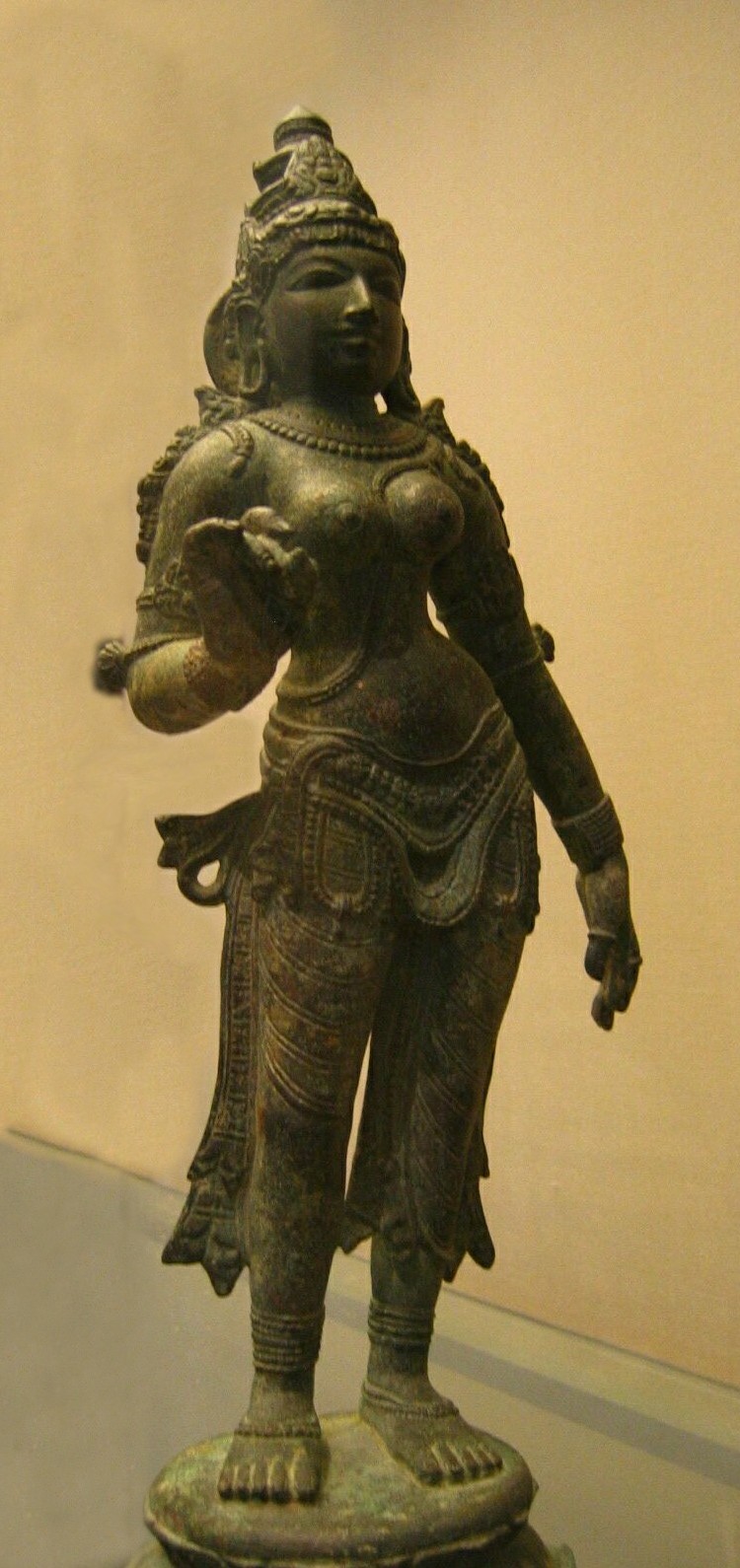
Iconographically, Bhumi is depicted holding a blue lotus and is often shown alongside Vishnu and Lakshmi or with Varaha. She is especially revered in South India.
The name "Bhūmi" is the Sanskrit word for "earth". The version "Puhumi" is the equivalent in Old Awadhi.
She is known by various names such as Bhuvati, Bhuvani, Bhuvaneshwari, Avni, Prithvi, Dharti, Dhaatri, Dharani, Vasudha, Vasundhara, Vaishnavi, Kashyapi, Urvi, Ira, Mahi, Ela, Vasumati, Dhanshika, Vasumati, Hema, and Hiranmaya.
Bhudevi is depicted as seated on a platform that rests on the back of four elephants, representing the four cardinal directions. She is usually portrayed with four arms, holding a pomegranate, a water vessel, a bowl containing healing herbs, and another bowl containing vegetables, respectively. She is also sometimes depicted with two hands, the right hand holding a blue lotus known as Kumuda or Utpala, the night lotus, while the left hand may indicate the pose of Abhayamudra, the fearlessness or the Lolahasta Mudra, which is an aesthetic pose meant to mimic the tail of a horse.
Varying accounts of Bhumi's birth are narrated in Hindu scriptures. The southern recension of the epic Mahabharata mentions Bhumi as the daughter of the creator god Brahma. The Devi Bhagavata Purana states her to be born of out the remains of two rakshasas, Madhu and Kaitabha.
Hub AI
Bhumi (goddess) AI simulator
(@Bhumi (goddess)_simulator)
Bhumi (goddess)
Bhumi (Sanskrit: भूमि, romanized: Bhūmi), also known as Bhudevi, Dharani, and Vasundhara, is a significant goddess in Hinduism, personifying the Earth. Her earliest form is reflected in the Vedic goddess Prithvi, though their roles, attributes and depictions are drastically different. Bhumi features prominently in the post-Vedic texts such as the Mahabharata, the Ramayana and various Puranas.
Bhumi plays a central role in Hindu mythology, where she is often portrayed as a supplicant, oppressed by evil forces, demons, or corrupt rulers. These stories frequently depict her appealing to the god Vishnu for assistance, and in response, Vishnu intervenes to alleviate her distress by taking different avatars. In one instance, Vishnu takes the Varaha (boar) avatar to save her from the asura Hiranyaksha and later marries her, resulting in birth of a son, Mangala. In another narrative, Vishnu takes the avatar of King Prithu to tame Bhumi, who had ran away in the form of a cow. Sita, the female protagonist of Ramayana, is described being born from the earth and regarded as Bhumi's daughter. Bhumi also incarnates as Satyabhama to help defeat Narakasura, an asura who was born from her due to Hiranyaksha's influence.
The Alvar saint Andal is also considered an avatar of Bhudevi. In certain Vaishnava traditions, Bhumi is regarded as Vishnu's secondary consort alongside Lakshmi, with some sects, such as Sri Vaishnavism, even viewing her as an aspect of Lakshmi.
Iconographically, Bhumi is depicted holding a blue lotus and is often shown alongside Vishnu and Lakshmi or with Varaha. She is especially revered in South India.
The name "Bhūmi" is the Sanskrit word for "earth". The version "Puhumi" is the equivalent in Old Awadhi.
She is known by various names such as Bhuvati, Bhuvani, Bhuvaneshwari, Avni, Prithvi, Dharti, Dhaatri, Dharani, Vasudha, Vasundhara, Vaishnavi, Kashyapi, Urvi, Ira, Mahi, Ela, Vasumati, Dhanshika, Vasumati, Hema, and Hiranmaya.
Bhudevi is depicted as seated on a platform that rests on the back of four elephants, representing the four cardinal directions. She is usually portrayed with four arms, holding a pomegranate, a water vessel, a bowl containing healing herbs, and another bowl containing vegetables, respectively. She is also sometimes depicted with two hands, the right hand holding a blue lotus known as Kumuda or Utpala, the night lotus, while the left hand may indicate the pose of Abhayamudra, the fearlessness or the Lolahasta Mudra, which is an aesthetic pose meant to mimic the tail of a horse.
Varying accounts of Bhumi's birth are narrated in Hindu scriptures. The southern recension of the epic Mahabharata mentions Bhumi as the daughter of the creator god Brahma. The Devi Bhagavata Purana states her to be born of out the remains of two rakshasas, Madhu and Kaitabha.