Hubbry Logo
search
logo

Canonical coordinates

logo
Community Hub0 Subscribers
Read side by side
from Wikipedia

In mathematics and classical mechanics, canonical coordinates are sets of coordinates on phase space which can be used to describe a physical system at any given point in time. Canonical coordinates are used in the Hamiltonian formulation of classical mechanics. A closely related concept also appears in quantum mechanics; see the Stone–von Neumann theorem and canonical commutation relations for details.

As Hamiltonian mechanics are generalized by symplectic geometry and canonical transformations are generalized by contact transformations, so the 19th century definition of canonical coordinates in classical mechanics may be generalized to a more abstract 20th century definition of coordinates on the cotangent bundle of a manifold (the mathematical notion of phase space).

Definition in classical mechanics

[edit]

In classical mechanics, canonical coordinates are coordinates and in phase space that are used in the Hamiltonian formalism. The canonical coordinates satisfy the fundamental Poisson bracket relations:

A typical example of canonical coordinates is for to be the usual Cartesian coordinates, and to be the components of momentum. Hence in general, the coordinates are referred to as "conjugate momenta".

Canonical coordinates can be obtained from the generalized coordinates of the Lagrangian formalism by a Legendre transformation, or from another set of canonical coordinates by a canonical transformation.

Definition on cotangent bundles

[edit]

Canonical coordinates are defined as a special set of coordinates on the cotangent bundle of a manifold. They are usually written as a set of or with the x's or q's denoting the coordinates on the underlying manifold and the p's denoting the conjugate momentum, which are 1-forms in the cotangent bundle at point q in the manifold.

A common definition of canonical coordinates is any set of coordinates on the cotangent bundle that allow the canonical one-form to be written in the form

up to a total differential. A change of coordinates that preserves this form is a canonical transformation; these are a special case of a symplectomorphism, which are essentially a change of coordinates on a symplectic manifold.

In the following exposition, we assume that the manifolds are real manifolds, so that cotangent vectors acting on tangent vectors produce real numbers.

Formal development

[edit]

Given a manifold Q, a vector field X on Q (a section of the tangent bundle TQ) can be thought of as a function acting on the cotangent bundle, by the duality between the tangent and cotangent spaces. That is, define a function

such that

holds for all cotangent vectors p in . Here, is a vector in , the tangent space to the manifold Q at point q. The function is called the momentum function corresponding to X.

In local coordinates, the vector field X at point q may be written as
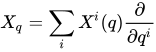
where the are the coordinate frame on TQ. The conjugate momentum then has the expression

where the are defined as the momentum functions corresponding to the vectors :

The together with the together form a coordinate system on the cotangent bundle ; these coordinates are called the canonical coordinates.

Generalized coordinates

[edit]

In Lagrangian mechanics, a different set of coordinates are used, called the generalized coordinates. These are commonly denoted as with called the generalized position and the generalized velocity. When a Hamiltonian is defined on the cotangent bundle, then the generalized coordinates are related to the canonical coordinates by means of the Hamilton–Jacobi equations.

See also

[edit]

References

[edit]
Revisions and contributorsEdit on WikipediaRead on Wikipedia
from Grokipedia
In classical mechanics, canonical coordinates consist of generalized position coordinates $ q_i $ and their conjugate momenta $ p_i $, forming the fundamental variables in the Hamiltonian formulation of dynamics, where the system's evolution is governed by Hamilton's first-order differential equations $ \dot{q}_i = \frac{\partial H}{\partial p_i} $ and $ \dot{p}_i = -\frac{\partial H}{\partial q_i} $, with $ H $ denoting the Hamiltonian function.[1] These coordinates parameterize the phase space, a $ 2N $-dimensional manifold for a system with $ N $ degrees of freedom, enabling a symplectic structure that preserves the geometric properties of motion.[2] The concept originated in the development of Hamiltonian mechanics during the 1830s, with William Rowan Hamilton introducing the Hamiltonian in 1834 and Carl Gustav Jacob Jacobi formalizing canonical transformations in 1837 as a means to simplify the Hamilton-Jacobi partial differential equation while preserving the form of Hamilton's equations.[3] Jacobi's initial theorem on these transformations, though lacking a full proof at the time, laid the groundwork for later advancements; proofs emerged in the mid-19th century from mathematicians like Adolphe Desboves and William Donkin, but Henri Poincaré provided the modern variational proof in 1899, establishing their role in celestial mechanics and integrability.[3] By the early 20th century, canonical coordinates became central to quantum mechanics through Dirac's canonical quantization, which maps Poisson brackets to commutators, bridging classical and quantum descriptions.[1] Key aspects of canonical coordinates include their transformation properties: a canonical transformation maps $ (q, p) $ to new variables $ (Q, P) $ via generating functions (e.g., $ F_1(q, Q, t) $ or $ F_2(q, P, t) $), ensuring the new Hamiltonian $ K(Q, P, t) $ yields equivalent dynamics while often simplifying the problem, such as rendering coordinates cyclic.[4] These transformations preserve Poisson brackets $ {q_i, p_j} = \delta_{ij} $ and the symplectic form, making them essential for analyzing conserved quantities and stability.[2] In practice, they facilitate action-angle variables for integrable systems like the harmonic oscillator or Kepler problem, where action integrals $ J_i = \oint p_i , dq_i $ yield frequencies and quantization conditions in semiclassical approximations.[1] Applications extend to diverse fields, including accelerator physics for beam dynamics, where canonical coordinates model particle trajectories under constraints, and nonlinear dynamics for studying chaos via phase space portraits.[2] In modern contexts, they underpin numerical symplectic integrators for long-term simulations in celestial mechanics and molecular dynamics, ensuring energy conservation over extended times.[5]

Introduction and Basics

Definition

In Hamiltonian mechanics, canonical coordinates are defined as conjugate pairs (qi,pi)(q^i, p_i), where the qiq^i (for i=1,,ni = 1, \dots, n) represent generalized position coordinates and the pip_i represent their corresponding conjugate momenta, describing the state of a mechanical system with nn degrees of freedom.[6][7] These coordinates parameterize the phase space of the system, a 2n2n-dimensional manifold that encompasses all possible configurations and momenta, providing a complete specification of the system's dynamical state at any instant.[7][6] The role of canonical coordinates is central to the Hamiltonian formulation, where the time evolution of the system is governed by Hamilton's equations—a set of 2n2n first-order partial differential equations derived from the Hamiltonian function H(qi,pi,t)H(q^i, p_i, t)—offering a symmetric and elegant description of the dynamics compared to second-order formulations.[6] These coordinates form a canonical basis that adheres to fundamental algebraic relations underpinning the Poisson bracket structure and symplectic invariance of phase space, with further details addressed in later sections.[7] The selection of such coordinates aligns with the inherent symplectic geometry of the phase space.[7]

Historical Development

The concept of canonical coordinates emerged from efforts to reformulate classical mechanics in a more analytical framework, building on Joseph-Louis Lagrange's introduction of generalized coordinates in his 1788 work Mécanique Analytique. Lagrange's approach emphasized variational principles and the use of arbitrary coordinates to describe mechanical systems, providing a foundation for later developments in phase space descriptions without directly formulating momentum-conjugate pairs.[8] William Rowan Hamilton advanced this framework in the 1830s through his reformulation of dynamics, introducing canonical coordinates as pairs of position and momentum variables in his 1834 paper "On a General Method in Dynamics" and the 1835 "Second Essay on a General Method in Dynamics," both published in the Philosophical Transactions of the Royal Society. Hamilton's innovation stemmed from analogies between optics and mechanics, leading to the characteristic and principal functions that enabled the description of systems via partial differential equations, marking a shift toward a unified treatment of conservative mechanical systems.[8] Carl Gustav Jacob Jacobi further evolved the theory in the 1840s, extending Hamilton's methods to time-dependent and non-conservative forces in works such as his 1837 paper in Crelle's Journal and later in Vorlesungen über Dynamik (1842–1843). Jacobi's contributions included refinements to integration techniques and the generalization of Hamilton's partial differential equations, enhancing the applicability of canonical formulations to complex problems like the three-body problem.[8] In the early 20th century, Élie Cartan formalized the geometric underpinnings of canonical coordinates within symplectic geometry, notably in his 1922 Leçons sur les invariants intégraux, where he applied differential forms to mechanical problems, including the symplectic form pidqiHdt\sum p_i dq_i - H dt. Cartan's exterior calculus and development of differential forms from 1899 onward provided an abstract manifold-based structure, influencing the field's transition to modern geometry.[9] The canonical framework bridged to quantum mechanics in the 1920s through Paul Dirac and Werner Heisenberg, who adapted Poisson brackets from classical Hamiltonian mechanics into quantum commutation relations in their respective 1925 papers: Dirac's "The Fundamental Equations of Quantum Mechanics" and Heisenberg's "Über quantentheoretische Umdeutung kinematischer und mechanischer Beziehungen." This correspondence enabled the quantization of canonical variables, laying groundwork for matrix and transformation theories of quantum dynamics.[10]

Classical Mechanics

Relation to Lagrangian Mechanics

In Lagrangian mechanics, the motion of a system is formulated using generalized coordinates $ q^i $ and their velocities $ \dot{q}^i $, with the Lagrangian $ L(q, \dot{q}) $ typically expressed as the difference between kinetic and potential energies.[11] This approach derives equations of motion from the principle of least action, where the action integral $ S = \int L , dt $ is stationary.[6] To bridge to the Hamiltonian formulation, canonical coordinates are introduced via the conjugate momenta $ p_i = \frac{\partial L}{\partial \dot{q}^i} $, which represent the generalized momenta associated with each coordinate.[11] This definition arises from a Legendre transformation, which switches the independent variables from velocities $ \dot{q}^i $ to momenta $ p_i $ by considering $ L $ as a function of $ q $ and $ \dot{q} $, and constructing the convex dual.[6] The resulting Hamiltonian is given by
H(q,p)=ipiq˙iL(q,q˙), H(q, p) = \sum_i p_i \dot{q}^i - L(q, \dot{q}),
where the velocities $ \dot{q}^i $ are expressed as functions of $ q $ and $ p $ by inverting the momentum relations.[11] In practice, this yields $ H $ as the total energy in terms of coordinates and momenta, facilitating analysis in phase space. For a simple example, consider a particle of mass $ m $ in Cartesian coordinates, where the Lagrangian is $ L = \frac{1}{2} m \dot{x}^2 - V(x) $. The conjugate momentum is then $ p_x = m \dot{x} $, the linear momentum, and the Hamiltonian becomes $ H = \frac{p_x^2}{2m} + V(x) $.[11] The transformation is well-defined when the mapping from $ \dot{q}^i $ to $ p_i $ is invertible, which holds if $ L $ is strictly convex in the velocities—commonly the case when the kinetic energy is quadratic in $ \dot{q}^i $, as in $ L = T(q, \dot{q}) - V(q) $ with $ T = \frac{1}{2} \sum_{ij} a_{ij}(q) \dot{q}^i \dot{q}^j $ and positive-definite metric $ a_{ij} $.[6] Under these conditions, the inverse exists, ensuring $ H(q, p) $ is uniquely determined and single-valued.[11]

Poisson Bracket Formulation

In canonical coordinates (qi,pi)(q^i, p_i) for a system with nn degrees of freedom, the Poisson bracket of two smooth functions ff and gg on the phase space is defined by
{f,g}=i=1n(fqigpifpigqi).(1) \{f, g\} = \sum_{i=1}^n \left( \frac{\partial f}{\partial q^i} \frac{\partial g}{\partial p_i} - \frac{\partial f}{\partial p_i} \frac{\partial g}{\partial q^i} \right). \tag{1}
This bilinear operation, introduced by Siméon Denis Poisson in his 1809 memoir on celestial mechanics, encodes the symplectic structure of phase space and generates infinitesimal canonical transformations.[12][13] The coordinates (qi,pi)(q^i, p_i) are canonical if they satisfy the fundamental Poisson bracket relations
{qi,qj}=0,{pi,pj}=0,{qi,pj}=δji,(2) \{q^i, q^j\} = 0, \quad \{p_i, p_j\} = 0, \quad \{q^i, p_j\} = \delta^i_j, \tag{2}
where δji\delta^i_j is the Kronecker delta. These conditions ensure that the Poisson bracket preserves the standard symplectic form under transformations, distinguishing canonical coordinates from general ones.[14][15] The Poisson bracket governs the time evolution of any function f(q,p,t)f(q, p, t) via Hamilton's equation
dfdt={f,H}+ft,(3) \frac{df}{dt} = \{f, H\} + \frac{\partial f}{\partial t}, \tag{3}
where H(q,p,t)H(q, p, t) is the Hamiltonian. For time-independent ff, this reduces to f˙={f,H}\dot{f} = \{f, H\}, linking the bracket directly to the system's dynamics.[16][13] As an illustrative example, consider a free particle in one dimension with Hamiltonian H=p2/2mH = p^2 / 2m. The canonical conditions yield {q,p}=1\{q, p\} = 1, so q˙={q,H}=p/m\dot{q} = \{q, H\} = p/m and p˙={p,H}=0\dot{p} = \{p, H\} = 0, implying constant velocity and uniform motion.[16] The Poisson bracket exhibits key algebraic properties: bilinearity, meaning {af+bg,h}=a{f,h}+b{g,h}\{af + bg, h\} = a\{f, h\} + b\{g, h\} and similarly for the second argument; antisymmetry, {f,g}={g,f}\{f, g\} = -\{g, f\}; and the Jacobi identity, {f,{g,h}}+{g,{h,f}}+{h,{f,g}}=0\{f, \{g, h\}\} + \{g, \{h, f\}\} + \{h, \{f, g\}\} = 0. These ensure the bracket defines a Lie algebra on the space of observables, facilitating the formulation of conserved quantities and symmetries.[15][17]

Geometric Formulation

Cotangent Bundles

In classical mechanics, the configuration space of a system is modeled as a smooth manifold $ Q $, while the phase space, which encodes both positions and momenta, is naturally identified with the cotangent bundle $ T^*Q $.[18] This bundle consists of all covectors over $ Q $, with the projection map $ \pi: T^*Q \to Q $ sending each covector to its base point in the configuration space.[19] The structure of $ T^*Q $ provides the geometric foundation for canonical coordinates, enabling the formulation of Hamiltonian dynamics in a coordinate-invariant manner.[20] Local coordinates on $ T^*Q $ are induced by choosing coordinates $ (q^i) $ on $ Q $, yielding canonical coordinates $ (q^i, p_i) $ on $ T^Q $, where $ i = 1, \dots, n $ and $ n = \dim Q $.[18] Here, the $ q^i $ represent position coordinates, while the $ p_i $ are the components of the covector $ p \in T^_q Q $ with respect to the dual basis $ {dq^i} $.[19] These coordinates are "canonical" in the sense that they align positions and momenta in a natural pairing, facilitating the transition from Lagrangian to Hamiltonian descriptions.[20] The cotangent bundle $ T^Q $ is equipped with a canonical one-form $ \theta $, known as the tautological or Liouville form, defined intrinsically by $ \theta_\alpha(\xi) = \alpha(\pi_ \xi) $ for $ \alpha \in T^*Q $ and $ \xi \in T_\alpha (T^*Q) $.[18] In local canonical coordinates, this takes the expression
θ=ipidqi. \theta = \sum_i p_i \, dq^i.
[19] This one-form satisfies the pullback property: for any smooth one-form $ \alpha $ on an open set of $ Q $, the pullback $ \alpha^* \theta = \alpha $.[20] The canonical symplectic two-form on $ T^*Q $ is then obtained as the exterior derivative $ \omega = -d\theta $.[18] Locally, this yields
ω=idqidpi, \omega = \sum_i dq^i \wedge dp_i,
which is closed ($ d\omega = 0 $) and non-degenerate, endowing $ T^*Q $ with its natural symplectic structure.[19] This form is independent of the choice of coordinates on $ Q $ and serves as the primitive for the geometry of phase space.[20] A concrete example arises when the configuration space is Euclidean space $ Q = \mathbb{R}^n $, in which case $ T^*Q \cong \mathbb{R}^{2n} $ with the standard canonical coordinates $ (q^1, \dots, q^n, p_1, \dots, p_n) $.[18] Here, the one-form is $ \theta = \sum_{i=1}^n p_i , dq^i $ and the two-form is $ \omega = \sum_{i=1}^n dq^i \wedge dp_i $, reproducing the familiar phase space of $ n $-dimensional Cartesian mechanics.[19] This setting underlies many standard applications, such as the harmonic oscillator or free particle dynamics.[20]

Symplectic Structure

A symplectic manifold is a pair (M,ω)(M, \omega), where MM is a smooth even-dimensional manifold and ω\omega is a closed, non-degenerate 2-form on MM.[21][22] The closedness condition, dω=0d\omega = 0, ensures that the form satisfies the requirements for a symplectic structure, while non-degeneracy means that for every point pMp \in M and nonzero tangent vector vTpMv \in T_p M, there exists wTpMw \in T_p M such that ω(v,w)0\omega(v, w) \neq 0. This structure underpins the geometry of phase space in Hamiltonian mechanics, where canonical coordinates qi,piq^i, p_i naturally arise. The Darboux theorem guarantees the existence of local canonical coordinates in which the symplectic form takes its standard appearance. Specifically, around any point on a symplectic manifold (M,ω)(M, \omega), there exist coordinates (q1,,qn,p1,,pn)(q^1, \dots, q^n, p_1, \dots, p_n) such that ω=i=1ndqidpi\omega = \sum_{i=1}^n dq^i \wedge dp_i.[23] This canonical form highlights how canonical coordinates adapt to the symplectic geometry, eliminating local invariants and allowing the manifold to be locally modeled on the standard symplectic vector space R2n\mathbb{R}^{2n} with the form dqidpi\sum dq^i \wedge dp_i. From the symplectic form ω\omega, the Poisson bracket of two smooth functions [f, g](/page/F&G): M \to \mathbb{R} is defined as {f,g}=ω(Xf,Xg)\{f, g\} = \omega(X_f, X_g), where XfX_f is the Hamiltonian vector field associated to ff, satisfying df=ιXfωdf = \iota_{X_f} \omega. The interior product ιXf\iota_{X_f} contracts ω\omega along XfX_f, yielding the 1-form dfdf, which links the differential of ff to the symplectic structure and ensures that XfX_f generates the flow preserving ω\omega. This formulation extends the classical Poisson bracket {qi,pj}=δji\{q^i, p_j\} = \delta^i_j to arbitrary functions on the manifold.[24] Liouville's theorem states that the Hamiltonian flow preserves the volume in phase space, meaning that the Liouville measure ωnn!\frac{\omega^n}{n!} is invariant under the time evolution generated by any Hamiltonian HH.[25] This follows from the fact that the Hamiltonian vector field XHX_H is divergence-free with respect to this measure, as LXH(ωnn!)=0\mathcal{L}_{X_H} \left( \frac{\omega^n}{n!} \right) = 0, where L\mathcal{L} denotes the Lie derivative.[26] Consequently, incompressible flow in phase space reflects the symplectic preservation under dynamics. For an example, consider the cotangent bundle TRnT^* \mathbb{R}^n as phase space, equipped with the canonical symplectic form ω=dqidpi\omega = \sum dq^i \wedge dp_i. In the 2D case (n=1n=1), this reduces to ω=dqdp\omega = dq \wedge dp on R2\mathbb{R}^2, ensuring that Hamiltonian flows are area-preserving maps, as the flow ϕt\phi_t satisfies ϕtω=ω\phi_t^* \omega = \omega and thus preserves the area form ω\omega.[27]

Formal Development and Applications

Canonical Transformations

In Hamiltonian mechanics, a canonical transformation is a change of coordinates in phase space from (qi,pi)(q_i, p_i) to (Qi,Pi)(Q_i, P_i) that preserves the form of Hamilton's equations of motion.[1] Such transformations maintain the canonical structure, ensuring that the new Hamiltonian K(Q,P,t)K(Q, P, t) generates dynamics identical to the original H(q,p,t)H(q, p, t) up to a total time derivative.[1] Equivalently, a map ϕ:(q,p)(Q,P)\phi: (q, p) \to (Q, P) is canonical if it preserves the Poisson brackets, satisfying {Qi,Qj}q,p=0\{Q_i, Q_j\}_{q,p} = 0, {Pi,Pj}q,p=0\{P_i, P_j\}_{q,p} = 0, and {Qi,Pj}q,p=δij\{Q_i, P_j\}_{q,p} = \delta_{ij}, or if it preserves the symplectic form such that ϕω=ω\phi^*\omega = \omega, where ω=idqidpi\omega = \sum_i dq_i \wedge dp_i.[28][1] Canonical transformations are often generated by a scalar function FF, known as a generating function, which relates the old and new variables through partial derivatives. There are four standard types for one degree of freedom (generalizing to multiple): F1(q,Q,t)F_1(q, Q, t) with pi=F1qip_i = \frac{\partial F_1}{\partial q_i} and Pi=F1QiP_i = -\frac{\partial F_1}{\partial Q_i}; F2(q,P,t)F_2(q, P, t) with pi=F2qip_i = \frac{\partial F_2}{\partial q_i} and Qi=F2PiQ_i = \frac{\partial F_2}{\partial P_i}; F3(p,Q,t)F_3(p, Q, t) with qi=F3piq_i = -\frac{\partial F_3}{\partial p_i} and Pi=F3QiP_i = -\frac{\partial F_3}{\partial Q_i}; and F4(p,P,t)F_4(p, P, t) with qi=F4piq_i = -\frac{\partial F_4}{\partial p_i} and Qi=F4PiQ_i = \frac{\partial F_4}{\partial P_i}.[1] The new Hamiltonian relates to the old by K(Q,P,t)=H(q,p,t)+FtK(Q, P, t) = H(q, p, t) + \frac{\partial F}{\partial t}, ensuring the transformation preserves the symplectic structure.[1] A key property is that the differential form pdqPdQ=dFpdq - PdQ = dF holds for the appropriate type of FF, directly linking to the invariance of the symplectic 2-form.[28] Point transformations, a special case, depend only on the coordinates Q=Q(q)Q = Q(q), with momenta transforming as Pi=jpjqjQiP_i = \sum_j p_j \frac{\partial q_j}{\partial Q_i} to maintain canonicity; these preserve the Poisson brackets if the Jacobian determinant is nonzero.[1] Extended canonical transformations incorporate explicit time dependence, allowing Q=Q(q,p,t)Q = Q(q, p, t) and P=P(q,p,t)P = P(q, p, t), which is useful for time-dependent systems while still satisfying the symplectic condition MTJM=JM^T J M = J, where MM is the Jacobian matrix and JJ is the symplectic matrix (0II0)\begin{pmatrix} 0 & I \\ -I & 0 \end{pmatrix}.[1][28] An illustrative example is the rotation in phase space for the one-dimensional harmonic oscillator with Hamiltonian H=p22m+12mω2q2H = \frac{p^2}{2m} + \frac{1}{2} m \omega^2 q^2. The transformation to action-angle variables q=2I mωsinϕq = \sqrt{\frac{2I}{\ m \omega}} \sin \phi, p=2Imωcosϕp = \sqrt{2 I m \omega} \cos \phi (generated by F2(q,P)=mωq22tanPF_2(q, P) = -\frac{m \omega q^2}{2 \tan P}) rotates the elliptical orbits into circles, yielding the simplified Hamiltonian K=ωIK = \omega I independent of ϕ\phi, and preserves the fundamental Poisson bracket {ϕ,I}=1\{ \phi, I \} = 1.[28] The Hamilton-Jacobi equation provides a systematic method to find canonical transformations that simplify the Hamiltonian, often reducing it to a constant or zero in the new coordinates. For time-independent systems, it is H(q,Wq)=EH\left(q, \frac{\partial W}{\partial q}\right) = E, where W(q)W(q) is the characteristic function generating the transformation via Pi=WQiP_i = \frac{\partial W}{\partial Q_i}; solving this partial differential equation yields coordinates where the new Hamiltonian depends only on constants of motion, facilitating integration of the equations.[1] For the harmonic oscillator, W=12mωq2cotαW = \frac{1}{2} m \omega q^2 \cot \alpha (with E=12mωA2E = \frac{1}{2} m \omega A^2) generates action-angle variables directly.[1]

Hamilton's Equations and Modern Uses

In canonical coordinates (qi,pi)(q^i, p_i), the dynamics of a Hamiltonian system are governed by Hamilton's equations, which arise from the fundamental Poisson brackets {qi,H}=Hpi\{q^i, H\} = \frac{\partial H}{\partial p_i} and {pi,H}=Hqi\{p_i, H\} = -\frac{\partial H}{\partial q^i}, where HH is the Hamiltonian function. These yield the first-order differential equations
q˙i=Hpi,p˙i=Hqi. \dot{q}^i = \frac{\partial H}{\partial p_i}, \quad \dot{p}_i = -\frac{\partial H}{\partial q^i}.
[29] This formulation encapsulates the time evolution of the system while preserving the symplectic structure inherent to the phase space.
A simple illustration is the one-dimensional harmonic oscillator, with Hamiltonian H=p2+q22H = \frac{p^2 + q^2}{2} (in units where mass and frequency are unity). Substituting into Hamilton's equations gives q˙=p\dot{q} = p and p˙=q\dot{p} = -q, whose solutions describe periodic motion with conserved energy.[29] Canonical coordinates provide the foundation for quantization in quantum mechanics, where the classical Poisson brackets {qi,pj}=δji\{q^i, p_j\} = \delta^i_j are promoted to commutators [q^i,p^j]=iδji[ \hat{q}^i, \hat{p}_j ] = i \hbar \delta^i_j for operator-valued observables in the Heisenberg picture. This correspondence ensures that quantum dynamics recover classical limits via Ehrenfest's theorem.[30] The canonical formalism extends to quantum field theory (QFT), where Hamilton's equations apply to infinite-dimensional phase spaces of field configurations ϕ(x)\phi(\mathbf{x}) and conjugate momenta π(x)\pi(\mathbf{x}), enabling the quantization of relativistic fields while respecting causality and unitarity. In numerical simulations of classical Hamiltonian systems, symplectic integrators—such as the explicit fourth-order schemes—discretize Hamilton's equations while preserving the symplectic form, yielding superior long-term energy conservation compared to non-symplectic methods; this is particularly vital in celestial mechanics for accurate N-body orbital predictions over extended timescales. In modern general relativity, the Arnowitt-Deser-Misner (ADM) formalism recasts Einstein's equations as a constrained Hamiltonian system using canonical coordinates on the space of spatial metrics and their momenta, facilitating numerical relativity simulations of black hole mergers and gravitational waves. Similarly, in chaos theory, the Kolmogorov-Arnold-Moser (KAM) theorem demonstrates that most invariant tori in integrable Hamiltonian systems persist under small perturbations, provided the frequency vectors satisfy a Diophantine condition, explaining the onset of global chaos in perturbed canonical systems.
User Avatar
No comments yet.
