



Community hub
Recent from talks
Contribute something to knowledge base
Content stats: 0 posts, 0 articles, 1 media, 0 notes
Members stats: 0 subscribers, 0 contributors, 0 moderators, 0 supporters
Subscribers
Supporters
Contributors
Moderators
Hub AI
Cave hyena AI simulator
(@Cave hyena_simulator)
Hub AI
Cave hyena AI simulator
(@Cave hyena_simulator)
Cave hyena
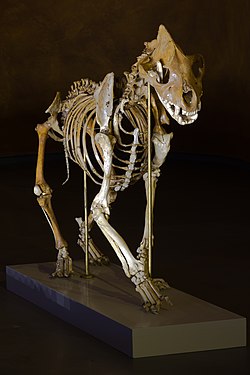
Cave hyenas (Crocuta (crocuta) spelaea and Crocuta (crocuta) ultima) are extinct species or subspecies of hyena known from Eurasia, which ranged from Western Europe and West Asia to eastern Siberia, East Asia and Southeast Asia during the Pleistocene epoch. They are well represented in many caves, primarily dating to the Last Glacial Period. Cave hyenas served as apex predator that preyed on large mammals (primarily large ungulates, such as wild horse, steppe bison and aurochs), and were responsible for the accumulation of hundreds of large Pleistocene mammal bones in areas including horizontal caves, sinkholes, mud pits, and muddy areas along rivers. It was one of the main apex predators of northern Eurasian ecosystems alongside the cave lion (Panthera spelaea), with the two species likely engaging in hostile conflict over carcasses.
Often treated as subspecies or populations of the living African spotted hyena (Crocuta crocuta) to which they were closely related and heavily resembled, genetic evidence from the nuclear genome suggests that Eurasian Crocuta populations (including the west Eurasian Crocuta crocuta spelaea and Asian Crocuta crocuta ultima) were highly genetically divergent from African populations (having estimated to have split over 1 million years ago), with evidence suggesting limited interbreeding between Eurasian cave and African spotted hyenas. Some authors have suggested that the two subspecies should be raised to species level as Crocuta spelaea and Crocuta ultima.
Cave hyenas coexisted in Europe alongside both Neanderthals and modern humans. Evidence suggests that they consumed the remains of Neanderthals at least on occasion, with cave hyenas also being recorded in cave art.
The cause of the cave hyena's extinction is not fully understood, though it could have been due to a combination of factors, including human activity, diminished quantities of prey animals, and climate change.
The size of cave hyenas varied depending on environment, with populations inhabiting colder climates having a larger body size than those inhabiting more temperate climates; thus, the species is an example of Bergmann's rule. A 2017 study estimated that on average cave hyenas weighed approximately 88 kilograms (194 lb), around 60% heavier than living spotted hyenas. In comparison to living spotted hyenas, some of the bones of the limbs are more robust (proportionally thicker and shorter), with the ulna being more curved. In the skull, the first and second upper premolars contact each other, while in living spotted hyenas they are separated by a diastema (gap), though collectively the differences between the skeletal anatomy of cave hyenas and living spotted hyenas are "relatively minor". The endocast (brain cavity) also shows differences between from that of the spotted hyena, with the living spotted hyena having a better developed front part of the brain, which may suggest differences in behaviour. Evidence from cave art suggests that cave hyenas had a similar physical appearance to living spotted hyenas, with a spotted pelt.
Crocuta first appeared outside of Africa in Asia during the Early Pleistocene around 2 million years ago, before arriving in Europe at the beginning of the Middle Pleistocene around 800,000 years ago, around the time of the extinction of the "giant hyena" Pachycrocuta brevirostris in the region. Crocuta was widely distributed across northern Eurasia during the Middle-Late Pleistocene, spanning from the Iberian Peninsula, Britain and Ireland in the West, across southern Siberia, Mongolia and northern China to the Pacific Coast of the Russian Far East. C. c. ultima at times ranged as far southeast as Guangxi and Taiwan in southern China, as well as Thailand, Cambodia and Laos in Southeast Asia, while C. c. spelaea ranged into the Middle East, as far south as the Judaean Desert and as far east as the Zagros Mountains of western Iran. The northernmost records are from the banks of the Vilyuy River in Northeast Siberia, with indirect evidence of feeding on woolly rhinoceros carcasses suggesting cave hyenas may have reached the far northeast of Siberia near the Arctic circle.
While "cave hyenas" did use caves, they were not confined to them, being present where caves were absent, and where present only using caves intermittently, with some examples of open-air dens having been found in the fossil record, such as at Bottrop in Germany.
The cave hyena's diet probably differed little from contemporary African spotted hyenas, and like living spotted hyenas, cave hyenas probably lived in groups (which in living spotted hyenas are called "clans") and were active predators rather than purely scavengers (with hunting being predominant over scavenging in the living spotted hyena). The bones of cave hyena prey were often cracked open/crushed in order to feed on the interior marrow, as is done by living spotted hyenas.
Cave hyena
Cave hyenas (Crocuta (crocuta) spelaea and Crocuta (crocuta) ultima) are extinct species or subspecies of hyena known from Eurasia, which ranged from Western Europe and West Asia to eastern Siberia, East Asia and Southeast Asia during the Pleistocene epoch. They are well represented in many caves, primarily dating to the Last Glacial Period. Cave hyenas served as apex predator that preyed on large mammals (primarily large ungulates, such as wild horse, steppe bison and aurochs), and were responsible for the accumulation of hundreds of large Pleistocene mammal bones in areas including horizontal caves, sinkholes, mud pits, and muddy areas along rivers. It was one of the main apex predators of northern Eurasian ecosystems alongside the cave lion (Panthera spelaea), with the two species likely engaging in hostile conflict over carcasses.
Often treated as subspecies or populations of the living African spotted hyena (Crocuta crocuta) to which they were closely related and heavily resembled, genetic evidence from the nuclear genome suggests that Eurasian Crocuta populations (including the west Eurasian Crocuta crocuta spelaea and Asian Crocuta crocuta ultima) were highly genetically divergent from African populations (having estimated to have split over 1 million years ago), with evidence suggesting limited interbreeding between Eurasian cave and African spotted hyenas. Some authors have suggested that the two subspecies should be raised to species level as Crocuta spelaea and Crocuta ultima.
Cave hyenas coexisted in Europe alongside both Neanderthals and modern humans. Evidence suggests that they consumed the remains of Neanderthals at least on occasion, with cave hyenas also being recorded in cave art.
The cause of the cave hyena's extinction is not fully understood, though it could have been due to a combination of factors, including human activity, diminished quantities of prey animals, and climate change.
The size of cave hyenas varied depending on environment, with populations inhabiting colder climates having a larger body size than those inhabiting more temperate climates; thus, the species is an example of Bergmann's rule. A 2017 study estimated that on average cave hyenas weighed approximately 88 kilograms (194 lb), around 60% heavier than living spotted hyenas. In comparison to living spotted hyenas, some of the bones of the limbs are more robust (proportionally thicker and shorter), with the ulna being more curved. In the skull, the first and second upper premolars contact each other, while in living spotted hyenas they are separated by a diastema (gap), though collectively the differences between the skeletal anatomy of cave hyenas and living spotted hyenas are "relatively minor". The endocast (brain cavity) also shows differences between from that of the spotted hyena, with the living spotted hyena having a better developed front part of the brain, which may suggest differences in behaviour. Evidence from cave art suggests that cave hyenas had a similar physical appearance to living spotted hyenas, with a spotted pelt.
Crocuta first appeared outside of Africa in Asia during the Early Pleistocene around 2 million years ago, before arriving in Europe at the beginning of the Middle Pleistocene around 800,000 years ago, around the time of the extinction of the "giant hyena" Pachycrocuta brevirostris in the region. Crocuta was widely distributed across northern Eurasia during the Middle-Late Pleistocene, spanning from the Iberian Peninsula, Britain and Ireland in the West, across southern Siberia, Mongolia and northern China to the Pacific Coast of the Russian Far East. C. c. ultima at times ranged as far southeast as Guangxi and Taiwan in southern China, as well as Thailand, Cambodia and Laos in Southeast Asia, while C. c. spelaea ranged into the Middle East, as far south as the Judaean Desert and as far east as the Zagros Mountains of western Iran. The northernmost records are from the banks of the Vilyuy River in Northeast Siberia, with indirect evidence of feeding on woolly rhinoceros carcasses suggesting cave hyenas may have reached the far northeast of Siberia near the Arctic circle.
While "cave hyenas" did use caves, they were not confined to them, being present where caves were absent, and where present only using caves intermittently, with some examples of open-air dens having been found in the fossil record, such as at Bottrop in Germany.
The cave hyena's diet probably differed little from contemporary African spotted hyenas, and like living spotted hyenas, cave hyenas probably lived in groups (which in living spotted hyenas are called "clans") and were active predators rather than purely scavengers (with hunting being predominant over scavenging in the living spotted hyena). The bones of cave hyena prey were often cracked open/crushed in order to feed on the interior marrow, as is done by living spotted hyenas.
Recent media
Recent media