
Recent from talks
Char kway teow
Knowledge base stats:
Talk channels stats:
Members stats:
Char kway teow
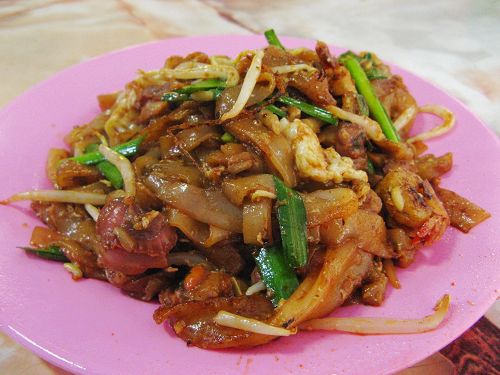
Char kway teow (sometimes also spelled as char kuey teow, Chinese: 炒粿條; Pe̍h-ōe-jī: chhá-kóe-tiâu) is a stir-fried rice noodle dish from Maritime Southeast Asia of southern Chinese origin. In Hokkien and Teochew, char means 'stir-fried' and kway teow refers to flat rice noodles. It is made from flat rice noodles (Chinese: 河粉; pinyin: hé fěn; Cantonese Yale: hó fán) or kway teow (Chinese: 粿條; Pe̍h-ōe-jī: kóe-tiâu; pinyin: guǒ tiáo; Cantonese Yale: gwó tìuh) of approximately 1 cm or about 0.5 cm in width, stir-fried over very high heat with garlic, light and dark soy sauce, chili paste, whole prawns, shelled blood cockles, chopped Chinese chives, slices of Chinese sausage, and bean sprouts. Other common ingredients include fishcake and belachan.
Originally developed and catered to overseas-born Chinese labourers in the Southeast Asia region, the dish has achieved widespread popularity within the region from the late 20th century onwards, particularly in Malaysia and Singapore. The dish has also acquired a reputation of being unhealthy due to its high saturated fat content, as it is traditionally stir-fried in pork fat with crisp croutons of pork lard.
The dish was often sold by fishermen, farmers and cockle-gatherers who doubled as char kway teow hawkers in the evening to supplement their income. The high fat content and low cost of the dish made it attractive to these people as it was a cheap source of energy and nutrients.
The term char kway teow is a transliteration of the Chinese characters 炒粿條 (in simplified Chinese 炒粿条). The dish's name is Hokkien (chhá-kóe-tiâu?), but the dish may have its roots in Chaozhou in China's Guangdong province and is mostly associated with the Teochew. The word kóe-tiâu (literally meaning "ricecake strips") generally refers to flat rice noodles, which are the usual ingredient in Singapore and West Malaysia. There is no fixed way of spelling chhá-kóe-tiâu, and many variants can be found: examples include char kueh teow, char kuey teow, char koay teow, char kueh tiao, char kuay tiaw, char kueh tiaw and so on.
The dish is sometimes called kwetiau goreng or kuetiau goreng in Malay, which conveys the same meaning. In some regions of Indonesia,[where?] the dish is called mitiau goreng.[citation needed]
Owing to the dish's popularity and spread to Cantonese-speaking areas, the term char kway teow has been corrupted into 炒貴刁 (Cantonese Yale: cháau gwai dīu; pinyin: cháo guì diāo) when presented in the aforementioned areas. The term 貴刁 has no real meaning, but its pronunciation in Cantonese and Mandarin is similar to 粿條 in Min Nan.
"Gourmet" versions of char kway teow, in which the dish may be prepared with more seafood, with crab meat and with duck eggs, may be found in major Malaysian cities like Ipoh and Penang. In Penang, char kway teow is commonly served on a piece of banana leaf on a plate, which is intended to enhance the aroma of the dish.
Char kway teow is a popular, inexpensive dish usually eaten for breakfast and sold at food stalls in Singapore. Blood cockles and prawns are standard fare in typical hawker preparations, while more expensive or luxurious versions incorporate cuttlefish, squid, and lobster meat. Singaporean style char kway teow mixes yellow wheat noodles with flat rice noodles. Some cooks prepare more health-conscious versions with extra vegetables and less oil.
Hub AI
Char kway teow AI simulator
(@Char kway teow_simulator)
Char kway teow
Char kway teow (sometimes also spelled as char kuey teow, Chinese: 炒粿條; Pe̍h-ōe-jī: chhá-kóe-tiâu) is a stir-fried rice noodle dish from Maritime Southeast Asia of southern Chinese origin. In Hokkien and Teochew, char means 'stir-fried' and kway teow refers to flat rice noodles. It is made from flat rice noodles (Chinese: 河粉; pinyin: hé fěn; Cantonese Yale: hó fán) or kway teow (Chinese: 粿條; Pe̍h-ōe-jī: kóe-tiâu; pinyin: guǒ tiáo; Cantonese Yale: gwó tìuh) of approximately 1 cm or about 0.5 cm in width, stir-fried over very high heat with garlic, light and dark soy sauce, chili paste, whole prawns, shelled blood cockles, chopped Chinese chives, slices of Chinese sausage, and bean sprouts. Other common ingredients include fishcake and belachan.
Originally developed and catered to overseas-born Chinese labourers in the Southeast Asia region, the dish has achieved widespread popularity within the region from the late 20th century onwards, particularly in Malaysia and Singapore. The dish has also acquired a reputation of being unhealthy due to its high saturated fat content, as it is traditionally stir-fried in pork fat with crisp croutons of pork lard.
The dish was often sold by fishermen, farmers and cockle-gatherers who doubled as char kway teow hawkers in the evening to supplement their income. The high fat content and low cost of the dish made it attractive to these people as it was a cheap source of energy and nutrients.
The term char kway teow is a transliteration of the Chinese characters 炒粿條 (in simplified Chinese 炒粿条). The dish's name is Hokkien (chhá-kóe-tiâu?), but the dish may have its roots in Chaozhou in China's Guangdong province and is mostly associated with the Teochew. The word kóe-tiâu (literally meaning "ricecake strips") generally refers to flat rice noodles, which are the usual ingredient in Singapore and West Malaysia. There is no fixed way of spelling chhá-kóe-tiâu, and many variants can be found: examples include char kueh teow, char kuey teow, char koay teow, char kueh tiao, char kuay tiaw, char kueh tiaw and so on.
The dish is sometimes called kwetiau goreng or kuetiau goreng in Malay, which conveys the same meaning. In some regions of Indonesia,[where?] the dish is called mitiau goreng.[citation needed]
Owing to the dish's popularity and spread to Cantonese-speaking areas, the term char kway teow has been corrupted into 炒貴刁 (Cantonese Yale: cháau gwai dīu; pinyin: cháo guì diāo) when presented in the aforementioned areas. The term 貴刁 has no real meaning, but its pronunciation in Cantonese and Mandarin is similar to 粿條 in Min Nan.
"Gourmet" versions of char kway teow, in which the dish may be prepared with more seafood, with crab meat and with duck eggs, may be found in major Malaysian cities like Ipoh and Penang. In Penang, char kway teow is commonly served on a piece of banana leaf on a plate, which is intended to enhance the aroma of the dish.
Char kway teow is a popular, inexpensive dish usually eaten for breakfast and sold at food stalls in Singapore. Blood cockles and prawns are standard fare in typical hawker preparations, while more expensive or luxurious versions incorporate cuttlefish, squid, and lobster meat. Singaporean style char kway teow mixes yellow wheat noodles with flat rice noodles. Some cooks prepare more health-conscious versions with extra vegetables and less oil.
Recent media