
Recent from talks
Chiang Mai Initiative
Knowledge base stats:
Talk channels stats:
Members stats:
Chiang Mai Initiative
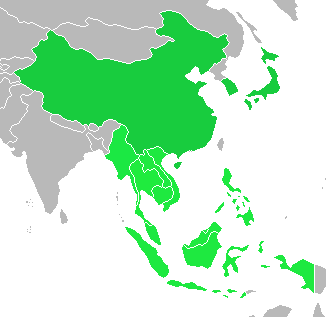
The Chiang Mai Initiative (CMI) is a multilateral currency swap arrangement among the ten members of the Association of Southeast Asian Nations (ASEAN), the People's Republic of China (including Hong Kong), Japan, and South Korea. It draws from a foreign exchange reserves pool worth US$120 billion and was launched on 24 March 2010. That pool has been expanded to $240 billion in 2012.
The initiative began as a series of bilateral swap arrangements after the ASEAN Plus Three countries met on 6 May 2000 in Chiang Mai, Thailand, at an annual meeting of the Asian Development Bank. After 1997 Asian financial crisis, member countries started this initiative to manage regional short-term liquidity problems and to avoid relying on the International Monetary Fund.
At the height of the 1997 Asian financial crisis, Japanese authorities proposed an Asian Monetary Fund, which would serve as a regional version of the International Monetary Fund (IMF). However, this idea was shelved after encountering strong resistance from the United States. After the crisis, finance ministers of members of the Association of Southeast Asian Nations (ASEAN), the People's Republic of China, Japan, and South Korea met on 6 May 2000 at the 33rd Annual Meeting of the Board of Governors of the Asian Development Bank (ADB) in Chiang Mai, Thailand, to discuss the establishment of a network of bilateral currency swap agreements. The proposal was dubbed the Chiang Mai Initiative and intended to avoid a future recurrence of the Asian Financial Crisis. It also implied the possibility of establishing a pool of foreign exchange reserves accessible by participating central banks to fight currency speculation. The proposal would also supplement the financial resources of international institutions such as the IMF. Joint Ministerial Statement (JMS) was issued after the ASEAN+3 Finance Minister's Meetings have mentioned the development of the CMI.
Early critics questioned the reasoning behind the initiative. The Asia Times Online wrote in an editorial published several days after the meeting, "The idea that the existence of a currency swap arrangement or the wider concept of an Asian monetary fund [...] could have prevented the Asian crisis or the worst of it, is both wrong and politically noxious." After IMF Managing Director Horst Köhler visited five Asian nations, including Thailand, in June 2000, the Asia Times Online denounced his endorsement of "the ill-conceived and likely never to be implemented Asean plus three [...] currency-swap plan". In a 2001 interview with the Far Eastern Economic Review, Köhler stated that the CMI would promote regional economic co-operation and development and that he would not oppose the formation of an Asian Monetary Union.
As of 16 October 2009, the network consisted of 16 bilateral arrangements among the ASEAN Plus Three countries worth approximately US$90 billion. Additionally, the ASEAN Swap Arrangement had a reserves pool of approximately US$2 billion.
In May 2007, at the 10th meeting of ASEAN+3 Finance Ministers the CMI further progress was agreed upon.[citation needed]
Foundation of CMI was meant to expand bilateral swaps of ASEAN. In addition, it was to aid the existing financial facilities of IMF. Nonetheless, the 2008 financial crisis proved that the CMI was not working up to its expectation and was in need of further development. Instead of seeking for CMI liquidity provision, Korea and Singapore used the US Federal Reserve as their way of securing liquidity, and Indonesia sought support from China and Japan. Consequently, policy-makers realised that the CMI needed a reserve pooling arrangement and took action to multilateralise the initiative. Hence, the Chiang Mai Initiative Multilateralisation (CMIM) Agreement was founded in 2009.[citation needed]
In February 2009, ASEAN+3 agreed to expand the fund to $120 billion up from the original level of $78 billion proposed in 2008.
Hub AI
Chiang Mai Initiative AI simulator
(@Chiang Mai Initiative_simulator)
Chiang Mai Initiative
The Chiang Mai Initiative (CMI) is a multilateral currency swap arrangement among the ten members of the Association of Southeast Asian Nations (ASEAN), the People's Republic of China (including Hong Kong), Japan, and South Korea. It draws from a foreign exchange reserves pool worth US$120 billion and was launched on 24 March 2010. That pool has been expanded to $240 billion in 2012.
The initiative began as a series of bilateral swap arrangements after the ASEAN Plus Three countries met on 6 May 2000 in Chiang Mai, Thailand, at an annual meeting of the Asian Development Bank. After 1997 Asian financial crisis, member countries started this initiative to manage regional short-term liquidity problems and to avoid relying on the International Monetary Fund.
At the height of the 1997 Asian financial crisis, Japanese authorities proposed an Asian Monetary Fund, which would serve as a regional version of the International Monetary Fund (IMF). However, this idea was shelved after encountering strong resistance from the United States. After the crisis, finance ministers of members of the Association of Southeast Asian Nations (ASEAN), the People's Republic of China, Japan, and South Korea met on 6 May 2000 at the 33rd Annual Meeting of the Board of Governors of the Asian Development Bank (ADB) in Chiang Mai, Thailand, to discuss the establishment of a network of bilateral currency swap agreements. The proposal was dubbed the Chiang Mai Initiative and intended to avoid a future recurrence of the Asian Financial Crisis. It also implied the possibility of establishing a pool of foreign exchange reserves accessible by participating central banks to fight currency speculation. The proposal would also supplement the financial resources of international institutions such as the IMF. Joint Ministerial Statement (JMS) was issued after the ASEAN+3 Finance Minister's Meetings have mentioned the development of the CMI.
Early critics questioned the reasoning behind the initiative. The Asia Times Online wrote in an editorial published several days after the meeting, "The idea that the existence of a currency swap arrangement or the wider concept of an Asian monetary fund [...] could have prevented the Asian crisis or the worst of it, is both wrong and politically noxious." After IMF Managing Director Horst Köhler visited five Asian nations, including Thailand, in June 2000, the Asia Times Online denounced his endorsement of "the ill-conceived and likely never to be implemented Asean plus three [...] currency-swap plan". In a 2001 interview with the Far Eastern Economic Review, Köhler stated that the CMI would promote regional economic co-operation and development and that he would not oppose the formation of an Asian Monetary Union.
As of 16 October 2009, the network consisted of 16 bilateral arrangements among the ASEAN Plus Three countries worth approximately US$90 billion. Additionally, the ASEAN Swap Arrangement had a reserves pool of approximately US$2 billion.
In May 2007, at the 10th meeting of ASEAN+3 Finance Ministers the CMI further progress was agreed upon.[citation needed]
Foundation of CMI was meant to expand bilateral swaps of ASEAN. In addition, it was to aid the existing financial facilities of IMF. Nonetheless, the 2008 financial crisis proved that the CMI was not working up to its expectation and was in need of further development. Instead of seeking for CMI liquidity provision, Korea and Singapore used the US Federal Reserve as their way of securing liquidity, and Indonesia sought support from China and Japan. Consequently, policy-makers realised that the CMI needed a reserve pooling arrangement and took action to multilateralise the initiative. Hence, the Chiang Mai Initiative Multilateralisation (CMIM) Agreement was founded in 2009.[citation needed]
In February 2009, ASEAN+3 agreed to expand the fund to $120 billion up from the original level of $78 billion proposed in 2008.
Recent media