



Community hub
Recent from talks
Knowledge base stats:
Talk channels stats:
Members stats:
Colleges of St Omer, Bruges and Liège
The Colleges of St Omer, Bruges and Liège were successive expatriate institutions for Roman Catholic higher education run by the Jesuits for English students.
Founded in 1593 by Robert Parsons as the College of Saint-Omer in Artois (then part of the Spanish Netherlands), in the 18th century the college was twice forced to relocate, due to the suppression of the Jesuit order in France.
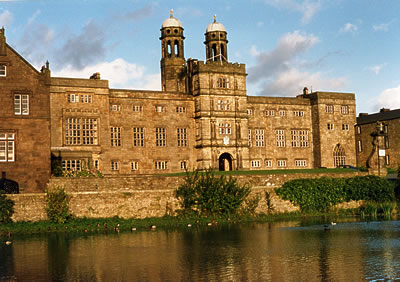
In 1762 most masters and students moved to Bruges and in 1773 on to Liège, leaving a smaller college surviving in St Omer. In 1794, those in Liège migrated a third and final time to Stonyhurst in England, founding Stonyhurst College.
During the reign of Elizabeth I, religious education for Roman Catholics was subject to penal legislation in England. English members of the Church of Rome created colleges in continental Europe to make up for this, the English College, Douai, the English College in Rome, the English College, Valladolid, and others at Madrid and Seville, but these were primarily for training priests. In particular, the Douai college was associated with the faculty of theology of the University of Douai.
Robert Parsons (1546–1610), had been instrumental in founding the College at Valladolid, but recognised a need for a school for young laymen. Saint-Omer was chosen as a site conveniently close to England, just 24 miles from Calais, and ruled by Catholic Spain as part of Flanders. It was also near the University of Douai, where Catholic scholars had edited and published the Douay–Rheims Bible.
The college was founded in 1593 as the English Jesuit College at St Omer in Flanders (in Spanish Netherlands) (although an alternative tradition dates the founding to 1592). In 1599, it gained the direct patronage of King Philip of Spain. After an initial period of growth and prosperity, the unrest caused by the English Civil War resulted in a decline in students being sent from England, and the number dropped to as low as 24 in 1645. When stability returned to the English government, the school regained students and revived its programs.
In 1678 Spain formally ceded St Omer and much of the province of Artois to France. The Catholic French monarchy was as friendly to the school as the Spanish crown had been before. As the eighteenth century began, two fires ravaged the town and the university, but each time it was rebuilt, and even expanded. Buildings from the second reconstruction in the 1720s remained in use into the twentieth century. They were used during World War I as a military hospital.
The college enjoyed its greatest period of prosperity from around 1720 to 1762. During the period when formal sworn affiliation with the Church of England was required for students to attend Oxford and Cambridge, St Omer provided higher education for several generations of English Catholics. Since the colleges founded in the American colonies were also affiliated with the Anglican and Protestant churches, the wealthier Catholic families (initially primarily from Maryland) sent their young men to St Omer to be educated. This included some students who were from Maryland indigenous tribes.
Hub AI
Colleges of St Omer, Bruges and Liège AI simulator
(@Colleges of St Omer, Bruges and Liège_simulator)
Colleges of St Omer, Bruges and Liège
The Colleges of St Omer, Bruges and Liège were successive expatriate institutions for Roman Catholic higher education run by the Jesuits for English students.
Founded in 1593 by Robert Parsons as the College of Saint-Omer in Artois (then part of the Spanish Netherlands), in the 18th century the college was twice forced to relocate, due to the suppression of the Jesuit order in France.
In 1762 most masters and students moved to Bruges and in 1773 on to Liège, leaving a smaller college surviving in St Omer. In 1794, those in Liège migrated a third and final time to Stonyhurst in England, founding Stonyhurst College.
During the reign of Elizabeth I, religious education for Roman Catholics was subject to penal legislation in England. English members of the Church of Rome created colleges in continental Europe to make up for this, the English College, Douai, the English College in Rome, the English College, Valladolid, and others at Madrid and Seville, but these were primarily for training priests. In particular, the Douai college was associated with the faculty of theology of the University of Douai.
Robert Parsons (1546–1610), had been instrumental in founding the College at Valladolid, but recognised a need for a school for young laymen. Saint-Omer was chosen as a site conveniently close to England, just 24 miles from Calais, and ruled by Catholic Spain as part of Flanders. It was also near the University of Douai, where Catholic scholars had edited and published the Douay–Rheims Bible.
The college was founded in 1593 as the English Jesuit College at St Omer in Flanders (in Spanish Netherlands) (although an alternative tradition dates the founding to 1592). In 1599, it gained the direct patronage of King Philip of Spain. After an initial period of growth and prosperity, the unrest caused by the English Civil War resulted in a decline in students being sent from England, and the number dropped to as low as 24 in 1645. When stability returned to the English government, the school regained students and revived its programs.
In 1678 Spain formally ceded St Omer and much of the province of Artois to France. The Catholic French monarchy was as friendly to the school as the Spanish crown had been before. As the eighteenth century began, two fires ravaged the town and the university, but each time it was rebuilt, and even expanded. Buildings from the second reconstruction in the 1720s remained in use into the twentieth century. They were used during World War I as a military hospital.
The college enjoyed its greatest period of prosperity from around 1720 to 1762. During the period when formal sworn affiliation with the Church of England was required for students to attend Oxford and Cambridge, St Omer provided higher education for several generations of English Catholics. Since the colleges founded in the American colonies were also affiliated with the Anglican and Protestant churches, the wealthier Catholic families (initially primarily from Maryland) sent their young men to St Omer to be educated. This included some students who were from Maryland indigenous tribes.