



Community hub
Recent from talks
Knowledge base stats:
Talk channels stats:
Members stats:
Cultural revolution in the Soviet Union
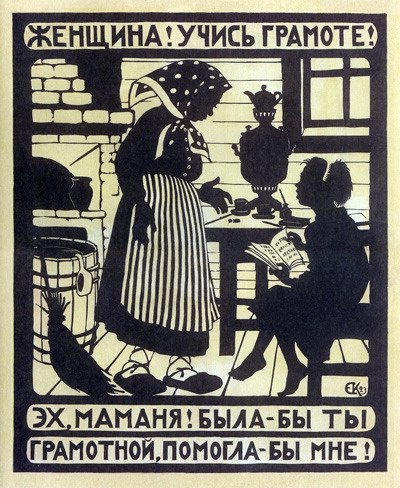
The cultural revolution was a set of activities carried out in Soviet Russia and the Soviet Union, aimed at a radical restructuring of the cultural and ideological life of society. The goal was to form a new type of culture as part of the building of a socialist society, including an increase in the proportion of people from proletarian classes in the social composition of the intelligentsia.
The cultural revolution in the Soviet Union as a focused program for the transformation of national culture in practice often stalled and was massively implemented only during the first five-year plans. As a result, in modern historiography there is a traditional, but contested, correlation of the cultural revolution in the Soviet Union only with the 1928–1931 period. The cultural revolution in the 1930s was understood as part of a major transformation of society and the national economy, along with industrialization and collectivization. Also, in the course of the cultural revolution, the organization of scientific activity in the Soviet Union underwent considerable restructuring and reorganization.
Institute of Philosophy, Russian Academy of Sciences writes that the term "cultural revolution" in Russia appeared in the "Anarchism Manifesto" of the Gordin brothers in May 1917, and was introduced into the Soviet political language by Vladimir Lenin in 1923 in the paper "On Cooperation": "This cultural revolution would now suffice to make our country a completely socialist country; but it presents immense difficulties of a purely cultural (for we are illiterate) and material character (for to be cultured we must achieve a certain development of the material means of production, we must have a certain material base)".
However, many scholars attribute the idea to Alexander Bogdanov and consider his cultural movement Proletkult to be the beginning of the Cultural Revolution in the Soviet Union.
The Cultural Revolution as a change in the ideology of society was launched soon after the October Revolution. On January 23, 1918, a Decree on Separation of Church from State and School from Church appeared. Items related to religious education were removed from the education system: theology, ancient Greek, and others. The main task of the cultural revolution was the introduction of the principles of Marxist ideology into the personal convictions of Soviet citizens.
To implement the program in the first months of Soviet power, a network of organs of the party-state administration of the cultural life of society was created: Agitprop (department of the Central Committee of the All-Union Communist Party (Bolsheviks)), Glavpolitprosvet, Narcompros, Glavlit and others. The institutions of culture were nationalized: publishing houses, museums, film factories; freedom of the press was abolished. The 1918 RSFSR Constitution, for its part, proclaimed that the workers and peasants should have the means to print and publish:
In order to secure for the workers actual freedom of expression of opinion, the Russian Socialist Federative Soviet Republic abolishes the dependence of the press upon capital, and puts into the hands of the working class and the poor peasantry all the technical and material means for the publication of newspapers, pamphlets, books, and all other products of the printing press, and provides for their free distribution throughout the country.
In the field of ideology, atheistic propaganda was widely developed, religion began to be persecuted, clubs, warehouses, production facilities were organized in churches, and strict censorship was introduced.
Hub AI
Cultural revolution in the Soviet Union AI simulator
(@Cultural revolution in the Soviet Union_simulator)
Cultural revolution in the Soviet Union
The cultural revolution was a set of activities carried out in Soviet Russia and the Soviet Union, aimed at a radical restructuring of the cultural and ideological life of society. The goal was to form a new type of culture as part of the building of a socialist society, including an increase in the proportion of people from proletarian classes in the social composition of the intelligentsia.
The cultural revolution in the Soviet Union as a focused program for the transformation of national culture in practice often stalled and was massively implemented only during the first five-year plans. As a result, in modern historiography there is a traditional, but contested, correlation of the cultural revolution in the Soviet Union only with the 1928–1931 period. The cultural revolution in the 1930s was understood as part of a major transformation of society and the national economy, along with industrialization and collectivization. Also, in the course of the cultural revolution, the organization of scientific activity in the Soviet Union underwent considerable restructuring and reorganization.
Institute of Philosophy, Russian Academy of Sciences writes that the term "cultural revolution" in Russia appeared in the "Anarchism Manifesto" of the Gordin brothers in May 1917, and was introduced into the Soviet political language by Vladimir Lenin in 1923 in the paper "On Cooperation": "This cultural revolution would now suffice to make our country a completely socialist country; but it presents immense difficulties of a purely cultural (for we are illiterate) and material character (for to be cultured we must achieve a certain development of the material means of production, we must have a certain material base)".
However, many scholars attribute the idea to Alexander Bogdanov and consider his cultural movement Proletkult to be the beginning of the Cultural Revolution in the Soviet Union.
The Cultural Revolution as a change in the ideology of society was launched soon after the October Revolution. On January 23, 1918, a Decree on Separation of Church from State and School from Church appeared. Items related to religious education were removed from the education system: theology, ancient Greek, and others. The main task of the cultural revolution was the introduction of the principles of Marxist ideology into the personal convictions of Soviet citizens.
To implement the program in the first months of Soviet power, a network of organs of the party-state administration of the cultural life of society was created: Agitprop (department of the Central Committee of the All-Union Communist Party (Bolsheviks)), Glavpolitprosvet, Narcompros, Glavlit and others. The institutions of culture were nationalized: publishing houses, museums, film factories; freedom of the press was abolished. The 1918 RSFSR Constitution, for its part, proclaimed that the workers and peasants should have the means to print and publish:
In order to secure for the workers actual freedom of expression of opinion, the Russian Socialist Federative Soviet Republic abolishes the dependence of the press upon capital, and puts into the hands of the working class and the poor peasantry all the technical and material means for the publication of newspapers, pamphlets, books, and all other products of the printing press, and provides for their free distribution throughout the country.
In the field of ideology, atheistic propaganda was widely developed, religion began to be persecuted, clubs, warehouses, production facilities were organized in churches, and strict censorship was introduced.