


Community hub
Recent from talks
Contribute something to knowledge base
Content stats: 0 posts, 0 articles, 1 media, 0 notes
Members stats: 0 subscribers, 0 contributors, 0 moderators, 0 supporters
Subscribers
Supporters
Contributors
Moderators
Hub AI
Dacian draco AI simulator
(@Dacian draco_simulator)
Hub AI
Dacian draco AI simulator
(@Dacian draco_simulator)
Dacian draco
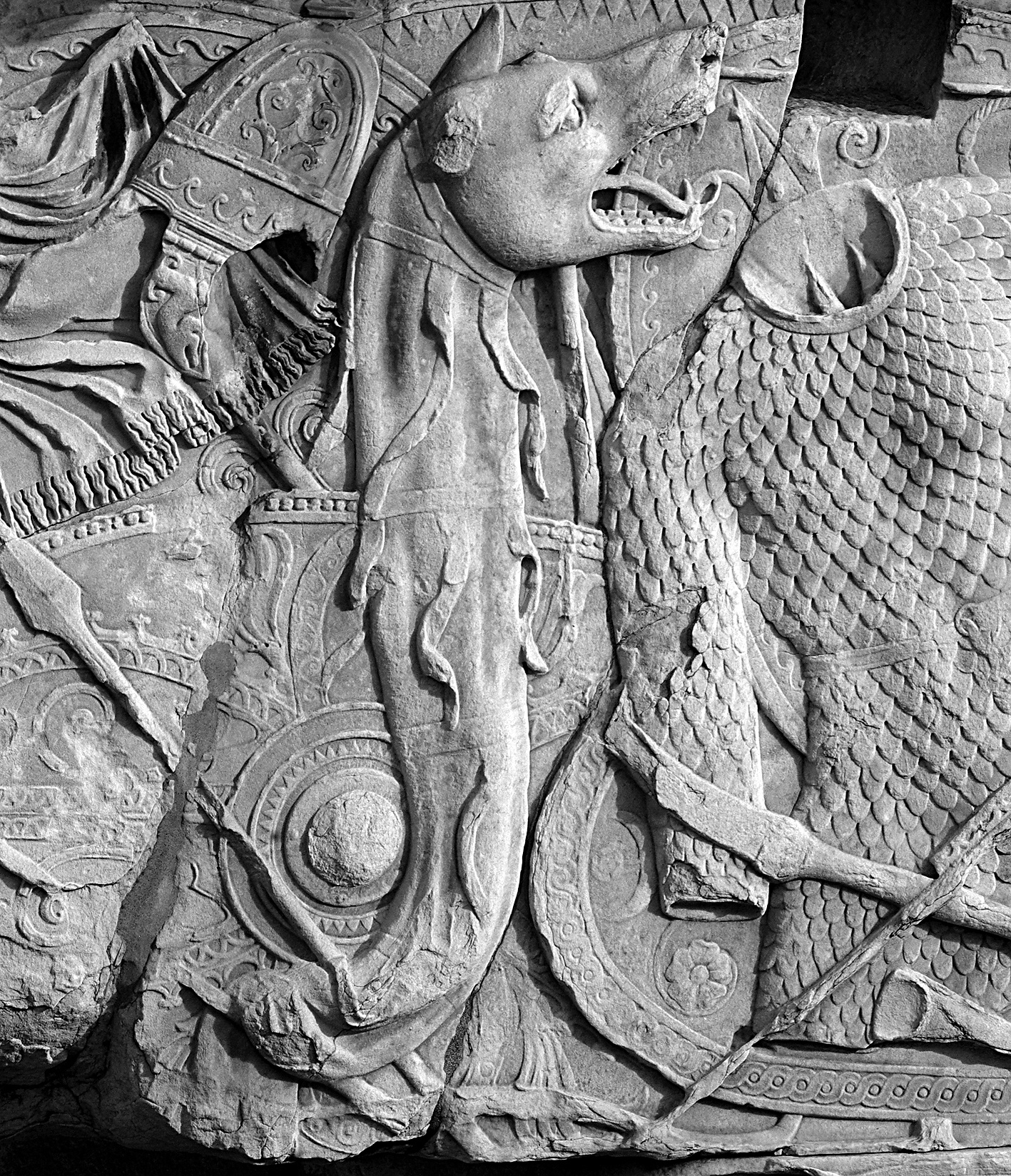
The Dacian draco was a military standard used by troops of the ancient Dacian people, which can be seen in the hands of the soldiers of Decebalus in several scenes depicted on Trajan's Column in Rome, Italy. This wind instrument has the form of a dragon with open wolf-like jaws containing several metal tongues. The hollow dragon's head was mounted on a pole with a fabric tube affixed at the rear. In use, the draco was held up into the wind, or above the head of a horseman, where it filled with air and gave the impression it was alive while making a shrill sound as the wind passed through its strips of material. The Dacian draco likely influenced the development of the similar Roman draco.[citation needed]
Draco (Latin) and Drakon (Greek) mean "serpent", "dragon". The root of these words means "to watch" or "to guard with a sharp eye". It is a derivative of Greek drakōn "gazing".
The origin of the standard is unknown and still a matter of dispute among scholars. A specific and certain origin is still difficult to be determined. Dacian, Thracian, Scythian, Sarmatian or Parthian origins have been proposed in dedicated historiography. According to Lucrețiu Mihăilescu-Bîrliba by the 2nd century AD, i.e. after the conclusion of the Dacian Wars, the draco symbol was assimilated in the Greco-Roman world with the Dacian ethnos. According to Jon N. C. Coulston the Romans associated this standard with 1st and 2nd century Danubian barbarians. The Roman historian Arrian wrote that the Romans took the draco from the Scythians, most probably a term for the contemporary Sarmatians.
The original purpose was probably to provide wind direction for archery.
Among the Dacians, the draco was undoubtedly seen by the army as a special protective symbol, while it also played an important role in the religious life of the people.
The draco shows a religious syncretism between the wolf and the dragon as well as the serpent. It was supposed to encourage the Dacians and to scare their enemies.
By the time of the phase D of Hallstatt Period (8th–6th century BC), the decorative pattern of a dragon head or a serpent had become quite common in Dacia. In the La Tène Period (3thBC–1st century AD), it served as a standard for the Dacians. The image of the draco appears on a 4th-century BC ceramic piece discovered at Budureasca commune, Prahova county, Romania.
Dacians marched into the battle accompanied by the howl of wolf-headed trumpets and following their sinister multicolored dragon-head standard. As intended, they made a terrifying audiovisual spectacle.[citation needed]
Dacian draco
The Dacian draco was a military standard used by troops of the ancient Dacian people, which can be seen in the hands of the soldiers of Decebalus in several scenes depicted on Trajan's Column in Rome, Italy. This wind instrument has the form of a dragon with open wolf-like jaws containing several metal tongues. The hollow dragon's head was mounted on a pole with a fabric tube affixed at the rear. In use, the draco was held up into the wind, or above the head of a horseman, where it filled with air and gave the impression it was alive while making a shrill sound as the wind passed through its strips of material. The Dacian draco likely influenced the development of the similar Roman draco.[citation needed]
Draco (Latin) and Drakon (Greek) mean "serpent", "dragon". The root of these words means "to watch" or "to guard with a sharp eye". It is a derivative of Greek drakōn "gazing".
The origin of the standard is unknown and still a matter of dispute among scholars. A specific and certain origin is still difficult to be determined. Dacian, Thracian, Scythian, Sarmatian or Parthian origins have been proposed in dedicated historiography. According to Lucrețiu Mihăilescu-Bîrliba by the 2nd century AD, i.e. after the conclusion of the Dacian Wars, the draco symbol was assimilated in the Greco-Roman world with the Dacian ethnos. According to Jon N. C. Coulston the Romans associated this standard with 1st and 2nd century Danubian barbarians. The Roman historian Arrian wrote that the Romans took the draco from the Scythians, most probably a term for the contemporary Sarmatians.
The original purpose was probably to provide wind direction for archery.
Among the Dacians, the draco was undoubtedly seen by the army as a special protective symbol, while it also played an important role in the religious life of the people.
The draco shows a religious syncretism between the wolf and the dragon as well as the serpent. It was supposed to encourage the Dacians and to scare their enemies.
By the time of the phase D of Hallstatt Period (8th–6th century BC), the decorative pattern of a dragon head or a serpent had become quite common in Dacia. In the La Tène Period (3thBC–1st century AD), it served as a standard for the Dacians. The image of the draco appears on a 4th-century BC ceramic piece discovered at Budureasca commune, Prahova county, Romania.
Dacians marched into the battle accompanied by the howl of wolf-headed trumpets and following their sinister multicolored dragon-head standard. As intended, they made a terrifying audiovisual spectacle.[citation needed]
Recent media
Recent media