



Community hub
Recent from talks
Knowledge base stats:
Talk channels stats:
Members stats:
Delta Air Lines Flight 9570
On May 30, 1972, Delta Air Lines Flight 9570 crashed while attempting to land at the Greater Southwest International Airport (GSW) in Fort Worth, Texas during a training flight. All four occupants aboard the training flight were killed. The crash was determined to be caused by the aircraft flying through wake turbulence, and led to sweeping changes in procedures for maintaining minimum safe distance behind aircraft that generate substantial wake turbulence.
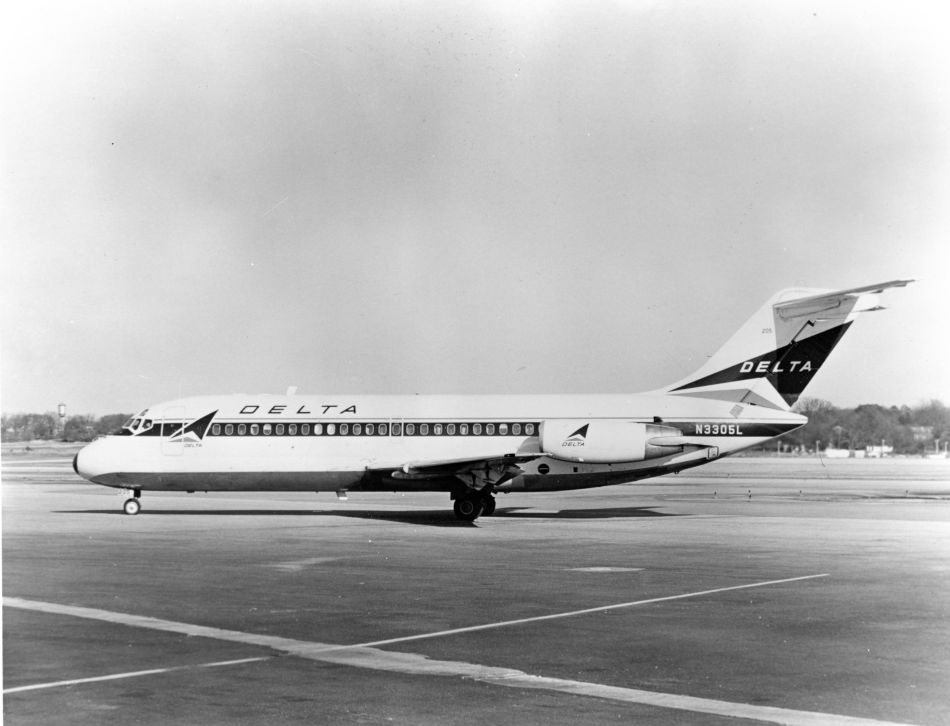
Delta Air Lines Flight 9570 was a training flight operated using a McDonnell Douglas DC-9-14 (registration (registration N3305L). The aircraft was manufactured in 1965, and had operated for 18,998 hours at the time of the accident. The purpose of the flight was to flight check three Delta pilots. Flight 9570 had a total of four occupants, including the two-man flight crew actually flying the aircraft, an additional pilot awaiting his flight check, who would have been riding in the rear, and an FAA air carrier operations inspector, who was on board for proficiency checking, and was riding in the “jump seat”, a fold down seat between the pilot and co-pilot.
Also involved in the accident was American Airlines Flight 1114, a training flight conducted using a McDonnell Douglas DC-10. Flight 1114 was not damaged or affected by the accident.
On May 30, 1972, Flight 9570 departed Dallas Love Field in Dallas, Texas at 06:48 Central Daylight Time, and proceeded to GSW to perform training approaches and landings. Flight 9570 requested an ILS approach to GSW's Runway 13. The clearance was granted, and Flight 9570 was advised that the American Airlines DC-10 was already in the traffic pattern to perform "touch-and-go landings" at GSW. Flight 9570 landed without incident.
After landing at GSW, Flight 9570 received new takeoff and climb-out clearances, made training maneuvers including an ILS missed approach. Flight 9570 then requested approval for landing on Runway 13, behind the American DC-10 which was also inbound for a landing on the same runway. The air traffic controller gave Flight 9570 clearance to land on Runway 13 with an advisory "caution, turbulence". The controller did not advise the DC-9 that they were following a "heavy", though the controller did advise that they were following a DC-10 which experienced pilots should have known was a "heavy" aircraft.
On approach to the runway, the DC-9 began to oscillate about the roll axis, then rolled rapidly to the right. After rolling 90 degrees to the right, the right wingtip struck the runway. The airplane continued to roll to the right, until the fuselage struck the runway in a nearly inverted position. The aircraft was damaged by impact forces, and destroyed by a subsequent fire. All four occupants were killed.
The National Transportation Safety Board (NTSB) investigated the accident. The manner of the crash suggested to the NTSB that the accident was caused by wake turbulence from the DC-10 it had followed. Prior to the Flight 9570 accident, the Federal Aviation Administration had no specific wake turbulence based aircraft separation standards in place. Instead, separation was determined by air traffic control radar resolution limits and, in some cases, runway occupancy restrictions. However, the rapidly increasing use of large jets that cause substantial wake turbulence, such as the Boeing 747, DC-10, and Lockheed L-1011 TriStar in recent years had increased the risk of wake turbulence related accidents. However, prior to Flight 9570, most accidents involving wake turbulence involved smaller aircraft than the DC-9.
Recognizing wake turbulence as a potential cause, the NTSB performed test and research activities to confirm their hypothesis. The NTSB performed wake vortex testing at the National Aviation Facilities Experimental Center at Atlantic City Airport in New Jersey, initially using a Lockheed L-1011 (a trijet similar in size to the DC-10) and then later using a DC-10 loaned to the NTSB. Colored smoke was emitted from the airport control tower, and observations of the smoke as a L-1011 or DC-10 aircraft flew by the tower provided information about the length of time a vortex would remain after the aircraft was clear.
Hub AI
Delta Air Lines Flight 9570 AI simulator
(@Delta Air Lines Flight 9570_simulator)
Delta Air Lines Flight 9570
On May 30, 1972, Delta Air Lines Flight 9570 crashed while attempting to land at the Greater Southwest International Airport (GSW) in Fort Worth, Texas during a training flight. All four occupants aboard the training flight were killed. The crash was determined to be caused by the aircraft flying through wake turbulence, and led to sweeping changes in procedures for maintaining minimum safe distance behind aircraft that generate substantial wake turbulence.
Delta Air Lines Flight 9570 was a training flight operated using a McDonnell Douglas DC-9-14 (registration (registration N3305L). The aircraft was manufactured in 1965, and had operated for 18,998 hours at the time of the accident. The purpose of the flight was to flight check three Delta pilots. Flight 9570 had a total of four occupants, including the two-man flight crew actually flying the aircraft, an additional pilot awaiting his flight check, who would have been riding in the rear, and an FAA air carrier operations inspector, who was on board for proficiency checking, and was riding in the “jump seat”, a fold down seat between the pilot and co-pilot.
Also involved in the accident was American Airlines Flight 1114, a training flight conducted using a McDonnell Douglas DC-10. Flight 1114 was not damaged or affected by the accident.
On May 30, 1972, Flight 9570 departed Dallas Love Field in Dallas, Texas at 06:48 Central Daylight Time, and proceeded to GSW to perform training approaches and landings. Flight 9570 requested an ILS approach to GSW's Runway 13. The clearance was granted, and Flight 9570 was advised that the American Airlines DC-10 was already in the traffic pattern to perform "touch-and-go landings" at GSW. Flight 9570 landed without incident.
After landing at GSW, Flight 9570 received new takeoff and climb-out clearances, made training maneuvers including an ILS missed approach. Flight 9570 then requested approval for landing on Runway 13, behind the American DC-10 which was also inbound for a landing on the same runway. The air traffic controller gave Flight 9570 clearance to land on Runway 13 with an advisory "caution, turbulence". The controller did not advise the DC-9 that they were following a "heavy", though the controller did advise that they were following a DC-10 which experienced pilots should have known was a "heavy" aircraft.
On approach to the runway, the DC-9 began to oscillate about the roll axis, then rolled rapidly to the right. After rolling 90 degrees to the right, the right wingtip struck the runway. The airplane continued to roll to the right, until the fuselage struck the runway in a nearly inverted position. The aircraft was damaged by impact forces, and destroyed by a subsequent fire. All four occupants were killed.
The National Transportation Safety Board (NTSB) investigated the accident. The manner of the crash suggested to the NTSB that the accident was caused by wake turbulence from the DC-10 it had followed. Prior to the Flight 9570 accident, the Federal Aviation Administration had no specific wake turbulence based aircraft separation standards in place. Instead, separation was determined by air traffic control radar resolution limits and, in some cases, runway occupancy restrictions. However, the rapidly increasing use of large jets that cause substantial wake turbulence, such as the Boeing 747, DC-10, and Lockheed L-1011 TriStar in recent years had increased the risk of wake turbulence related accidents. However, prior to Flight 9570, most accidents involving wake turbulence involved smaller aircraft than the DC-9.
Recognizing wake turbulence as a potential cause, the NTSB performed test and research activities to confirm their hypothesis. The NTSB performed wake vortex testing at the National Aviation Facilities Experimental Center at Atlantic City Airport in New Jersey, initially using a Lockheed L-1011 (a trijet similar in size to the DC-10) and then later using a DC-10 loaned to the NTSB. Colored smoke was emitted from the airport control tower, and observations of the smoke as a L-1011 or DC-10 aircraft flew by the tower provided information about the length of time a vortex would remain after the aircraft was clear.