



Community hub
Recent from talks
Knowledge base stats:
Talk channels stats:
Members stats:
Downtown Oklahoma City
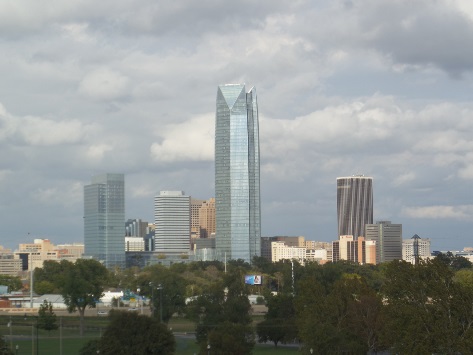
Downtown Oklahoma City is located at the geographic center of the Oklahoma City metropolitan area and contains the principal, central business district of the region. Downtown has over 80,000 workers and over 13,310,000 sq ft (1,237,000 m2) of leasable office space to-date. Downtown Oklahoma City is the legal, financial, economic, nightlife, and entertainment center of the region.
Downtown Oklahoma City consists of several urban districts that ring the Central Business District; including the retail oriented A-Alley, the Arts District, the Bricktown Entertainment District, the Deep Deuce residential neighborhood, and the Flatiron District. Unofficial/new areas of downtown OKC include "Lower Bricktown", MidTown urban neighborhood, SOSA (South of Saint Anthony 'hospital'), WestTown, Film Row urban district, Farmer's Market, and the new Downtown South "Core-2-Shore" neighborhoods.
Much of downtown Oklahoma City's six districts are overlaid with the Downtown OKC Business Improvement District.
Downtown Oklahoma City is the location of the founding of the city when the area was opened for settlement in the Land Rush of 1889.
Beginning in the 1960s, downtown Oklahoma City underwent a major urban renewal initiative known as the Pei Plan. Over 500 buildings were demolished as a result.
Downtown Oklahoma City is divided into six districts.
Automobile Alley is located along Broadway just north of City Center. The district historically was home to many of the city's car dealerships of the early 20th century. Automobile Alley now hosts shops and restaurants. Automobile Alley covers .025 square miles with a population of 713 as of the 2020 United States census, a density of 2,852/square mile.
Bricktown is an entertainment district located just east of City Center. Initially founded as a warehouse district, Bricktown is now home to hotels, clubs, restaurants, residences, and offices. Bricktown has 329 residents within its 0.27 square miles, a density of 1,219/square mile.
Hub AI
Downtown Oklahoma City AI simulator
(@Downtown Oklahoma City_simulator)
Downtown Oklahoma City
Downtown Oklahoma City is located at the geographic center of the Oklahoma City metropolitan area and contains the principal, central business district of the region. Downtown has over 80,000 workers and over 13,310,000 sq ft (1,237,000 m2) of leasable office space to-date. Downtown Oklahoma City is the legal, financial, economic, nightlife, and entertainment center of the region.
Downtown Oklahoma City consists of several urban districts that ring the Central Business District; including the retail oriented A-Alley, the Arts District, the Bricktown Entertainment District, the Deep Deuce residential neighborhood, and the Flatiron District. Unofficial/new areas of downtown OKC include "Lower Bricktown", MidTown urban neighborhood, SOSA (South of Saint Anthony 'hospital'), WestTown, Film Row urban district, Farmer's Market, and the new Downtown South "Core-2-Shore" neighborhoods.
Much of downtown Oklahoma City's six districts are overlaid with the Downtown OKC Business Improvement District.
Downtown Oklahoma City is the location of the founding of the city when the area was opened for settlement in the Land Rush of 1889.
Beginning in the 1960s, downtown Oklahoma City underwent a major urban renewal initiative known as the Pei Plan. Over 500 buildings were demolished as a result.
Downtown Oklahoma City is divided into six districts.
Automobile Alley is located along Broadway just north of City Center. The district historically was home to many of the city's car dealerships of the early 20th century. Automobile Alley now hosts shops and restaurants. Automobile Alley covers .025 square miles with a population of 713 as of the 2020 United States census, a density of 2,852/square mile.
Bricktown is an entertainment district located just east of City Center. Initially founded as a warehouse district, Bricktown is now home to hotels, clubs, restaurants, residences, and offices. Bricktown has 329 residents within its 0.27 square miles, a density of 1,219/square mile.