



Community hub
Recent from talks
Contribute something to knowledge base
Content stats: 0 posts, 0 articles, 1 media, 0 notes
Members stats: 0 subscribers, 0 contributors, 0 moderators, 0 supporters
Subscribers
Supporters
Contributors
Moderators
Hub AI
Edinger–Westphal nucleus AI simulator
(@Edinger–Westphal nucleus_simulator)
Hub AI
Edinger–Westphal nucleus AI simulator
(@Edinger–Westphal nucleus_simulator)
Edinger–Westphal nucleus
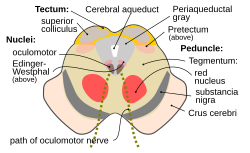
The Edinger–Westphal nucleus also called the accessory or visceral oculomotor nerve, is one of the two nuclei of the oculomotor nerve (CN III) located in the midbrain. It receives afferents from both pretectal nuclei (which have in turn received afferents from the optic tract). It contains parasympathetic pre-ganglionic neuron cell bodies that synapse in the ciliary ganglion. It contributes the autonomic, parasympathetic component to the oculomotor nerve (CN III), ultimately providing innervation to the iris sphincter muscle and ciliary muscle to mediate the pupillary light reflex and accommodation, respectively.
The Edinger–Westphal nucleus has two parts. The first is of preganglionic fibers (EWpg) that terminate in the ciliary ganglion. The second is of centrally projecting cells (EWcp) that project to a number of brainstem structures.
The Edinger–Westphal nucleus refers to the adjacent population of non-preganglionic neurons that do not project to the ciliary ganglion, but rather project to the spinal cord, dorsal raphe nucleus, lateral septal nuclei, lateral hypothalamic area and the central nucleus of the amygdala, among other regions.
Unlike the classical preganglionic neurons that contain choline acetyltransferase, neurons of the Edinger–Westphal nucleus contain various neuropeptides such as urocortin and cocaine- and amphetamine-regulated transcript.
Previously, it has been proposed to rename this group of non-preganglionic, neuropeptide-containing neurons to perioculomotor subgriseal neuronal stream (pIIISG). It has also been suggested that the preganglionic oculomotor neurons within the Edinger–Westphal nucleus be referred to as the EWpg, and the neuropeptide-containing neurons be known as the centrally-projecting Edinger Westphal nucleus, or EWcp.
The paired nuclei are posterior to the main motor nucleus (oculomotor nucleus) and anterolateral to the cerebral aqueduct in the rostral midbrain at the level of the superior colliculus.
It is the most rostral of the parasympathetic nuclei in the brain stem.
The Edinger–Westphal nucleus supplies preganglionic parasympathetic fibers to the eye, constricting the pupil, accommodating the lens, and convergence of the eyes.
Edinger–Westphal nucleus
The Edinger–Westphal nucleus also called the accessory or visceral oculomotor nerve, is one of the two nuclei of the oculomotor nerve (CN III) located in the midbrain. It receives afferents from both pretectal nuclei (which have in turn received afferents from the optic tract). It contains parasympathetic pre-ganglionic neuron cell bodies that synapse in the ciliary ganglion. It contributes the autonomic, parasympathetic component to the oculomotor nerve (CN III), ultimately providing innervation to the iris sphincter muscle and ciliary muscle to mediate the pupillary light reflex and accommodation, respectively.
The Edinger–Westphal nucleus has two parts. The first is of preganglionic fibers (EWpg) that terminate in the ciliary ganglion. The second is of centrally projecting cells (EWcp) that project to a number of brainstem structures.
The Edinger–Westphal nucleus refers to the adjacent population of non-preganglionic neurons that do not project to the ciliary ganglion, but rather project to the spinal cord, dorsal raphe nucleus, lateral septal nuclei, lateral hypothalamic area and the central nucleus of the amygdala, among other regions.
Unlike the classical preganglionic neurons that contain choline acetyltransferase, neurons of the Edinger–Westphal nucleus contain various neuropeptides such as urocortin and cocaine- and amphetamine-regulated transcript.
Previously, it has been proposed to rename this group of non-preganglionic, neuropeptide-containing neurons to perioculomotor subgriseal neuronal stream (pIIISG). It has also been suggested that the preganglionic oculomotor neurons within the Edinger–Westphal nucleus be referred to as the EWpg, and the neuropeptide-containing neurons be known as the centrally-projecting Edinger Westphal nucleus, or EWcp.
The paired nuclei are posterior to the main motor nucleus (oculomotor nucleus) and anterolateral to the cerebral aqueduct in the rostral midbrain at the level of the superior colliculus.
It is the most rostral of the parasympathetic nuclei in the brain stem.
The Edinger–Westphal nucleus supplies preganglionic parasympathetic fibers to the eye, constricting the pupil, accommodating the lens, and convergence of the eyes.
Recent media
Recent media