



Community hub
Recent from talks
Knowledge base stats:
Talk channels stats:
Members stats:
Elsenz Valley Railway
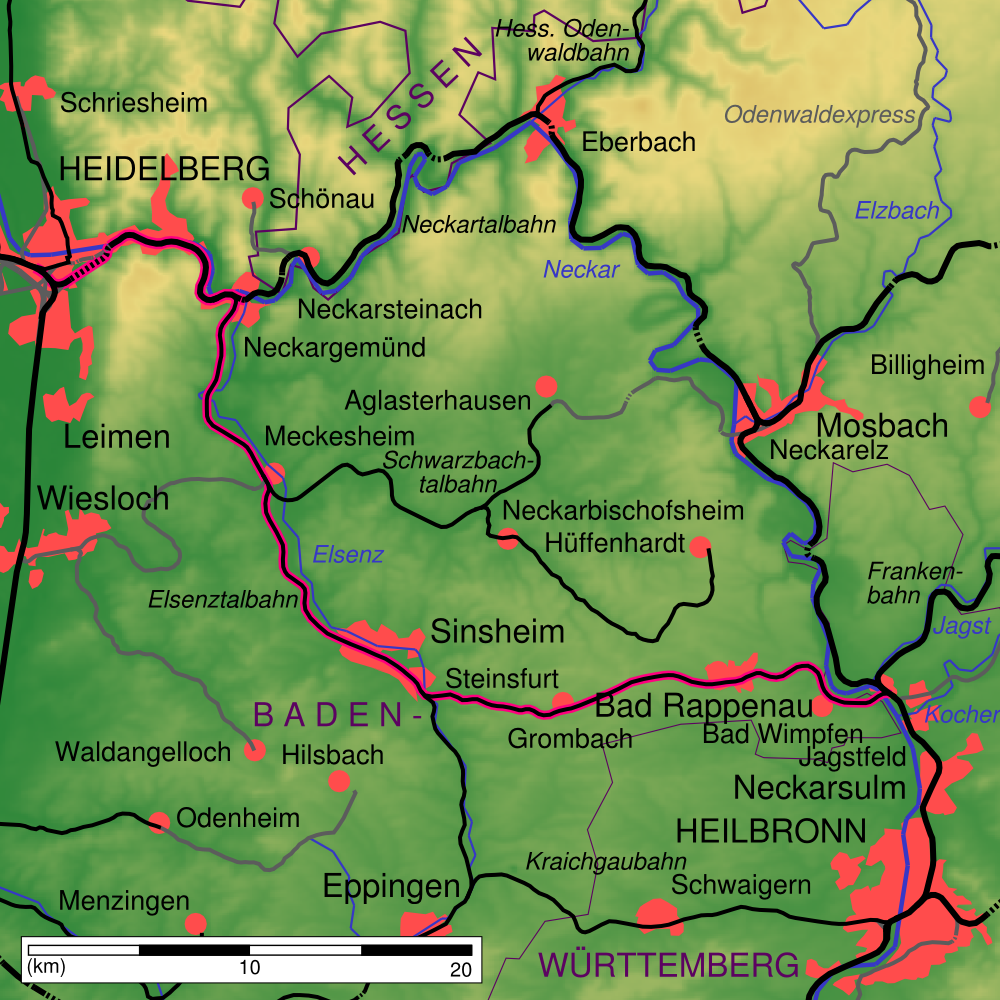
The Elsenz Valley Railway (Elsenztalbahn) or Neckargemünd–Bad Friedrichshall railway is an electrified, partly double-tracked main line in the German state of Baden-Württemberg, running from Heidelberg via Sinsheim to Bad Friedrichshall, that, for part of its course, follows the Elsenz river that gives it its name. The crossing stations on the single-tracked sections were controlled by mechanical signal boxes until 2008, but are now controlled by electronic interlockings.
The section from Heidelberg to Meckesheim was opened on 23 October 1862 by the Grand Duchy of Baden State Railway as part of the Odenwald Railway and is one of the oldest railways in Germany. The section from Meckesheim to Bad Rappenau was opened by the Baden State Railway on 25 June 1868 and it was extended to Bad Friedrichshall-Jagstfeld on 5 August 1869.
The line has been electrified to allow the extension of the Rhine-Neckar S-Bahn on the Heidelberg–Steinsfurt section of the line and the operation of Heilbronn Stadtbahn on the section between Sinsheim and Bad Friedrichshall-Jagstfeld.
At the end of the 1840s, the Kingdom of Württemberg wanted to connect its railway lines with those of Grand Duchy of Baden, from Heilbronn via Sinsheim either to Wiesloch or Heidelberg. Baden did not agree to support this proposal, however, as it only wanted a line via Pforzheim.
A railway committee was founded in Mosbach for the construction of an Odenwald Railway on 24 May 1853 and another one was founded in Heidelberg in 1856 . As part of this process, it was determined on 27 April 1860 that the section from Heidelberg via Meckesheim to Mosbach would be built at government expense. After preparatory work that had been in progress since 1858, construction subsequently commenced. The line was initially built as a single track, but it was prepared for eventual doubling. The inaugural train trip took place on 22 October 1862 in very poor weather. On the following day operations by the Grand Duchy of Baden State Railways were recorded on the line. There was a derailment on the first day of operations on the Neckar bridge at Neckarelz due to a landslide as a result of heavy rain.
A line from Waibstadt to the Rappenau salt works (Saline Rappenau) was planned. A petition was presented against this in 1862 by the town of Sinsheim and 25 other municipalities, which instead sought a line from Meckesheim via Sinsheim to Rappenau. The latter followed by an extension to Jagstfeld was approved on 19 January 1866.
The opening trip on the section from Meckesheim to Bad Rappenau took place on 18 June 1868 with regular services commencing on 25 June. There were initially two viaducts on this section, three bridges, 14 level crossing keepers houses and 36 level crossings. The connecting line to the salt works had been put into operation in April.
The second track from Heidelberg Karlstor to Meckesheim was opened in mid 1869, because with the lines to Bavaria and Württemberg significantly more trains would run on this section.
Hub AI
Elsenz Valley Railway AI simulator
(@Elsenz Valley Railway_simulator)
Elsenz Valley Railway
The Elsenz Valley Railway (Elsenztalbahn) or Neckargemünd–Bad Friedrichshall railway is an electrified, partly double-tracked main line in the German state of Baden-Württemberg, running from Heidelberg via Sinsheim to Bad Friedrichshall, that, for part of its course, follows the Elsenz river that gives it its name. The crossing stations on the single-tracked sections were controlled by mechanical signal boxes until 2008, but are now controlled by electronic interlockings.
The section from Heidelberg to Meckesheim was opened on 23 October 1862 by the Grand Duchy of Baden State Railway as part of the Odenwald Railway and is one of the oldest railways in Germany. The section from Meckesheim to Bad Rappenau was opened by the Baden State Railway on 25 June 1868 and it was extended to Bad Friedrichshall-Jagstfeld on 5 August 1869.
The line has been electrified to allow the extension of the Rhine-Neckar S-Bahn on the Heidelberg–Steinsfurt section of the line and the operation of Heilbronn Stadtbahn on the section between Sinsheim and Bad Friedrichshall-Jagstfeld.
At the end of the 1840s, the Kingdom of Württemberg wanted to connect its railway lines with those of Grand Duchy of Baden, from Heilbronn via Sinsheim either to Wiesloch or Heidelberg. Baden did not agree to support this proposal, however, as it only wanted a line via Pforzheim.
A railway committee was founded in Mosbach for the construction of an Odenwald Railway on 24 May 1853 and another one was founded in Heidelberg in 1856 . As part of this process, it was determined on 27 April 1860 that the section from Heidelberg via Meckesheim to Mosbach would be built at government expense. After preparatory work that had been in progress since 1858, construction subsequently commenced. The line was initially built as a single track, but it was prepared for eventual doubling. The inaugural train trip took place on 22 October 1862 in very poor weather. On the following day operations by the Grand Duchy of Baden State Railways were recorded on the line. There was a derailment on the first day of operations on the Neckar bridge at Neckarelz due to a landslide as a result of heavy rain.
A line from Waibstadt to the Rappenau salt works (Saline Rappenau) was planned. A petition was presented against this in 1862 by the town of Sinsheim and 25 other municipalities, which instead sought a line from Meckesheim via Sinsheim to Rappenau. The latter followed by an extension to Jagstfeld was approved on 19 January 1866.
The opening trip on the section from Meckesheim to Bad Rappenau took place on 18 June 1868 with regular services commencing on 25 June. There were initially two viaducts on this section, three bridges, 14 level crossing keepers houses and 36 level crossings. The connecting line to the salt works had been put into operation in April.
The second track from Heidelberg Karlstor to Meckesheim was opened in mid 1869, because with the lines to Bavaria and Württemberg significantly more trains would run on this section.