
Recent from talks
Engraved gem
Knowledge base stats:
Talk channels stats:
Members stats:
Engraved gem
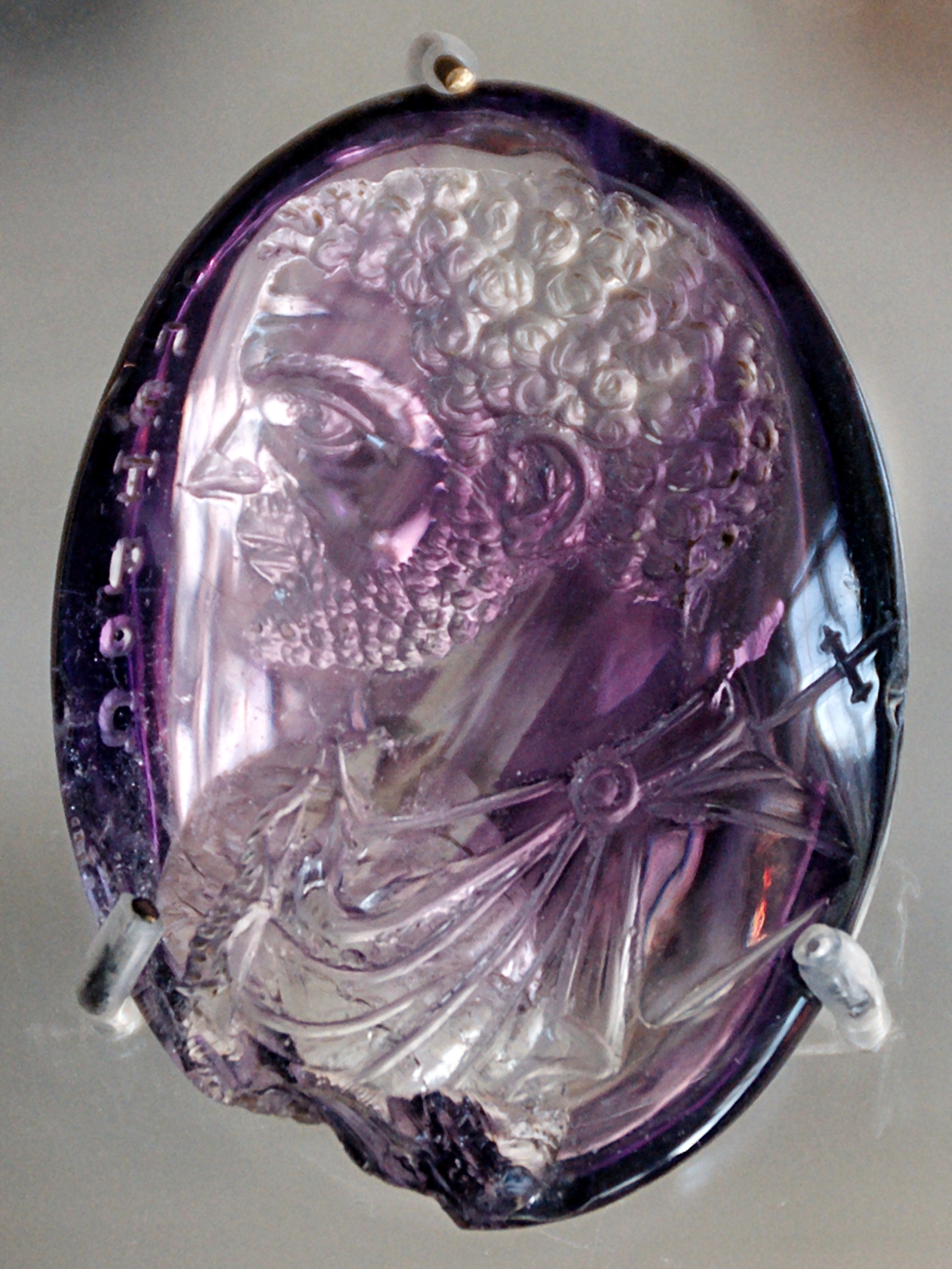
An engraved gem, frequently referred to as an intaglio, is a small and usually semi-precious gemstone that has been carved, in the Western tradition normally with images or inscriptions only on one face. The engraving of gemstones was a major luxury art form in the ancient world, and an important one in some later periods.
Strictly speaking, engraving means carving in intaglio (with the design cut into the flat background of the stone), but relief carvings (with the design projecting out of the background as in nearly all cameos) are also covered by the term. This article uses cameo in its strict sense, to denote a carving exploiting layers of differently coloured stone. The activity is also called gem carving and the artists gem-cutters. References to antique gems and intaglios in a jewellery context will almost always mean carved gems; when referring to monumental sculpture, the term counter-relief, meaning the same as intaglio, is more likely to be used. Vessels like the Cup of the Ptolemies and heads or figures carved in the round are also known as hardstone carvings.
Glyptics or glyptic art covers the field of small carved stones, including cylinder seals and inscriptions, especially in an archaeological context. Though they were keenly collected in antiquity, most carved gems originally functioned as seals, often mounted in a ring; intaglio designs register most clearly when viewed by the recipient of a letter as an impression in hardened wax. A finely carved seal was practical, as it made forgery more difficult – the distinctive personal signature did not really exist in antiquity.
Gems were mostly cut by using abrasive powder from harder stones in conjunction with a hand-drill, probably often set in a lathe. Emery has been mined for abrasive powder on Naxos since antiquity. Some early types of seal were cut by hand, rather than a drill, which does not allow fine detail. There is no evidence that magnifying lenses were used by gem cutters in antiquity. A medieval guide to gem-carving techniques survives from Theophilus Presbyter. Byzantine cutters used a flat-edged wheel on a drill for intaglio work, while Carolingian ones used round-tipped drills; it is unclear where they learnt this technique from. In intaglio gems at least, the recessed cut surface is usually very well preserved, and microscopic examination is revealing of the technique used. The colour of several gemstones can be enhanced by a number of artificial methods, using heat, sugar and dyes. Many of these can be shown to have been used since antiquity – since the 7th millennium BC in the case of heating.
The technique has an ancient tradition in the Near East, and is represented in all or most early cultures from the area, and the Indus Valley civilization. The cylinder seal, whose design appears only when it is rolled over damp clay, from which the flat ring type developed, was the usual form in Mesopotamia, Assyria and other cultures, and spread to the Aegean and Minoan world, including parts of Greece and Cyprus. These were made in various types of stone, not all hardstone, and gold rings were a related development in Minoan seals, which are often very fine. The Greek tradition emerged in Ancient Greek art under Minoan influence on mainland Helladic culture, and reached an apogee of subtlety and refinement in the Hellenistic period. Pre-Hellenic Ancient Egyptian seals tend to have inscriptions in hieroglyphs rather than images. The biblical Book of Exodus describes the form of the hoshen, a ceremonial breastplate worn by the high priest, bearing twelve gems engraved with the names of the Twelve tribes of Israel.
Round or oval Greek gems (along with similar objects in bone and ivory) are found from the 8th and 7th centuries BC, usually with animals in energetic geometric poses, often with a border marked by dots or a rim. Early examples are mostly in softer stones. Gems of the 6th century are more often oval, with a scarab back (in the past this type was called a "scarabaeus"), and human or divine figures as well as animals; the scarab form was apparently adopted from Phoenicia. The forms are sophisticated for the period, despite the usually small size of the gems. In the 5th century gems became somewhat larger, but still only 2-3 centimetres tall. Despite this, very fine detail is shown, including the eyelashes on one male head, perhaps a portrait. Four gems signed by Dexamenos of Chios are the finest of the period, two showing herons.
Relief carving became common in 5th century BC Greece, and gradually most of the spectacular carved gems in the Western tradition were in relief, although the Sassanian and other traditions remained faithful to the intaglio form. Generally a relief image is more impressive than an intaglio one; in the earlier form the recipient of a document saw this in the impressed sealing wax, while in the later reliefs it was the owner of the seal who kept it for himself, probably marking the emergence of gems meant to be collected or worn as jewellery pendants in necklaces and the like, rather than used as seals – later ones are sometimes rather large to use to seal letters. However inscriptions are usually still in reverse ("mirror-writing") so they only read correctly on impressions (or by viewing from behind with transparent stones). This aspect also partly explains the collecting of impressions in plaster or wax from gems, which may be easier to appreciate than the original.
The cameo, which is rare in intaglio form, seems to have reached Greece around the 3rd century; the Farnese Tazza is the only major surviving Hellenistic example (depending on the date assigned to the Gonzaga Cameo – see below), but other glass-paste imitations with portraits suggest that gem-type cameos were made in this period. The conquests of Alexander the Great had opened up new trade routes to the Greek world and increased the range of gemstones available. Roman gems generally continued Hellenistic styles, and can be hard to date, until their quality sharply declines at the end of the 2nd century AD. Philosophers are sometimes shown; Cicero refers to people having portraits of their favourite on their cups and rings. The Romans invented cameo glass, best known from the Portland Vase, as a cheaper material for cameos, and one that allowed consistent and predictable layers on even round objects.
Hub AI
Engraved gem AI simulator
(@Engraved gem_simulator)
Engraved gem
An engraved gem, frequently referred to as an intaglio, is a small and usually semi-precious gemstone that has been carved, in the Western tradition normally with images or inscriptions only on one face. The engraving of gemstones was a major luxury art form in the ancient world, and an important one in some later periods.
Strictly speaking, engraving means carving in intaglio (with the design cut into the flat background of the stone), but relief carvings (with the design projecting out of the background as in nearly all cameos) are also covered by the term. This article uses cameo in its strict sense, to denote a carving exploiting layers of differently coloured stone. The activity is also called gem carving and the artists gem-cutters. References to antique gems and intaglios in a jewellery context will almost always mean carved gems; when referring to monumental sculpture, the term counter-relief, meaning the same as intaglio, is more likely to be used. Vessels like the Cup of the Ptolemies and heads or figures carved in the round are also known as hardstone carvings.
Glyptics or glyptic art covers the field of small carved stones, including cylinder seals and inscriptions, especially in an archaeological context. Though they were keenly collected in antiquity, most carved gems originally functioned as seals, often mounted in a ring; intaglio designs register most clearly when viewed by the recipient of a letter as an impression in hardened wax. A finely carved seal was practical, as it made forgery more difficult – the distinctive personal signature did not really exist in antiquity.
Gems were mostly cut by using abrasive powder from harder stones in conjunction with a hand-drill, probably often set in a lathe. Emery has been mined for abrasive powder on Naxos since antiquity. Some early types of seal were cut by hand, rather than a drill, which does not allow fine detail. There is no evidence that magnifying lenses were used by gem cutters in antiquity. A medieval guide to gem-carving techniques survives from Theophilus Presbyter. Byzantine cutters used a flat-edged wheel on a drill for intaglio work, while Carolingian ones used round-tipped drills; it is unclear where they learnt this technique from. In intaglio gems at least, the recessed cut surface is usually very well preserved, and microscopic examination is revealing of the technique used. The colour of several gemstones can be enhanced by a number of artificial methods, using heat, sugar and dyes. Many of these can be shown to have been used since antiquity – since the 7th millennium BC in the case of heating.
The technique has an ancient tradition in the Near East, and is represented in all or most early cultures from the area, and the Indus Valley civilization. The cylinder seal, whose design appears only when it is rolled over damp clay, from which the flat ring type developed, was the usual form in Mesopotamia, Assyria and other cultures, and spread to the Aegean and Minoan world, including parts of Greece and Cyprus. These were made in various types of stone, not all hardstone, and gold rings were a related development in Minoan seals, which are often very fine. The Greek tradition emerged in Ancient Greek art under Minoan influence on mainland Helladic culture, and reached an apogee of subtlety and refinement in the Hellenistic period. Pre-Hellenic Ancient Egyptian seals tend to have inscriptions in hieroglyphs rather than images. The biblical Book of Exodus describes the form of the hoshen, a ceremonial breastplate worn by the high priest, bearing twelve gems engraved with the names of the Twelve tribes of Israel.
Round or oval Greek gems (along with similar objects in bone and ivory) are found from the 8th and 7th centuries BC, usually with animals in energetic geometric poses, often with a border marked by dots or a rim. Early examples are mostly in softer stones. Gems of the 6th century are more often oval, with a scarab back (in the past this type was called a "scarabaeus"), and human or divine figures as well as animals; the scarab form was apparently adopted from Phoenicia. The forms are sophisticated for the period, despite the usually small size of the gems. In the 5th century gems became somewhat larger, but still only 2-3 centimetres tall. Despite this, very fine detail is shown, including the eyelashes on one male head, perhaps a portrait. Four gems signed by Dexamenos of Chios are the finest of the period, two showing herons.
Relief carving became common in 5th century BC Greece, and gradually most of the spectacular carved gems in the Western tradition were in relief, although the Sassanian and other traditions remained faithful to the intaglio form. Generally a relief image is more impressive than an intaglio one; in the earlier form the recipient of a document saw this in the impressed sealing wax, while in the later reliefs it was the owner of the seal who kept it for himself, probably marking the emergence of gems meant to be collected or worn as jewellery pendants in necklaces and the like, rather than used as seals – later ones are sometimes rather large to use to seal letters. However inscriptions are usually still in reverse ("mirror-writing") so they only read correctly on impressions (or by viewing from behind with transparent stones). This aspect also partly explains the collecting of impressions in plaster or wax from gems, which may be easier to appreciate than the original.
The cameo, which is rare in intaglio form, seems to have reached Greece around the 3rd century; the Farnese Tazza is the only major surviving Hellenistic example (depending on the date assigned to the Gonzaga Cameo – see below), but other glass-paste imitations with portraits suggest that gem-type cameos were made in this period. The conquests of Alexander the Great had opened up new trade routes to the Greek world and increased the range of gemstones available. Roman gems generally continued Hellenistic styles, and can be hard to date, until their quality sharply declines at the end of the 2nd century AD. Philosophers are sometimes shown; Cicero refers to people having portraits of their favourite on their cups and rings. The Romans invented cameo glass, best known from the Portland Vase, as a cheaper material for cameos, and one that allowed consistent and predictable layers on even round objects.
Recent media