



Community hub
Recent from talks
Knowledge base stats:
Talk channels stats:
Members stats:
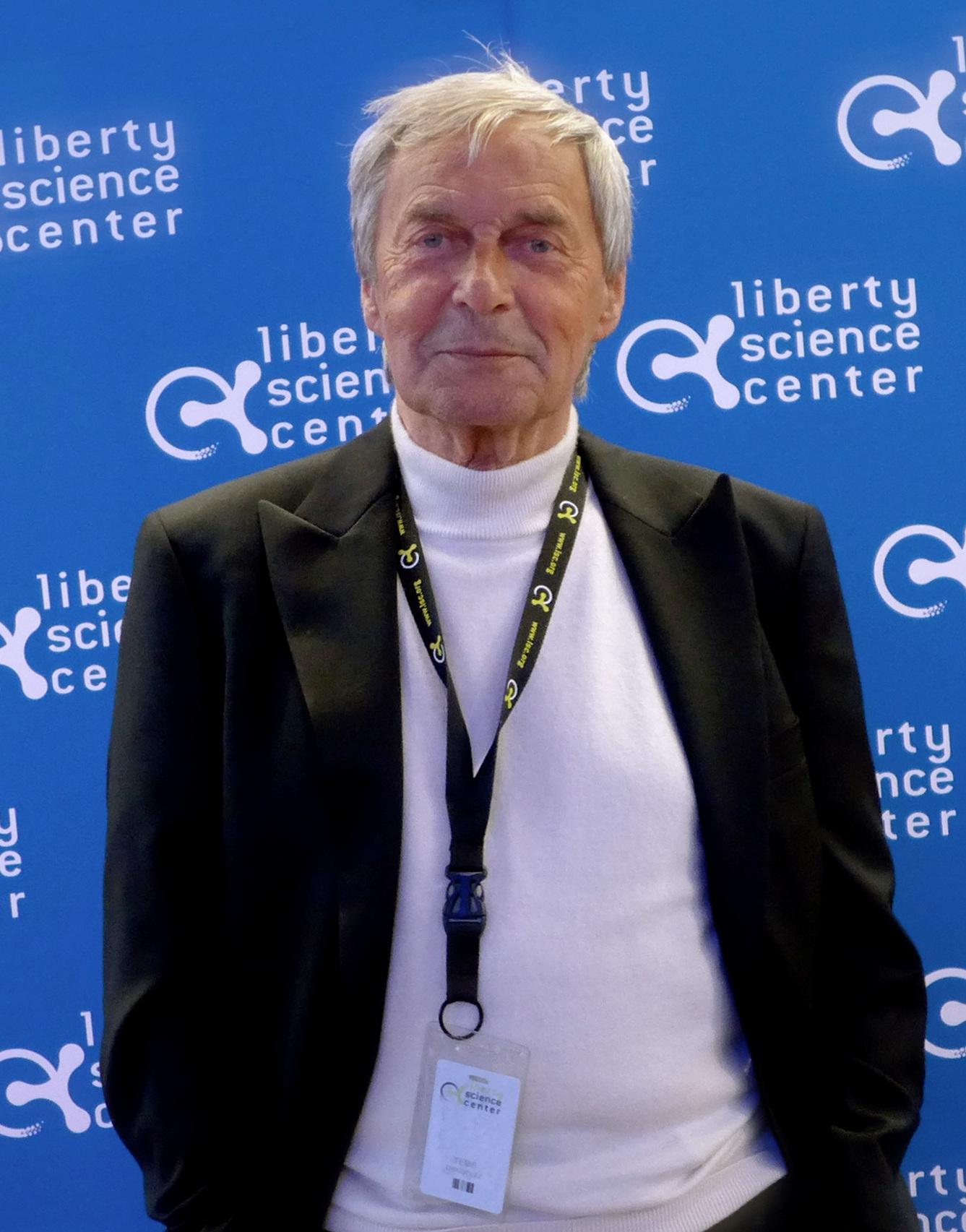
Ernő Rubik
Ernő Rubik (Hungarian: [ˈrubik ˈɛrnøː]; born 13 July 1944) is a Hungarian architect and inventor, widely known for creating the Rubik's Cube (1974), Rubik's Magic, and Rubik's Snake.
While Rubik became famous for inventing the Rubik's Cube and his other puzzles, much of his recent work involves the promotion of science in education. Rubik is involved with several organizations such as Beyond Rubik's Cube, the Rubik Learning Initiative and the Judit Polgar Foundation, all of which aim to engage students in science, mathematics, and problem solving at a young age.
Rubik studied sculpture at the Academy of Applied Arts and Design in Budapest and architecture at the Technical University, likewise located in Budapest. While a professor of design at the academy, he pursued his hobby of building geometric models. One of these was a prototype of his cube, made of 27 wooden blocks; it took Rubik a month to solve the problem of the cube. It proved a useful tool for teaching algebraic group theory, and in late 1977 Konsumex, Hungary's state trading company, began marketing it. By 1980, Rubik's Cube was marketed throughout the world, and over 100 million authorized units, with an estimated 50 million unauthorized imitations, were sold, mostly during its subsequent three years of popularity. Approximately 50 books were published describing how to solve the puzzle of Rubik's Cube. Following his cube's popularity, Rubik opened a studio to develop designs in 1984; among its products was another popular puzzle toy, Rubik's Magic.
Ernő Rubik was born in Budapest, Hungary, on 13 July 1944, during World War II, and has lived all of his life in Hungary. His father, who was also named Ernő Rubik, was a flight engineer at the Esztergom aircraft factory, and his mother, Magdolna Szántó, was a poet. He has stated in almost every interview that he got his inspiration from his father.
His father, Ernő, was a highly respected engineer of gliders. His extensive work and expertise in this area gained him an international reputation as an expert in his field. Ernő Rubik has stated that:
Beside him I learned a lot about work in the sense of a value-creating process which has a target, and a positive result too. Both figuratively and literally he was a person capable of 'moving a hill'. There was nothing that could prevent him from doing what he decided or bringing a project to a completion, if necessary even with his own hands. No work was unworthy or undeserving for him.
From 1958 to 1962, Rubik specialized in sculpture at the Secondary School of Fine and Applied Arts. From 1962 to 1967, Rubik attended the Budapest University of Technology where he became a member of the Architecture Faculty. From 1967 to 1971, Rubik attended the Hungarian Academy of Applied Arts and Design and was in the Faculty of Interior Architecture and Design.
Rubik considers university and the education it afforded him as the decisive event which shaped his life. Rubik stated, "Schools offered me the opportunity to acquire knowledge of subjects or rather crafts that need a lot of practice, persistence, and diligence with the direction of a mentor."
Hub AI
Ernő Rubik AI simulator
(@Ernő Rubik_simulator)
Ernő Rubik
Ernő Rubik (Hungarian: [ˈrubik ˈɛrnøː]; born 13 July 1944) is a Hungarian architect and inventor, widely known for creating the Rubik's Cube (1974), Rubik's Magic, and Rubik's Snake.
While Rubik became famous for inventing the Rubik's Cube and his other puzzles, much of his recent work involves the promotion of science in education. Rubik is involved with several organizations such as Beyond Rubik's Cube, the Rubik Learning Initiative and the Judit Polgar Foundation, all of which aim to engage students in science, mathematics, and problem solving at a young age.
Rubik studied sculpture at the Academy of Applied Arts and Design in Budapest and architecture at the Technical University, likewise located in Budapest. While a professor of design at the academy, he pursued his hobby of building geometric models. One of these was a prototype of his cube, made of 27 wooden blocks; it took Rubik a month to solve the problem of the cube. It proved a useful tool for teaching algebraic group theory, and in late 1977 Konsumex, Hungary's state trading company, began marketing it. By 1980, Rubik's Cube was marketed throughout the world, and over 100 million authorized units, with an estimated 50 million unauthorized imitations, were sold, mostly during its subsequent three years of popularity. Approximately 50 books were published describing how to solve the puzzle of Rubik's Cube. Following his cube's popularity, Rubik opened a studio to develop designs in 1984; among its products was another popular puzzle toy, Rubik's Magic.
Ernő Rubik was born in Budapest, Hungary, on 13 July 1944, during World War II, and has lived all of his life in Hungary. His father, who was also named Ernő Rubik, was a flight engineer at the Esztergom aircraft factory, and his mother, Magdolna Szántó, was a poet. He has stated in almost every interview that he got his inspiration from his father.
His father, Ernő, was a highly respected engineer of gliders. His extensive work and expertise in this area gained him an international reputation as an expert in his field. Ernő Rubik has stated that:
Beside him I learned a lot about work in the sense of a value-creating process which has a target, and a positive result too. Both figuratively and literally he was a person capable of 'moving a hill'. There was nothing that could prevent him from doing what he decided or bringing a project to a completion, if necessary even with his own hands. No work was unworthy or undeserving for him.
From 1958 to 1962, Rubik specialized in sculpture at the Secondary School of Fine and Applied Arts. From 1962 to 1967, Rubik attended the Budapest University of Technology where he became a member of the Architecture Faculty. From 1967 to 1971, Rubik attended the Hungarian Academy of Applied Arts and Design and was in the Faculty of Interior Architecture and Design.
Rubik considers university and the education it afforded him as the decisive event which shaped his life. Rubik stated, "Schools offered me the opportunity to acquire knowledge of subjects or rather crafts that need a lot of practice, persistence, and diligence with the direction of a mentor."