


Community hub
Recent from talks
Contribute something
Nothing was collected or created yet.
Eta Leonis
View on Wikipedia  | |
| Observation data Epoch J2000 Equinox J2000 | |
|---|---|
| Constellation | Leo |
| Right ascension | 10h 07m 19.9519s[1] |
| Declination | +16° 45′ 45.592″[1] |
| Apparent magnitude (V) | 3.486[2] |
| Characteristics | |
| Evolutionary stage | Blue supergiant (blue loop)[3] |
| Spectral type | A0 Ib[2] |
| U−B color index | −0.206[2] |
| B−V color index | −0.026[2] |
| Astrometry | |
| Radial velocity (Rv) | 1.40[4] km/s |
| Proper motion (μ) | RA: −2.80[1] mas/yr Dec.: −1.82[1] mas/yr |
| Parallax (π) | 2.57±0.16 mas[1] |
| Distance | 1,270 ± 80 ly (390 ± 20 pc) |
| Absolute magnitude (MV) | −5.54[3] |
| Details | |
| Mass | 10[5] M☉ |
| Radius | 47[3] R☉ |
| Luminosity | 19,000[5] L☉ |
| Surface gravity (log g) | 2.00[5] cgs |
| Temperature | 9,600[2] K |
| Metallicity | −0.04[3] |
| Rotational velocity (v sin i) | 2[2] km/s |
| Age | 25[5] Myr |
| Other designations | |
| η Leo, 30 Leonis, HR 3975, BD+17°2171, HD 87737, FK5 379, HIP 49583, SAO 98955, GC 13899 | |
| Database references | |
| SIMBAD | data |
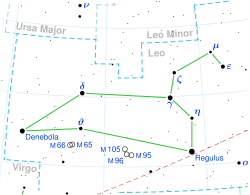
Eta Leonis (η Leo, η Leonis) is a third-magnitude blue supergiant star in the constellation Leo, about 1,270 light years away.
Nomenclature
[edit]With Regulus, γ Leonis (Algieba), and ζ Leonis (Adhafera), it formed the Arabic lunar mansion Al Jabhah, the forehead (of the lion).[6] Some sources apply the name Al Jabhah to this star specifically,[7] though the name Algieba for γ Leonis has the same etymology.[8]
Properties
[edit]Eta Leonis is a blue supergiant with the stellar classification A0Ib. Since 1943, the spectrum of this star has served as one of the stable anchor points by which other stars are classified.[9] Though its apparent magnitude is 3.5, making it a relatively dim star to the naked eye, it is nearly 20,000 times more luminous than the Sun, with an absolute magnitude of -5.60. The Hipparcos astrometric data has estimated the distance of Eta Leonis to be roughly 390 parsecs from Earth, or 1,270 light years away. It is believed to be in a blue loop phase.[3]
Eta Leonis is apparently a multiple star system, but the number of components and their separation is uncertain.[10]
References
[edit]- ^ a b c d e Van Leeuwen, F. (2007). "Validation of the new Hipparcos reduction". Astronomy and Astrophysics. 474 (2): 653–664. arXiv:0708.1752. Bibcode:2007A&A...474..653V. doi:10.1051/0004-6361:20078357. S2CID 18759600.
- ^ a b c d e f Firnstein, M.; Przybilla, N. (2012). "Quantitative spectroscopy of Galactic BA-type supergiants. I. Atmospheric parameters". Astronomy & Astrophysics. 543: A80. arXiv:1207.0308. Bibcode:2012A&A...543A..80F. doi:10.1051/0004-6361/201219034. S2CID 54725386.
- ^ a b c d e Przybilla, N.; Butler, K.; Becker, S. R.; Kudritzki, R. P. (2006). "Quantitative spectroscopy of BA-type supergiants". Astronomy and Astrophysics. 445 (3): 1099. arXiv:astro-ph/0509669. Bibcode:2006A&A...445.1099P. doi:10.1051/0004-6361:20053832. S2CID 118953817.
- ^ Gontcharov, G. A. (2006). "Pulkovo Compilation of Radial Velocities for 35 495 Hipparcos stars in a common system". Astronomy Letters. 32 (11): 759–771. arXiv:1606.08053. Bibcode:2006AstL...32..759G. doi:10.1134/S1063773706110065. S2CID 119231169.
- ^ a b c d Tanrıverdi, Taner (2013). "Elemental abundances of the supergiant stars σ Cygnus and η Leonis". New Astronomy. 25: 50. arXiv:1512.04557. Bibcode:2013NewA...25...50T. doi:10.1016/j.newast.2013.03.013. S2CID 118525375.
- ^ Allen, R. H. (1899), Star Names: Their Lore and Meaning, p. 257
- ^ Rhoads, Jack W. (November 15, 1971), Technical Memorandum 33-507-A Reduced Star Catalog Containing 537 Named Stars (PDF), Jet Propulsion Laboratory, California Institute of Technology.
- ^ Ridpath, Ian. "Star Tales - Leo". Retrieved 28 July 2025.
- ^ Garrison, R. F. (December 1993). "Anchor Points for the MK System of Spectral Classification". Bulletin of the American Astronomical Society. 25: 1319. Bibcode:1993AAS...183.1710G.
- ^ Mason, Brian D. (1996). "ICCD Speckle Observations of Binary Stars.XV.An Investigation of Lunar Occultation Systems". The Astronomical Journal. 112: 2260. Bibcode:1996AJ....112.2260M. doi:10.1086/118179.
External links
[edit]- Jim Kaler's Stars: Eta Leonis
