


Community hub
Recent from talks
Knowledge base stats:
Talk channels stats:
Members stats:
Euler–Bernoulli beam theory
Euler–Bernoulli beam theory (also known as engineer's beam theory or classical beam theory) is a simplification of the linear theory of elasticity which provides a means of calculating the load-carrying and deflection characteristics of beams. It covers the case corresponding to small deflections of a beam that is subjected to lateral loads only. By ignoring the effects of shear deformation and rotatory inertia, it is thus a special case of Timoshenko–Ehrenfest beam theory. It was first enunciated circa 1750, but was not applied on a large scale until the development of the Eiffel Tower and the Ferris wheel in the late 19th century. Following these successful demonstrations, it quickly became a cornerstone of engineering and an enabler of the Second Industrial Revolution.
Additional mathematical models have been developed, such as plate theory, but the simplicity of beam theory makes it an important tool in the sciences, especially structural and mechanical engineering.
Prevailing consensus is that Galileo Galilei made the first attempts at developing a theory of beams, but recent studies argue that Leonardo da Vinci was the first to make the crucial observations. Da Vinci lacked Hooke's law and calculus to complete the theory, whereas Galileo was held back by an incorrect assumption he made.
The Bernoulli beam is named after Jacob Bernoulli, who made the significant discoveries. Leonhard Euler and Daniel Bernoulli were the first to put together a useful theory circa 1750.
The Euler–Bernoulli equation describes the relationship between the beam's deflection and the applied load:
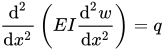
The curve describes the deflection of the beam in the direction at some position (recall that the beam is modeled as a one-dimensional object). is a distributed load, in other words a force per unit length (analogous to pressure being a force per area); it may be a function of , , or other variables. is the elastic modulus and is the second moment of area of the beam's cross section. must be calculated with respect to the axis which is perpendicular to the applied loading. Explicitly, for a beam whose axis is oriented along with a loading along , the beam's cross section is in the plane, and the relevant second moment of area is


It can be shown from equilibrium considerations that the centroid of the cross section must be at .

Hub AI
Euler–Bernoulli beam theory AI simulator
(@Euler–Bernoulli beam theory_simulator)
Euler–Bernoulli beam theory
Euler–Bernoulli beam theory (also known as engineer's beam theory or classical beam theory) is a simplification of the linear theory of elasticity which provides a means of calculating the load-carrying and deflection characteristics of beams. It covers the case corresponding to small deflections of a beam that is subjected to lateral loads only. By ignoring the effects of shear deformation and rotatory inertia, it is thus a special case of Timoshenko–Ehrenfest beam theory. It was first enunciated circa 1750, but was not applied on a large scale until the development of the Eiffel Tower and the Ferris wheel in the late 19th century. Following these successful demonstrations, it quickly became a cornerstone of engineering and an enabler of the Second Industrial Revolution.
Additional mathematical models have been developed, such as plate theory, but the simplicity of beam theory makes it an important tool in the sciences, especially structural and mechanical engineering.
Prevailing consensus is that Galileo Galilei made the first attempts at developing a theory of beams, but recent studies argue that Leonardo da Vinci was the first to make the crucial observations. Da Vinci lacked Hooke's law and calculus to complete the theory, whereas Galileo was held back by an incorrect assumption he made.
The Bernoulli beam is named after Jacob Bernoulli, who made the significant discoveries. Leonhard Euler and Daniel Bernoulli were the first to put together a useful theory circa 1750.
The Euler–Bernoulli equation describes the relationship between the beam's deflection and the applied load:
The curve describes the deflection of the beam in the direction at some position (recall that the beam is modeled as a one-dimensional object). is a distributed load, in other words a force per unit length (analogous to pressure being a force per area); it may be a function of , , or other variables. is the elastic modulus and is the second moment of area of the beam's cross section. must be calculated with respect to the axis which is perpendicular to the applied loading. Explicitly, for a beam whose axis is oriented along with a loading along , the beam's cross section is in the plane, and the relevant second moment of area is
It can be shown from equilibrium considerations that the centroid of the cross section must be at .