



Community hub
Recent from talks
Knowledge base stats:
Talk channels stats:
Members stats:
Gnome Monosoupape
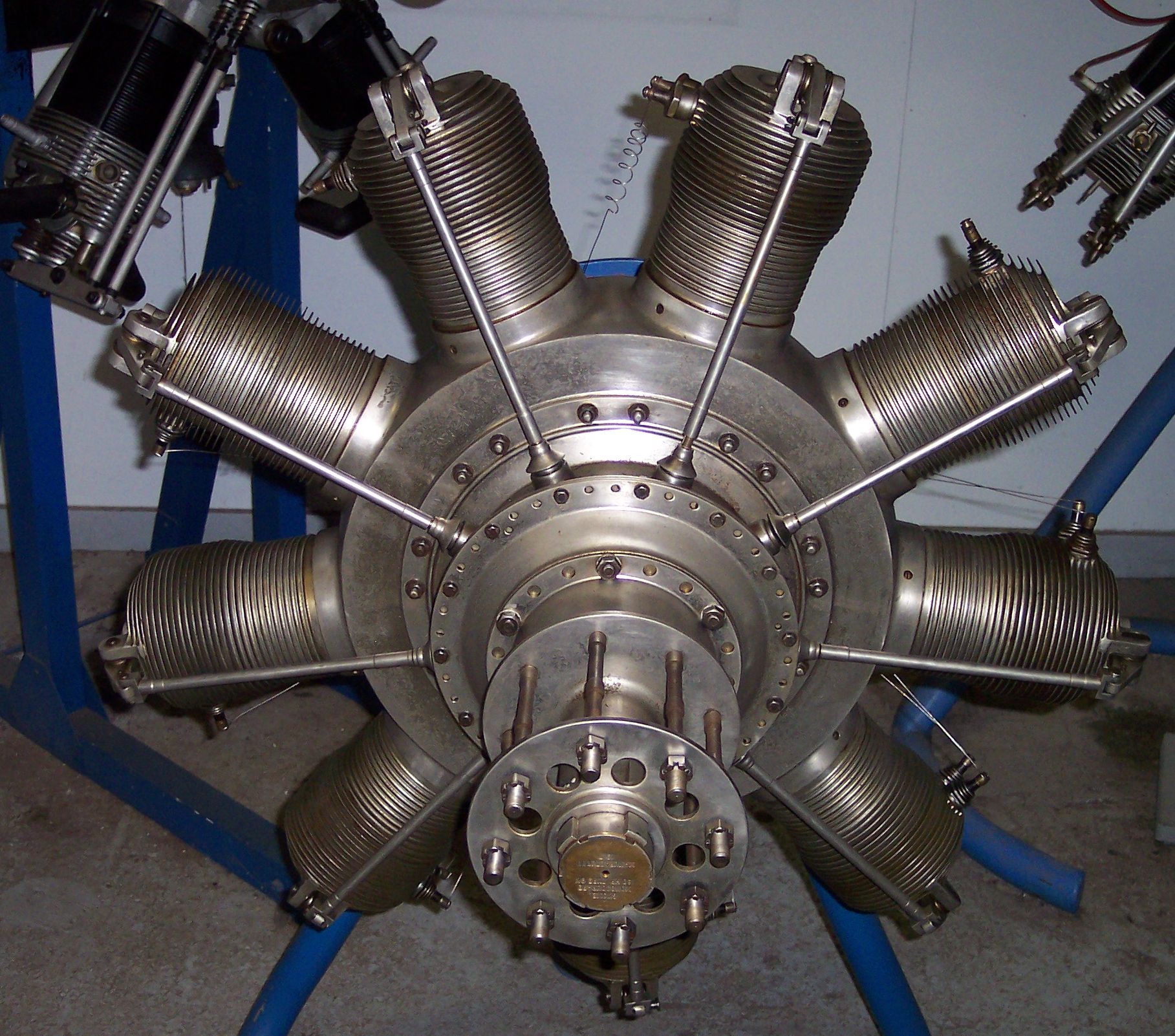
The Monosoupape (French for single-valve), is a rotary engine design first introduced in 1913 by Gnome Engine Company (renamed Gnome et Rhône in 1915). It uses an arrangement of internal transfer ports to replace the automatic centre-piston inlet valve found on earlier Gnome engines. The elimination of the inlet valve removed a common source of engine failure but also resulted in increased fuel consumption.
French aircraft manufacturers ordered relatively few Monosoupape engines preferring other types including Gnome et Rhône's own Le Rhône series. 2,188 Monosoupape engines were manufactured in Britain, with additional licensed production taking place in Italy and the United States.
British aircraft designer Thomas Sopwith described the Monosoupape as "one of the greatest single advances in aviation". However the type was also criticised for its poor reliability with Royal Flying Corps commander Hugh Trenchard describing it as a "beast of an engine".
Unlike other rotaries, the early Gnome engines like the Gnome Omega, Lambda and Delta used a unique arrangement of valves in order to eliminate pushrods that operated during the inlet phase of the combustion cycle on more conventional engines. Instead, a single exhaust valve on the cylinder head was operated by a pushrod that opened the valve when the pressure dropped at the end of the power stroke. A pressure-operated inlet valve, which was balanced by a counterweight to equalize the centrifugal forces, was placed in the centre of the piston crown, where it opened to allow the fuel–air charge to enter from the engine's central crankcase.
Although ingenious, the system had several drawbacks: the cylinder heads had to be removed to perform maintenance of the intake valves, and to adjust the timing correctly. Fuel economy suffered in comparison to other rotaries because the inlet valves could not be opened and closed at the ideal times.
In 1913, Louis Seguin and his brother Laurent (engineers who founded the Société Des Moteurs Gnome [the Gnome motor company] in 1905) introduced the new Monosoupape series, which eliminated the inlet valve, replacing it with piston-controlled transfer ports similar to those found in a two-stroke engine. Beginning with the power stroke, the four-stroke engine operated normally until the piston had traveled half way to the bottom of its stroke (bottom dead center, or BDC), when the exhaust valve was opened "early". This let the still-hot burnt combustion gases "pop" out of the engine while the piston was still moving down, relieving exhaust pressure and preventing exhaust gases from entering the crankcase. After a small additional amount of travel, the piston uncovered 36 small ports around the base of the cylinder, leading to the crankcase which held additional fuel–air mixture (the charge). No transfer took place at this point since there was no pressure differential; the cylinder was still open to the air and thus at ambient pressure. The overhead valve exhausted directly into the slipstream since no exhaust manifold could be practically fitted to the spinning crankcase and cylinders.
During the exhaust stroke, scavenging occurred as the air moving past the cylinder exterior lowered the pressure inside due to the direct exposure of the exhaust port to the slipstream. The piston continued its exhaust stroke until top dead center (TDC) was reached, but the valve remained open. The piston began to move down on its intake stroke with the valve still open, pulling new air into the cylinder. It remained open until it was three quarters of the way down, at which point the valve closed and the remainder of the intake stroke greatly reduced the air pressure. When the piston uncovered the transfer ports again, the low pressure in the cylinder drew in the balance of the charge.
The charge was an overly rich mixture of air, which was acquired through the hollow crankshaft, and fuel that was continuously injected by a fuel nozzle on the end of a fuel line, entering the crankcase through the hollow crankshaft. The nozzle was in the proximity of, and aimed at, the inside base of the cylinder where the transfer ports were located. The fuel nozzle was stationary with the crankshaft, and the cylinders rotated into position in turn. The compression stroke was conventional.
Hub AI
Gnome Monosoupape AI simulator
(@Gnome Monosoupape_simulator)
Gnome Monosoupape
The Monosoupape (French for single-valve), is a rotary engine design first introduced in 1913 by Gnome Engine Company (renamed Gnome et Rhône in 1915). It uses an arrangement of internal transfer ports to replace the automatic centre-piston inlet valve found on earlier Gnome engines. The elimination of the inlet valve removed a common source of engine failure but also resulted in increased fuel consumption.
French aircraft manufacturers ordered relatively few Monosoupape engines preferring other types including Gnome et Rhône's own Le Rhône series. 2,188 Monosoupape engines were manufactured in Britain, with additional licensed production taking place in Italy and the United States.
British aircraft designer Thomas Sopwith described the Monosoupape as "one of the greatest single advances in aviation". However the type was also criticised for its poor reliability with Royal Flying Corps commander Hugh Trenchard describing it as a "beast of an engine".
Unlike other rotaries, the early Gnome engines like the Gnome Omega, Lambda and Delta used a unique arrangement of valves in order to eliminate pushrods that operated during the inlet phase of the combustion cycle on more conventional engines. Instead, a single exhaust valve on the cylinder head was operated by a pushrod that opened the valve when the pressure dropped at the end of the power stroke. A pressure-operated inlet valve, which was balanced by a counterweight to equalize the centrifugal forces, was placed in the centre of the piston crown, where it opened to allow the fuel–air charge to enter from the engine's central crankcase.
Although ingenious, the system had several drawbacks: the cylinder heads had to be removed to perform maintenance of the intake valves, and to adjust the timing correctly. Fuel economy suffered in comparison to other rotaries because the inlet valves could not be opened and closed at the ideal times.
In 1913, Louis Seguin and his brother Laurent (engineers who founded the Société Des Moteurs Gnome [the Gnome motor company] in 1905) introduced the new Monosoupape series, which eliminated the inlet valve, replacing it with piston-controlled transfer ports similar to those found in a two-stroke engine. Beginning with the power stroke, the four-stroke engine operated normally until the piston had traveled half way to the bottom of its stroke (bottom dead center, or BDC), when the exhaust valve was opened "early". This let the still-hot burnt combustion gases "pop" out of the engine while the piston was still moving down, relieving exhaust pressure and preventing exhaust gases from entering the crankcase. After a small additional amount of travel, the piston uncovered 36 small ports around the base of the cylinder, leading to the crankcase which held additional fuel–air mixture (the charge). No transfer took place at this point since there was no pressure differential; the cylinder was still open to the air and thus at ambient pressure. The overhead valve exhausted directly into the slipstream since no exhaust manifold could be practically fitted to the spinning crankcase and cylinders.
During the exhaust stroke, scavenging occurred as the air moving past the cylinder exterior lowered the pressure inside due to the direct exposure of the exhaust port to the slipstream. The piston continued its exhaust stroke until top dead center (TDC) was reached, but the valve remained open. The piston began to move down on its intake stroke with the valve still open, pulling new air into the cylinder. It remained open until it was three quarters of the way down, at which point the valve closed and the remainder of the intake stroke greatly reduced the air pressure. When the piston uncovered the transfer ports again, the low pressure in the cylinder drew in the balance of the charge.
The charge was an overly rich mixture of air, which was acquired through the hollow crankshaft, and fuel that was continuously injected by a fuel nozzle on the end of a fuel line, entering the crankcase through the hollow crankshaft. The nozzle was in the proximity of, and aimed at, the inside base of the cylinder where the transfer ports were located. The fuel nozzle was stationary with the crankshaft, and the cylinders rotated into position in turn. The compression stroke was conventional.