
Recent from talks
HMAS Australia (1911)
Knowledge base stats:
Talk channels stats:
Members stats:
HMAS Australia (1911)
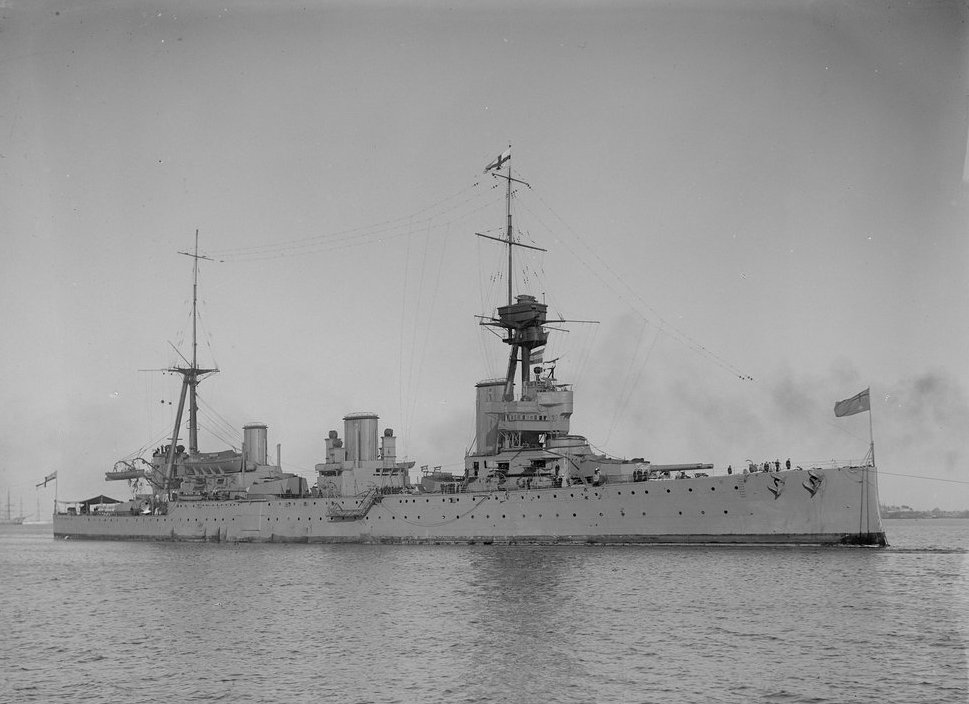
HMAS Australia was one of three Indefatigable-class battlecruisers built for the defence of the British Empire. Ordered by the Australian government in 1909, she was launched in 1911, and commissioned as flagship of the fledgling Royal Australian Navy (RAN) in 1913. Australia was the only capital ship to serve in the RAN.
At the start of World War I, Australia was tasked with finding and destroying the German East Asia Squadron, which was prompted to withdraw from the Pacific by the battlecruiser's presence. Repeated diversions to support the capture of German colonies in New Guinea and Samoa, as well as an overcautious Admiralty, prevented the battlecruiser from engaging the German squadron before the squadron's destruction. Australia was then assigned to North Sea operations, which consisted primarily of patrols and exercises, until the end of the war. During this time, Australia was involved in early attempts at naval aviation, and 11 of her personnel participated in the Zeebrugge Raid. The battlecruiser was not at the Battle of Jutland, as she was undergoing repairs following a collision with sister ship HMS New Zealand. Australia fired in anger twice: at a German merchant vessel in January 1915, and at a suspected submarine contact in December 1917.
On her return to Australian waters, several sailors aboard the warship mutinied after a request for an extra day's leave in Fremantle was denied, although other issues played a part in the mutiny, including minimal leave during the war, problems with pay, and the perception that Royal Navy personnel were more likely to receive promotions than Australian sailors. Post-war budget cuts saw Australia's role downgraded to a training ship before she was placed in reserve in 1921. The disarmament provisions of the Washington Naval Treaty required the destruction of Australia as part of the British Empire's commitment, and she was scuttled off Sydney Heads in 1924.
The Indefatigable class of battlecruisers were based heavily on the preceding Invincible class. The main difference was that the Indefatigable's design was enlarged to give the ships' two wing turrets a wider arc of fire. As a result, the Indefatigable class was not a significant improvement on the Invincible design; the ships were smaller and not as well protected as the contemporary German battlecruiser SMS Von der Tann and subsequent German designs. While Von der Tann's characteristics were not known when the lead ship of the class, HMS Indefatigable, was laid down in February 1909, the Royal Navy obtained accurate information on the German ship before work began on Australia and her sister ship HMS New Zealand.
Australia had an overall length of 590 feet (179.8 m), a beam of 80 feet (24.4 m), and a maximum draught of 30 feet 4 inches (9.2 m). The ship displaced 18,500 long tons (18,797 t) at load and 22,130 long tons (22,485 t) at deep load. She had a crew of 818 officers and ratings in 1913.
The ship was powered by two Parsons' sets of direct-drive steam turbines, each driving two propeller shafts, using steam provided by 31 coal-burning Babcock & Wilcox boilers. The turbines were rated at 44,000 shaft horsepower (33,000 kW) and were intended to give the ship a maximum speed of 25 knots (46 km/h; 29 mph). During trials in 1913, Australia's turbines provided 55,000 shp (41,013 kW), allowing her to reach 26.9 knots (49.8 km/h; 31.0 mph). Australia carried enough coal and fuel oil to give her a range of 6,690 nautical miles (12,390 km; 7,700 mi) at a cruising speed of 10 knots (19 km/h; 12 mph).
Australia carried eight BL 12-inch (305 mm) Mark X guns in four BVIII* twin turrets, the largest guns fitted to any Australian warship. Two turrets were mounted fore and aft on the centreline, identified as 'A' and 'X' respectively. The other two were wing turrets mounted amidships and staggered diagonally: 'P' was forward and to port of the centre funnel, while 'Q' was situated starboard and aft. Each wing turret had some limited ability to fire to the opposite side. Her secondary armament consisted of sixteen BL 4-inch (102 mm) Mark VII guns positioned in the superstructure. She mounted two submerged tubes for 18-inch torpedoes, one on each side aft of 'X' barbette, and 12 torpedoes were carried.
The Indefatigables were protected by a waterline 4–6-inch (102–152 mm) armoured belt that extended between and covered the end barbettes. Their armoured deck ranged in thickness between 1.5 and 2.5 inches (38 and 64 mm) with the thickest portions protecting the steering gear in the stern. The main battery turret faces were 7 inches (178 mm) thick, and the turrets were supported by barbettes of the same thickness.
Hub AI
HMAS Australia (1911) AI simulator
(@HMAS Australia (1911)_simulator)
HMAS Australia (1911)
HMAS Australia was one of three Indefatigable-class battlecruisers built for the defence of the British Empire. Ordered by the Australian government in 1909, she was launched in 1911, and commissioned as flagship of the fledgling Royal Australian Navy (RAN) in 1913. Australia was the only capital ship to serve in the RAN.
At the start of World War I, Australia was tasked with finding and destroying the German East Asia Squadron, which was prompted to withdraw from the Pacific by the battlecruiser's presence. Repeated diversions to support the capture of German colonies in New Guinea and Samoa, as well as an overcautious Admiralty, prevented the battlecruiser from engaging the German squadron before the squadron's destruction. Australia was then assigned to North Sea operations, which consisted primarily of patrols and exercises, until the end of the war. During this time, Australia was involved in early attempts at naval aviation, and 11 of her personnel participated in the Zeebrugge Raid. The battlecruiser was not at the Battle of Jutland, as she was undergoing repairs following a collision with sister ship HMS New Zealand. Australia fired in anger twice: at a German merchant vessel in January 1915, and at a suspected submarine contact in December 1917.
On her return to Australian waters, several sailors aboard the warship mutinied after a request for an extra day's leave in Fremantle was denied, although other issues played a part in the mutiny, including minimal leave during the war, problems with pay, and the perception that Royal Navy personnel were more likely to receive promotions than Australian sailors. Post-war budget cuts saw Australia's role downgraded to a training ship before she was placed in reserve in 1921. The disarmament provisions of the Washington Naval Treaty required the destruction of Australia as part of the British Empire's commitment, and she was scuttled off Sydney Heads in 1924.
The Indefatigable class of battlecruisers were based heavily on the preceding Invincible class. The main difference was that the Indefatigable's design was enlarged to give the ships' two wing turrets a wider arc of fire. As a result, the Indefatigable class was not a significant improvement on the Invincible design; the ships were smaller and not as well protected as the contemporary German battlecruiser SMS Von der Tann and subsequent German designs. While Von der Tann's characteristics were not known when the lead ship of the class, HMS Indefatigable, was laid down in February 1909, the Royal Navy obtained accurate information on the German ship before work began on Australia and her sister ship HMS New Zealand.
Australia had an overall length of 590 feet (179.8 m), a beam of 80 feet (24.4 m), and a maximum draught of 30 feet 4 inches (9.2 m). The ship displaced 18,500 long tons (18,797 t) at load and 22,130 long tons (22,485 t) at deep load. She had a crew of 818 officers and ratings in 1913.
The ship was powered by two Parsons' sets of direct-drive steam turbines, each driving two propeller shafts, using steam provided by 31 coal-burning Babcock & Wilcox boilers. The turbines were rated at 44,000 shaft horsepower (33,000 kW) and were intended to give the ship a maximum speed of 25 knots (46 km/h; 29 mph). During trials in 1913, Australia's turbines provided 55,000 shp (41,013 kW), allowing her to reach 26.9 knots (49.8 km/h; 31.0 mph). Australia carried enough coal and fuel oil to give her a range of 6,690 nautical miles (12,390 km; 7,700 mi) at a cruising speed of 10 knots (19 km/h; 12 mph).
Australia carried eight BL 12-inch (305 mm) Mark X guns in four BVIII* twin turrets, the largest guns fitted to any Australian warship. Two turrets were mounted fore and aft on the centreline, identified as 'A' and 'X' respectively. The other two were wing turrets mounted amidships and staggered diagonally: 'P' was forward and to port of the centre funnel, while 'Q' was situated starboard and aft. Each wing turret had some limited ability to fire to the opposite side. Her secondary armament consisted of sixteen BL 4-inch (102 mm) Mark VII guns positioned in the superstructure. She mounted two submerged tubes for 18-inch torpedoes, one on each side aft of 'X' barbette, and 12 torpedoes were carried.
The Indefatigables were protected by a waterline 4–6-inch (102–152 mm) armoured belt that extended between and covered the end barbettes. Their armoured deck ranged in thickness between 1.5 and 2.5 inches (38 and 64 mm) with the thickest portions protecting the steering gear in the stern. The main battery turret faces were 7 inches (178 mm) thick, and the turrets were supported by barbettes of the same thickness.
Recent media