Hubbry Logo
search
logo
585245

Hexham wolf

logo
Community Hub0 Subscribers
Read side by side
from Wikipedia

Hexham wolf
Other nameThe Wolf of Allendale
SpeciesGray wolf
SexMale
Years active1904–1905
Known forKilling livestock, howling
OwnerCaptain Bain of Shotley Bridge (suspected)
AppearanceEither black and tan or dun, large
Named afterThe town near where he killed livestock

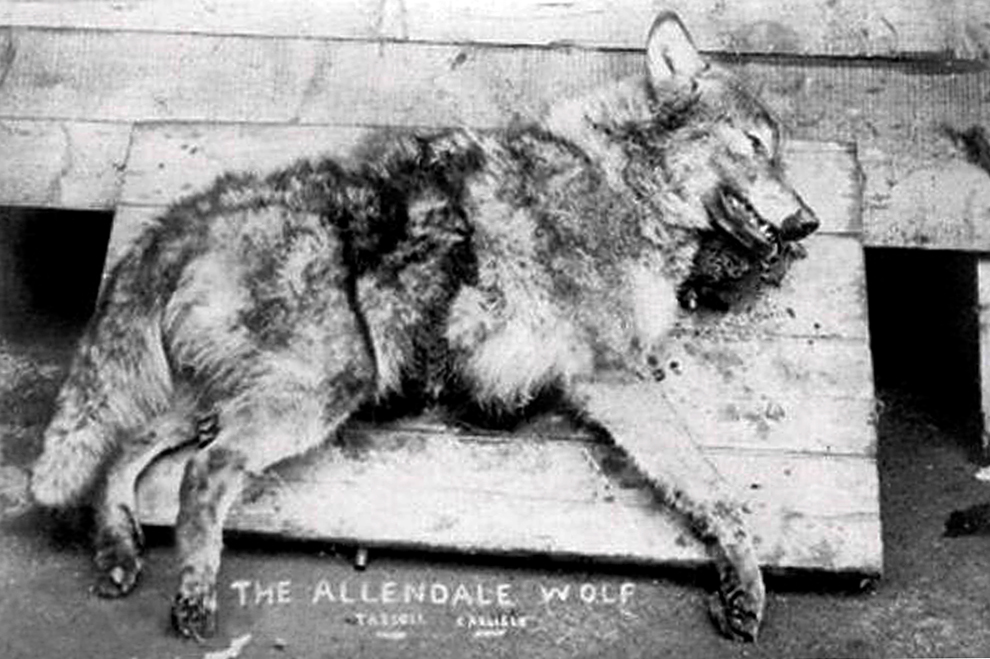
The Hexham wolf (also called the Allendale wolf or the Wolf of Allendale) was a grey wolf that escaped from a zoo and killed livestock in Hexham and Allendale, Northumberland during the winter of 1904.[1] Conflicting reports label it as being either "black and tan" or "dun", although it was largely reported as being large and male.[2]

On December 10th 1904, the Hexham Courant ran a story with the title "Wolf at Large in Allendale", reporting that over the past two to three weeks livestock loss in Hexham and Allendale had become so severe that some farmers were now housing animals in the night.[2] Though it was suspected that the livestock killer was an escaped wolf belonging to Captain Bain of Shotley Bridge, that wolf was too young to pose a threat, and a much larger wolf was spotted by Allenheads school.[2] On 9 December 1904, a grey wolf that had just committed a "great slaughter of a flock of sheep" was tracked for miles but escaped; the next day, he returned to his kill, and a new search party went out to no avail.[2]

The public of Northumberland began, then, to get anxious;[3] sheep were kept inside at night and lights were lit all night; rewards were offered to whoever could kill the wolf. A large meeting of farmers from the area was held on 20 December, chaired by the local MP Maj. Wentworth Henry Canning Beaumont and £5 reward was offered for the wolf's skin.[4] Subsequently, the Hexham Wolf Committee was set up to help find the wolf.[2] On 29 December 1904, some platelayers found the carcass of an animal cut in two by a passing train and thrown a distance of 40 yards. They buried the animal, but later after discussing it with the Stationmaster at Cumwhinton, dug it up again and bought it back to the station where a member of the Hexham Wolf Committee identified it as a full-grown grey male wolf.[5] Captain Bain declared the wolf too old to be his and it was proclaimed on 7 January 1905 that the wolf found was not the Hexham wolf, who was still at large.[2] By the end of January 1905, interest was waning in stories of the Hexham wolf, newspapers pushing it further back until it disappeared altogether.[2]

When the Hexham Heads were discovered in 1971, the werewolf sightings that resulted were thought to be the Hexham wolf.[6]

Allendale Wolf in Dalek's clothing

In 2014 the Allen Valleys Folk Festival was started and this features the burning of a wooden sculpture of the "Allendale Wolf".[7] One year the wolf gained Dalek features[8] after a campaign to support the Museum of Classic Sci-Fi who were being threatened by the planning authorities.[9]

See also

[edit]

References

[edit]
[edit]
Revisions and contributorsEdit on WikipediaRead on Wikipedia
from Grokipedia
The Hexham wolf, also known as the Allendale wolf, was a large grey male wolf that escaped from a private menagerie in Shotley Bridge, County Durham, in 1904 and proceeded to kill numerous sheep on the moors above Hexham and in the Allendale area of Northumberland, England, during the winter of that year.[1][2] The attacks began in October 1904, with the wolf responsible for the deaths of over 40 sheep, prompting widespread alarm among local farmers who began keeping their livestock indoors at night and lighting lamps for protection.[1] In response, the Hexham Wolf Committee was formed, offering a £5 reward for the wolf's skin to encourage capture, while search parties, including one of 150 armed residents, were organized following sightings such as one near Allenheads School.[1] The menagerie owner, Captain Bain, denied the animal belonged to him, though it was widely suspected to have originated from his collection.[1][2] On December 29, 1904, the wolf was struck and killed by an express train on the Settle-Carlisle railway line near Cumwhinton station, close to Carlisle in Cumberland (now Cumbria), where its body was found severed in two pieces about 40 yards from the tracks.[1][3] Railway workers initially buried the remains before exhuming them; the skin was then sewn together, preserved, and sold, later appearing on a contemporary postcard as a memento of the incident.[1] The event, while involving an imported exotic animal rather than a native British wolf, is often remembered as one of the last recorded instances of a wolf causing havoc in England, fueling local folklore despite its prosaic explanation as an escaped zoo specimen.[3][2]

Historical Context

Wolves in Britain

The grey wolf (Canis lupus), native to Britain, was once widespread across the landscape following the retreat of the last Ice Age around 10,000 years ago, inhabiting diverse habitats from forests to moorlands. As an apex predator, it played a crucial ecological role in regulating populations of large herbivores such as red deer (Cervus elaphus) and roe deer (Capreolus capreolus), preventing overbrowsing that could degrade vegetation and alter ecosystems. This top-down control helped maintain biodiversity by allowing tree regeneration and supporting understory plants essential for other wildlife. Human expansion, including deforestation for agriculture and settlement, began to fragment wolf territories during the Roman and early medieval periods, but it was the rise of pastoral farming in the medieval era that intensified conflicts. By the late medieval period, wolves were actively persecuted due to their predation on livestock, with bounties and organized hunts leading to their rapid decline. In England, no verified wild wolves remained after the 16th century, with the last likely killed around the time of Henry VII's reign (1485–1509), as royal efforts to eradicate them coincided with the enclosure of lands for sheep farming. Scotland saw wolves persist longer in remote Highland areas, but systematic extermination through bounties and wolf hunts reduced numbers dramatically; the last confirmed wild wolf there was killed in 1680 near Killiecrankie by Sir Ewen Cameron of Lochiel. In Ireland, part of the broader British Isles context, the final verified wild wolf was hunted down in 1786 in County Carlow. The Industrial Revolution in the 18th and 19th centuries further marginalized any surviving wolves by transforming rural landscapes into industrialized zones, eliminating suitable habitats. By 1900, no feral wolf populations existed in England or mainland Britain, though the species was reintroduced in captivity through zoos and private menageries starting in the mid-18th century, such as at the Tower of London and later establishments like London Zoo, where they served educational and exhibition purposes. These captive wolves, often imported from continental Europe, underscored the absence of wild populations and highlighted the rarity of any escaped individuals in the early 20th century.

Northumberland in the Early 20th Century

Northumberland, located in northeastern England, featured a predominantly rural landscape in the early 20th century, characterized by expansive moors and fells that extended across its western uplands, alongside its proximity to the Scottish border along the Cheviot Hills. These rugged terrains, including areas around Hexham and Allendale, were integral to local agriculture, with sheep farming serving as the primary economic activity; the open moors supported large flocks of hardy breeds like the Cheviot, which thrived in the harsh, windswept conditions.[4][5][6] The region's economy heavily depended on this pastoral system, where sheep rearing not only provided wool and meat but also sustained tenant farmers and shepherds across vast hill farms; moors in Allendale and the Hexham vicinity accommodated thousands of grazing animals, making any predator threat a direct assault on livelihoods. This vulnerability was exacerbated during the winter of 1904, marked by exceptionally harsh weather, including widespread snowfall averaging 46 cm (18 inches) across northern England in November, which forced livestock into more exposed lowlands and heightened risks from roaming animals.[7][8] Hexham's social fabric blended agricultural and mining communities, with a population of approximately 7,071 in its four wards as recorded in the 1901 census, reflecting a modest market town serving surrounding rural districts. Coal mining, centered in nearby pits like those at Fourstones, employed many residents alongside farming, fostering tight-knit groups where formal policing was sparse—rural constables numbered few, leading communities to rely on informal militias or collective action for addressing local threats such as poaching or stray animals. With wolves having been extinct in Britain since the late 17th century following systematic persecution, the prospect of a large predator reappearing in this isolated, sheep-dependent setting would have ignited profound alarm among these interdependent communities.[9][10][11][12]

The Incident

The Wolf's Escape

The Hexham wolf originated from a private menagerie at Shotley Bridge in County Durham, owned by Captain William Bain, who maintained a collection of exotic animals including grey wolves for display and entertainment.[13] Although Bain denied the culprit belonged to him, claiming his escaped animal was a young cub, it was widely suspected to have originated from his collection.[14] The wolf, a large male specimen, escaped in October 1904, with the precise date uncertain but the first indications of its presence noted in late October through nearby livestock disturbances.[14] Measuring approximately five feet in total length, it was initially confused with an oversized local dog due to its unfamiliar appearance in the region.[15] In the immediate aftermath of the escape, the wolf targeted sheep on nearby moors, resulting in several early kills close to the menagerie grounds but no attacks on humans.[13] Private menageries such as Bain's were a popular pastime among the Edwardian elite, reflecting a broader trend of collecting exotic species from Europe and elsewhere, though containment standards were often lax, contributing to occasional escapes.[13] By this period, wild wolves had long been extinct in Britain, making the incident a rare encounter with the species.[16]

Livestock Attacks and Sightings

The livestock attacks attributed to the Hexham wolf commenced in late October or early November 1904, shortly after its escape from the private menagerie at Shotley Bridge, and intensified during the harsh winter months.[2][14] Initial reports described isolated killings of sheep, with one farmer discovering two of his animals savagely torn apart, their entrails partially consumed, signaling a predator driven by hunger rather than excess.[17] By early December, the incidents escalated across the Hexham moors and Allendale valleys, where snowy conditions favored the wolf's targeting of vulnerable, scattered flocks in remote pastures.[1] The attacks peaked in mid-December 1904, culminating in what local reports termed a "great slaughter," during which numerous sheep were killed in a single night near the village of Allenheads.[17] Farmers noted the wolf's selective predation, often leaving carcasses with throats torn and limited portions eaten, amid the deepening snow that blanketed Northumberland's uplands and hindered livestock protection. Overall, the marauder was linked to the deaths of approximately 40 sheep, with additional injuries reported among surviving animals, though exact totals varied in contemporary accounts.[1] These patterns evoked widespread alarm, as the beast evaded traps and guards set by shepherds during all-night vigils.[18] Eyewitness sightings fueled the panic, with farmers and locals describing a large grey beast prowling at dusk through the misty valleys. One shepherd near Catton provided a vivid account of encountering the creature, noting its glowing eyes and remarkably swift movements as it vanished into the underbrush.[17] Another reliable observation came from residents near Allenheads School, where the wolf was spotted lurking in the vicinity, its dun-colored form blending with the winter landscape.[1] While no direct human confrontations were confirmed, The economic toll on local farmers was severe, disrupting livelihoods in an already challenging rural economy dependent on sheep rearing. Losses mounted as flocks were decimated, prompting the formation of the Hexham Wolf Committee and a £5 reward for the beast's capture or proof of kill—equivalent to several weeks' wages for a laborer at the time.[1] This financial strain, coupled with the need to house livestock indoors and maintain constant watches, underscored the broader impact on Northumberland's pastoral communities during the 1904-1905 winter.[2]

Pursuit and Resolution

Community Hunt

Following the initial livestock attacks in October 1904, local farmers in Hexham and Allendale formed vigilante groups to track the predator, arming themselves with shotguns to protect their flocks.[19] These efforts were spurred by reports of over 40 sheep lost in the preceding weeks, prompting residents, including miners from the area, to organize patrols amid growing alarm.[13] By early December 1904, the crisis escalated, leading to the formation of the Hexham Wolf Committee, which coordinated community-wide hunts and offered a £5 reward for the beast's skin to incentivize participation.[20] A major hunt occurred later that month near Allenheads School, mobilizing around 150 participants, including gamekeepers and local residents, who scoured the moors with guns in response to a reported sighting of the wolf.[19] Additional measures included systematic patrols along railway lines, where the animal was suspected to roam, though specific use of baited traps remains unconfirmed in contemporary accounts.[15] The hunts faced significant obstacles due to the harsh winter conditions, with deep snow covering the Northumberland moors and complicating movement across the rugged terrain.[1] False sightings of domestic dogs and foxes further diverted resources, as hunters systematically shot and examined suspicious animals to rule out imposters.[15] Local media, particularly the Hexham Courant, amplified the urgency through headlines like "Wolf at Large in Allendale" on December 10, 1904, rallying public support and sustaining the mobilization despite the beast's elusiveness.[19]

Capture and Identification

On December 29, 1904, the wolf met its end when it was struck and killed by a Carlisle-bound express train near Cumwhinton station on the Settle-Carlisle railway line, approximately 40 yards from the tracks. The body was found severed in two pieces by railway workers, who initially buried it before exhuming the remains for further examination. This incident occurred amid ongoing searches by the Hexham Wolf Committee, which had been pursuing the animal responsible for livestock attacks in the region.[1][14] A post-mortem examination confirmed the animal as a large male grey wolf (Canis lupus), measuring about 5 feet in length. It was suspected to have originated from Captain Bain's private menagerie in Shotley Bridge, though Bain himself denied ownership of the escaped individual. The animal's age and condition supported the conclusion that this was an escaped captive wolf rather than a native or feral one.[14][13] The mutilated body was too damaged for full preservation, but the head was removed, sent to the Midland Railway headquarters in Derby, and displayed in a taxidermist's shop window for public viewing before being mounted outside the company boardroom. No formal veterinary report detailed aggressive anomalies beyond typical predatory instincts, and the wolf was eventually buried after these proceedings. Following its death, sheep attacks in the Hexham and Allendale areas ceased immediately, with all confirmed killings—numbering over 40 livestock—attributed solely to this single animal.[20][1]

Cultural Impact

Folklore and Werewolf Associations

Following the 1904 incident, rumors circulated among Hexham residents that the wolf was a supernatural entity rather than an escaped animal, with some locals attributing its elusiveness and ferocity to otherworldly origins amid the Edwardian era's growing interest in the occult.[21] These tales drew parallels to contemporary beast legends, with speculation that the wolf could have been a werewolf.[19] Local legends earned the animal the nickname "Wolf of Allendale."[22] The myths spread through 20th-century folklore collections by local historians and anomalous phenomena chroniclers, including Charles Fort's Lo! (1931), which highlighted the wolf's rampage as evidence of extraordinary events.[23] Prior werewolf lore was not prominent in Northumberland folklore, but the incident's isolation and fear ignited interpretations of mass hysteria among skeptics.[19] In modern times, the legends persist in Hexham's ghost tours and the Allen Valleys Folk Festival's annual burning of a wooden wolf effigy as of 2025, symbolizing the community's triumph over the beast while preserving its supernatural allure.[23][24]

Connection to the Hexham Heads

In 1971, two brothers named Colin and Leslie Robson, aged 11 and 9 respectively, discovered two small stone heads, each approximately 6 cm high and carved in a Celtic style, while digging in the garden of their family home at 3 Rede Avenue in Hexham, Northumberland.[25] The artifacts, initially perceived as innocuous curiosities, were brought indoors, where they soon became the focus of reported poltergeist activity in the Robson household, including furniture overturning and objects moving inexplicably.[25] A neighbor also claimed to have encountered a half-man, half-beast apparition in her bedroom, heightening the sense of unease surrounding the finds.[26] The heads were subsequently sent to Dr. Anne Ross, a respected Celtic archaeologist at the University of Southampton, for examination; she identified them as potential Iron Age Romano-Celtic ritual objects and published descriptions of them in the journal Archaeologia Aeliana in 1973.[25] Following their transfer to Ross's home, similar disturbances occurred, with Ross and her daughter independently reporting sightings of a werewolf-like figure—described by Ross as a six-foot-tall entity with a wolf's upper body and human lower half, stooping and emitting a cold presence.[26] The activity reportedly ceased once the heads were removed from the residences involved.[25] One of the heads, featuring a snarling, beast-like expression, amplified the eerie associations.[25] Local residents drew connections between these events and the 1904 Hexham wolf incident, interpreting the apparitions and disturbances as manifestations of the animal's restless spirit or a revived curse tied to the earlier livestock attacks.[25] This linkage blended the 1971 occurrences with longstanding regional folklore, though it remained a matter of popular belief rather than verified causation.[25] Parapsychological investigations in the 1970s, including those by chemist Don Robins of the Dragon Project, yielded no empirical evidence of supernatural activity, attributing the phenomena to possible psychological factors or environmental influences.[27] Geological analyses produced conflicting results, with some experts identifying the material as modern cement rather than ancient stone, leading to claims that the heads were fabricated in the 1950s by local resident Des Craigie as children's toys.[25] The whereabouts of the original heads are unknown today, though replicas exist in some collections, and their ties to the wolf legend are viewed as coincidental overlaps in Hexham's folkloric tradition rather than a direct causal relationship.[27]
User Avatar
No comments yet.