
Recent from talks
Phyllanthus emblica
Knowledge base stats:
Talk channels stats:
Members stats:
Phyllanthus emblica
Phyllanthus emblica, also known as emblic, emblic myrobalan, myrobalan, nelikai, Indian gooseberry, Malacca tree, amloki or amla, is a deciduous tree of the family Phyllanthaceae. Its native range is tropical and southern Asia.
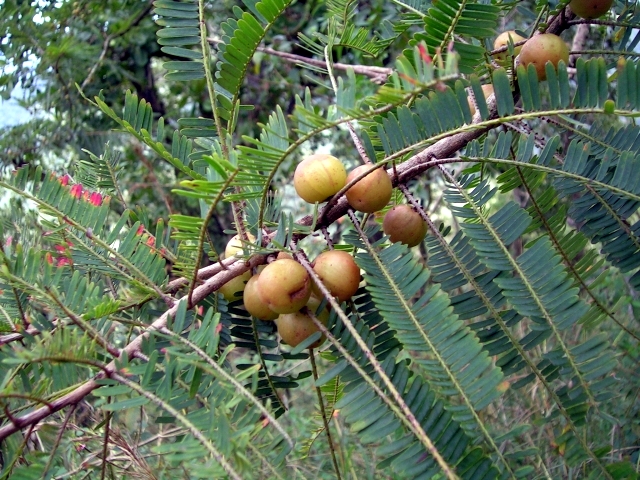
The tree is small to medium in size, reaching 1–8 metres (3+1⁄2–26 feet) in height. The bark is mottled. The branchlets are finely pubescent (not glabrous), 10–20 centimetres (4–8 inches) long, usually deciduous. The leaves are simple, subsessile and closely set along branchlets, light green, resembling pinnate leaves. The flowers are greenish–yellow. The fruit is nearly spherical, light greenish–yellow, quite smooth and hard on appearance, with six vertical stripes or furrows. The fruit is up to 26 millimetres (1 in) in diameter, and, while the fruit of wild plants weigh approximately 5.5 grams (0.2 ounces), cultivated fruits average 28.4 g (1 oz) to 56 g (2 oz).
The fruits contain high amounts of ascorbic acid (vitamin C), and have a bitter taste that may derive from a high density of ellagitannins, such as emblicanin A (37%), emblicanin B (33%), punigluconin (12%), and pedunculagin (14%). Amla also contains punicafolin and phyllanemblinin A, phyllanemblin other polyphenols, such as flavonoids, kaempferol, ellagic acid, and gallic acid.
Ripening in autumn, the berries are harvested by hand after climbing to upper branches bearing the fruits. The taste of Indian Gooseberry is sour, bitter and astringent, and it is quite fibrous.
The amla fruit may be eaten raw or cooked, and in South Asia, the fruit is often pickled with salt, oil, and spices. It is used as an ingredient in dishes including dal (a lentil preparation), and is also made into amle ka murabbah, a sweet dish made by soaking the berries in sugar syrup until they are candied. It is traditionally consumed after meals.[citation needed]
In the Batak area of Sumatra, Indonesia, the inner bark is used to impart an astringent, bitter taste to the broth of a traditional fish soup known as holat.
In Ayurveda, dried and fresh fruits of the plant are used as a common constituent.
In the Buddhist tradition there are many references to the fruit of the emblic myrobalan. In the Śatapañcāśatka, Buddha's knowledge is described in a poetic simile: "O Bhagavan, the entire origination of all types of phenomena throughout time is within the range of your mind, like an ambalan fruit in the palm of your hand".
Hub AI
Phyllanthus emblica AI simulator
(@Phyllanthus emblica_simulator)
Phyllanthus emblica
Phyllanthus emblica, also known as emblic, emblic myrobalan, myrobalan, nelikai, Indian gooseberry, Malacca tree, amloki or amla, is a deciduous tree of the family Phyllanthaceae. Its native range is tropical and southern Asia.
The tree is small to medium in size, reaching 1–8 metres (3+1⁄2–26 feet) in height. The bark is mottled. The branchlets are finely pubescent (not glabrous), 10–20 centimetres (4–8 inches) long, usually deciduous. The leaves are simple, subsessile and closely set along branchlets, light green, resembling pinnate leaves. The flowers are greenish–yellow. The fruit is nearly spherical, light greenish–yellow, quite smooth and hard on appearance, with six vertical stripes or furrows. The fruit is up to 26 millimetres (1 in) in diameter, and, while the fruit of wild plants weigh approximately 5.5 grams (0.2 ounces), cultivated fruits average 28.4 g (1 oz) to 56 g (2 oz).
The fruits contain high amounts of ascorbic acid (vitamin C), and have a bitter taste that may derive from a high density of ellagitannins, such as emblicanin A (37%), emblicanin B (33%), punigluconin (12%), and pedunculagin (14%). Amla also contains punicafolin and phyllanemblinin A, phyllanemblin other polyphenols, such as flavonoids, kaempferol, ellagic acid, and gallic acid.
Ripening in autumn, the berries are harvested by hand after climbing to upper branches bearing the fruits. The taste of Indian Gooseberry is sour, bitter and astringent, and it is quite fibrous.
The amla fruit may be eaten raw or cooked, and in South Asia, the fruit is often pickled with salt, oil, and spices. It is used as an ingredient in dishes including dal (a lentil preparation), and is also made into amle ka murabbah, a sweet dish made by soaking the berries in sugar syrup until they are candied. It is traditionally consumed after meals.[citation needed]
In the Batak area of Sumatra, Indonesia, the inner bark is used to impart an astringent, bitter taste to the broth of a traditional fish soup known as holat.
In Ayurveda, dried and fresh fruits of the plant are used as a common constituent.
In the Buddhist tradition there are many references to the fruit of the emblic myrobalan. In the Śatapañcāśatka, Buddha's knowledge is described in a poetic simile: "O Bhagavan, the entire origination of all types of phenomena throughout time is within the range of your mind, like an ambalan fruit in the palm of your hand".
Recent media