



Community hub
Wikipedia
Jasraj
View on Wikipedia
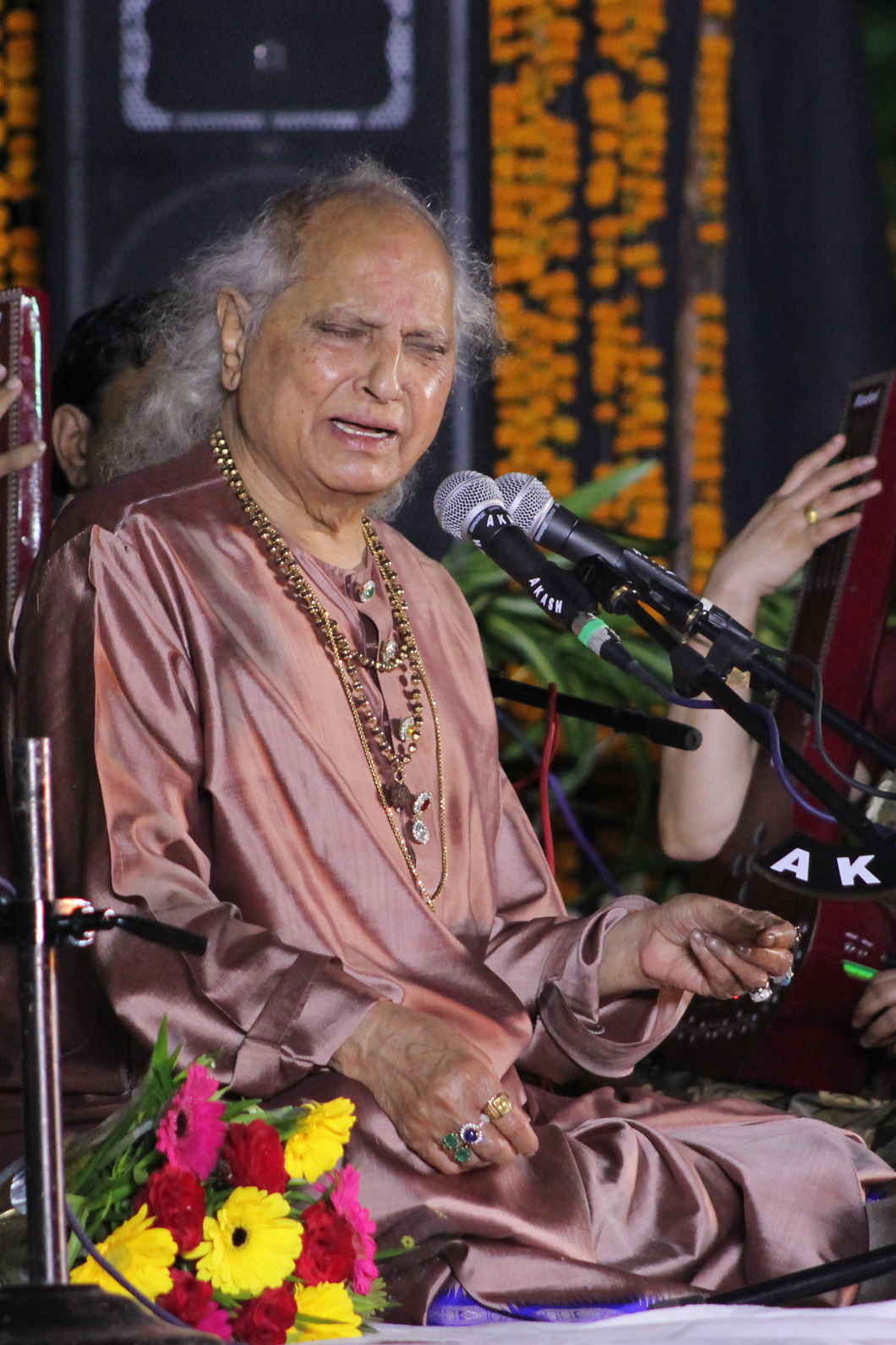
Pandit Jasraj (28 January 1930[4] – 17 August 2020[5]) was an Indian classical vocalist, belonging to the Mewati gharana (musical apprenticeship lineage). His musical career spanned 75 years resulting in national and international fame, respect and numerous major awards and accolades. His legacy includes memorable performances of classical and semi-classical vocal music, classical and devotional music, albums and film soundtracks, innovations in various genres including Haveli Sangeet and popularizing the Mewati Gharana – a school of thought in Hindustani classical music. Pandit Jasraj taught music to amateur and professional students in India, Europe, Canada and the United States.
Key Information


Early life
[edit]Pandit Jasraj was born on 28 January 1930[4] in Pili Mandori, a village in the then Hisar district (now in Fatehabad district) of Haryana,[note 1] in an artistic Brahmin family[6] to Pandit Motiram, a classical singer and Krishna Bai.[7][8] He was the youngest of three sons, in a family of classical singers. Motiram died in 1934 when Jasraj was four, on the day he was to be appointed as the state musician in the court of Mir Osman Ali Khan, the Nizam (ruler) of Hyderabad State.[9][10][11] His eldest brother was vocalist Pandit Maniram, who instructed Jasraj after the death of their father. Jasraj's elder brother, Pandit Pratap Narayan, was also an accomplished musician and was the father of music composer duo Jatin–Lalit, singer-actress Sulakshana Pandit and actress Vijeta Pandit. Pandit Pratap Narayan taught Jasraj to play tabla starting at age 7, but Jasraj decided that he wanted to only sing by 14.[12][13]
Jasraj spent his youth in Hyderabad, and travelled often to Sanand in Gujarat to study music with musicians of the Mewati gharana.[14][15] Jasraj performed for Thakur Jaiwant Singhji Vaghela, the Thakur Sahib of Sanand, who was deeply dedicated to classical music,[16] and received training from him.[16][17]
In 1946, Jasraj moved to Calcutta, where he began singing classical music for radio.[15]
Personal life
[edit]
In 1962, Jasraj married Madhura Shantaram, the daughter of film director V. Shantaram, whom he had first met in 1960 in Bombay.[18] They initially lived in Calcutta, moving to Bombay in 1963.[19] They had two children, a son, Shaarang Dev Pandit, a daughter, Durga Jasraj, and four grandchildren.[13]
Madhura made a film, Sangeet Martand Pandit Jasraj in 2009[20] and directed her first Marathi film, Aai Tuza Ashirwad, in 2010, in which Jasraj and Lata Mangeshkar sang in Marathi.[21][22]
Career
[edit]
Training
[edit]Jasraj was initiated into vocal music by his father, and later trained as a tabla accompanist under his elder brother, Pandit Pratap Narayan.[23] He would frequently accompany Maniram in his solo vocal performances.[7] He credits the vocalist, Begum Akhtar, as inspiring him to take up classical music.[18]
Jasraj began training as a vocalist at the age of 14, after renouncing tabla in reaction to how accompanists were treated at the time .[24][25] He would practice singing close to 14 hours a day. In 1952 when he was 22 he performed his first stage concert as a vocalist in the court of King Tribhuvan Bir Bikram Shah of Nepal in Kathmandu.[7][26][27] Before becoming a stage performer, Jasraj worked as a performing artist on radio for several years.[4]
He initially trained as a classical vocalist with Pandit Maniram, and later with Jaiwant Singh Waghela, a vocalist and beenkar.[15]
Technique and style
[edit]
Classical music
[edit]Although Jasraj belonged to the Mewati gharana,[28] a school of music known for its traditional performances of khayals, Jasraj had sung khayals with some flexibility, adding elements of lighter styles, including the thumri.[4] During the initial stages of his career, he was criticised for incorporating elements from other schools of music, or gharanas, into his singing.[4] Musicologist S. Kalidas has noted, however, that this borrowing of elements across gharanas has now become more commonly accepted.[4]
Jasraj created a novel form of jugalbandi called Jasrangi that is styled on the ancient system of moorchhana, between a male and a female vocalist, who each sing different ragas at the same time.[7][9] He was also known for presenting a variety of rare ragas including Abiri Todi and Patdeepaki.[29]
Semi-classical and popular music
[edit]In addition to performing classical music, Jasraj had worked to popularise innovations in semi-classical musical styles, such as Haveli Sangeet, which involves semi-classical performances in temples.[30] He had also sung classical and semi-classical compositions for film soundtracks, such as the song, 'Vandana Karo', composed in the raga Ahir Bhairav by the composer Vasant Desai, for the film Ladki Sahyadri Ki (1966),[30] a duet with vocalist Bhimsen Joshi for the soundtrack of the film Birbal My Brother (1975),[31] and a ballad, Vaada Tumse Hai Vaada for a horror film titled 1920 (2008) directed by Vikram Bhatt.[30]
In memory of his father, Jasraj organised an annual musical festival called the Pandit Motiram Pandit Maniram Sangeet Samaroh in Hyderabad.[9][10] The festival has been held annually since 1972.[15]

On 28 January 2017, the production house Navrasa Duende celebrated Jasraj's 87th birthday and 80 years of his service to music with a classical music concert titled My Journey, an Intimate Evening with Pandit Jasraj at Jawaharlal Nehru Stadium, New Delhi. He received a standing ovation.[32]
Teaching
[edit]Jasraj tutored several students who have gone on to perform as classical musicians, including Saptarshi Chakraborty,[12] Sanjeev Abhyankar,[33][26] violinist Kala Ramnath,[34][26] Sandeep Ranade,[35][36] shehnai player Lokesh Anand,[37] Tripti Mukherjee,[38] Suman Ghosh,[25] flautist Shashank Subramanyam,[39][26] Anuradha Paudwal,[12] Sadhana Sargam,[25] and Ramesh Narayan.[40][38]
He was also the founder of schools for Indian classical music in Atlanta, Tampa, Vancouver, Toronto, New York, New Jersey, Pittsburgh, Mumbai, and Kerala. Jasraj would spend six months of each year in the United States and Canada at either his home in New Jersey, teaching, or touring.[13][41][42] At age 90, he was teaching some of his international students through Skype.[43][14][44]
Death
[edit]Pandit Jasraj remained in the US when the country entered its COVID-19 lockdown.[45] He died at his home in New Jersey on 17 August 2020 at 5:15 am EST, due to cardiac arrest.[46][47] His body was later repatriated on an Air India flight to Mumbai[48] where it was cremated with state honours and 21-gun salute at Pawan Hans Crematorium in Vile Parle.[1][2] The Prime Minister of India, Narendra Modi said that his death "leaves a deep void in the Indian cultural sphere. Not only were his renditions outstanding, he also made a mark as an exceptional mentor to several other vocalists."[49]
On 27 December 2023, Modi released a commemorative postage stamp to mark 50 years of Jasraj's music festival.[50]
Awards and honours
[edit]- Padma Shri (1975)[51]
- Sangeet Natak Akademi Award (1987)[52]
- Padma Bhushan (1990)[51]
- Padma Vibhushan (2000)[51]
- Swathi Sangeetha Puraskaram (2008)[53][54]
- Sangeet Natak Akademi Fellowship (2010)[55][56]
- Pu La Deshpande lifetime achievement award (2012)[57]
- Bharat Ratna Bhimsen Joshi Classical Music Life Achievement Award (2013)[58]
- Sumitra Charat Ram Award for Lifetime Achievement (2014)[59]
- Marwar Sangeet Ratna Award (2014)[60]
- Gangubai Hangal Lifetime Achievement Award (2016)[61]
- Asteroid 300128 Panditjasraj, discovered by astronomers with the Mount Lemmon Survey in 2006, was named in his honour.[62] The official naming citation was published by the Minor Planet Center on 27 August 2019 (M.P.C. 115895).[63]
- Sangeet Kala Ratna[59]
- Master Dinanath Mangeshkar Award[52]
- Maharashtra Gaurav Puraskar[64]
Discography
[edit]- Raga Symphony (2009)[discography 1]
- Anuraag (2000)[discography 1]
- Devotionally Yours[discography 2]
- The Glory of Dawn – Morning Raagas (2005)[discography 3]
- Invocation (1993)[discography 4]
- Kanha[discography 5]
- Khazana (2008)[discography 1]
- In Concert Vancouver Vols. 1 & 2 (1997)[discography 6]
- Malhar – A Downpour of Music (2005)[discography 7]
- The Meditative Music of Pandit Jasraj[discography 8]
- Parampara – The Mewati Tradition[discography 9]
- Pride of India (2002)[discography 1]
- Multaani & Din-ki-Purya[discography 1]
- Shri Krishna Anuraag (2000)[discography 10]
- Songs of Krishna Vol. 1 & Vol. 2 (2000)[discography 1]
- The Spiritual Journey (2005)[discography 11]
- Baiju Bawra Vols. 1 & 2 (2008)[discography 12]
- Devi Upasana (2007)[discography 13]
- Miyan Tansen Vol 1 & Vol 2 (2006)[discography 14]
- Tapasya Vol. 1 (2005)[discography 15]
- Darbar (2003)[discography 16]
- Maheshwara Mantra (2002)[discography 17]
- Soul Food (2005)[discography 18]
- Haveli Sangeet (2001)[discography 19]
- Inspiration (2000)[discography 20]
- Ragas Triveni and Multani Live[discography 21]
- Ragas Bihagda and Gaud Giri Malhar[discography 22]
- Worship By Music/Live Stuggart '88[discography 23]
- Ornamental Voice[discography 24]
Performances in film soundtracks
[edit]- "Vandana Karo" in Ladki Sahyadri Ki (1966, music by Vasant Desai, based on Ahir Bhairav)[30]
- Jugalbandi with Bhimsen Joshi in Birbal My Brother (1973, music by Shyam Prabhakar, based on Malkauns)[30][31]
- "Neend Na Aaye" in Ek Hasina Thi (2004, music by Amar Mohile)
- "Vaada Tumse Hai Vaada" in 1920 (2008, music by Adnan Sami)[30]
- A song in Life of Pi (2012, music by Mychael Danna, based on Ahir Bhairav)[discography 25]
Notes
[edit]- ^ Pili Mandori is now within the Fatehabad district.
References
[edit]- ^ a b Raghuvanshi, Aakanksha (20 August 2020). "Legendary Vocalist Pandit Jasraj Cremated With State Honours. Anup Jalota, Kailash Kher And Others Attend Funeral". NDTV. New Delhi. Retrieved 21 August 2020.
- ^ a b "Pandit Jasraj funeral: Legendary vocalist gets state funeral in Mumbai, Sanjay Leela Bhansali pays tribute". Hindustan Times. 20 August 2020. Retrieved 21 August 2020.
- ^ "Legendary Indian vocalist Pandit Jasraj passes away". Mumbai Live. 17 August 2020. Retrieved 18 August 2020.
- ^ a b c d e f Khurana, Suanshu (25 January 2015). "Pandit Jasraj looks back at a long, musical life on his 85th birthday". The Indian Express. Retrieved 5 August 2017.
- ^ "Pandit Jasraj, 90, passes away in New Jersey; Modi mourns 'exceptional mentor'". The Economic Times. 17 August 2020. Retrieved 17 August 2020.
- ^ "Remembering the Legendary Classical Vocalist Pandit Jasraj on his 91 st Birth Anniversary - Saregama Blog". 28 January 2021. Retrieved 29 August 2024.
- ^ a b c d Sharma, Supriya (31 March 2017). "Pandit Jasraj on his life-long love for music". Hindustan Times. Retrieved 5 August 2017.
- ^ "Fun Interview On Wishlist, Pandit Jasraj Talks Of Cricket, Deer And Krishna". NDTV (Interview). Interviewed by Radhika Bordia. Retrieved 5 August 2017.
- ^ a b c Kumar, Ranee (1 December 2004). "A custom of culture". The Hindu.
- ^ a b Jāʼisī, Ṣidq; Luther, Narendra (2004). The Nocturnal Court: The Life of a Prince of Hyderabad. Oxford University Press. ISBN 978-0195666052.
- ^ "My Father Died Five Hours Before He Was To Be Announced The Royal Musician In Court Of Osman Ali Khan". The Times of India (Interview). Interviewed by Papri Paul. 11 December 2016. Archived from the original on 3 April 2019. Retrieved 21 May 2020.
- ^ a b c Pawar, Yogesh (15 March 2019). "Pt Jasraj's 90-year musical journey". DNA India. Retrieved 19 August 2019.
- ^ a b c Bhagat, Shalini Venugopal (25 August 2020). "Pandit Jasraj, Master Indian Vocalist, Is Dead at 90". The New York Times. ISSN 0362-4331. Retrieved 27 August 2020.
- ^ a b "Pandit Jasraj looks back on gold mohurs from a king, hopes for more voices to join his". Hindustan Times (Interview). Interviewed by Vanessa Viegas. 20 January 2020. Retrieved 2 June 2020.
- ^ a b c d Paul, Papri (28 January 2015). "Pandit Jasraj takes a trip down the memory lane to relive his idyllic childhood spent in Hyderabad". The Times of India. Retrieved 5 August 2017.
- ^ a b "The Master's Voice". Harmony — Celebrate Age (Interview). Interviewed by Rajashree Balaram. 1 November 2009.
- ^ "Pandit Jasraj: 'Music is what can take you to heaven'". gulfnews.com. 10 September 2015. Retrieved 21 May 2020.
- ^ a b "Raag Jasraj, in the maestro's voice". The Times of India (Interview). Interviewed by Anubha Sawhney. 27 December 2003. Retrieved 5 August 2017.
- ^ "Jai ho! Jasraj". The Hindu (Interview). Interviewed by S. Priyadershini. 8 October 2007.
- ^ "Madhura Jasraj recounts life with the Maestro". Ministry of Information and Broadcasting (India). 26 November 2009.
- ^ Nivas, Namita (10 September 2010). "Age no bar". The Indian Express.
- ^ "V Shantaram's daughter turns director". Hindustan Times. 26 October 2010. Retrieved 6 July 2020.
- ^ "Interview – Pt Jasraj: Music has universal appeal". narthaki.com (Interview). Interviewed by Vijai Shanker. 6 September 2012. Retrieved 14 August 2019.
- ^ "The Sun of Music". Khabar (Interview). Interviewed by Parthiv N. Parekh. Archived from the original on 23 July 2012. Retrieved 14 August 2019.
- ^ a b c Thakur, Pradeep (12 September 2010). Indian Music Masters of Our Times- Part 1. Punjab, India: Pradeem Thakur & Sons. pp. 179–190. ISBN 9788190870566.
- ^ a b c d "I have never gone looking for disciples, says Pandit Jasraj". The Hindu (Interview). Interviewed by Narendra Kusnur. 14 March 2019. ISSN 0971-751X. Retrieved 22 August 2019.
- ^ "Pandit Jasraj looks back on gold mohurs from a king, hopes for more voices to join his". Hindustan Times (Interview). Interviewed by Vanessa Viegas. 20 January 2020. Retrieved 23 June 2020.
- ^ Kulkarni, Pranav (15 December 2008). "Pandit Jasraj casts magic spell". The Indian Express. Retrieved 4 August 2017.
- ^ Mathur, Siddhartha (10 February 2012). "Unforgettable". The Indian Express. Retrieved 5 August 2017.
- ^ a b c d e f Gaekwad, Manish (31 March 2017). "Cinema classical: Singing for the gods, Pandit Jasraj took time out to enthral mortals". Scroll.in. Retrieved 22 August 2019.
- ^ a b Gautam, Savitha (24 February 2011). "Looking back… musically". The Hindu. ISSN 0971-751X. Retrieved 21 May 2020.
- ^ "Pandit Jasraj turns 87, celebrates in the form of a concert" (Press release). Indo-Asian News Service. 28 January 2017. Retrieved 29 January 2017 – via The Statesman.
- ^ "Sanjeev Abhyankar". Ragamala. Archived from the original on 26 August 2007. Retrieved 27 April 2020.
- ^ "Bio | Kala Ramnath | The Singing Violin of Indian Classical Music". kalaramnath.com. Archived from the original on 6 May 2020. Retrieved 27 April 2020.
- ^ "NaadSadhana: A Tabla-Swarmandal AI/ML jugalbandi app for classical singers, trainees". 16 May 2019.
- ^ "Coronavirus | Na Corona Karo song goes viral on social media". The Hindu. 2 April 2020.
- ^ "Lokesh Anand". Dainik Bhaskar. Archived from the original on 26 August 2007. Retrieved 18 August 2020.
- ^ a b Kumar, P. k Ajith (17 January 2016). "His music knows no age". The Hindu. ISSN 0971-751X. Retrieved 19 May 2020.
- ^ Subramanyam, Shashank (16 January 2009). "On an innovative journey". The Hindu (Interview). Interviewed by Savitha Gautam. ISSN 0971-751X. Retrieved 19 May 2020.
- ^ "Ramesh Narayan: My biggest achievement is not any award or accolade, but Pandit Jasraj's discipleship – Times of India". The Times of India. Retrieved 27 April 2020.
- ^ Watts, Gabbie (27 July 2017). "Sangeetayan Promotes Indian Classical Music In Atlanta". WABE 90.1.
- ^ Rele, Nitish (May 2006). "Pandit Jasraj Looks to Enlighten Americans on Indian Music". Khaas Baat. Retrieved 19 May 2020.
- ^ "Pandit Jasraj on turning 90, teaching music through Skype: 'I don't like when people say woh zamaana achha tha'". Hindustan Times (Interview). Interviewed by Press Trust of India. 28 January 2020. Retrieved 22 May 2020.
- ^ "Pandit Jasraj feels reality shows have benefited classical music" (Interview). Interviewed by Indo-Asian News Service. 21 February 2012. Retrieved 22 June 2020 – via Zee News.
- ^ "Legendary classical vocalist Pandij Jasraj dies at 90". Press Trust of India. 17 August 2020.
- ^ "Pandit Jasraj passes away at 90". The Indian Express. 17 August 2020. Retrieved 17 August 2020.
- ^ "Music legend Pandit Jasraj, recipient of Padma Vibhushan award, passes away at the age of 90". www.timesnownews.com. 17 August 2020. Retrieved 17 August 2020.
- ^ "Pt Jasraj's mortal remains reach Mumbai, state funeral on Thursday". www.daijiworld.com. Retrieved 21 August 2020.
- ^ @narendramodi (17 August 2020). "The unfortunate demise of Pandit Jasraj Ji leaves a deep void in the Indian cultural sphere" (Tweet) – via Twitter.
- ^ "Union Home Minister and Minister of Cooperation, Shri Amit Shah releases a commemorative Postal Stamp, to mark 50 years of Pandit Jasraj's music festival – 'Pandit Motiram Pandit Maniram Sangeet Samaroha', in New Delhi today". pib.gov.in (Press release). 27 December 2023. Retrieved 1 January 2024.
- ^ a b c "Padma Awards Directory (1954–2017)" (PDF). Ministry of Home Affairs.
- ^ a b "Pandit Jasraj". Sangeet Natak Akademi. Archived from the original on 9 September 2017. Retrieved 22 August 2019.
- ^ "Marar, Jasraj bag awards". The Hindu. 12 March 2008.
- ^ "Pandit Jasraj gets Kerala Govt's award". Hindustan Times. 12 March 2008. Retrieved 6 July 2020.
- ^ "Declaration of Sangeet Natak Akademi fellowships (Akademi Ratna) and Akademi Awards (Akademi Puraskar) for the year 2009" (Press release). Ministry of Culture (India). 16 February 2010. Retrieved 17 February 2010.
- ^ "Sangeet Natak Akademi Award for Pandit Jasraj". Hindustan Times. 30 September 2010. Retrieved 6 July 2020.
- ^ "Pandit Jasraj given Pu La Deshpande lifetime achievement award". DNA India. 8 November 2012. Retrieved 27 April 2020.
- ^ "Pandit Jasraj to Receive Maharashtra Government's Top Music Award" (Press release). Press Trust of India. Retrieved 27 April 2020 – via India West.[permanent dead link]
- ^ a b "Orchestral symphony is very interesting: Pandit Jasraj". Hindustan Times (Interview). Interviewed by Debarun Borthakur. 18 November 2014. Retrieved 22 August 2019.
- ^ "Three music maestros get Marwar Sangeet Ratna Award". Hindustan Times. 11 December 2014. Retrieved 22 August 2019 – via PressReader.
- ^ Nayak, N. Dinesh (19 January 2016). "Jasraj receives Hangal award". The Hindu. ISSN 0971-751X. Retrieved 15 May 2020.
- ^ "JPL Small-Body Database Browser: 300128 Panditjasraj (2006 VP32)" (26 February 2019 last obs.). Jet Propulsion Laboratory. Retrieved 26 September 2019.
- ^ "MPC/MPO/MPS Archive". Minor Planet Center. Retrieved 26 September 2019.
- ^ Rockwell, Teed (13 October 2008). "Pandit Jasraj in Concert". India Currents. Retrieved 14 May 2020.
Discography references
[edit]- ^ a b c d e f Romero, Angel (18 August 2018). "Artist Profiles: Pandit Jasraj". World Music Central. Retrieved 22 August 2019.
- ^ "Devotionally Yours – Pandit Jasraj". The Indian Express. OCLC 652343767. Retrieved 22 August 2019.
- ^ The glory of dawn: morning ragas (in Hindi), Times Music, 2005, OCLC 881488955
- ^ Invocation. (in Sanskrit), Water Lily Acoustic, 1993, OCLC 31731043
- ^ "Kanha – Padma Vibhushan Pandit Jasraj Indian Classical Music / Hindustani Classical". www.amazon.com. Retrieved 22 August 2019.
- ^ In concert: Vancouver, BC-August 10/96, World Media, 2000, OCLC 50315127
- ^ Jasraj (2005), Malhar a downpour of music (in Nepali), Times Music, OCLC 881489066
- ^ The meditative music of Pandit Jasraj. (in Hindi), Oriental Records, OCLC 369698317
- ^ Parampara: the Mewati tradition : 75th birthday celebrations (in Hindi), Times Music, India, 2005, OCLC 819532237
- ^ Shri Krishna Anuraag, Adhishri Tradings : Sony Music, 2000, OCLC 704701864
{{citation}}: CS1 maint: publisher location (link) - ^ The spiritual journey, Times Music, India, 2005, OCLC 86082899
- ^ Gopalka, Kushal (29 December 2007). "Music Review | On an old note". Mint. Retrieved 22 August 2019.
- ^ Devi upasana, Virgin Records (India) Pvt Ltd. : Made available through hoopla, 2007, OCLC 1098875065
- ^ Miyan Tansen: as interpreted by Pandit Jasraj. (in Hindi), Times Music, 2006, OCLC 823747327
- ^ Tapasya. Volume 1 Volume 1, Navras, 2004, OCLC 662580006
- ^ Darbar (in Hindi), Sense World Music, 2003, OCLC 475643917
- ^ Maheshwara mantra., Oreade Music, 2002, OCLC 652433351
- ^ Soul Food: Live at the Saptak Festival, Sense World Music, 2002, OCLC 85891441
- ^ Haveli sangeet., Navras Records Ltd., 2001, OCLC 53891975
- ^ Inspiration, Navras Records, 2000, OCLC 45263860
- ^ Raga Triveni & Raga Multani. (in Sanskrit), Navras, 1994, OCLC 418882680
- ^ Ragas Bihagda & Gaud giri malhar live at the QEH August 18, 1993 (in Hindi), Navras, 18 August 1993, OCLC 873053602
- ^ Worship by music, Indische Tanzschule "Chhandra Dhara"., 1991, OCLC 27740578
- ^ Ornamental voice, (in Indic), Chhanda Dhara, 1989, OCLC 23685849
- ^ Mermelstein, David (3 December 2012). "OSCARS: 'Life Of Pi' Score". Deadline. OCLC 814673923. Retrieved 22 August 2019.
Further reading
[edit]- Raja, Deepak (23 May 2011). "Pandit Jasraj: the romanticist crusader". Deepak Raja's world of Hindustani Music. Retrieved 22 August 2019.
- Qamar, Jamshed (28 January 2017). "पंडित जसराज की सालगिरह पर, उनके संघर्ष की कहानी" [On the anniversary of Pandit Jasraj, the story of his struggle]. www.gaonconnection.com (in Hindi). Retrieved 22 August 2019.
- Sinha, Manjari (3 February 2017). "The maestro's musical odyssey..." The Hindu. ISSN 0971-751X. Retrieved 22 August 2019.
- Sinha, Manjari (5 April 2019). "The making of Pandit Jasraj". The Hindu. ISSN 0971-751X. Retrieved 23 August 2019.
- Authorised biography by Budhiraja, Sunita (July 2018). Rasraj Pandit Jasraj. Vani Prakashan. ISBN 978-93-87889-58-3.
External links
[edit]
- Official Site Archived 11 December 2019 at the Wayback Machine
- Jasraj discography at Discogs
- Pandit Jasraj Institute of Music, New York


| International | |
|---|---|
| National | |
| Artists | |
| People | |
| Other | |

Grokipedia
Jasraj
View on GrokipediaEarly life and training
Family background
Pandit Jasraj was born on January 28, 1930, in the village of Pili Mandori in the then Hisar district (now Fatehabad district) of Haryana, India, into a Brahmin family with a deep-rooted tradition in Hindustani classical music.[3][6] His father, Pandit Motiram, was a prominent vocalist and court musician associated with the Mewati gharana, a lineage that traced back several generations in the family, emphasizing khayal and dhrupad forms, and grandson of Pandit Jyotiram, a musician in the family lineage.[7][2][1] Motiram's untimely death in 1934, when Jasraj was just four years old, occurred on the very day he was to be formally appointed as a court musician in the princely state of Hyderabad under Nizam Mir Osman Ali Khan.[8][9][10] The family, comprising Jasraj's mother and his elder brothers—vocalist Pandit Maniram, the eldest and a key figure in preserving the gharana's traditions, and Pandit Pratap Narayan, another accomplished musician—faced significant challenges following the loss.[11][7] Under Maniram's leadership as the new patriarch, they relocated from Haryana to Hyderabad, where Maniram secured a position as a court musician, providing stability amid their musical pursuits.[8][9] In his early childhood, Jasraj was immersed in the family's musical environment, witnessing performances by his father and brothers that instilled a profound appreciation for the art form from a tender age.[2][11] This foundational exposure in the close-knit household laid the groundwork for his later initiation into formal training under his brothers.[7]Musical initiation
Pandit Jasraj was born into a family steeped in the Mewati gharana tradition of Hindustani classical music.[12] His musical journey began in early childhood with a brief initiation into vocal music by his father, Pandit Motiram, a renowned exponent of the gharana, before Motiram's untimely death in 1934 when Jasraj was just four years old.[2][13] Following his father's passing, the family faced financial hardships, prompting Jasraj to turn to percussion to contribute to their livelihood; at around age six, he began intensive tabla training under his elder brother, Pandit Pratap Narayan, and by age seven, he was already accompanying his siblings in concerts as a tabla player.[14][15][12] These early years involved initial struggles, as Jasraj navigated the demands of performing as an accompanist in family sangeet sabhas—musical assemblies organized by the Pandit family to preserve and share their heritage—where he gained exposure to the devotional Haveli Sangeet traditions rooted in Vaishnava temple music.[16][17] A pivotal shift occurred at age 14 in 1944, when, distressed by the humiliating treatment of accompanists during a concert—where a senior artist publicly berated the percussionists—Jasraj renounced tabla and recommitted to vocals, beginning formal vocal training under another elder brother, Pandit Maniram.[18][19][12] In 1946, at age 16, Jasraj moved with his family to Calcutta (now Kolkata), a hub for classical music, where he continued honing his skills through local events and family concerts, marking his adolescent immersion in the vibrant 1940s music scene of the city.[2][20]Formal training
Pandit Jasraj received his formal musical training within the Mewati gharana of Hindustani classical music, beginning intensively under the guidance of his elder brother and primary guru, Pandit Maniram, following the early death of their father in 1934.[21] This tutelage was supplemented by studies with Maharaja Jaiwant Singh of Sanand, Gujarat, where Jasraj traveled regularly from Hyderabad to deepen his immersion in the gharana's traditions during the 1940s and 1950s.[21][22] His period of dedicated sadhana, or rigorous practice, spanned over a decade, starting at age 14 when he transitioned from tabla accompaniment to vocal training, and continued until his public debut as a vocalist in 1952 at age 22.[23][24] During this time, Jasraj practiced up to 14 hours daily, focusing on voice modulation and the nuanced aesthetics of the Mewati style to build a strong foundation before performing publicly.[25] Under these gurus, Jasraj mastered core forms such as khayal, bhajan, and dhrupad, with particular emphasis on layakari, the intricate rhythmic complexities that distinguish Mewati renditions through bol-bant and taan patterns.[26] He also integrated elements of Haveli Sangeet, the devotional temple music of the Pushtimarg tradition, into his training, which enriched the gharana's lyrical depth and emotional expression.[27] Key techniques included nom-tom alaps, a rhythmic vocal exploration using syllables like "nom" and "tom" to bridge aalap and bandish phases, preserving the gharana's blend of meditative elaboration and structural precision.[28]Career
Professional debut and rise
Pandit Jasraj transitioned from familial performances and early radio appearances to the professional stage with his debut concert in 1952 at the age of 22, held in the court of King Tribhuvan Bir Bikram Shah in Kathmandu, Nepal. This event, where he rendered pieces such as Raga Multani and the bhajan "Gal bhujang bhasm ang," earned him a substantial honorarium of 5,000 gold coins, signaling the beginning of his recognition beyond private and broadcast circles.[29][30] Following his debut, Jasraj's career gained momentum through regular engagements on All India Radio, where he had begun performing classical music in 1946 after moving to Calcutta, and continued with monthly concerts that broadcast his voice nationwide during the 1950s and 1960s. These radio slots, combined with increasing invitations to music conferences and festivals across India, solidified his presence in the Hindustani classical music scene, drawing audiences to his soulful interpretations rooted in the Mewati gharana. By the late 1960s and into the 1970s, he had emerged as a prominent concert artist, regularly performing at major venues and events in cities like Mumbai, after settling there in the early 1960s.[31][2][20] Jasraj's rise extended globally in the 1970s, as he embarked on his first international tours to the United States and Europe, captivating audiences with live performances that introduced his devotional style to Western listeners and established him as a bridge between Indian classical traditions and international appreciation. Notable among these were concerts in New York and other U.S. cities, where he became one of the earliest Hindustani vocalists to receive widespread poster promotions for shows. His contributions to festivals like the Sawai Gandharva Bhimsen Mahotsav in Pune further highlighted his stature, with repeated appearances in the 1970s and beyond that underscored his enduring appeal in India's premier music gatherings. Over the course of more than 80 years—from his initial musical explorations in the 1930s to performances into his 90s—Jasraj's career encompassed thousands of concerts worldwide, marking a trajectory from regional artist to global icon.[2][32][33][34]Performance style and innovations
Pandit Jasraj's performance style was characterized by a lyrical and emotive vocal quality, deeply rooted in the Mewati gharana tradition he inherited through his training. His voice possessed a remarkable range spanning three-and-a-half octaves, enabling seamless transitions across registers while maintaining perfect diction and clarity in swara articulation.[21] This allowed for a singing approach that emphasized melody and meend (glides), with subtle gamaks and murkis adding emotional depth, creating a legato-like flow in his renditions.[35] Central to his style was an intense focus on bhakti rasa, infusing devotional sentiment into both khayal and bhajans, where performances often built from gentle, meditative explorations to ecstatic rhythmic climaxes. In pure khayal, Jasraj adhered to the classical rigor of the Mewati gharana, prioritizing bol alaps, sargams, and taans that preserved the bandish's textual integrity while expanding improvisational vistas through murchana techniques for novel raag expansions.[12][35] In contrast, his semi-classical interpretations, such as thumri and popular bhajans, leaned toward greater expressiveness and romantic bhava, incorporating intuitive bol bolan and lighter taans to evoke personal devotion and accessibility, distinguishing them from the more structured depth of khayal.[36] Jasraj's innovations significantly enriched Hindustani music, particularly through his compositions in Haveli Sangeet, where he elevated temple-based devotional forms into sophisticated classical pieces by blending them with khayal structures. He created over a hundred bandishes and explored rare ragas like Nat Narayan and Shuddh Bhairavi, while fusing semi-classical elements in novel ways, such as the Jasrangi jugalbandi—a duet format where male and female voices sang distinct ragas in different scales, interwoven via the ancient murchhana paddhati. His rhythmic expertise shone in layakari, employing sapat and gamak taans with precise badhat across octaves, alongside command over laya to heighten improvisational drama unique to his Mewati interpretations.[12][37][35][38]Teaching and institutions
Pandit Jasraj adhered to the traditional guru-shishya parampara of Hindustani classical music, imparting knowledge through personal mentorship and rigorous training to preserve the Mewati gharana's stylistic essence. He trained hundreds of disciples worldwide, fostering a legacy of performers who carried forward his interpretive depth and devotional emphasis.[39] Among his prominent shishyas were vocalists Sanjeev Abhyankar and Madhup Mudgal, both of whom achieved concert prominence and exemplified his blend of technical precision and emotional bhakti.[40] Other notable disciples included Tripti Mukherjee, Ratan Mohan Sharma, and instrumentalists like violinist Kala Ramnath and flautist Shashank Subramanyam, with over 20 becoming accomplished concert artists.[40] In 1995, Jasraj founded the Pandit Jasraj Music Academy in New Jersey, USA, as an experimental initiative to teach Indian classical music to enthusiasts abroad, which evolved into the Pandit Jasraj Institute for Music Research, Artistry and Appreciation (PJIM) in 2006 as a nonprofit organization dedicated to the Mewati gharana.[41] The institute offers structured programs from beginner to advanced levels, equivalent to academic degrees, emphasizing guru-shishya bonds and open to committed learners regardless of background.[41] It operates centers in the US, including New Jersey, New York, and Pittsburgh, while affiliated schools in India, such as those in Rajasthan, Haryana, Kerala, and Mumbai, extend his pedagogical reach domestically.[39][42] Jasraj actively promoted the Mewati gharana internationally through teaching sessions and performances starting in the 1980s, attracting students in Europe, Canada, and the US to his clear enunciation and innovative phrasing.[39] His global outreach included tours and residencies, such as in Vancouver in 1987, where he demonstrated ragas like Nat Narayani, inspiring cross-cultural appreciation of the gharana's lyrical subtlety.[39] A key aspect of his educational efforts involved reviving Haveli Sangeet, the devotional temple music of the Pushtimarg tradition, by integrating its dhrupad-based compositions into khayal performances and teaching them to disciples for broader dissemination.[40][39] He performed these pieces in temples across India and composed accessible arrangements to aid students in mastering their rhythmic complexity and spiritual resonance, ensuring the form's survival beyond ritual contexts.[39]Personal life and death
Marriage and family
Pandit Jasraj married Madhura Shantaram in 1962, shortly after meeting her through family connections in the cultural circles of Mumbai. Madhura, the daughter of acclaimed filmmaker V. Shantaram, brought a strong artistic heritage to the union, supporting Jasraj's dedication to music while managing family life amid his travels.[43][44] The couple had two children: a son, Shaarang Dev Pandit, who pursued music as a composer and performer, and a daughter, Durga Jasraj, who trained in Hindustani classical vocals and became involved in music production and media. Both children grew up immersed in a household centered on classical arts, often participating in family musical sessions that reinforced their shared passion for the tradition.[45][46] Jasraj's elder brother, Pandit Pratap Narayan, a skilled musician who had initially trained him on the tabla, remained a key figure in the family's musical bonds, with Pratap's children—such as the composer duo Jatin-Lalit—extending the collaborative spirit across generations through informal family gatherings focused on music.[3][47] After a year in Kolkata post-marriage, the family settled in Mumbai, where they built their life around cultural pursuits. From the 2000s onward, they maintained a residence in [New Jersey](/page/New Jersey), U.S., allowing Jasraj to nurture family ties while connecting with global audiences through teaching and performances.[48][49] Madhura passed away on 25 September 2024 in Mumbai, aged 86, due to age-related ailments.[46]Later years and death
In his later years, Pandit Jasraj divided his time between India and the United States, maintaining a residence in Colonia, New Jersey, where he spent several months annually from the 2010s onward.[1][50] He entered a phase of semi-retirement, focusing on selective performances and mentoring disciples, while adapting to virtual teaching during the COVID-19 pandemic after arriving in the US on February 15, 2020.[1][51] His final public appearance was a Facebook Live rendition in April 2020 for the Sankat Mochan Festival in Varanasi, marking a poignant virtual continuation of his tradition-bound concerts.[51] Jasraj's health had been affected by age-related complications in his final decade, culminating in a sudden cardiac arrest on August 17, 2020, at 5:15 a.m. EST, at his New Jersey home; he was 90 years old.[1][52] His daughter, Durga Jasraj, confirmed the news, noting he passed peacefully surrounded by family and students.[53] Following his death, Jasraj received an initial farewell in New Jersey attended by US-based disciples and Indian consular officials, including Consul General Randhir Jaiswal.[54] His mortal remains were repatriated to India via a special Air India flight, arriving in Mumbai on August 19, 2020, where a state funeral was arranged with full honors, including the Tricolour draped over a glass casket for public viewing (antim darshan).[55][56] Cremation occurred the next day at Chandanwadi Electric Crematorium, with family members, including wife Madhura Jasraj and children, leading tributes that emphasized his devotional spirit and global influence; Prime Minister Narendra Modi described him as an "exceptional mentor," while musicians like A.R. Rahman and Lata Mangeshkar mourned the loss of a "voice of divinity."[57][58] Posthumously, Jasraj's family has sustained his musical legacy through ongoing performances and educational efforts. His son, Shaarang Dev Pandit, and daughter, Durga Jasraj—both accomplished vocalists in the Mewati gharana—continue to tour internationally, teach disciples, and organize events via the Pandit Jasraj Cultural Foundation, which commemorates his birth and death anniversaries with concerts honoring his innovations in classical music.[59][60]Awards and recognition
Major national awards
Pandit Jasraj was honored with several prestigious national awards by the Government of India and state governments, recognizing his lifelong dedication to Hindustani classical music and his mastery of the Mewati gharana tradition, which emphasizes emotional depth and technical precision in vocal rendition. In 1975, he received the Padma Shri, India's fourth-highest civilian honor, for his outstanding contributions to classical vocal music.[4] This award highlighted his early innovations in blending bhakti elements with gharana techniques, establishing him as a leading exponent of the style.[3] The Sangeet Natak Akademi Award, the highest national recognition for performing arts, was conferred upon him in 1987 for his profound impact on Hindustani vocal music.[61] It acknowledged his role in preserving and evolving the Mewati gharana through original compositions and performances that integrated rare ragas and talas.[62] In 1990, Jasraj was awarded the Padma Bhushan, the third-highest civilian honor, further affirming his stature as a custodian of classical traditions.[4] The award underscored his efforts in promoting the gharana's philosophical underpinnings, drawing from his family's musical legacy. The pinnacle of his national accolades came in 2000 with the Padma Vibhushan, India's second-highest civilian award, celebrating his global influence and compositional genius within the Mewati lineage.[4] Additionally, in 2010, he was elected to the Sangeet Natak Akademi Fellowship (Akademi Ratna), the academy's highest honor for lifetime achievement, for his creation of over 300 bandishes and mentorship of disciples who carried forward the Mewati gharana.[63] State-level recognitions included the Kalidas Samman in 1997–98 from the Government of Madhya Pradesh, awarded for excellence in classical music and his innovative interpretations of traditional forms.[64] He also received the Swathi Sangeetha Puraskaram in 2008 from the Government of Kerala for his contributions to Carnatic and Hindustani music traditions.| Award | Year | Issuing Body | Significance in Context of Mewati Gharana |
|---|---|---|---|
| Padma Shri | 1975 | Government of India | Recognized foundational work in vocal innovation and bhakti-infused renditions. |
| Sangeet Natak Akademi Award | 1987 | Sangeet Natak Akademi | Honored preservation and evolution of gharana techniques through rare ragas. |
| Padma Bhushan | 1990 | Government of India | Affirmed role as custodian of gharana's emotional and philosophical depth. |
| Kalidas Samman | 1997–98 | Government of Madhya Pradesh | Celebrated excellence in classical music interpretations. |
| Padma Vibhushan | 2000 | Government of India | Culminated recognition of global propagation and compositional legacy. |
| Swathi Sangeetha Puraskaram | 2008 | Government of Kerala | Acknowledged contributions bridging Hindustani traditions. |
| Sangeet Natak Akademi Fellowship | 2010 | Sangeet Natak Akademi | Lifetime honor for bandish creation and disciple mentorship in the gharana. |