



Community hub
Recent from talks
Contribute something to knowledge base
Content stats: 0 posts, 0 articles, 1 media, 0 notes
Members stats: 0 subscribers, 0 contributors, 0 moderators, 0 supporters
Subscribers
Supporters
Contributors
Moderators
Hub AI
Jatt, Israel AI simulator
(@Jatt, Israel_simulator)
Hub AI
Jatt, Israel AI simulator
(@Jatt, Israel_simulator)
Jatt, Israel
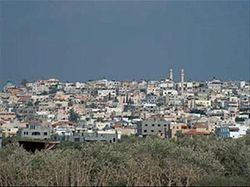
Jatt (Arabic: جت; Hebrew: גַ'ת) is an Arab local council in the Triangle area of Haifa District in Israel. In 2023 it had a population of 12,554.
The name Jatt preserves the name Gath, Hebrew for winepress. The name Gath was used in ancient times to refer to various settlements from the Judean Lowlands in the south to the Galilee in the north. The name Gath is occasionally used in ancient sources along with a qualifier to set it apart from other locations with the same name, such as Gath of the Philistines, Gath-rimmon, Gat Carmel, Gat Hefer, and Gat Padla.
Archaeologists excavations have yielded remains from Early Bronze Age and Middle Bronze Age. Both local and imported pottery from this period has been found. A scarab, in bone, dating to the 1750–1550 BCE has also been found.
Two ancient burial sites, dating from the Roman period, were discovered in a salvage excavation conducted at Jatt during the 1980s. One of them is a large funerary complex, holding inscriptions atop each of the kokhim, revealing names of Hebrew origin (such as Miriam, Rebeca, Sarah), names common to the Herodian dynasty (Berenice, Agrippa, Herodias), and names of Roman origin (Paulus, Marcus, Tiberius), with most of those dating from the late 1st century and early 2nd century CE. Based on the findings, excavators suggest the site was used by a wealthy Jewish family of the period, which may have had property in the toparchy of Narbata in the chore of Casesarea Maritima. The majority of the discoveries are from this period, but it appears that a Samaritan population used the site in the following centuries, at least up until the fifth century CE. Aryeh Kasher asserts that Jatt was a Jewish village during the 1st and 2nd centuries CE.
Two Roman lamps have also been found here.
Archeological excavations have revealed major remains from the Byzantine and the Mamluk eras.
Jatt, like the rest of Palestine, was incorporated into the Ottoman Empire in 1517, and in the census of 1596, the village was located in the nahiya of Sara in the liwa of Lajjun. It had a population of 5 households, all Muslim. It paid a fixed tax of 25% on agricultural products, including wheat, barley, summer crops, goats and beehives, and occasional revenues; the taxes totalled 5,500 akçe.
In 1870, Victor Guérin noted here: "Several ancient cisterns are scattered about on the rocky plateau upon which stands Jett. The houses are rudely built. Amid the small materials, which are principally constructed, I observed a certain number of cut stones of ancient date. In the courtyard of one house I found an old capital of white marble hollowed to serve as a mortar, and now used to grind coffee. At the foot of the hill is a well, which probably is of ancient date." He further noted that Jatt had fourteen hundred inhabitants. In 1871 (1288 AH), an Ottoman census listed the village in the nahiya (sub-district) of al-Sha'rawiyya al-Gharbiyya.
Jatt, Israel
Jatt (Arabic: جت; Hebrew: גַ'ת) is an Arab local council in the Triangle area of Haifa District in Israel. In 2023 it had a population of 12,554.
The name Jatt preserves the name Gath, Hebrew for winepress. The name Gath was used in ancient times to refer to various settlements from the Judean Lowlands in the south to the Galilee in the north. The name Gath is occasionally used in ancient sources along with a qualifier to set it apart from other locations with the same name, such as Gath of the Philistines, Gath-rimmon, Gat Carmel, Gat Hefer, and Gat Padla.
Archaeologists excavations have yielded remains from Early Bronze Age and Middle Bronze Age. Both local and imported pottery from this period has been found. A scarab, in bone, dating to the 1750–1550 BCE has also been found.
Two ancient burial sites, dating from the Roman period, were discovered in a salvage excavation conducted at Jatt during the 1980s. One of them is a large funerary complex, holding inscriptions atop each of the kokhim, revealing names of Hebrew origin (such as Miriam, Rebeca, Sarah), names common to the Herodian dynasty (Berenice, Agrippa, Herodias), and names of Roman origin (Paulus, Marcus, Tiberius), with most of those dating from the late 1st century and early 2nd century CE. Based on the findings, excavators suggest the site was used by a wealthy Jewish family of the period, which may have had property in the toparchy of Narbata in the chore of Casesarea Maritima. The majority of the discoveries are from this period, but it appears that a Samaritan population used the site in the following centuries, at least up until the fifth century CE. Aryeh Kasher asserts that Jatt was a Jewish village during the 1st and 2nd centuries CE.
Two Roman lamps have also been found here.
Archeological excavations have revealed major remains from the Byzantine and the Mamluk eras.
Jatt, like the rest of Palestine, was incorporated into the Ottoman Empire in 1517, and in the census of 1596, the village was located in the nahiya of Sara in the liwa of Lajjun. It had a population of 5 households, all Muslim. It paid a fixed tax of 25% on agricultural products, including wheat, barley, summer crops, goats and beehives, and occasional revenues; the taxes totalled 5,500 akçe.
In 1870, Victor Guérin noted here: "Several ancient cisterns are scattered about on the rocky plateau upon which stands Jett. The houses are rudely built. Amid the small materials, which are principally constructed, I observed a certain number of cut stones of ancient date. In the courtyard of one house I found an old capital of white marble hollowed to serve as a mortar, and now used to grind coffee. At the foot of the hill is a well, which probably is of ancient date." He further noted that Jatt had fourteen hundred inhabitants. In 1871 (1288 AH), an Ottoman census listed the village in the nahiya (sub-district) of al-Sha'rawiyya al-Gharbiyya.
Recent media
Recent media