Hubbry Logo
JetBlue Flight 292JetBlue Flight 292Main
Open search
JetBlue Flight 292
Community hub
JetBlue Flight 292
logo
8 pages, 0 posts
0 subscribers
Be the first to start a discussion here.
JetBlue Flight 292
JetBlue Flight 292
from Wikipedia

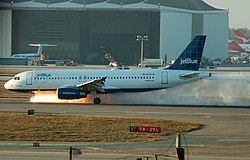
JetBlue Flight 292 was a scheduled flight from Bob Hope Airport in Burbank, California, to John F. Kennedy International Airport in New York City. On September 21, 2005, Captain Scott Burke executed an emergency landing in the Airbus A320-232 at Los Angeles International Airport after the nose gear jammed in an abnormal position.[1][2][3] No one was injured.

Key Information

Aircraft

[edit]

The aircraft involved was an Airbus A320-232, registered as N536JB[4] with serial number 1784. It was manufactured by Airbus Industrie in 2002 and had logged 14227 airframe hours. It was powered by two IAE V2527-A5 engines.[5]

Incident

[edit]

The captain was 46-year-old Scott Burke, with 10,829 total flight hours, 2,552 of which were on the Airbus A320. The first officer was 37-year-old David Razler, who out of 5,732 total flight hours had an estimated 1,284 hours on the Airbus A320.[6]

Carrying 140 passengers and six crew, the Airbus A320-232 departed Burbank at 3:17 p.m. PDT (UTC−07:00). The aircraft was scheduled to fly 2,465 miles (3,967 km) to John F. Kennedy International Airport.[citation needed]

After takeoff from Burbank, the pilots could not retract the landing gear. They then flew low over Long Beach Municipal Airport in Long Beach (the location of a JetBlue hub) to allow officials in the airport's control tower to assess the damage to its landing gear before attempting a landing. It was found that the nosewheel was rotated ninety degrees to the left, perpendicular to the direction of the fuselage.[citation needed]

Rather than land at Long Beach Airport, the crew decided to divert to Los Angeles International Airport (LAX), in order to take advantage of its long, wide runways and modern safety equipment.[citation needed]

The pilots flew the aircraft, which can carry up to 46,860 pounds (21,260 kg) of aviation fuel, in a figure eight pattern between Bob Hope Airport in Burbank and LAX for more than two hours in order to burn fuel and lower the risk of fire upon landing. This also served to lighten the plane, reducing potential stress on the landing gear and dramatically lowering landing speed as well.[7][8] The Airbus A320 does not have the mechanical ability to dump fuel,[9] despite various news agencies reporting that the aircraft was doing so over the ocean.[citation needed]

Because JetBlue planes are equipped with DirecTV satellite television, passengers on Flight 292 were able to watch live news coverage of their flight and listen to "analysts discuss[ing] their probable fate" while the plane circled over the Los Angeles for hours burning off fuel. Reportedly, moments before the plane touched down, a member of the flight crew turned off the broadcast as they had decided that it was "upsetting the passengers too much."[10]

Emergency services and fire engines were standing by on the LAX ramp ahead of the landing. Although foam trucks were available, they were not used. The US Federal Aviation Administration no longer recommends pre-foaming runways, chiefly due to concerns that it would deplete firefighting foam supplies that might later be needed to respond to a fire; it is also difficult to determine exactly where a runway should be foamed, and pre-foaming might also reduce the effectiveness of the aircraft's brakes, potentially causing it to slide off the runway.[11]

Passengers deplane by application of airport stairs vehicle

The plane landed on runway 25L. The nose gear generated sparks and flames when it touched down, but the plane was otherwise undamaged. To keep the nose gear off the ground as long as possible, reverse thrust was not used to slow the aircraft. As a result, the plane took longer than usual to decelerate, coming to a stop at 6:20 p.m. just 1,000 feet (300 m) before the end of the 11,096-foot (3,382 m) runway. (In comparison, the longest runway at Long Beach is 10,000 ft (3,000 m).)[12] Los Angeles Fire Dept. Battalion Chief Lou Roupoli said, "The pilot did an outstanding job. He kept the plane on its rear tires as long as he could before he brought the nose gear down".[13]

Aftermath and evaluation

[edit]
The damage done to Flight 292's landing gear

Passengers began to disembark less than seven minutes later. The landing was smooth and no physical injuries were reported. The aircraft was evacuated via an airport stairs vehicle, as opposed to evacuation slides.[6][8]

As JetBlue did not operate from LAX at the time, the aircraft was towed to a Continental Airlines hangar at LAX for evaluation.[14] Expert opinion expressed was that, despite the drama and live worldwide coverage, there was little real danger to the passengers or crew of Flight 292.[15] The A320, like all modern airliners, is engineered to tolerate certain failures, and, if necessary, can be landed without the nose gear at all.[15]

The aircraft involved, seen in 2019

The National Transportation Safety Board report says that worn-out seals were to blame for the malfunction, and that the Brake Steering Control Unit (BSCU) system contributed to the problem. The NTSB reported that Airbus had since upgraded the system to take care of the problem.[16]

Following the incident, the aircraft was repaired and returned to service still bearing the name "Canyon Blue". The flight route designation for JetBlue's flights from Burbank to New York was changed from 292 to 358 while the other direction became 359.[citation needed]

Similar incidents

[edit]

The media reported that this was at least the seventh occurrence of an Airbus A320 series aircraft touching down with the landing gear locked ninety degrees out of position, and one of at least sixty-seven "nose wheel failures" on A319, A320 and A321 aircraft worldwide since 1989. Earlier incidents included another JetBlue flight bound for New York City, a United Airlines flight into Chicago, and an America West Airlines flight into Columbus, Ohio.[citation needed]

While some incidents were traced to faulty maintenance and denied as a design flaw by Airbus Industries, the manufacturer had issued maintenance advisories to A320 owners which were later mandated as airworthiness directives (AD) by American and European aviation authorities.[6] Messier-Dowty, which manufactures nose gear assemblies for the A320, stated in an NTSB report in 2004 that part of the gear had been redesigned to prevent future problems, but at the time the redesign was awaiting approval.[17] Mechanics familiar with this common fault usually replace or reprogram the Brake Steering Control Unit (BSCU) computer.[citation needed]

Notable passengers

[edit]

Actress Taryn Manning was on the flight on her way to New York to promote the film Hustle & Flow.[18] Screenwriter Zach Dean was also on the plane and, while contemplating his mortality, resolved to write a script about mortality, which eventually became the film Deadfall.[19]

[edit]

NBC's Saturday Night Live featured a sketch parodying the event with the actors Steve Carell and Amy Poehler. The sketch was originally pitched by Colin Jost who subsequently co-wrote the sketch with Eric Kenward and Bill Hader. It was Jost's first sketch broadcast on the program.[20]

The New Zealand television series World's Worst Flights had an episode featuring this incident.[21]

References

[edit]
[edit]
Revisions and contributorsEdit on WikipediaRead on Wikipedia
from Grokipedia
JetBlue Flight 292 was a scheduled operated by Airways on September 21, 2005, using an A320-232 (registration N536JB) from Bob Hope Airport in , to in . Shortly after takeoff, the nose failed to retract properly due to a mechanical malfunction, with the wheels becoming cocked at a 90-degree angle to the , prompting the crew to declare an emergency and divert to (LAX). The circled for over three hours to burn off fuel before executing a successful at 18:18 Pacific Daylight Time, resulting in minor damage to the but no injuries among the 146 occupants (140 passengers and 6 crew members). The incident garnered significant media attention as it unfolded live on television, with passengers aboard the aircraft—equipped with in-flight live —able to watch news coverage of their own , including helicopter footage of the plane circling LAX. The flight crew, Captain Scott Burke and First Officer David Razler, managed the situation by attempting multiple gear extensions and coordinating with , ultimately performing a high-speed on the longer runways at LAX to minimize risks. Post-landing, services including over 20 trucks responded, spraying the with as a precaution against , though none occurred. The (NTSB) investigation, identified as LAX05IA312, determined the probable cause to be a fatigue failure of two anti-rotation lugs in the nose 's shock absorber assembly during retraction, which allowed the wheels to rotate uncontrollably; this was compounded by a design limitation in the Brake Steering Control Unit (BSCU) that prevented recentering of the wheels. The aircraft, which had accumulated 14,227 flight hours, was repaired and returned to service. The event highlighted vulnerabilities in systems and contributed to subsequent and regulatory reviews of similar components across A320 fleets, though no immediate fleet-wide grounding occurred. JetBlue's official statement emphasized the crew's professionalism and the safe outcome, with all passengers accommodated on subsequent flights.

Background

Flight Information

JetBlue Flight 292 was a scheduled domestic passenger flight operated by Airways from Airport in (), to in (JFK), on September 21, 2005. The flight departed from at 3:31 p.m. Pacific Daylight Time. The flight crew consisted of Scott and First Officer David Razler, along with four flight attendants. Burke, aged 46 at the time, held an airline pilot certificate and had accumulated 10,829 total flight hours, including 2,552 hours on the A320. First Officer Razler, aged 37, also held an airline pilot certificate with 5,732 total flight hours, of which 1,284 were on the A320. The aircraft was an A320-232, registered as N536JB. A total of 140 passengers and 6 members were on board, for a combined of 146 individuals. The flight was routine in its pre-departure preparations, with no reported anomalies prior to takeoff.

Aircraft Details

The aircraft involved in the incident was an Airbus A320-232, registered as N536JB with manufacturer's serial number 1784. It first flew on April 10, 2002, and was delivered to JetBlue Airways on May 24, 2002, making it approximately three years and five months old at the time of the event. The airplane had accumulated 14,227 flight hours and was powered by two International Aero Engines (IAE) V2527-A5 high-bypass turbofan engines. JetBlue maintained the aircraft in accordance with its FAA-approved continuous airworthiness maintenance program, with all routine inspections and records current prior to the flight and no history of major discrepancies or issues reported for the or s. The nose featured an oleo-pneumatic with hydraulic actuation for extension, retraction, and , providing up to 65 degrees of directional control during ground operations; the was designed to allow full 360-degree rotation when unlocked for but could experience vulnerabilities in the centering mechanism under certain compressive loads. At the time, the was configured with 162 seats in a single-class economy layout, featuring leather seats with a 32-inch pitch throughout and personal screens at each position.

The Incident

Departure and Initial Malfunction

JetBlue Flight 292, an A320-232 registered as N536JB, departed from in , at 3:31 p.m. PDT on September 21, 2005, bound for in . The takeoff was smooth, with the first officer, David Razler, serving as the pilot flying and reporting no initial abnormalities during the rollout or liftoff. The began a normal climb, and the flight crew, led by Captain Scott Burke, proceeded with standard post-takeoff procedures. Shortly after liftoff, as the handle was moved to the up position, the crew encountered resistance in retracting the nose (NLG). Cockpit indicators revealed that the NLG had failed to retract fully and was misaligned at a 90-degree angle, triggering an Electronic Centralized Aircraft Monitor (ECAM) warning for "L/G SHOCK ABSORBER FAULT." The pilots immediately cycled the gear handle to the down position and back to up in accordance with the quick reference handbook procedures, but the NLG remained extended and rotated, followed by a secondary "WHEEL N/W STRG FAULT" message indicating a nose wheel steering issue. While the troubleshot the system and consulted maintenance control, the first officer maintained control during the climb. The flight reached approximately 10,000 feet before the malfunction was fully confirmed, at which point the crew declared an around 4:00 p.m. PDT. They contacted (ATC) at Los Angeles Air Route Traffic Control Center (ARTCC) to report the situation and requested vectors to steer clear of populated areas while assessing options. The crew's initial actions focused on stabilizing the and avoiding any immediate hazards, with no unusual vibrations or performance degradation noted beyond the gear anomaly.

Diversion to Los Angeles

Following the nose landing gear malfunction detected shortly after takeoff, the flight crew elected to divert to (LAX) around mid-afternoon on September 21, 2005, selecting it over closer alternatives such as due to LAX's superior runway length of 11,096 feet on Runway 25L and enhanced emergency response capabilities. The crew performed a low flyby at for visual confirmation of the gear position before proceeding to LAX. The aircraft proceeded southward from the initial troubleshooting area near Palmdale, California, then entered a holding pattern over Southern California, circling for approximately two hours at altitudes ranging from 5,000 to 14,000 feet mean sea level to burn off excess fuel and reduce the overall weight for a safer emergency landing. Fuel management focused on controlled burn-off during the hold to approach the Airbus A320's maximum landing weight, avoiding the need for fuel dumping while maintaining a stable center of gravity. Coordination with air traffic control involved communications with Air Route Traffic Control Center, Tracon, and LAX Tower, where the crew reported the cocked nose gear, resulting in vectors to Runway 25L and activation of airport protocols. Throughout the diversion, the crew provided ongoing updates to passengers about the gear issue and preparations, instructing them to assume bracing positions and outlining evacuation procedures in case of a nose gear collapse upon touchdown.

Emergency Landing

The Airbus A320 operating as JetBlue Flight 292 approached at for an following the diversion from its original route. The aircraft touched down at 6:18 p.m. PDT at approximately 120 knots, with the crew electing to keep the nose elevated as long as possible to minimize stress on the malfunctioning . Upon touchdown, the , which had rotated 90 degrees, contacted the after the main gear, causing the tires to deflate and generating significant smoke, sparks, and flames due to friction between the exposed rims and the surface. The aircraft remained on the centerline, with Captain Scott Burke employing differential braking on the main and selective reverse to maintain directional control, coming to a stop without . Firefighting crews were pre-positioned along the runway with foam at the ready, but no ignition of fuel occurred despite the visible pyrotechnics from the gear contact, allowing the aircraft to halt without further incident.

Immediate Response

Evacuation Procedures

Following the emergency landing at Los Angeles International Airport on September 21, 2005, the captain assessed the aircraft's condition and confirmed with air traffic control that no fire was present, opting for a controlled deplaning rather than an immediate emergency evacuation using slides. The flight crew had anticipated potential issues with the nose gear, briefing passengers on bracing positions and preparing the cabin by relocating carry-on baggage to the aft area and positioning able-bodied individuals near the forward exits. Once the aircraft came to a complete stop, the captain shut down the engines and remained in the cockpit to monitor systems and verify stability, while the first officer and flight attendants directed passengers to stay seated until further instructions. The forward left door (Door 1L) was then opened, and all 146 occupants—140 passengers and 6 crew members—exited orderly via mobile air stairs positioned by ground personnel, avoiding the use of aft doors due to the cocked position of the nose gear, which could have compromised stability if it had fully collapsed. The deplaning process was completed without the deployment of emergency slides, as the situation permitted a safer, standard procedure. Flight attendants played a key role in managing passenger flow, ensuring compliance with instructions and maintaining calm during the exit, while the captain coordinated with ground control from the . Minor challenges arose from the smell of burnt rubber emanating from the nose gear area due to its skidding contact with the , which heightened urgency but did not result in visible smoke inside the cabin or delays from passenger belongings. LAX emergency response teams, including over 150 firefighters and paramedics with fire trucks on standby, provided ground support by positioning the air stairs and guiding deplaned passengers to waiting buses for transport away from the runway. No injuries occurred during the deplaning, underscoring the effectiveness of the crew's protocols in a high-stress scenario.

Passenger and Crew Outcomes

All 140 passengers and six crew members aboard JetBlue Flight 292 emerged unharmed from the at on September 21, 2005, with no reports of physical injuries such as cuts, bruises, fractures, or . The came to a stop on the without fire or structural failure beyond the nose , allowing for a normal deplaning process via air stairs at the forward door, which was completed rapidly and without the need for slides. No medical transport to hospitals was required, as emergency responders confirmed the absence of any immediate health concerns upon inspection. Passengers described intense emotional distress during the three-hour diversion, including widespread fear as the aircraft circled to burn fuel and braced for the landing, with some openly praying and others watching coverage of their own plane on onboard screens. The crew, consisting of Scott Burke, First Officer David Razler, and four flight attendants, was widely praised for maintaining composure, providing clear briefings on brace positions, and distributing comfort items like blankets and water to ease tensions. Following the incident, the crew underwent FAA-mandated rest periods, and provided access to employee assistance programs for counseling to address any psychological effects, though specific details on utilization remain private. Passengers received standard post-incident support from the airline, including assistance with rebooking and communication with families, contributing to a collective sense of relief upon safe disembarkation.

Investigation and Findings

NTSB Report

The (NTSB) initiated its investigation into the JetBlue Flight 292 incident immediately following the emergency landing on September 21, 2005, at , with the probe led by NTSB investigator Howard Plagens. The investigation involved participation from the (FAA), , and Airways, focusing on the nose malfunction of the A320 aircraft. The NTSB classified the event as an incident rather than an , given the absence of fatalities or substantial damage beyond the nose gear, and issued its final report on November 25, 2008, after extensive analysis of the components, flight , and maintenance . No public preliminary report was released in the immediate aftermath, though initial findings informed operational bulletins issued by in October 2005. The probable cause was determined to be the fatigue of two anti-rotation lugs in the nose landing gear's centering mechanism, resulting from repeated cyclic pre-landing tests that allowed the nosewheels to deviate from the neutral position during gear retraction. Contributing factors included the design of the Brake Steering (BSCU) logic, which prevented automatic nosewheel centering during retraction, and the absence of a standardized procedure to reset the BSCU prior to takeoff. Maintenance records showed no prior warnings or deviations from regulatory standards, with the aircraft's nose gear having been inspected and serviced in compliance with and FAA requirements before the flight. As a result of the findings, the NTSB endorsed safety recommendations including enhanced inspections of the nose landing gear downlock and centering systems across the A320 fleet. These led to Airbus Operational Engineering Bulletins (OEBs) 175-1 and 176 in October 2005 for BSCU reset procedures, as well as FAA Airworthiness Directives (ADs) 2005-24-06 and 2007-18-09, and an equivalent EASA AD 2006-0174, mandating repetitive inspections and modifications to mitigate fatigue risks in the anti-rotation lugs and related components. also implemented updated BSCU software standards L4.8 and L4.9B to address the centering logic deficiencies.

Technical Analysis

The nose landing gear (NLG) system on the A320 aircraft, supplied by Messier-Dowty, is a hydraulically actuated assembly designed to support the aircraft's forward weight during ground operations and . It consists of a , wheel , and an upper support structure featuring four anti-rotation lugs that ensure longitudinal alignment and prevent unintended during retraction and extension. functionality is provided by hydraulic rams controlled through a servo integrated with the Brake and Control Unit (BSCU), while retraction is powered by a dedicated hydraulic that responds to commands from the Control and Interface Unit (LGCIU). The failure on JetBlue Flight 292 occurred when the NLG rotated 90 degrees and locked in position, preventing proper centering for retraction. This was initiated by the BSCU's pre-landing steering integrity tests, which cyclically rotate the NLG slightly off-center (up to 57 cycles per flight) to verify system health; under these conditions, the absence of full hydraulic pressure during testing prevented the gear from returning to neutral. The resulting misalignment imposed excessive lateral loads on the anti-rotation lugs during the retraction sequence, leading to the of two lugs and allowing the gear to freely to 90 degrees before jamming. Metallurgical examination of the failed lugs, conducted as part of the investigation, revealed that the fractures were predominantly fatigue-driven, with over 95% of the crack surfaces exhibiting fatigue striations and ratchet marks indicative of progressive crack growth under cyclic loading. The remaining portion of each fracture showed ductile overstress features, consistent with final overload separation. Microscopic analysis identified crack sites at the lug roots, where stress concentrations from the repeated BSCU-induced movements had accumulated over the component's ; the other two lugs displayed smaller cracks, one measuring approximately 0.1 inches deep. These findings were attributed to the design's vulnerability to the specific loading pattern rather than a defect in the Messier-Dowty components. Post-incident simulations by on a dedicated test rig replicated the sequence of events, confirming that the BSCU fault code 671 (indicating unavailable hydraulic to the steering servo) directly prevented gear centering during the cyclic tests. These ground-based tests applied equivalent loads and hydraulic conditions to the NLG assembly, successfully inducing the 90-degree rotation and demonstrating that resetting the BSCU with restored could recover normal function. The simulations underscored the interaction between the BSCU logic and hydraulic as a key vulnerability in the A320 NLG design. The determined that the incident's probable cause was the fatigue failure of two anti-rotation lugs on the NLG upper support assembly due to repeated cyclic pre-landing steering tests by the BSCU. To mitigate this risk, issued Service Bulletin A320-32-1310, introducing a reinforced upper support assembly with enhanced lug durability. Complementing this, BSCU software standard L4.9B was developed to eliminate the pre-landing test cycles entirely, while interim standard L4.8 limited them to 8 per flight; these updates addressed the root cause by reducing cyclic stresses. The mandated implementation through Airworthiness Directive 2007-18-09, requiring repetitive inspections of the NLG upper support and providing the retrofit as a terminating action, which was applied across the global A320 fleet by late 2007.

Similar Incidents

One notable incident contrasting mechanical landing gear malfunction with an external cause was in January 2009, where a bird strike caused dual engine failure on an Airbus A320 shortly after takeoff from New York LaGuardia Airport, leading to a controlled ditching on the with the intentionally retracted to minimize drag and facilitate evacuation; all 155 aboard survived without life-threatening injuries. This event underscored differences from Flight 292's hydraulic-related nose gear issue, as the gear functioned normally but was not deployed due to the scenario. Earlier, Flight 143 in July 1983 involved fuel exhaustion on a due to a metric-imperial conversion error during refueling, resulting in an unpowered glide to a former airstrip in ; with no engine power for , the crew extended the via gravity drop, achieving a safe touchdown despite tire bursts on the rough surface, with no fatalities among 69 aboard. This highlighted advancements in pilot training for powerless landings since then, differing from Flight 292's powered but gear-compromised approach. A more recent parallel occurred with Flight 6803 in March 2021, an A320-214 from to that experienced a nose landing gear during approach, causing the wheels to turn approximately 90 degrees upon touchdown at Jakarta Soekarno-Hatta Airport; the aircraft skidded but stopped without fire or injuries to 187 passengers and crew, mirroring the directional control challenges of Flight 292. Broader patterns in operations reveal recurring but typically non-fatal nose landing gear issues, with a Canadian Transportation Safety Board study documenting 67 such worldwide from 1989 to 2004, most resulting in minor damage or safe landings like Flight 292's close call; between 2000 and 2010, at least a dozen similar A320 incidents were reported, predominantly involving or extension malfunctions without fatalities. Investigations into these events, including multiple cases of 90-degree wheel misalignment, identified varied root causes such as component wear or hydraulic discrepancies, none linked to a single systemic flaw. Post-Flight 292 enhancements, including refined emergency checklists and maintenance protocols for A320 gear systems, contributed to overall gains; Boeing's statistical analysis indicates a 40% decline in commercial jet rates over the two decades following 2005, reflecting reduced recurrence of gear-related events through better training and design mitigations.

Long-Term Impact

Regulatory and Safety Changes

In response to the nose landing gear failure on JetBlue Flight 292, the (FAA) issued Airworthiness Directive (AD) 2005-24-06, which mandated checks of the nose (NLG) charge pressure and repetitive borescope inspections of the NLG upper support and cylinder lugs to detect and prevent cracks. This directive was later superseded by AD 2007-18-19, which incorporated Service Bulletin A320-32-1310 for a modified, more robust upper support assembly, providing an optional terminating action to end the required inspections. These measures directly addressed the failure of anti-rotation lugs identified in the (NTSB) investigation as the probable cause of the incident. The incident prompted enhancements in pilot and operational procedures, including Airbus Operations Engineering Bulletins (OEB) 175-1 and 176 issued in October 2005, which introduced in-flight reset procedures for the Brake Control Unit (BSCU) to recover nosewheel in case of faults. These bulletins were integrated into flight crew programs, emphasizing simulator scenarios for handling asymmetric gear deployments and NLG malfunctions during certification and recurrent . Additionally, updates to the BSCU software—progressing to standards L4.8 (limiting pre-landing test cycles to eight per flight) and L4.9B (eliminating them entirely)—reduced the risk of cyclic fatigue contributing to gear failures. Following the NTSB recommendations, JetBlue Airways implemented enhanced maintenance protocols aligned with the FAA ADs, including the adoption of the modified NLG upper support s across its A320 fleet by 2007. The airline has reported no similar NLG incidents involving fatigue-related lug failures since the event. On a broader scale, the findings from JetBlue Flight 292 contributed to industry-wide improvements in protocols, influencing the (EASA) AD 2006-0174, which paralleled the FAA's directives for international operators. These changes, including modifications and procedural resets, have enhanced the overall reliability of NLG systems in A320-family .

Effects on JetBlue Airways

The incident with Flight 292 led to FAA Airworthiness Directives (2005-24-06 and 2007-18-19) requiring fleet-wide inspections and modifications to the nose landing gear on A320 aircraft, including software updates to the Brakes and Steering Control Unit to address the fatigue failure identified in the . These measures applied to 's A320 fleet, which numbered over 70 aircraft at the time, ensuring enhanced safety protocols across operations. The aircraft involved, registration N536JB and named "Canyon Blue," sustained only minor damage to the nose gear tires and wheels, allowing for repairs and a swift return to service without the need for a ; it remained in JetBlue's fleet for nearly two decades following the event. Fully insured against such incidents, the airline avoided significant direct financial losses from the , though the overall cost of complying with the directives contributed to operational expenses across the fleet. Reputational impacts were largely positive, with the crew's professional handling of the earning widespread praise for maintaining calm during the live-televised . Long-term, leveraged the incident in safety training and marketing campaigns to highlight its commitment to well-being, reinforcing its strong safety record—no fatal accidents have occurred in the airline's 25-year history as of 2025.

Notable Passengers and Media Coverage

Among the passengers on JetBlue Flight 292 were actress , known for her role in the 2005 film , who later recounted writing farewell notes to her family and boyfriend during the ordeal. Also aboard was New York Times critic Alexandra Jacobs, who was seven months pregnant and already a fearful flier; she described the experience as feeling like living through a plane crash, which intensified her pre-existing anxiety about air travel. The incident received extensive live media coverage, with broadcasting the emergency circling and landing in real time, a feed that passengers aboard the —equipped with in-flight satellite TV—watched themselves, heightening the surreal tension. and other networks similarly aired the event, drawing millions of viewers worldwide as the A320 approached with its nose gear jammed at a 90-degree angle. Video footage of the sparks and smoke from the landing tires quickly spread across news outlets and early online platforms, becoming one of the most widely viewed incidents of the year. Although not featured in major television series like Air Crash Investigation or Mayday, the event has been depicted in numerous aviation-focused documentaries and online retrospectives, emphasizing the pilots' composure during the three-hour diversion. The high-profile nature of the live broadcast amplified public awareness of landing gear malfunctions and emergency procedures, contributing to broader discussions on aviation safety in the mid-2000s. For individuals like Jacobs, it underscored the psychological impact of such events on passengers prone to flight anxiety. Marking the 20th anniversary in 2025, media outlets including and published survivor accounts and analyses praising Captain Scott Burke's heroic maneuvering, which ensured a successful evacuation with no serious injuries among the 146 people on board.

References

Add your contribution
Related Hubs
User Avatar
No comments yet.