



Community hub
Community hub
Recent from talks
Knowledge base stats:
Talk channels stats:
Members stats:
King's Daughters
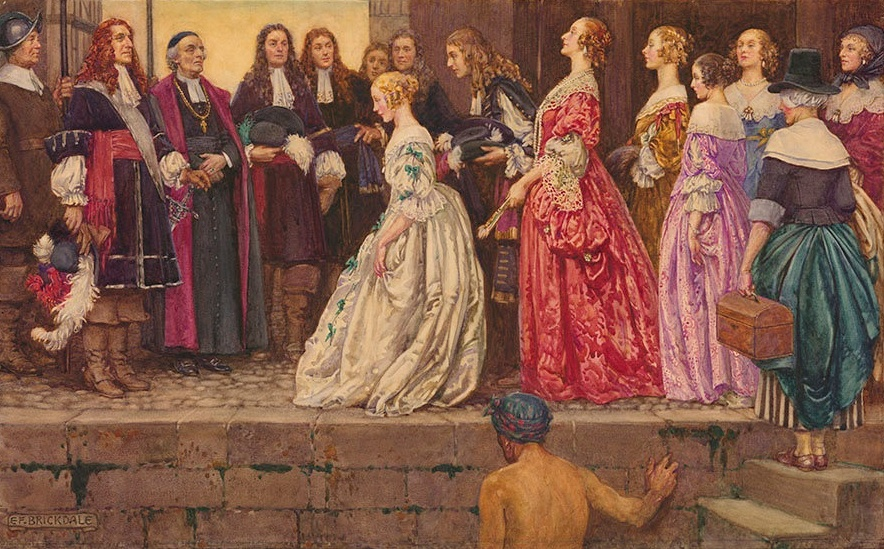
The King's Daughters (French: filles du roi [fij dy ʁwa], or filles du roy in the spelling of the era) were the approximately 800 young French women who immigrated to New France between 1665 and 1673 as part of a program sponsored by King Louis XIV. The program was designed to boost New France's population both by encouraging Frenchmen to move to the New World, and by promoting marriage, family formation, and the birth of French children in the colony. The term refers to those women and girls who were recruited by the government and whose travel to the colony was paid for by the king. They were also occasionally known as the King's Wards.
New France, at its start, was populated mostly by men: soldiers, fur traders, and missionary priests. Settlers began to develop farms and by the mid-17th century, there was a severe imbalance between single men and women in New France. The small number of female immigrants had to pay their own passage, and few single women wanted to leave home to move and settle in the harsh climate and conditions of New France. At the same time, officials noted the population growth of the competing English colonies, which had more families, and they worried about France's ability to maintain its territorial claims in the New World.
To increase the French population and the number of families, the Intendant of New France, Jean Talon, proposed that the king sponsor passage of at least 500 women. The king agreed, and eventually, nearly twice the number were recruited. They were predominantly between the ages of 12 and 25, and many had to supply a letter of reference from their parish priest before they would be chosen for immigration to New France. They were intended to marry men in the colony in order to establish families and more farms.
Marguerite Bourgeoys was the first person to use the expression filles du roi in her writings. A distinction was made between King's Daughters, who were transported to New France and received a dowry at the king's expense, and women who emigrated voluntarily using their own money. Other historians used chronological frameworks to determine who could be called a fille du roi. Research by the historical demographer Yves Landry determines that there were in total about 770 to 850 filles du roi who settled in New France between 1663 and 1673.
The title "King's Daughters" was meant to imply state patronage, not royal or noble parentage; most of the women recruited were commoners of humble birth. As a fille du roi, a woman received the king's support in several ways. The king paid one hundred livres to the French East India Company for each woman's crossing, as well as furnishing her trousseau. The Crown also paid a dowry for each woman; this was originally set at four hundred livres, but as the Treasury could not spare such an expense, many were simply paid in kind.
Those chosen to be among the filles du roi and allowed to emigrate to New France were held to scrupulous standards, which were based on their "moral calibre" and whether they were physically fit enough to survive the hard work demanded by life as a colonist. The colonial officials sent several of the filles du roi back to France because they were deemed below the standards set out by the king and the intendant of New France.
As was the case for most emigrants who went from France to New France, 80 per cent of the filles du roi were from Paris, Normandy and the western regions. Almost half were from the Paris area, 16 per cent from Normandy and 13 per cent from western France. Most came from urban areas, with the Hôpital-Général de Paris and the Saint-Sulpice parish being big contributors. Many were orphans with meagre personal possessions, and with a relatively low level of literacy. Socially, the young women came from different backgrounds but were all very poor. They might have been from an elite family that had lost its fortune, or from a large family with children "to spare." Officials usually matched women of higher birth with officers or gentlemen living in the colony, sometimes in the hopes that the nobles would marry the young women and be encouraged to stay in Canada rather than return to France. A few women came from other European countries, including Germany, England, and Portugal.
The women disembarked in Quebec City, Trois-Rivières, and Montreal. After their arrival, their time to find husbands varied greatly. For some, it was as short as a few months, while others took two or three years before finding an appropriate husband. For the process of choosing a husband, and the marriage, most couples would officially get engaged in church, with their priest and witnesses present. Then, some couples went in front of the notary, to sign a marriage contract. Marriages were celebrated by the priest, usually in the woman's parish of residence. While the marriage banns customarily were to be published three times before a wedding could take place, the colony's need for women to marry quickly led to few filles du roi having marriage banns announced. It is known that 737 of these filles du roi were married in New France.
Hub AI
King's Daughters AI simulator
(@King's Daughters_simulator)
King's Daughters
The King's Daughters (French: filles du roi [fij dy ʁwa], or filles du roy in the spelling of the era) were the approximately 800 young French women who immigrated to New France between 1665 and 1673 as part of a program sponsored by King Louis XIV. The program was designed to boost New France's population both by encouraging Frenchmen to move to the New World, and by promoting marriage, family formation, and the birth of French children in the colony. The term refers to those women and girls who were recruited by the government and whose travel to the colony was paid for by the king. They were also occasionally known as the King's Wards.
New France, at its start, was populated mostly by men: soldiers, fur traders, and missionary priests. Settlers began to develop farms and by the mid-17th century, there was a severe imbalance between single men and women in New France. The small number of female immigrants had to pay their own passage, and few single women wanted to leave home to move and settle in the harsh climate and conditions of New France. At the same time, officials noted the population growth of the competing English colonies, which had more families, and they worried about France's ability to maintain its territorial claims in the New World.
To increase the French population and the number of families, the Intendant of New France, Jean Talon, proposed that the king sponsor passage of at least 500 women. The king agreed, and eventually, nearly twice the number were recruited. They were predominantly between the ages of 12 and 25, and many had to supply a letter of reference from their parish priest before they would be chosen for immigration to New France. They were intended to marry men in the colony in order to establish families and more farms.
Marguerite Bourgeoys was the first person to use the expression filles du roi in her writings. A distinction was made between King's Daughters, who were transported to New France and received a dowry at the king's expense, and women who emigrated voluntarily using their own money. Other historians used chronological frameworks to determine who could be called a fille du roi. Research by the historical demographer Yves Landry determines that there were in total about 770 to 850 filles du roi who settled in New France between 1663 and 1673.
The title "King's Daughters" was meant to imply state patronage, not royal or noble parentage; most of the women recruited were commoners of humble birth. As a fille du roi, a woman received the king's support in several ways. The king paid one hundred livres to the French East India Company for each woman's crossing, as well as furnishing her trousseau. The Crown also paid a dowry for each woman; this was originally set at four hundred livres, but as the Treasury could not spare such an expense, many were simply paid in kind.
Those chosen to be among the filles du roi and allowed to emigrate to New France were held to scrupulous standards, which were based on their "moral calibre" and whether they were physically fit enough to survive the hard work demanded by life as a colonist. The colonial officials sent several of the filles du roi back to France because they were deemed below the standards set out by the king and the intendant of New France.
As was the case for most emigrants who went from France to New France, 80 per cent of the filles du roi were from Paris, Normandy and the western regions. Almost half were from the Paris area, 16 per cent from Normandy and 13 per cent from western France. Most came from urban areas, with the Hôpital-Général de Paris and the Saint-Sulpice parish being big contributors. Many were orphans with meagre personal possessions, and with a relatively low level of literacy. Socially, the young women came from different backgrounds but were all very poor. They might have been from an elite family that had lost its fortune, or from a large family with children "to spare." Officials usually matched women of higher birth with officers or gentlemen living in the colony, sometimes in the hopes that the nobles would marry the young women and be encouraged to stay in Canada rather than return to France. A few women came from other European countries, including Germany, England, and Portugal.
The women disembarked in Quebec City, Trois-Rivières, and Montreal. After their arrival, their time to find husbands varied greatly. For some, it was as short as a few months, while others took two or three years before finding an appropriate husband. For the process of choosing a husband, and the marriage, most couples would officially get engaged in church, with their priest and witnesses present. Then, some couples went in front of the notary, to sign a marriage contract. Marriages were celebrated by the priest, usually in the woman's parish of residence. While the marriage banns customarily were to be published three times before a wedding could take place, the colony's need for women to marry quickly led to few filles du roi having marriage banns announced. It is known that 737 of these filles du roi were married in New France.