Hubbry Logo
KutenaiKutenaiMain
Open search
Kutenai
Community hub
Kutenai
logo
8 pages, 0 posts
0 subscribers
Be the first to start a discussion here.
Kutenai
Kutenai
from Wikipedia

Key Information

PeopleKtunaxa
LanguageKtunaxa,
ʔa·qanⱡiⱡⱡitnam
CountryKtunaxa ʔamakʔas
Ktunaxa

The Kutenai (/ˈktən, -n/ KOO-tə-nay, -⁠nee),[4][5] also known as the Ktunaxa (/tʌˈnɑːhɑː/ tun-AH-hah;[6] Kutenai: [ktunʌ́χɑ̝]), Ksanka (/kəˈsɑːnkɑː/ kə-SAHN-kah), Kootenay (in Canada) and Kootenai (in the United States), are an indigenous people of Canada and the United States. Kutenai bands live in southeastern British Columbia, northern Idaho, and western Montana. The Kutenai language is a language isolate, thus unrelated to the languages of neighboring peoples or any other known language.

Four bands form Ktunaxa Nation in British Columbia. The Ktunaxa Nation was historically closely associated with the Shuswap Indian Band through tribal association and intermarriage. Two federally recognized tribes represent Kutenai people in the U.S.: the Kootenai Tribe of Idaho and the Confederated Salish and Kootenai Tribes (CSKT) in Montana, a confederation also including Bitterroot Salish and Pend d'Oreilles bands.

Name

[edit]

Around 40 variants of the name Kutenai have been attested since 1820; two others are also in current use. Kootenay is the common spelling in British Columbia, including in the name of the Lower Kootenay First Nation. Kootenai is used in Montana and Idaho, including in the Kootenai Tribe of Idaho and the Confederated Salish and Kootenai Tribes. These two spellings have been used for various placenames on their respective sides of the Canadian-U.S. border, notably the Kootenay River, called the Kootenai River in the United States.[7] Kutenai is the common form in the literature about the people, and has been adopted by Kutenai in both countries as an international spelling when discussing the people as a whole.[7][8] The name evidently derives from the Blackfoot word for the people, Kotonáwa, which itself may derive from the Kutenai term Ktunaxa.[7][8] This is supported by an interview with Vernon Finley, previous tribal chairman of the CSKT. He supposes the term to be "given... by some other tribe" and that it was likely "a mispronunciation of whatever that word is," since 'Kootenai' holds no meaning in any neighboring language.[9]

In the Kutenai language, Ktunaxa is considered the most correct general term for the culture and peoples. Differing etymologies have been suggested, tying the name to the verb for "eating food plain, [meaning] without seasoning," or alternately to the verb for "licking up blood."[9] In the same interview referenced above, Finley attests the latter meaning to the image of a Ktunaxa warrior shooting an enemy, drawing out the arrow, and licking the blood from the arrowhead.[9] He also says that, historically, people identified themselves primarily with the name of their band and less so with the broad term Ktunaxa.

It has been attested that some Columbian Plateau groups may have called themselves "Upnuckanick."[10] Ksanka, meaning "people of the standing arrow" is the name of the southeastern-most of the seven bands, who are today primarily associated with what is now northwestern Montana, and are politically organized within the CSKT.[9]

Communities

[edit]

Four Kutenai bands live in southeastern British Columbia, one lives in northern Idaho, and one lives in northwestern Montana:

Canada - British Columbia
  • The Ktunaxa Nation Council (KNC) (until 2005 the Ktunaxa/Kinbasket Tribal Council)[11] includes the four Canadian bands:
    • Ɂakisq̓nuk First Nation ("place of two lakes"; also known as the Columbia Lake Indian Band).[12] An Upper Kutenai group, they are headquartered in Akisqnuk, south of Windermere. Reserves include: Columbia Lake #3, St. Mary's #1A, ca. 33 km2, population: 264)[13]
    • Lower Kootenay Band, (Yaqan Nukiy or Lower Kootenay First Nation).[14] A Lower Kutenai group, they are headquartered in Creston, on the most populous reserve Creston #1 along the Kootenay River, ca. 6 km north of the US-Canada border. Reserves include: Creston #1, Lower Kootenay #1A, #1B, #1C, #2, #3, #5, #4, St. Mary's #1A, ca. 26 km2, population: 214)
    • ʔaq̓am First Nation ("deep dense woods").[15] An Upper Kutenai group, they live along the St. Mary's River near Cranbrook. Tribal headquarters are located on the most populous reserve, Kootenay #1; reserves include: Bummers Flat #6, Cassimayooks (Mayook) #5, Isidore's Ranch #4, Kootenay #1, St. Mary's #1A, ca. 79 km2, population: 357)
    • Yaq̓it ʔa·knuqⱡi’it First Nation (Tobacco Plains First Nation, ʔa·kanuxunik, Akan'kunik, or ʔakink̓umⱡasnuqⱡiʔit - 'People of the place of the flying head'.[16] An Upper Kutenai band, they live near Grasmere on the east shore of the Lake Koocanusa below the mouth of Elk River, ca. 15 km north of the British Columbia-Montana border. Reserves include: St. Mary's #1A, Tobacco Plains #2, ca. 44 km2, population: 165)[17]

Additionally, the Shuswap Indian Band were formerly part of the Ktunaxa Nation. They are a Secwepemc (Shuswap) band who settled in Kutenai territory in the mid-19th century. They were eventually incorporated into the group and intermarried with them, and spoke the Kutenai language. They departed the Ktunaxa nation in 2004 and are now part of the Shuswap Nation Tribal Council. They are located near Invermere, just northeast of Windermere Lake; their reserves include: St. Mary's #1A, Shuswap IR, ca. 12 km2, population: 244).

United States - Idaho
United States - Montana

History

[edit]

The Kutenai today live in southeastern British Columbia, Idaho, and Montana. They are loosely divided into two groups: the Upper Kutenai and the Lower Kutenai, referring to the different sections of the Kootenay River (spelled "Kootenai" in the U.S.) where the bands live. The Upper Kutenai are the Ɂakisq̓nuk First Nation (Columbia Lake Band), the ʔaq̓am First Nation (St. Mary's First Nation), and the Yaq̓it ʔa·knuqⱡi’it First Nation (Tobacco Plains Band) in British Columbia, as well as the Montana Kootenai. The Lower Kutenai are the Lower Kootenay First Nation of British Columbia and the Kootenai Tribe of Idaho.[20]

Origins

[edit]

Scholars have numerous ideas about the origins of the Ktunaxa. One theory is that they originally lived on the prairies, and were driven across the Rockies by the competing Blackfoot people[21] or by famine and disease.[22] Some Upper Kootenay participated in a Plains Native lifestyle for part of the year, crossing the Rockies to the east for the bison hunt. They were relatively well known to the Blackfoot, and sometimes their relations with them were in the form of violent confrontation over food competition.

Some Ktunaxa remained on or returned to the prairies year-round; they had a settlement near Fort Macleod, Alberta. This group of Ktunaxa suffered high mortality rates, partly because of the depredations of the Blackfoot, and partly because of smallpox epidemics. With numbers sharply reduced, these Plains Ktunaxa returned to the Kootenay region of British Columbia.[citation needed]

Some of the Ktunaxa say that their ancestors came originally from the Great Lakes region of Michigan. To date, scholars have not found either archeological or historic evidence to support this account.[citation needed]

The Ktunaxa territory in British Columbia has archeological sites with some of the oldest human-made artifacts in Canada, dated to 11,500 before the present (BP). It has not been proven whether these artifacts were left by ancestors of the Ktunaxa or by another, possibly Salishan, group. [citation needed] Human occupation of the Kootenay Rockies has been demonstrated by dated sites with evidence of quarrying and flint-knapping, especially of quartzite and tourmaline.[citation needed] This oldest assemblage of artifacts is known as the Goatfell Complex, named after the Goatfell region about 40 km east of Creston, British Columbia on Highway 3. These artifacts have been found at quarries in Goatfell, Harvey Mountain, Idaho, Negro Lake and Kiakho Lake (both near Lumberton and Cranbrook), North Star Mountain just west of Creston on Highway 3, and at Blue Ridge. All these sites are within 50 km of Creston, with the exception of Blue Ridge, which is near the village of Kaslo, quite a distance north on the west side of Kootenay Lake.

Archaeologist Dr. Wayne Choquette believes that the artifacts represented in the Goatfell Complex, dated from 11,500 BP up to the early historical period, show that there has been no break in the archaeological record. In addition, he says that it appears that the technology was local. No evidence supports the conjecture that the region's first inhabitants emigrated from this area, nor that they were replaced or succeeded by a different people. Choquette concludes that the Ktunaxa today are the descendants of those first people to inhabit the land.[citation needed]

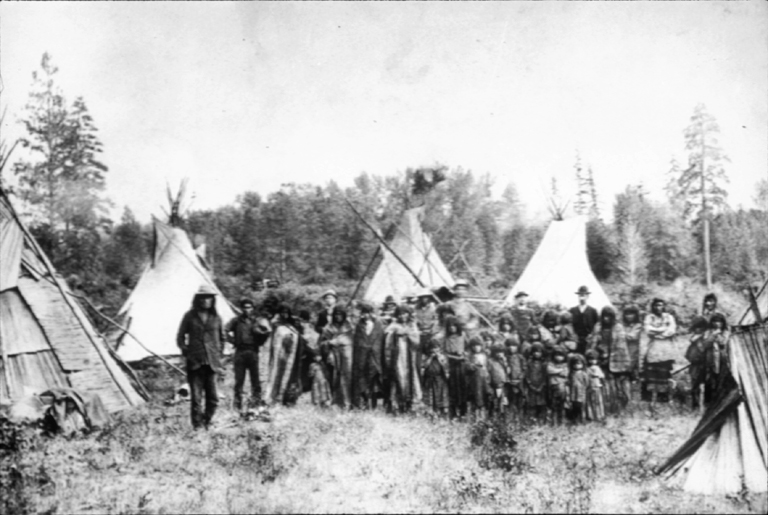
Other scholars, such as Reg Ashwell, suggest that the Ktunaxa moved to the British Columbia region in the early half of the 18th century, having been harassed and pushed there from East of the Rockies by the Blackfoot. He notes that their language is isolated from that of Salish tribes common to the Pacific Coast. In addition, their traditional dress, many of their customs (such as their use of teepee-style portable dwellings), and their traditional religion have more in common with Plains peoples than with the Coastal Salish.[23]

The Goatfell assemblage of artifacts suggests that prior to 11,500 BP, the people who came to inhabit the Kootenay mountains may have lived in what is now the southwestern United States, during a period when British Columbia was beneath the Cordilleran ice sheet of the last ice age. The Goatfell Complex, and specifically the techniques of manufacture of the tools and points, are part of a tradition of knapping that existed in the North American Great Basin and the intermontane west of the continent in the late Pleistocene. The prevailing theory is that as the glaciers retreated, people moved northward, following the revival of the flora and fauna to the north.[citation needed]

From the time of the first Ktunaxa settlement in the Kootenays, until the historical period beginning in the late 18th century, there is little known of the people's social, political, and intellectual development. Stone tool technologies changed and became more complex and differentiated.[citation needed] They were probably big game hunters in their earliest prehistoric phase. The Ktunaxa were first noted in the historical record when mentioned on Alexander Mackenzie's map, circa 1793.[citation needed]

As temperatures continued to warm, the glacial lakes drained and fish found habitat in the warmer waters. The Lower Kootenay across the Pacific Northwest made fishing a fundamental part of their diet and culture, while maintaining the old traditions of game hunting.[citation needed]

Early history

[edit]
Ktunaxa girls, photographed by Edward S. Curtis in 1911

Anthropological and ethnographic interest in the Ktunaxa were recorded from the mid-19th century. What these European and North American scholars recorded has to be viewed with a critical eye, since they did not have the theoretical sophistication expected of anthropologists today. They imputed much of their own cultural values into what they were able to observe among the Ktunaxa. But their accounts are the most detailed descriptions of Ktunaxa lifestyles at a time when Aboriginal lifeways all over the world were dramatically changing in the face of settlement by Europeans and European Americans.[citation needed]

The earliest ethnographies detail Ktunaxa culture around the turn of the 20th century. Europeans observed the Ktunaxa enjoying a stable economic life and rich social life, based on a detailed ritual calendar. Their economic life focused on fishing, using fish traps and hooks, and travelling on the waterways in the sturgeon-nosed canoe. They had seasonal and sometimes ritual hunts for bear, deer, caribou, gophers, geese, and the many other fowl in Lower Kootenay country. As mentioned above, the Upper Kootenay often crossed the Rockies to participate in the bison hunt. The Lower Kootenay, however, did not participate in communal bison hunts; these were not important to their economy or culture.[citation needed]

The Ktunaxa conducted vision quests, particularly by a young man in a passage to adulthood. They used tobacco ritually. They practiced a Sun Dance and Grizzly Bear Dance, a midwinter festival, a Blue Jay Dance, and other social and ceremonial activities.[citation needed] The men belonged to different societies or lodges, such as the Crazy Dog Society, the Crazy Owl Society, and the Shamans' Society. These groups took on certain responsibilities, and membership in a lodge came with obligations in battle, hunting, and community service.

The Ktunaxa and their neighbors the Sinixt both used the sturgeon-nosed canoe. This water craft was first described in 1899 as having some similarity to canoes used in the Amur region of Asia.[24] At the time, some scholars believed in a theory of dispersal, concluding that similarities of artifacts or symbols among cultures represented that a superior culture had transmitted its elements to another culture. Since then, however, most scholars have concluded that many such innovations arose independently among different cultures.

Harry Holbert Turney-High, the first to write an extensive ethnography of the Ktunaxa (focusing on bands in the United States), records a detailed description of the harvesting of bark to make this canoe (67):

A tree ... growing rather high in the mountains is sought. Finding one of the desired size and quality, a man climbed it to the proper height and cut a ring around the bark with his elk-horn chisel or flint knife. In the meantime a helper cut out another ring at the base of the tree. This done, an incision was made down the length of the trunk connecting the two rings. This cut had to be as straight and accurate as possible. A stick of about two inches in diameter was used carefully to pry the bark from the tree. The bark was wrapped up so that it would not dry out on the way to camp. The inside, or tree-side of the bark sheet, became the outside of the canoe, while the outside surface became the inside of the boat. The bark was considered ready for immediate use. There was no scraping or seasoning, nor was it decorated in any way.

Christian missionaries traveled to the Ktunaxa territories and worked to convert the peoples, keeping extensive written records of the process and of their observations of the culture. As a result of their accounts, there is more information about the missionary process than about other aspects of Ktunaxa history at the turn of the 20th century.

The Ktunaxa had been exposed to Christianity as early as the 18th century, when a Lower Kootenay prophet from Flathead Lake in Montana by the name of Shining Shirt spread news of the coming of the 'Blackrobes' (French Jesuit missionaries) (Cocolla 20). Ktunaxa people also encountered Christian Iroquois sent west by the Hudson's Bay Company. By the 1830s the Ktunaxa had begun to adopt certain Christian elements in a syncretic blend of ceremonies. They were influenced less by European missionaries than through their contact with Christian Natives from other parts of Canada and the United States.

Father Pierre-Jean de Smet in 1845-6 was the first missionary to tour the region. He intended to establish missions to minister to Native peoples, and assessing the success and needs of those already established.[citation needed] The Catholic Jesuits had made it a priority to minister to these newly discovered peoples in the New World. While there was missionary activity in Eastern North America for 200 years, the Ktunaxa were not the objects of the church's attentions until the mid-late 19th century. Following De Smet, a Jesuit named Philippo Canestrelli lived among the Ksanka people of Montana in the 1880s and 90s. He wrote a much celebrated grammar of their language, published in 1896. The first missionary to take up a permanent post in the Yaqan Nu'kiy territory, i.e. the Creston Band of Lower Kootenay, was Father Nicolas Coccola, who arrived in the Creston area in 1880. His memoirs, corroborated by newspaper reports and Ktunaxa oral histories, are the basis for the early 20th-century history of the Ktunaxa.

In the first stages of Ktunaxa-European contact, mainly the result of a gold rush that began in earnest in 1863 with the discovery of gold in Wild Horse Creek, the Ktunaxa were little interested in European-driven economic activities. Traders worked to recruit them to trap in support of the fur trade, but few Lower Kootenay found this worthwhile. The Lower Kootenay region is, as mentioned above, remarkably rich in fish, birds, and large game. As the economic life of the Yaqan Nu'kiy was notably secure, they resisted new and unfamiliar economic activities.

Slowly though, the Yaqan Nu'kiy began participating in European-driven industries. They served as hunters and guides for the miners at the Bluebell silver-lead mine at Riondel. The richest gold mine ever discovered in the Kootenays was discovered by a Ktunaxa man named Pierre, and staked by him and Father Coccola in 1893.[citation needed]

20th century

[edit]

While there was sometimes conflict between the Yaqan Nu'kiy and the local settler community at Creston, their relations were more characterized by peaceful coexistence. Their conflicts tended to be over land use. In contrast, relations between the Lower Kootenay and the surrounding European society in Bonners Ferry, Idaho, deteriorated.

By the turn of the 20th century, some Yaqan Nu'kiy were engaged in agricultural activities introduced by European settlers, but their approach to the land was different. An example of the type of conflict that repeatedly arose between European settlers and Native farmers is shown by a newspaper article in the Creston Review dated Friday, 9 August 1912:

A dispute over the rights to cut hay on the flat lands, between the Indians and the white men, which might have resulted in bloodshed, was settled Wednesday by W.F. Teetzel, government agent, of Nelson, who told both Indians and whites that if violence is done, no one would be allowed to cut hay on government land. ... The principal trouble this year occurred when some Indians threatened Frank Lewis and drove him from the hay he had already cut. The Indians claim they have cut land at this particular place for years while the old-time ranchers say that hay has never before been cut there. Mr. Lewis complained to Policeman Gunn who, as the definite boundry [sic] of the Indian reservation is not known was at a loss what to do because no violence was committed whereby he could act. ... Mr. Teetzel arrived from Nelson Wednesday and in conference with Chief Alexander, got him to promise to see that Mr. Lewis got his hay, and warned him to keep the Indians from violence under penalty of losing the right of cutting hay on the flats. This warning he also gave to the white men. This is not the only one of the cases occurring this year. One farmer whose place is located near the reservation has been continually bothered by the Indians cutting his fences and turning their cattle in to graze on his property.

The Creston Review, also reported on 21 June 1912: "[Indian Agent Galbraith] says everything is in good condition and the majority of the Indians are at work picking berries for the ranchers who find their help useful and profitable."

These examples illustrate the dynamic of relations between two peoples: the Ktunaxa whose lands have been vastly reduced by the introduction of a reserve system, and the European settlers who are constantly looking to expand their access to the land (and later industries).

During the 20th century the Yaqan Nu'kiy gradually became involved in all the industries of the Creston valley: agriculture, forestry, mining, and later health care, education, and tourism. This process of integration separated the Yaqan Nu'kiy from their traditional lifeways, yet they have remained a very successful and self-confident community. They gradually gained more control and self-government, with less involvement from the Department of Indian or Aboriginal Affairs. Like most tribes in British Columbia, the Yaqan Nu'kiy did not have a treaty defining their rights regarding their territory. They have been working for decades on a careful and more or less cooperative treaty negotiation process with the government of Canada.[citation needed] The Creston Band of the Ktunaxa today has 113 individuals living on the reserve, and many others living off-reserve and working in various industries in Canada and the United States.[citation needed]

Feeling that they have lost some traditions that are very important to them, the Ktunaxa are working to revive their culture, and particularly to encourage language study. A total of 10 fluent speakers of Ktunaxa live in both the U.S. and Canada. The Yaqan Nu'kiy have developed a language curriculum for grades 4–6, and have been teaching it for four years, to develop a new generation of native speakers. They are involved in designing curriculum for grades 7–12, which requires meeting B.C. curriculum guidelines. Concurrent with this, they are recording oral stories and myths, as well as to videotaping the practice of their traditional crafts and technologies, with spoken directions.

"Kootenai Nation War"

[edit]

On 20 September 1974, the Kootenai Tribe headed by Chairwoman Amy Trice declared war on the United States government. Their first act was to post tribal members on each end of U.S. Highway 95 that runs through the town of Bonners Ferry. They asked motorists to pay a toll to drive through the land that had been the tribe's aboriginal land. (About 200 Idaho State Police were on hand to keep the peace and there were no incidents of violence.) They intended to use the toll money to house and care for elderly tribal members. Most tribes in the United States are forbidden to declare war on the U.S. government because of treaties, but the Kootenai Tribe never signed a treaty.

The United States government ultimately made a land grant of 12.5 acres (0.051 km2), the basis of what is now the Kootenai Reservation.[25] In 1976 the tribe issued "Kootenai Nation War Bonds" that sold at $1.00 each. The bonds were dated 20 September 1974 and contained a brief declaration of war on the United States. These bonds were signed by Amelia Custack Trice, Tribal Chairwoman, and Douglas James Wheaton Sr., Tribal Representative. They were printed on heavy paper stock and were designed and signed by the western artist Emilie Touraine.[citation needed]

See also

[edit]

Literature

[edit]
  • Boas, Franz, and Alexander Francis Chamberlain. Kutenai Tales. Washington: Govt. Print. Off, 1918.
  • Chamberlain, A. F., "Report of the Kootenay Indians of South Eastern British Columbia," in Report of the British Association for the Advancement of Science, (London, 1892)
  • Finley, Debbie Joseph, and Howard Kallowat. Owl's Eyes & Seeking a Spirit: Kootenai Indian Stories. Pablo, Mont: Salish Kootenai College Press, 1999. ISBN 0-917298-66-7
  • Kootenai Culture Committee (Autumn 2015). "The Traditional Worldview of the Kootenai People". Montana: The Magazine of Western History. 65 (3). Helena, Montana: Montana Historical Society Press: 47–73.
  • Linderman, Frank Bird, and Celeste River. Kootenai Why Stories. Lincoln, Neb: University of Nebraska Press, 1997. ISBN 0-585-31584-1
  • Maclean, John, Canadian Savage Folk, (Toronto, 1896)
  • Tanaka, Beatrice, and Michel Gay. The Chase: A Kutenai Indian Tale. New York: Crown, 1991. ISBN 0-517-58623-1
  • Thompson, Sally (2015). People Before The Park-The Kootenai and Blackfeet Before Glacier National Park. Helena, Montana: Montana Historical Society Press.
  • Turney-High, Harry Holbert. Ethnography of the Kutenai. Menasha, Wis: American Anthropological Association, 1941.

References

[edit]
[edit]
Revisions and contributorsEdit on WikipediaRead on Wikipedia
from Grokipedia
The Kutenai (also Ktunaxa or Kootenay) are an Indigenous people whose traditional territory encompasses approximately 70,000 square kilometers centered on the basin in southeastern , with historical extensions into parts of , , , and Washington. They have occupied these mountainous and riverine landscapes for over 10,000 years, adapting a semi-nomadic lifestyle of seasonal hunting, fishing, and gathering to exploit diverse ecosystems from the to the . The , spoken by fewer than 250 fluent speakers as of recent counts, is a with no known relations to other North American Indigenous languages, underscoring their cultural distinctiveness. In , the Ktunaxa Nation comprises four main bands with a combined population of around 1,500, while U.S. bands such as the maintain separate communities totaling several hundred members. Their society emphasized oral traditions for transmitting knowledge of and spiritual practices tied to the land, with dwellings varying from conical tipis in upland areas to mat-covered longhouses near rivers. European contact in the introduced and reserves, profoundly altering traditional patterns while prompting adaptations that preserve core elements of their heritage amid modern governance structures.

Names and Terminology

Etymology and Variants

The autonym Ktunaxa (pronounced roughly "k-too-nah-ha"), used by the people in , serves as the primary self-designation, while Kutenai or Kootenai are common exonyms in the United States. The of ktunaxa remains uncertain, with no consensus on its linguistic roots within the Ktunaxa language, which is an isolate. Anthropologist proposed in 1918 that it derives from a meaning "to go out into the open," though alternative interpretations link it to terms for specific fish species or unseasoned food preparation, reflecting the challenges in reconstructing pre-contact semantics. European variants of the name proliferated in records from the early , including Kootenay (prevalent in ), Kootenai, Kootanae, Coutenai, and Kutanay, often anglicized from phonetic transcriptions or influenced by French explorers and traders. These spellings, numbering over two dozen attested forms by the 1820s, appear in documents as early as 1826, when trader William Kittson referenced the group during explorations of the Kootenay region. Scholarly analysis suggests some exonyms may trace to neighboring languages, such as the Blackfoot term /kutuniua/ for the Kutenai, as noted by Harry Turney-High in 1941. The Upper and Lower Kutenai subgroups, differentiated by geography along the watershed—Upper in the mountainous headwaters near the and Lower in the broader river valleys toward the Columbia—also correspond to distinct dialects of the Ktunaxa language, influencing localized name usages in historical accounts. This division predates extensive European contact and reflects adaptive variations without implying separate ethnic origins.

Traditional Territory and Environment

Geographic Extent

The traditional territory of the Ktunaxa (Kutenai) people historically spanned southeastern , with extensions into northwestern , northern , and portions of , primarily centered on the watershed and the eastern flanks of the . This area, known as ʔaq'am, encompassed approximately 70,000 square kilometers defined by natural boundaries such as river confluences, mountain ranges, and subalpine forests. The Ktunaxa divided their territory ecologically into upper and lower zones corresponding to the Kootenay River's course, with the Upper Ktunaxa occupying montane and headwater regions characterized by rugged terrain, coniferous forests, and high- plateaus, while the Lower Ktunaxa focused on downstream river valleys featuring broader floodplains, wetlands, and transitional grasslands. These divisions aligned with variations in , , and , influencing seasonal mobility within the watershed. Post-contact territorial reductions confined Ktunaxa communities to designated reserves, including the shared in (encompassing 1.3 million acres for the ) and the Kootenai Tribal lands near , in the United States, alongside multiple British Columbia reserves such as those at , St. Mary's, Tobacco Plains, and Creston administered under the Ktunaxa Nation. These reservations represent a fraction of the original expanse, bounded by modern political borders rather than ecological features.

Subsistence and Adaptation

The Kutenai maintained a centered on , , and gathering, with practices adapted to the rugged terrain of river valleys, forested mountains, and accessible plains east of the Continental Divide. Large game such as deer, , , caribou, , mountain sheep, and goats formed the primary protein sources, hunted year-round using bows with - or self-tipped arrows, traps, snares, deadfalls, and communal drives involving surrounds or charges on horseback. hunts, critical for meat and hides, required seasonal migrations through mountain passes like Crowsnest and Kootenay Passes to eastern plains, where animals were driven into snowdrifts, cliffs, or encircled for slaughter. Fishing supplemented hunting, targeting , , whitefish, suckers, and ling in rivers like the Kootenay and Columbia, as well as lakes such as . Methods included weirs with basket traps, spears, harpoons, nets, and hook-and-line techniques, often conducted from canoes or through ice in winter, with dried for storage. Gathering provided carbohydrates and vitamins through roots like and camas, dug with sticks in spring, and berries including serviceberries, chokecherries, and huckleberries collected in summer and autumn, then roasted, boiled, or dried on racks for winter use. Roots and berries were cached in tree platforms or pits to prevent spoilage and wildlife access. Seasonal patterns dictated mobility, with small bands shifting from winter valley camps reliant on stored foods and opportunistic hunting to spring root grounds, summer berry patches and bison hunts, and fall salmon runs. The introduction of horses before 1800 enhanced these adaptations by enabling larger group movements, increased transport of up to 2,000-3,000 pounds of meat per animal, and expanded access to plains resources, shifting some settlements to prairies and facilitating tipi use for mobile camps. Trade via mountain passes with Plains tribes like Blackfeet and exchanged Kutenai tobacco, camas, , and products obtained eastward for and other goods, intensifying post-horse economic exchanges without evidence of , as preservation techniques like production from mixed with berries sustained populations across territories from Tobacco Plains to the .

Language

Ktunaxa as a Linguistic Isolate

The Ktunaxa language, spoken by the Ktunaxa people in southeastern , northern , and northwestern , is classified as a linguistic isolate, showing no demonstrable genetic relationship to neighboring or other North American language families despite geographic proximity. This isolation underscores a distinct linguistic lineage, potentially reflecting ancient divergence or independent development, with structural features such as polysynthetic morphology and unique setting it apart from surrounding tongues. As of the , approximately 215 individuals reported proficiency in Ktunaxa, though fluent speakers number around 18 to 20, primarily elders, earning it a critically endangered status from due to intergenerational transmission breakdown and minimal acquisition by youth. Dialectal variation exists between the northern Ktunaxa form, used in Canadian communities and , and the southern Ksanka variant spoken near , , with further subdivisions into upper and lower registers reflecting subtle lexical and phonological differences across bands. Historical documentation began with limited recordings by fur traders in the late but gained systematic depth through 19th- and early 20th-century ethnographers, including and Alexander Chamberlain's fieldwork around 1910, which captured oral narratives and grammar essentials amid rapid cultural shifts. Subsequent efforts, such as Lawrence Kramer's 1968–1969 recordings, expanded lexical inventories, yet the language's orthographic standardization remains inconsistent, complicating preservation. Revitalization initiatives, including immersion programs and community-led curricula under the Ktunaxa Nation's 2023 Interim Language Strategy, have increased exposure through apps, workshops, and collaborations, but empirical metrics show limited gains in , with projections indicating potential by 2101 absent accelerated transmission. This linguistic bolsters Ktunaxa by encoding worldview elements—such as relational ontologies tied to —not readily translatable, heightening stakes for amid speaker attrition.

Culture and Social Structure

Traditional Practices and Economy

The Kutenai maintained bilateral kinship systems, with no formalized lineages or clans, where social groups centered on co-residential households rather than extended kin structures. These small, flexible bands operated at a local level, emphasizing consensus in . Leadership fell to chiefs or headmen whose authority derived from personal prowess in , warfare, and , rather than strict , allowing adaptive suited to mobile subsistence lifestyles. Subsistence relied on seasonal rounds that tracked availability across diverse environments, including riverine in summer at communal camps and dispersed winter aggregations in semi-permanent villages for hunting and storage. Primary resources encompassed and other fish from rivers like the Kootenay, supplemented by big game such as deer and , roots, berries, and small mammals, with techniques adapted to montane and valley ecotones to minimize depletion. This pattern supported population densities of roughly 0.1 persons per square kilometer in core territories, prioritizing mobility over . Pre-contact exchange networks linked Kutenai bands to neighboring groups, facilitating access to materials like marine shells from coastal Salish traders and lithic tools via interior routes, though direct evidence of extensive horse-mediated trade postdates initial European introductions. Artifacts reflect practical adaptations, including tightly woven baskets from cedar roots for storage and , and pictographs on cliff faces likely marking territorial or navigational cues amid rugged . These items underscore technological ingenuity in resource processing without reliance on metal or ceramics.

Religion and Worldview

The Ktunaxa traditional worldview centers on , positing spiritual presences within animals, landscapes, and natural forces that influence human affairs and provide explanatory frameworks for environmental causality. Oral traditions describe a creator entity whose physical form gives rise to the upon death, establishing humans as land stewards under the guidance of ascended spirit animals that embody moral and practical lessons for survival. These narratives emphasize interdependence with the , where phenomena like seasonal changes or animal behaviors are interpreted through spirit interactions rather than isolated material causes. The grizzly bear occupies a pivotal sacred role as a spiritual guide and ancestral figure, symbolizing strength and wisdom derived from its observed dominance in the rugged terrain; Ktunaxa accounts portray it as a core connector between the physical and spiritual realms, informing ethical conduct toward . This centrality aligns with broader animistic reverence for potent , potentially rooted in empirical adaptations to predation risks and resource competition, though ethnographic records highlight its primacy in guiding visions over formalized worship. Spiritual authority resides with medicine people who interpret dreams and visions—often induced in isolated natural settings—for and , employing alongside appeals to spirits without hierarchical or scripture. Practices lack of large-scale communal ceremonies in pre-contact core traditions, favoring individualized experiential insights that parallel survival heuristics, such as plant efficacy observed through trial and animal , integrated into causal spirit narratives. Sun-associated spirits, possibly influenced by later Plains adoptions like the Sun , represent beneficent forces but remain secondary to localized animal and visionary elements.

History

Pre-Contact Origins

Archaeological investigations in the upper drainage reveal evidence of human occupation dating back to the early postglacial period, with cultural components including lithic tools and faunal remains indicative of adaptations to montane and riparian environments. Sites within the traditional Ktunaxa territory, such as those in the and Columbia landscape units, contain artifacts like projectile points and ground stone tools suited for processing game and plants in coniferous forests and riverine settings, reflecting seasonal mobility between high-elevation hunting grounds and valley bases. This material record aligns with oral traditions asserting continuous Ktunaxa presence for millennia, though direct attribution of the oldest sites (potentially exceeding 10,000 years in regional context) to proto-Ktunaxa groups relies on inferred cultural continuity rather than definitive markers. The Ktunaxa language, classified as a linguistic isolate with no demonstrated relation to neighboring Salishan or Algonquian families, supports notions of long-term territorial stability, as influxes of linguistically affiliated groups from coastal or plains migrations did not assimilate or displace Ktunaxa speech patterns. Ethnographic and archaeological data indicate a distinct adaptive niche, emphasizing small-game , , and root gathering in forested uplands, distinct from the salmon-focused economies of Salishan peoples to the west. Lack of shared linguistic borrowings or overlays with incoming groups further suggests endogenous development over extended timescales, predating broader Plateau cultural shifts around 5,000–3,000 years ago. Pre-contact inter-tribal dynamics involved resource-driven alliances and conflicts, including intermarriage and with Shuswap (Secwepemc) bands for access to eastern passes, contrasted by raids against Blackfeet groups over bison hunting territories east of the Rockies. Oral accounts and ethnographic records describe Ktunaxa warriors conducting punitive expeditions into Blackfeet ranges to counter encroachments, fostering a defensive posture that reinforced territorial boundaries without evidence of large-scale displacement. These relations, predicated on competition for herds and routes, underscore a resilient adapted to the rugged interior without reliance on external confederacies.

Initial European Contact (Late 18th-Early 19th Century)

The first documented European contact with the Kutenai occurred on December 31, 1792, when surveyor Peter Fidler encountered a group of Ktunaxa (Kutenai) people near the gap in present-day , east of the . Fidler, guided by Piikani (Peigan Blackfoot) traders, recorded that the Kutenai had never before seen Europeans and served as intermediaries in networks, transporting goods like horses across the continental divide but expressing a desire for direct access to company posts. Trade during this meeting involved exchanges of and other furs for metal tools, beads, and , initiating the influx of European manufactured goods into Kutenai society. Prior to Fidler's arrival, the Kutenai had acquired through intertribal routes extending southward to groups, enabling expanded seasonal migrations for and enhancing transport of goods across mountainous terrain. The introduction of firearms via early traders like Fidler augmented this equestrian adaptation, improving efficiency in buffalo procurement and defense while facilitating raids; however, it also intensified intertribal warfare, particularly with bands competing for advantages and grounds. This technological shift marked a transition from pedestrian reliance on rivers and foot travel to mounted nomadism, altering traditional settlement patterns and economic strategies. In the early 1800s, the traversed regions adjacent to Kutenai territory in the northern , primarily engaging with neighboring Salish (Flathead) peoples who provided intelligence on local tribes, including indirect references to Kutenai presence and trade networks. Concurrently, European-introduced diseases, particularly transmitted along corridors, inflicted severe demographic impacts; oral accounts collected from Kutenai elders describe outbreaks in the late affecting bands through contact with infected traders or intermediaries, resulting in high mortality consistent with virgin-soil epidemics in immunologically naive populations. Precise population reductions for the Kutenai remain estimates derived from ethnographic records, but analogous Plateau epidemics suggest losses exceeding 50% in exposed groups, disrupting social structures and accelerating reliance on horse-based recovery strategies.

19th-Century Interactions and Treaties

The Hellgate Treaty, signed on July 16, 1855, at Hell Gate in the Bitter Root Valley of present-day Montana, confederated the Bitterroot Salish (Flathead), Upper Pend d'Oreille, and Lower Kutenai tribes under U.S. authority, ceding vast territories in exchange for the establishment of the Flathead Indian Reservation encompassing approximately 1.317 million acres. The agreement, ratified by the U.S. Senate on March 8, 1859, and proclaimed by President James Buchanan on April 18, 1859, aimed to consolidate these groups on the reservation while reserving rights to hunt, fish, and gather off-reservation lands. However, the Kootenai band centered at Bonners Ferry in northern Idaho, numbering around 500–700 historically, was not represented at the negotiations and did not consent to or sign the treaty, resulting in their exclusion from the Flathead Reservation and the absence of a dedicated U.S. treaty for their group. This left the Bonners Ferry band in off-reservation status, with federal authorities seizing their lands without formal agreement, reducing their holdings to minimal allotments like 12.5 acres by later decades. In Canada, Ktunaxa interactions with colonial authorities intensified in the late under the of 1876, which centralized federal control over Indigenous lands and status. Reserves were allocated to Ktunaxa bands primarily in the and , fragmenting cohesive traditional territories into discrete units and dividing the population into smaller, administratively defined groups. In , government agents formally divided the Ktunaxa into bands and assigned specific reserves, establishing the six communities that persist today across southeastern . These impositions opposed by the Ktunaxa, coincided with resource pressures from the Kootenay gold discoveries in 1863 and the subsequent silver rush peaking in the , which spurred settler influxes, mining claims, and displacements from ancestral hunting and fishing sites along the . Throughout the century, Ktunaxa bands derived initial advantages from exchanges with European posts like Kootenae House (established ), acquiring firearms, metal tools, and horses that enhanced mobility and hunting efficiency for deer, , and seasonal plains buffalo pursuits by eastern groups. Yet, escalating settler and miner encroachments depleted game populations through commercial overhunting—particularly affecting buffalo herds accessed by Plains Kutenai—and disrupted seasonal migrations, leading some bands to experience as traditional subsistence economies faltered amid reliance on inconsistent trade goods.

20th-Century Challenges and the 1974 Declaration

In the early , the confronted U.S. assimilation efforts that accelerated land loss and cultural disruption, as federal policies like the of 1887 fragmented communal holdings, reducing the band's territory to roughly 12.5 acres despite their absence from any ratified treaties. Boarding schools across the Pacific Northwest, operational from the 1880s to the 1920s, systematically suppressed Indigenous languages and traditions through enforced separation of children from families, contributing to the erosion of Kutenai practices among affected members. Service by Kootenai members in mirrored broader Native American enlistment rates, which exceeded population proportions, fostering postwar disillusionment with unequal treatment and galvanizing pan-Indigenous activism amid movements challenging federal neglect. By 1974, with a population of 67 and denied aid due to falling below the 125-member threshold for recognition, tribal chairwoman Amy Trice issued a symbolic declaration of war against the on , framing it as a response to treaty-less land seizures and demands for housing, jobs, road repairs, and federal status. The action involved non-violent toll booths on highways crossing tribal land—charging 10 cents per vehicle—to publicize grievances, though dispersed them using non-lethal force without escalation. This tactic prompted negotiations, yielding federal recognition via a presidential resolution under President , reservation enhancements, infrastructure improvements, and programs, including a tribal for Kootenai River fisheries formalized in 1976, all achieved absent and highlighting administrative oversights in adjudication.

Modern Developments and Governance

Demographic Overview

The Ktunaxa people, numbering approximately 2,300 individuals in total, are distributed across six communities in and smaller groups . The Ktunaxa Nation Council in represents about 1,500 members, encompassing both registered status Indians and non-status descendants primarily in . In the United States, the maintains around 150 enrolled members on its 12.5-acre reservation near Bonners Ferry, while an additional several hundred Kootenai individuals are enrolled within the of the Flathead Reservation in , yielding a U.S. subtotal of roughly 800. Urban migration has significantly reduced on-reserve populations, with approximately 50% of status Ktunaxa in living off-reserve in cities such as Cranbrook, Creston, and larger urban centers like or . This dispersal reflects economic opportunities and intermarriage, though it strains community cohesion and cultural transmission. Demographic aging exacerbates , with only 210 fluent speakers of Ktunaxa recorded in the , predominantly among older generations. Despite these challenges, enrollment figures demonstrate modest growth, aligning with the broader 9.4% increase in 's Indigenous population from 2016 to 2021, driven by higher birth rates and expanded eligibility criteria that affirm ongoing vitality rather than decline.

Self-Governance and Economic Initiatives

The Ktunaxa Nation Council, formed in 1970 as the Kootenay Indian District Council to advance political and social objectives, has coordinated across its member since the 1980s, emphasizing consensus-based decision-making and multi-level accountability structures that integrate individual, family, and responsibilities. This approach aligns with the Nation's traditional practices and has facilitated unified policy on resource stewardship and economic priorities, as evidenced by the council's role in negotiating sector-specific agreements. Under influential leaders such as Sophie Pierre, who served as chief of the 'Aq'am ('St. Mary's') community from 1985 to 2011 and later as Chief Commissioner of the Treaty Commission, the Ktunaxa pursued economic diversification through education reforms and , including the establishment of community-controlled institutions like the St. Eugene Golf Resort and Casino. Pierre's efforts in fostering self-reliant governance earned her recognition as the inaugural Senior Fellow in Indigenous Governance and Development at in November 2024. Key enterprises include Ktunaxa Enterprises Limited, a collectively owned entity launched to manage sustainable ventures in and , generating revenues that support broader investments while adhering to cultural values. Forestry initiatives feature revenue-sharing under the 2015 Ktunaxa Nation Forest Revenue Sharing Agreement, which allocates provincial stumpage fees from specified tenures—totaling millions in annual distributions—to fund Nation priorities like and capacity-building. These mechanisms, alongside economic and agreements for , have diversified income streams, enabling the Ktunaxa to lessen dependence on federal transfers, with council reports highlighting increased self-generated revenues as a core strategy for long-term stability. The Ktunaxa Nation in asserts and rights under section 35 of the , stemming from their lack of adhesion to in the interior of , which imposes a constitutional duty on to consult and potentially accommodate asserted rights prior to decisions affecting traditional territories. These assertions align with the honour of principle, emphasizing process over guaranteed outcomes, as section 35 provides a framework for negotiation rather than veto power over development. More recently, the Ktunaxa have referenced the Declaration on the Rights of (UNDRIP), domesticated in via the Declaration on the Rights of Indigenous Peoples Act (2021), to bolster claims for in land-related matters, though judicial application remains interpretive and subordinate to existing constitutional tests. In the United States, Kutenai bands, including those within the Confederated Salish and Kootenai Tribes of the Flathead Nation and the Kootenai Tribe of Idaho, primarily leverage reserved rights under the 1855 Treaty of Hellgate for off-reservation hunting and fishing, which federal courts have upheld as protecting "usual and accustomed" places subject to conservation regulations, rather than relying on non-treaty aboriginal status alone. These rights permit tribal members to hunt and fish on ceded lands free from state interference where not extinguished, as affirmed in cases emphasizing treaty language over state primacy. A pivotal Canadian precedent is Ktunaxa Nation v. British Columbia (Forests, Lands and Natural Resource Operations) (2017 SCC 54), where the unanimously held that the provincial government's consultation process fulfilled its section 35 duty, despite rejecting the Ktunaxa's Charter-based religious freedom claim under section 2(a) against a proposed Jumbo Valley ski resort, ruling that development impacting a sacred spirit's did not infringe the itself but required meaningful engagement to address potential . The decision underscored that Aboriginal groups cannot claim absolute exclusion zones via spiritual assertions but reinforced procedural safeguards, influencing subsequent disputes by prioritizing evidence-based accommodation over unsubstantiated vetoes. In 2025, the allocated $58 million from the Environmental Damages Fund—derived from fines—for Ktunaxa-led environmental restoration in the Kootenay region, including up to $30 million in non-competitive funding for fish projects and $16 million competitively for broader conservation, exemplifying pragmatic co-management arrangements that support Ktunaxa priorities without conceding title or halting economic activity. This initiative, announced on March 13, 2025, focuses on habitat enhancement rather than resolving underlying claims, reflecting ongoing negotiations amid unresolved assertions.

Controversies and Criticisms

Development Projects and Spiritual Sites

The Jumbo Glacier Resort, proposed in 1991 by Glacier Resorts Ltd. for development in the Jumbo Valley—known to the Ktunaxa Nation as Qat'muk, a spiritually significant area regarded as the birthplace and home of the Grizzly Bear Spirit—sparked prolonged opposition from the Ktunaxa, who argued that any permanent human structures would desecrate the site and drive away the spirit central to their religious beliefs. Proponents, including the developer and some regional stakeholders, emphasized potential economic advantages, projecting 750–800 permanent full-time jobs, 150–250 construction positions, and enhanced tourism revenue in British Columbia's East Kootenay region through year-round skiing on four glaciers. Ktunaxa leaders maintained that these material gains could not justify spiritual harm, prioritizing cultural preservation over development despite offers of financial accommodations, which they rejected as early as 2008. Legal challenges culminated in the 2017 Supreme Court of Canada unanimous ruling in Ktunaxa Nation v. (Forests, Lands and Natural Resource Operations), which held that the province's duty to consult Indigenous groups did not extend to veto power based on religious claims, as the minister had reasonably considered spiritual impacts without infringing protections; the decision prioritized procedural consultation and in over absolute preservation. Environmental assessments, among the most extensive for a Canadian , included a management plan to mitigate habitat disruption in the valley, a key linking populations across and into the . Critics highlighted risks of increased human-bear conflicts and fragmentation of grizzly movement, though no peer-reviewed studies demonstrated inevitable population collapse, with provincial data indicating stable grizzly numbers in the Purcells under managed conditions. By January 2020, persistent opposition from Ktunaxa, environmental groups, and locals led to the permanent retirement of tenure rights by the government, designating the 6,000-hectare area as protected wilderness and effectively halting the $450 million after nearly three decades of contention. This outcome underscored tensions between Indigenous spiritual imperatives and resource extraction, forgoing potential Indigenous-led models that could have integrated cultural elements with revenue—such as eco-tourism emphasizing Ktunaxa heritage—while averting documented ecological pressures like and on sensitive alpine . The resolution favored preservation, yet regional analyses noted opportunity costs, including unleveraged jobs and that might have diversified Ktunaxa economic initiatives beyond traditional sectors.

Internal and External Critiques

Within the Ktunaxa Nation, internal debates have arisen over the repurposing of historical sites for , exemplified by the division surrounding the transformation of the former St. Eugene Mission residential school into a complex. Some community members advocated for due to the site's traumatic associations with colonial-era abuses, while others supported the initiative as a means to generate revenue and jobs, highlighting tensions between cultural reckoning and pragmatic self-sufficiency. Governance reforms have also faced self-criticism regarding citizen engagement, with initial skepticism among Ktunaxa citizens that their input in constitutional processes would be disregarded by leadership, reflecting broader concerns about top-down decision-making and the need for greater transparency in band-level structures. These divisions underscore ongoing factionalism in resource allocation, where bands sometimes prioritize differing approaches to forestry, tourism, and conservation, complicating unified nation-building efforts. Externally, some analysts challenge prevailing narratives portraying indigenous groups like the Ktunaxa as inherently dependent victims of historical dispossession, pointing to empirical successes in economic diversification—such as the St. Eugene Resort's annual $13.6 million in revenue and creation of 250 jobs, including for First Nations members—as evidence of self-reliant capacity that undercuts dependency tropes. These achievements, achieved through partnerships and market-oriented ventures like courses and , demonstrate that internal agency and entrepreneurial can mitigate reliance on federal transfers, though critics argue such outcomes remain mixed due to persistent legal and fiscal constraints from unresolved land claims. Debates extend to ideological viewpoints, with external conservative perspectives emphasizing integration into market economies and reduced to foster long-term prosperity, contrasted against traditionalist emphases on cultural preservation over development, as seen in resistance to certain projects that risk environmental or spiritual values. Empirical data from Ktunaxa initiatives reveal variable treaty negotiation outcomes, with self-governance advances in revenue streams offset by internal factionalism that hampers cohesive advancement.

References

Add your contribution
Related Hubs
User Avatar
No comments yet.