



Community hub
Recent from talks
Contribute something
Nothing was collected or created yet.
List of Korean flags
View on Wikipedia
This is a list of flags used by South Korea, North Korea, the Joseon Cybernation, and their predecessor states.
Korean reunification flag
[edit]| Flag | Date | Use | Description |
|---|---|---|---|

|
1991–present | Korean Unification Flag | Used to represent the whole of Korea when North and South participate together in international sporting events.[1] |
National
[edit]| Flag | Date | Use | Description |
|---|---|---|---|
| Present national flags | |||

|
1948–present |  Flag of the Democratic People's Republic of Korea (Ramhongsaek Konghwagukki) Flag of the Democratic People's Republic of Korea (Ramhongsaek Konghwagukki)
|
Red field with a blue bar on the top and bottom separated by a thin white stripe, the red field charged near the hoist with a white disc with a red star in the center. Current, post-1992 standard shown. |

|
1948–present | Flag of the Republic of Korea (Taegeukgi)
|
White field with a red and blue taegeuk in the center and four black trigrams, one in each corner of the flag. Modified several times since its original adoption in 1948. Current, post-2011 version shown. |

|
2022–present | Flag of the Joseon Cybernation
|
Black field with a white Nakseo magic square surrounding eight white trigrams itself surrounding a taegeugdo with alternating blue, red, and yellow. Current, post-late 2023 version shown. |
| Historical versions | |||
.svg)
|
Extant 1392 |  The Royal flag of the Goryeo dynasty[2] The Royal flag of the Goryeo dynasty[2]
|
Also known as the "Bong-gi", which means "The Phoenix Flag". |

|
Extant 1392 | The Royal banner of the Goryeo dynasty.
|
Also known as the "Haema-gi", which means "The Seahorse Flag". |

|
Extant 1392 | The Royal banner of the Goryeo dynasty.
|
Also known as the "Sang-gi", which means "The Elephant Flag". |
.png)
|
Extant 1876 |  The Personal standard of the King of Joseon[3][4] The Personal standard of the King of Joseon[3][4]
|
|

|
1882–1907 |  Royal standard of the Joseon dynasty[4] Royal standard of the Joseon dynasty[4]
|
|

|
1897–1907 | Imperial standard of the Korean Empire
|
|
.png)
|
1908–1910 | Imperial standard of the Korean Empire
|
|
.png)
|
1908–1910 | Standard of emperor emeritus of the Korean Empire
|
|
.png)
|
1908–1910 | Standard of empress of the Korean Empire
|
|
.png)
|
1908–1910 | Standard of crown prince of the Korean Empire
|
|
.png)
|
1908–1910 | Standard of crown princess of the Korean Empire
|
|
.png)
|
1908–1910 | Standard of prince of the Korean Empire
|
|
.svg)
|
1882–1910 | *Flag of the Joseon dynasty and Korean Empire
The first version from top is depicted in the 1882 U.S. Navy book Flags of Maritime Nations. The third version from the top is a replica of the one given by emperor Gojong to American diplomat Owen N. Denny (1838–1900), who served as his advisor. The second version from the bottom is depicted in the 1899 U.S. Navy book Flags of Maritime Nations. Lowest is the version found in the 1944 United States postage stamp series. |
The former Korean imperial flag had a different taegeuk from that in the current South Korean flag. Note that the 1882 U.S. Navy depiction may be left-right reversed. The arrangement of the trigrams was not officially fixed until an ordinance of 1949, when the South Korean government issued the construction. |
.svg)
| |||
.svg)
| |||
.svg)
| |||
.svg)
| |||

| |||

|
1919–1948 | The flag of the Provisional Government of the Republic of Korea
|
In exile in several cities of China |
.svg)
| |||
.svg)
| |||

|
1945–1946 | Flag of the People's Republic of Korea
|
A white rectangular background with three red horizontal strips throughout middle, and a red and blue taegeuk with white border near hoist side. Used by the People's Committees throughout postwar Korea. |
.svg)
|
1945–1948 | Flag of the United States Army Military Government in Korea
|
A white rectangular background, a red and blue taegeuk in the center that symbolizes harmony, and four black trigrams, on each corner of the flag. |
.svg)
| |||

|
1946–1948 | Flag of the Provisional People's Committee for North Korea | A white rectangular background, a red and blue taegeuk in the center that symbolizes harmony, and four black trigrams, on each corner of the flag. |
.svg)
|
1948–1992 | Flag of the Democratic People's Republic of Korea | Red field with a blue bar on the top and bottom separated by a thin white stripe, the red field charged near the hoist with a white disc with a red star in the center. |
.svg)
|
15 August 1948 – 14 October 1949 | Civil and state flag and ensign of the First Republic of South Korea. | This flag was designed by the first National Assembly. |
.svg)
|
15 October 1949 – 20 February 1984 | Civil and state flag and ensign of the First, Second, Third, Fourth and the Fifth Republic of South Korea. | The construction sheet was specified by the Ministry of Education and Culture in October 1949. The exact colors were specified via presidential decree in October 1997.[5][6] |
.svg)
|
21 February 1984 – 14 October 1997 | Civil and state flag and ensign of the Fifth and Sixth Republic of South Korea. | |
.svg)
|
15 October 1997 – 29 May 2011 | Civil and state flag and ensign of the Sixth Republic of South Korea. | |
Political flags
[edit]| Flag | Date | Party | Description |
|---|---|---|---|
 |
1935–1947 |  Korean National Revolutionary Party Korean National Revolutionary Party
|
|
 |
1926–? | Down-with-Imperialism Union
|
Red flag with the abbreviation ㅌ.ㄷ in the middle |
.svg) |
1909–1940s | Korean National Association
|
Red flag with yellow canton bearing red-blue taegeuk. |
 |
1913–current |  Young Korean Academy Young Korean Academy
|
|

|
1949–present | Flag of the Workers' Party of Korea | Combination of a hammer (workers), a writing brush (intellectuals) and a Korean sickle (peasants), crossed over a red field. |

|
1946–present | Flag of the Socialist Patriotic Youth League | Emblem of Youth League on a red flag, with "Youth" (청년) on the emblem. |

|
1945–present | Flag of the Socialist Women's Union of Korea | Red-white-red flag with the name of the organization: "Women's League" (녀성동맹). |

|
1955–present | Flag of the Korean Youth League in Japan | Tricolor flag with the League's logo. |

|
1994?–present | Flag of Mindan | Sky blue flag with a Taegeuk surrounding by five petals of hibiscus syriacus. The formal name of the society (Zainihon Daikanminkoku Mindan) is written in kanji in white, and the abbreviation (Mindan) is written in hangul in yellow. |

|
2024–present | Flag of the Democratic Party of Korea | Blue flag with the party emblem in the middle. |

|
2020–present | Flag of the People Power Party | White flag with the party emblem in the middle. |
.svg)
|
Red flag with the party emblem in the middle. | ||

|
2014–present | Flag of the Justice Party | White flag with the party emblem in the middle. |
Governmental flags
[edit]North Korea
[edit]| Flag | Date | Use | Description |
|---|---|---|---|
| Standard of the President of the State Affairs Commission | |||

|
2018–present | Flag of the President of the State Affairs Commission
|
Emblem of the President of the State Affairs Commission on a dark red field. |
| Flag of the National Government | |||
.svg)
|
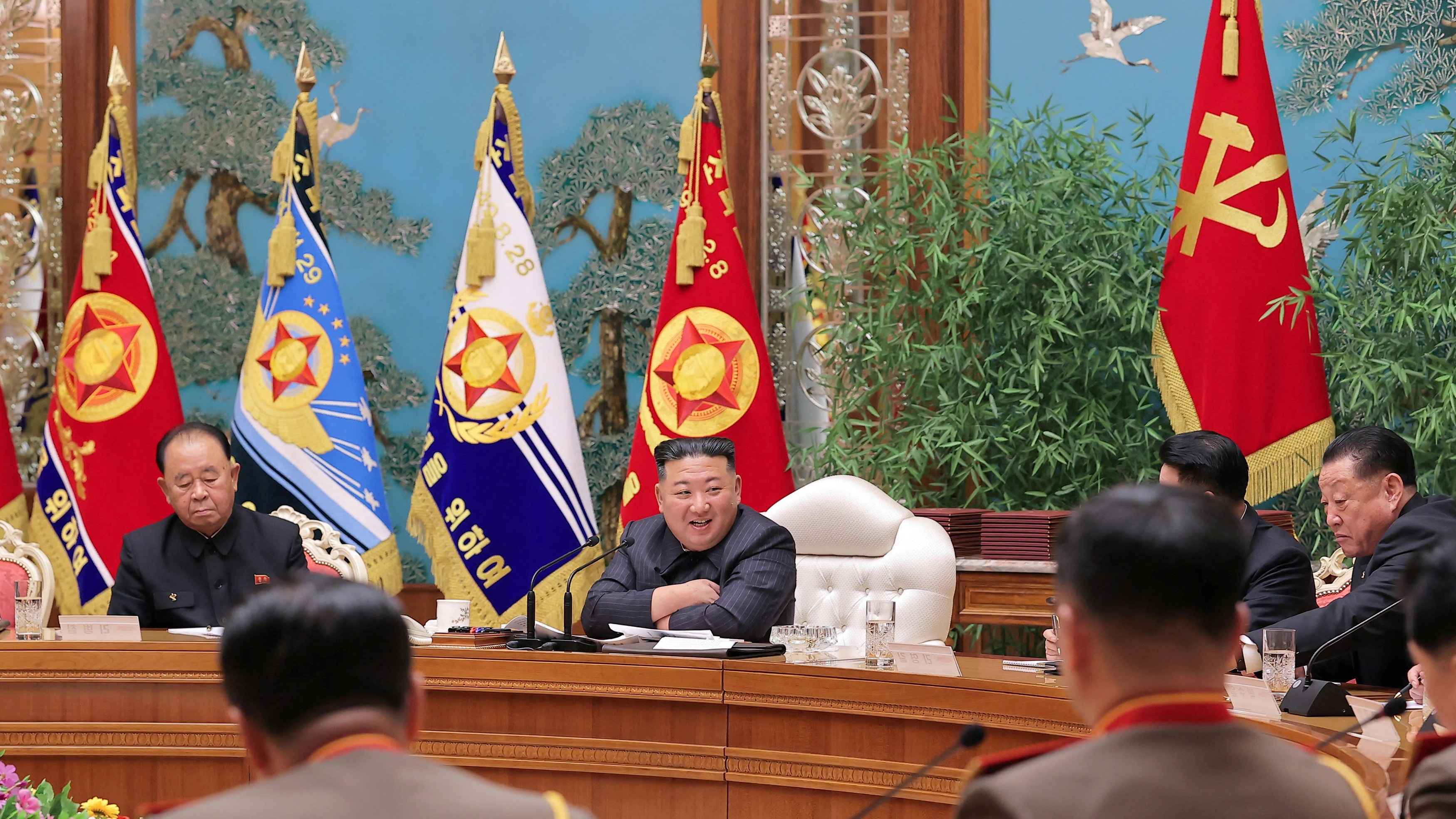
2023–present | Flag of the Ministry of National Defence | Red flag with the emblem of the Korean People's Army that defaced with the emblem of North Korea |
.svg)
|
2023–present | Flag of the Ministry of Social Security, also flag of the Social Security Forces | Top portion in dark green and a narrow gold stripe, middle in black with two rectangles bearing two black oblique stripes on both hoist and fly, bottom in dark green and a narrow gold stripe, superimposed with the emblem of the ministry. The slogan reads "Protect the political security of the socialist motherland and the happiness of the People!" (사회주의조국의 정치적안전과 인민의 행북을 보위하여) |
.svg)
|
2023–present | Flag of the Ministry of State Security | Bicolour of black and gold with 5 alternating stripes between the large stripes and additional black stripe with the emblem of the ministry in the middle. The slogan reads "For the firm security of the party and the country, and the victory of the great achievements of the Juche Revolution! (당과 국가의 굳건한 안전과 주체혁명위업의 승리를 위하여)" |
South Korea
[edit]| Flag | Date | Use | Description |
|---|---|---|---|
| Presidential standard | |||

|
1967–present (design update in 2020) |
Presidential Standard
|
Two Phoenix taking golden Hibiscus syriacus under their wings. |
| Standard of the prime minister | |||

|
1988–present | Standard of the prime minister
|
Golden Hibiscus syriacus inlaid in symbolic Hibiscus syriacus insignia |
| Flag of the National Government | |||
.svg)
|
1988–2016 | Flag of the National Government
|
Symbolic Hibiscus syriacus insignia, inlaid with the word 정부 ("Government"). |

|
2016–present | Flag of the National Government
|
Symbolic Taeguk insignia, with wordmark in Korean 대한민국정부 ("Government of the Republic of Korea"). |

|
2005–present | Flag of the South Korean national police agency. | Insignia of the South Korean National Police, with the words 경찰청 ("Police Agency") |

|
2005–present | Flag of the South Korean coast guard | Insignia of the South Korean coast guard, with the words 해양경찰청 ("Maritime Police Agency") |

|
2004–present | Flag of the South Korean Supreme Prosecutors' Office | Insignia of the Supreme Prosecutors' Office, with the words 검찰 / Prosecution Service |

|
2022–present | Flag of the Corruption Investigation Office for High-ranking Officials | Insignia of the Corruption Investigation Office for High-ranking Officials, with the words 고위공직자범죄수사처 ("Corruption Investigation Office for High-ranking Officials") |
| Flag of the Committee for the Five Northern Korean Provinces | |||

|
1949–2016 | Flag of the Committee for the Five Northern Korean Provinces
|
White flag with a Hibiscus syriacus superimposed by a blue north pointer |

|
2016–present | Flag of the Committee for the Five Northern Korean Provinces
|
Symbolic Taeguk insignia, with grey words 이북5도위원회 ("Committee for the Five Northern [Korean] Provinces") |
| Flag of the Korean Central Intelligence Agency | |||

|
?–1981 | Flag of the Korean Central Intelligence Agency
|
White trapezoid on blue background with orange emblem |
Military
[edit]| Flag | Date | Use | Description |
|---|---|---|---|

|
4th century | Military Flag of Goguryeo
|
A banner with a simple orange field. |
.svg)
|
Mid 5th Century | Military Flag of Goguryeo
|
A black 4-pointed banner with 3 white stripes. |
.svg)
|
Late 5th Century | Military Flag of Goguryeo
|
A red swallowtail banner with a yellow stripe. |

|
Military flag of Baekje
|
A banner with a simple yellow field. | |

|
Military flag of Silla
|
A banner with a blue field with a white crescent moon in the center. | |

|
 Flag of the commander of Joseon Flag of the commander of Joseon
|
A banner with Nakseo magic square. | |

|
Flag of the commander Eo Jae-yeon
|
As one of the military flags of the Joseon Dynasty, it is called Sujagi (帥字旗) or Sugi (帥旗). During the Joseon Dynasty, it was hung as a mark of the general in the military camp. As for the shape, the word for "command" (帥) is engraved in black letters on the pressed color, and some have a dream (decoration of the flag) around the flag. | |

|
1930s | Military flag of anti-Japanese partisans
|
Red field with golden word "Anti-Japanese People's Guerilla Troop" (반일인민유객대). Revived as ceremonial unit color for historical units in North Korea beginning 2015. |
North Korea
[edit]| Flag | Date | Use | Description |
|---|---|---|---|

|
1996–2002 | Flag of the Supreme Commander of the Korean People's Army
|
|

|
2002–2022[7] | The Supreme Commander Star on a red flag. Sometimes used as a war flag during military exercises. | |
.svg)
|
1948 | Flag of the Korean People's Army
|
Initially designed in 1948 with the early draft for the Emblem of North Korea in 1948. The slogan reads: "For the independence of the motherland and the people" (조국의 독립과 인민을 위하여). Used only as ceremonial unit color for historical units beginning 2013. |
.svg)
|
With a red star with golden border and bearing a hammer and two sickles. The inspection reads: "Korean People's Army / [Unit number] / 1st (as in ceremonies) Defensive Division" (조선인민군 제1국방사단). Revived as ceremonial unit color for historical units beginning 2015. | ||
.svg)
|
1948–1961 | Used only as ceremonial unit color for historical units beginning 2013. | |
.svg)
| |||
.svg)
|
Used for Guards units only. The slogan on obverse side reads: "For the motherland's freedom and independence" (조국의 자유와 독립을 위하여). The reverse side have a Guards badge with Korean letters reading "[Unit number] / Guards Kang Kon 2nd (as in ceremonies) Infantry Division" (근위강건제2부병사단). Revived as ceremonial unit color for Guards units beginning 2013. | ||
.svg)
| |||
.svg)
|
1961–1992[8] | Latest version shown; emblem adopted in 1992.[8] The slogan reads: "For the unification and independence of the motherland, and the freedom and happiness of the people" (조국의 통일, 독립과 인민의 자유와 행복을 위하여). | |
.svg)
|
1992–1993 | Emblem of DPRK updated to the one featuring the Paektu Mountain. | |
.svg)
|
1961–1993 (reverse) |
With a red star with golden border and bearing a hammer and two sickles. | |
.svg)
|
1993–2023 | Flag of the General Staff of the Korean People's Army | Seen used during the October 1995 parade, observed very rarely. |
_(1993-2023).svg)
| |||
|
|
2023–present | Red flag with the emblem of the KPA is defaced with the emblem of the DPRK emblazoned on largened red star. The slogan reads "For the endless prosperity of the fatherland and the security of the people! (조국의 무궁한 번영과 인민의 안녕을 위하여)", with the date of the founding of the KPA as 2 February 1948 in the canton. | |
.svg)
|
A design containing the façade of the WPK headquarters in Pyongyang, a red shield bearing the emblem of WPK, and two swords.[9] | ||
.svg)
|
1993–2023[10] | Flag of the People's Army Ground Force
|
Emblem of KPA with slogan: "For the unification and independence of the motherland, and the freedom and happiness of the people" (조국의 통일, 독립과 인민의 자유와 행복을 위하여).[8]
Until the death of Kim Il Sung, version with the slogan "Let us defend the Party's Central Committee headed by dear Comrade Kim Il Sung with our lives!" (경애하는 김일성동지를 수반으로 하는 당중앙위원회를 목숨으로 사수하자!) was also used. When Kim Jong Il was in power, the slogan used between 1997 and 2011 was: "Let us defend the headquarters of the revolution headed by the great Comrade Kim Jong Il with our lives!" (위대한 김정일동지를 수반으로 하는 혁명의 수뇌부를 목숨으로 사수하자!). Until the flag replacement in 2023, the slogan "Let us defend the Party's Central Committee headed by the great Comrade Kim Jong Un with our lives!" (위대한 김정은동지를 수반으로 하는 당중앙위원회를 목숨으로 사수하자!) was also used. The 4.25 commemorates the foundation of People's Anti-Japanese Guerrilla Army on April 25, 1932.[8] Also used since 2020 by the Special Operations, Strategic Forces and Social Security Forces as branch and unit colours. Continually used as ceremonial unit color for historical units as of 2025. |
.svg)
| |||
.svg)
| |||
.svg)
| |||
_(1993-2023).svg)
|
Reverse side of the flag of the Korean People's Army Ground Force. | With Korean letters reading "Revolutionary armed forces of the Workers' Party of Korea, Korean People's Army [unit name] / No.425 unit (in ceremonies)" (조선로동당의 혁명적무장력인 조선인민군 제425 군부대).
The number 425 commemorates the foundation of People's Anti-Japanese Guerrilla Army on April 25, 1932. | |
.svg)
|
2023–present | Flag of the People's Army Ground Force
|
Identical to the former flag except the emblem of the KPA is defaced with the emblem of the DPRK emblazoned on largened red star. The slogan reads "For the endless prosperity of the fatherland and the security of the people! (조국의 무궁한 번영과 인민의 안녕을 위하여)", with the date of founding of the particular unit placed in the canton. This flag is used by units of the Ground Forces to serve as a unit flag. The date of foundation on the canton differs among KPAGF units of regiment/brigade level and above, independent battalions and educational institutions. |
.svg)
|
Reverse side of the flag of the Korean People's Army Ground Force. | Identical to the former flag except the party symbol is placed within a design containing the facade of the WPK headquarters in Pyongyang, a red shield bearing the emblem of WPK, and two swords. The slogan reads "Let us defend the Party's Central Committee headed by Dear Comrade Kim Jong Un with our lives!" (경애하는 김정은동지를 수반으로 하는 당중앙위원회를 목숨으로 사수하자!)[9] | |
.svg)
|
1993–2023[10] | Flag of the People's Navy
|
Emblem of KPA with anchor. The slogan reads: "For the unification and independence of the motherland, and the freedom and happiness of the people" (조국의 통일, 독립과 인민의 자유와 행복을 위하여).
Until the death of Kim Il Sung, version with the slogan "Let us defend the Party's Central Committee headed by dear Comrade Kim Il Sung with our lives!" (경애하는 김일성동지를 수반으로 하는 당중앙위원회를 목숨으로 사수하자!) was also used. When Kim Jong Il was in power, the slogan used between 1997 and 2011 was: "Let us defend the headquarters of the revolution headed by the great Comrade Kim Jong Il with our lives!" (위대한 김정일동지를 수반으로 하는 혁명의 수뇌부를 목숨으로 사수하자!). Until the flag replacement in 2023, the slogan "Let us defend the Party's Central Committee headed by the great Comrade Kim Jong Un with our lives!" (위대한 김정은동지를 수반으로 하는 당중앙위원회를 목숨으로 사수하자!) was also used. The 4.25 commemorates the foundation of People's Anti-Japanese Guerrilla Army on April 25, 1932. Continually used as ceremonial unit color for historical units as of 2025. |
.svg)
| |||
.svg)
| |||
.svg)
| |||
_(1993-2023).svg)
|
Reverse side of the flag of the flag of Korean People's Navy. | With Korean letters reading "Revolutionary armed forces of the Workers' Party of Korea, Korean People's Army [unit name] / No.415 unit (in ceremonies)" (조선로동당의 혁명적무장력인 조선인민군 제415 군부대).
The number 415 commemorates the birthday of Kim Il-Sung on April 15. | |
.svg)
|
2023–present | Flag of the People's Navy
|
Identical to the former flag except the emblem of the KPA is defaced with the emblem of the DPRK emblazoned on largened red star, surrounded by a laurel wreath, and surmounted by an anchor and steering wheel. The slogan reads "For the endless prosperity of the fatherland and the stabling of the people! (조국의 무궁한 번영과 인민의 안녕을 위하여)", with the date of founding of the particular unit placed in the canton. The representative flag of the whole branch displays the date 28 August 1949. |
.svg) 
|
Reverse side of the flag of the flag of Korean People's Navy. | Identical to the former flag except the party symbol is placed within a design containing the façade of the WPK headquarters in Pyongyang, an anchor, and a red shield bearing the emblem of WPK. The slogan reads "Let us defend the Party's Central Committee headed by Dear Comrade Kim Jong Un with our lives!" (경애하는 김정은동지를 수반으로 하는 당중앙위원회를 목숨으로 사수하자!)[9] | |

|
1990s–present | Naval ensign of North Korea
|
Red flag with Paektu Mountain in rays in a disc with national color outlines and a red star. |

|
1990s–present | Naval Ensign of North Korea for Guards Units
|
|

|
1990s–present | Naval Jack of North Korea
|
|
.svg)
|
1993–2023,[10] (insignia updated in 2012) | Flag of the Korean People's Army Air and Anti-Air Force
|
Emblem of KPA with wings. The slogan reads: "For the unification and independence of the motherland, and the freedom and happiness of the people" (조국의 통일, 독립과 인민의 자유와 행복을 위하여).
Until the death of Kim Il Sung, version with the slogan "Let us defend the Party's Central Committee headed by dear Comrade Kim Il Sung with our lives!" (경애하는 김일성동지를 수반으로 하는 당중앙위원회를 목숨으로 사수하자!) was also used. When Kim Jong Il was in power, the slogan used between 1997 and 2011 was: "Let us defend the headquarters of the revolution headed by the great Comrade Kim Jong Il with our lives!" (위대한 김정일동지를 수반으로 하는 혁명의 수뇌부를 목숨으로 사수하자!). Until the flag replacement in 2023, the slogan "Let us defend the Party's Central Committee headed by the great Comrade Kim Jong Un with our lives!" (위대한 김정은동지를 수반으로 하는 당중앙위원회를 목숨으로 사수하자!) was also used. The 4.25 commemorates the foundation of People's Anti-Japanese Guerrilla Army on April 25, 1932. Continually used as ceremonial unit color for historical units as of 2025. |
.svg)
| |||
.svg)
| |||
.svg)
| |||
_(1993-2023).svg)
|
1993–2023 | Reverse side of the flag of the Korean People's Army Air and Anti-Air Force. | With Korean letters reading "Revolutionary armed forces of the Workers' Party of Korea, Korean People's Army [unit name] / No.216 unit (in ceremonies)" (조선로동당의 혁명적무장력인 조선인민군 제216 군부대).
The number 216 commemorates the birthday of Kim Jong-Il on February 16. |
.svg)
|
2023–present | Flag of the Korean People's Army Air Force
|
Identical to the former flag except the emblem of the KPAAF is defaced with the emblem of the DPRK emblazoned on largened red star with additional stars at the top. Lower stripes are arranged as chevrons, and with six trailing jet fighters emerging behind the emblem. The slogan reads "For the endless prosperity of the fatherland and the security of the people! (조국의 무궁한 번영과 인민의 안녕을 위하여)", with the date of founding of the particular unit placed in the canton. The representative flag of the whole branch displays the date 29 November 1945. |
.svg)
|
Reverse side of the flag of the Korean People's Army Air Force. | Identical to the former flag except the party symbol is placed within a design containing the façade of the WPK headquarters in Pyongyang, a red shield bearing the emblem of WPK, and an eagle. The slogan reads "Let us defend the Party's Central Committee headed by Dear Comrade Kim Jong Un with our lives!" (경애하는 김정은동지를 수반으로 하는 당중앙위원회를 목숨으로 사수하자!)[9] | |

|
2018–2020 | Flag of the Strategic Force | Emblem of KPA on an upper half globe |
.svg)
|
With Korean letters reading "Revolutionary armed forces of the Workers' Party of Korea, Korean People's Army [unit name] / No.108 unit (in ceremonies)" (조선로동당의 혁명적무장력인 조선인민군 제108 군부대).
The number 108 commemorates the birthday of Kim Jong-Un on January 8. | ||
.svg)
|
2023–present | With the same pattern as army flag but has the date 3 July 1999 on obverse side. | |
.svg)
| |||
.svg)
|
2023–present | Flag of the Missile Administration
|
The Flag of the Missile Administration is seen with its Emblem in a large form with the founding date of 2016.4.30, The slogan reads "For the defense of the Democratic People's Republic of Korea and the security of its people! (조선민주주의인민공화국의 안전과 인민의 안녕을 위하여)" |
.svg)
|
Identical to the Backside flags of the KPA except the party symbol is placed within a design containing the façade of the WPK headquarters in Pyongyang | ||

|
2018–2020 | Flag of the Special Operation Force | Emblem of KPA with the Big Dipper. |
.svg)
|
With Korean letters reading "Revolutionary armed forces of the Workers' Party of Korea, Korean People's Army [unit name]". / No.506 unit (in ceremonies)" (조선로동당의 혁명적무장력인 조선인민군 제506 군부대).
The number 506 commemorates the 7th Congress of the Workers' Party of Korea on May 6, 2016. | ||
.svg)
|
2023–Present | With the same pattern as army flag but has the date 7 February 1969 on obverse side. | |
.svg)
| |||

|
2007–2023 | Flag of the Worker-Peasant Red Guards | Slogan used until 2012, since then the flag shares the same motto as the rest of the KPA. |
.svg)
|
With Korean letters reading "Worker-Peasant Red Guards". | ||
.svg)
|
2023–Present | The slogan reads "For the endless prosperity of the fatherland and the security of the people! (조국의 무궁한 번영과 인민의 안녕을 위하여)" | |
.svg)
|
With Korean letters reading "Worker-Peasant Red Guards". |
South Korea
[edit]| Flag | Date | Use | Description |
|---|---|---|---|

|
1948–present | Flag of the Armed Forces
|
Insignia of the armed forces on a red field. |

|
?–present | Flag of the Minister of National Defense
|
Insignia of the armed forces and four stars on a red field. |

|
?–present | Flag of the Vice Minister of National Defense
|
Insignia of the armed forces and four stars on a blue field. |

|
?–present | Flag of the Joint Chiefs of Staff
|
Crimson flag with the insignia of the JCS and the words 합동참모본부. |

|
?–present | Flag of the Chairman of the Joint Chiefs of Staff
|
Insignia of the Chairman of the Joint Chiefs of Staff on a crimson field. |

|
1946–present | Flag of the Army
|
Insignia of the army on a field parted per fess; above is white, below is blue. |

|
?–present | Flag of the Chief of Staff of the Army
|
Insignia of the Chief of Staff and four stars on a red field. |
.svg)
|
?–present | Flag of the Daejang
|
Four stars and a Hibiscus syriacus on a red field. |
.svg)
|
?–present | Flag of the Jungjang
|
Three stars and a Hibiscus syriacus on a red field. |
.svg)
|
?–present | Flag of the Sojang
|
Two stars and a Hibiscus syriacus on a red field. |
.svg)
|
?–present | Flag of the Junjang
|
A star and a Hibiscus syriacus on a red field. |

|
1955–present | Naval ensign, navy flag, and naval jack | Taegeuk on crossed anchors in a white canton on a blue field |

|
?–present | Flag of the Chief of Naval Operations
|
Insignia of the Chief of Naval Operations and four stars on a blue field |
.svg)
|
?–present | Flag of the Daejang
|
Four stars and a Hibiscus syriacus on a blue field. |
.svg)
|
?–present | Flag of the Jungjang
|
Three stars and a Hibiscus syriacus on a blue field. |
.svg)
|
?–present | Flag of the Sojang
|
Two stars and a Hibiscus syriacus on a blue field. |
.svg)
|
?–present | Flag of the Junjang
|
A star and a Hibiscus syriacus on a blue field. |

|
1952–present | Flag of the Marine Corps
|
The similarity with the flag of the United States Marine Corps shows the strong influence of the United States since the creation of South Korean armed forces. |

|
?–present | Flag of the Commandant of the Marine Corps
|
Three stars above the insignia of the Marine Corps on a red field. |
|
|
?–present | Flag of the Jungjang
|
Three stars and a Hibiscus syriacus on a red field. |
|
|
?–present | Flag of the Sojang
|
Two stars and a Hibiscus syriacus on a red field. |
|
|
?–present | Flag of the Junjang
|
A star and a Hibiscus syriacus on a red field. |

|
1952–present | Flag of the Air Force
|
Insignia of the air force on a sky blue field. |

|
?–present | Flag of the Chief of Staff of the Air Force
|
Insignia of the Chief of Staff and four stars on a sky blue field. |
.svg)
|
?–present | Flag of the Daejang
|
Four stars and a Hibiscus syriacus on a sky blue field. |
.svg)
|
?–present | Flag of the Jungjang
|
Three stars and a Hibiscus syriacus on a sky blue field. |
.svg)
|
?–present | Flag of the Sojang
|
Two stars and a Hibiscus syriacus on a sky blue field. |
.svg)
|
?–present | Flag of the Junjang
|
A star and a Hibiscus syriacus on a sky blue field. |

|
1968–present | Flag of the Republic of Korea Reserve Forces | Insignia of the Reserve Forces on a blue field. |
See also
[edit]References
[edit]
- ^ Myers, Brian Reynolds (7 February 2018). "On the February 8 Parade and the Olympics". Sthele Press. Retrieved 9 February 2018.
By forbearing to march behind the yin-yang flag at the opening ceremony of the Olympics, the South Korean athletes are making a bigger sacrifice than the North Koreans... [T]he peninsula flag means two very different things to the two Koreas. In the South it symbolizes a desire for peaceful co-existence, or at most for a unification of equal partners in the reassuringly remote future. In wall posters above the DMZ it has always symbolized the southern masses' yearning for "autonomous unification", meaning absorption by the North. It's worrying to think how inner-track propaganda is certain to misrepresent the South Koreans' eschewal of their state flag for this of all symbols — and at this of all events.
- ^ 봉기(鳳旗) (in Korean). War Memorial of Korea. Archived from the original on 2 February 2017. Retrieved 15 November 2021.
- ^ "History of the South Korean flag". www.crwflags.com.
- ^ a b Kariyasu, Nozomi (July 2009). The History of Taegeuk Flags [of South Korea] (PDF). 23rd International Congress of Vexillology. Yokohama, Japan: International Federation of Vexillological Associations.
- ^ "Ministry of Education Notice No. 2". Official Gazette. 15 October 1949. Retrieved 18 January 2022.
- ^ 관보 [Official Gazette] (in Korean). Government of the Republic of Korea. 25 October 1997. p. 25. Retrieved 5 June 2024.
- ^ "North Korea completes erasure of Kim Jong Un's 'supreme commander' symbol". NK News. 2022-02-17. Retrieved 2022-08-10.
- ^ a b c d Tertitskiy, Fyodor (10 April 2018). "What North Korea's army flags can teach us about its recent history". NK News. Retrieved 9 September 2018.
- ^ a b c d "New Flags of the KPA in a meeting of the WPK Central Military Commission on 6 February 2023".
- ^ a b c "Colors of KPA Redesigned". KCNA. 13 February 2023. Retrieved 13 February 2023.
List of Korean flags
View on GrokipediaThe list of Korean flags catalogs the banners, standards, and ensigns employed by Korean kingdoms, dynasties, empires, and contemporary states across millennia, featuring royal designs such as the phoenix-emblazoned Bong-gi of the Goryeo dynasty (918–1392), military and ceremonial flags of the Joseon dynasty (1392–1910), and modern national symbols including the Taegeukgi—originally promulgated as Joseon's flag in 1883 and adopted by the Republic of Korea in 1948—and the red-dominant flag of the Democratic People's Republic of Korea, introduced in 1948 to embody communist ideology with its central star and ideological stripes.[1][2][3] These flags reflect shifts from feudal symbolism rooted in yin-yang cosmology and Confucian hierarchy to 20th-century national emblems shaped by independence struggles, Japanese colonial suppression (1910–1945), and postwar ideological partition under Soviet and American influence.[2] Notable variants include imperial standards of the Korean Empire (1897–1910) with augmented trigrams and the unification flag used in international sports since 1991 to evoke pre-division unity.[4]
Historical Flags
Flags of Ancient and Medieval Kingdoms
Historical records and archaeological evidence indicate that the ancient and medieval kingdoms of Korea preceding the Goryeo dynasty (918–1392 CE) lacked standardized national flags akin to modern vexillology. Instead, military banners, standards, and ceremonial flags—known as "gi" (旗) in Korean—served functional roles in warfare, processions, and royal symbolism, often bearing motifs from cosmology, animals, or geometric shapes. These were typically rectangular or triangular cloths attached to poles, used to signal commands, identify units, or invoke auspicious forces. Primary sources include 4th–6th century CE Goguryeo tomb murals depicting battle scenes and processions, and the 12th-century chronicle Samguk Sagi (History of the Three Kingdoms), which compiles earlier oral and written traditions from the Three Kingdoms era (57 BCE–668 CE).[5] Gojoseon (c. 2333 BCE–108 BCE), the earliest attested Korean state, left no surviving depictions or descriptions of banners, though Chinese annals like the Records of the Grand Historian (c. 94 BCE) mention its military engagements without vexillological details. Similarly, proto-states like Buyeo and the Samhan confederacies (1st century BCE–3rd century CE) provide scant evidence, with reliance on imported Chinese-style standards inferred from regional interactions.[6] In Goguryeo (37 BCE–668 CE), tomb murals from sites like Anak Tomb No. 3 (357 CE) and others in present-day North Korea illustrate military processions with pole-mounted banners carried by infantry and cavalry. These often featured directional guardian symbols adapted from Han Chinese cosmology: the azure dragon (east), white tiger (west), vermilion bird (south), and black tortoise/snake (north), painted dynamically amid clouds or hunts to represent cosmic order and martial prowess. At least 34 tombs preserve such motifs, suggesting their use on field banners for protection and orientation, though no textual flag specifications survive. Baekje (18 BCE–660 CE) murals and artifacts imply similar animal or floral standards, but details remain elusive due to fewer preserved sites.[5][7] Silla (57 BCE–935 CE), the southern kingdom that unified the peninsula with Tang aid by 668 CE, has a documented military banner in the Samguk Sagi, described as a blue field bearing a white crescent moon shape, evoking a daytime half-moon for visibility and perhaps lunar symbolism tied to the kingdom's founding myths. This banner likely functioned as a unit identifier in battles against Goguryeo and Baekje. Balhae (698–926 CE), a northern successor to Goguryeo, inherited similar practices, with tomb evidence suggesting continued use of guardian motifs, though conquest by the Khitan Liao dynasty in 926 CE destroyed most records. Overall, these banners emphasized utility over national identity, with designs varying by clan or command rather than state uniformity.[8]Flags of the Goryeo Dynasty
The Goryeo Dynasty, ruling from 918 to 1392, did not employ a standardized national flag akin to modern designs but relied on royal and military banners for identification in warfare and ceremonies. These standards, often featuring auspicious animals on colored fields, symbolized imperial authority and were used by the king and high-ranking officials. Surviving examples and historical depictions, primarily preserved through artifacts in institutions like the War Memorial of Korea, provide evidence of their use from the 10th century onward..svg) The Bong-gi, or Phoenix Flag, served as a primary royal banner, depicting a phoenix emblem on a yellow background, signifying the king's presence and divine protection. This flag, attributed to use from approximately the 930s until the dynasty's end in 1392, is exhibited at the War Memorial of Korea, where it is recognized as an authentic representation of Goryeo royal insignia..svg)[9] The phoenix motif drew from East Asian symbolism associating the bird with renewal and the empress, though in Goryeo context it underscored monarchical legitimacy amid frequent invasions.[1] Another royal standard was the Haema-gi, known as the Seahorse Flag, featuring a seahorse (haema) on its field, likely symbolizing naval or maritime prowess given Goryeo's coastal defenses against Jurchen and Mongol threats. This banner, also housed at the War Memorial of Korea, reflects the dynasty's adaptation of mythical creatures for military signaling.[10] The Sang-gi, or Elephant Flag, portrayed an elephant, an exotic symbol of strength imported via tribute from southern regions, used in royal processions and battles to denote command hierarchy. Historical records from later dynasties reference elephant banners in Goryeo military contexts, though direct primary texts from the era are sparse, with attributions relying on artifactual and secondary analyses. These banners functioned as vexilla in armies, with variations possibly including fringes for distinction, but evidence remains fragmentary due to the perishable nature of textiles and limited archaeological yields beyond museum-preserved replicas or illustrations. No comprehensive royal flag code exists from Goryeo annals, suggesting usage was pragmatic rather than rigidly codified.[1]Flags of the Joseon Dynasty
The Joseon Dynasty (1392–1897) lacked a standardized national flag akin to modern usage for the majority of its existence, relying instead on diverse royal standards and military banners to denote authority, command, and unit affiliation during ceremonies, processions, and warfare. These vexillological elements drew from Neo-Confucian symbolism, cosmology, and practical identification needs, with designs often incorporating trigrams, mythical creatures, and protective motifs rather than a singular emblematic banner for the state.[2][11] Royal standards, such as the eo-gi (御旗), signified the king's presence and were employed in official processions. Traditional designs featured four-clawed dragons on a field, symbolizing imperial authority while differentiating from the five-clawed dragons reserved for Chinese emperors; these banners underscored the monarch's sovereignty without implying equality to the Son of Heaven.[2] By the late 19th century, amid growing foreign interactions, formalized royal flags emerged, including variants documented around 1876 and 1882 that incorporated taegeuk (yin-yang) and trigram elements, precursors to broader national symbolism.[12] Military banners formed a critical component of Joseon's vexillology, aiding battlefield coordination among the dynasty's armies, which emphasized defensive postures against invasions like those from Japan in 1592–1598 and Manchu forces in the 17th century. The sujagi (帥旗), or commander's flag, marked general positions and often bore the Chinese character for "commander" (帥) or the nakseo magic square—a nine-character grid believed to ward off evil and ensure victory, rooted in geomantic traditions. A preserved example, the rank flag of General Eo Jae-yeon (1823–1871), captured during 19th-century conflicts and repatriated to South Korea in 2007, exemplifies this type, measuring approximately 4.5 square meters and constructed from hemp or cotton. Additional military flags depicted directional guardians—azure dragon (east), white tiger (west), vermilion bird (south), and black tortoise (north)—aligning with cosmological divisions to represent army flanks or elite units. Processional and auxiliary banners incorporated taegeuk circles and eight trigrams (bagua), reflecting philosophical principles of balance and change central to Joseon governance, though these were not unified under a national design until the adoption of the Taegukgi in 1883 under King Gojong, signaling modernization efforts.[2][1]Flag of the Korean Empire
The national flag of the Korean Empire, known as the Taegukgi, consisted of a white rectangular field bearing a central taegeuk symbol—a red upper half and blue lower half divided by an S-shaped curve representing the duality of yin and yang—surrounded by four black trigrams in the corners: geon (☰) for heaven in the top left, gam (☵) for water in the top right, ri (☲) for fire in the bottom left, and gon (☷) for earth in the bottom right.[12] This design symbolized the harmony of opposites and the foundational elements of the universe, drawing from traditional Korean cosmology and philosophy.[2] The flag measured approximately 60 cm by 54 cm in early standardized forms, nearly square in proportion.[13] Originally designed in 1882 for a diplomatic mission to Japan and formally proclaimed as the national flag on March 6, 1883, by King Gojong during the late Joseon period, the Taegukgi continued in official use throughout the Korean Empire from its proclamation on October 12, 1897, until annexation by Japan on August 29, 1910.[12] It represented Korea's assertion of sovereignty amid pressures from imperial powers, appearing on diplomatic envoys, the Independence Arch erected in Seoul in 1897, postage stamps from July 22, 1895, and passports issued in 1904.[2] Early depictions, such as those in the 1889 U.S. Navy publication Flags of Maritime Nations, showed variations with curved or whorl-like trigram bars rather than straight ones, reflecting a lack of initial standardization that persisted into the empire era.[12] The Taegeuk Flag Regulation of December 8, 1900, under Emperor Gojong formalized its specifications, including the cross-arranged trigrams, as displayed at the Paris World Exposition that year.[13] In addition to the national flag, the Korean Empire employed distinct imperial standards from 1908 to 1910 for the emperor, emperor emeritus, empress, and crown prince, often featuring the taegeuk motif augmented with imperial insignia on a white or colored field to denote rank and authority.[12] These standards underscored the monarchical hierarchy during a period of modernization efforts, such as the Gwangmu Reform, aimed at preserving Korean autonomy against Japanese encroachment, though they were ultimately supplanted following the Japan–Korea Annexation Treaty.[2] The white background of the Taegukgi evoked traditional Korean mourning colors and purity, contrasting with the multicolored flags of neighboring powers.[13]Flag of the Provisional Government of the Republic of Korea
The flag of the Provisional Government of the Republic of Korea consisted of a white rectangular field bearing a central taegeuk emblem—a circle divided into red (upper) and blue (lower) halves symbolizing the complementary forces of yang and um (positive and negative energies)—surrounded by four solid black trigrams positioned in the corners. [12] The trigrams, derived from the ancient Chinese I Ching, represent heaven (☰, top-left), water (☵, top-right), earth (☷, bottom-left), and fire (☲, bottom-right), denoting foundational principles of nature and balance. [12] This design, known as the taegeukgi, measured in a 3:2 ratio and emphasized white as a symbol of purity and peace in Korean tradition. [14] Established on April 11, 1919, in Shanghai amid the March 1st Movement's independence protests against Japanese colonial rule, the Provisional Government adopted the taegeukgi as its official banner to signify Korean sovereignty and resistance. [14] The flag's use predated the government's formal founding, emerging prominently during the 1919 uprisings when Korean activists hoisted it as a symbol of national revival, drawing on earlier 19th-century precedents from the Joseon era but standardizing its form for anti-colonial efforts. [14] Operating in exile across China, including Chongqing by the 1940s, the government flew the flag at diplomatic outposts and during alliances with Republic of China forces, reinforcing its role in international appeals for Korean liberation. [2] The taegeukgi's symbolism underscored a philosophical harmony central to Korean cosmology, with the interlocking taegeuk halves illustrating dynamic equilibrium between opposing forces, while the trigrams evoked elemental cycles essential for prosperity and order. [12] This emblematic continuity from pre-colonial designs helped legitimize the Provisional Government's claims, distinguishing it from Japanese imperial symbols imposed after 1910. [14] Post-liberation in 1945, the flag's prominence influenced its retention as the Republic of Korea's national standard upon formal adoption on October 15, 1948, by the constitutional assembly. [14] No significant variants were recorded during the Provisional era, maintaining uniformity despite resource constraints in exile. [12]National Flags
Republic of Korea (South Korea)
The national flag of the Republic of Korea, designated as the Taegukgi (태극기), comprises a white field with a central taegeuk circle featuring a red upper half and blue lower half, encircled by four black trigrams in the corners: Geon (☰, heaven) at top-left, Gon (☷, earth) at bottom-left, Ri (☲, fire) at top-right, and Gam (☵, water) at bottom-right.[15] [16] The flag adheres to a 3:2 width-to-height ratio, with the taegeuk circle's diameter equaling one-third of the height and the trigrams positioned such that their outer edges align one-third from the flag's edges.[17] [18] Originally designed in 1882 during the Joseon Dynasty as a national symbol, the Taegukgi was reestablished following World War II and formally adopted by the Republic of Korea on August 15, 1948, coinciding with the nation's independence proclamation.[19] [16] Its color specifications were standardized in 1997, with the modern version incorporating a lighter blue hue finalized in 2011.[16] The white background signifies purity and peace, core values in Korean tradition.[16] The taegeuk embodies the dynamic balance of opposing cosmic forces—red for positive yang energy and blue for negative eum energy—drawing from East Asian philosophical principles of harmony.[16] [19] The trigrams represent fundamental natural elements and forces, symbolizing creation, stability, transformation, and flow, respectively, to illustrate universal equilibrium.[16] Governed by the Act on the Flag of the Republic of Korea, the Taegukgi serves as the civil, state, and war flag, with regulations promoting its dignified display to foster patriotism and prohibiting misuse such as commercial exploitation or desecration.[20]Democratic People's Republic of Korea (North Korea)
The national flag of the Democratic People's Republic of Korea consists of three horizontal bands: blue at the top and bottom, separated from a central red band of triple width by narrow white stripes. A white disc bearing a red five-pointed star is centered in the upper hoist-side quadrant of the red band.[21][3] The flag was designed in 1947 and officially adopted on 8 September 1948 by the 1st Supreme People's Assembly upon passage of the DPRK's first constitution.[22] No substantive changes to the design have occurred since adoption.[23] According to official DPRK explanations, the blue bands symbolize sovereignty, peace, and friendship; the red band represents the revolutionary traditions of the Korean people; the white stripes and disc evoke Korean culture's emphasis on purity and monotheism; and the star stands for the unity of the population under socialist ideals.[21] These interpretations align with the regime's ideological framework, though independent vexillological analyses note the design's departure from traditional Korean symbolism in favor of Soviet-influenced motifs.[24] Protocol mandates that the flag be flown from sunrise to sunset on state buildings, with half-masting reserved for mourning periods declared by the government; it takes precedence over all other flags in the DPRK.[21] The flag's proportions are 1:2, and it is required for official use without alterations.[3]Flags of Unity and Special Use
Korean Reunification Flag
The Korean Reunification Flag, also known as the Unification Flag of Korea, consists of a white field bearing a light blue silhouette of the Korean Peninsula, including Jeju Island to the south and Ulleungdo to the east.[25] The white background symbolizes purity and peace, while the blue outline represents the sky and aspirations for unity between North and South Korea.[26] This flag serves as a symbolic representation of a unified Korea during joint events, particularly in international sports competitions where the two nations participate as a single team.[4] The flag's design originated from inter-Korean discussions in the late 1980s and early 1990s aimed at fostering cooperation in global events. Initial agreements during talks for the 1990 Asian Games specified inclusion of the peninsula and Jeju Island, deliberately excluding disputed territories to avoid contention.[27] It was first officially employed on July 12, 1991, when a unified Korean team competed in the 41st World Table Tennis Championships in Chiba, Japan, and later that year in the FIFA World Youth Championship.[4] Subsequent modifications incorporated Ulleungdo in 2002, reflecting South Korea's claims over surrounding islands, though the inclusion of the Liancourt Rocks (known as Dokdo in South Korea and Takeshima in Japan) remains a point of territorial sensitivity not universally depicted.[28] Primarily utilized in ceremonial contexts, the flag has appeared in Olympic Games, such as the unified women's ice hockey team at the 2018 PyeongChang Winter Olympics, where North and South Korean athletes marched together under it during the opening ceremony on February 9, 2018.[26] It also features in bilateral summits and cultural exchanges, symbolizing aspirational reunification without implying political merger, as both governments maintain distinct national flags for sovereign purposes.[29] Despite its peaceful imagery, the flag's use underscores ongoing divisions, with design choices like the undivided peninsula evoking hopes for reconciliation amid persistent ideological and territorial disputes.[28]Political Flags
Political Flags of South Korea
Political flags in South Korea are employed by political parties for election campaigns, rallies, and internal events, serving to visually distinguish party supporters and convey ideological symbols. Unlike national or governmental flags, these are not subject to legal standardization under the Flag and Emblem Act of 1949, allowing parties flexibility in design, often centering the official party emblem—typically a stylized logo incorporating the party name in Hangul—on a solid-colored field reflective of traditional party hues. Conservative parties have conventionally adopted blue to evoke stability and tradition, while liberal parties have varied, sometimes incorporating green for renewal or peace, though blue appears in designs for both major parties in recent years.[30][31] The People Power Party (국민의힘), established in 2020 as the primary conservative force succeeding the Liberty Korea Party, utilizes a flag with its emblem—a dynamic motif symbolizing national power, often rendered in white or contrasting tones—on a predominantly white or blue background for visibility in gatherings. This design aligns with the party's rebranding emphasis on unity and strength, as evidenced by its deployment in presidential and legislative election events since 2020.[32][30] The Democratic Party of Korea (더불어민주당), the leading liberal party formed in 2015 through mergers of centrist and progressive factions, employs a blue flag featuring its emblem—a rose-like symbol representing democratic growth and solidarity—in the center, used prominently in opposition rallies and victories celebrations, such as after the 2024 general election where it secured a parliamentary majority. Predecessor entities, like the New Politics Alliance for Democracy (2014–2015), featured similar blue fields with white Hangul lettering of the party name and an arch motif beneath, underscoring continuity in visual identity for campaign mobilization.[31][30] Smaller or historical parties have also maintained flags, such as the Democratic Republican Party (1963–1980), a ruling conservative entity under Park Chung-hee that displayed a flag with its name and emblem to reinforce regime loyalty during its dominance, holding power through martial law periods until dissolution in 1980. These flags, while not bearing official state status, play a causal role in political signaling, aiding voter identification and mobilization amid South Korea's competitive multi-party system, where over 30 registered parties existed as of 2024. Wait, no cite Wiki, so omit specific historical description if not sourced elsewhere.| Party | Flag Description | Adoption/Use Period | Traditional Color |
|---|---|---|---|
| People Power Party | Emblem on white/blue field | 2020–present | Blue |
| Democratic Party of Korea | Emblem on blue field | 2015–present | Blue (with green historical associations) |
| New Politics Alliance for Democracy (predecessor) | White Hangul name and arch on blue field | 2014–2015 | Blue |
Political Flags of North Korea
The Workers' Party of Korea (WPK), the founding and sole ruling political party of North Korea established on October 10, 1945 as the Communist Party of North Korea and reorganized through mergers into its current form by 1949, maintains the primary political flag in the country.[33] This flag symbolizes the party's vanguard role in guiding the state's Juche ideology and revolutionary objectives, with no independent flags documented for the minor satellite parties such as the Korean Social Democratic Party or Chondoist Chongu Party, which operate under WPK subordination. The WPK flag consists of a red field representing revolutionary struggle, bearing the party's central emblem in gold: a hammer for industrial workers, a traditional Korean sickle for peasants, and a writing brush for intellectuals, intersecting to denote the united front of these classes under party leadership.[34] The emblem's design, adopted concurrently with the party's consolidation in the late 1940s, draws from modified communist iconography to incorporate Korean elements, distinguishing it from standard Soviet-style symbols.[22] It has remained unchanged through the party's 75-year history as of 2020, enduring as a fixture at congresses, state ceremonies, and party headquarters in Pyongyang.[35] In practice, the WPK flag often appears alongside or subordinate to the national flag during political events, underscoring the party's fusion with state apparatus, where it flies prominently over the Kumsusan Palace of the Sun and Central Committee buildings.[33] Youth and mass organizations affiliated with the WPK, such as the Kim Il-sung Socialist Youth League, may display derivative banners incorporating the emblem, but these function as extensions rather than distinct political flags. The flag's symbolism reinforces the regime's emphasis on self-reliance and anti-imperialism, as articulated in official propaganda tracing its origins to the anti-Japanese guerrilla struggles led by Kim Il-sung.[34]Governmental Flags
Governmental Flags of South Korea
The governmental flags of South Korea encompass standards and ensigns used by executive branch officials and the central government, distinct from the national flag (Taegeukgi). These flags symbolize authority and are flown at official residences, vehicles, and events involving the president, prime minister, and government apparatus. They incorporate elements like the taegeuk (yin-yang symbol) and the mugunghwa (rose of Sharon, the national flower), reflecting continuity with national symbolism while denoting specific offices.[36][37] The Presidential Standard, used by the president as head of state and government, is a white field with the presidential seal centered. The seal comprises a blue-and-red taegeuk encircled by four gold mugunghwa blossoms, topped by a ribbon inscribed "대한민국 대통령" (President of the Republic of Korea) in Hangul. This design has been in use since at least the late 20th century, with the current form standardized under presidential decree, and it is hoisted at the Blue House (now presidential office) and accompanying the president's motorcade.[36][38] The Flag of the Prime Minister, denoting the head of the State Council, features a blue field with a central emblem of a gold mugunghwa flower outlined in white, symbolizing the office's administrative coordination role under the presidential system established by the 1987 Constitution. It dates to post-democratization reforms and is displayed during official duties, such as cabinet meetings.[36][39] The Flag of the Government of the Republic of Korea, representing the executive branch collectively, consists of a white field bearing the taegeuk symbol above the Hangul inscription "대한민국" (Republic of Korea). Adopted on March 1, 2016, to replace an earlier version, it is used at government buildings, international representations, and policy coordination events, emphasizing national unity and administrative authority.[37]Governmental Flags of North Korea
The Democratic People's Republic of Korea (DPRK) utilizes its national flag for most governmental functions, with limited distinct standards for high-level officials. The primary governmental flag is the personal standard of the Chairman of the State Affairs Commission, a position established in 2016 and held by Kim Jong-un, serving as the head of state. This flag consists of a red field bearing the emblem of the Chairman, and it was first publicly observed in June 2018 during Kim Jong-un's summit meeting with U.S. President Donald Trump in Singapore, where it appeared on official vehicles.[40][41] No specific flags are documented for other governmental roles, such as the Premier (currently Kim Tok-hun, head of government since 2020) or members of the State Affairs Commission. Ministries and state organs, including the Supreme People's Assembly, rely on the national flag or institutional seals rather than unique vexilla. This reflects the DPRK's emphasis on unified symbolism under centralized leadership, where the national and Workers' Party of Korea flags predominate in official displays.[42]Military Flags
Military Flags of the Republic of Korea
The Republic of Korea Armed Forces maintain distinct flags for its primary branches—the Army, Navy, Air Force, and Marine Corps—each incorporating service-specific emblems on fields reflecting traditional colors associated with land, sea, sky, and amphibious operations. These flags symbolize branch identity, operational domains, and national defense commitments, often derived from post-1945 military reorganizations following the establishment of the Republic on August 15, 1948. While the national flag serves as the primary ensign across services, branch flags are hoisted at headquarters, ceremonies, and vessels to denote command authority and unit affiliation. Republic of Korea Army FlagThe Army flag features a bicolor field divided horizontally, white above blue, with the service's insignia centered. The emblem originates from the cap badge issued in April 1946 to troops of the initial South Korean Defense Guard, predecessor to the modern Army founded September 15, 1948. This design evokes purity (white) and steadfast resolve (blue), aligned with ground force symbolism. Rank flags for general officers employ a red background with the national flower, the Rose of Sharon, and varying star counts to denote hierarchy. Republic of Korea Navy Flags
The Navy, established November 11, 1945, as the Marine Defense Group and formalized December 5, 1945, uses the national flag as its primary ensign on warships. The naval jack, introduced in 1955, consists of the taegeuk symbol superimposed on crossed anchors within a white canton occupying the hoist, on a blue field; variants exist with and without anchor hooks, the taegeuk sized to half the canton's width. A dedicated navy flag employs a deep blue field with crossed anchors and the taegeuk, representing enveloping seas, interlocked naval solidarity, and cosmic harmony. These elements underscore the Navy's role in maritime defense since its expansion post-Korean War.[43][44] Republic of Korea Air Force Flag
Established October 10, 1949, the Air Force flag displays the service emblem on a light blue field, symbolizing the skies and aerial domain. The emblem integrates aviation motifs with national symbols, used at bases and in ceremonial contexts. General officer rank flags mirror Army conventions with red fields, Rose of Sharon, and stars, adapted for air command structures. Aircraft markings include roundels derived from the taegeuk for identification in joint operations. Republic of Korea Marine Corps Flag
As a Navy subordinate branch since its activation April 29, 1949, the Marine Corps flag predominantly red (evoking valor and amphibious assault) bears a white scroll with red Hangul "해병대" (Haebyeongdae, denoting Marine Corps), flanked by a gold star and eagle. This design highlights rapid reaction and reserve roles, with the eagle signifying vigilance over land-sea interfaces. The Corps' flags emphasize expeditionary heritage from Korean War expansions.
Military Flags of the Korean People's Army
The Korean People's Army (KPA), the military organization of North Korea established on February 8, 1948, employs distinct flags for its primary branches, which are adaptations of the national flag featuring branch-specific emblems and colors to denote organizational identity and hierarchy. These flags emphasize socialist symbolism, including red stars, wreaths, and inscriptions in Hangul script glorifying the Workers' Party of Korea and its leadership. Updates to the designs were introduced in 2023, incorporating a central gold ring with a wreath, a red star bearing the national emblem, and foliage borders, reflecting evolving state iconography observed during military parades on February 8, 2023. The flag of the KPA Ground Force, the largest branch comprising approximately 1.1 million active personnel as of 2023 estimates, modifies the national flag by substituting black for the blue horizontal stripes while retaining the central red panel with white stripes; the red star is encircled by a gold wreath, and Korean script reads "Korean People's Army" along the edges. This design has been in use since at least the 1990s, with the 2023 revision adding the new emblematic charge for uniformity across branches. The Korean People's Navy flag features a red upper half bearing the KPA emblem augmented with an anchor, overlaid on a lower section of alternating blue and white wavy stripes symbolizing the sea—specifically four blue and three white—to evoke maritime operations; the proportion approximates 1:2, and it serves as both ensign and jack. Adopted in the 1990s and updated in 2023 with the revised central device, this flag distinguishes the navy's approximately 60,000 personnel focused on coastal defense and submarine warfare.[45] The Korean People's Army Air and Anti-Air Force flag is predominantly light blue, representing the sky, with the KPA emblem including wings or aviation motifs in the center, flanked by gold Hangul inscriptions such as "Defend the Sky of the Fatherland"; a darker blue stripe may appear at the base in some variants. The 2023 iteration aligns with branch-wide changes, incorporating the gold-ringed red star, and supports the air force's estimated 110,000 personnel operating aging Soviet-era aircraft. Additional flags exist for specialized units, such as the Worker-Peasant Red Guards, a paramilitary reserve force of several million civilians, whose flag mirrors Ground Force patterns but with red-dominant fields and red guard-specific script; it underscores the regime's emphasis on mass mobilization. The Supreme Commander flag, reserved for the head of state in military capacity, displays a large red star with rays on a red field bordered in gold, historically tied to Kim Il-sung and successors. These designs prioritize ideological conformity over practical field utility, as evidenced by their prominence in state ceremonies rather than combat documentation.Subnational and Regional Flags
Provincial and Municipal Flags of South Korea
South Korea's first-level administrative divisions, comprising 9 provinces, 6 metropolitan cities, 1 special city (Seoul), 1 special self-governing city (Sejong), and their equivalents, maintain official emblems that serve as de facto flags. These designs emphasize local symbolism such as natural features, Hangul representations, and aspirational motifs, typically rendered on a white or colored field without incorporating national elements like the taegeuk or trigrams. Adoption dates vary, with many updated in the 21st century to align with economic or regional development themes, reflecting local government autonomy in emblem creation under the Local Autonomy Act of 1995.[46][47] Examples include Seoul's emblem, adopted on October 28, 1996, featuring a Y-shaped symbol in green (mountains and environment), blue (Han River and vitality), and yellow (sun and future vision) on a white field, symbolizing a human-centered metropolis surrounded by nature.[48] Gyeonggi Province's current emblem, introduced by November 27, 2014, displays a stylized blue and white logo with "Global Inspiration" text in English and Hangul on white, using colors like Gyeonggi Blue for knowledge and technology, evoking ambition and global leadership.[49] North Chungcheong Province updated its flag on October 6, 2023, to a white field bearing purple "ㅊ" (for sky aspirations) and blue "ㅂ" (for regional springs), with radial arrows signifying progress from national center to world hub and 11 strokes for inter-county cooperation.[50] Daegu Metropolitan City's flag is green with a central mark representing Palgong Mountain and Nakdong River, embodying vigor, openness, and progressive spirit.[51] Municipal-level flags, numbering over 200 across cities (si), counties (gun), and districts (gu), mirror this emblem-centric approach, often highlighting parochial elements like agricultural products, historical sites, or industrial foci on monochromatic or symbolically colored backgrounds. These are locally proclaimed without national standardization, leading to diverse, logo-like aesthetics akin to corporate branding, as local ordinances prioritize representational utility over vexillological tradition. Verification of designs relies on provincial gazettes and vexillological compilations, with some variations in usage between indoor/outdoor contexts or pre/post-rebranding iterations.[52]Administrative Flags of North Korea
In the Democratic People's Republic of Korea (DPRK), administrative divisions including provinces, special cities, and counties uniformly employ the national flag rather than distinct designs, underscoring the state's emphasis on centralized authority and ideological uniformity under the Workers' Party of Korea. This practice contrasts with South Korea, where subnational entities maintain unique flags; DPRK provincial symbols, if any exist, remain undocumented in verifiable official records and are not displayed publicly, as confirmed by vexillological analyses indicating no adoption of localized banners beyond the national emblem.[53][54] Special administrative or economic zones represent limited exceptions, though their flags were tied to experimental foreign-oriented policies rather than routine governance. The Kaesong Industrial Region, established in 2002 as a joint inter-Korean venture under DPRK oversight, utilized a blue banner featuring the zone's logo and Korean inscription for its management committee, reflecting collaborative administration until operations ceased in 2016 amid political tensions.[55] Similarly, the proposed Sinuiju Special Administrative Region, announced in September 2002 to emulate Hong Kong's autonomy model along the Chinese border, envisioned a dedicated flag—described in some accounts as turquoise with a central white flower—but the initiative collapsed following the disappearance of its appointed foreign administrator, with no evidence of the flag's production or hoisting.[41] These cases highlight transient policy experiments rather than enduring administrative vexillology, as Rason Special Economic Zone and other areas revert to the national flag without specialized variants.[42]References
- https://commons.wikimedia.org/wiki/File:Military_Banner_of_Silla.svg
- https://commons.wikimedia.org/wiki/File:Royal_Flag_of_Goryeo_magi.svg
- https://commons.wikimedia.org/wiki/File:Flag_of_the_President_of_South_Korea.svg
- https://commons.wikimedia.org/wiki/File:Flag_of_the_Prime_Minister_of_the_Republic_of_Korea.svg