


.JPG/2000px-Lublin_PanoramaStaregoMiasta_(cropped).JPG)

Community hub
Lublin
View on WikipediaLublin[a] is the eighth-largest city in Poland[7] and the second-largest city of historical Lesser Poland. It is the capital and the centre of Lublin Voivodeship with a population of 336,339 (December 2021).[2] Lublin is the largest Polish city east of the Vistula River, located 153 km (95 mi) southeast of Warsaw.
Key Information


One of the events that greatly contributed to the city's development was the Polish–Lithuanian Union of Krewo in 1385. Lublin thrived as a centre of trade and commerce due to its strategic location on the route between Vilnius and Kraków; the inhabitants had the privilege of free trade in the Grand Duchy of Lithuania. The Lublin Parliament session of 1569 led to the creation of a real union between the Crown of the Kingdom of Poland and the Grand Duchy of Lithuania, thus creating the Polish–Lithuanian Commonwealth. Lublin witnessed the early stages of the Reformation in the 16th century. A Calvinist congregation was founded and groups of radical Arians appeared in the city, making it an important global centre of Arianism.[8]
Until the partitions at the end of the 18th century, Lublin was an important royal city of the Kingdom of Poland. Its delegates, alike nobles, had the right to participate in the royal election. In 1578, Lublin was chosen as the seat of the Crown Tribunal, the highest appeal court in the Polish–Lithuanian Commonwealth, and for centuries, the city has been flourishing as a centre of culture and higher learning.
In 2011, the analytical Financial Times Group found Lublin to be one of the best cities for business in Poland.[9] The Foreign Direct Investment ranking placed Lublin second among larger Polish cities in the cost-effectiveness category. Lublin is noted for its green spaces and a high standard of living;[10] the city has been selected as the 2023 European Youth Capital and 2029 European Capital of Culture.[11][12] Its historical Old Town is one of Poland's national monuments (Pomnik historii) tracked by the National Heritage Board of Poland.[13]
History
[edit]
Archaeological finds indicate a long presence of cultures in the area. A complex of settlements started to develop on the future site of Lublin and in its environs in the sixth to seventh centuries. Remains of settlements dating back to the sixth century were discovered in the centre of today's Lublin on Czwartek ("Thursday") Hill.
The early Middle Ages were marked by an intensified settlement of people, particularly in the areas along river valleys. The settlements were centred around the stronghold on Old Town Hill, which was likely one of the main centres of the Lendians, a Lechitic tribe. When the tribal stronghold was destroyed in the 10th century, the centre shifted to the northeast, to a new stronghold above Czechówka valley and, after the mid-12th century, to Castle Hill.
At least two churches are presumed to have existed in Lublin in the early medieval period. One of them was most probably erected on Czwartek Hill during the rule of Casimir the Restorer in the 11th century.[14] The castle became the seat of a castellan, first mentioned in historical sources from 1224, but was quite possibly present from the start of the 12th or even 10th century. The oldest historical document mentioning Lublin dates from 1198, so the name must have come into general use some time earlier.[14]

The location of Lublin at the eastern borders of the Polish lands gave it military significance. During the first half of the 13th century, Lublin was a target of attacks by Mongols, Tatars, Ruthenians, and Lithuanians, which resulted in its destruction.[14] It was also ruled by Kingdom of Galicia–Volhynia between 1289 and 1302.[14] Lublin was founded as a town by Władysław I the Elbow-high or between 1258 and 1279 during the rule of the prince Bolesław V the Chaste.[14] Casimir III the Great, appreciating the site's strategic importance, built a masonry castle in 1341 and encircled the city with defensive walls.[15] From 1326, if not earlier, the stronghold on Castle Hill included a chapel in honor of the Holy Trinity. A stone church dating to 1335–1370 exists to this day.[14]
Jagiellonian Poland
[edit]

In 1392, the city received an important trade privilege from the king Władysław II Jagiełło. With the coming of peace between Poland and Lithuania, it developed into a trade centre, handling a large portion of commerce between the countries. In 1474, the area around Lublin was carved out of Sandomierz Voivodeship and combined to form the Lublin Voivodeship, the third voivodeship of Lesser Poland.
During the 15th and 16th centuries, the town grew rapidly. The largest trade fairs of the Polish–Lithuanian Commonwealth were held in Lublin. In the 16th century, the parliaments (Sejm) of the Kingdom of Poland were held in Lublin several times. On 26 June 1569, one of the most important proclaimed the Union of Lublin, which united Poland and Lithuania. Lublin as one of the most influential cities[14] of the state enjoyed voting rights during the royal elections in Poland.
Some of the artists and writers of the 16th century Polish renaissance lived and worked in Lublin, including Sebastian Klonowic and Jan Kochanowski, who died in the city in 1584. In 1578, the Crown Tribunal, the highest court of the Lesser Poland Province, was established in Lublin.[14]
Since the second half of the 16th century, Protestant Reformation movements devolved in Lublin, and a large congregation of Polish Brethren was present in the city. One of Poland's most important Jewish communities was established in Lublin around this time.[14] Jews established a widely respected yeshiva, Jewish hospital, synagogue, cemetery, and education centre (kahal) and built the Grodzka Gate (known as the Jewish Gate) in the historic district. Jews were a vital part of the city's life until the Holocaust, during which they were relocated by Nazi Germany to the infamous Lublin Ghetto and ultimately murdered.[14]

The yeshiva became a centre of learning of Talmud and Kabbalah, leading the city to be called "the Jewish Oxford".[14] In 1567, the rosh yeshiva (headmaster) received the title of rector from the king along with rights and privileges equal to those of the heads of Polish universities.
The city declined due to the disastrous Deluge, when it was invaded by Russo-Cossack forces in 1655, and Sweden in 1656.
19th and early 20th century
[edit]After the Third Partition of Poland in 1795, Lublin was located in the Austrian Empire, then following the Austro-Polish War of 1809 it was part of the short-lived Polish Duchy of Warsaw, and then in 1815 it became part of the Congress Poland in the Russian Partition of Poland.
.jpg)
At the beginning of the 19th century, new squares, streets, and public buildings were built. In 1877, a railway connection to Warsaw and Kovel and Lublin Station were constructed, spurring industrial development. Lublin's population grew from 28,900 in 1873 to 50,150 in 1897 (including 24,000 Jews).[16]
Russian rule ended in 1915, when the city was occupied by German and Austro-Hungarian armies. After the defeat of the Central Powers in 1918, the Provisional People's Government of the Republic of Poland—the first government of independent Poland—operated in Lublin for a short time. In the interwar years, the city continued to modernise and its population grew; important industrial enterprises were established, including the first aviation factory in Poland, the Plage i Laśkiewicz works, later nationalised as the LWS factory. The Catholic University of Lublin was founded in 1918.
In 1921, Roman Catholics constituted 58.9% of the city's population, with Jews at 39.5%. In 1931, 63.7% of the inhabitants were Roman Catholic and 34.7% Jewish.[17]
On 20 July 1931 a violent tornado carved a path of destruction through the city, destroying dozens of structures in downtown and killing six people. This tornado is officially rated F4 on the Fujita scale; however, the Polish Weather Service estimated winds at 246 to 324 mph (396 to 521 km/h), potentially ranking it as an F5.[18]
World War II
[edit]
In early September 1939, during the joint German-Soviet invasion of Poland, which started World War II, the Polish government evacuated a portion of the Polish gold reserve from Warsaw to Lublin, and then further east to Łuck,[19] before the city was occupied by Germany, and found itself in the newly formed General Government territory. The Polish population became a target of severe Nazi persecutions focusing on intelligentsia and Polish Jews. In November 1939, during the Intelligenzaktion, the Germans carried out mass arrests of hundreds of Poles, including teachers, judges, lawyers, engineers, priests, lecturers of the local theological seminary, and lecturers and students of the Catholic University of Lublin,[20] which the occupiers closed down.[20] Arrested Poles were held in a prison established in the Lublin Castle, and many were afterwards deported to concentration camps.[20]
On 23–25 December 1939, the Germans carried out massacres of 31 Poles in several locations in Lublin.[21] Among the victims were lawyers, professors, school principals, starosts of Lublin and Lubartów counties and other well-known and respected citizens of the region.[21] In January and February 1940, the occupiers arrested 23 Capuchin friars and 43 Jesuit friars.[22] Persecution of Polish intelligentsia was continued with the AB-Aktion. On 24 June 1940, the Germans carried out mass arrests of over 800 Poles in Lublin, who were then imprisoned in the castle, along with dozens of Poles who were arrested at the same time in other towns in the region, including Biała Podlaska, Chełm, Puławy.[23] Many of the prisoners were then deported to the Sachsenhausen and Auschwitz concentration camps, while around 500 Poles were murdered in five large massacres carried out in the present-day district of Rury in 1940.[24] Among the victims of the massacres were both men and women: doctors, engineers, local officials, lawyers, judges, activists, military officers, parliamentarians, Polish resistance members, policemen, teachers and school and university students.[23]

An attempt to "Germanise" the city led to an influx of the ethnic Volksdeutsche, increasing the number of German minority from 10–15% in 1939 to 20–25%. Near Lublin, the so-called "reservation" for the Jews was built based on the idea of racial segregation known as the "Nisko or Lublin Plan".[25]
The Germans established and operated a Baudienst forced labour camp for Poles in Lublin.[26] Many Poles from or associated with Lublin, including 94 lecturers, alumni and students of the Catholic University of Lublin were murdered by the Soviets in the large Katyn massacre in April–May 1940.[27]

The Jewish population was forced into the newly established Lublin Ghetto near Podzamcze. The city served as headquarters for Operation Reinhardt, the main German effort to exterminate all Jews in occupied Poland. The majority of the ghetto inmates, about 26,000 people, were deported to the Bełżec extermination camp between 17 March and 11 April 1942. The remainder were moved to facilities around the Majdanek concentration camp established at the outskirts of the city. Almost all of Lublin's Jews were murdered during the Holocaust in Poland. The secret Polish Council to Aid Jews "Żegota", established by the Polish resistance movement operated in the city.[28] There are also known cases of local Polish men and women, who were captured and sent to either forced labour or concentration camps by the Germans for sheltering and aiding Jews.[29] Poles who saved Jews in other places in the region were also temporarily imprisoned in the local castle, before being sent to the Auschwitz concentration camp.[30]
After the war, some survivors emerged from hiding with the Christian rescuers or returned from the Soviet Union, and re-established a small Jewish community in the city, but their numbers were insignificant. Most survivors left Poland for Israel, the United States and other countries.[31]
In the first years of the occupation, many expelled Poles from Gdańsk and German-annexed Pomerania were deported to Lublin,[32] and later on, in 1943, around 9,000 expelled Poles from the nearby Zamojszczyzna region were brought to Lublin and imprisoned in the Majdanek concentration camp and in a transit camp at Krochmalna Street; many were afterwards deported to forced labour in Germany.[33] In August 1943, thanks to efforts of the Polish Rada Główna Opiekuńcza charity organisation, around 2,200 people were released from those two camps.[33] Many of the released people, including hundreds of kidnapped Polish children, were extremely exhausted or sick, and were taken to local hospitals,[33] which quickly became overcrowded.[34] Many exhausted children died soon.[34] Lublin pharmacists and residents organized help for the children, and after leaving the hospital, the people were taken in by the inhabitants of the surrounding villages, which resulted in an epidemic typhus outbreak, which caused many deaths among the population.[34]
On 24 July 1944, the city was taken by the Soviet Army and became the temporary headquarters of the Soviet-controlled communist Polish Committee of National Liberation established by Joseph Stalin, which was to serve as the basis for a puppet government. The Soviets carried out arrests of Polish resistance members, including the regional delegate of the Polish government-in-exile, Władysław Cholewa, and the commander of the regional branch of the Home Army, Colonel Kazimierz Tumidajski, who was eventually killed in Russian captivity in 1947.[35] The capital of new Poland was moved to Warsaw in January 1945 after the Soviet westward offensive.
Post-war period
[edit]In the postwar years, Lublin continued to grow, tripling its population and greatly expanding its area. A considerable scientific and research base was established around the newly founded Maria Curie-Skłodowska University. A large automotive factory, Fabryka Samochodów Ciężarowych (FSC), was built in the city. In 2017, the city was awarded the Europe Prize by the Parliamentary Assembly of the Council of Europe for having made exceptional efforts to spread the ideal of European unity.[36]
Geography
[edit]
Lublin lies in eastern Poland on the Lublin Upland. The Bystrzyca river, a tributary of the Wieprz river, passes through the city and divides it into two parts: western, with a more varied relief with loess gorges, and eastern, which is flat. In the southern part of the city there is an artificial Zemborzyce Lake created by damming Bystrzyca.
The area of the city is 147 km2. The highest point lies at a height of 235.0 m (771.0 ft) and the lowest point at a height of 163.6 m (537 ft).
Lublin has a humid continental climate (Köppen Dfb) with cold, damp winters and warm summers.
| Climate data for Lublin (1991–2020, extremes 1951–present) | |||||||||||||
|---|---|---|---|---|---|---|---|---|---|---|---|---|---|
| Month | Jan | Feb | Mar | Apr | May | Jun | Jul | Aug | Sep | Oct | Nov | Dec | Year |
| Record high °C (°F) | 12.0 (53.6) |
16.9 (62.4) |
23.2 (73.8) |
29.3 (84.7) |
31.6 (88.9) |
34.1 (93.4) |
35.1 (95.2) |
35.3 (95.5) |
33.8 (92.8) |
26.6 (79.9) |
19.6 (67.3) |
14.8 (58.6) |
35.3 (95.5) |
| Mean daily maximum °C (°F) | −0.1 (31.8) |
1.6 (34.9) |
6.6 (43.9) |
13.8 (56.8) |
19.1 (66.4) |
22.4 (72.3) |
24.5 (76.1) |
24.3 (75.7) |
18.6 (65.5) |
12.5 (54.5) |
6.1 (43.0) |
1.2 (34.2) |
12.6 (54.7) |
| Daily mean °C (°F) | −2.5 (27.5) |
−1.4 (29.5) |
2.4 (36.3) |
8.6 (47.5) |
13.6 (56.5) |
16.9 (62.4) |
18.9 (66.0) |
18.4 (65.1) |
13.4 (56.1) |
8.2 (46.8) |
3.2 (37.8) |
−1.0 (30.2) |
8.2 (46.8) |
| Mean daily minimum °C (°F) | −4.9 (23.2) |
−4.2 (24.4) |
−1.1 (30.0) |
3.8 (38.8) |
8.4 (47.1) |
11.7 (53.1) |
13.6 (56.5) |
13.1 (55.6) |
9.0 (48.2) |
4.6 (40.3) |
0.8 (33.4) |
−3.3 (26.1) |
4.3 (39.7) |
| Record low °C (°F) | −33.7 (−28.7) |
−30.6 (−23.1) |
−24.2 (−11.6) |
−7.3 (18.9) |
−4.1 (24.6) |
0.2 (32.4) |
4.1 (39.4) |
0.8 (33.4) |
−3.8 (25.2) |
−7.7 (18.1) |
−20.6 (−5.1) |
−24.5 (−12.1) |
−33.7 (−28.7) |
| Average precipitation mm (inches) | 33.6 (1.32) |
31.5 (1.24) |
37.9 (1.49) |
42.3 (1.67) |
70.7 (2.78) |
66.8 (2.63) |
82.2 (3.24) |
54.9 (2.16) |
62.8 (2.47) |
47.4 (1.87) |
36.5 (1.44) |
34.5 (1.36) |
601.0 (23.66) |
| Average extreme snow depth cm (inches) | 9.2 (3.6) |
10.8 (4.3) |
8.1 (3.2) |
3.0 (1.2) |
0.0 (0.0) |
0.0 (0.0) |
0.0 (0.0) |
0.0 (0.0) |
0.0 (0.0) |
0.8 (0.3) |
4.0 (1.6) |
6.2 (2.4) |
10.8 (4.3) |
| Average precipitation days (≥ 0.1 mm) | 17.10 | 15.01 | 14.83 | 12.50 | 13.43 | 13.17 | 14.07 | 10.93 | 11.97 | 13.07 | 14.47 | 16.33 | 166.88 |
| Average snowy days (≥ 0 cm) | 18.8 | 17.8 | 9.6 | 1.5 | 0.0 | 0.0 | 0.0 | 0.0 | 0.0 | 0.6 | 4.8 | 14.4 | 67.5 |
| Average relative humidity (%) | 87.9 | 85.5 | 78.7 | 70.5 | 72.9 | 74.5 | 74.4 | 73.4 | 80.1 | 84.5 | 89.0 | 89.5 | 80.1 |
| Mean monthly sunshine hours | 44.5 | 70.3 | 127.5 | 187.7 | 253.1 | 262.8 | 263.2 | 246.4 | 166.2 | 116.5 | 52.8 | 30.3 | 1,821.3 |
| Source 1: Institute of Meteorology and Water Management[37][38][39][40][41][42][43][44] | |||||||||||||
| Source 2: Meteomodel.pl (records, relative humidity 1991–2020)[45][46][47] | |||||||||||||
Population
[edit]| Year | Pop. | ±% |
|---|---|---|
| 1950 | 116,629 | — |
| 1960 | 183,400 | +57.3% |
| 1970 | 238,500 | +30.0% |
| 1978 | 290,420 | +21.8% |
| 1988 | 345,758 | +19.1% |
| 2002 | 357,110 | +3.3% |
| 2011 | 349,103 | −2.2% |
| 2021 | 334,681 | −4.1% |
| 2024 | 328,300 | −1.9% |
| source [48][49][50][51] | ||

The population of Lublin at the end of 2024 was 328,300.[52]

Economy and infrastructure
[edit]The Lublin region is a part of eastern Poland, which has benefited less from the economic transformation after 1989 than regions of Poland located closer to Western Europe. Despite the fact that Lublin is one of the closest neighbour cities for Warsaw, the investment inflow in services from the Polish capital has secured a steady growth due to relatively fast connection, while external investments are progressing, enabling nearby satellite municipality Świdnik for large-scale industrial investments.[citation needed]


Lublin is a regional centre of IT companies. Asseco Business Solutions S.A., eLeader Sp z o.o., CompuGroup Medical Polska Sp. z o.o., Abak-Soft Sp. z o.o. and others have their headquarters here. Other companies (for example Comarch S.A., Britenet Sp. z o.o., Simple S.A., Asseco Poland S.A.) outsourced to Lublin, to take advantage of the educated specialists. There is a visible growth in professionals eager to work in Lublin,[citation needed] due to reasons like quality of life, culture management, the environment, improving connection to Warsaw, levels of education, or financial, because of usually higher operating margins of global organisations present in the area.[citation needed]
The large car factory Fabryka Samochodów Ciężarowych (FSC) was acquired by the South Korean Daewoo conglomerate in the early 1990s. With Daewoo's financial troubles in 1998 related to the Asian financial crisis, the production at FSC practically collapsed and the factory entered bankruptcy.[53] Efforts to restart its van production succeeded when the engine supplier bought the company to keep its prime market.[citation needed] With the decline of Lublin as a regional industrial centre, the city's economy has been reoriented toward service industries. Currently, the largest employer is the Maria Curie-Sklodowska University.
The price of land and investment costs are lower than in western Poland. However, the Lublin area has to be one of the main beneficiaries of the EU development funds.[54] Jerzy Kwiecinski, the deputy secretary of state in the Ministry for Regional Development at the Conference of the Ministry for Regional Development (Poland in the European Union — new possibilities for foreign investors) said:
In the immediate financial outlook, between 2007 and 2013, we will be the largest beneficiaries of the EU — every fifth Euro will be spent in Poland. In total, we will have at our disposal 120 billion EUR, assigned exclusively for post-development activities. This sum will be an enormous boost for our country.[55]
In September 2007, the prime minister signed a bill creating a special economic investment zone in Lublin that offers tax incentives. It is part of "Park Mielec" — the European Economic Development area.[56] At least 13 large companies had declared their wish to invest here, e.g., Carrefour, Comarch, Safo, Asseco, Aliplast, Herbapol, Modern-Expo, and Perła Browary Lubelskie.[57][58] At the same time, the energy conglomerate, Polska Grupa Energetyczna, which will build Poland's first nuclear power station, is to have its main offices in Lublin.
Modern shopping centers built in Lublin like Tarasy Zamkowe (Castle Terraces), Lublin Plaza, Galeria Olimp, Galeria Gala, the largest shopping mall in the city, covering 33,500 square meters of area. Similar investments are planned for the near future such as Park Felin (Felicity) and a new underground gallery ("Alchemy") between and beneath Świętoduska and Lubartowska Streets.[59]
Media
[edit]The local TVP station, TVP3 Lublin, broadcasts from a 104 m (341 ft)-tall concrete television tower.[60] The station put its first program on the air in 1985. In recent years it contributed programming to TVP3 channel and later TVP Info.
The radio stations airing from Lublin include Radio 'eR – 87.9 FM', Radio 'Eska Lublin' – 103.6 FM, Radio Lublin (regional station of the Polish Radio) – 102.2 FM, [ Radio Centrum (university radio station)] – 98.2 FM, Radio 'Free' (city station of the Polish Radio) – 89,9 FM, and Radio 'Złote Przeboje' (Golden Hits) Lublin – 95.6 FM.
Local newspapers include Kurier Lubelski daily, regional partner of the national newspaper Dziennik Wschodni daily, Gazeta Wyborcza [ Lublin Edition] daily (regional supplement to the national newspaper Gazeta Wyborcza), [ Metro] (daily, free), and Nasze Miasto Lublin weekly (free).
-
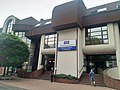 TVP3 Lublin headquarters
 -
 Radio Lublin transmitter tower


Transport
[edit]Airport
[edit]
The Lublin Airport (Port Lotniczy Lublin) (IATA: LUZ) is located about 10 km (6.2 miles) SE of Lublin. With approximately 8 destinations and over 450 000 passengers served in 2018, it is the biggest airport in Eastern Poland. There is a direct train and bus link from the airport to downtown.
Railways
[edit]From Lublin Główny railway station, ten trains depart each day to Warsaw, and three to Kraków, as in other major cities in Poland. Lublin has also direct train connections with Rzeszów, Szczecin, Gdynia, and other Polish cities and towns in the region as Nałęczów, Chełm or Zamość. The express train to Warsaw takes about two hours.[61]
.jpg)
There are other smaller stations in Lublin for local trains:
- Lublin Ponikwoda railway station
- Lublin Północny railway station
- Lublin Zemborzyce railway station
- Lublin Zadębie railway station
- Lublin Zachodni railway station
- Stasin Polny railway station
- Rudnik Przystanek railway station
Roads
[edit].jpg)

Lublin is located at the intersection of expressways S12, S17, and S19. Expressway S17 between Lublin and Warsaw was completed in 2020. S19 between Lublin and Rzeszów was largely finished in 2022. The rest of the planned expressway network around the city, that will be built in the coming years, consists of S12 to the east in the direction Chełm, S19 north towards Białystok, and S17 southeast towards Zamość. The expressway bypass of Lublin allows transit traffic to avoid the city centre.
Long-distance buses depart from near the Castle in the Old Town and serve most of the same destinations as the rail network.
Lublin is one of only four towns in Poland to have trolleybuses (the others are Gdynia, Sopot, and Tychy).[62]
Lublin is the largest city in Poland to not have a tram network
Culture and tourism
[edit]Lublin is the largest city in eastern Poland and serves as an important regional cultural capital. Since then, many important international events have taken place here, involving international artists, researchers and politicians.
Architecture
[edit]Lublin's Old Town shares several traditions with Lesser Poland, mostly the dialect and historic architecture that brings a unique ambience comparable with Kraków. It is, however, a distinct experience, which benefits from artistic renovation, that progressed somehow slower and more modestly focusing more on quality and less on commercialization. Historic buildings, including ruined townhouses that await for new owners, create a unique atmosphere of the renaissance city. Lublin's Old Town has cobbled, narrow streets and mostly medieval layout and design. Many venues around Old Town enjoy an architecture applicable for restaurants, art hotels, pubs galleries, and clubs. Apart from entertainment, the area houses small businesses and prestigious offices.
There are several historic churches in the Old Town, including the Holy Trinity Chapel in Lublin Castle with the frescos, that are a mixture of Roman Catholic motifs with eastern Byzantine styles, reinforcing how the city connects the west with the east. Other important churches are the Late Gothic Virgin Mary Victorious Church, Renaissance Dominican Basilica and Bernardine church as well as Baroque St. John the Baptist Cathedral.
Monuments of the 20th-century architecture include the Chachmei Lublin Yeshiva and its synagogue, socialist-realist Zamkowy Square and brutalist Słowacki housing estate by Oskar Hansen.
-
 Courtyard of the Lublin Castle with the 13th-century keep and the 14th-century Holy Trinity Chapel
 -
 Frescoes inside the Holy Trinity Chapel
 -
 Grodzka Gate
 -
 Crown Tribunal at the Market Square
 -
 Historic tenement houses at the Market Square
 -
 Lublin Cathedral
 -
 Interior of the Cathedral
 -
 Late Gothic Virgin Mary Victorious Church
 -
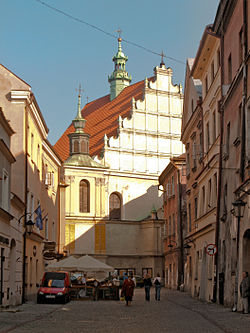 Dominican Church
 -
 Lubomirski Palace
 -
 Eclectic Grand Hotel Lublinianka
 -
 Chachmei Lublin Yeshiva and its synagogue


.jpg)

The arts
[edit]Museum
[edit]
The premier museum in the city is the National Museum of Lublin, one of the oldest and largest museums of Eastern Poland. It is located in the Lublin castle and contains some castle's interiors, like the Holy Trinity Chapel with its frescoes in the Byzantine style. The museum permanent collection include also many Polish and foreign painting from the 17th to 20th century, as well as the gallery of paintings by Tamara de Lempicka.
Other museums include also the Museum of the History of the City of Lublin, the Museum of the Eastern Territories of the Old Polish Republic, the Józef Czechowicz Museum, the Under the clock Martyrdom Museum and the Museum of Housing Estates on the Słowacki Housing Estate.
Important museum is also the Majdanek State Museum in the former Majdanek Nazi concentration and extermination camp. In 2011 it was visited by 121,404 visitors.[63]
Cinema
[edit]Lublin is a city with a proactive approach towards filmmaking industry. The city is featured in some notable films, and that include Oscar-winning The Reader which was partially filmed at the Nazi Majdanek concentration camp.[64]
In 2008, Lublin collaborated with Ukrainian Lviv, to film and distribute promotional materials which painted both cities as attractive to the filmmaking industry. Films were handed out between filmmakers present at Cannes Festival.[65] This was sponsored by the European Union. There are numerous movie theatres in Lublin including a few multiplexes, i.e. Cinema City and Multikino chains, also smaller venues like Cinema Bajka, Cinema Chatka Żaka, Cinema Perla, Cinema Grazyna and Cinema Medyk.
The Lublin Film Fund has been active since 2009, actively caring for cultivation of cinematographic talents in Lublin and promoting the city by provision of financial and organizational support. Numerous feature films have been partially financed by the fund, including Kamienie na Szaniec, Panie Dulskie, Volta and award-winning Carte Blanche.[66]
Theatres
[edit].jpg)

There are many cultural organizations in Lublin, either municipal, governmental and/or non-governmental. Among the popular venues are municipal theatres and playhouses such as:
- Musical Theatre in Lublin – Teatr Muzyczny w Lublinie, opera, operetta, musical, ballet
- Henryk Wieniawski Lublin Philharmonic – Filharmonia Lubelska
- Juliusz Osterwa Theatre
- Hans Christian Andersen Theatre – with puppet programmes for children
Fringe theatres:
- Centrum Kultury w Lublinie
- Ośrodek Praktyk Teatralnych – Gardzienice
- Ośrodek "Brama Grodzka – Theatre NN"
- Centrum Projekt Pracovnia Maat
Galleries
[edit]There are numerous art galleries in Lublin; some are run by private owners, and some are municipal, government, NGO, or associations' venues. The Labyrinth Gallery (formerly "BWA") is the Artistic Exhibitions Office – Biuro Wystaw
Food and music
[edit]In the Old Town and the immediate surrounding, over 100 unique restaurants, fine-dining venues, cafes, pubs, clubs and other catering outlets are located. In the latter half of the 2010s, the robust international community gathered around Lublin's Medical University has impacted the growth of restaurants offering various world cuisines.
Catering to students, who account for 35% of the population, the city offers a vibrant music and nightclub scene[67] Lublin has many theatres and museums and a professional orchestra, the Lublin Philharmonic.[68][69][70][71]
City of festivals
[edit]_04.jpg)


Lublin aims to be known as the Polish Capital of Festivals.[14] Most years, Lublin increases the number of festivals held in the city. The most significant of them include:
- Carnaval Sztukmistrzów – held in last days of July, is the largest new circus festival in Poland. Name of the Carnival is inspired by the character of The Magician of Lublin, from a novel by Isaac Bashevis Singer.[72]
- Urban Highline Festival – held in last days of July[73]
- Night of Culture (Noc Kultury) – usually held on the first Saturday night of June. Consisting of hundreds of events spanning the city, it is a cultural manifestation of Lublin's potential. Admission to all events is free.[74]
- OpenCity Festival – outdoor performances festival. International artists and performers create art installations in public places in Lublin.[75]
- Night of Museums – Lublin's culture institutions become open to visitors at night.
- The Jagiellonian Fair (Jarmark Jagielloński) – held in late August, is a chance to meet numerous artists, artisans, and craftspeople from Central and Eastern Europe.
- St Nicolas Day International Festival of Folk Music (Mikołajki Folkowe)[76] – the oldest folk music festival in Poland, held in the first decade of December[77]
- East Of Culture – Different Sounds Art'n'Music Festival (Wschód Kultury – Inne Brzmienia Art'n'Music Festival), held in late June, is a meeting of world-class artists that represent various nationalities and practise diverse music styles.[78]
- Lubelskie Dni Kultury Studenckiej – Lublin's Days of Student Culture – an annual students' holiday. Usually celebrated for about three weeks between May and June. Due to the city's large student population, the festival in Lublin is the longest in Poland.[citation needed]
- Lublin. Miasto Poezji – Poetry Festival organised by Ośrodek "Brama Grodzka – Teatr NN" and Polish Literature Institute of Catholic University in Lublin.
- Noc z Czechowiczem – A Night with Czechowicz – a walking tour, inspired by the "Poem on the City of Lublin" written by Józef Czechowicz. It is held on the first full moon in July, and is organised by Ośrodek "Brama Grodzka – Teatr NN".
- Najstarsze Pieśni Europy – The oldest songs of Europe – Festival of Muzyka Kresów Foundation
- Future Shorts – World Short Film Label
- International Lublin Dance Festival – Międzynarodowe Spotkania Teatrów Tańca – one of the leading dance art festivals in Europe[79]
- International Theatre Festival "Confrontations" – Międzynarodowy Festiwal Teatralny "Konfrontacje"[80]
- Ukraine in the Center of Lublin – Ukraina w Centrum Lublina[81] – held in November since 2008, is a showcase of contemporary Ukrainian culture and a space for Polish-Ukrainian intercultural dialogue.
- "Falkon" – Fantasy and Science Fiction Festival – Ogólnopolski Festiwal Fantastyki Falkon – held in November, is one of the biggest fantasy conventions in Poland.[82]
- Polish Students' Theatre Festival – Studencki Ogólnopolski Festiwal Teatralny Kontestacje
- International Folk Dance Festival – Międzynarodowe Spotkania Folklorystyczne im. Ignacego Wachowiaka
- Scena Młodych – Youth Scene, music festival
- Zwierciadła – Mirrors – High School Theatres Revision
- Zaduszki Jazzowe – Jazz Souls' Day – which take place in Dominican Order Monastery
European Capital of Culture
[edit]In 2007, Lublin joined the group of Polish cities as candidates for the title of European Capital of Culture. Lublin was shortlisted, but ultimately Wrocław was chosen. Lublin is a pilot city of the Council of Europe and the European Commission Intercultural cities programme.
Sports
[edit]
| Club | Sport | League | Trophies |
|---|---|---|---|
| Speed Car Motor Lublin | Speedway | Ekstraliga | 3 Polish Championships (2022, 2023, 2024) |
| Start Lublin | Basketball (men's) | Polish Basketball League | 0 |
| MKS Lublin | Handball (women's) | Polish Women's Superliga | 22 Polish Championships 11 Polish Cups 1 Women's EHF Cup (2001) |
| AZS UMCS Lublin | Basketball (women's) | Basket Liga Kobiet | 1 Polish Championship (2023) 1 Polish Cup (2016) |
| Budowlani Lublin | Rugby union | Ekstraliga | 1 Polish Cup (2002) |
| LUK Lublin | Volleyball (men's) | PlusLiga | 1 Polish Championship (2025) 1 CEV Challenge Cup (2025) |
| Motor Lublin | Football (men's) | Ekstraklasa | 0 |
| AZS UMCS Lublin | Futsal (men's) | I liga | 0 |
Other notable clubs:
- AZS UMCS Lublin – multi-sports club, one of the top athletics clubs in Poland.
- Lublinianka – men's football team competing in the Polish 4th Division (as of 2023[update]), city's oldest football club.
- Unia Lublin – women's football team competing in the II liga (3rd tier) (as of 2023[update]).
- LSKT – Lublin's Taekwon-do sport club.
- Tytani Lublin – semi-professional American football team.
International events
[edit]- 2019 FIFA U-20 World Cup
- An annual motocross race
Education
[edit]

There are five public schools of higher education:
- Maria Curie-Sklodowska University (UMCS)
- John Paul II Catholic University of Lublin (KUL)
- Medical University of Lublin
- University of Life Sciences in Lublin
- Politechnika Lubelska
Lublin is home to private higher education establishments.
- University of Economics and Innovation in Lublin
- Lubelska Szkoła Biznesu
- Wyższa Szkoła Nauk Społecznych z siedzibą w Lublinie
- Wyższa Szkoła Przedsiębiorczości i Administracji
- Vincent Pol University in Lublin
It is home to one of the oldest still-functioning schools in Poland, The Staszic School, which was established in 1586. The school has many notable alumni, such as Bolesław Prus, one of the most influential Polish writers and novelists, and Lesław Paga, the co-founder of the Warsaw Stock Exchange.
Politics and local government
[edit]Lublin is the capital of the province called Lublin Voivodeship, a province (voivodeship) created in 1999. The city is a separate urban gmina and city county (powiat).
Municipal government
[edit]
Lublin is governed by the municipal legislature known as the city council (Rada Miasta) and the city's mayor (Prezydent Miasta). The city council is made up of 31 councillors directly elected by the city's inhabitants. The remit of the council and president extends to all areas of municipal policy and development planning, up to and including the development of local infrastructure, transport, and planning permission. The city's current mayor is Krzysztof Żuk, who has served in this position since 2010.[83]
Symbols
[edit]Lublin has an official flag, a 5:8 rectangle divided into three horizontal stripes: white (top), green (narrow, middle), and red (bottom). In the central part, there is the coat of arms of Lublin. It is also allowed to hang the flag in the form of a vertical ribbon: then white should be on the left side or near the spar.

Districts
[edit]Lublin is divided into 27 administrative divisions (dzielnica):[84] Abramowice, Bronowice, Czechów Południowy, Czechów Północny, Czuby Południowe, Czuby Północne, Dziesiąta, Felin, Głusk, Hajdów-Zadębie, Kalinowszczyzna, Konstantynów, Kośminek, Ponikwoda, Rury, Sławin, Sławinek, Stare Miasto, Szerokie, Śródmieście, Tatary, Węglin Południowy, Węglin Północny, Wieniawa, Wrotków, Za Cukrownią, and Zemborzyce.
International relations
[edit]Lublin is a pilot city of the Council of Europe and the EU Intercultural cities programme.[85] In 2017, Lublin was awarded the Europe Prize by the Parliamentary Assembly of the Council of Europe.[86] In 2023, Lublin was selected as the European Youth Capital[87] by international jury of the European Youth Forum. Lublin is a signatory of the European charter for equality of women and men in local life.[88]
In 2023, following the 2022 Russian invasion of Ukraine, the city of Lublin was honoured by President of Ukraine Volodymyr Zelensky who granted it the title of "City-Rescuer" in recognition of its humanitarian and financial assistance to Ukraine and the country's war refugees.[89][90]
.jpg)

In Lublin, there is a Consulate General of Ukraine, an Honorary Consulate General of Hungary, honorary consulates of Austria, Brazil, Czech Republic, Germany, Moldova, Peru, Slovenia, and an Honorary Vice-Consulate of Italy [91]
Two settlements outside of Poland were created that were named Lublin. Lublin, Wisconsin, is a village in Taylor County in the United States, while Lublin, Moldova, was a Jewish agricultural colony founded in what is now the village of Nimereuca in 1842.
Twin towns — sister cities
[edit]


Former twin towns:
 Brest, Belarus (terminated on 3 March 2022 as a response to the Belarusian involvement in the Russian invasion of Ukraine)[99]

Notable residents
[edit]

.jpg)
.jpg)
- Biernat z Lublina (~1465-~1529), Polish poet, fabulist, translator and physician
- Franciszka Arnsztajnowa (1865–1942), née Meyerson, poet, playwright and translator
- Jacek Bąk, Polish footballer and captain of Poland during World Cup 2006
- Józef Czechowicz, (1903–1939), poet, writer and editor
- Katarzyna Dolinska, contestant on Cycle 10 of America's Next Top Model. She came in 5th place.
- Rabbi Jacob ben Ephraim (unknown–1648), "The Gaon Rabbi Jacob of Lublin"
- Rabbi Joshua Falk (1555–1614), also known as Joshua ben Alexander HaCohen Falk
- Rabbi Shneur Zalman Fradkin (1830–1902), "The Toras Chessed"
- Rabbi Aryeh Tzvi Frumer (1884–1943), "The Kozhiglover Rav", Holocaust victim
- Rafał Gan-Ganowicz (1932–2002), mercenary, journalist and activist
- Jacob Glatstein (1896–1971), literary critic
- Alter Mojze Goldman (1909–1988), resistance fighter
- Rabbi Zadok HaKohen Rabinowitz (1823–1900)
- Kitty Hart-Moxon (born 1926), Holocaust survivor
- Julia Hartwig (1921–2017), poet, writer and translator
- Paweł Holc (born 1971), footballer
- Rabbi Moses Isserles (1520–1572), "Rema"
- Jann (born 1999), singer-songwriter
- Sebastian Klonowic (1545–1602), Polish poet and composer
- Jan Kochanowski (1530–1584), Polish Renaissance poet
- Józef Ignacy Kraszewski (1812–1887), Polish writer, publisher, historian, journalist, scholar, political activist, painter and author
- Szymon Ładniak (born 2003), racing driver
- Anna Langfus (1920–1966), née Anna Szternfinkiel, writer, Prix de Goncourt winner in 1966
- Felix Lembersky (1913–1970), artist and painter
- Janusz Lewandowski (1951–), MEP, former minister of privatisation
- Rabbi Solomon Luria (1510–1573), "The Maharshal"
- Aleksandra Mirosław (born 1994), speed climber
- Marcin Narwojsz (born 1976), retired footballer
- Wincenty Pol (1807–1872), poet and geographer
- Rabbi Jacob Pollak (1460–1541)
- Stanisław Kostka Potocki (1755–1821), Polish nobleman, politician and writer
- Rabbi Sholom Rokeach (1781–1855), "Sar Sholom", the first Belzer Rebbe
- Yitzhak Sadeh (born Isaac Landsberg; 1890–1952), a founder of the Israel Defense Forces
- Mateusz Sawrymowicz (born 1987), swimmer
- Rabbi Shalom Shachna (unknown–1558)
- Rabbi Meir Shapiro (1887–1933), "The Lubliner Rav"
- Rabbi Joel Sirkis (1561–1640), also known as Joel ben Samuel Sirkis
- Bartosz Staszewski (1990–), activist and filmmaker
- Patryk Szysz (1998–), Polish professional footballer
- Dominik Tarczyński (born 1979), Member of European Parliament
- Bronisława Wajs (1908–1987), Polish-Romani poet and singer
- Henryk Wieniawski (1835–1880), violinist, born in Lublin
- Tomasz Wójtowicz (1953–2022), volleyball player, Olympic champion
- Rabbi Yaakov Yitzchak of Lublin (1745–1815), "The Seer of Lublin"
- Rabbi Mordecai Yoffe (1530–1612), "The Levush"
- Krzysztof Zalewski (born 1984), singer-songwriter
- Wladyslaw Zmuda (born 1954), Polish former professional footballer, four-time World Cup participant
- Johann Hermann Zukertort (1842–1888), chess grand master
- Henio Zytomirski (1933–1942), Holocaust victim
See also
[edit]
- Church of the Holy Myrrh-Bearing Women, Lublin
- Lublin Triangle
- Lublin Renaissance
- Lublin Holocaust Memorial
- Lublin Department (Polish: Departament Lubelski): a unit of administrative division and local government in Poland's Duchy of Warsaw, 1806–15
- Vilnius–Lublin Portal
- Old Jewish Cemetery, Lublin
- Cathedral of the Transfiguration, Lublin
- Tourism in Poland
- Union of Lublin (painting)
- Missionary Church and Monastery, Lublin
- Urban Highline Festival Lublin
Notes
[edit]References
[edit]- ^ "Interpelacja w sprawie mozliwosci i stanu realizacji postulatow" (pdf) (in Polish). Przewodniczago Rady Miasta Lublin. August 19, 2013. Archived from the original on September 16, 2016. Retrieved September 24, 2016.
- ^ a b "Local Data Bank". Statistics Poland. Retrieved 18 July 2022. Data for territorial unit 0663000.
- ^ Rozporządzenie Prezydenta Rzeczypospolitej Polskiej z dnia 25 kwietnia 2007 r. w sprawie uznania za pomnik historii "Lublin - historyczny zespół architektoniczno-urbanistyczny", Dz. U., 2007, vol. 86, No. 574
- ^ "Lublin". Lexico UK English Dictionary. Oxford University Press. Archived from the original on 2020-08-03.
- ^ "Lublin". Lexico UK English Dictionary US English Dictionary. Oxford University Press. Archived from the original on 2021-08-25.
- ^ "Lublin". Collins English Dictionary. HarperCollins. Retrieved 3 August 2019.
- ^ "Główny Urząd Statystyczny" [Central Statistical Office] (in Polish). To search: Select "Miejscowości (SIMC)" tab, select "fragment (min. 3 znaki)" (minimum 3 characters), enter town name in the field below, click "WYSZUKAJ" (Search).
- ^ "Local history - Information about the town - Lublin - Virtual Shtetl". Archived from the original on 20 March 2017. Retrieved 20 March 2017.
- ^ lublin.eu (21 February 2012): Lublin ahead of Wrocław, Gdańsk and Łódź (and behind Warsaw, Cracow, Katowice and Poznań).
- ^ Lublin, UM. "Standard of living in Lublin / Lublin – investment destination / Investors / Business / Lublin City Office". Retrieved 20 March 2017.
- ^ "Our European Youth Capital for 2023 is…. Lublin!". European Youth Forum. Retrieved 2021-03-03.
- ^ "Lublin has been awarded the title of European Capital of Culture 2029!". 25 September 2024.
- ^ RP, Kancelaria Sejmu. "Internetowy System Aktów Prawnych".
- ^ a b c d e f g h i j k l Andrzej Rozwałka; Rafał Niedźwiadek; Marek Stasiak (2006). 'Origines Polonorum': Lublin wczesnośredniowieczny. TRIO / FNP. pp. 199–203. Summary translated by Philip Earl Steele (PDF).
{{cite book}}:|work=ignored (help) - ^ "Tourist Guide: Lublin" (PDF). Lublin City Council. 2009. p. 2. Archived from the original (PDF) on 20 April 2015.
- ^ Joshua D. Zimmerman, Poles, Jews and the Politics of Nationality, Univ of Wisconsin Press, 2004, ISBN 978-0-299-19464-2, Google Print, p. 16
- ^ Sadkowski, Konrad (1995). Church, nation and state in Poland: Catholicism and national identity formation in the Lublin region, 1918–1939. University of Michigan. pp. 85–86.
- ^ "European Severe Weather Database". European Severe Storms Laboratory. 2022. Retrieved December 8, 2022.
- ^ Wróbel, Janusz (2002). "Wojenne losy polskiego złota". Biuletyn Instytutu Pamięci Narodowej (in Polish). No. 8-9 (19-20). IPN. p. 56. ISSN 1641-9561.
- ^ a b c Wardzyńska, Maria (2009). Był rok 1939. Operacja niemieckiej policji bezpieczeństwa w Polsce. Intelligenzaktion (in Polish). Warszawa: IPN. p. 247.
- ^ a b Wardzyńska. Był rok 1939. Operacja niemieckiej policji bezpieczeństwa w Polsce. Intelligenzaktion. p. 247–248
- ^ Wardzyńska. Był rok 1939. Operacja niemieckiej policji bezpieczeństwa w Polsce. Intelligenzaktion. p. 248
- ^ a b Wardzyńska. Był rok 1939. Operacja niemieckiej policji bezpieczeństwa w Polsce. Intelligenzaktion. p. 264–265
- ^ Wardzyńska. Był rok 1939. Operacja niemieckiej policji bezpieczeństwa w Polsce. Intelligenzaktion. p. 265
- ^ Diemut Majer; United States Holocaust Memorial Museum (2003). "Non-Germans" under the Third Reich: The Nazi Judicial and Administrative System in Germany and Occupied Eastern Europe with Special Regard to Occupied Poland, 1939–1945. JHU Press. p. 759. ISBN 978-0-8018-6493-3. Retrieved 19 February 2012.
- ^ Wardzyńska, Maria (2009). "Obozy niemieckie na okupowanych terenach polskich". Biuletyn Instytutu Pamięci Narodowej (in Polish). Vol. 4, no. 99. IPN. p. 29. ISSN 1641-9561.
- ^ Pawelec, Marek (2010). ""Lista Katyńska" KUL". Przegląd Uniwersytecki (in Polish). Vol. 4, no. 126. Katolicki Uniwersytet Lubelski Jana Pawła II. p. 8. ISSN 0866-9961.
- ^ Datner, Szymon (1968). Las sprawiedliwych (in Polish). Warszawa: Książka i Wiedza. p. 69.
- ^ Rejestr faktów represji na obywatelach polskich za pomoc ludności żydowskiej w okresie II wojny światowej (in Polish). Warszawa: IPN. 2014. pp. 64, 250, 271.
- ^ Rejestr faktów represji na obywatelach polskich za pomoc ludności żydowskiej w okresie II wojny światowej, pp. 80, 255, 263
- ^ Helena Ziemba née Herszenborn; Irena Gewerc-Gottlieb (2001). "Ścieżki Pamięci, Żydowskie Miasto w Lublinie – Losy, Miejsca, Historia (Path of Memory. Jewish Town in Lublin - Fate, Places, History)". 1. Mój Lublin Szczęśliwy i Nieszczęśliwy; 2. W Getcie i Kryjówce w Lublinie (PDF file, direct download 4.9 MB) (in Polish). Rishon LeZion, Israel; Lublin, Poland: Ośrodek "Brama Grodzka - Teatr NN" & Towarzystwo Przyjaźni Polsko-Izraelskiej w Lublinie. pp. 24, 27, 29, 30.
- ^ Drywa, Danuta (2020). "Germanizacja dzieci i młodzieży polskiej na Pomorzu Gdańskim z uwzględnieniem roli obozu koncentracyjnego Stutthof". In Kostkiewicz, Janina (ed.). Zbrodnia bez kary... Eksterminacja i cierpienie polskich dzieci pod okupacją niemiecką (1939–1945) (in Polish). Kraków: Uniwersytet Jagielloński, Biblioteka Jagiellońska. p. 184.
- ^ a b c "Wysiedleńcy z Zamojszczyzny w obozie koncentracyjny na Majdanku". Majdanku.eu (in Polish). Retrieved 11 September 2021.
- ^ a b c Gajderowicz, Magdalena; Skrzyniarz, Ryszard (2020). "Dzieci Zamojszczyzny w obozie na Majdanku (w wybranych aktach archiwalnych i relacjach)". In Kostkiewicz, Janina (ed.). Zbrodnia bez kary... Eksterminacja i cierpienie polskich dzieci pod okupacją niemiecką (1939–1945) (in Polish). Kraków: Uniwersytet Jagielloński, Biblioteka Jagiellońska. pp. 144–145.
- ^ Grabowski, Waldemar (2002). "Na drodze do powstania". Biuletyn Instytutu Pamięci Narodowej (in Polish). No. 8-9 (19-20). IPN. p. 42. ISSN 1641-9561.
- ^ The Europe Prize
- ^ "Średnia dobowa temperatura powietrza". Normy klimatyczne 1991-2020 (in Polish). Institute of Meteorology and Water Management. Archived from the original on 3 December 2021. Retrieved 20 January 2022.
- ^ "Średnia minimalna temperatura powietrza". Normy klimatyczne 1991-2020 (in Polish). Institute of Meteorology and Water Management. Archived from the original on 15 January 2022. Retrieved 20 January 2022.
- ^ "Średnia maksymalna temperatura powietrza". Normy klimatyczne 1991-2020 (in Polish). Institute of Meteorology and Water Management. Archived from the original on 15 January 2022. Retrieved 20 January 2022.
- ^ "Miesięczna suma opadu". Normy klimatyczne 1991-2020 (in Polish). Institute of Meteorology and Water Management. Archived from the original on 9 January 2022. Retrieved 20 January 2022.
- ^ "Liczba dni z opadem >= 0,1 mm". Normy klimatyczne 1991-2020 (in Polish). Institute of Meteorology and Water Management. Archived from the original on 15 January 2022. Retrieved 20 January 2022.
- ^ "Średnia grubość pokrywy śnieżnej". Normy klimatyczne 1991-2020 (in Polish). Institute of Meteorology and Water Management. Archived from the original on 15 January 2022. Retrieved 20 January 2022.
- ^ "Liczba dni z pokrywą śnieżna > 0 cm". Normy klimatyczne 1991-2020 (in Polish). Institute of Meteorology and Water Management. Archived from the original on 21 January 2022. Retrieved 20 January 2022.
- ^ "Średnia suma usłonecznienia (h)". Normy klimatyczne 1991-2020 (in Polish). Institute of Meteorology and Water Management. Archived from the original on 15 January 2022. Retrieved 20 January 2022.
- ^ "Lublin-Radawiec Absolutna temperatura maksymalna" (in Polish). Meteomodel.pl. 6 April 2018. Retrieved 22 January 2022.
- ^ "Lublin-Radawiec Absolutna temperatura minimalna" (in Polish). Meteomodel.pl. 6 April 2018. Retrieved 20 January 2022.
- ^ "Katowice Średnia wilgotność" (in Polish). Meteomodel.pl. 6 April 2018. Retrieved 20 January 2022.
- ^ "Lublin (Lubelskie) » mapy, nieruchomości, GUS, noclegi, szkoły, regon, atrakcje, kody pocztowe, wypadki drogowe, bezrobocie, wynagrodzenie, zarobki, tabele, edukacja, demografia".
- ^ "Demographic and occupational structure and housing conditions of the urban population in 1978-1988" (PDF).
- ^ "Statistics Poland - National Censuses".
- ^ "Statistics Poland - City of Lublin".
- ^ "Urząd Statystyczny w Lublinie / Lublin". lublin.stat.gov.pl. Retrieved 2025-05-29.
- ^ "Daewoo Polish Truck Factory Bankrupt". AP NEWS. Retrieved 2022-02-01.
- ^ "Samorząd Miasta Lublin". Um.lublin.pl. Archived from the original on 2011-09-30. Retrieved 2009-05-05.
- ^ internet ART; www.internetart.pl (2007-05-31). "PAIiIZ | News | Inwestycje w Polsce". Paiz.gov.pl. Retrieved 2009-05-05.
{{cite web}}: CS1 maint: multiple names: authors list (link) - ^ Marcin Bielesz (2007-09-27). "Lublin fetuje specjalną strefę ekonomiczną". Miasta.gazeta.pl. Retrieved 2009-05-05.
- ^ "Wyborcza.pl". Lublin.wyborcza.pl. Retrieved 4 March 2022.
- ^ "Serwis regionalny Lublin". 18 August 2007. Archived from the original on 18 August 2007. Retrieved 4 March 2022.
- ^ opracowali: tn, dil, msa, ms, jb, pr, wa (2007-01-01). "Taki był 2006 rok". Miasta.gazeta.pl. Retrieved 2009-05-05.
{{cite web}}: CS1 maint: multiple names: authors list (link) - ^ "Przegląd obiektów z emisjami". Emi.emitel.pl. Archived from the original on 2014-11-02. Retrieved 2009-05-05.
- ^ "Lublin - Rozkład jazdy pociągów PKP, autobusów PKS oraz komunikacji miejskiej dla miasta Lublin". Rozklad.mortin.pl. Retrieved 2009-06-02.
- ^ "Zarząd Transportu Miejskiego w Lublinie". Ztm.lublin.eu. Retrieved 4 March 2022.
- ^ "Statystyki". Frekwencja zwiedzających. Państwowe Muzeum na Majdanku. 2011. Retrieved 2013-04-28.
- ^ "The Reader". IMDb.com. 30 January 2009.
- ^ "Lublin, Lwów | miasto filmowe - Aktualności". Film.lublin.eu. 2008-04-08. Retrieved 2009-07-08.
- ^ "Lublin filmowy / lublin.eu - oficjalny portal miasta Lublin". Lublin.eu. Retrieved 2021-07-26.
- ^ "Lublin-Lubelski Serwis Informacyjny-lublin". Lsi.lublin.pl. Retrieved 2009-05-05.
- ^ "Teatr Lubelski". 18 August 2007. Archived from the original on 18 August 2007. Retrieved 4 March 2022.
- ^ "Teatr Stary W Lublinie - the Old Theatre in Lublin". Archived from the original on 2007-11-08. Retrieved 2016-07-04.
- ^ "Filharmonia im. H. Wieniawskiego w Lublinie, filharmonia lubelska, filharmonia w Lublinie, orkiestra symfoniczna, koncerty, muzyka kameralna, zespoły :: Strona główna". Filkarmonialubelska.pl.
- ^ "Muzeum Lubelskie w Lublinie". Archived from the original on 2006-02-23. Retrieved 2006-02-10.
- ^ "Carnaval Sztukmistrzów 2021 |22-25 lipca, Lublin". Sztukmistrze.eu. Retrieved 4 March 2022.
- ^ "Strona Główna". Urbanhighline.pl. Retrieved 4 March 2022.
- ^ "Strona główna". Nockultury.pl. Retrieved 4 March 2022.
- ^ "Otwarte Miasto". Opencity.pl. Retrieved 4 March 2022.
- ^ "The Saint Nicholas Orchestra - main". Mikolaje.lublin.pl. Retrieved 2020-02-15.
- ^ Stelmaszczuk, Marcin. "XXXI Międzynarodowy Festiwal Muzyki Ludowej Mikołajki Folkowe". Mikolajki.folk.pl. Retrieved 4 March 2022.
- ^ "About Festival | Different Sounds". En.innebrzmienia.eu. Retrieved 4 March 2022.
- ^ "IDTF – International Dance Theatres Festival". Mstt.pl. Retrieved 4 March 2022.
- ^ "Homepage". Konfrontacje.pl. Retrieved 4 March 2022.
- ^ "Wydarzenia / Kultura / lublin.eu - oficjalny portal miasta Lublin". Lublin.eu. Retrieved 2020-03-13.
- ^ "Wydarzenia / Kultura / lublin.eu - oficjalny portal miasta Lublin". Lublin.eu. Retrieved 2020-03-13.
- ^ "Mayor of Lublin City / Lublin City Office". Lublin.eu. Retrieved 2020-02-18.
- ^ "Dzielnice Lublina / O mieście / Lublin / lublin.eu - oficjalny portal miasta Lublin". Lublin.eu. Retrieved 2020-02-18.
- ^ Council of Europe (2011). "Intercultural city: Lublin, Poland". coe.int. Retrieved 22 May 2011.
- ^ "Wyborcza.pl". lublin.wyborcza.pl. Retrieved 2019-12-05.
- ^ "Our European Youth Capital for 2023 is…. Lublin!". European Youth Forum. Retrieved 2021-02-27.
- ^ "Poland: 16 pioneering cities commit to going above and beyond for local equality". ccre.org. Retrieved 2021-11-16.
- ^ "Poland's Lublin honoured by Ukraine's Zelensky: City Hall". polskieradio.pl. 7 April 2023. Retrieved 16 September 2023.
- ^ "The title of "City-Rescuer" for Lublin from President of Ukraine". lublin.eu. 6 April 2023. Retrieved 16 September 2023.
- ^ "Misje dyplomatyczne, urzędy konsularne i organizacje międzynarodowe w Polsce". Portal Gov.pl (in Polish). Retrieved 20 September 2024.
- ^ a b c d e f g h i j k l m n o p q r s t u v w "Lublin's Partner and Friend Cities" [Lublin's Partner and Friend Cities]. Lublin.eu (in Polish). Archived from the original on 2019-05-24. Retrieved 2018-12-05.
- ^ Офіційний сайт міста Івано-Франківська. mvk.if.ua (in Ukrainian). Retrieved 7 March 2010.
- ^ "Signing ceremony of the partnership agreement between Lublin and Kharkiv (online) / Lublin City Office". lublin.eu. Retrieved 2023-03-17.
- ^ "The Lublin City Council adopted a resolution on signing a twinning agreement with Kryvyi Rih". decentralization.gov.ua. Retrieved 2023-03-17.
- ^ "Portrait of Münster: Die Partnerstädte". Stadt Münster. Archived from the original on 2013-05-09. Retrieved 2013-08-07.
- ^ "The Municipality of Lublin City". Um.lublin.eu. 1992-10-01. Archived from the original on 2009-04-23. Retrieved 2009-05-05.
- ^ "Lublin's Partner and Friend Cities". The Municipality of Lublin City. Archived from the original on 20 July 2011. Retrieved 2 July 2009.
- ^ "Lublin zrywa współpracę z Brześciem" (in Polish). 3 March 2022. Retrieved 6 March 2022.
External links
[edit]

- Lublin official website (in Polish) (in English)
- Górczyk, Wojciech Jerzy, (2020), The Former Reformati Order's Monasteries Route (Lublin, p. 30-33), ISBN 978-83-949345-3-8
- Official site Lublin the City of Inspiration (English version)
- Lublin Municipality official website (in Polish) (in English)
- Lublin, Poland at JewishGen
- . Encyclopædia Britannica (11th ed.). 1911.
| |||||||||||||||||||||||||||||


| International | |
|---|---|
| National | |
| Geographic | |
| Other | |

Lublin
View on GrokipediaHistory
Early settlement and medieval foundations
Archaeological investigations in the Lublin Upland reveal prehistoric human activity, including a Magdalenian open-air site at Klementowice, marking the northeasternmost known extent of this Upper Paleolithic technocomplex in Europe. Neolithic settlements in the region, associated with the Linearbandkeramik (LBK) culture, emerged during its earliest phase around the mid-6th millennium BCE, as evidenced by excavations in areas like Hrubieszów. Early medieval Slavic traces appear from the 6th century CE, with fortified sites such as Chodlik indicating dense settlement networks in the vicinity.[5][6][7][8] The first documentary reference to Lublin dates to 1198 in the Hypatian Chronicle, recording its name as an established locale. By the 12th century, the creation of the Lublin castellany formalized administrative control, with initial fortifications on the castle hill comprising wood-reinforced earthen walls to secure the strategic river confluence and trade routes linking Rus' principalities to Polish territories. The earliest named castellan, Wojciech, is attested in 1224, underscoring the site's role in tribute collection, judicial functions, and military defense along the eastern frontier.[8][9] Early 13th-century developments included the erection of a stone donjon tower, bolstering defenses amid incursions; the stronghold repelled sieges by Prince Roman in 1205 and Prince Daniel in 1244. These foundations positioned Lublin as a key bulwark after the stabilization of the Polish-Ruthenian border, fostering gradual urban coalescence around the elevated citadel amid a landscape of dispersed agrarian communities.[8][9]Union of Lublin and early modern prosperity
The Union of Lublin was formalized on 1 July 1569 during a Sejm session convened in the city, establishing a real union between the Kingdom of Poland and the Grand Duchy of Lithuania to form the Polish-Lithuanian Commonwealth.[10] This agreement created a single state with a common monarch elected by both nations, a unified Sejm, and coordinated foreign policy, while allowing Lithuania to retain its separate legal system, treasury, and army.[11] The choice of Lublin as the negotiation site stemmed from its strategic location facilitating attendance by Polish and Lithuanian nobles, as well as the availability of royal castle accommodations.[12] The union's ratification by oath in Lublin Castle marked a pivotal consolidation of power, averting potential fragmentation amid external threats like the Muscovite state.[13] This event significantly elevated Lublin's political and economic stature within the newly formed Commonwealth, positioning it as a key administrative center in the Lublin Voivodeship.[14] The influx of nobility, envoys, and merchants during the prolonged Sejm proceedings stimulated local trade and services, laying groundwork for subsequent growth. In the ensuing decades, Lublin emerged as a vibrant commercial hub on east-west trade routes, hosting major fairs that drew participants from across Poland, Germany, Armenia, Tatar regions, and Scotland.[15] The 16th and early 17th centuries constituted Lublin's golden age, characterized by population expansion from approximately 7,000 residents in the late 1500s to 11,300 by the early 1600s, driven by immigration and economic opportunities.[14] Prosperity manifested in flourishing crafts such as textiles, leatherworking, and metalwork, alongside a thriving Jewish community of around 840 individuals by 1550, which bolstered commerce through banking, brokerage, and international networks.[16] Architectural developments, including Renaissance-style buildings and fortifications, reflected this wealth, with the city's markets serving as conduits for grain, timber, and luxury goods exports to Western Europe.[15] However, this period of affluence began to wane by the mid-17th century due to wars and economic shifts affecting the broader Commonwealth.[14]Partitions, uprisings, and 19th-century decline
Following the Third Partition of Poland on October 24, 1795, Lublin fell under Austrian Habsburg control as part of the Kingdom of Galicia and Lodomeria, where it served as a provincial administrative center with limited autonomy.[17] The city's economy, previously bolstered by trade and craftsmanship, began to stagnate under foreign administration, as Austrian policies prioritized integration into the empire's agrarian framework over urban development, leading to slowed population growth and reduced commercial vitality compared to its early modern peak.[17] At the Congress of Vienna in 1815, Lublin was incorporated into the semi-autonomous Kingdom of Poland (Congress Poland), a Russian satellite state under Tsar Alexander I, marking its transfer to effective Russian dominance.[18] This period initially saw modest urban improvements, including new public buildings and streets in the early 19th century, but overarching Russian oversight imposed tariffs and restrictions that hampered independent economic initiatives.[19] By mid-century, Jews constituted nearly half of Lublin's population, making it a key center for Jewish scholarship and trade until around 1850, after which Russian regulations curtailed communal autonomy.[20] The November Uprising of 1830–1831, sparked in Warsaw on November 29, 1830, against Russian conscription and control, extended to the Lublin region, where local Polish nobles and militias mobilized against imperial forces, though no major pitched battles occurred in the city itself.[21] Russian suppression was swift and brutal, culminating in the uprising's defeat by October 1831, followed by executions, exiles to Siberia, and confiscations of property from participants, which depleted Lublin's elite and disrupted local governance.[21] The January Uprising of 1863–1864 similarly engulfed Lublin, with insurgents clashing with Russian troops in the surrounding areas, including skirmishes that reflected widespread provincial resistance to Russification decrees and serfdom remnants.[22] The rebellion, initiated on January 22, 1863, by the Polish National Government in Warsaw, aimed to restore independence but collapsed under superior Russian numbers and logistics by 1864, resulting in over 20,000 Polish deaths, mass deportations, and the dismantling of Congress Poland's residual autonomy.[23] Post-uprising repressions accelerated Lublin's decline into a backwater under intensified Russification from the 1860s onward, including mandatory Russian-language education, administrative replacement of Poles with Russian officials, and cultural suppression that eroded Polish institutions and bilingual traditions.[24] Economic stagnation persisted, with the city relying on agriculture and small-scale crafts amid limited industrialization; the 1877 arrival of the Warsaw-Terespol railway offered minor connectivity but failed to spur significant growth, as Russian policies funneled investment toward core empire territories.[19] By the 1897 census, Lublin's population reached approximately 50,000, reflecting slow demographic expansion amid emigration and poverty, underscoring its diminished regional prominence by century's end.[25]Interwar independence and urbanization
Following Poland's declaration of independence on November 11, 1918, Lublin briefly served as the seat of the Provisional People's Government of the Republic of Poland, established on November 7 under Ignacy Daszyński, marking an early center of the nascent state's administration before relocation to Warsaw.[19][26] As the capital of the newly formed Lublin Voivodeship in 1919, the city experienced administrative consolidation and economic revival after over a century of Russian partition rule, which had previously stifled local autonomy and development.[26][27] Urbanization accelerated through rural-to-urban migration, with the population rising by over 50 percent during the interwar era due to job-seeking influxes from surrounding agrarian areas, reaching more than 120,000 inhabitants by 1939, including a substantial Jewish community of around 42,000.[28][29] This growth strained housing but spurred residential expansion and modernization efforts, including the construction of factories, public buildings, and infrastructure to support industrial and administrative functions.[30] Key developments included the establishment of Poland's first aviation factory, Plage i Laśkiewicz, in 1928, which produced aircraft and contributed to emerging manufacturing sectors like metalworking and machinery.[30] Educational institutions bolstered the city's intellectual profile, with the Catholic University of Lublin (KUL) founded in 1918 as one of Poland's earliest interwar higher education centers, emphasizing theology, humanities, and sciences amid post-partition cultural reclamation.[31] Additional confessional universities emerged, fostering a vibrant academic environment that attracted students and supported professional training.[31] Infrastructure improvements, such as expanded utilities and transport links, facilitated trade and connectivity within the voivodeship, though economic challenges like the Great Depression from 1929 limited full-scale modernization.[27] Lublin's role as a regional hub thus reflected broader Second Republic efforts to unify diverse territories, with steady but uneven progress in urbanization driven by state investment and private initiative.World War II occupation and Holocaust
German forces occupied Lublin on September 18, 1939, shortly after the invasion of Poland began on September 1, incorporating the city into the General Government territory under Nazi administration.[32] Immediately following the occupation, the Jewish community, numbering approximately 40,000 prior to the war, faced punitive measures including a forced contribution of 300,000 zloty to the German army on October 14, 1939, with roundups and violence enforcing compliance. [33] In November 1939, Sonderaktion Lublin targeted the Polish intelligentsia with arrests and executions, setting a pattern of repression against perceived threats to German control. To concentrate and isolate the Jewish population, Nazi authorities deported about 10,000 Jews from Lublin to surrounding towns in early 1941, paving the way for the establishment of the Lublin Ghetto in March 1941. The ghetto was divided into two sections—A for laborers and their families, and B for others—enclosed by fencing in February 1942, with severe restrictions on movement and inadequate food supplies leading to widespread starvation and disease.[33] Forced labor was imposed, particularly in workshops producing for the German war effort, while selections for deportation began in spring 1941. Mass deportations commenced on March 17, 1942, with around 1,400 Jews sent daily to the Bełżec extermination camp, continuing through mid-1942 as part of the broader extermination policy; subsequent transports went to Sobibór and other sites, liquidating most of the ghetto by November 1943.[34] [35] Lublin served as the administrative headquarters for Operation Reinhard, the Nazi plan initiated in 1942 to murder Jews in the General Government, directed by SS officer Odilo Globocnik from a building in the city.[36] [37] This operation oversaw the construction and operation of extermination camps at Bełżec, Sobibór, and Treblinka, resulting in approximately 1.7 million Jewish deaths, with Lublin's infrastructure facilitating deportations from the ghetto and region.[38] On the outskirts, Majdanek concentration camp was established in October 1941 initially for Soviet POWs, evolving into a site for Jewish prisoners from Lublin and elsewhere, where gas chambers and mass shootings claimed tens of thousands of lives amid brutal conditions of forced labor, starvation, and executions.[39] [40] Executions occurred throughout the occupation, including mass shootings at sites like the Jesuit Ponds, where hundreds of Jews and Poles were killed in reprisals for resistance activities. Limited armed resistance emerged in the ghetto, with small uprisings suppressed harshly, though underground networks smuggled food and aided escapes. The ghetto's remnants were deported or killed by late 1943, and Majdanek was liberated by Soviet forces on July 22-23, 1944, revealing gas chambers and crematoria with fewer than 500 survivors among the estimated 78,000 victims who perished there.[41] Post-liberation records indicate only about 2,393 Jewish survivors registered in Lublin by 1945, reflecting near-total annihilation of the pre-war community.[42]Communist imposition and suppression
The Red Army captured Lublin on July 24, 1944, following intense urban combat against German forces, marking the city's shift from Nazi occupation to Soviet control.[43] Lublin then became the temporary headquarters of the Polish Committee of National Liberation (PKWN), a communist-dominated provisional government proclaimed on July 22 in nearby Chełm and relocated to the city by July 26.[44] The PKWN, operating under Soviet oversight, issued the July Manifesto on July 22, which initiated land reforms redistributing estates over 50 hectares, nationalized major industries and banks, and established a judiciary subservient to the new regime, effectively laying the groundwork for one-party rule.[45] Suppression of opposition began immediately, with the formation of the communist security apparatus, including the Citizens' Militia and the Internal Security Corps, targeting Armia Krajowa (Home Army) units that had contributed to the anti-German resistance but refused integration into Soviet-aligned forces.[46] In the Lublin region, where Home Army structures remained intact post-"liberation," authorities conducted mass arrests of suspected anti-communists, labeling them as "bandits" or fascist collaborators; by late 1944, hundreds of former partisans were detained, many tortured or executed extrajudicially by the nascent Ministry of Public Security (UB).[47] This repression drove survivors underground, forming organizations like Wolność i Niezawisłość (Freedom and Independence, WiN), which sustained low-level insurgency against the regime until approximately 1947, eliciting further counterinsurgency operations involving deportations and collective punishments.[47] The Stalinist period from 1948 to 1953 intensified these measures, with Lublin serving as a hub for regional UB operations that resulted in thousands of political convictions across the voivodeship through rigged trials accusing defendants of espionage or sabotage.[46] The Lublin Castle, repurposed as a UB prison from 1944 to 1954, confined political prisoners, including clergy and intellectuals, amid broader campaigns against the Catholic Church, which faced property seizures and harassment for opposing atheistic policies. Executions of condemned individuals, often carried out secretly, contributed to the site's notoriety, as evidenced by commemorative monuments to victims dumped in local sites like the Jesuit Rura pond. Overall, these impositions dismantled independent institutions, enforced ideological conformity through terror, and integrated Lublin into the Polish People's Republic, suppressing dissent until the regime's partial thaw after Stalin's death in 1953.[48]Post-1989 revival and integration
Following the collapse of communist rule in Poland during the Round Table Talks of 1989, Lublin experienced a shift to democratic governance, with the first local self-government elections held in May 1990, enabling the election of non-communist authorities and decentralizing administrative control from central planning. This political liberalization facilitated the revival of civil society institutions suppressed under the Polish People's Republic, including independent trade unions and cultural associations tied to the Solidarity movement, which had roots in earlier Lublin strikes of 1980.[49] Economically, Lublin transitioned from a state-dominated industrial base to a market-oriented model under the Balcerowicz Plan implemented in January 1990, which involved rapid privatization, price liberalization, and macroeconomic stabilization, initially causing short-term unemployment spikes but yielding sustained growth. By the 2000s, the city's economy emphasized services, education, and emerging sectors like information technology, business process outsourcing, automotive, aviation, and medical industries, with over 8,000 jobs in BPO/SSC/IT centers by 2024 and Lublin leading eastern Poland in business services investment.[50][51] Unemployment, which reached double digits in the early 1990s amid industrial restructuring, declined to regional levels around 5-7% by the 2020s, below the Lubelskie Voivodeship average but reflecting eastern Poland's structural challenges compared to western regions.[52] Poland's accession to the European Union on May 1, 2004, integrated Lublin into broader European markets and funding mechanisms, with the city absorbing EU cohesion and structural funds for infrastructure upgrades, including the construction and modernization of expressways S12, S17, and S19 linking it to Warsaw and the Ukrainian border.[53] These investments enhanced connectivity, supported logistics as a "gateway to the east," and boosted trade, while urban renewal projects improved public spaces and historical preservation, countering decades of neglect.[54] Higher education, anchored by institutions like Maria Curie-Skłodowska University and Lublin University of Technology, expanded dramatically in line with national trends, with technical university enrollment nationwide rising from 75,700 in 1990 to 340,200 by 2015, positioning Lublin as a student hub with over 100,000 enrollees across public and private institutions by the 2010s.[55] Demographically, Lublin's metropolitan population peaked near 350,000 in the early 1990s before stabilizing around 330,000 by 2023, with minimal net growth amid national depopulation trends but sustained by internal migration for education and services.[56] This revival solidified Lublin's role as eastern Poland's primary economic and cultural center, though regional disparities persist, with per capita GDP lagging national averages due to slower industrial reconversion.[57]Geography
Topography and urban layout
Lublin occupies the northern fringe of the Lublin Upland in southeastern Poland, featuring undulating loess-covered terrain typical of the region.[58] The city's average elevation stands at approximately 203 meters above sea level, with higher hills rising to around 250-280 meters in surrounding areas.[59] The Bystrzyca River, a tributary of the Wieprz, traverses the city from south to north, forming a central valley that divides the urban area into eastern and western banks, with the river's floodplain influencing local hydrology and green corridors.[60] [61] The urban layout centers on the elevated historic Old Town (Stare Miasto), perched on a prominent hill that provided defensive advantages in medieval times, with the Lublin Castle dominating the skyline.[62] This core retains a largely preserved medieval and Renaissance street grid, featuring a rectangular market square (Rynek) as the focal point, surrounded by tenement houses and radiating streets that adapt to the hilly topography.[62] Beyond the fortified walls, the city expands into 25 administrative districts encompassing residential neighborhoods, industrial zones, and service areas, shaped by post-World War II spatial planning that emphasized functional zoning and axis-aligned development along the Bystrzyca River and rail lines.[63] [64] [65] The river valley integrates parks and green axes, mitigating urban density while accommodating modern expansions on the periphery.[66] [67]Climate and environmental factors
Lublin experiences a humid continental climate classified as Dfb under the Köppen-Geiger system, characterized by cold, snowy winters and warm summers with no dry season.[68][69] The average annual temperature is approximately 8.9°C, with January as the coldest month at an average of -4.3°C and August the warmest at around 25.4°C for highs.[70][71]| Month | Avg Max (°C) | Mean (°C) | Avg Min (°C) | Precip. (mm) | Snowfall (cm) |
|---|---|---|---|---|---|
| January | 0.4 | -4.3 | -5.4 | 39 | 17.7 |
| February | 2.1 | -2.5 | -4.6 | 34 | 12.7 |
| March | 7.8 | 1.5 | -1.2 | 35 | 6.2 |
| April | 15.2 | 7.0 | 3.8 | 39 | 0.8 |
| May | 20.5 | 12.5 | 8.9 | 51 | 0 |
| June | 23.1 | 15.5 | 12.2 | 67 | 0 |
| July | 25.2 | 17.5 | 14.1 | 79 | 0 |
| August | 25.1 | 17.0 | 13.9 | 58 | 0 |
| September | 19.6 | 12.0 | 9.5 | 55 | 0 |
| October | 13.5 | 7.0 | 4.8 | 42 | 0 |
| November | 6.9 | 1.5 | 0.3 | 43 | 2.0 |
| December | 1.8 | -2.0 | -3.6 | 41 | 14.0 |
Demographics
Population dynamics and trends
Lublin's population grew substantially in the post-World War II era, increasing from 114,991 in 1950 to around 350,000 by 2010, fueled by internal migration from rural areas, state-directed industrialization, and urban expansion policies.[81][56] This expansion reflected broader Polish demographic shifts under communism, where centralized planning prioritized city development to support heavy industry and administration, drawing workers to eastern regional centers like Lublin.[82] The population peaked at approximately 357,000 in the early 2000s, after which stagnation and decline set in amid Poland's transition to a market economy.[83] By 2023, the estimated population stood at 329,565, with an average annual decline of 0.56% from 2021 to 2023, and metro area figures showing a 0.6% drop from 2022 to 2023.[84][56] Projections indicate further reduction to 326,875 by 2025, consistent with ongoing negative growth rates.[81] This reversal stems primarily from negative natural increase and net out-migration. Nationally, Poland recorded just 252,000 births in 2024 against 409,000 deaths, yielding a severe demographic imbalance that amplifies local pressures in aging eastern regions like Lubelskie Voivodeship.[85] In Lublin's hinterland, natural population decrease combines with migration losses—young adults departing for higher-wage opportunities in western Poland or the EU—exacerbating depopulation in peripheral areas with limited economic pull.[82] Lublin's universities provide a temporary boost via student inflows, sustaining a relatively high proportion of working-age residents (60% aged 15-64), but fail to offset permanent resident outflows.[1] Without targeted interventions to enhance retention and fertility, these trends signal sustained contraction, mirroring Poland's eastward demographic gradient.[82]Ethnic composition and historical shifts
Lublin's ethnic composition has undergone profound transformations, primarily driven by historical migrations, privileges granted to minorities, and catastrophic events like the Holocaust. In the 15th century, the Jewish community received trading privileges from King Kazimierz IV Jagiellonczyk in 1453, fostering growth amid a predominantly Polish population. By the early 19th century, under Russian partition rule, Jews comprised nearly half of the city's residents, reflecting their roles in commerce and crafts within the multiethnic Polish-Lithuanian Commonwealth legacy. [16] [16] The interwar period saw Jews at 34.6% of Lublin's population in 1931, numbering 38,937 individuals in a city of about 112,000, alongside a Polish majority and small German and Ukrainian minorities. Pre-World War II estimates place the Jewish population at approximately 40,000, integral to urban life. German occupation from 1939 initiated forced Germanization, temporarily elevating the ethnic German presence through Volksdeutsche influxes, though this was reversed post-war. [16] The Holocaust decimated Lublin's Jewish community, with the ghetto established in 1940 leading to deportations to extermination camps like Bełżec and Majdanek; by war's end, over 99% of the district's Jews were murdered, leaving fewer than 300 survivors in the city. Post-1945, Soviet-imposed borders and population transfers expelled remaining Germans and resettled some Ukrainians, homogenizing the demographic toward ethnic Poles. By the late 20th century, Jews numbered in the dozens, with negligible other minorities. [33] As of the early 21st century, Lublin remains overwhelmingly ethnically Polish, aligning with national figures of 96.9% Polish ethnicity from 2011 estimates, though recent Ukrainian migration post-2022 invasion has introduced small communities, estimated at around 100 official residents but likely higher due to temporary workers. Official records note minimal German (14) and Romani presences, underscoring a stable Polish homogeneity shaped by historical traumas and state policies. [86]Religious demographics and cultural influences
Roman Catholicism constitutes the dominant religion in Lublin, consistent with patterns in eastern Poland where adherence remains higher than the national average. In the Lublin Voivodeship, which encompasses the city, 80.7% of respondents identified as Roman Catholic in Poland's 2021 national census, compared to 71.3% nationwide.[87] [88] Other registered religious groups include Eastern Orthodox adherents, reflecting historical Ruthenian influences, as well as smaller Protestant denominations and Jehovah's Witnesses, though their shares remain under 1% each based on voluntary reporting to statistical authorities.[89] Historically, Lublin featured a substantial Jewish population that shaped its religious landscape until World War II. In 1939, Jews numbered approximately 42,000 in a total population of 122,000, accounting for about 35% of residents and establishing the city as a preeminent center of Jewish scholarship and religious life in Eastern Europe.[33] The community supported institutions like the Yeshiva Chachmei Lublin, founded in 1930 as one of the world's largest Talmudic academies.[33] The German occupation from 1939 led to the creation of a ghetto in 1941 and systematic deportations starting in March 1942, culminating in the near-total annihilation of the Jewish population by 1943 through extermination camps such as Bełżec and Majdanek.[33] These religious demographics have profoundly influenced Lublin's cultural fabric. Catholic traditions underpin major festivals, architectural landmarks like the Lublin Cathedral (built 1586–1625), and social norms, fostering a conservative ethos in the region.[90] The Jewish heritage persists in preserved sites such as the 16th-century Old Jewish Cemetery and former synagogues, contributing to Lublin's identity as a site of multicultural memory, though active Jewish religious practice today involves only a negligible community of dozens.[91] Eastern Orthodox elements appear in hybrid structures like the 1418 Chapel of the Holy Trinity, whose interior frescoes blend Gothic and Byzantine styles, symbolizing medieval Ruthenian-Polish interactions.[92] Postwar communist policies suppressed overt religious expression, but the 1989 transition revived Catholic influence, evident in public processions and the role of the Church in civil society.[93]Economy
Major sectors and recent growth
Lublin's economy features a blend of traditional manufacturing and emerging high-tech sectors, with services comprising the largest share of employment. Key industries include automotive and machinery production, which trace roots to the interwar period and involve manufacturing passenger car components, lorries, tractors, coaches, and aviation equipment, often through small- and medium-sized enterprises serving as subcontractors to larger firms.[94] [95] These sectors benefit from research and development centers focused on design, process modeling, and technical documentation, supported by collaborations between businesses, universities, and local government via initiatives like the Lublin Automotive and Machinery Upland Foundation.[94] Aviation, biotechnology, information technology (IT), and business process outsourcing (BPO) represent fast-growing areas, leveraging Lublin's status as an educational hub with multiple universities producing over 15,000 graduates annually. The biotechnology and medical sectors draw on academic strengths in life sciences, while IT and BPO capitalize on a skilled, cost-competitive workforce. Aviation clusters emphasize equipment production and innovation, positioning Lublin as a regional center for advanced manufacturing in eastern Poland.[51] [96] Recent economic expansion has been robust, with the Lublin region's GDP increasing by 66.8% from 2015 to 2022, reflecting investments in infrastructure and incentives like up to 70% tax relief in the Polish Investment Zone. City budget investment expenditures reached PLN 3.27 billion between 2010 and 2018, fostering over 1,500 new enterprises annually. Employment in the city stood at 134,562 workers in 2023, with an unemployment rate of 4.3% and average monthly gross salaries of €2,162, indicating steady labor market resilience amid Poland's broader post-pandemic recovery.[96] Despite the region's historically lower GDP per capita compared to western Poland, these trends signal convergence through diversification into trade, services, and industrial output exceeding some EU peers.[97]Infrastructure and development challenges
Lublin's road infrastructure has seen significant advancements through the construction of expressways S17 and S19, aimed at enhancing connectivity to Warsaw and southern Europe. The S17 expressway, spanning from Lublin to Warsaw, was completed in 2019, linking the city to the broader European motorway network and facilitating improved freight and passenger mobility.[98] Sections of the S19, including the Lublin to Kraśnik segment (42 km), remain under construction as of 2025, with works on the Lublin-Lubartów portion commencing in November 2024 following issuance of implementation permits.[99][100] The full Lublin-Rzeszów stretch (189.5 km) was operational by 2025, supporting regional logistics but highlighting persistent gaps in nationwide expressway coverage.[97] Public transport in Lublin emphasizes electrification, with over 40% of the fleet comprising zero-emission buses and trolleybuses as part of decarbonization efforts transitioning from coal dependency.[101] Lublin Airport, located in Świdnik, has expanded with a new terminal designed for one million annual passengers, backed by an 18.4 million euro investment, alongside ongoing security and cargo facility upgrades initiated in 2025 to bolster regional air links.[102][103] Rail connections to Warsaw were modernized by 2019, yet broader urban development relies heavily on European Union cohesion funds for projects like integrated territorial investments under the 2021-2027 program.[98][104] Development challenges persist due to Lublin's position in eastern Poland, where rural sub-regions lag in infrastructure compared to the urban core, exacerbating economic disparities and limiting attractiveness for investment.[97] Municipal budgets face constraints, as evidenced by 2020 fiscal pressures that prioritized essential investments amid reduced resources, compounded by national regulatory hurdles in sectors like energy storage and transport planning.[105][106] Geopolitical tensions near borders introduce risks to logistics ambitions, despite Poland's push to position Lublin as a EU-Ukraine transit hub.[107][108] Traffic congestion and incomplete expressway networks continue to hinder efficiency, with construction delays on routes like S19 underscoring the need for sustained EU funding to bridge infrastructure gaps.[109][110]Government and Politics
Local administration and governance
Lublin operates as a city with county rights (miasto na prawach powiatu), combining municipal and county-level administration under Poland's three-tier local government system, which includes communes, counties, and voivodeships. The executive authority is vested in the mayor (prezydent miasta), elected directly by residents for a five-year term, who oversees the city office (Urząd Miasta) and implements council decisions. Legislative power resides with the city council (Rada Miasta), comprising 35 members elected via proportional representation in multi-member districts, responsible for adopting the budget, local statutes, and spatial planning.[111][112] The current mayor, Krzysztof Żuk of the Civic Platform party, has served continuously since November 2010, securing re-election in the first round of the April 7, 2024, local elections with 57.49% of the vote against challengers from Law and Justice and other groups.[113][114] His administration emphasizes infrastructure development, EU fund utilization, and urban revitalization, with the 2024 victory ensuring alignment between executive and council majorities. The mayor appoints a management board to execute policies, subject to council oversight, and coordinates with the voivodeship governor on regional matters. Elections occur every five years under the National Electoral Commission (Państwowa Komisja Wyborcza), with turnout in Lublin's 2024 mayoral vote at approximately 53%, reflecting stable civic engagement in a city of around 330,000 residents. The council's composition post-2024 favors Żuk's coalition, enabling passage of key ordinances on housing, transport, and public services without frequent vetoes. Lublin's governance integrates with the Lublin Voivodeship, where the city holds administrative primacy as the capital, influencing regional policy through inter-municipal associations like the Union of Polish Cities.[1] For internal organization, Lublin divides into 27 districts (dzielnice), such as Czechów, Bronowice, and Sławin, each with district councils (rady dzielnic) that advise on hyper-local issues like maintenance and community events but lack binding fiscal powers. These districts facilitate decentralized service delivery, including waste management and green spaces, under the mayor's unified budget exceeding 4 billion PLN annually as of 2024.[115][1]Political alignments and regional role
Krzysztof Żuk, affiliated with the Civic Platform (part of the Civic Coalition), has served as mayor of Lublin since 2010 and was re-elected to a fourth term in the April 2024 local elections with 57.49% of the vote in the first round. The city's governance reflects a centrist orientation, influenced by its status as a university hub, contrasting with broader conservative leanings in rural eastern Poland. Lublin's municipal policies emphasize urban development, cultural initiatives, and European integration, aligning with national trends under the post-2023 Civic Coalition-led government. At the voivodeship level, political control differs, with the Law and Justice (PiS) party holding the marshal position since 2018 through Jarosław Stawiarski, who leads the regional assembly (sejmik). This division highlights tensions between urban liberal-leaning centers like Lublin and the more conservative provincial constituencies, where PiS maintains strong support in agricultural areas. The voivode, appointed by the central government, is Krzysztof Komorski of the Civic Platform, overseeing administrative execution.[116] Lublin plays a pivotal regional role as the administrative and economic capital of Lublin Voivodeship, the largest city in eastern Poland with a population exceeding 340,000, serving as a gateway for cross-border ties with Ukraine and Belarus.[117] It concentrates innovation, services, and business processes in a predominantly agricultural voivodeship, leading Eastern Poland's business services sector and fostering academic-driven growth amid rural challenges.[118] As an EU eastern border hub, the city coordinates regional development, infrastructure projects like expressways S12, S17, and S19, and initiatives for refugee support from neighboring conflicts.[116]Culture and Society
Architectural heritage and preservation
Lublin's architectural heritage spans medieval fortifications to Renaissance structures, reflecting its role as a multicultural hub in eastern Poland. The city's origins trace to 6th-century settlements on hills like Czwartek and Zamkowe, with the castle established by the 12th century as part of the Lublin castellany.[62] Fortifications expanded under King Casimir III the Great in the 14th century, including stone towers and gates that formed the basis of the Old Town's defensive layout.[119] Gothic elements dominate early landmarks, such as the Kraków Gate, constructed around 1340 as a limestone defensive tower leading into the Old Town.[120] The Lublin Castle exemplifies layered architectural evolution, beginning with a 13th-century stone tower and later incorporating Renaissance and Gothic Revival features after 19th-century reconstructions.[8] Within the castle, the Holy Trinity Chapel preserves frescoes completed in 1418 by a team of Ruthenian painters led by Master Andrey, blending Byzantine iconography with Latin inscriptions in a rare fusion of Eastern and Western styles.[121] These murals, covering walls and vaults, depict saints, donors, and symbolic motifs like owls representing heresy, executed over eight years from 1410.[122] The Old Town features tenement houses from the 16th-18th centuries, with Renaissance arcades around the market square showcasing Italian influences introduced via royal patronage.[119] Preservation efforts intensified post-World War II, as Lublin avoided the extensive destruction seen in other Polish cities, allowing much of the Old Town to retain original fabric.[123] The castle underwent major stabilization in recent decades to address foundation instability, funded through national programs, enabling public access and museum functions.[124] Conservation of the Trinity Chapel's frescoes focuses on maintaining their polychrome integrity against environmental degradation, with ongoing documentation preserving Ruthenian techniques.[125] Broader initiatives, including EU-supported projects, target wooden and urban heritage in Lublin's historic core, countering urban pressures while prioritizing structural authenticity over modernization.[126] Despite these measures, challenges persist from prior Soviet-era misuse of sites like the castle as a prison, necessitating careful restoration to original designs.[127]Arts, museums, and intellectual life
The National Museum in Lublin, founded in 1916, serves as the primary institution for arts and cultural preservation in the region, with its main branch in Lublin Castle housing collections of Polish fine arts, crafts, and historical artifacts spanning from the Middle Ages to the 20th century.[128] Notable exhibits include Jan Matejko's large-scale historical painting Union of Lublin, depicting the 1569 event, alongside works by Stanisław Wyspiański and regional folk art displays that illustrate traditional Lublin ethnographic motifs.[129] The museum's branches, such as the Holy Trinity Chapel, feature preserved 14th-century Gothic architecture overlaid with Ruthenian-Byzantine frescoes executed between 1410 and 1418 under King Władysław II Jagiełło, exemplifying a distinctive synthesis of Orthodox iconography and Western styles unique to the Lublin school.[130][8] Contemporary art in Lublin is promoted through galleries like Galeria Labirynt, established as a hub for modern and experimental exhibitions since the 1980s, often addressing social and political themes through multimedia installations and performances.[131] Other venues, including the Saska Gallery and Brain Damage Gallery, host rotating shows of local and international artists, contributing to a vibrant scene that includes street art murals commemorating historical events and cultural figures.[129] The Lublin Open Air Village Museum, one of Poland's largest skansen complexes covering 28 hectares, preserves over 120 structures of traditional rural architecture from the 17th to 19th centuries, with demonstrations of folk crafts that underscore the area's artisanal heritage.[132] Intellectual life in Lublin draws from its centuries-old academic foundations, with records of scholarly activity tracing to the 16th century, evolving into a network of cultural institutions that host lectures, debates, and publications on philosophy, history, and literature.[133] Centers like the Workshops of Culture and the Centre for the Meeting of Cultures organize interdisciplinary events, including literary festivals and philosophical symposia, engaging the public in discussions of regional identity and broader European thought traditions.[134] This ecosystem supports ongoing research into Lublin's multicultural past, particularly its Jewish and Ruthenian influences, through archival projects and public programming that prioritize empirical historical analysis over narrative imposition.[91]Festivals, cuisine, and traditions
Lublin hosts several annual festivals that highlight its historical and multicultural heritage. The Jagiellonian Fair, held in late August in the Old Town, features workshops in traditional dance, singing, and crafts, drawing on folk practices from the region's past.[135] [136] The European Festival of Taste occurs in September, showcasing regional foods and culinary demonstrations in the historic center.[137] The Night of Culture, a major summer event, opens numerous museums, galleries, and sites for free access, with performances emphasizing local arts.[138] Carnaval Sztukmistrzów in late July focuses on street theater, circus arts, and urban highlining, attracting international performers to public spaces.[139] Regional cuisine emphasizes hearty, ingredient-driven dishes rooted in local agriculture, including buckwheat and onions. Cebularz lubelski, a flatbread topped with caramelized onions and poppy seeds, originated as a staple among pre-war Jewish bakers and remains protected under EU traditional specialty status.[140] Forszmak lubelski is a thick stew of pickled cucumbers, bacon, and tomato paste, often served in bread bowls, reflecting peasant cooking methods.[141] Pierogi filled with potatoes, cheese, mushrooms, or meat are ubiquitous, alongside buckwheat-based gryczanka pancakes.[142] Traditions in Lublin draw from its layered Polish, Jewish, and Eastern European influences, though the Jewish population, once comprising a third of residents and central to Talmudic scholarship, was decimated during World War II.[143] Contemporary customs include folk craft revivals at fairs, such as weaving and pottery, tied to rural Lublin Voivodeship practices.[144] Easter and Christmas observances feature regional variants like blessed foods in baskets or caroling, but urban life has shifted toward secular events like municipal New Year's Eve celebrations in the market square.[138] These elements preserve causal links to agrarian and interwar multicultural roots amid post-communist modernization.[123]Religious institutions and practices
Lublin's religious institutions and practices are overwhelmingly Roman Catholic, aligning with the Lubelskie region's demographics where 99.44% of residents declare Catholicism as their faith. The Roman Catholic Archdiocese of Lublin administers over 100 parishes in the city and surrounding areas, with the Archcathedral of St. John the Baptist and St. John the Evangelist as its central edifice. Erected between 1586 and 1604 by the Society of Jesus, this early Baroque structure—modeled on Italian designs—features ornate frescoes and serves as the site for major diocesan liturgies, including ordinations and feast day celebrations.[145] Other prominent Catholic churches include the 17th-century St. Joseph's Church, founded by Katarzyna Sanguszkowa, and the 20th-century St. Michael the Archangel Church in Bronowice, designed by Oskar Sosnowski with modernist basilica elements. Catholic practices encompass daily Masses, sacramental rites, and annual observances like Corpus Christi processions through the Old Town.[146] Historically a hub of Jewish scholarship dubbed the "Jerusalem of the North," Lublin hosted renowned institutions such as the 16th-century Talmudic academy and the Maharshal Synagogue, with a pre-World War II population of approximately 45,000 Jews supporting multiple synagogues, yeshivas, and ritual baths. The Holocaust decimated this community via the Lublin Ghetto and Operation Reinhardt, reducing it to a few hundred survivors by 1945. Today, a small Jewish congregation of under 100 active members maintains sites like the Chewra Nosim Synagogue at Lubartowska 10, used for prayers until 2006 and now for cultural purposes, and the restored synagogue within the Chachmei Lublin Yeshiva, built in 1930 as the world's largest Talmudic school. Jewish practices persist through High Holy Day services and the annual Lubliner Festival, which revives traditions via music and education without commercial intent.[147][148][149] Eastern Christian communities reflect Lublin's multicultural past, with Orthodox parishes conducting Byzantine liturgies—such as at Dolińskiego 1 on Sundays at 9:00—and the Greek-Catholic church at Al. Warszawska 71, constructed in 1759 and restored in 2000, holding services on Sundays at 10:00. Protestant groups, including Lutherans at Al. Armii Wojska Polskiego 10 and Baptists at Probostwo 30, offer weekly worship, though each serves fewer than 200 adherents. These minority practices emphasize scriptural study and community gatherings amid Catholicism's predominance.[92]Education and Research
Universities and academic institutions
Lublin serves as a significant academic center in eastern Poland, hosting five public universities and several private higher education institutions that collectively enroll over 100,000 students.[150] These institutions emphasize research in fields such as humanities, medicine, engineering, and agriculture, contributing to the region's intellectual and economic development. The city's universities trace their origins to the post-World War II era, with many established amid efforts to rebuild Polish higher education following occupation and destruction.[151] The Maria Curie-Skłodowska University (UMCS), founded in October 1944 shortly after the end of Nazi occupation in Lublin, is the largest university in eastern Poland, comprising 12 faculties and enrolling approximately 17,000 students, including 1,800 from abroad across 60 countries.[152] It offers programs in disciplines ranging from natural sciences to social sciences, with a focus on interdisciplinary research supported by facilities like its botanic garden. The John Paul II Catholic University of Lublin (KUL), established on November 7, 1918, by the Polish Episcopate under Father Idzi Radziszewski, stands as the oldest higher education institution in the city and one of Poland's pioneering Catholic universities. It resumed operations in 1944 after wartime closures and currently serves around 19,000 students across nearly 50 degree programs, emphasizing theology, philosophy, and humanities while maintaining a commitment to Catholic intellectual tradition. Pope John Paul II, a former student and professor there from 1946 to 1961, later influenced its renaming in his honor in 2005. The Lublin University of Technology (Politechnika Lubelska), created on May 13, 1953, as a state technical institution, specializes in engineering and applied sciences, with over 900 international students participating in English-taught courses among its offerings.[153] It maintains a modern campus designed for technical education and ranks among Poland's regional leaders in innovation transfer.[154] The Medical University of Lublin, originating in 1944 as part of early postwar medical training initiatives and gaining full autonomy in 1950, focuses on health sciences including medicine, dentistry, and nursing, providing comprehensive clinical education through affiliated hospitals. Its programs integrate research with practical training, serving both Polish and international cohorts in a research-oriented environment.[155] Additional public institutions, such as the University of Life Sciences in Lublin, support specialized education in agriculture and veterinary sciences, while private colleges like the University College of Enterprise and Administration offer vocational and business-oriented degrees, broadening access to higher education in the region.[151] These entities collectively foster Lublin's role as an academic hub, though challenges like funding constraints and demographic shifts influence enrollment and research output.[150]Scientific contributions and innovation hubs
Lublin serves as Eastern Poland's primary hub for scientific research, hosting five public universities and several specialized institutes that emphasize interdisciplinary collaboration in fields such as biotechnology, agriculture, materials science, and medicine. Maria Curie-Skłodowska University (UMCS), the largest institution, has produced notable outputs including research on plasma treatment devices and environmental sciences, with 15 faculty members ranked in the global top 2% of scientists by citations in 2020.[156] The Lublin University of Technology contributes advancements in engineering, exemplified by awards to researchers like Jakub Rzeczkowski for innovations in mechanical and materials engineering in 2024.[157] Agricultural research at the University of Life Sciences focuses on sustainable farming practices, supported by a dedicated repository for disseminating faculty publications.[158] The Medical University of Lublin prioritizes health-related research to enhance clinical services, including ongoing studies in diagnostics and therapy development.[159] Key scientific achievements in Lublin include high rates of patent filings and technology transfer, particularly in plasma physics applications for material processing and agricultural biotechnology enhancements.[160] UMCS researchers have been featured in international podcasts highlighting discoveries in natural sciences, such as ecological modeling and chemical analysis techniques, underscoring the city's role in empirical advancements.[161] Faculty from local institutions, including chemists like Emil Chibowski and Stefan Sokołowski, appear in rankings of highly influential scientists based on publication impact.[162] These efforts are bolstered by the John Paul II Catholic University, which supports projects in humanities-integrated sciences, contributing to broader knowledge dissemination.[163] Innovation hubs in Lublin facilitate commercialization and startup growth, with the Lublin Science and Technology Park acting as a central platform for university-business partnerships. Established to foster regional development, the park provides incubation spaces, innovation laboratories, and training facilities, hosting activities in key enabling technologies like AI and digital transformation.[164][165] It supports over 980 services through networks like the TKDIH European Digital Innovation Hub, aiding investment sourcing, skill-building, and pre-investment testing in sectors such as clean tech and telemedicine.[166] The ecosystem has spurred startups in e-commerce and AI, with city investments in incubators driving tech sector expansion as of 2025.[167][168] These initiatives emphasize practical technology transfer, aligning research outputs with economic applications.[169]Sports and Recreation
Professional clubs and achievements
Motor Lublin, Lublin's leading professional football club established in association with the local automotive industry, secured promotion to the Ekstraklasa—the top tier of Polish football—for the 2024–25 season, ending a 32-year absence from the elite division after winning successive promotions from the II liga in the 2022–23 campaign.[170] In volleyball, Bogdanka LUK Lublin (formally LKPS Lublin) claimed its inaugural Polish PlusLiga title in the 2024–25 season, defeating Aluron CMC Warta Zawiercie 3–1 in the final series on May 10, 2025, marking the club's first medal in Poland's premier men's volleyball league after promotion to the top flight in 2021.[171][172] PGE Start Lublin, the city's professional basketball team, reached the runner-up position in the Polish Basketball League during the 2019–20 season.[173] The club has also competed in European competitions, though without advancing beyond early rounds in recent years.[173]Facilities and community involvement
Lublin's primary sports facility is the Motor Lublin Arena, a multi-purpose stadium with a capacity of 15,247 seats, opened in 2014 and serving as the home ground for the Motor Lublin football club.[174] The venue hosts not only football matches but also concerts, exhibitions, and cultural events, accommodating up to 20,000 spectators for non-sporting gatherings.[175] Constructed at a cost reflecting modern standards, it features single-tiered stands, skyboxes, and floodlighting at 2,055 lux, positioning it as one of eastern Poland's most advanced stadiums.[174] Aquatic and recreational centers managed by the Municipal Sports and Recreation Board (MOSiR) include the Łabędzia Sports and Recreation Centre, equipped with an Olympic-standard swimming pool, recreational pools, jacuzzis, and saunas for public use.[176] Additional facilities encompass the Zemborzyce Artificial Lake, offering rentals for water sports equipment, kayaks, and bikes, alongside beach volleyball and windsurfing areas.[177] University-affiliated venues like the UMCS Sport Center provide indoor courts for basketball, volleyball, and fitness, accessible to both students and the broader community.[178] Community involvement is facilitated through the city's sports club portal, which lists over 100 clubs offering training in disciplines such as football, basketball, handball, swimming, and wrestling, with programs targeting youth and amateurs.[179] MOSiR organizes specialized classes and events, promoting participation rates that align with Lublin's emphasis on physical activity as a social integrator, including informal initiatives for diverse groups.[180] Local sponsorships, such as those from regional firms supporting Motor Lublin, engage thousands of fans across the Lublin Voivodeship, fostering community loyalty evidenced by attendance at matches exceeding 10,000 for key fixtures.[181] Volunteering in sports events, including those at the Arena, draws from a pool of residents motivated by regional studies on civic engagement in athletics.[182]International Relations
Twin cities and partnerships
Lublin maintains an extensive network of twin city relationships, formalized through bilateral agreements to facilitate exchanges in culture, education, economy, and civic initiatives. These partnerships, often dating back decades, emphasize mutual support, particularly with Eastern European cities amid regional geopolitical challenges. The city prioritizes ties with Ukrainian municipalities, reflecting Poland's broader solidarity efforts following the 2022 Russian invasion.[183][184] As of 2024, Lublin's twin cities encompass over 25 municipalities across Europe, North America, and Asia. Notable partnerships include:- Delmenhorst, Germany: Established for cultural and educational collaboration.
- Nancy, France: Focused on historical and academic ties since the late 1980s.
- Lancaster, United Kingdom: Signed in 1994, emphasizing youth and economic exchanges.
- Münster, Germany: Agreement from 1991, promoting environmental and urban development projects.
- Nilüfer, Turkey: Centers on trade and tourism cooperation.
- Timișoara, Romania: Recent emphasis on EU-funded innovation partnerships.