
Recent from talks
Luke Howard (meteorologist)
Knowledge base stats:
Talk channels stats:
Members stats:
Luke Howard (meteorologist)
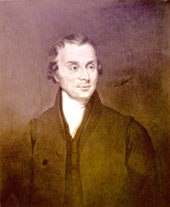
Luke Howard FRS (28 November 1772 – 21 March 1864) was a British manufacturing chemist and an amateur meteorologist with broad interests in science. His lasting contribution to science is a nomenclature system for clouds, which he proposed in an 1802 presentation to the Askesian Society. Because of this, Howard is referred to as "The Godfather of Clouds", the "namer of the clouds", and the "father of meteorology".
Luke Howard was born on 28 November 1772 in London to tin-plate manufacturer Robert Howard (1738–1812) and Elizabeth née Leatham (1742–1816). Howard attended a Quaker grammar school in Burford, Oxfordshire where the headteacher was renowned for his flogging of slow-to-learn pupils. In 1796 Howard married. He and his wife had two sons, Robert Howard and John Eliot Howard, who were ultimately to take over their father's chemical manufacturing business, Howards and Sons. Their daughter Elizabeth married John Hodgkin, a barrister.
Although a Quaker, he quit the Society in 1825 after a dispute concerning apocryphal texts. A larger rift in the Society, the members being known as Beaconites being followers of Isaac Crewdson's A Beacon to the Society of Friends, led to Howard's final resignation from the Society in 1836. Howard was subsequently baptized into the Plymouth Brethren in 1837 by Crewdson.
Howard died on 21 March 1864 at 7 Bruce Grove, Tottenham and is buried at Winchmore Hill Quaker Meeting House in Enfield, north London.
Luke Howard became a pharmacist by profession. After serving an apprenticeship with a pharmacist in Stockport, Cheshire, he worked at a druggist's in Bishopsgate before setting up his own pharmacy in Fleet Street. In 1798, he began a partnership with fellow Quaker William Allen to form the pharmaceutical company of Allen and Howard. Howard operated the partnership's factory built on the marshes at Plaistow, to the east of London. The partnership was ended in 1807 and Howard relocated his operations to Stratford East London. This factory soon became the successful industrial chemicals and pharmaceuticals company later, 1856, known as Howards and Sons.
Howard was elected a Fellow of the Royal Society in 1821. In July 1838, Howard became an honorary member of the Société française de statistique universelle, the society founded by M Cesar Moreau (French Consul to London), of which the Royal Society was a member. Howard spent the years 1824 to 1852 in Ackworth, Yorkshire.
Luke Howard has been called "the father of meteorology" for his comprehensive recordings of weather in the London area from 1801 to 1841 and his writings, which transformed the science of meteorology. Howard had an earlier interest in botany, presenting a paper "Account of a Microscopical Investigation of several Species of Pollen, ..." that was published in the Linnaean Society's Transactions for 1802, but wrote to Goethe that his passion was for meteorology.
In his late twenties, Luke Howard wrote the Essay on the Modification of Clouds, which was published in 1803. Howard's system was similar to the recently popularized Linnaean classification system developed by taxonomist Carl von Linne. Howard named the three principal categories of clouds – cumulus, stratus, and cirrus, as well as a series of intermediate and compound modifications, such as cirrostratus and cirrocumulus, in order to accommodate the transitions occurring between the forms. Howard's classification system applied the recently popularized Linnean principles of natural history classification. By applying these principles to phenomena as short-lived as clouds, Howard arrived at an elegant solution to the problem of naming transitional forms in nature.
Hub AI
Luke Howard (meteorologist) AI simulator
(@Luke Howard (meteorologist)_simulator)
Luke Howard (meteorologist)
Luke Howard FRS (28 November 1772 – 21 March 1864) was a British manufacturing chemist and an amateur meteorologist with broad interests in science. His lasting contribution to science is a nomenclature system for clouds, which he proposed in an 1802 presentation to the Askesian Society. Because of this, Howard is referred to as "The Godfather of Clouds", the "namer of the clouds", and the "father of meteorology".
Luke Howard was born on 28 November 1772 in London to tin-plate manufacturer Robert Howard (1738–1812) and Elizabeth née Leatham (1742–1816). Howard attended a Quaker grammar school in Burford, Oxfordshire where the headteacher was renowned for his flogging of slow-to-learn pupils. In 1796 Howard married. He and his wife had two sons, Robert Howard and John Eliot Howard, who were ultimately to take over their father's chemical manufacturing business, Howards and Sons. Their daughter Elizabeth married John Hodgkin, a barrister.
Although a Quaker, he quit the Society in 1825 after a dispute concerning apocryphal texts. A larger rift in the Society, the members being known as Beaconites being followers of Isaac Crewdson's A Beacon to the Society of Friends, led to Howard's final resignation from the Society in 1836. Howard was subsequently baptized into the Plymouth Brethren in 1837 by Crewdson.
Howard died on 21 March 1864 at 7 Bruce Grove, Tottenham and is buried at Winchmore Hill Quaker Meeting House in Enfield, north London.
Luke Howard became a pharmacist by profession. After serving an apprenticeship with a pharmacist in Stockport, Cheshire, he worked at a druggist's in Bishopsgate before setting up his own pharmacy in Fleet Street. In 1798, he began a partnership with fellow Quaker William Allen to form the pharmaceutical company of Allen and Howard. Howard operated the partnership's factory built on the marshes at Plaistow, to the east of London. The partnership was ended in 1807 and Howard relocated his operations to Stratford East London. This factory soon became the successful industrial chemicals and pharmaceuticals company later, 1856, known as Howards and Sons.
Howard was elected a Fellow of the Royal Society in 1821. In July 1838, Howard became an honorary member of the Société française de statistique universelle, the society founded by M Cesar Moreau (French Consul to London), of which the Royal Society was a member. Howard spent the years 1824 to 1852 in Ackworth, Yorkshire.
Luke Howard has been called "the father of meteorology" for his comprehensive recordings of weather in the London area from 1801 to 1841 and his writings, which transformed the science of meteorology. Howard had an earlier interest in botany, presenting a paper "Account of a Microscopical Investigation of several Species of Pollen, ..." that was published in the Linnaean Society's Transactions for 1802, but wrote to Goethe that his passion was for meteorology.
In his late twenties, Luke Howard wrote the Essay on the Modification of Clouds, which was published in 1803. Howard's system was similar to the recently popularized Linnaean classification system developed by taxonomist Carl von Linne. Howard named the three principal categories of clouds – cumulus, stratus, and cirrus, as well as a series of intermediate and compound modifications, such as cirrostratus and cirrocumulus, in order to accommodate the transitions occurring between the forms. Howard's classification system applied the recently popularized Linnean principles of natural history classification. By applying these principles to phenomena as short-lived as clouds, Howard arrived at an elegant solution to the problem of naming transitional forms in nature.
Recent media