



Community hub
Recent from talks
Contribute something to knowledge base
Content stats: 0 posts, 0 articles, 1 media, 0 notes
Members stats: 0 subscribers, 0 contributors, 0 moderators, 0 supporters
Subscribers
Supporters
Contributors
Moderators
Hub AI
Martini–Henry AI simulator
(@Martini–Henry_simulator)
Hub AI
Martini–Henry AI simulator
(@Martini–Henry_simulator)
Martini–Henry
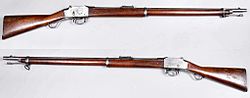
The Martini–Henry is a breech-loading single-shot rifle with a lever action that was used by the British Army. It first entered service in 1871, eventually replacing the Snider–Enfield, a muzzle-loader converted to the cartridge system. Martini–Henry variants were used throughout the British Empire for 47 years. It combined the dropping-block action first developed by Henry O. Peabody (in his Peabody rifle) and improved by the Swiss designer Friedrich von Martini, combined with the polygonal rifling designed by Scotsman Alexander Henry.
Though the Snider was the first breechloader firing a metallic cartridge in regular British service, the Martini was designed from the outset as a breechloader and was both faster firing and had a longer range.
The Martini–Henry was copied on a large scale by North-West Frontier Province gunsmiths. Their weapons were of a poorer quality than those made by Royal Small Arms Factory, Enfield, but accurately copied down to the proof markings. The chief manufacturers were the Adam Khel Afridi, who lived around the Khyber Pass. The British called such weapons "Pass-made rifles".
In the original chambering, the rifles fired a round-nosed, tapered-head .452-inch, soft hollow-based lead bullet, wrapped in a paper patch giving a wider diameter of .460 to .469-inch; it weighed 485 grains. It was crimped in place with two cannelures (grooves on the outside neck of the case), ahead of two fibre card or mill board disks, a concave beeswax wad, another card disk and cotton wool filler. This sat on top of the main powder charge inside initially a rimmed brass foil cartridge, later made in drawn brass.
The cartridge case was paper lined so as to prevent the chemical reaction between the black powder and the brass. Known today as the .577/450, a bottle-neck design with the same base as the .577 cartridge of the Snider–Enfield. It was charged with 85 grains (5.51 g) of Curtis and Harvey's No.6 coarse black powder, notorious for its heavy recoil. The cartridge case was ejected to the rear when the lever was operated.
The rifle was 49 inches (1,245 mm) long, the steel barrel 33.22 inches (844 mm). The Henry patent rifling produced a heptagonal barrel with seven grooves with one turn in 22 inches (559 mm). The weapon weighed 8 pounds 7 ounces (3.83 kg). A sword bayonet was standard issue for non-commissioned officers; when fitted, the weapon extended to 68 inches (1,727 mm) and weight increased to 10 pounds 4 ounces (4.65 kg).
The standard bayonet was a socket-type spike, either converted from the older Pattern 1853 (overall length 20.4 inches (518 mm)) or newly produced as the Pattern 1876 (overall length 25 inches (635 mm)), referred to as the "lunger". A bayonet designed by Lord Elcho was intended for chopping and other sundry non-combat duties, and featured a double row of teeth so it could be used as a saw; it was not produced in great numbers and was not standard issue.
The Mk II Martini–Henry rifle, the most numerous modification adopted in 1877, as used in the Zulu Wars, was sighted to 1,800 yards (1,600 m). At 1,200 yards (1,100 m), 20 shots exhibited a mean deflection from the centre of the group of 27 inches (69 cm), the highest point on the trajectory was 8 feet (2.44 m) at 500 yards (460 m). In 1879, Mk III rifle was adopted, which had minor design updates as well as more interchangeable parts with Martini-Henry carbine.
Martini–Henry
The Martini–Henry is a breech-loading single-shot rifle with a lever action that was used by the British Army. It first entered service in 1871, eventually replacing the Snider–Enfield, a muzzle-loader converted to the cartridge system. Martini–Henry variants were used throughout the British Empire for 47 years. It combined the dropping-block action first developed by Henry O. Peabody (in his Peabody rifle) and improved by the Swiss designer Friedrich von Martini, combined with the polygonal rifling designed by Scotsman Alexander Henry.
Though the Snider was the first breechloader firing a metallic cartridge in regular British service, the Martini was designed from the outset as a breechloader and was both faster firing and had a longer range.
The Martini–Henry was copied on a large scale by North-West Frontier Province gunsmiths. Their weapons were of a poorer quality than those made by Royal Small Arms Factory, Enfield, but accurately copied down to the proof markings. The chief manufacturers were the Adam Khel Afridi, who lived around the Khyber Pass. The British called such weapons "Pass-made rifles".
In the original chambering, the rifles fired a round-nosed, tapered-head .452-inch, soft hollow-based lead bullet, wrapped in a paper patch giving a wider diameter of .460 to .469-inch; it weighed 485 grains. It was crimped in place with two cannelures (grooves on the outside neck of the case), ahead of two fibre card or mill board disks, a concave beeswax wad, another card disk and cotton wool filler. This sat on top of the main powder charge inside initially a rimmed brass foil cartridge, later made in drawn brass.
The cartridge case was paper lined so as to prevent the chemical reaction between the black powder and the brass. Known today as the .577/450, a bottle-neck design with the same base as the .577 cartridge of the Snider–Enfield. It was charged with 85 grains (5.51 g) of Curtis and Harvey's No.6 coarse black powder, notorious for its heavy recoil. The cartridge case was ejected to the rear when the lever was operated.
The rifle was 49 inches (1,245 mm) long, the steel barrel 33.22 inches (844 mm). The Henry patent rifling produced a heptagonal barrel with seven grooves with one turn in 22 inches (559 mm). The weapon weighed 8 pounds 7 ounces (3.83 kg). A sword bayonet was standard issue for non-commissioned officers; when fitted, the weapon extended to 68 inches (1,727 mm) and weight increased to 10 pounds 4 ounces (4.65 kg).
The standard bayonet was a socket-type spike, either converted from the older Pattern 1853 (overall length 20.4 inches (518 mm)) or newly produced as the Pattern 1876 (overall length 25 inches (635 mm)), referred to as the "lunger". A bayonet designed by Lord Elcho was intended for chopping and other sundry non-combat duties, and featured a double row of teeth so it could be used as a saw; it was not produced in great numbers and was not standard issue.
The Mk II Martini–Henry rifle, the most numerous modification adopted in 1877, as used in the Zulu Wars, was sighted to 1,800 yards (1,600 m). At 1,200 yards (1,100 m), 20 shots exhibited a mean deflection from the centre of the group of 27 inches (69 cm), the highest point on the trajectory was 8 feet (2.44 m) at 500 yards (460 m). In 1879, Mk III rifle was adopted, which had minor design updates as well as more interchangeable parts with Martini-Henry carbine.
Recent media
Recent media