


Community hub
Recent from talks
Contribute something
Nothing was collected or created yet.
Metta Sandiford-Artest
View on Wikipedia
Metta Sandiford-Artest[1] (born Ronald William Artest Jr., November 13, 1979), previously legally named Metta World Peace, is an American former professional basketball player who played 17 seasons in the National Basketball Association (NBA). Under the name Ron Artest, he played college basketball for the St. John's Red Storm. He was drafted by the Chicago Bulls in the first round of the 1999 NBA draft.
Key Information


In 2001, he signed with the Indiana Pacers, where he won the NBA Defensive Player of the Year Award and was also named an NBA All-Star in 2004. Later that year, he was involved in a fight between the Pacers and the Detroit Pistons, and was suspended for the remainder of the 2004–05 season, the longest suspension for on-court misconduct in NBA history. Weeks after the start of the 2005–06 season, he was traded to the Sacramento Kings, and spent the 2008–09 season with the Houston Rockets. In 2009, he signed with the Los Angeles Lakers, and helped the team win the NBA championship in 2010.
In 2011, Artest legally changed his name to Metta World Peace, and continued to play with the Lakers until 2013, when he signed with the New York Knicks. After a year of hiatus from the NBA, he returned to the Lakers for his final seasons in 2015 before retiring in 2017. In 2020, he changed his name to Metta Sandiford-Artest.
Early life
[edit]Metta Sandiford-Artest was born Ronald William Artest Jr. on November 13, 1979, and raised in Queensbridge in Long Island City, Queens, New York. He has two younger brothers, Isaiah and Daniel.[2] He played high school basketball at La Salle Academy. He also teamed with future NBA players Elton Brand and Lamar Odom on the same Amateur Athletic Union (AAU) team.[3]
Growing up, Artest witnessed the killing of a fellow player, 19-year-old Lloyd Newton, on a basketball court in Niagara Falls, New York, during an altercation at a 1991 YMCA-sanctioned basketball tournament.[4] Artest recalled the incident during an interview in 2009: "I remember one time, one of my friends, he was playing basketball and they were winning the game. It was so competitive, they broke a leg from a table and they threw it and it went right through his heart and he died right on the court. So I'm accustomed playing basketball really rough."[5]
College career
[edit]Artest played college basketball at St. John's University from 1997 to 1999. At St. John's, he majored in mathematics.[6][3] In 1999, he led the Red Storm to a 14–4 record in the Big East Conference and 28–9 overall and the Elite Eight of the NCAA Division I Tournament, losing to Ohio State.
Professional career
[edit]Chicago Bulls (1999–2002)
[edit]Artest was selected by the Chicago Bulls with the 16th pick of the 1999 NBA draft.[7][8]
Artest played a total of 175 games for the Bulls over 2+1⁄2 years, the bulk as a starter, during which time he averaged about 12.5 points and just over four rebounds per game. He was named to the NBA All-Rookie Second Team in the 1999–2000 season.[9]
Indiana Pacers (2002–2006)
[edit]Midway through the 2001–02 season, Artest was traded by Chicago to the Indiana Pacers along with Ron Mercer, Brad Miller, and Kevin Ollie, for Jalen Rose, Travis Best, Norman Richardson, and a second-round draft pick.[10] On January 27, 2003, Artest got into a verbal altercation with Miami Heat head coach Pat Riley and flashed an obscene gesture into the crowd and was suspended for four games.[11] During the 2003–04 season with the Pacers, he averaged 18.3 points per game, 5.7 rebounds per game, and 3.7 assists per game. Artest made the 2004 NBA All-Star Game as a reserve and was named the Defensive Player of the Year. He wore three jersey numbers for the Pacers: 15, 23, and 91.
The Malice at the Palace
[edit]On November 19, 2004, Artest was at the center of an altercation among players and fans during a game in Auburn Hills, Michigan, between Artest's Pacers and the home team Detroit Pistons. The brawl involved Artest, Pistons center Ben Wallace, Artest's teammates Jermaine O'Neal and Stephen Jackson, several other players, and spectators including Pistons fans John Green[12] and A. J. Shackleford.[13]
The fight resulted in the game being stopped with less than a minute remaining. O'Neal, Jackson, and Wallace were suspended indefinitely the day after the game. A day later, the NBA suspended Artest for the rest of the regular season, plus any playoff games. Artest missed 86 games, the longest suspension for an on-court incident in NBA history.[14]
Aftermath and trade
[edit]After playing 16 games early in the 2005–06 season, Artest demanded a trade from the Indiana Pacers, and he was placed on the team's inactive roster. Artest's call for a trade created a rift between him and his teammates. "We felt betrayed, a little disrespected," teammate Jermaine O'Neal said. As for their basketball relationship, O'Neal added: "The business relationship is over. That's fact." Pacers president Larry Bird said he also felt "betrayed" and "disappointed."[15]
On January 24, 2006, reports from NBA sources confirmed that the Sacramento Kings had agreed to trade Peja Stojaković to the Pacers for Artest. However, before the trade could be completed, many press outlets reported that Artest had informed team management that he did not want to go to the Kings. According to Artest's agent, his original trade request was only made because he was upset when he heard rumors that the Pacers were going to trade him to the Kings for Stojaković early in the season. While not denying his agent's story, Artest did deny that he had rejected the trade to Sacramento, saying that he would play anywhere, contradicting earlier press accounts stating Artest was holding up the trade. Given conflicting accounts, it is unclear why the trade was delayed, but it was nonetheless completed on January 25 and Artest was officially sent to the Kings for Stojaković.[16]
Sacramento Kings (2006–2008)
[edit]
Though traded midseason to the Kings franchise, Artest quickly found his place on the team by providing some much-needed defense.[17] Though many[who?] feared his abrasive personality would be a problem, he worked well with his teammates and then-coach Rick Adelman. Artest wore #93 for his jersey number with the Kings. After acquiring Artest in late January 2006, the team immediately went on a 14–5 run, the team's best run of the season. The Kings broke .500 and landed the eighth spot in the Western Conference. This prompted ESPN to declare that "Ron Artest has breathed new life in the Sacramento Kings and enhanced their chances of reaching the playoffs for the ninth straight year."[18] Fox Sports proclaimed, "Artest has Kings back in playoff hunt."[17]
He was suspended for Game 2 of the team's first-round series against the San Antonio Spurs following a flagrant foul (elbow to the head) on Manu Ginóbili. The Kings eventually were eliminated from the playoffs in six games.
After the playoffs, Artest offered to donate his entire salary to keep teammate Bonzi Wells, who became a free agent after the 2005–06 NBA season, with the team. He even jokingly threatened to kill Wells if he did not re-sign with the Kings.[19] Wells was later picked up by the Houston Rockets and then traded to the New Orleans Hornets for former Sacramento Kings player Bobby Jackson. Artest also offered to donate his salary to retain the services of head coach Rick Adelman, whose contract expired after the same season. Adelman and the Kings did not agree on a contract extension so the two parted ways.
Houston Rockets (2008–2009)
[edit]
On July 29, 2008, it was reported that Artest was to be traded to the Houston Rockets along with Patrick Ewing Jr. and Sean Singletary for Bobby Jackson, recently drafted forward Donté Greene, a 2009 first-round draft pick, and cash considerations.[20] The deal was made official on August 14, due to Greene's rookie contract signing on July 14.[21] In response to the trade, Yao Ming was generally positive, but jokingly expressed hope that Artest is "not fighting anymore and going after a guy in the stands." In response, Artest said, "This is Tracy (McGrady) and Yao's team, you know. I'm not going to take it personal. I understand what Yao said, but I'm still ghetto. That's not going to change. I'm never going to change my culture. Yao has played with a lot of black players, but I don't think he's ever played with a black player that really represents his culture as much as I represent my culture."[22]
Artest and Yao later exchanged extensive phone calls. Artest also said, "Whatever Adelman needs me to do, whether that's come off the bench, sixth, seventh man, start, I don't even care. Whatever he needs me to do, I'm 100 percent sure it's going to work out."[23]
On October 30, 2008, Artest received his first technical as a Houston Rocket, as he raced towards a group of Dallas Mavericks players and then quickly went to Yao Ming who bumped Josh Howard after play stopped. Artest was trying to pull Yao away from the play and to the foul line, but contact was made with Maverick players. The TNT broadcast crew felt that this technical was unwarranted and reckoned it was based upon Artest's prior reputation as a feisty player in the league. In the playoffs, Artest helped the Rockets advance past the first round for the first time in 12 seasons.[24] In Game 2 of the second round against the Los Angeles Lakers, Artest, who was battling for rebounding position with Kobe Bryant, was elbowed in the neck by Bryant, which was later ruled to be a Type 1 flagrant foul. After being called for an offensive foul, Artest was indignant and proceeded to antagonize Bryant after the play, which eventually led to an ejection by Joe Crawford.[25] In Game 3, Artest was again ejected in the fourth quarter after a hard foul on Pau Gasol, who was attempting to dunk on a fast-break. It was determined the next day that the foul was not serious enough to warrant an ejection, and the flagrant foul was downgraded.[26]
Los Angeles Lakers (2009–2013)
[edit]
2009–11: Championship season
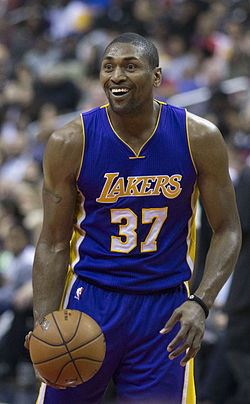
[edit]In July 2009, the Los Angeles Lakers signed Artest to a five-year deal worth about $33 million.[27][28][29] Artest chose the number 37 jersey, which he said was in honor of Michael Jackson. Jackson's Thriller album was at No. 1 on the charts for 37 straight weeks.[30]
In Game 5 of the 2010 Western Conference Finals, Artest hit a game-winning shot at the buzzer after grabbing a last second offensive rebound. He scored 25 points against the Phoenix Suns in Game 6 and went to the NBA Finals for the first time in his career. In the finals, the Lakers defeated the Boston Celtics, four games to three. Artest scored 20 points in the clincher and sank the team's last field goal – a three-pointer late in the fourth quarter – to virtually seal the victory.[31] Afterwards, Lakers head coach Phil Jackson called Artest the most valuable player of Game 7 against the Celtics.[32][33] He won his first championship ring with the Lakers.
For the 2010–11 season, Artest switched back to number 15, his college number at St. John's and the first number he wore in his NBA career.[34]
On April 26, 2011, Artest won the NBA's J. Walter Kennedy Citizenship Award.[35]
2011–13: Controversy and injury-riddled season
[edit]Artest changed his name to Metta World Peace during the offseason. He came into training camp for the 2011–12 season out of shape. Consequently, new Lakers coach Mike Brown moved him to a reserve role with reduced playing time.[36] World Peace lamented that Brown's coaching style placed too much emphasis on statistics.[37]

On April 22, 2012, in a game against the Oklahoma City Thunder, World Peace elbowed James Harden in the head as he was celebrating a dunk. He received a flagrant foul 2 and was immediately ejected.[38] Harden was later found to have suffered a concussion.[39] After the game, World Peace apologized and stated that the elbow was "unintentional."[40] On April 24, 2012, World Peace was suspended for seven games, meaning he would miss the Lakers' season finale game against the Sacramento Kings as well as the first few games of the playoffs.[41]
After a 1–4 start to the 2012–13 season, the Lakers fired Brown as head coach and hired Mike D'Antoni. On December 18, 2012, in a win against the Philadelphia 76ers, he grabbed a career-high 16 rebounds to add to his 19 points. On January 11, 2013, he suffered a right leg injury against the Thunder that would hamper him for two months.[42] Around the same time, he also had an injury to his right arm that made it difficult to bend. His health worsened to the point where D'Antoni moved him off the perimeter on defense and had him guard power forwards instead. By mid-March, he was able to guard the perimeter again.[42] On March 25, against the Golden State Warriors, World Peace tore the lateral meniscus in his left knee.[43] He underwent surgery that was originally estimated to sideline him for six weeks.[44] Despite the estimates, he returned 12 days after his surgery. In his absence, D'Antoni was using a reduced seven-man rotation with Kobe Bryant playing close to all 48 minutes each game. World Peace wanted to reduce his teammates' workload, if even for a few minutes, as the Lakers fought to qualify for the playoffs.[45][46] The Lakers qualified for the playoffs as the seventh seed,[47] but were swept 4–0 by San Antonio in the first round.[48] Due to the Lakers' other injuries, World Peace played in Game 3 in spite of running with discomfort after having fluid drained from a cyst behind his surgically repaired left knee.[49] He missed the final game of the series,[50] and later admitted he came back too soon.[51] For the season, he averaged his most points (12.4) since 2008–09, and shot his highest percentage (.404) since 2009–10. Still, ESPN wrote those numbers indicated that "the 33-year-old is clearly on the decline."[51]
On July 11, 2013, after four seasons with the Lakers, the team waived World Peace via the amnesty clause to gain relief from the salary cap.[52][53]
New York Knicks (2013–2014)
[edit]On July 16, 2013, World Peace signed a two-year deal with his hometown team the New York Knicks.[54] On February 24, 2014, he was waived by the Knicks after they bought out his contract.[55][56][57]
Sichuan Blue Whales (2014)
[edit]On August 4, 2014, World Peace signed with the Sichuan Blue Whales of the Chinese Basketball Association.[58] Due to a recurrent knee injury, he was replaced on the roster in December 2014 with Daniel Orton. In 15 games, World Peace averaged 19 points, 6 rebounds and 2.3 steals per game.
Pallacanestro Cantù (2015)
[edit]On March 24, 2015, World Peace signed with Pallacanestro Cantù of Italy for the rest of the 2014–15 Lega Basket Serie A season.[59] On May 27, 2015, in Cantù's Game 5 quarter-final loss to Reyer Venezia Mestre which ended their season, World Peace was ejected from the game and charged with five fouls after getting involved in a skirmish during the fourth quarter.[60] In July 2015, he parted ways with the club after the two parties could not come to a new contract agreement.[61]
Return to the Lakers (2015–2017)
[edit]On September 24, 2015, World Peace signed with the Los Angeles Lakers, returning to the franchise for a second stint.[62] On November 6, 2015, he made his season debut in a 104–98 win over the Brooklyn Nets,[63] playing 17 minutes with a plus-minus of 12.[64] Teammate Kobe Bryant praised him for his impact on "everybody on the floor defensively."[64]
On September 21, 2016, World Peace re-signed with the Lakers.[65] On April 11, 2017, World Peace scored a team-leading 18 points in the second half to help the Lakers extend its longest winning streak in four years to five games with a 108–96 victory over the New Orleans Pelicans. He had the ball in his hands with the crowd on its feet for the Lakers' final possession in what was potentially his final game at Staples Center. During the game, he got his 1,716th and 1,717th career steals to move past Ron Harper for 22nd place in NBA history.[66]
New Orleans Gators (2017)
[edit]During the offseason, World Peace played with the New Orleans Gators of the Global Mixed Gender Basketball (GMGB) League.[67]
San Diego Kings (2019)
[edit]In 2019, World Peace signed a one-day contract with the San Diego Kings of the American Basketball Association to bolster their squad against the four-time defending league champion Jacksonville Giants.[68]
Coaching career
[edit]World Peace was a player development coach in 2017–18 for the South Bay Lakers, the Los Angeles Lakers' development-league team in the G League.[69][70] During the offseason in 2018, he played 3x3 basketball with the BIG3. He played under the name Ron Artest at the request of league co-founder Ice Cube, who wanted to "turn back the clock a little bit."[71]
NBA career statistics
[edit]| GP | Games played | GS | Games started | MPG | Minutes per game |
| FG% | Field goal percentage | 3P% | 3-point field goal percentage | FT% | Free throw percentage |
| RPG | Rebounds per game | APG | Assists per game | SPG | Steals per game |
| BPG | Blocks per game | PPG | Points per game | Bold | Career high |
| † | Won an NBA championship | * | Led the league |
Regular season
[edit]| Year | Team | GP | GS | MPG | FG% | 3P% | FT% | RPG | APG | SPG | BPG | PPG |
|---|---|---|---|---|---|---|---|---|---|---|---|---|
| 1999–00 | Chicago | 72 | 63 | 31.1 | .407 | .314 | .674 | 4.3 | 2.8 | 1.7 | .5 | 12.0 |
| 2000–01 | Chicago | 76 | 74 | 31.1 | .401 | .291 | .750 | 3.9 | 3.0 | 2.0 | .6 | 11.9 |
| 2001–02 | Chicago | 27 | 26 | 30.5 | .433 | .396 | .628 | 4.9 | 2.9 | 2.8 | .9 | 15.6 |
| 2001–02 | Indiana | 28 | 24 | 29.3 | .411 | .215 | .733 | 5.0 | 1.8 | 2.4 | .6 | 10.9 |
| 2002–03 | Indiana | 69 | 67 | 33.6 | .428 | .336 | .736 | 5.2 | 2.9 | 2.3 | .7 | 15.5 |
| 2003–04 | Indiana | 73 | 71 | 37.2 | .421 | .310 | .733 | 5.3 | 3.7 | 2.1 | .7 | 18.3 |
| 2004–05 | Indiana | 7 | 7 | 41.6 | .496 | .412 | .922 | 6.4 | 3.1 | 1.7 | .9 | 24.6 |
| 2005–06 | Indiana | 16 | 16 | 37.7 | .460 | .333 | .612 | 4.9 | 2.2 | 2.6 | .7 | 19.4 |
| 2005–06 | Sacramento | 40 | 40 | 40.1 | .383 | .302 | .717 | 5.2 | 4.2 | 2.0 | .8 | 16.9 |
| 2006–07 | Sacramento | 70 | 65 | 37.7 | .440 | .358 | .740 | 6.5 | 3.4 | 2.1 | .6 | 18.8 |
| 2007–08 | Sacramento | 57 | 54 | 38.1 | .453 | .380 | .719 | 5.8 | 3.5 | 2.3 | .7 | 20.5 |
| 2008–09 | Houston | 69 | 55 | 35.5 | .401 | .399 | .748 | 5.2 | 3.3 | 1.5 | .3 | 17.1 |
| 2009–10† | L.A. Lakers | 77 | 77 | 33.8 | .414 | .355 | .688 | 4.3 | 3.0 | 1.4 | .3 | 11.0 |
| 2010–11 | L.A. Lakers | 82 | 82* | 29.4 | .397 | .356 | .676 | 3.3 | 2.1 | 1.5 | .4 | 8.5 |
| 2011–12 | L.A. Lakers | 64 | 45 | 26.9 | .394 | .296 | .617 | 3.4 | 2.2 | 1.1 | .4 | 7.7 |
| 2012–13 | L.A. Lakers | 75 | 66 | 33.7 | .403 | .342 | .734 | 5.0 | 1.5 | 1.6 | .6 | 12.4 |
| 2013–14 | New York | 29 | 1 | 13.4 | .397 | .315 | .625 | 2.0 | .6 | .8 | .3 | 4.8 |
| 2015–16 | L.A. Lakers | 35 | 5 | 16.9 | .311 | .310 | .702 | 2.5 | .8 | .6 | .3 | 5.0 |
| 2016–17 | L.A. Lakers | 25 | 2 | 6.4 | .279 | .237 | .625 | .8 | .4 | .4 | .1 | 2.3 |
| Career | 991 | 840 | 31.7 | .414 | .339 | .715 | 4.5 | 2.7 | 1.7 | .5 | 13.2 | |
| All-Star | 1 | 0 | 17.0 | .600 | .000 | .500 | 3.0 | 3.0 | 1.0 | .0 | 7.0 | |
Playoffs
[edit]| Year | Team | GP | GS | MPG | FG% | 3P% | FT% | RPG | APG | SPG | BPG | PPG |
|---|---|---|---|---|---|---|---|---|---|---|---|---|
| 2002 | Indiana | 5 | 5 | 33.4 | .407 | .462 | .692 | 6.0 | 3.2 | 2.6 | .6 | 11.8 |
| 2003 | Indiana | 6 | 6 | 42.0 | .389 | .387 | .800 | 5.8 | 2.2 | 2.5 | 1.0 | 19.0 |
| 2004 | Indiana | 15 | 15 | 38.9 | .378 | .288 | .718 | 6.5 | 3.2 | 1.4 | 1.1 | 18.4 |
| 2006 | Sacramento | 5 | 5 | 39.6 | .383 | .333 | .696 | 5.0 | 3.0 | 1.6 | .8 | 17.4 |
| 2009 | Houston | 13 | 13 | 37.5 | .394 | .277 | .714 | 4.3 | 4.2 | 1.1 | .2 | 15.6 |
| 2010† | L.A. Lakers | 23 | 23 | 36.5 | .398 | .291 | .579 | 4.0 | 2.1 | 1.5 | .5 | 11.2 |
| 2011 | L.A. Lakers | 9 | 9 | 31.9 | .443 | .321 | .762 | 4.6 | 2.2 | 1.1 | .8 | 10.6 |
| 2012 | L.A. Lakers | 6 | 6 | 39.3 | .367 | .389 | .750 | 3.5 | 2.3 | 2.2 | .7 | 11.7 |
| 2013 | L.A. Lakers | 3 | 3 | 28.0 | .250 | .143 | 1.000 | 3.7 | 1.7 | .7 | .3 | 6.0 |
| Career | 85 | 85 | 36.9 | .389 | .308 | .714 | 4.8 | 2.8 | 1.5 | .7 | 13.9 | |
Media presence
[edit]
Television
[edit]In April 2010, it was announced that Artest would help develop and produce his own reality show, They Call Me Crazy, in conjunction with E1 Entertainment and Tijuana Entertainment.[72]
On December 18, 2010, an art show honoring Artest was held in Toronto, Canada. Entitled Lovable Badass,[73] the show featured work by 30 Canadian and American artists, illustrators, painters and sculptors inspired by the athlete. Artest made a surprise appearance at the exhibition's opening night, commenting that "(the show) was definitely special. It was unexpected. Overwhelming."[74]
Artest was part of the line-up for the thirteenth season of the reality show Dancing with the Stars, though he finished in last place, being eliminated in the show's first week.[75]
In October 2012, he appeared as a panelist on Nickelodeon's game show Figure It Out.
In September 2013, he made the first in a recurring series of skits on the Comedy Central sketch show Key and Peele called "Metta World News," in which he plays a newscaster.[76]
Peace competed against actor Skylar Astin in an episode of Spike's Lip Sync Battle that aired June 21, 2017. He performed Cypress Hill's "Insane in the Brain" and Katy Perry's "Roar" but did not win.[77]
In January 2018, it was announced that World Peace was a contestant in the first American edition of Celebrity Big Brother.[78] Metta became the fourth celebrity to be evicted from the house on Day 20. He also appeared in the second season as part of a Head of Household competition.
In 2023, Metta World Peace competed in season ten of The Masked Singer as the wild card contestant "Cuddle Monster" who Nick Cannon called the largest costume in this series. He was eliminated on "Trolls Night".[79]
Artest Media Group
[edit]World Peace is the founder of the Artest Media Group. Established in 2010, the brand management company's clients include himself and music artists Vinita, Deacon, Sade Artest, Rugby, and Emmaline Cleary. Music producers Wip, Q, and Lucky are also associated with the group. On February 19, 2013, World Peace was awoken by a squad of police who received a tip there had been gun play within his property. Authorities were quick to recognize their mistake after World Peace explained that the armed individuals were actors shooting a "life on the streets"-styled movie for his group.[80]
Discography
[edit]On October 31, 2006, Artest released a rap album entitled My World.[81] He published the album on the Lightyear Records label under his own imprint, Tru Warier Records. The album features guest artists P. Diddy, Juvenile, Mike Jones, Big Kap, Nature and Capone.
Advocacy
[edit]He has become involved in advocacy relating to mental health issues.[82] In December 2010, he announced that he would donate some or all of his salary for the 2011–12 NBA season toward mental health awareness charities. Artest also auctioned off his 2009–10 championship ring and donated the proceeds to various mental health charities nationwide.[83] In 2016, he told Sports Illustrated, "Some people don't understand mental health is broad. You have to ask questions. Are you depressed? Are you schizophrenic? Do you have anxiety? Are you bipolar? Those are the different things that come under the banner of mental health."[84]
He has posed for PETA ad campaigns encouraging people to report animal abuse and to have their pets neutered.[85]
On March 26, 2024, Artest endorsed Robert F. Kennedy Jr.’s candidacy for the 2024 United States presidential election at a campaign event.[86]
Disciplinary and legal issues
[edit]Early career incidents
[edit]In a December 2009 Sporting News interview, Artest admitted he led a "wild" lifestyle as a young player, and drank Hennessy cognac in the locker room at halftime while with the Bulls.[87] In February 2004, he wore a bathrobe over his practice uniform to a Pacers practice as "a symbolic reminder to take it easy."[88]
Artest was suspended for three games in 2003 for destroying a TV camera at Madison Square Garden, and for four games the same year for a confrontation with Miami Heat coach Pat Riley.[89] He was also suspended for two games early in the 2004–05 season by Pacers head coach Rick Carlisle after he allegedly asked for a month off because he was tired from promoting an R&B album for the group Allure on his Tru Warier production label, on which he released his own album, a rap recording titled My World, in October 2006.[89][90]
The Malice at the Palace
[edit]On November 19, 2004, Artest was at the center of an altercation among players and fans during a game in Auburn Hills, Michigan, between Artest's Pacers and the home team Detroit Pistons.
The brawl began when Artest fouled Pistons center Ben Wallace as Wallace was putting up a shot. Wallace, upset at being fouled hard when the game was effectively over (the Pacers led 97–82 with less than 50 seconds to go), responded by shoving Artest in the face, leading to an altercation near the scorer's table. Artest walked to the sideline and laid down on the scorer's table. Reacting to Wallace throwing something at Artest, Pistons fan John Green threw a cup of Diet Coke[91] at Artest, hitting him. Artest jumped into the front-row seats and confronted a man he incorrectly believed to be responsible, which in turn erupted into a brawl between Pistons fans and several of the Pacers. Artest returned to the basketball court, and punched Pistons fan A.J. Shackleford, who was apparently taunting Artest verbally.[13] This fight resulted in the game being stopped with less than a minute remaining. Artest's teammates Jermaine O'Neal and Stephen Jackson were suspended indefinitely the day after the game, along with Wallace.
On November 21, the NBA suspended Artest for the rest of the regular season, plus any playoff games. All told, Artest missed 86 games (73 regular season games plus 13 playoff games), the longest suspension for an on-court incident in NBA history. Eight other players (four Pacers and four Pistons) received suspensions, without pay, which ranged from one to thirty games in length. Each of the players involved were levied fines and ordered to do community service. Several fans were also charged and were banned from attending Pistons games for life. Artest lost approximately $5 million in salary due to the suspension.[92]
Legal issues
[edit]On March 5, 2007, Artest was arrested for domestic violence, and excused from the Sacramento Kings indefinitely by GM Geoff Petrie.[93] On March 10, Kings announced that Artest would return to the team, while his case was being reviewed by the Placer County District Attorney.[94] On May 3, he was sentenced to 20 days in jail and community service. Artest spent only 10 days in the jail, as the judge stayed 10 days of the sentence, and served the remainder in a work release program.[95] On July 14, 2007, the NBA suspended Artest for seven games at the beginning of the 2007–08 NBA season for his legal problems.[96]
In 2007, Artest was forced to relinquish ownership of his dog, a Great Dane, for malnutrition and neglect.[97]
Personal life
[edit]Name change
[edit]On September 16, 2011, Artest officially changed his name to Metta World Peace.[98][99] "Changing my name was meant to inspire and bring youth together all around the world," World Peace said in a statement released after the name change court hearing.[75] World Peace chose the first name Metta, a traditional Buddhist word that means loving kindness and friendliness towards all.[98]
Family
[edit]World Peace and Kimsha Hatfield started an on-and-off relationship when they were 15 and 14.[100] Their first child Sadie was born in 1997.[101] They went on to have two more children together, Ron III and Diamond, and were married from June 2003 until their divorce in 2009.[102][103] Kimsha was a cast member on VH1's reality TV show Basketball Wives: LA. Ron III also became a professional basketball player.[104] World Peace has another son, Jeron, with his former high school girlfriend Jennifer Palma.[105][106] He paid for his brother to attend law school,[107] and became a grandfather with the birth of his eldest daughter Sadie's first child.
On May 4, 2020, World Peace announced that he had changed his name once again to Metta Sandiford-Artest, combining his last name with that of his second wife, Maya Sandiford.[1]
Sandiford-Artest has a company, The Artest Management Group, which includes a film division and a Certified Public Accountant division to assist athletes with tax preparation. He became interested in mathematics in high school and in the late 2010s he began taking analytics classes at UCLA and developing a sports app. "I’ve turned it on mentally," he said, and compared his new pursuits to the teenage years he learned basketball.[108] In March 2023, Sandiford-Artest was announced as a partner in MOORvision Technologies and Ucam, a camera built to capture athlete's point of view during games.[109]
Filmography
[edit]![[icon]](https://en.wikipedia.org/wiki/File:Wiki_letter_w_cropped.svg) |
See also
[edit]

References
[edit]- ^ a b Baer, Jack (May 6, 2020). "Metta World Peace says he changed his name again to Metta Sandiford-Artest". Yahoo Sports. Retrieved May 6, 2020.
- ^ Aasen, Adam (February 10, 2005). "The man behind the melee". Indiana Daily Student. Archived from the original on December 9, 2013. Retrieved April 11, 2010.
- ^ a b "Ron Artest Bio Page". NBA.com. November 13, 1979. Retrieved December 29, 2010.
- ^ Player Dies in Stabbing at Basketball Game. Nytimes.com (April 15, 1991). Retrieved on April 27, 2012.
- ^ A wild and crazy night: Kobe gets tough, Artest gets angry and the NBA has some decisions to make. Retrieved on May 7, 2009.
- ^ Ron Artest Pro and College Stats. Databasebasketball.com (November 13, 1979). Retrieved on April 27, 2012.
- ^ "1999 NBA draft". Archived from the original on February 21, 2017. Retrieved June 24, 2010.
- ^ "1999 NBA Draft". Basketball-Reference.com. Retrieved March 7, 2025.
- ^ "Lakers Waive Metta World Peace Under Amnesty Provision". www.nba.com. Retrieved February 20, 2024.
- ^ Tim Davenport, "A Ron Artest Review: The Soap Opera So Far", Silver Screen and Roll, July 4, 2009.
- ^ "Artest 'disappointed with the league's ruling'". ESPN.com. Associated Press. January 29, 2003. Retrieved April 26, 2023.
- ^ "Fan details strides made since brawl". ESPN.com. November 19, 2009. Retrieved April 26, 2023.
- ^ a b "Artest, Jackson charge Palace stands". ESPN.com. November 21, 2004. Retrieved April 26, 2023.
- ^ "Suspensions without pay, won't be staggered". ESPN. November 22, 2004. Retrieved April 26, 2023.
- ^ 'Betrayed' Bird says Artest must go – December 27, 2005. MSNBC (December 27, 2005). Retrieved on April 27, 2012.
- ^ "Done deal: Pacers trade Artest to Kings for Peja". ESPN. Indianapolis. January 26, 2006. Retrieved December 16, 2022.
- ^ a b Kahn, Mike (March 14, 2006). "Artest has Kings back in playoff hunt". Fox Sports. Archived from the original on May 24, 2006.
- ^ NBA Preview – Lakers At Kings – March 14, 2006. espn.com (March 14, 2006). Retrieved on April 27, 2012.
- ^ Amick, Sam (July 9, 2006). "Q & A: Artest hits the road and the hardwood". The Sacramento Bee. p. C1. Archived from the original on May 12, 2008.
- ^ Rockets agree to send pick, Greene, Jackson to Kings for Artest. Sports.espn.go.com (July 31, 2008). Retrieved on April 27, 2012.
- ^ "It's official: Rockets acquire Ron Artest in blockbuster trade". NBA.com. Retrieved August 14, 2008.
- ^ Feigen, Jonathan (July 30, 2008). "Despite Yao's comments, Artest seems happy about future". Houston Chronicle. Retrieved August 14, 2008.
- ^ Feigen, Jonathan (August 15, 2008). "Rockets hoping Artest ends playoff drought". Houston Chronicle. Retrieved December 29, 2010.
- ^ "Rockets down Blazers, advance to second round for first time in 12 years". CBS Sports. May 1, 2009. Retrieved May 1, 2009.
- ^ Sheridan, Chris. League also looking at Celtics-Magic, May 7, 2009. Retrieved September 4, 2010.
- ^ "Artest not suspended for Game 4, foul downgraded". NBA.com. May 9, 2009. Retrieved December 29, 2010.
- ^ "Lakers officially sign Ron Artest". July 7, 2009. Archived from the original on July 11, 2009. Retrieved July 7, 2009.
- ^ Stein, Marc (July 2, 2009). "Artest says he's leaving Rockets for LA". Retrieved July 2, 2009.
- ^ "Artest signs 5-year deal with L.A." ESPN. July 8, 2009. Retrieved December 29, 2010.
- ^ "Aretest, Brown sign contracts". July 8, 2009. Retrieved July 8, 2009.
- ^ "Boston Celtics vs. Los Angeles Lakers – Box Score – June 17, 2010 – ESPN". ESPN. June 17, 2010. Retrieved July 7, 2010.
- ^ Dwyer, Kelly (June 18, 2010). "Lakers take Game 7, win back-to-back titles". yahoo.com. Archived from the original on June 29, 2011.
- ^ Solomon, Jerome (June 18, 2010). "Artest was Game 7 MVP for Lakers". The Houston Chronicle. Archived from the original on June 21, 2010.
- ^ "Ron Artest switching to No. 15 Lakers jersey". ocregister. August 20, 2010. Archived from the original on August 22, 2010. Retrieved August 20, 2010.
- ^ McMenamin, Dave (April 27, 2011). "Ron Artest wins citizenship award". ESPN.com. Retrieved April 26, 2023.
- ^ McMenamin, Dave (January 27, 2012). "World Peace declining? Nah, just "bored"". ESPN.com.
- ^ Berger, Ken (February 11, 2012). "Lakers, World Peace struggling to adjust to Brown and vice versa". CBSSports.com. Archived from the original on February 12, 2012.
- ^ McMenamin, Dave (April 22, 2012). "Metta World Peace ejected for elbow". ESPN.com. Retrieved April 26, 2023.
- ^ Mayberry, Darnell (April 22, 2012). "OKC Thunder: James Harden faces rigorous evaluation, uncertain return to court after concussion". NewsOK. Retrieved April 22, 2012.
- ^ Medina, Mark (April 22, 2012). "Metta World Peace apologizes for ejection, doesn't take questions". Los Angeles Times. Retrieved April 23, 2012.
- ^ "Metta World Peace suspended for 7". ESPN.com. April 24, 2012. Retrieved April 26, 2023.
- ^ a b McMenamin, Dave (March 17, 2013). "Metta World Peace feeling, playing better". ESPN.com. Retrieved April 26, 2023.
- ^ Pincus, Eric (March 26, 2013). "Metta World Peace out with torn meniscus in left knee". Los Angeles Times. Archived from the original on April 1, 2013.
- ^ Rohlin, Melissa (March 28, 2013). "Ready for surgery, Metta World Peace tweets he's ready to play". Los Angeles Times. Archived from the original on March 31, 2013.
- ^ McMenamin, Dave (April 10, 2013). "Rapid Reaction: Lakers 104, Hornets 96". ESPN.com. Retrieved April 26, 2023.
- ^ McMenamin, Dave (April 10, 2013). "Metta World Peace details his recovery". ESPN.com. Retrieved April 26, 2023.
- ^ "Lakers fend off Rockets in OT in battle for West No. 7 seed". ESPN.com. Associated Press. April 17, 2013. Retrieved April 18, 2013.
- ^ "Tony Parker-led Spurs finish sweep of Lakers with rout". ESPN.com. Associated Press. April 28, 2013. Retrieved April 26, 2023.
- ^ "Spurs send Lakers to worst home playoff loss, brink of elimination". ESPN.com. Associated Press. April 26, 2013. Retrieved April 26, 2023.
- ^ McMenamin, Dave (April 27, 2013). "Lakers depleted again for Game 4". ESPN.com. Retrieved April 26, 2023.
- ^ a b McMenamin, Dave (May 6, 2013). "2012-13 Lakers Report Card: Starting five". ESPN.com. Retrieved April 26, 2023.
- ^ "Lakers Waive Metta World Peace Under Amnesty Provision". NBA.com. Turner Sports Interactive, Inc. July 11, 2013. Retrieved July 15, 2013.
- ^ Zwerling, Jared (July 9, 2013). "Metta World Peace eyes future". ESPN.com. Retrieved April 26, 2023.
- ^ "Knicks Sign Metta World Peace". NBA.com. Turner Sports Interactive, Inc. July 16, 2013. Archived from the original on July 18, 2013. Retrieved July 16, 2013.
- ^ "Knicks Waive Metta World Peace And Beno Udrih". NBA.com. Turner Sports Interactive, Inc. February 24, 2014. Archived from the original on March 3, 2014. Retrieved February 24, 2014.
- ^ "Knicks buy out Metta World Peace". ESPN.com. February 24, 2014. Retrieved April 26, 2023.
- ^ Golliver, Ben (February 24, 2014). "Knicks release Metta World Peace, Beno Udrih". SI.com. Retrieved August 25, 2015.
- ^ "Metta World Peace officially signs with Sichuan Blue Whale". Sportando.com. August 4, 2014. Retrieved August 4, 2014.
- ^ "Pallacanestro Cantù announces Metta World Peace". Sportando. March 24, 2015. Retrieved August 25, 2015.
- ^ "Metta World Peace, a.k.a. The Panda's Friend, was ejected from final game of Italian season – SportsNation – ESPN". ESPN.com. Archived from the original on July 22, 2015. Retrieved August 25, 2015.
- ^ "Metta World Peace won't return to Cantù, GM says". Sportando. July 20, 2015. Retrieved August 25, 2015.
- ^ "Lakers Sign Metta World Peace". NBA.com. September 24, 2015. Retrieved September 24, 2015.
- ^ "Bryant, Lakers beat winless Nets for 1st victory". NBA.com. November 6, 2015. Archived from the original on November 9, 2015. Retrieved November 10, 2015.
- ^ a b Singh, Ramneet (November 8, 2015). "Kobe Bryant On Metta World Peace: 'Raises The Play Of Everybody On The Floor'". LakersNation.com. Retrieved November 10, 2015.
- ^ "Lakers Sign Metta World Peace". NBA.com. September 21, 2016. Retrieved April 26, 2023.
- ^ "Metta scores 18 in possible farewell, Lakers top Pels 108-96". ESPN.com. April 11, 2017. Retrieved April 12, 2017.
- ^ "THE NEW ORLEANS GATORS SIGN METTA WORLD PEACE FORMERLY KNOWN AS RON ARTEST". neworleansgators.com. August 25, 2017. Archived from the original on July 22, 2019. Retrieved September 30, 2017.
- ^ Scott, Ramon (December 9, 2019). "Kings have Peace, Giants get victory". EastCountySports.com. Retrieved November 2, 2024.
- ^ "South Bay Lakers Hire Metta World Peace as Player Development Coach". NBA.com. October 23, 2017. Retrieved October 23, 2017.
- ^ Ganguli, Tania (October 23, 2017). "Metta World Peace rejoins Lakers organization in new role for fan favorite". Los Angeles Times. Retrieved October 23, 2017.
- ^ Peter, Josh (June 21, 2018). "Ron Artest is back: Metta World Peace turns back clock in BIG3 league". USA Today.
- ^ Vlessing, Etan (April 1, 2010). "Ron Artest to get own reality series". The Hollywood Reporter. Archived from the original on April 4, 2010. Retrieved April 5, 2010.
- ^ Lovable Badass: Artists on Artest. Lovablebadass.blogspot.com (December 28, 2010). Retrieved on April 27, 2012.
- ^ Feschuk, Dave (December 19, 2010). "Art show on Artest overwhelms the Lakers forward – Toronto Star, Canada". The Star.
- ^ a b Shelburne, Ramona (September 1, 2011). "Ron Artest talks name-change holdup". ESPN.com. Retrieved April 26, 2023.
- ^ Key & Peele: Metta World News – Rhetoric on YouTube
- ^ Halterman, Alexandra (June 19, 2017). "Hear Metta World Peace 'Roar': Lakers Star Does His Best Katy Perry on 'Lip Sync Battle'". Billboard. Retrieved March 6, 2019.
- ^ Hearon, Sarah (January 28, 2018). "'Celebrity Big Brother' Cast Revealed". Us Weekly. Retrieved February 7, 2018.
- ^ Schneider, Michael (November 15, 2023). ""The Masked Singer" Reveals Identity of the Cuddle Monster: Here's the Celebrity Under the Costume". Variety. Retrieved October 16, 2023.
- ^ "Outside Metta World Peace's home, real cops confront fake gunmen". Los Angeles Times. February 20, 2013. Retrieved February 22, 2013.
- ^ "Artest is King of "My World"". The Seattle Times. Atlanta. Associated Press. October 21, 2006. Retrieved January 3, 2025.
- ^ Smith, Shelley (October 18, 2010). "Ron Artest: An unlikely advocate". ESPN.com. Retrieved April 26, 2023.
- ^ McMenamin, Dave (December 9, 2010). "Ron Artest to donate 2011-12 salary". ESPN.com. Retrieved April 26, 2023.
- ^ Nadkarni, Rohan Metta World Peace Q&A: Lakers forward on mental health and more Sports Illustrated. June 7, 2016
- ^ Lloyd, Jonathan (July 25, 2013). "Metta World Peace Returns to LA on PETA Billboard". nbclosangeles.com. NBC4. Retrieved October 18, 2015.
- ^ SPMA, SPMA (March 27, 2024). "Metta World Peace Endorses RFK Jr. for President 2024". sportmanagementhub.com. SPMA Hub. Retrieved March 27, 2024.
- ^ Greenberg, Steve (December 2, 2009). "SN Conversation with Ron Artest: 'I used to drink Hennessy at halftime'". sportingnews.com. Retrieved December 2, 2009.
- ^ "Artest aiming to be ready for playoffs". ESPN.com. February 23, 2004. Retrieved April 26, 2023.
- ^ a b "Artest Timeline: Ron-Ron's troubled past". ESPN.com. January 6, 2006. Retrieved April 26, 2023.
- ^ Alipour, Sam (October 4, 2006). "Road trippin' with Tru Wariers". ESPN Page 2. Retrieved April 26, 2023.
- ^ "Fan details strides made since brawl". ESPN.com. Associated Press. November 19, 2009. Retrieved November 19, 2009.
I remember throwing the cup, actually a cup of Diet Coke, not a beer, but I had been drinking and I've had issues with alcohol in the past
- ^ "Palace brawl lives in infamy 1 year later". MSNBC. November 26, 2005. Archived from the original on July 19, 2012. Retrieved October 3, 2012.
- ^ "Kings suspend Artest after domestic violence arrest". ESPN.com. Associated Press. March 6, 2007. Retrieved July 16, 2021.
- ^ Amick, Sam (March 10, 2007). "Kings reinstate teary-eyed Artest after two-game absence". The Sacramento Bee.
- ^ Watson, Matt (May 3, 2007). "Ron Artest Sentenced to 20 Days (He'll Likely Never Serve)" (FanHouse). AOL Sports Blog.
- ^ "Jackson, Artest suspended following court pleas". ESPN.com. Associated Press. July 15, 2007. Retrieved July 15, 2007.
- ^ "Artest's Dog Released Under Foster Care Agreement". KCRA. March 10, 2007. Retrieved August 16, 2020.
- ^ a b Bolch, Ben (September 16, 2011). "We have World Peace: Ron Artest gets name change". Los Angeles Times. Retrieved October 5, 2011.
- ^ "Court approves Artest's name change to Metta World Peace". NBA.com. Associated Press. September 16, 2011. Archived from the original on March 14, 2014. Retrieved March 12, 2014.
- ^ "Metta World Peace". IMDb. Retrieved November 19, 2019.
- ^ https://www.pressreader.com/philippines/the-philippine-star/20150413/282033325719799. Retrieved November 19, 2019 – via PressReader.
{{cite web}}: Missing or empty|title=(help) - ^ "Ron Artest: I've Been Divorced for Years!". TMZ. July 25, 2011. Retrieved September 17, 2011.
- ^ Feigen, Jonathan (August 9, 2008). "Rockets forward Artest thrives on competitive nature". Houston Chronicle. Retrieved September 17, 2011.
- ^ "Ron Artest III". NBA G League.com. Retrieved January 18, 2022.
- ^ Lieber, Jill (October 26, 2005). "Artest puts himself to the test". USA Today. Retrieved September 17, 2011.
- ^ "Artest Makes A Play For Custody Of His Son". NY Daily News. September 12, 2006. Archived from the original on July 14, 2012. Retrieved September 17, 2011.
- ^ "Ron Artest finds peace amid mental health journey | NBA.com". NBA. Retrieved August 12, 2025.
- ^ Powell, Shaun (December 18, 2018). "Ron Artest finds peace amid mental health journey". NBA.com. Retrieved August 15, 2020.
- ^ Ramil, David (March 31, 2023). "Wearable Camera Aims To Change How Sports, Entertainment Viewed". forbes.com. Retrieved April 10, 2023.
External links
[edit]
- Career statistics from NBA.com · Basketball Reference
| International | |
|---|---|
| National | |
| Artists | |
Metta Sandiford-Artest
View on GrokipediaMetta Sandiford-Artest (born Ronald William Artest Jr.; November 13, 1979) is an American former professional basketball player who competed in the National Basketball Association (NBA) for 17 seasons across six teams, retiring after the 2015–16 season.[1][2] Drafted 16th overall by the Chicago Bulls in 1999, he gained prominence with the Indiana Pacers, where his physical defensive style earned him All-NBA Third Team honors in 2004, but his career was overshadowed by the "Malice at the Palace" brawl on November 19, 2004, during a Pacers–Pistons game, in which he charged into the stands after a fan threw a drink at him, resulting in a 73-game suspension.[1][3] Later, Artest signed with the Los Angeles Lakers in 2009 and contributed defensively to their 2010 NBA championship victory over the Boston Celtics, averaging 10.6 points and 4.6 rebounds in the Finals series.[1] In 2011, he legally changed his name to Metta World Peace to symbolize his commitment to promoting peace and addressing mental health issues, influenced by his interest in Buddhism; he reverted to a variation incorporating his wife's surname, Sandiford, in 2020.[4][5]
Early life and education
Childhood and family background
Metta Sandiford-Artest, born Ronald William Artest Jr. on November 13, 1979, in Queens, New York, was raised primarily by his mother, Sarah Artest, a bank teller, in the Queensbridge Houses public housing complex in [Long Island City](/page/Long Island City).[6][7] His father, Ron Artest Sr., a former boxer, was largely absent from his daily life following the parents' divorce, which contributed to early family instability.[8] Artest grew up alongside two younger brothers, Daniel and Isaiah, in an environment marked by single-parent households and limited resources.[9] Queensbridge Houses, the largest public housing development in the United States at the time with over 3,000 apartments housing predominantly low-income African-American and Latino families, exposed Artest to pervasive street violence and socioeconomic hardship during the 1980s crack epidemic.[10] Crime in New York City Housing Authority properties like Queensbridge spiked dramatically in that decade, with NYCHA-wide violent incidents rising "ferociously" amid broader urban decay and strained police-resident relations.[11] These conditions, including frequent exposure to neighborhood killings and domestic conflicts in his household, instilled a toughness that Artest later described as survival-driven, though it also exacerbated challenges with emotional regulation from a young age.[8][12] The combination of an absent paternal figure and witnessing familial strife shaped Artest's early resilience, as he navigated a setting where public housing neighborhoods faced elevated risks of incarceration and poverty cycles, with later data showing violent crime rates in Queensbridge roughly double the city average.[13][14] This upbringing in a high-crime project fostered self-reliance but without romanticized narratives of inevitable escape, as empirical patterns in such environments often perpetuated intergenerational disadvantage through concentrated urban poverty.[11]High school basketball
Sandiford-Artest, then known as Ron Artest, played high school basketball at La Salle Academy in Manhattan, New York, where he developed into one of the nation's elite prospects through his combination of size, athleticism, and intensity. Standing at 6 feet 6 inches as a senior forward, he showcased raw physicality that overwhelmed opponents, pairing aggressive rebounding with early defensive tenacity that hinted at future NBA potential.[15] In his senior season during the 1996–1997 campaign, Artest faced suspensions for behavioral issues but rebounded to lead La Salle to the New York City Catholic High School Athletic Association championship. On March 17, 1997, he scored a game-high 26 points in the title game against St. Francis Prep, powering a 71–54 victory that capped his high school tenure.[16] His performance earned him McDonald's All-American honors and cemented his status as New York City's top high school player, drawing widespread scout interest despite off-court challenges.[16][15]College career at St. John's University
Artest enrolled at St. John's University in 1997, recruited by head coach Fran Fraschilla, and played his freshman season in 1997–98, earning All-Big East Rookie Team honors for his defensive contributions and athleticism.[17] During this period, reports indicated early challenges with personal discipline, including undisclosed use of alcohol and marijuana, which Fraschilla later noted Artest concealed effectively but which may have impacted team dynamics.[18] In his sophomore year of 1998–99 under new coach Mike Jarvis, Artest started all 31 games, averaging 16.5 points, 8.6 rebounds, 1.7 assists, 1.7 steals, and 2.0 blocks per game while shooting 47.6% from the field.[19] His versatile forward play helped lead St. John's to a 14–4 Big East record, a 28–9 overall mark, a Big East Tournament finals appearance, and an Elite Eight run in the NCAA Tournament, where they fell to Ohio State.[20] For these efforts, he received First-Team All-Big East selection and the Haggerty Award as the top player in New York City metropolitan college basketball.[21][22] Artest declared for the 1999 NBA draft on April 12, forgoing his remaining two years of eligibility, citing his professional physical attributes—such as size, strength, and defensive instincts—as outweighing the benefits of further college skill development, despite acknowledged needs for maturity and perimeter shooting refinement.[23][24] This early departure reflected a calculation that his NBA-ready tools, honed against elite competition, positioned him for immediate professional success over extended collegiate seasoning.[25]NBA playing career
Chicago Bulls tenure (1999–2002)
Sandiford-Artest was selected by the Chicago Bulls with the 16th overall pick in the first round of the 1999 NBA draft out of St. John's University.[1] As a rookie in the 1999–2000 season, he quickly earned a starting role, appearing in 72 games while averaging 31.1 minutes, 12.0 points, 4.3 rebounds, 1.7 steals, and 0.5 blocks per game, though his shooting efficiency lagged with a 40.7% field goal percentage and 67.4% free throw percentage.[1] His defensive tenacity contributed to earning a spot on the NBA All-Rookie Second Team, signaling early promise for a franchise mired in post-Michael Jordan rebuilding, finishing with a league-worst 17–65 record.[26] [1] In his sophomore year of 2000–01, Sandiford-Artest maintained heavy minutes at 31.1 per game across 76 appearances, posting similar scoring output at 11.9 points alongside 3.9 rebounds, 2.0 steals, and 0.6 blocks, but continued efficiency struggles evident in a 40.1% field goal rate despite an improved 75.0% from the line.[1] He began evolving into a perimeter-oriented defender, with steals per game rising slightly amid the Bulls' ongoing struggles, as the team limped to a 15–67 finish, one of the worst in franchise history.[1] This period highlighted his physicality and versatility on a young, talent-laden but uncoordinated roster featuring players like Elton Brand, yet lacking the structure for contention. During the lockout-shortened 2001–02 season, prior to his midseason departure, Sandiford-Artest elevated his production in 27 games with the Bulls, averaging 15.6 points, 4.9 rebounds, 2.8 steals, and 0.9 blocks in 30.5 minutes, showcasing heightened defensive impact with career-high steals and blocks rates for the team.[1] However, persistent free-throw woes persisted at 62.8%, underscoring shooting inconsistencies that tempered his offensive reliability.[1] On February 19, 2002, the Bulls traded him, along with Ron Mercer, Brad Miller, and Kevin Ollie, to the Indiana Pacers in a seven-player deal acquiring Jalen Rose, Travis Best, Norman Richardson, and a conditional second-round pick, primarily to bolster backcourt scoring and depth amid frontcourt redundancy with emerging rookie Trenton Hassell.[27] This move marked his exit from a Bulls squad that ended the year at 21–61, reflecting management's pivot away from developing raw forwards in favor of veteran guards during continued rebuild efforts.[27]Indiana Pacers era (2002–2006)
Ron Artest was acquired by the Indiana Pacers on February 19, 2002, in a seven-player trade with the Chicago Bulls that sent Jalen Rose, Travis Best, Ron Mercer, and Kevin Ollie to Chicago in exchange for Artest, Brad Miller, Ron Mercer (reacquired in the deal), and Ebi Ere.[28] The move paired him with Jermaine O'Neal, forming a formidable frontcourt duo anchored by Artest's perimeter defense and physicality.[29] In the 2002–03 season, Artest's first full year in Indiana, he averaged 15.5 points, 5.2 rebounds, 2.9 assists, and 2.3 steals per game, contributing to a Pacers team that finished with 48 wins and advanced to the second round of the playoffs.[29] His defensive intensity disrupted opponents, as he frequently drew assignments on the league's top scorers, employing aggressive tactics to contest shots and force turnovers.[30] Artest signed a multi-year contract extension with the Pacers on October 31, 2002, securing his long-term commitment amid rising expectations.[31] His performance elevated in the 2003–04 season, where he averaged 18.3 points, 5.3 rebounds, 3.7 assists, and 2.1 steals per game, earning unanimous praise for his lockdown defense.[30] For these efforts, he won the NBA Defensive Player of the Year award, receiving 476 of 605 possible voting points ahead of Ben Wallace's 325.[30] Artest was also selected to the All-NBA First Team, recognizing his dual-end impact.[1] Under coach Rick Carlisle, the Pacers achieved a franchise-best 61–21 record in 2003–04, propelled by Artest's role in their defensive scheme that limited opponents' scoring.[28] He provided physical containment against elite wings, including matchups where his relentless pressure altered shooting efficiencies, as seen in regular-season games against stars like Kobe Bryant.[30] Indiana advanced to the Eastern Conference Finals, defeating the New Jersey Nets and Boston Celtics before falling to the Detroit Pistons in six games, with Artest logging heavy minutes in pivotal defensive stands.[28] Artest's stardom grew, but the high-stakes environment amplified his on-court temperament, evidenced by accumulating technical fouls and ejections amid intense playoff battles.[32] In the 2004–05 season, he boosted his scoring to 24.6 points per game while maintaining defensive contributions, though team dynamics strained under pressure.[1] By December 2005, amid a middling start to the 2005–06 campaign, Artest publicly requested a trade, signaling frustrations with the organization's direction and his role.[33]Sacramento Kings and Houston Rockets (2006–2009)
On January 25, 2006, Artest was traded from the Indiana Pacers to the Sacramento Kings in exchange for Peja Stojaković, shortly after the Malice at the Palace incident and amid ongoing team tensions in Indiana.[34] In the partial 2005–06 season with Sacramento, he contributed to a late surge, helping the Kings post a 20–9 record after the All-Star break, though the team ultimately finished 44–38 and missed the playoffs. The Kings' roster instability and lack of cohesive play limited broader success, despite Artest's defensive intensity and scoring ability.[35] During the 2006–07 season, Artest established himself as a scoring threat, averaging 18.8 points, 6.4 rebounds, and 2.0 steals per game over 70 appearances, while shooting 44.7% from the field.[1] His physical style complemented Sacramento's up-tempo offense, but the Kings won just 33 games amid front-office disarray and inconsistent supporting cast, failing to contend in the Western Conference.[36] Artest's versatility shone in transition and isolation plays, yet team dysfunction—exacerbated by injuries and poor chemistry—hindered playoff aspirations.[37] In the 2007–08 season, Artest maintained productivity with averages of 17.1 points and 4.8 rebounds per game, but Sacramento regressed further to a 38–44 record, underscoring persistent organizational issues.[1] On July 29, 2008, he was traded to the Houston Rockets for Bobby Jackson, Donté Greene, and a future second-round pick, as the Kings sought salary relief and youth infusion.[38] With Houston in 2008–09, Artest adapted to a complementary role alongside Yao Ming and Tracy McGrady, prioritizing perimeter defense and averaging 13.8 points, 4.3 rebounds, and 1.9 steals per game across 62 outings.[1] His length and tenacity bolstered the Rockets' league-leading 53 wins and a first-round playoff upset over the Lakers, though Yao's injury ended their run in the second round.[39] This period highlighted Artest's maturing defensive focus and improved mid-range efficiency, signaling readiness for contending systems despite earlier nomadic fit challenges.[40]Los Angeles Lakers championship years (2009–2013)
Ron Artest signed a five-year, $33 million contract with the Los Angeles Lakers on July 3, 2009, joining the defending NBA champions to bolster their perimeter defense and forward depth.[41] [42] During the 2009–10 regular season, Artest averaged 11.0 points, 5.0 rebounds, and 1.5 steals per game while starting 76 contests, providing physicality and switchability in Phil Jackson's defensive schemes that emphasized help rotations and denying penetration.[1] His addition helped the Lakers maintain a league-best +6.2 net rating, contributing to a 57–25 record and the Western Conference's top seed.[43] In the 2010 playoffs, Artest elevated his impact, averaging 11.2 points, 4.0 rebounds, and 1.0 steals across 23 games, with efficient shooting at 41.6% from the field and 30.8% from three-point range.[44] His defensive versatility was crucial in the NBA Finals against the Boston Celtics, where he helped contain Paul Pierce and Ray Allen through physical on-ball pressure and team schemes, limiting Boston's wing scoring in key moments.[45] Artest's signature contribution came in Game 7 on June 17, 2010, scoring 20 points including a clutch three-pointer with under a minute remaining that extended the Lakers' lead to 83–79, securing a 4–3 series victory and the franchise's 16th championship.[46] This performance underscored his role as a high-impact role player in a star-driven system, with positive on-court differentials reflecting his net positive effect during high-stakes possessions.[47] The 2010–11 season saw Artest, now legally Metta World Peace after a September 2011 name change, struggle amid the Lakers' failed repeat bid, averaging 8.3 points and facing a one-game suspension in the Western Conference Semifinals for striking Dallas Mavericks guard J.J. Barea on May 5, 2011.[1] [48] The team exited in four games to the Mavericks, hampered by internal dynamics and Artest's reduced efficiency. Subsequent years brought further challenges, including a seven-game suspension carrying into 2012–13 for elbowing Oklahoma City Thunder guard James Harden on April 22, 2012, and a torn left meniscus requiring surgery on March 27, 2013, sidelining him for the playoffs. [49] These setbacks contributed to diminished production—6.3 points per game in 2012–13—and culminated in the Lakers using the amnesty clause to waive World Peace on July 11, 2013.[50] [1]Final NBA seasons and international play (2013–2019)
Following his waiver by the New York Knicks on February 24, 2014, after appearing in 29 games with averages of 1.2 points and 1.5 rebounds per game in limited 13.4 minutes, Sandiford-Artest pursued opportunities abroad amid declining NBA viability at age 34.[1] He signed a one-year, $1.4 million contract with the Sichuan Blue Whales of China's CBA on August 4, 2014, motivated by financial incentives surpassing typical late-career NBA minimums.[51] In 15 games, he averaged 19.0 points, 6.0 rebounds, and 2.3 steals, demonstrating sustained scoring efficiency despite age-related athletic diminishment evident in slower transition play and reduced vertical leap.[52] In March 2015, Sandiford-Artest joined Pallacanestro Cantù of Italy's Lega Basket Serie A for the season's remainder, a short-term move reflecting adaptability to lower-tier professional basketball for income stability.[53] His stint ended amid playoff ejection for a minor altercation, underscoring persistent intensity but highlighting diminished elite conditioning, as he played in limited regular-season and postseason games without dominant statistical output.[54] Sandiford-Artest returned to the Los Angeles Lakers in 2015–16 and 2016–17 as a veteran presence, appearing in 22 games (6.0 points per game) and 25 games (1.0 point per game), respectively, primarily in mentorship roles off the bench rather than starter minutes.[1] His role emphasized leadership and perimeter defense for young players, with empirical data showing career-low per-minute production—reflecting irreversible physical decline from peak years, including reduced burst speed and rebounding rates—yet maintaining competitiveness through veteran IQ and physicality.[2] Post-Lakers, Sandiford-Artest transitioned from NBA play by 2017, with no verified professional games through 2019, aligning with retirement from high-level competition amid age-39 physical limitations; sporadic G League or minor league pursuits were unconfirmed, as he shifted toward coaching influences by 2017–18.[55] This phase illustrated pragmatic career extension via international leagues for earnings, contrasting earlier athletic primes, with data confirming adaptability but inevitable efficacy drop-off in professional scoring and defensive metrics.[1]Coaching pursuits and post-retirement basketball involvement
Player development roles
Following his departure from professional playing after the 2016–17 NBA season with the Los Angeles Lakers, Metta World Peace accepted a player development coach position with the South Bay Lakers, the organization's G League affiliate, on October 23, 2017, for the 2017–18 campaign.[55][56] In this role, he supported head coach Coby Karl and the staff in fostering the skills of developmental prospects, marking his entry into structured basketball instruction after a 19-year professional career that included a 2004 NBA Defensive Player of the Year award and a 2010 NBA championship.[57][58] World Peace's involvement emphasized transitioning his on-court expertise into teachable fundamentals for G League talent, including defensive positioning and physical conditioning derived from his reputation as a premier perimeter defender who led the league in steals per game in 2002–03.[55] This tenure represented an initial step in his shift from competitor to educator, with the South Bay Lakers finishing the regular season at 18–32 while providing a platform for him to engage directly with emerging athletes.[59] He departed the position after one season, amid ongoing overseas playing commitments that concluded his athletic career in 2019.[60]Head coaching ambitions and recent campaigns
In June 2025, following the dismissal of Tom Thibodeau, Sandiford-Artest launched a public campaign on social media for the New York Knicks head coaching position, emphasizing his Queens origins and desire to deliver a championship to his hometown.[61][62] He posted statements asserting, "Metta is the perfect choice for head coach of the [Knicks]... Since 1999, this was suppose to happen," highlighting his early NBA entry and self-perceived alignment with the franchise's needs.[63] This effort followed a similar overture for the Phoenix Suns vacancy earlier that month, where he expressed willingness to lead, underscoring a pattern of proactive self-advocacy amid limited formal coaching credentials.[64] Sandiford-Artest's pitch centered on his NBA championship pedigree from the 2010 Lakers, defensive expertise as a former All-Defensive First Team selection, and personal growth from past volatility, which he claimed would foster empathy and toughness in players.[65][66] Supporters like Draymond Green endorsed his candidacy, citing relational skills honed through adversity and potential to instill winning habits, while Sandiford-Artest referenced his daily 5 a.m. training regimen and Division II women's coaching experience as evidence of readiness.[67][65] However, skeptics pointed to his absence of assistant-level NBA experience and historical on-court incidents as barriers, with media outlets framing the bid as unconventional given his non-traditional path.[68][69] As of October 2025, Sandiford-Artest had not secured an NBA head coaching role, though he continued articulating ambitions in interviews and maintained networking efforts, including youth camps abroad.[70] He reiterated goals of winning titles through innovative player development, drawing from his 19-year playing career's lessons in resilience and strategy, while critiquing conventional hiring biases toward pedigreed assistants.[71][72] Despite the Knicks ultimately selecting another candidate, his campaign highlighted a broader pursuit of leveraging firsthand elite-level insights over traditional ladders.[73]Statistical achievements and playing style
Career statistics overview
Metta Sandiford-Artest played 17 NBA seasons from 1999 to 2017, appearing in 991 regular-season games and averaging 13.1 points, 4.4 rebounds, 2.5 assists, 1.7 steals, and 0.5 blocks per game while shooting 41.5% from the field.[1] His career defensive box plus-minus (DBPM) stood at +1.4, contributing to 56.7 defensive win shares (DWS), underscoring his perimeter defensive prowess.[1] In 85 playoff games, he averaged 13.9 points, 5.0 rebounds, 2.8 assists, 1.6 steals, and 0.7 blocks per game, with improved rebounding efficiency in postseason play.[1]| Statistic | Regular Season (Per Game) | Playoffs (Per Game) |
|---|---|---|
| Games Played (GP) | 991 | 85 |
| Minutes Per Game (MPG) | 30.7 | 36.7 |
| Points Per Game (PPG) | 13.1 | 13.9 |
| Rebounds Per Game (RPG) | 4.4 | 5.0 |
| Assists Per Game (APG) | 2.5 | 2.8 |
| Steals Per Game (SPG) | 1.7 | 1.6 |
| Blocks Per Game (BPG) | 0.5 | 0.7 |
| Field Goal % (FG%) | .415 | .385 |
| 3-Point % (3P%) | .344 | .308 |
| Free Throw % (FT%) | .718 | .718 |
Awards, accolades, and defensive impact
Sandiford-Artest earned several NBA honors during his career, including the Defensive Player of the Year award in 2004, when he led the league with consistent perimeter disruption and finished third in steals per game at 2.1.[30][1] He was selected to the 2004 NBA All-Star Game as an Eastern Conference reserve and earned All-NBA Third Team recognition that season for his two-way contributions.[75][1] Additional defensive accolades include All-Defensive Second Team in 2003 and All-Defensive First Team in 2004.[1] As a rookie with the Chicago Bulls in 1999-2000, he made the All-Rookie Second Team after averaging 12.5 points and 4.3 rebounds per game.[26] His most prominent team achievement came in 2010, when he contributed to the Los Angeles Lakers' NBA championship, providing veteran perimeter defense in the playoffs.[1] At 6 feet 7 inches and 260 pounds, Sandiford-Artest's physical build facilitated versatile, switchable defense across positions 1 through 4, allowing him to body up larger forwards while maintaining lateral quickness against guards.[1] This combination of size, strength, and tenacity causally elevated team defenses; during his 2003-04 peak with the Indiana Pacers, who ranked third in defensive rating (98.2 points allowed per 100 possessions) and third in opponent points per game (85.6), he anchored the perimeter with a personal defensive rating of 96 and routinely held elite scorers below their averages, as evidenced by his league-leading voting for Defensive Player of the Year.[76][77] In the 2010 playoffs, his assignments limited opponents like Paul Pierce to inefficient shooting (5-for-15 in Game 7 of the Finals), contributing to the Lakers' title-clinching victory through sustained physical containment.[1] Early in his career, Sandiford-Artest's aggressive style led to elevated turnovers—averaging 2.6 per game as a rookie amid high-usage plays—but he evolved into a more disciplined role player, reducing errors while preserving disruptive impact, as seen in career defensive rating of 103.4.[1][78]| Season | Award/Accolade |
|---|---|
| 1999-2000 | All-Rookie Second Team[26] |
| 2003-04 | NBA All-Star[75] NBA Defensive Player of the Year[30] All-NBA Third Team[1] All-Defensive First Team[1] |
| 2009-10 | NBA Champion[1] |