


Community hub
Miami Herald
View on Wikipedia
The Miami Herald is an American daily newspaper owned by The McClatchy Company and headquartered in Miami-Dade County, Florida.[3] Founded in 1903, it serves the Miami-Dade, Broward, and Monroe counties.
Key Information


It once circulated throughout Florida, Latin America, and the Caribbean.[4] The Miami Herald has been awarded 24 Pulitzer Prizes.[5]
Overview
[edit]The newspaper has been awarded 24 Pulitzer Prizes since beginning publication in 1903.[6] The paper's well-known columnists include Pulitzer-winning political commentator Leonard Pitts Jr., Pulitzer-winning reporter Mirta Ojito, humorist Dave Barry and novelist Carl Hiaasen. Other columnists have included Fred Grimm and sportswriters Michelle Kaufman, Edwin Pope, Dan Le Batard, Bea Hines and Greg Cote.
The Miami Herald participates in "Politifact Florida", a website that focuses on Florida issues, with the Tampa Bay Times. The Herald and the Times share resources on news stories related to Florida.[7]
History
[edit]
20th century
[edit]In 1903, Frank B. Stoneman, father of Marjory Stoneman Douglas, reorganized and moved the Orlando Record to Miami.[8] The first edition was published September 15, 1903, as the Miami Evening Record.[9] After the recession of 1907, the newspaper had severe financial difficulties. In December 1907 it began to publish as the Miami Morning News-Record.[8] Its largest creditor was Henry Flagler. Through a loan from Henry Flagler, Frank B. Shutts, who was also the founder of the law firm Shutts & Bowen, acquired the paper and renamed it the Miami Herald on December 1, 1910. Shutts, originally from Indiana, had come to Florida to monitor the bankruptcy proceedings of the Fort Dallas Bank. Although it is the longest continuously published newspaper in Miami, the earliest newspaper in the region was The Tropical Sun, established in 1891. The Miami Metropolis, which later became The Miami News, was founded in 1896, and was the Herald's oldest competitor until 1988, when it went out of business.[10]
During the Florida land boom of the 1920s, the Miami Herald was the largest newspaper in the world, as measured by lines of advertising.[11] During the Great Depression in the 1930s, the Herald came close to receivership, but recovered.
On October 25, 1939, John S. Knight, son of a noted Ohio newspaperman, bought the Herald from Frank B. Shutts. Knight became editor and publisher, and made his brother, James L. Knight, the business manager. The Herald had 383 employees. Lee Hills arrived as city editor in September 1942. He later became the Herald's publisher and eventually the chairman of Knight-Ridder Inc., a position he held until 1981.
The Herald was also involved in its first First Amendment Supreme Court case, Pennekamp v. Florida 328 U.S. 331 (1946), in which it and one of its editors, John D. Pennekamp for whom John Pennekamp Coral Reef State Park is named for, were held in contempt of court by the Dade County Circuit Court for two publications it made on November 2 and November 7 in 1944, both of which were critical of the court's operations.[12][13] The Supreme Court sided with Pennekamp and the Herald, and ultimately held that under the facts of that case, "the danger to fair judicial administration has not the clearness and immediacy necessary to close the door of permissible public comment, and the judgment is reversed as violative of petitioners' right of free expression in the press under the First and Fourteenth Amendments."[14]
The Miami Herald International Edition, printed by partner newspapers throughout the Caribbean and Latin America, began in 1946. It is commonly available at resorts in the Caribbean countries such as the Dominican Republic, and, though printed by the largest local newspaper Listín Diario, it is not available outside such tourist areas. It was extended to Mexico in 2002.[15]
The Herald won its first Pulitzer Prize in 1950, for its reporting on Miami's organized crime. Its circulation was 176,000 daily and 204,000 on Sundays.
On August 19, 1960, construction began on the Herald building on Biscayne Bay. Also on that day, Alvah H. Chapman, started work as James Knight's assistant. Chapman was later promoted to Knight-Ridder chairman and chief executive officer. The Herald moved into its new building at One Herald Plaza[16][17][18] without missing an edition on March 23–24, 1963.
The paper also won another press freedom case in Miami Herald Publishing Co. v. Tornillo (1974).[19] In the case, Pat Tornillo Jr., president of the United Teachers of Dade, had requested that the Herald print his rebuttal to an editorial criticizing him, citing Florida's "right-to-reply" law, which mandated that newspapers print such responses. Represented by longtime counsel Dan Paul, the Herald challenged the law, and the case was appealed to the Supreme Court.[20] The Court unanimously overturned the Florida statute under the Press Freedom Clause of the First Amendment, ruling that "Governmental compulsion on a newspaper to publish that which 'reason' tells it should not be published is unconstitutional."[21] The decision showed the limitations of a 1969 decision, Red Lion Broadcasting Co. v. Federal Communications Commission, in which a similar "fairness doctrine" had been upheld for radio and television, and establishing that broadcast and print media had different Constitutional protections.[20]
The first African American man to be a reporter at the Herald was Thirlee Smith, Jr. in 1967.[22] The first African American woman to work as a reporter at the Miami Herald was Bea Hines, starting on June 16, 1970.[23] Hines was nominated for a Pulitzer Prize in 1981 for columns which included topics like police brutality and profiling.[24]
Publication of a Spanish-language supplemental insert named El Herald began in 1976. It was renamed El Nuevo Herald in 1987, and in 1998 became an independent publication. The Miami Herald and El Nuevo Herald quickly took diverging editorial directions, sometimes leading to tense relations and conflicting information about the Hispanic community in the USA.[25]
In 1997, the Miami Herald assigned the first national reporter charged with covering LGBT news. Reporter Steve Rothaus, who had been with the paper since 1985, was assigned to this post.[26] After more than 33 years with the paper, Rothaus retired in 2019 as part of a buyout offer made to 450 employees.[27]
21st century
[edit]

In 2002, the Miami Herald launched its own Home & Design magazine (created by Sarah Harrelson).[28] In 2003, the Miami Herald and El Universal of Mexico City created an international joint venture, and in 2004 they together launched The Herald Mexico, a short-lived English-language newspaper for readers in Mexico. Its final issue was published in May 2007.
On July 27, 2005, former Miami city commissioner Arthur Teele walked into the main lobby of the Herald's headquarters and phoned Herald columnist Jim DeFede, one of several telephone conversations that the two had had during the day, to say that he had a package for DeFede. He then asked a security officer to tell his (Teele's) wife Stephanie that he loved her, before pulling out a gun and committing suicide.[29] This happened the day the Miami New Times, a weekly newspaper, published salacious details of Teele's alleged affairs, including allegations that he had had sex and used cocaine with a transsexual prostitute.
The day before committing suicide, Teele had had another telephone conversation with DeFede, who recorded this call without Teele's knowledge, which was illegal under Florida law. DeFede admitted to the Herald's management that he had taped the call. Although the paper used quotes from the tape in its coverage, DeFede was fired the next day for violating the paper's code of ethics, and he was likely guilty of a felony.
Many journalists and readers of the Herald disagreed with the decision to fire rather than suspend DeFede, arguing that it had been made in haste and that the punishment was disproportionate to the offense. 528 journalists, including about 200 current and former Herald staffers, called on the Herald to reinstate DeFede, but the paper's management refused to back down. The state attorney's office later declined to file charges against the columnist, holding that the potential violation was "without a (living) victim or a complainant".[30]
On September 8, 2006, the Miami Herald's president Jesús Díaz Jr. fired three journalists because they had allegedly been paid by the United States government to work for anti-Cuba propaganda TV and radio channels. The three were Pablo Alfonso, Wilfredo Cancio Isla and Olga Connor.[31] Less than a month later, responding to pressure from the Cuban community in Miami, Díaz resigned after reinstating the fired journalists, saying that "policies prohibiting such behavior were ambiguously communicated, inconsistently applied and widely misunderstood over many years".[32] Nevertheless, he continued to state that such payments, especially if made from organs of the state, violate the principles of journalistic independence.[32] At least seven other journalists who did not work at the Herald, namely Miguel Cossio, Carlos Alberto Montaner, Juan Manuel Cao, Ariel Remos, Omar Claro, Helen Aguirre Ferre, Paul Crespo, and Ninoska Perez-Castellón, were also paid for programs on Radio Martí or TV Martí,[31][33] both financed by the government of the United States through the Broadcasting Board of Governors, receiving a total of between US$15,000 and US$175,000 since 2001.
In May 2011, the paper announced it had sold 14 acres (5.7 ha) of Biscayne Bayfront land surrounding its headquarters in the Arts & Entertainment District of Downtown Miami for $236 million, to a Malaysian resort developer, Genting Malaysia Berhad. McClatchy announced that the Herald and El Nuevo Herald would be moving to another location by 2013.[34] In May 2013, the paper moved to a new building in suburban Doral.[35] The old building was demolished in 2014.[36]
In November 2018, the Herald broke the story that "in 2007, despite substantial evidence that corroborated [female teenagers'] stories of [sexual] abuse by [Jeffrey] Epstein, the U.S. attorney in Miami, Alexander Acosta, signed off on a secret deal for the multimillionaire, one that ensured he would never spend a day in prison." Thus, the full extent of Epstein's crimes and his collaborators remained hidden and the victims unaware of this arrangement.[37] In July 2019, Epstein was charged with sex trafficking dozens of minors between 2002 and 2005; reporting at the time noted how the Herald brought public attention to accusations against Epstein.[38][39][40]
On December 17, 2019, it was announced the Miami Herald would move to a six-days-a-week format.[41]
On January 21, 2020, it was announced that the Miami Herald would close its Doral printing plant and move its printing and packaging operations to the South Florida Sun Sentinel's printing facilities in Deerfield Beach. The Herald stopped printing its own editions as of April 26, 2020.[42][43]
The average daily (printed) circulation of the Herald, which was 440,225 as recently as 1998, had fallen to 12,623 by August 2024. Paid digital circulation had reached 44,011, but fell to 30,840 in 2023.[44]
Gallery
[edit]-
 Radio Tower platform and pylons in front of the former building site
 -
 Open field where newspaper building once stood
 -
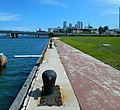 Mooring bollards and remaining walkway


Miami Herald Silver Knight Awards
[edit]The Miami Herald Silver Knight Awards is an awards program that recognizes outstanding individuals and leaders who have maintained good grades and contributed service to their schools and communities. The Silver Knight Awards program was instituted at the Miami Herald in 1959 by John S. Knight, past publisher of The Miami Herald, founder and editor emeritus of Knight-Ridder Newspapers and winner of the 1968 Pulitzer Prize for Editorial Writing.[45]
The program is open to high school seniors with a minimum 3.2 GPA (unweighted) in public, charter, private, and parochial schools in Miami-Dade and Broward counties. Students may be recognized in one of 15 categories: Art, Athletics, Business, Digital and Interactive (previously New Media), Drama, English and Literature, General Scholarship, Journalism, Mathematics, Music and Dance, Science, Social Science, Speech, Vocational-Technical, and World Languages. Each school may only nominate one student per category.
A panel of independent judges appointed by the Miami Herald for each category interviews the nominees in that category. Each panel selects one Silver Knight and three Honorable Mentions in its category for each of the two counties (30 Silver Knights and 90 Honorable Mentions each year). The honorees are revealed during the Silver Knight Awards ceremony, televised locally from Miami's James L. Knight Center.[46][47] In 2020, Silver Knights received a $2,000 scholarship, a Silver Knight statue, an AAdvantage 25,000-mile travel certificate and a medallion (from sponsor American Airlines). Honorable Mentions each received a $500 scholarship and an engraved plaque.
Because of the COVID-19 pandemic, the 2020 awards ceremony was live-streamed on May 28 from a video studio at the Miami Herald's newsroom; the nominees attended via Zoom video conference.[48]
The Silver Knight Awards have been given in Miami-Dade County since 1959 and in Broward County since 1984. Silver Knight Awards were given to Palm Beach County students from 1985 through 1990.[49] The program is sponsored by organizations with ties to South Florida; the cash awards have been made possible over the years in part by the support of the John S. and James L. Knight Foundation and the Arthur M. Blank Family Foundation.
Headquarters
[edit]Miami Herald Media Company, which owns the Miami Herald and El Nuevo Herald, is headquartered in Sweetwater, Miami-Dade County, Florida.[1]
The previous headquarters, One Herald Plaza, were located on a 14-acre (5.7 ha) plot in Biscayne Bay, Miami. This facility opened in March 1963. In 2011 the Genting Group, a Malaysian company, offered to pay the Miami Herald Media Company $236 million for the current headquarters property. The company began scouting for a new headquarters location after finalizing the sale.[50] The then president and publisher of the media company, David Landsberg, stated that it was not necessary at that point to be located in the city center, and remaining there would be too expensive.[51] The newspaper moved to its current Doral headquarters in 2013. On April 28, 2014, demolition began on the building on Biscayne Bay between the MacArthur and Venetian causeways.[52]
In a later period it was headquartered in Doral, Florida.[53][51] It is located in a two‑story, 160,000-square-foot (15,000 m2) building that had been the U.S. Southern Command center. The newspaper used 110,000 square feet (10,000 m2) of space for office purposes. In 2013 there were 650 people working there. The newspaper had purchased land adjacent to the headquarters to build the 119,000-square-foot (11,100 m2) printing plant.[51] The newspaper, working during the COVID-19 pandemic in Florida, was to close its Doral offices in August 2020 and later relocate to a new facility after a period of remote work.[54] The remote work began prior to the closure of the office, which did occur. The publication sold the Doral office in September 2021, getting $27.3 million.[55]
In 2023 the newspaper announced its new headquarters would be in the Waterford Business District.[3]
Awards
[edit]Pulitzer Prizes
[edit]The Miami Herald has received 24 Pulitzer Prizes:[6]
- 2023: Editorial Writing, the editorial board, for "Editorials on the failure of Florida public officials to deliver on many taxpayer-funded amenities and services promised to residents over decades."[56]
- 2022: Breaking News Reporting, staff, "For its urgent yet sweeping coverage of the collapse of the Champlain Towers South condominium complex."[57]
- 2017: Editorial Cartooning, Jim Morin, "For editorial cartoons that delivered sharp perspectives through flawless artistry, biting prose and crisp wit."[58]
- 2017: Explanatory Reporting, International Consortium of Investigative Journalists, McClatchy and Miami Herald, "For the Panama Papers, a series of stories using a collaboration of more than 300 reporters on six continents to expose the hidden infrastructure and global scale of offshore tax havens. (Moved by the Board from the International Reporting category, where it was entered.)"[59]
- 2009: Breaking News Photography, Patrick Farrell, "for his provocative, impeccably composed images of despair after Hurricane Ike and other lethal storms caused a humanitarian disaster in Haiti."
- 2007: Local Reporting, Debbie Cenziper, "for reports on waste, favoritism and lack of oversight at the Miami housing agency that resulted in dismissals, investigations and prosecutions." In 2007, Cenziper's investigation was featured in the PBS documentary series Exposé: America's Investigative Reports in an episode entitled "Money For Nothing."
- 2004: Commentary, Leonard Pitts Jr., "for his fresh, vibrant columns that spoke, with both passion and compassion, to ordinary people on often divisive issues."
- 2001: Breaking News Reporting, "for its coverage of the seizure of Elián González by federal agents."
- 1999: Investigative Reporting, staff, "for its detailed reporting that revealed pervasive voter fraud in a city mayoral election that was subsequently overturned."
- 1996: Editorial Cartooning, Jim Morin
- 1993: Meritorious Public Service, staff, "for coverage that not only helped readers cope with Hurricane Andrew's devastation but also showed how lax zoning, inspection and building codes had contributed to the destruction.";
- 1993: Commentary, Liz Balmaseda, "for her commentary from Haiti about deteriorating political and social conditions and her columns about Cuban-Americans in Miami."
- 1991: Spot News Reporting, staff, "for stories profiling a local cult leader Yahweh ben Yahweh, his followers, and their links to several area murders."
- 1988: Commentary, Dave Barry, "for his consistently effective use of humor as a device for presenting fresh insights into serious concerns."
- 1988: Feature Photography, Michel du Cille, "for photographs portraying the decay and subsequent rehabilitation of a housing project overrun by the drug crack."
- 1987: National Reporting, staff, "for its exclusive reporting and persistent coverage of the U.S.-Iran-Contra connection."
- 1986: Spot News Photography, Michel du Cille and Carol Guzy, for their photographs of the devastation caused by the eruption of the Nevado del Ruiz volcano in Colombia.
- 1986: General Reporting, Edna Buchanan, for her versatile and consistently excellent police beat reporting.
- 1983: Editorial Writing, the editorial board, "for its campaign against the detention of illegal Haitian immigrants by federal officials."
- 1981: International Reporting, Shirley Christian, "for her dispatches from Central America."
- 1980: Feature Writing, Madeleine Blais, "for 'Zepp's Last Stand.'"
- 1976: General Reporting, Gene Miller, for his persistent and courageous reporting over 8+1⁄2 years that led to the exoneration and release of two men who had twice been tried for murder and wrongfully convicted and sentenced to death in Florida.
- 1967: Specialized Reporting, Gene Miller, for investigative reporting that helped to free two persons wrongfully convicted of murder.
- 1951: Meritorious Public Service, staff, "for crime reporting during the year."
Missouri Lifestyle Journalism Awards
[edit]In the 1960s under the leadership of Women's Page editor Marie Anderson and assistant women's page editor Marjorie Paxson the Herald won four Missouri Lifestyle Journalism Awards (then called the Penney-Missouri Awards) for General Excellence.[60] The section won the award in 1960, the year of the awards' inauguration.[60] In 1961, it won again, and the program director asked Anderson to sit the 1962 awards out.[60] In 1963 the paper took second place, and in 1964 another first, and the paper was barred from competing for the next five years. In 1969 it won another first. Kimberly Wilmot Voss and Lance Speere, writing in the scholarly journal Florida Historical Quarterly, said Anderson "personified" the Penney-Missouri competition's goals.[61]
Notable staff
[edit]See also
[edit]

References
[edit]- ^ a b "Contact Us Information & Submission Form". Miami Herald. Retrieved December 11, 2023.
- ^ "McClatchy Markets". McClatchy. Retrieved February 1, 2022.
- ^ a b Bojnansky, Erik (June 28, 2023). "Miami Herald announced as incoming tenant to Waterford Business District". South Florida Business Journal. American City Business Journals. Retrieved September 16, 2023.
- ^ Merrill, John C. and Harold A. Fisher. The world's great dailies: profiles of fifty newspapers (1980) pp. 196–201.
- ^ Kleinman, Jeff (June 3, 2023). "Miami Herald Editorial Board wins Pulitzer for 'Broken Promises' series on civic letdowns". Miami Herald. Miami Herald Media Company. Retrieved September 16, 2023.
- ^ a b "Our Markets: Miami Herald". The McClatchy Company. Archived from the original on April 20, 2016.
- ^ "PolitiFact Florida | Sorting out the truth in politics". Politifact.com. Retrieved October 22, 2012.
- ^ a b Miami Evening Record Formed in 1903
- ^ "Headlines!; Unfolding 117 Years of History with the Miami Herald". Coral Gables Museum. Retrieved May 11, 2023.
- ^ "Miami Evening Record Formed in 1903". Miami History Blog. Retrieved April 23, 2021.
- ^ Smiley, Nixon (1974). Knights of the Fourth Estate: The Story of the Miami Herald. Miami: E. A. Seeman. p. 54. ISBN 978-0-912458-42-7.
- ^ Ville, John R. (January 1, 2009). "Pennekamp v. Florida (1946)". firstamendment.mtsu.edu. Retrieved August 22, 2024.
- ^ Terrell, William Glenn (July 24, 1946). "Opinion | Pennekamp, et al., v. State, 156 Fla. 227, 22 So. 2d 875 (Fla. 1945)". casetext.com. Archived from the original on September 22, 2023. Retrieved August 22, 2024.
- ^ Reed, Stanley F. (June 3, 1946). "Opinion | Pennekamp v. Florida, 328 U.S. 331 (1946)". supreme.justia.com. Retrieved June 22, 2024.
- ^ "The Miami Herald | American newspaper". Encyclopedia Britannica. Retrieved August 25, 2017.
- ^ "Former Miami Herald Site on Biscayne Bay Sells for $1.2 Billion". NBC 6 South Florida. April 27, 2023. Retrieved May 11, 2023.
- ^ Beasley, Ron (July 7, 2014). "Demolition of the Miami Herald building — end of an era". North Miami Beach News. Retrieved May 11, 2023.
- ^ VIGLUCCI, ANDRES (April 27, 2023). "Bids top $1 billion for Miami waterfront land where Genting wanted to build casino". miami herald. Retrieved May 11, 2023.
- ^ Dennis Hevesi (February 2, 2010). "Dan Paul, 85, leading lawyer for press freedom". The Boston Globe. Archived from the original on May 9, 2013. Retrieved April 24, 2013.
- ^ a b Richard Campbell; Christopher R. Martin; Bettina Fabos (February 20, 2012). Media and Culture with 2013 Update: An Introduction to Mass Communication. Bedford/St. Martin's. p. 498. ISBN 978-1-4576-0491-1. Retrieved April 24, 2013.
- ^ "Miami Herald Publishing Co. v. Tornillo, 418 U.S. 241 (1974)". via FindLaw. Archived from the original on June 6, 2013. Retrieved April 24, 2013.
- ^ "Thirlee, Smith Jr. AT&T Miami-Dade County African-American History Calendar 2005/2006. | The Black Archives History & Research Foundation of South FL, Inc". The Black Archives History & Research Foundation of South FL, Inc. Retrieved November 17, 2024.
- ^ Chrissos, Joan (October 7, 2023). "Bea Hines, documenting Miami's pride and pain for more than 50 years, earns top award". Miami Herald. Retrieved November 15, 2024.
- ^ "Finding Aid to The HistoryMakers ® Video Oral History with Bea L. Hines" (PDF). The HistoryMakers. Retrieved November 16, 2024.
- ^ Gutiérrez, Bárbara (June 15, 2001). "El Nuevo Herald Provides a Latin American Take On the News". Nieman Reports. Retrieved July 29, 2024.
- ^ "How the Miami Herald's Steve Rothaus became an LGBT pioneer in mainstream journalism". Columbia Journalism Review. Retrieved November 30, 2022.
- ^ Parsley, Jason. "Steve Rothaus Takes Buyout From Miami Herald". southfloridagaynews.com. Retrieved November 30, 2022.
- ^ Mendelsohn, Meredith (March 2, 2018). "'Cultured' Mag Founder Takes Us Inside Her Home and Her Mini Media Empire". 1stDibs Introspective. Retrieved July 1, 2024.
- ^ Carlson, Coralie (July 28, 2005). "Former Miami commissioner Teele is dead, police say". St. Augustine Record. Associated Press. Archived from the original on July 30, 2017. Retrieved July 30, 2017.
- ^ "Miami Code Violations on the Rise". Code Violation Center. January 27, 2016. Archived from the original on April 7, 2016. Retrieved March 25, 2016.
- ^ a b "US 'paid anti-Cuba journalists'". BBC News. September 9, 2006. Retrieved September 9, 2006.
- ^ a b Bauzá, Vanessa; Baró Diaz, Madeline. "Herald Publisher Resigns". Sun‑Sentinel. Archived from the original on October 22, 2015.
- ^ "10 Miami journalists take U.S. pay". Miami Herald. Archived from the original on January 3, 2007.
- ^ Hanks, Douglas (May 27, 2011). "Miami Herald parent sells land for $236 million; newspaper operations unaffected". Miami Herald. Archived from the original on August 28, 2011.
- ^ "Miami Herald completes move from downtown Miami". Miami Herald. May 17, 2013. Retrieved May 17, 2013.
- ^ "Demolition Begins on Miami Herald Building (Photos)". Miami New Times. April 28, 2014. Retrieved January 9, 2023.
- ^ Julie K. Brown, Aaron Albright (November 28, 2018). "Perversion of Justice". Miami Herald. Retrieved November 29, 2018.
- ^ Siegel, Pervaiz Shallwani|Kate Briquelet|Harry (July 6, 2019). "Jeffrey Epstein Arrested for Sex Trafficking of Minors". Retrieved July 7, 2019.
- ^ Mazzei, Patricia; Rashbaum, William K. (July 6, 2019). "Jeffrey Epstein, Billionaire Long Accused of Molesting Minors, Is Charged". The New York Times. ISSN 0362-4331. Retrieved July 7, 2019.
- ^ Hsu, Tiffany (July 9, 2019). "The Jeffrey Epstein Case Was Cold, Until a Miami Herald Reporter Got Accusers to Talk". The New York Times. ISSN 0362-4331. Retrieved July 10, 2019.
- ^ Aminda Marqués González (December 17, 2019). "The Miami Herald is replacing Saturday print edition with expanded Friday, Sunday papers". miamiherald.com. Archived from the original on December 29, 2019. Retrieved February 15, 2020.
- ^ "Miami Herald to close production plant, move printing operations to Broward County". Miami Herald. January 21, 2020. Retrieved May 28, 2020.
- ^ "The Miami Herald Cuts 70 Jobs and Closes Its Printing Plant". Miami New Times. January 22, 2020. Retrieved May 28, 2020.
- ^ Christensen, Dan (December 18, 2024). "The long goodbye of Florida's newspapers - read all about it". Florida Bulldog. Retrieved August 6, 2025.
- ^ "1968 Pulitzer Prize Winners & Finalists - The Pulitzer Prizes". Retrieved May 28, 2020.
- ^ "Silver Knight: Qualifications & Nomination Process". Miami Herald. October 29, 2008. Archived from the original on March 28, 2016.
- ^ "What is a Silver Knight?". Miami Herald. October 29, 2008. Retrieved October 17, 2016.
- ^ "Silver Knights are extraordinary. The ceremony honoring them was anything but ordinary". Miami Herald. May 28, 2020. Retrieved May 28, 2020.
- ^ "Silver Knight success stories: Where are they now?". Miami Herald. May 6, 2007. Retrieved May 28, 2020.
- ^ "The Miami Herald Moving Project". The Movers US Group. October 27, 2011. Retrieved July 30, 2017.
- ^ a b c Beasley, Adam. "Our new home: Miami Herald's Doral headquarters reflects a modern reality." Miami Herald. Tuesday June 4, 2013. Retrieved January 25, 2014. Archived from the original on February 3, 2014 at the Wayback Machine
- ^ "Demolition begins on former Miami Herald bayfront building". Miami Herald. April 28, 2014. Archived from the original on July 12, 2014. Retrieved April 29, 2014.
- ^ "Contact Us." Miami Herald. Retrieved January 24, 2014. "The Miami Herald 3511 NW 91 Ave. Miami, FL 33172" - While the address says "Miami, FL", the location is actually in Doral. See this map of Miami-Dade County municipalities and the City of Doral land use map, compare with the full address. As seen from this City of Houston FAQ, the U.S. Postal Service assigns city names in addresses based on convenience and not on municipal boundaries.
- ^ Marqués González, Aminda (June 9, 2020). "Miami Herald is moving out of its office building in Doral". Miami Herald. Retrieved January 9, 2023.
- ^ Dinkova, Lidia (September 29, 2021). "Former Miami Herald, el Nuevo Herald office building in Doral trades for $27M". The Real Deal. Retrieved January 9, 2023.
- ^ "2023 Pulitzer Prize Winners & Finalists". Pulitzer.org. Retrieved September 5, 2025.
- ^ "The 2022 Pulitzer Prize Winner in Breaking News Reporting". Pulitzer.
- ^ "The 2017 Pulitzer Prize Winner in Editorial Cartooning". www.pulitzer.org. Retrieved July 30, 2017.
- ^ "The 2017 Pulitzer Prize Winner in Explanatory Reporting". www.pulitzer.org. Retrieved July 30, 2017.
- ^ a b c Harper, Kimberly. "Marie Anderson". State Historical Society of Missouri. Archived from the original on January 17, 2019. Retrieved December 26, 2018.
- ^ Voss, Kimberly Wilmot; Speere, Lance (2007). "A Women's Page Pioneer: Marie Anderson and Her Influence at the Miami Herald and Beyond". Florida Historical Quarterly. 85 (4): 398–421. JSTOR 30150079.
- ^ "Jeanne Voltz, 81; Past Editor of Times' Food Section". Los Angeles Times. January 16, 2002. Retrieved September 30, 2023.
- ^ "Jeanne Appleton Voltz 1920-2002". University of Alabama. Retrieved September 30, 2023.
- ^ Voss, Kimberly Wilmot (April 2013). "Food Journalism or Culinary Anthropology? Re-evaluating Soft News and the Influence of Jeanne Voltz's Food Section in the Los Angeles Times". American Journalism. 29 (2): 66–91. doi:10.1080/08821127.2012.10677826. ISSN 0882-1127. S2CID 151228187.
External links
[edit]- Official website

- Today's Miami Herald front page at the Freedom Forum website


Pulitzer Prize for Public Service (1951–1975) | ||
|---|---|---|
| .png) | |
Pulitzer Prize for Public Service (1976–2000) | ||
|---|---|---|
| | |
Miami Herald
View on GrokipediaOverview and Operations
Summary and Founding
The Miami Herald is an American daily newspaper headquartered in Miami, Florida, serving as a primary source of local and regional news for South Florida. It originated with the first edition of its predecessor, the Miami Evening Record, published on September 15, 1903, before being acquired and renamed the Miami Herald on December 1, 1910, by Frank B. Shutts, an Indiana-born attorney who relocated to Miami and financed the venture with a loan from railroad developer Henry Flagler.[3][7] Shutts established the paper to address the informational needs of Miami's expanding population during the early 20th-century land boom, a period marked by speculative real estate fervor, tourism promotion, and infrastructure growth that transformed the area from a frontier outpost into a burgeoning urban center.[8] In its early years, the Herald prioritized coverage of local affairs, including community events, real estate activities, and civic developments reflective of Miami's rapid urbanization and appeal as a tourist destination. As the region developed amid influences like seasonal visitors and later influxes of Cuban immigrants following political upheavals, the newspaper cultivated a reputation for rigorous local reporting, emphasizing empirical scrutiny of public issues and institutional accountability over time.[3] The Herald evolved into a major Florida journalistic institution, with daily circulation reaching a historical peak of 440,225 in 1998, enabling broad dissemination of its content on matters of regional significance. Its foundational commitment persists in pursuing credible, fact-based accounts of South Florida's complexities, informed by direct observation and verification rather than unexamined narratives from biased institutional sources.[9][3]Ownership History
The Miami Herald was acquired in 1937 by brothers John S. Knight and James L. Knight for $2.25 million, marking a pivotal shift from local ownership under Frank B. Shutts to the Knights' burgeoning newspaper chain, which provided capital for modernization and expansion amid Miami's growth.[10] [11] This acquisition laid the foundation for professionalized operations, with John Knight assuming the role of president and publisher on October 15, 1937, fostering editorial independence through family-controlled resources that prioritized journalistic quality over short-term profits.[12] The Knights' group evolved into Knight Newspapers, merging with Ridder Publications in 1974 to form Knight Ridder, a major chain that retained control of the Herald until 2006, during which period the paper won multiple Pulitzers and grew circulation significantly, underscoring how chain ownership stabilized finances against local market volatility.[3] In 2006, McClatchy Company purchased Knight Ridder for approximately $4.5 billion in cash and stock, retaining the Miami Herald as its largest acquisition while divesting others to manage debt loads exacerbated by the rise of digital advertising competition.[13] [3] This transaction, completed amid industry-wide print revenue declines from online platforms like Craigslist and Google, saddled McClatchy with over $4 billion in assumed obligations, constraining investments in digital transitions and contributing to operational strains that prioritized cost controls over expansive journalism.[14] McClatchy's financial pressures culminated in a Chapter 11 bankruptcy filing on February 13, 2020, driven by $700 million in pension liabilities and persistent ad revenue erosion, prompting a court-supervised auction won by Chatham Asset Management, a New Jersey-based hedge fund, for $312 million in September 2020.[14] [15] Chatham's private equity model extinguished much of the debt, enabling a shift to private ownership that emphasized balance sheet repair and selective digital investments, though it involved staff reductions—McClatchy-wide cuts exceeded 1,000 positions pre-bankruptcy and continued post-acquisition via buyouts—to align costs with shrinking print circulations, which fell from peaks over 300,000 daily in the Knight Ridder era to under 100,000 by 2020.[16] This ownership change preserved the Herald's core newsroom but raised concerns among journalists about potential prioritization of financial returns over investigative depth, as hedge fund strategies often favor efficiency metrics like EBITDA over long-term public service missions.[17] Under Chatham's stewardship, McClatchy merged with accelerate360—a distribution and media firm encompassing a360 Media's lifestyle titles like Us Weekly—on December 13, 2024, forming McClatchy Media Company to integrate local news with national entertainment content for diversified revenue streams, including subscriptions, events, and e-commerce, amid ongoing print ad declines projected at 5-10% annually industry-wide.[18] [19] The all-stock merger, valuing combined assets to reach 100 million unique monthly users, reflects causal adaptations to fragmented media economics, where pure news models proved unsustainable, though it bolsters financial stability by blending Herald-style reporting with tabloid-scale distribution without diluting editorial firewalls, as Chatham pledged continued journalistic autonomy.[20] This evolution highlights private equity's role in averting total collapse but underscores tensions between profitability imperatives and traditional ownership's emphasis on civic accountability.[21]Headquarters and Circulation
The Miami Herald maintained its headquarters in a waterfront facility in downtown Miami from 1963 until May 2013, when operations relocated to a two-story building at 3511 NW 91st Avenue in Doral, Miami-Dade County, Florida, following the 2011 sale of the downtown property for $236 million to support financial restructuring.[22][23] The Doral site, previously used by U.S. Southern Command, accommodated printing presses, newsrooms for both the Herald and El Nuevo Herald, and distribution logistics until August 2020, when the newspaper vacated the premises amid the COVID-19 pandemic's acceleration of remote work and reduced need for centralized physical infrastructure.[24] Subsequent sales of the Doral property in 2024 and 2025 for redevelopment into warehouses underscored the shift away from large-scale print facilities.[25][26] Print operations ceased in-house by April 2020, with editions now outsourced, reflecting broader industry adaptations to declining physical distribution demands. The Herald's distribution network continues to emphasize home delivery and single-copy sales across South Florida, prioritizing reliability in Miami-Dade, Broward, and Palm Beach counties despite logistical challenges from urban density and traffic.[27] No Saturday print edition has been produced since March 2020, consolidating resources for weekday and Sunday runs.[27] Historically, the newspaper achieved peak average daily print circulation of 440,225 in 1998, driven by South Florida's population boom and dominance as the region's leading English-language daily.[9] By 2024, daily print circulation had contracted to approximately 53,000, indicative of nationwide trends in readership migration and rising production costs, though Sunday editions retained higher volumes around 100,000 in prior years.[28] Complementing this, the sister Spanish-language El Nuevo Herald, targeted at the area's substantial Hispanic population exceeding 2 million, reported 42,069 daily circulation as of 2015, with combined Herald-El Nuevo print figures totaling about 78,700 daily in 2019 to sustain regional market share.[29]Digital Transformation and Challenges
The Miami Herald launched its website, miamiherald.com, on May 11, 1996, marking an early entry into online publishing amid the nascent internet era for newspapers.[30] Following the 2012 implementation of a digital paywall, the outlet pivoted toward a digital-first strategy, emphasizing multimedia content, email newsletters revamped in 2017, and app-based delivery to adapt to shifting reader habits. By 2019, this included niche offerings like a sports-only subscription pass priced at $30 for the first year, aimed at attracting targeted audiences without requiring full news access.[31] Digital challenges intensified in the 2010s and 2020s due to the dominance of Google and Facebook in capturing over 90% of new digital ad spending growth, diverting revenue streams traditionally reliant on print classifieds and display ads from local papers like the Herald.[32] This structural shift contributed to repeated layoffs, including 24 positions cut in 2014 amid "challenging conditions," six newsroom roles eliminated in April 2023, and broader McClatchy-wide reductions tied to unprofitable print operations.[33][34] These cuts reflect industry-wide causal pressures where platform intermediaries siphon ad dollars, forcing local journalism outlets to shrink staff while competing for fragmented online attention. Despite these headwinds, the paywall has shown efficacy in building a subscription base, with successes in specialized tiers like the sports pass helping offset ad losses through direct reader revenue.[35] As of 2025, miamiherald.com attracts approximately 6 million monthly unique visitors, supporting digital growth amid McClatchy's broader network reaching 18.3 million.[36][37] This traffic, bolstered by newsletters and mobile alerts, underscores a partial adaptation to digital economics, though sustained viability hinges on diversifying beyond platform-dependent ads.[38]Historical Development
Early Years (1903–1940s)
The Miami Herald originated from the Miami Evening Record, founded on September 15, 1903, by Frank Stoneman as an afternoon newspaper amid the initial phases of Miami's explosive land boom, which attracted speculators and developers to the region's nascent real estate market.[39] In 1910, Indiana attorney Frank B. Shutts acquired the struggling Record for $24,000, merging it with the Miami Morning News-Record to establish the Miami Herald on December 1 of that year, with startup capital borrowed from railroad pioneer Henry M. Flagler, whose Florida East Coast Railway had spurred the area's connectivity and growth.[40] [41] Shutts, initially uninterested in journalism but drawn to its potential for civic influence, positioned the Herald as a booster for infrastructure and economic development, including advocacy for port enhancements to capitalize on Miami's strategic coastal position for trade and tourism.[42] This alignment reflected causal drivers of regional expansion, where transportation and harbor improvements directly enabled population influx and commerce, unencumbered by later corporate consolidations. The newspaper's early reporting priorities were shaped by Miami's volatile growth, emphasizing real estate booms, municipal projects, and natural disasters that tested the city's resilience. The 1926 Great Miami Hurricane, a Category 4 storm that struck on September 18 with winds exceeding 130 mph and caused hundreds of deaths alongside $100 million in damages (equivalent to billions today), received exhaustive coverage from the Herald, documenting the devastation from the Florida Keys to Palm Beach and highlighting vulnerabilities in unchecked development.[43] [44] During the Prohibition era (1920–1933), the Herald empirically chronicled local crime waves, including rum-running operations via speedboats from the Bahamas, which exploited Miami's proximity to international waters and contributed to a surge in bootlegging-related violence and corruption in South Florida.[12] By the 1940s, the Herald had stabilized after the Great Depression's setbacks, with circulation rebounding amid World War II-driven migration to military training bases and defense industries in South Florida, which swelled Miami's population from approximately 67,000 in 1930 to over 172,000 by 1940.[12] This growth paralleled the newspaper's expansion to serve an increasingly diverse readership, including early Cuban immigrant communities tied to cigar manufacturing and trade, fostering initial hemispheric connections that later intensified. Shutts guided the publication until around 1937, after which his influence persisted through family and editorial continuity until his death in 1947, maintaining a focus on factual local journalism amid wartime demands.[40]Expansion Under Knight Ridder (1950s–2005)
In the post-World War II era, under Knight Newspapers ownership—which transitioned to Knight Ridder following the 1974 merger with Ridder Publications—the Miami Herald capitalized on South Florida's rapid population growth, with Dade County nearly doubling in residents between 1940 and 1950. Circulation expanded accordingly, rising from 86,313 daily copies in 1941 to 175,985 by 1951, reflecting increased demand for local and regional news amid economic development and migration.[10][3] Knight Newspapers committed significant capital to infrastructure, constructing a $30 million headquarters and printing plant at One Herald Plaza in 1960, then the largest private construction project in Florida history. This facility incorporated advanced offset printing technology, boosting production efficiency and enabling higher-quality color reproduction and faster distribution to support the paper's growing footprint across Miami-Dade, Broward, and Monroe counties.[10] The investment facilitated professionalization, including expanded newsroom resources and bureaus to cover state and national stories with local angles, such as the 1962 Cuban Missile Crisis, where the Herald detailed evacuation drills, military mobilizations, and socioeconomic strains on Florida's coastal communities due to the crisis's proximity to Cuba.[45] The newspaper's investigative focus deepened during economic booms, yielding scoops on municipal corruption and organized crime syndicates infiltrating Miami's development projects, which reinforced its role in promoting governmental accountability.[12] By the 1980s and 1990s, amid suburban sprawl driven by Cuban exile waves post-1959 revolution and subsequent refugee influxes, the Herald prioritized hyper-local reporting on zoning disputes, infrastructure strains, and ethnic community integration, sustaining peak daily circulation above 300,000 while serving an increasingly diverse readership without formalized zonal print editions but through targeted sections and distribution strategies.[10][3]McClatchy Era and Industry Shifts (2006–2019)
In June 2006, McClatchy Company completed its $4.5 billion acquisition of Knight Ridder, assuming ownership of the Miami Herald and integrating it into a portfolio of 32 daily newspapers amid intensifying pressure from Tribune Company's parallel bid for Knight Ridder assets.[13] This transaction positioned McClatchy as the second-largest U.S. newspaper publisher at the time, but it inherited substantial debt from the deal, exacerbating vulnerabilities as print advertising revenues began eroding due to the rise of online platforms like Craigslist and Google, which siphoned classified and display ad dollars through lower-cost digital alternatives.[46] McClatchy responded with aggressive cost-control measures at the Herald, prioritizing retention of local reporting beats on South Florida issues while trimming administrative and non-essential roles to offset causal revenue shortfalls driven by these structural industry shifts.[47] The Herald's newsroom, which employed approximately 400 journalists at the time of acquisition, faced successive rounds of reductions as McClatchy-wide layoffs accelerated in response to plummeting ad income; for instance, the company eliminated 1,400 positions (10% of its workforce) in June 2008 and another 1,600 (15%) in March 2009, with the Herald bearing proportional impacts amid Florida's housing market collapse.[48][49][50] By 2019, ahead of McClatchy's bankruptcy filing, the Herald's staff had contracted to under 200, reflecting broader causal dynamics where print circulation and ad revenues—once comprising over 80% of newspaper income—declined by double digits annually, forcing reallocation toward digital subscriptions and targeted local content to sustain viability.[51] Despite these constraints, the paper maintained emphasis on empirical local coverage, including detailed reporting on the 2008 recession's disproportionate effects on Florida's real estate and tourism sectors, where home foreclosures surged 200% statewide and unemployment in Miami-Dade County reached 14.1% by mid-2009.[52] Adaptation to digital disruption included early integration of bloggers for opinion and community engagement sections, alongside nascent data journalism efforts to leverage public records and analytics for investigative pieces on immigration policy debates central to South Florida's demographics.[53] McClatchy rolled out company-wide digital platforms to the Herald, enabling multimedia storytelling and programmatic advertising, though these yielded limited offsets to print losses—evidenced by McClatchy's 11% revenue drop (nearly $68 million) in the first three quarters of 2019 alone, primarily from advertising and circulation erosion.[54][51] This period underscored causal trade-offs: while cost-cutting preserved core local beats like immigration enforcement impacts on migrant labor in construction and agriculture, it constrained depth in national reporting, prioritizing verifiable, data-driven accounts over expansive resources.[55][56]Bankruptcy, Chatham Acquisition, and 2020s Mergers
In February 2020, McClatchy Company, publisher of the Miami Herald, filed for Chapter 11 bankruptcy protection amid mounting financial pressures, including a pension shortfall exceeding $800 million and over $120 million in required pension contributions due that year.[57][58] The filing listed net debt of approximately $697 million, with the company's underfunded pension plan—covering over 24,000 employees and only 57% funded—forcing termination effective August 31, 2020, after which the Pension Benefit Guaranty Corporation assumed responsibility for benefits.[59][60] This restructuring addressed legacy obligations from prior ownership but preserved operations across McClatchy's 30 newspapers, including the Miami Herald, without immediate cessation of publication.[61] Chatham Asset Management, McClatchy's largest creditor and a New Jersey-based hedge fund, emerged as the acquirer through a court-supervised auction concluded in July 2020, with the $312 million deal approved on August 4 and fully transitioning assets to a private entity by September 4.[62][63] The acquisition eliminated public shareholder structure, shedding much of the debt and pension liabilities while retaining the McClatchy name and integrating the portfolio under private equity oversight, which prioritized balance sheet deleveraging over dividend payouts.[15] Post-acquisition, the Miami Herald continued local reporting, though staff reductions occurred, such as six layoffs in 2023 targeting editing and research roles to streamline costs.[34] In December 2024, McClatchy completed a merger with accelerate360 (formerly A360 Media), incorporating lifestyle and entertainment publications like Us Weekly and Woman's World to expand audience reach to over 100 million unique monthly users through cross-promotion of local journalism and consumer content.[18][20] The resulting McClatchy Media Company operates under continued Chatham control, leveraging combined digital and print distribution for revenue diversification amid declining ad markets, with the Miami Herald maintaining its focus on South Florida coverage.[64] By mid-2025, operations showed stabilization via diversified holdings, though selective workforce adjustments persisted to align with post-merger efficiencies.[20]Editorial Stance and Journalistic Approach
Political Orientation and Endorsements
The Miami Herald's editorial positions have been rated as left-center biased by Media Bias/Fact Check, reflecting a moderate favoritism toward liberal causes in opinion content while maintaining high factual reporting standards in news.[4] AllSides similarly classifies it as Lean Left, based on blind bias surveys and editorial reviews indicating a consistent tilt in story selection and framing.[5] These assessments align with patterns in coverage of issues like immigration and environmental policy, where progressive viewpoints—such as support for expanded migrant protections and stringent climate regulations—predominate in editorials.[4] In presidential endorsements, the newspaper has shown a Democratic-leaning pattern in recent decades, including a 2016 recommendation for Hillary Clinton over Donald Trump, emphasizing concerns about the latter's honesty and policy direction.[65] While it endorsed Republican Ronald Reagan in 1984, this decision led to the resignations of key editorial staff, highlighting internal tensions over diverging from perceived institutional norms; subsequent cycles have favored Democrats more consistently.[66] For the 2020 election, although no explicit presidential endorsement appeared in major archives, opinion columns and reporting heavily critiqued Trump while amplifying Biden-aligned narratives, contributing to the observed skew.[67] The Herald has frequently opposed Republican Florida Governor Ron DeSantis on COVID-19 policies, labeling his resistance to vaccine mandates and mask requirements as "reckless" and conducive to "anti-vaxx fervor" in multiple editorials from 2021 to 2025.[68][69] This stance exemplifies a broader empirical tilt in opinion pieces toward progressive public health measures, with rare counterpoints to conservative critiques appearing amid predominantly left-leaning commentary. Local endorsements via the editorial board further reflect this orientation, prioritizing Democratic or moderate candidates in South Florida races over recent years.[70]Reporting Style and Local Focus
The Miami Herald's reporting style emphasizes beat-driven journalism, with dedicated coverage of local issues such as Miami-Dade County criminal activities and regional ties to Latin America, drawing on empirical data from public records and on-the-ground sourcing to ensure community accountability. Reporters frequently utilize Freedom of Information Act (FOIA) requests and similar public records mechanisms to access government documents, as demonstrated in investigative series like "Shakedown City," which exposed patterns of corruption in Miami Beach through analysis of procurement records and official communications, earning the 2024 Brechner Freedom of Information Award. This approach prioritizes verifiable local evidence over broader national wire service narratives, fostering detailed accountability on topics ranging from municipal governance to cross-border influences.[71] Complementing this, the Herald incorporates whistleblower accounts and insider tips to initiate probes into systemic issues, often cross-verifying them against official data to substantiate claims of misconduct in local institutions. Its methodological rigor extends to data-driven features, such as economic analyses of tourism's role in South Florida, where reporting has quantified contributions like $11.1 billion to Miami-Dade's economy in 2022, surpassing pre-pandemic benchmarks through aggregation of visitor spending, hotel revenues, and employment metrics from county and state sources. This focus on quantifiable local impacts underscores a commitment to causal analysis of regional dynamics, including seasonal fluctuations and policy effects on industries vital to the area's economy.[72] Multilingual capabilities enhance the Herald's local orientation via its sister publication, El Nuevo Herald, the second-largest Spanish-language news outlet in the United States, which provides parallel coverage tailored to South Florida's Hispanic communities and extends to Latin American developments with on-site reporting and translated originals. Post-2000s industry shifts prompted a pivot toward original enterprise journalism, reducing dependence on syndicated wires in favor of staff-led investigations rooted in community beats, as reflected in sustained engagement with local government and economic stories amid declining print resources. This evolution highlights strengths in hyper-local sourcing, enabling the Herald to differentiate through granular, evidence-based narratives that hold regional power structures accountable.[73][74]Allegations of Bias and Viewpoint Diversity
The Miami Herald has faced allegations of left-leaning bias, particularly from conservative commentators who argue that its reporting and editorials selectively frame issues to favor progressive viewpoints. Media bias rating organizations, including AllSides and Media Bias/Fact Check, classify the Herald as having a lean left or slight to moderate liberal bias, citing use of loaded language in political coverage and a tendency toward factually supported but ideologically slanted narratives.[5][4] These assessments align with broader empirical patterns in U.S. journalism, where surveys indicate that over 80% of journalists identify as Democrats or independents leaning left, potentially influencing institutional output despite journalistic standards. Conservatives have specifically critiqued the Herald's pre-2010 midterm election coverage for a "steady negative blitz" on Republican candidates and issues, portraying it as an effort to sway voters rather than neutral reporting.[75] Criticisms extend to the Herald's handling of national figures like Donald Trump, with detractors pointing to disproportionate emphasis on anti-Trump protests and opposition to related initiatives, such as the proposed Trump presidential library in Miami-Dade County, while downplaying supportive local developments.[76] On immigration, the paper's editorials have opposed Florida's enforcement policies, labeling them "anti-immigrant" and highlighting perceived hypocrisies in state reliance on migrant labor, which right-leaning observers contend minimizes the causal links between lax federal border policies and local strains on resources and crime rates.[77][78] Such framing, critics argue, reflects a systemic media preference for humanitarian angles over enforcement imperatives, as evidenced by the Herald's amplification of migrant mistreatment allegations without equivalent scrutiny of policy failures enabling unauthorized entries.[79] Regarding viewpoint diversity, the Herald publishes occasional conservative op-eds, such as defenses of Republican figures against mockery, suggesting some effort to include dissenting perspectives.[80] However, internal ideological homogeneity raises concerns; for instance, investigative reporter Sarah Blaskey has been accused of leveraging her position—rooted in a documented socialist history—to target Republican officials like Miami's mayor with ethics probes, illustrating potential staff leanings that undermine balance.[81] Broader critiques, including from Florida Republicans like Wilton Simpson, allege reporter collusion with litigants in politically charged stories, such as redistricting disputes, further eroding perceptions of impartiality.[82] While the paper issues corrections for factual errors, these instances of alleged slant persist amid industry-wide data showing limited conservative representation in newsrooms, which empirical analyses link to echo-chamber effects in sourcing and emphasis.[83]Notable Investigations
Jeffrey Epstein Coverage
In November 2018, Miami Herald investigative reporter Julie K. Brown published the "Perversion of Justice" series, a three-part exposé detailing Jeffrey Epstein's sex trafficking network and the lenient 2008 federal non-prosecution agreement orchestrated by then-U.S. Attorney Alexander Acosta.[84] The reporting revealed how Epstein, accused of abusing dozens of underage girls, secured a plea deal that allowed him to serve just 13 months in a county jail with work release privileges, despite evidence of over 30 victims in Palm Beach alone and broader interstate activities.[85] Brown's methodology centered on tracking down and interviewing more than 60 survivors, many previously unidentified, who described recruitment tactics involving payments for sexual acts and referrals to Epstein's properties in Florida, New York, and elsewhere.[85] The series highlighted procedural irregularities in the 2008 deal, including Acosta's office bypassing victims' rights under the Crime Victims' Rights Act by concealing the agreement from them, which later formed grounds for a 2019 federal lawsuit vacating the pact.[84] This coverage prompted renewed federal scrutiny by the Southern District of New York, culminating in Epstein's arrest on July 6, 2019, on charges of sex trafficking minors, as prosecutors cited the Herald's revelations in underscoring the prior deal's inadequacy.[86] Epstein died by suicide in custody on August 10, 2019, before trial, but the reporting facilitated Ghislaine Maxwell's December 2020 arrest and 2021 conviction on related trafficking charges.[87] For the work, the Miami Herald received the 2020 Pulitzer Prize for Explanatory Reporting, recognizing its illumination of systemic failures in prosecuting powerful figures.[88] Subsequent coverage has addressed unsealed documents from Epstein-related cases, including 2024 releases from Virginia Giuffre's defamation suit against Maxwell that detailed recruitment patterns and elite associations, as well as 2025 efforts to access grand jury transcripts and estate financial records amid ongoing victim compensation claims exceeding $150 million.[89][90] These follow-ups have sustained focus on the plea deal's leniency factors, such as Epstein's legal team's influence and prosecutorial deference to his connections, contributing to broader examinations of accountability gaps for high-profile offenders.[91]Other Key Stories (e.g., Organized Crime and Local Corruption)
The Miami Herald chronicled the surge of organized crime in South Florida during the 1970s and 1980s, particularly the violent cocaine trade that supplanted earlier Italian-American mafia operations with Colombian cartel dominance. On July 11, 1979, the newspaper detailed the Dadeland Mall shootout in Kendall, where two drug traffickers were gunned down in broad daylight by assailants wielding automatic weapons, an event signaling the onset of Miami's "Cocaine Cowboys" era with over 600 homicides linked to narcotics by 1981.[92] This coverage exposed the infiltration of smuggling networks into local ports and communities, prompting federal interventions like Operation Swordfish in 1982, which dismantled key Marielito Cuban exile gangs responsible for extortion and murders, resulting in dozens of convictions.[11] In 2000, the Herald provided multifaceted reporting on the Elián González custody dispute, balancing viewpoints from the boy's Miami relatives—who sought political asylum—against demands from his Cuban father, amid escalating tensions that culminated in a federal raid on April 22 at the Little Havana home.[93] The saga, involving Immigration and Naturalization Service rulings and court battles, underscored local exile community frustrations with U.S.-Cuba policy, with the paper documenting over 100 related stories that highlighted legal, familial, and political dimensions without endorsing one side outright.[94] This approach revealed patterns of institutional overreach in immigration enforcement, contributing to broader scrutiny of federal handling of high-profile cases. More recently, in the 2020s, the Herald tracked systemic graft in Miami-Dade politics, including the public corruption trial of former commissioner Joe Martinez, convicted in 2025 of accepting over $25,000 in unlawful compensation tied to zoning favors for a strip club owner.[95] Martinez, a five-term official and ex-police sergeant, received a 34-month prison sentence on September 15, 2025, following a jury verdict on charges stemming from 2010-2016 activities, with the reporting amplifying evidence from wiretaps and financial records that exposed quid-pro-quo schemes eroding public trust.[96] These investigations have driven accountability, yielding convictions that deterred similar abuses and enhanced oversight in local government, though some observers contend that intensive crime coverage risks sensationalism, inflating perceived threats and readership at the expense of nuanced context.[97]Awards and Achievements
Pulitzer Prizes
The Miami Herald has won 24 Pulitzer Prizes since 1951, with awards distributed across categories such as public service, investigative reporting, general news reporting, breaking news, international reporting, explanatory reporting, editorial writing, and commentary.[3] These honors, administered by Columbia University and judged by panels of journalists and academics, affirm instances of rigorous fact-based reporting that exposed corruption, advanced accountability, and documented significant events, often yielding causal impacts like policy reforms or overturned elections. The newspaper's investigative persistence, exemplified by Gene Miller's two wins for uncovering wrongful death cases through exhaustive searches, underscores a pattern of empirical-driven journalism linking evidence to systemic failures. Key awards include the 1983 Pulitzer for Local Reporting, awarded to the staff for coverage of hazardous waste dumping that prompted environmental cleanups and prosecutions in South Dade County. In 1987, the staff received the General News Reporting prize for persistent revelations of U.S. involvement in the Iran-Contra affair, contributing to congressional scrutiny.[98] The 1999 Investigative Reporting award recognized exposure of voter fraud in a Miami mayoral election, leading to its nullification.[99] Breaking news coverage of the 2000 federal raid on Elián González's Miami home earned the 2001 prize for balanced, on-scene reporting amid intense local controversy.[100] More recent wins feature the 2017 Explanatory Reporting prize for illuminating offshore financial secrecy via the Panama Papers, enhancing public understanding of tax evasion mechanisms, and the 2017 Editorial Cartooning award to Jim Morin for incisive visuals on political and social issues.[101] In 2018, Jim Wyss won International Reporting for on-the-ground dispatches from Venezuela documenting economic collapse and government mismanagement under hyperinflation exceeding 1 million percent annually. The 2022 Breaking News prize went to the staff for comprehensive coverage of the Surfside condominium collapse that killed 98 people, integrating engineering analysis with resident accounts to highlight building safety lapses.[102] The 2023 Editorial Writing award honored a series by the board, led by Amy Driscoll, critiquing Florida officials' unfulfilled infrastructure promises despite billions in taxpayer funds.[103] While the Pulitzer board's selections prioritize verifiable impact, certain awards, such as the 1991 Editorial Writing prize for opposing federal detention of Haitian refugees, correlate with left-leaning advocacy on immigration, reflecting potential institutional preferences in judging panels drawn from mainstream media and academia, where empirical scrutiny reveals disproportionate progressive viewpoints.[104] Nonetheless, the Miami Herald's prizes consistently stem from documented evidence rather than ideological alignment alone, distinguishing them amid broader critiques of award biases.| Year | Category | Recipient | Citation |
|---|---|---|---|
| 1951 | Public Service | Staff | |
| 1967 | General News Reporting | Gene Miller | |
| 1976 | Investigative Reporting | Gene Miller | |
| 1983 | Local Reporting | Staff | |
| 1987 | General News Reporting | Staff | [98] |
| 1991 | Editorial Writing | Editorial Board | [104] |
| 1999 | Investigative Reporting | Staff | [99] |
| 2001 | Breaking News Reporting | Staff | [100] |
| 2006 | Commentary | Leonard Pitts Jr. | [105] |
| 2017 | Explanatory Reporting | Staff | [101] |
| 2017 | Editorial Cartooning | Jim Morin | [101] |
| 2018 | International Reporting | Jim Wyss | |
| 2022 | Breaking News Reporting | Staff | [102] |
| 2023 | Editorial Writing | Editorial Board (Amy Driscoll et al.) | [103] |