
Recent from talks
1838 Mormon War
Knowledge base stats:
Talk channels stats:
Members stats:
1838 Mormon War
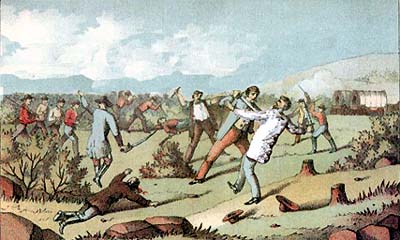
The 1838 Mormon War, also known as the Missouri Mormon War, was a series of armed conflicts between Mormons (Latter Day Saints) and other settlers in northern Missouri during the summer and fall of 1838. Initially characterized by mutual vigilante violence, it escalated into direct intervention by the Missouri state militia. The conflict concluded with the issuance of the Missouri Executive Order 44, which mandated the expulsion of the Mormons from the state.
Early Latter Day Saints settled in Missouri driven by religious revelations instructing them to "gather" in Kirtland, Ohio, and Jackson County, Missouri. Facing increasing hostility from neighboring settlers, an 1833 crisis resulted in their forceful eviction from Jackson County by vigilantes. The Missouri legislature created Caldwell County in 1836 as a "compromise" for displaced Mormon settlers; however, the relocation of Mormon leaders from Kirtland in early 1838 intensified fears of Mormon consolidation and expansion in the state.
Violence reignited on August 6, 1838, after a group attempted to prevent Mormons from voting in Gallatin, Daviess County, catalyzing the formation of vigilance committees that sought to expel the Mormons from Missouri. Local militia largely failed to quell the unrest, which rapidly escalated into a series of raids and counter-raids. Key engagements included the Battle of Crooked River (October 24), and the Haun's Mill Massacre (October 30) where anti-Mormon vigilantes killed 17 unarmed Latter Day Saints.
After the engagements at Crooked River, Governor Lilburn Boggs concluded that the Mormons were in open insurrection against state authority, and issued an order on October 27 commanding state troops that they "must be exterminated or driven from the state." Mormons surrendered on November 1, 1838. The state's response to the conflict provoked widespread controversy and severely damaged Boggs's political standing. The war resulted in 22 deaths and the displacement of 10,000 Latter Day Saints, most seeking refuge in Illinois.
In spring of 1830, Joseph Smith published the Book of Mormon and founded the Church of Christ, a restorationist church. While Smith settled in Kirtland, Ohio, he sent some of his close associates to western Missouri to proselytize among Native Americans. After encountering some moderate success, Mormons began making permanent settlements in Jackson County, Missouri in 1831.
In August 1831, Smith announced that Independence, Missouri and the surrounding area would become the "centerplace" of his planned "City of Zion"—a gathering place within Mormon millennial theology. Mormon leadership in Missouri was instructed to make extensive land purchases in the area to be distributed to incoming members.
Under the auspice of Mormon leaders in Kirtland, settlers trickled to the county during the following months. By 1833, Mormons numbered over a thousand, representing about a third and as much as half of the county's population.[clarification needed] The Mormon settlers' religious, cultural, and political differences, economic cohesion, their perceived affinity for neighboring Native American tribes, and their divine claims to the land of "Zion" contributed to growing animosity.
Most Latter Day Saint settlers were originally from New England and the Ohio Valley and, unlike their southern neighbors, generally opposed slavery. In July 1833, a local meeting was held by non-Mormon residents in Independence after an article titled "Free People of Color" was published in the Mormon newspaper, The Evening and Morning Star. The article's mention of the potential arrival of free black converts was particularly controversial.
Hub AI
1838 Mormon War AI simulator
(@1838 Mormon War_simulator)
1838 Mormon War
The 1838 Mormon War, also known as the Missouri Mormon War, was a series of armed conflicts between Mormons (Latter Day Saints) and other settlers in northern Missouri during the summer and fall of 1838. Initially characterized by mutual vigilante violence, it escalated into direct intervention by the Missouri state militia. The conflict concluded with the issuance of the Missouri Executive Order 44, which mandated the expulsion of the Mormons from the state.
Early Latter Day Saints settled in Missouri driven by religious revelations instructing them to "gather" in Kirtland, Ohio, and Jackson County, Missouri. Facing increasing hostility from neighboring settlers, an 1833 crisis resulted in their forceful eviction from Jackson County by vigilantes. The Missouri legislature created Caldwell County in 1836 as a "compromise" for displaced Mormon settlers; however, the relocation of Mormon leaders from Kirtland in early 1838 intensified fears of Mormon consolidation and expansion in the state.
Violence reignited on August 6, 1838, after a group attempted to prevent Mormons from voting in Gallatin, Daviess County, catalyzing the formation of vigilance committees that sought to expel the Mormons from Missouri. Local militia largely failed to quell the unrest, which rapidly escalated into a series of raids and counter-raids. Key engagements included the Battle of Crooked River (October 24), and the Haun's Mill Massacre (October 30) where anti-Mormon vigilantes killed 17 unarmed Latter Day Saints.
After the engagements at Crooked River, Governor Lilburn Boggs concluded that the Mormons were in open insurrection against state authority, and issued an order on October 27 commanding state troops that they "must be exterminated or driven from the state." Mormons surrendered on November 1, 1838. The state's response to the conflict provoked widespread controversy and severely damaged Boggs's political standing. The war resulted in 22 deaths and the displacement of 10,000 Latter Day Saints, most seeking refuge in Illinois.
In spring of 1830, Joseph Smith published the Book of Mormon and founded the Church of Christ, a restorationist church. While Smith settled in Kirtland, Ohio, he sent some of his close associates to western Missouri to proselytize among Native Americans. After encountering some moderate success, Mormons began making permanent settlements in Jackson County, Missouri in 1831.
In August 1831, Smith announced that Independence, Missouri and the surrounding area would become the "centerplace" of his planned "City of Zion"—a gathering place within Mormon millennial theology. Mormon leadership in Missouri was instructed to make extensive land purchases in the area to be distributed to incoming members.
Under the auspice of Mormon leaders in Kirtland, settlers trickled to the county during the following months. By 1833, Mormons numbered over a thousand, representing about a third and as much as half of the county's population.[clarification needed] The Mormon settlers' religious, cultural, and political differences, economic cohesion, their perceived affinity for neighboring Native American tribes, and their divine claims to the land of "Zion" contributed to growing animosity.
Most Latter Day Saint settlers were originally from New England and the Ohio Valley and, unlike their southern neighbors, generally opposed slavery. In July 1833, a local meeting was held by non-Mormon residents in Independence after an article titled "Free People of Color" was published in the Mormon newspaper, The Evening and Morning Star. The article's mention of the potential arrival of free black converts was particularly controversial.
Recent media