


Community hub
Mutual exclusivity
View on Wikipedia | This article includes a list of general references, but it lacks sufficient corresponding inline citations. (October 2009) |
| Part of a series on statistics |
| Probability theory |
|---|
 |
In logic and probability theory, two events (or propositions) are mutually exclusive or disjoint if they cannot both occur at the same time. A clear example is the set of outcomes of a single coin toss, which can result in either heads or tails, but not both.
In the coin-tossing example, both outcomes are, in theory, collectively exhaustive, which means that at least one of the outcomes must happen, so these two possibilities together exhaust all the possibilities.[1] However, not all mutually exclusive events are collectively exhaustive. For example, the outcomes 1 and 4 of a single roll of a six-sided die are mutually exclusive (both cannot happen at the same time) but not collectively exhaustive (there are other possible outcomes; 2,3,5,6).
Logic
[edit]In logic, two propositions and are mutually exclusive if it is not logically possible for them to be true at the same time; that is, is a tautology. To say that more than two propositions are mutually exclusive, depending on the context, means either 1. " is a tautology" (it is not logically possible for more than one proposition to be true) or 2. " is a tautology" (it is not logically possible for all propositions to be true at the same time). The term pairwise mutually exclusive always means the former.




Probability
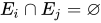
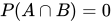
[edit]In probability theory, events E1, E2, ..., En are said to be mutually exclusive if the occurrence of any one of them implies the non-occurrence of the remaining n − 1 events. Therefore, two mutually exclusive events cannot both occur. Formally said, is a set of mutually exclusive events if and only if given any , if then . As a consequence, mutually exclusive events have the property: .[2]


For example, in a standard 52-card deck with two colors it is impossible to draw a card that is both red and a club because clubs are always black. If just one card is drawn from the deck, either a red card (heart or diamond) or a black card (club or spade) will be drawn. When A and B are mutually exclusive, P(A ∪ B) = P(A) + P(B).[3] To find the probability of drawing a red card or a club, for example, add together the probability of drawing a red card and the probability of drawing a club. In a standard 52-card deck, there are twenty-six red cards and thirteen clubs: 26/52 + 13/52 = 39/52 or 3/4.
One would have to draw at least two cards in order to draw both a red card and a club. The probability of doing so in two draws depends on whether the first card drawn was replaced before the second drawing since without replacement there is one fewer card after the first card was drawn. The probabilities of the individual events (red, and club) are multiplied rather than added. The probability of drawing a red and a club in two drawings without replacement is then 26/52 × 13/51 × 2 = 676/2652, or 13/51. With replacement, the probability would be 26/52 × 13/52 × 2 = 676/2704, or 13/52.
In probability theory, the word or allows for the possibility of both events happening. The probability of one or both events occurring is denoted P(A ∪ B) and in general, it equals P(A) + P(B) – P(A ∩ B).[3] Therefore, in the case of drawing a red card or a king, drawing any of a red king, a red non-king, or a black king is considered a success. In a standard 52-card deck, there are twenty-six red cards and four kings, two of which are red, so the probability of drawing a red or a king is 26/52 + 4/52 – 2/52 = 28/52.
Events are collectively exhaustive if all the possibilities for outcomes are exhausted by those possible events, so at least one of those outcomes must occur. The probability that at least one of the events will occur is equal to one.[4] For example, there are theoretically only two possibilities for flipping a coin. Flipping a head and flipping a tail are collectively exhaustive events, and there is a probability of one of flipping either a head or a tail. Events can be both mutually exclusive and collectively exhaustive.[4] In the case of flipping a coin, flipping a head and flipping a tail are also mutually exclusive events. Both outcomes cannot occur for a single trial (i.e., when a coin is flipped only once). The probability of flipping a head and the probability of flipping a tail can be added to yield a probability of 1: 1/2 + 1/2 =1.[5]
Statistics
[edit]In statistics and regression analysis, an independent variable that can take on only two possible values is called a dummy variable. For example, it may take on the value 0 if an observation is of a white subject or 1 if the observation is of a black subject. The two possible categories associated with the two possible values are mutually exclusive, so that no observation falls into more than one category, and the categories are exhaustive, so that every observation falls into some category. Sometimes there are three or more possible categories, which are pairwise mutually exclusive and are collectively exhaustive — for example, under 18 years of age, 18 to 64 years of age, and age 65 or above. In this case a set of dummy variables is constructed, each dummy variable having two mutually exclusive and jointly exhaustive categories — in this example, one dummy variable (called D1) would equal 1 if age is less than 18, and would equal 0 otherwise; a second dummy variable (called D2) would equal 1 if age is in the range 18–64, and 0 otherwise. In this set-up, the dummy variable pairs (D1, D2) can have the values (1,0) (under 18), (0,1) (between 18 and 64), or (0,0) (65 or older) (but not (1,1), which would nonsensically imply that an observed subject is both under 18 and between 18 and 64). Then the dummy variables can be included as independent (explanatory) variables in a regression. The number of dummy variables is always one less than the number of categories: with the two categories black and white there is a single dummy variable to distinguish them, while with the three age categories two dummy variables are needed to distinguish them.
Such qualitative data can also be used for dependent variables. For example, a researcher might want to predict whether someone gets arrested or not, using family income or race, as explanatory variables. Here the variable to be explained is a dummy variable that equals 0 if the observed subject does not get arrested and equals 1 if the subject does get arrested. In such a situation, ordinary least squares (the basic regression technique) is widely seen as inadequate; instead probit regression or logistic regression is used. Further, sometimes there are three or more categories for the dependent variable — for example, no charges, charges, and death sentences. In this case, the multinomial probit or multinomial logit technique is used.
See also
[edit]- Contrariety
- Dichotomy
- Disjoint sets
- Double bind
- Event structure
- Oxymoron
- Synchronicity
- MECE principle (mutually exclusive and collectively exhaustive)
Notes
[edit]- ^ Miller, Scott; Childers, Donald (2012). Probability and Random Processes (Second ed.). Academic Press. p. 8. ISBN 978-0-12-386981-4.
The sample space is the collection or set of 'all possible' distinct (collectively exhaustive and mutually exclusive) outcomes of an experiment.
- ^ intmath.com; Mutually Exclusive Events. Interactive Mathematics. December 28, 2008.
- ^ a b Stats: Probability Rules.
- ^ a b Scott Bierman. A Probability Primer. Carleton College. Pages 3-4.
- ^ "Non-Mutually Exclusive Outcomes. CliffsNotes". Archived from the original on 2009-05-28. Retrieved 2009-07-10.
References
[edit]- Whitlock, Michael C.; Schluter, Dolph (2008). The Analysis of Biological Data. Roberts and Co. ISBN 978-0-9815194-0-1.
- Lind, Douglas A.; Marchal, William G.; Wathen, Samuel A. (2003). Basic Statistics for Business & Economics (4th ed.). Boston: McGraw-Hill. ISBN 0-07-247104-2.


Mutual exclusivity
View on GrokipediaLogic
Propositional logic
In propositional logic, mutually exclusive propositions are defined as a pair of statements that cannot both be true simultaneously; if one is true, the other must necessarily be false.[6] This concept applies to contradictory propositions, where the truth of one directly negates the possibility of the other.[7] For instance, the propositions "It is raining" (denoted as P) and "It is not raining" (denoted as ¬P) exemplify mutual exclusivity, as both cannot hold true under the same conditions. Logically, mutual exclusivity is represented through negation, where a proposition P and its direct negation ¬P form a contradictory pair that excludes joint truth.[6] This relationship is fundamental to the structure of propositional logic, ensuring that propositions maintain consistent truth values without overlap in affirmative states.[7] The mutual exclusivity of such propositions can be illustrated using a truth table, which enumerates all possible truth value assignments:| P | ¬P |
|---|---|
| T | F |
| F | T |
Set-theoretic formulation
In set theory, two sets and are mutually exclusive, also known as disjoint, if they share no common elements, formally expressed as their intersection being the empty set: .[9] This condition ensures that no element belongs to both sets simultaneously, distinguishing mutual exclusivity from cases where sets overlap. Venn diagrams provide a visual representation of this concept. For mutually exclusive sets, the diagram depicts two or more non-overlapping regions, such as separate circles within a universal rectangle, illustrating the absence of intersection; in contrast, non-exclusive sets show overlapping areas where shared elements would reside.[10] The notion extends to a collection or family of sets , where the sets are mutually exclusive if they are pairwise disjoint, meaning for every pair .[11] Such families are fundamental in structuring complex sets without redundancy in membership. Mutually exclusive sets relate closely to partitions of a universal set . A partition is a collection of non-empty, mutually exclusive subsets whose union equals , ensuring every element of belongs to exactly one subset.[12] This structure is used to divide into exhaustive, non-overlapping categories.Probability
Definition in probability theory
In probability theory, two events and defined on a probability space are mutually exclusive if the probability of their intersection is zero, that is, . This condition implies that and cannot occur simultaneously in any outcome of the sample space.[13][14] In contrast, events are not mutually exclusive if , allowing for the possibility that both can happen together with positive probability.[15] For example, when rolling a fair six-sided die, the event of obtaining an even number (2, 4, or 6) and the event of obtaining an odd number (1, 3, or 5) are mutually exclusive, as their intersection is the empty set and thus has probability zero.[16] The concept extends to a finite or countable collection of events (or infinite), which are mutually exclusive if the intersection of any two distinct events has probability zero, i.e., for all .[14] This ensures no overlap across the entire set. Mutual exclusivity ties directly to the axiomatic foundations of probability theory, as established by Andrey Kolmogorov, where it underpins the additivity property for unions of such events within the sigma-algebra of the sample space.[17] In this framework, it reflects the logical prerequisite of disjointness but incorporates measure-theoretic probability.[18]Key properties and formulas
One of the fundamental properties of mutually exclusive events in probability theory is the addition rule, which simplifies the computation of the probability of their union. For two mutually exclusive events and , the probability that at least one occurs is the sum of their individual probabilities:Statistics
Relation to independence
In probability theory, two events and are independent if the probability of their intersection equals the product of their individual probabilities, that is, . This definition permits the joint occurrence of both events, as the occurrence of one does not alter the probability of the other.[28] A key distinction arises with mutually exclusive events, which by definition have [0](/page/0), meaning they cannot occur simultaneously. For non-trivial cases where [0](/page/0) and [0](/page/0), this implies [0](/page/0) \neq P(A) P(B), rendering the events dependent. Specifically, the conditional probability [0](/page/0) \neq P(A), confirming that knowledge of 's occurrence precludes . Consider a fair coin flip: the events "heads" and "tails" are mutually exclusive, as only one can occur, and they are dependent since observing heads sets the probability of tails to 0 (and vice versa). In contrast, the events "heads on the first flip" and "heads on a second, separate flip" are independent, with , and not mutually exclusive.[28] Events cannot satisfy both mutual exclusivity and independence simultaneously except in degenerate cases, such as when or , where the intersection probability is trivially zero but one event has no probabilistic impact.Applications in hypothesis testing
In statistical hypothesis testing, mutual exclusivity is a key assumption in chi-square tests for categorical data, where observations must fall into mutually exclusive categories to ensure accurate estimation of expected frequencies in contingency tables.[29] This assumption prevents double-counting and maintains the integrity of the test statistic, which compares observed and expected frequencies to assess independence or goodness-of-fit.[30] For instance, in a contingency table analyzing customer preferences across product types, categories like "brand A" and "brand B" must be non-overlapping for the test to validly reject or fail to reject the null hypothesis of no association. Mutual exclusivity also underpins variance partitioning in analysis of variance (ANOVA) and multinomial distributions, where data are divided into non-overlapping groups or outcomes to decompose total variance into attributable components.[31] In one-way ANOVA, the independent variable's levels—such as treatment groups—must be mutually exclusive to correctly allocate sums of squares between groups and within groups, enabling F-tests for mean differences.[32] Similarly, multinomial hypothesis tests, often via chi-square goodness-of-fit, model probabilities across exhaustive and mutually exclusive categories, such as testing if observed counts match expected proportions in a multinomial experiment. A practical example arises in market share analysis, where categories like "brand A" versus "all other brands" are treated as mutually exclusive, with shares summing to 100%, allowing chi-square tests to evaluate if observed market allocations deviate significantly from expected benchmarks based on historical data.[33] This setup facilitates inference on competitive positioning without overlap, such as confirming whether brand A's 30% share aligns with a null hypothesis of uniform distribution across five competitors. Violations of mutual exclusivity, such as overlapping categories, can lead to misestimation of variances and inflated Type I error rates in these tests, as the model assumes no individual contributes to multiple cells, potentially biasing p-values and confidence intervals.[34] Researchers must verify category disjointness prior to analysis to avoid such errors, often by recoding data into non-overlapping bins. Software implementations facilitate these applications; in R, thechisq.test() function from the stats package handles contingency tables under the mutual exclusivity assumption for chi-square tests, while in Python, scipy.stats.chi2_contingency() from SciPy performs similar analyses on observed frequencies, implicitly requiring exclusive categories.[35] For multinomial models in ANOVA contexts, functions like aov() in R or statsmodels.anova_lm in Python enforce group exclusivity through factor specifications.
Linguistics
Mutual exclusivity bias in word learning
The mutual exclusivity bias in word learning is a cognitive heuristic observed in young children, whereby they assume that each object or category in the world corresponds to a single, unique word, avoiding overlap in referents between different labels. This bias leads children to interpret novel words as referring to unnamed or unfamiliar entities rather than extending them to already labeled ones, thereby constraining possible meanings during vocabulary acquisition.[2] The theoretical basis for this bias lies in its role as a domain-specific constraint that addresses the "mapping problem" in early language development, where the sheer number of potential word-referent pairings creates immense ambiguity. Ellen Markman proposed mutual exclusivity as a default assumption that children apply to accelerate the induction of word meanings, building on the idea that learners impose structural principles to make sense of linguistic input without exhaustive trial and error. In her seminal work, Markman argued that this constraint is particularly effective for basic-level nouns, helping children partition the world into discrete categories efficiently.[36][2] Mechanistically, the bias functions as a pragmatic inference: upon encountering a new word, children prioritize referents without established labels, effectively ruling out known words as candidates for the novel term. This one-to-one mapping principle operates swiftly, often within a single exposure, enabling "fast mapping" where partial information suffices for initial word assignment. By disfavoring synonymy or polysemy in early stages, the heuristic simplifies hypothesis generation and supports incremental lexicon growth.[37] For example, if a child already knows the word dog for a familiar canine, and an adult introduces the novel label wug in the presence of the dog and an unfamiliar bird-like creature, the child will typically map wug to the unnamed creature rather than the dog, preserving the exclusivity of existing labels. Such scenarios illustrate how the bias guides referential choices in everyday interactions, extending beyond whole objects to attributes or parts when appropriate.[38]Experimental evidence and development
One of the foundational experiments demonstrating the mutual exclusivity bias was conducted by Markman and Wachtel in 1988, using a lookup task with three-year-old children. In this paradigm, children were presented with two objects—one familiar with a known label (e.g., "ball") and one novel—and heard a novel word (e.g., "dax"). The children preferentially mapped the novel word to the unnamed novel object rather than the familiar one, indicating a bias to avoid overlapping labels for the same referent.[37] Subsequent studies have explored the developmental trajectory of this bias, showing it emerges between 16 and 24 months of age. For instance, Halberda (2003) used a preferential looking task and found that 17-month-olds reliably applied mutual exclusivity to map novel labels to novel objects, whereas 14- and 16-month-olds did not, suggesting the bias develops as vocabulary grows to around 100-200 words. The bias peaks in strength around 2 to 3 years, as evidenced by robust performance in disambiguation tasks among preschoolers, where children consistently reject second labels for known objects unless contextual cues suggest otherwise. As children become more linguistically sophisticated, typically by 4 to 5 years, the bias begins to decline, with older children showing greater flexibility in accepting multiple labels for the same object, such as basic-level and superordinate terms (e.g., "dog" and "animal"). This maturation is linked to increased exposure to polysemous words and hierarchical categories, allowing children to override the bias when pragmatic or syntactic information indicates overlap. For example, Liittschwager and Markman (1994) observed that while 2-year-olds strongly adhered to mutual exclusivity, 4-year-olds were more willing to learn subordinate labels for familiar objects when prompted appropriately.[39] Cross-linguistic research supports the universality of the bias, with similar patterns observed in English-speaking children and those acquiring Mandarin Chinese, among other languages. In a study of Mandarin-learning toddlers, the bias facilitated novel word mapping to unnamed objects in disambiguation tasks, mirroring English findings and indicating that it operates independently of specific linguistic typology. This consistency across typologically diverse languages like English (analytic) and Mandarin (isolating with classifiers) suggests an innate or early-emerging cognitive constraint rather than a language-specific heuristic.[40] Critiques of the bias highlight its flexibility rather than rigidity, showing it can be overridden by syntactic cues, such as morphological markers indicating part-whole relations, or by familiarity with the referent. For instance, when novel words are presented in phrases like "a dax for the ball" (implying a part), children as young as 3 years suspend mutual exclusivity and map the word to a feature of the known object instead of a novel one. This adaptability underscores that the bias serves as a default strategy, modulated by contextual evidence to accommodate real-world linguistic complexity. Recent research as of 2024 has questioned whether mutual exclusivity truly represents a cognitive bias or instead arises from pragmatic inferences about speaker focus and informativeness.[41]Other fields
Economics and decision making
In economics and decision making, mutual exclusivity describes a set of alternatives where the selection of one option inherently precludes the selection of the others, often due to limited resources or incompatible objectives. This concept is central to scenarios like investment choices, where decision-makers must rank and choose among competing options to optimize outcomes. For instance, in portfolio management or strategic planning, mutually exclusive alternatives force a trade-off, ensuring that resources are allocated efficiently without overlap.[42] A primary application occurs in capital budgeting, where firms evaluate mutually exclusive projects by computing and comparing their net present values (NPV) to select the option that maximizes shareholder wealth under capital constraints. The NPV method discounts future cash flows to their present value using the cost of capital, and for mutually exclusive projects, the rule is to accept the one with the highest positive NPV, as it indicates the greatest addition to firm value. This approach is preferred over others because it directly aligns with value maximization and avoids scale biases inherent in rate-based metrics. For example, consider two mutually exclusive projects evaluated at a 15% discount rate: Project A with an initial cost of $1,000,000 and cash flows of $350,000 (year 1), $450,000 (year 2), $600,000 (year 3), and $750,000 (year 4), yielding an NPV of $467,937; Project B with an initial cost of $10,000,000 and cash flows of $3,000,000 (year 1), $3,500,000 (year 2), $4,500,000 (year 3), and $5,500,000 (year 4), yielding an NPV of $1,358,664. The firm selects Project B, as its higher NPV justifies the larger investment.[42] When evaluating mutually exclusive projects of differing scales or initial investments, supplementary decision rules like the incremental internal rate of return (IRR) and profitability index provide additional insights for ranking. The incremental IRR measures the return on the differential cash flows between two projects (e.g., the larger minus the smaller), accepting the larger if this rate exceeds the cost of capital, thus resolving conflicts where traditional IRR might mislead due to size differences. The profitability index, calculated as the ratio of NPV to initial investment (or present value of inflows to outflows), ranks options by efficiency, favoring the project with the highest index when capital rationing applies, though NPV remains the ultimate tiebreaker for exclusive choices.[43][42] Behavioral economics introduces nuances through prospect theory, which reveals systematic biases in choices among mutually exclusive options under uncertainty, as individuals weigh losses more heavily than equivalent gains relative to a reference point. In the seminal Asian disease problem, participants faced two equivalent but framed programs to combat a hypothetical outbreak affecting 600 people: a gain-framed sure save of 200 lives led 72% to prefer it over a risky option with expected value equivalence, while a loss-framed sure loss of 400 lives prompted only 22% to choose it, favoring the riskier gamble instead—demonstrating how framing alters preferences for exclusive alternatives and challenges rational choice assumptions in economic decisions.[44] This reflection effect underscores risk-averse behavior in gains and risk-seeking in losses, influencing real-world exclusive choices like investment portfolios under volatility.Computer science and information theory
In computer science, mutual exclusivity is a fundamental concept in concurrent programming, where mutex (short for mutual exclusion) locks ensure that only one thread or process can access a shared resource at a time, preventing race conditions and maintaining data integrity. A mutex operates as a synchronization primitive with locked and unlocked states, allowing atomic lock and unlock operations to protect critical sections of code that manipulate shared variables. For instance, in POSIX threads, functions likepthread_mutex_lock and pthread_mutex_unlock enforce this exclusivity, ensuring that concurrent executions do not interfere with each other. This mechanism is essential in multiprocessor systems and preemptively scheduled environments to avoid inconsistencies, such as interleaved updates to a shared counter.[45][46]
In data structures, mutual exclusivity is modeled through disjoint sets, also known as the union-find structure, which maintains collections of elements partitioned into non-overlapping subsets where no element belongs to more than one set. Each set is represented by a canonical element (parent or root), and operations like union (merging sets) and find (identifying the representative) efficiently manage these exclusive partitions, typically with near-constant time complexity using path compression and union by rank. This structure is widely used in algorithms for graph connectivity, such as Kruskal's minimum spanning tree, to track components without allowing overlaps. The disjoint sets embody mutual exclusivity by ensuring the universe of elements is exhaustively partitioned into mutually exclusive groups.[47][48]
In information theory, mutual exclusivity underpins entropy calculations, as Shannon entropy quantifies uncertainty over a probability distribution of mutually exclusive outcomes in a sample space. For a discrete random variable with mutually exclusive events , the entropy measures the average information content, assuming no overlaps. For independent sources and , the joint entropy mirrors the additivity seen in mutually exclusive events, reflecting zero dependence. In contrast, conditional entropy captures remaining uncertainty in given , equaling for independent sources but reducing below for dependent ones, highlighting how mutual exclusivity relates to but differs from informational dependence.[49][50]
An illustrative application appears in error-correcting codes, where codewords are designed to be mutually exclusive—distinct and separated by a minimum Hamming distance—to enable detection and correction of transmission errors without ambiguity. For example, in Hamming codes, this exclusivity ensures that received words closer to one valid codeword than others can be decoded reliably, preventing overlaps that would mimic erroneous signals. Such designs maintain error-free communication over noisy channels by enforcing non-intersecting spheres around each codeword.[51]
In database systems, mutual exclusivity is enforced through constraints like enumeration (ENUM) types, which restrict column values to a predefined set of mutually exclusive options, ensuring data integrity by preventing invalid or overlapping entries. For instance, an ENUM column for user roles (e.g., 'admin', 'user', 'guest') allows only one selection per record, akin to a single choice from disjoint categories. This is often implemented via CHECK constraints in SQL databases like PostgreSQL, where the constraint verifies values against an exclusive list at insertion or update, supporting applications in categorical data modeling without redundancy.[52]