


Community hub
Recent from talks
Contribute something
Nothing was collected or created yet.
Nectarivore
View on Wikipedia

In zoology, a nectarivore is an animal which derives its energy and nutrient requirements from a diet consisting mainly or exclusively of the sugar-rich nectar produced by flowering plants.
Nectar as a food source presents a number of benefits as well as challenges. It is essentially a solution of (as much as 80%) the simple sugars sucrose, glucose and fructose, which are easily ingested and digested, representing a rich and efficient source of nutrition. This solution is often diluted either by the plant that produces it or by rain falling on a flower and many nectarivores possess adaptations to effectively rid themselves of any excess water ingested this way.
However, nectar is an incomplete source of nutrition. While it does contain proteins and amino acids,[1] these are found in low quantities, and it is severely deficient in minerals and vitamins.[2] Very few organisms consume nectar exclusively over their whole life cycle, either supplementing it with other sources, particularly insects (thus overlapping with insectivores) or only consuming it exclusively for a set period.[3] Many species are nectar robbers or nectar thieves, performing no pollination while still consuming nectar. Many species are both nectar robbers and pollinators, depending on the plant species they encounter.
Nectar is produced by flowering plants to attract pollinators to visit the flowers and transport pollen between them. Flowers often have specialized structures that make the nectar accessible only for animals possessing appropriate morphological structures, and there are numerous examples of coevolution between nectarivores and the flowers they pollinate. For example, hummingbirds and hawkmoths have long narrow beaks that can reach nectar at the bottom of long tubular flowers.[4][5]
The majority of nectar feeders are insects or birds, but instances can also be found in other animal groups.
Insects
[edit]
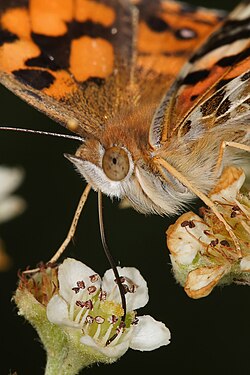
Nectarivory is extremely common in insects. Key families with large proportions of nectarivores include the Coleoptera, Lepidoptera, Diptera, Hymenoptera and Hemiptera. Some, but not all, are also pollinators: others engage in nectar robbing by avoiding the reproductive organs of plants altogether, particularly those with deep corollas, by piercing into the base of the flower to reach the nectary directly, such as carpenter bees and secondarily honey bees (who consume nectar from holes made by others),[6] as well as ants, who frequently consume nectar and pollen where available despite actively inhibiting germination of pollen at the flowers they visit to the detriment of the plant.[7]

Nectar-feeding insects gain enough water from nectar to rarely need to drink, though adult butterflies and moths may engage in puddling in order to obtain dissolved substances not abundant in nectar, particularly salts and amino acids.[8] Some flying nectarivores, particularly larger bees, do not lose enough water by evaporation while on the wing to offset their high intake due to nectar-feeding, as well as water produced metabolically while flying. They must excrete while on the wing to prevent water loading, and may wait at the nest entrance to evaporate off some of their water load before flying out.[9]
Arachnids
[edit]There is evidence that some spiders, though normally thought to be exclusively carnivorous, consume nectar indirectly by consuming nectarivorous insects, and/or directly from flowers. This behavior is thought to be more common among spiders that live among foliage. A few make nectar their primary food source, such as Bagheera kiplingi, a member of the jumping spiders,[10][11][12] while others such as the crab spiders, feed more rarely and opportunistically. None of the spider groups observed feeding on nectar build webs, they are all wandering species.[13]
Birds
[edit]
Nectar-feeding is widespread among birds, but no species consumes nectar exclusively. Most combine it with insectivory for a mixed diet. Of particular interest are three lineages of specialized nectarivorous birds: the hummingbirds (Trochilidae), sunbirds (Nectariniidae) and honeyeaters (Meliphagidae). These groups have adapted to permit a nectar-central diet, showing higher activity of digestive enzymes which break down sugars, higher rates of absorption of sugars, and altered kidney function. To maintain flight a bird must rapidly excrete much of the water content of the nectar it consumes. A hummingbird's kidneys are capable of rapidly producing large quantities of hyposmotic urine i.e. urine containing a lower concentration of dissolved substances than the blood.[14] Some other bird groups have one or more similar specializations – for instance, the Lories, one group of Australasian parrots within the larger parrot family Psittacidae, possess similar digestive modifications.[15] These are examples of parallel evolution. The Hawaiian honeycreepers have several species adapted to feed on nectar. The Hawaiian tree Metrosideros polymorpha is heavily dependant on the pollination of the more or less nectarivorous honeycreepers.[16]
Mammals
[edit].jpg)
Many species of bat feed on nectar, their lifestyle similar to that of nectarivorous birds. In the Americas there is significant overlap between flowers pollinated by bats and hummingbirds – both need similarly-composed nectar to keep up energy-intensive hovering flight. In this part of the world there is particularly close association between some species of columnar cacti and bat species, who provide pollination in exchange for nectar with composition matching their nutritional needs.[17] Nectarivorous bats might be at particular risk of extinction due to their reliance on particular species of flowering plants.[18]
A single marsupial species, the honey possum, feeds on nectar and pollen exclusively. It raises fewer young which grow more slowly than other marsupials of its size, because of the time-consuming effort of nectar-drinking from many flowers to support itself. It may spend periods in deep sleep to reduce its need for food, and shows the typical nectarivore adaptations for excess water-removal.[19]
See also
[edit]References
[edit]- ^ Nepi M, Soligo C, Nocentini D, Abate M, Guarnieri M, Cai G, Bini L, Puglia M, Bianchi L, Pacini E (2012). "Amino acids and protein profile in floral nectar: Much more than a simple reward". Flora. 207 (7): 475–481. Bibcode:2012FMDFE.207..475N. doi:10.1016/j.flora.2012.06.002.
- ^ Gartrell B (2000). "The Nutritional, Morphologic, and Physiologic Bases of Nectarivory in Australian Birds". Journal of Avian Medicine and Surgery. 14 (2): 85–94. doi:10.1647/1082-6742(2000)014[0085:TNMAPB]2.0.CO;2. S2CID 86118478.
- ^ Nicolson S, Fleming P (2014). "Drinking problems on a 'simple' diet: physiological convergence in nectar-feeding birds". J Exp Biol. 217 (7): 1015–23. Bibcode:2014JExpB.217.1015N. doi:10.1242/jeb.054387. hdl:2263/39829. PMID 24671960.
- ^ Wiens, John A. (1992). The Ecology of Bird Communities: Processes and variations. Cambridge University Press. p. 336. ISBN 9780521426350.
- ^ Richard, A.J. (1997). Plant breeding systems (Second ed.). Chapman & Hall. ISBN 978-0-412-57440-5.
- ^ Dedej S, Delaplane K (2005). "Net energetic advantage drives honey bees (Apis mellifera) to nectar larceny in Vaccinium ashei Reade". Behavioral Ecology and Sociobiology. 57 (4): 398–403. Bibcode:2005BEcoS..57..398D. doi:10.1007/s00265-004-0852-z. S2CID 10927900.
- ^ Hull D, Beattie A (1988). "Adverse effects on pollen exposed to Atta texana and other North American ants: implications for ant pollination". Oecologia. 75 (1): 153–155. Bibcode:1988Oecol..75..153H. doi:10.1007/BF00378829. PMID 28311849. S2CID 20674424.
- ^ Beck J, Mahlenberg E, Fiedler K (1999). "Mud-puddling behavior in tropical butterflies: in search of proteins or minerals?". Oecologia. 119 (1): 140–148. Bibcode:1999Oecol.119..140B. doi:10.1007/s004420050770. PMID 28308154. S2CID 20103546.
- ^ Nicolson S (2009). "Water homeostasis in bees, with the emphasis on sociality". J Exp Biol. 212 (3): 429–434. Bibcode:2009JExpB.212..429N. doi:10.1242/jeb.022343. hdl:2263/13697. PMID 19151218.
- ^ Mihai, Andrei (Oct 13, 2009). "First (mainly) vegetarian spider found". ZME Science.
- ^ Jackson R, Pollard S, Nelson X, Edwards G, Barrion A (2001). "Jumping spiders (Araneae: Salticidae) that feed on nectar". J. Zool. 255 (1): 1469–7998. doi:10.1017/S095283690100108X.
- ^ Meehan J, Olson E, Reudink M, Kyser T, Curry R (2009). "Herbivory in a spider through exploitation of an ant–plant mutualism". Curr. Biol. 19 (19): 892–893. Bibcode:2009CBio...19.R892M. doi:10.1016/j.cub.2009.08.049. PMID 19825348. S2CID 27885893.
- ^ Taylor R, Pfannenstiel R (2008). "Nectar Feeding by Wandering Spiders on Cotton Plants". Environ. Entomol. 37 (4): 996–1002. doi:10.1093/ee/37.4.996. PMID 18801266.
- ^ Nicolson S, Fleming P (2014). "Drinking problems on a 'simple' diet: physiological convergence in nectar-feeding birds" (PDF). J Exp Biol. 217 (7): 1015–23. Bibcode:2014JExpB.217.1015N. doi:10.1242/jeb.054387. PMID 24671960. S2CID 18006942.
- ^ Schweizer M, Güntert M, Seehausen O, Leuenberger C, Hertwig S (2014). "Parallel adaptations to nectarivory in parrots, key innovations and the diversification of the Loriinae". Ecol Evol. 4 (14): 2045–7758. Bibcode:2014EcoEv...4.2867S. doi:10.1002/ece3.1131. PMC 4130445. PMID 25165525.
- ^ Pratt, H. Douglas; Conant, Shelia (2005-05-12). The Hawaiian Honeycreepers: Drepanidinae. OUP Oxford. ISBN 978-0-19-854653-5.
- ^ Nassar J, Ramirez N, Linares O (1997). "Comparative pollination biology of Venezuelan columnar cacti and the role of nectar-feeding bats in their sexual reproduction". Am. J. Bot. 84 (7): 918–927. doi:10.2307/2446282. JSTOR 2446282. PMID 21708646.
- ^ Arita H, Santos-Del-Prado K (1999). "Conservation Biology of Nectar-Feeding Bats in Mexico". J. Mammal. 80 (1): 31–41. doi:10.2307/1383205. JSTOR 1383205.
- ^ Richardson K, Wooller R, Collins B (1986). "Adaptations to a diet of nectar and pollen in the marsupial Tarsipes rostratus (Marsupialia: Tarsipedidae)". J. Zool. 208 (2): 285–297. doi:10.1111/j.1469-7998.1986.tb01515.x.
| Carnivores |
|  | ||||||
|---|---|---|---|---|---|---|---|---|
| Herbivores | ||||||||
| Cellular | ||||||||
| Others | ||||||||
| Methods | ||||||||

Nectarivore
View on GrokipediaDefinition and Characteristics
Definition
A nectarivore is an animal that derives a significant portion, often the primary source, of its energy and nutritional requirements from nectar, a sugar-rich fluid secreted by floral nectaries as a reward for pollinators.[9] This dietary specialization distinguishes nectarivory from more generalist feeding strategies, emphasizing reliance on nectar's high-carbohydrate content for activities such as flight and thermoregulation.[10] Nectar typically comprises 50–80% water by weight, with sugars accounting for 10–70% (w/w) and forming 80–90% of the dry matter, primarily as sucrose, glucose, and fructose in varying ratios depending on plant species and environmental factors.[9] It also includes trace amounts of amino acids (0.19–12.7 mM total, encompassing all 20 proteinogenic types, often dominated by non-essential ones like proline and glutamine), as well as secondary compounds such as phenolics, alkaloids, and flavonoids.[10] While these sugars serve as an efficient energy source, nectar generally lacks substantial proteins and lipids, which occur only in low concentrations and are not primary nutritional contributors.[9] Unlike pollinivores, which primarily consume pollen for protein, nectarivores focus specifically on nectar intake, without necessarily exploiting pollen or other floral structures.[11] The concept of nectarivory emerged in 19th-century entomology and ornithology, with foundational observations by Charles Darwin on the mutualistic pollination systems where nectar rewards attract and sustain animal visitors.[12] The term "nectarivore" itself was coined later, with its earliest recorded use in 1967 within ecological literature.[13]Adaptations
Nectarivores exhibit a suite of morphological adaptations that facilitate access to nectar hidden within floral structures. Insects often possess elongated proboscises, which function as siphons to draw nectar from deep corollas, as seen in long-proboscid flies where the proboscis length corresponds to specific flower tube dimensions for efficient feeding.[14] In birds and mammals, tubular bills and extensible tongues enable precise probing; for instance, the hummingbird tongue features a reversible, forked tip that traps nectar through elastic expansion and contraction during lapping, allowing uptake without reliance on capillary action.[15][16] Physiological adaptations address the challenges of nectar's high water content and sugar composition. Specialized kidneys in birds like hummingbirds permit rapid excretion of dilute urine, processing 3–5 times their body weight in fluid daily to manage osmotic loads from nectar intake.[17] Gut microbiomes in species such as sunbirds contribute to detoxifying secondary metabolites in nectar, enhancing nutrient absorption.[18] Behavioral adaptations optimize energy acquisition while minimizing risks. Hovering flight in birds allows stationary access to pendant flowers, reducing the need to perch and enabling rapid visits to multiple blooms.[19] Nocturnal feeding in bats synchronizes with flower anthesis peaks at night, exploiting less competitive resources under cover of darkness.[20] Certain nectarivores employ nectar-robbing tactics, such as piercing corolla bases to extract rewards without contacting reproductive parts, thereby avoiding pollination duties while securing food.[21] Nectar’s low protein content poses nutritional challenges, prompting supplementation strategies like pollen consumption in birds to meet amino acid needs during breeding seasons.[17] This diet also demands high metabolic rates for energy processing; hummingbirds, for example, sustain heart rates up to 1,200 beats per minute to fuel rapid digestion and activity. Convergent evolution underscores these adaptations across taxa, with unrelated groups developing analogous structures for similar ecological niches. Sunbirds and hummingbirds, despite phylogenetic distance, share elongated bills and brush-tipped tongues for nectar extraction, reflecting parallel responses to selective pressures from tubular flowers.[22]Ecological and Evolutionary Aspects
Ecological Role
Nectarivores play a central role in pollination mutualism, where plants offer nectar as a reward to attract these animals, which in turn facilitate pollen transfer between flowers. This interaction is essential for the reproduction of many flowering plants, with animal pollinators, including nectarivores, responsible for approximately 90% of angiosperm species globally.[23] In some habitats, such as tropical forests, this dependency exceeds 94%, underscoring the disproportionate influence of nectarivores on plant reproduction in biodiversity hotspots.[24] Through their pollination activities, nectarivores provide key ecosystem services that bolster plant diversity and support agricultural productivity. They maintain floral communities by enabling gene flow and preventing inbreeding, which enhances overall biodiversity and resilience in ecosystems. In agriculture, nectarivores contribute to the pollination of crops like almonds, where managed and wild pollinators ensure fruit set and yield stability, accounting for a significant portion of global food production volume—up to 35% for animal-pollinated crops.[25][26][27] Additionally, nectarivorous birds serve as indicators of ecosystem health, as their populations are highly sensitive to habitat alterations, signaling broader biodiversity declines.[28] Nectarivores engage in various interactions that shape community dynamics, including competition for limited nectar resources among species, which can influence foraging behaviors and resource partitioning. Predation risks also arise at floral sites, such as spiders ambushing nectar-feeding insects or birds at flowers, potentially disrupting pollination efficiency. Indirectly, nectarivores contribute to seed dispersal by promoting fruit production through successful pollination, as pollinated plants develop fruits that attract frugivores for seed transport.[29][30][31] Habitat fragmentation and pesticide use pose major threats to nectarivores, reducing available nectar sources and directly harming populations through exposure and loss of foraging areas. In tropical ecosystems, where nectarivores drive over 90% of plant reproduction, these pressures exacerbate declines, threatening both floral diversity and associated food webs. Conservation efforts emphasize protecting connected habitats to sustain nectarivore services. Recent post-2020 research highlights eco-evolutionary feedbacks, where herbivores indirectly boost nectar production by altering pollinator dynamics and plant fitness trade-offs.[32][33][24][34]Evolutionary History
Nectarivory first emerged during the Middle-Late Triassic, approximately 240–201 million years ago, associated with gymnosperm 'flowers,' with significant diversification during the Cretaceous period (~145–66 million years ago) coinciding with the rapid radiation of angiosperms that provided new floral resources for animal exploitation.[35] This dietary specialization initially developed among insects, with early evidence from pollen-feeding beetles transitioning to nectar consumption as gymnosperm-associated lineages shifted to angiosperm hosts around the mid-Cretaceous.[36] Fossil records indicate that insect nectarivores, such as long-proboscid flies, predated vertebrate adopters by millions of years, leveraging specialized mouthparts for accessing nectar in primitive flowers.[37] The evolution of nectarivory has been tightly linked to coevolutionary dynamics between animals and plants, where flower morphology adapted to match pollinator traits, such as the development of long-tubed corollas suited to specialized feeders with elongated proboscises or bills.[38] Concurrently, nectar chemistry evolved to selectively attract or deter specific taxa, incorporating sugars, amino acids, and secondary metabolites that align with the digestive capabilities of target pollinators while discouraging non-pollinators.[10] For instance, sucrose-dominant nectars in many hummingbird-pollinated flowers reflect reciprocal adaptations in avian sucrase enzyme activity, exemplifying convergent coevolution across distant lineages.[39] Convergent evolution has driven independent origins of nectarivory in multiple vertebrate groups, including birds like New World hummingbirds (Trochilidae) and Old World sunbirds (Nectariniidae), which separately developed hovering flight and tubular tongues despite phylogenetic distance.[40] Similarly, among mammals, nectar-feeding bats (e.g., glossophagine species) and marsupials such as the honey possum (Tarsipes rostratus) exhibit parallel traits like elongated, brush-tipped tongues and enhanced nectar-processing enzymes, arising from unrelated ancestral diets.[41] In parrots, parallel adaptations to nectarivory, including bill shape and gut morphology, show strong phenotype-environment correlations that facilitated diversification in lories and lorikeets.[40] Diversification of nectarivory in insects involved multiple independent transitions, such as from carnivorous ancestors in beetles, where mid-Cretaceous fossils reveal mouthparts specialized for both pollen and nectar intake, marking a shift toward angiosperm reliance.[42] Fossil evidence from Burmese amber further documents ancient nectar-feeding flies with siphonate proboscides dating back to the Early Cretaceous, underscoring repeated innovations in insect lineages during the angiosperm terrestrial revolution.[35] Recent research from 2024 highlights convergent evolution of nectaries in ferns, which independently recruited ant bodyguards via sugary rewards during the Cretaceous, paralleling angiosperm strategies and expanding plant-animal mutualisms beyond flowers.[43] Eco-evolutionary models further demonstrate how herbivores indirectly shape nectar evolution by suppressing plant growth, thereby selecting for increased nectar production to bolster pollinator attraction and defense.[44] These insights, drawn from phylogenetic and dynamic simulations, reveal ongoing feedbacks that refine nectar composition in response to multi-trophic pressures.[45]Nectarivores by Taxonomic Group
Insects
Insects constitute the most diverse group of nectarivores among animals, encompassing the vast majority of known pollinators and nectar-feeding species, with estimates exceeding 200,000 species primarily within this class.[46] These insects play a critical ecological role, contributing to the pollination of approximately 35% of global food crops through their foraging behaviors.[47] The primary orders engaging in nectarivory include Hymenoptera, Lepidoptera, Diptera, and Coleoptera, each exhibiting specialized mouthpart adaptations that facilitate nectar extraction from flowers.[48] In the order Hymenoptera, bees are prominent nectarivores, often equipped with pollen baskets (corbiculae) on their hind legs for simultaneous collection of nectar and pollen, enhancing their efficiency as pollinators.[49] Lepidopterans, such as butterflies and moths, possess a coiled proboscis that uncoils to access nectar, with lengths reaching up to 28 cm in some species to exploit deep floral tubes.[50] Dipterans, or flies, typically feature short, lapping mouthparts suited for consuming nectar from shallow or exposed flowers, allowing them to act as generalist feeders across diverse plant communities.[51] Coleopterans, including beetles, rely on chewing mandibles modified with cutting edges and teeth to access nectar, often feeding on both floral rewards and plant tissues in a less specialized manner.[52] Notable examples illustrate the behavioral diversity of insect nectarivory. The eastern carpenter bee (Xylocopa virginica) exemplifies generalist feeding, targeting a wide range of flowers for nectar while employing powerful mandibles to pierce corollas.[53] In Lepidoptera, the monarch butterfly (Danaus plexippus) depends heavily on nectar to fuel its long-distance migration, converting sugars into lipid reserves essential for the journey spanning thousands of kilometers.[54] Hawkmoths of the family Sphingidae demonstrate nocturnal pollination strategies, hovering to feed on nectar from pale, fragrant flowers using an elongated proboscis, thereby facilitating reproduction in night-blooming plants.[55] Unique aspects of insect nectarivory include nectar-robbing behaviors, where individuals like carpenter bees pierce the base of flowers to extract nectar without contacting reproductive structures, thus bypassing pollination.[21] Social species within Hymenoptera, such as honeybees, process collected nectar through regurgitation and enzymatic activity to produce honey, a concentrated energy store for colony sustenance.[56] Nectarivory has evolved independently across insect lineages, often representing a dietary shift from ancestral habits like predation or foliage consumption to exploit floral resources.[57]Arachnids
Nectarivory among arachnids is predominantly documented in spiders (order Araneae), where it supplements a primarily carnivorous diet by providing carbohydrates, amino acids, and hydration. This behavior has been observed in over 60 spider species across 10 families, with floral and extrafloral nectar being the most common plant-derived food source. Unlike the specialized nectarivory seen in many insects, spider nectar feeding is typically opportunistic, aiding survival during prey shortages or in resource-poor habitats such as arid regions.[58] A notable example is the jumping spider Bagheera kiplingi (family Salticidae), which exhibits an extreme shift toward herbivory; in Mexican populations, plant materials including extrafloral nectar from Vachellia trees and Beltian bodies constitute over 90% of its diet. Other salticids, such as Phidippus and Menemerus species, regularly visit flowers to imbibe nectar, with laboratory tests confirming this capability in 90 species and field observations in at least 31. Crab spiders (family Thomisidae), including genera like Misumena and Thomisus, position themselves on flowers to ambush pollinators but also directly consume nectar and pollen during periods of low prey availability, enhancing their endurance on inflorescences.[59][60] Spiders access nectar primarily through direct licking with their chelicerae, often pressing mouthparts against nectaries or using palps and forelegs to extract droplets, as observed in salticids visiting up to 80 flowers per hour guided by olfactory cues. Indirect nectar intake occurs via predation on nectar-laden insects like bees or flies, though this is incidental to their carnivorous habits. In arid environments, nectar's high water content (often 50-80%) provides essential hydration, allowing species like wandering hunters in the family Anyphaenidae to persist in dry habitats. This dietary flexibility underscores broader opportunism in spiders, enabling physiological adaptations to variable food resources without a full transition from carnivory.[61][58]Birds
Avian nectarivores represent a diverse group of birds specialized for feeding on floral nectar, primarily within several passerine and non-passerine families. The most prominent is the Trochilidae, or hummingbirds, comprising over 360 species exclusively in the Americas, from Alaska to Tierra del Fuego, where they dominate nectar-feeding niches through hovering flight and long bills adapted for tubular flowers.[62] In the Old World, the Nectariniidae (sunbirds) are key, with around 140 species distributed across sub-Saharan Africa, southern Asia, and parts of Southeast Asia, featuring slender, curved bills for accessing deep corollas. The Meliphagidae (honeyeaters), with approximately 180 species, prevail in Australasia, including Australia, New Guinea, and Pacific islands, often perching to probe blossoms with brush-tipped tongues. Additionally, certain members of the Psittacidae (parrots), particularly the Loriinae subfamily of lorikeets, have independently evolved nectarivory, with about 50 species in Australasia and nearby regions exhibiting specialized papillae-covered tongues for lapping nectar and pollen.[63][64][65] Representative examples illustrate these adaptations in action. The ruby-throated hummingbird (Archilochus colubris), common in eastern North America, visits up to 2,000 flowers daily to meet its energy demands, pollinating plants like bee balm and cardinal flower in the process.[66] In Australia, the New Holland honeyeater (Phylidonyris novaehollandiae) forages aggressively on native Proteaceae flowers such as kangaroo paw, using its tubular tongue to extract nectar while also consuming insects for protein. The rainbow lorikeet (Trichoglossus moluccanus), widespread in eastern Australia and introduced elsewhere, employs its unique brush-like tongue with projecting papillae to collect nectar and pollen from eucalypts and other trees, often in noisy flocks.[67] These birds exhibit unique behavioral and physiological traits suited to nectar dependence. Many defend nectar-rich patches territorially, with hummingbirds engaging in aerial chases to monopolize feeders or flower clusters, ensuring exclusive access to high-energy resources. Their metabolic rates are extraordinarily high; hummingbirds, for instance, must consume nectar equivalent to half their body weight daily to offset overnight losses of up to 10% of mass during torpor, a state that reduces energy expenditure. Parallel evolution is evident between New World hummingbirds and Old World sunbirds or honeyeaters, with convergent traits like extensible tongues and specialized bills arising independently to exploit similar floral resources.[68][69]Mammals
Mammalian nectarivores are primarily found among bats in the order Chiroptera and certain marsupials in the infraclass Marsupialia, with bats representing the most diverse and specialized group. In Chiroptera, nectar-feeding species are concentrated in the subfamily Glossophaginae within the family Phyllostomidae, predominantly in the Neotropics, where they exhibit morphological and behavioral adaptations for nocturnal foraging.[70][71] Among marsupials, the honey possum (Tarsipes rostratus) is an obligate nectarivore endemic to southwestern Australia, while some pygmy possums in the genus Cercartetus opportunistically consume nectar and pollen.[72][73] These mammals play crucial ecological roles as pollinators, supplementing their high-energy nectar diets with pollen and insects to meet nutritional needs.[74] Nectarivorous bats, such as those in Glossophaginae, rely on echolocation to locate flowers in the dark, emitting high-frequency calls to detect nectar sources from distances up to several meters.[74] They possess elongated snouts and tongues fringed with hair-like papillae that function like mops to extract nectar efficiently from deep corollas, enhancing feeding rates in sympatric species.[75][76] A prominent example is the lesser long-nosed bat (Leptonycteris yerbabuenae), a migratory species that travels over 1,000 kilometers annually from Mexico to the southwestern United States, pollinating columnar cacti and agaves along a seasonal nectar corridor.[77][78] In contrast, the grey-headed flying fox (Pteropus poliocephalus), a pteropodid bat from eastern Australia, combines nectar and pollen from eucalypts with fruit in its diet, using its brush-tipped tongue to lap up floral rewards while roosting in large colonies.[79][80] Among marsupials, the honey possum (Tarsipes rostratus) is uniquely adapted as the only non-flying mammal with an exclusive diet of nectar and pollen, featuring a long, extensible tongue with a brush tip for collecting rewards from diverse proteaceous and myrtaceous flowers, and specialized kidneys to handle high water intake.[72][81] Pygmy possums, such as Cercartetus species, are opportunistic feeders that prioritize nectar from eucalypts and banksias when available, supplementing with insects for protein, and use torpor to conserve energy during nectar shortages.[73][82] These adaptations allow them to thrive in heathlands and woodlands, though their small size (10-40 grams) imposes high metabolic demands. Certain primates, particularly lemurs in Madagascar, also engage in nectarivory. Species like the black-and-white ruffed lemur (Varecia variegata) feed on nectar from large flowers such as the traveler's palm (Ravenala madagascariensis), using long tongues to access rewards without damaging blooms, thereby serving as important pollinators. This behavior supplements their primarily frugivorous diet and highlights convergent evolution in mammalian nectar feeding.[83] Conservation challenges for mammalian nectarivores are acute, driven by habitat loss and degradation of nectar-producing plants. Over 20 species of nectar-feeding bats are classified as endangered or vulnerable globally, primarily due to deforestation and agricultural expansion reducing floral resources in the Neotropics and Australasia.[84][74] These bats pollinate more than 300 plant species, including economically vital crops like agave (used for tequila production) and mango, underscoring their irreplaceable ecosystem service.[85] The honey possum faces habitat fragmentation in southwestern Australia, though not yet listed as endangered, its populations are declining from urban development and altered fire regimes.[86] Efforts to mitigate include habitat restoration and protected corridors to sustain these vital pollinators.[87]References
- https://en.wiktionary.org/wiki/pollinivore