


Community hub
Recent from talks
Contribute something
Nothing was collected or created yet.
Nokia 6030
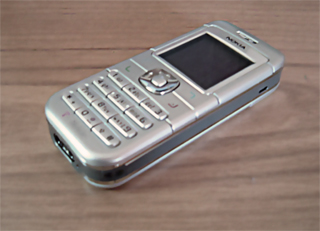
View on Wikipedia Nokia 6030B (Silver) | |
| Manufacturer | Nokia |
|---|---|
| Predecessor | Nokia 6010 |
| Successor | Nokia 6070 |
| Compatible networks | GSM 900/1800 GSM 850/1900 |
| Dimensions | 104 mm (4.1 in) H 44 mm (1.7 in) W 18 mm (0.71 in) D |
| Weight | 90 g (3.2 oz) |
| Display | 128×128 px 65K colors |
| Connectivity | FBus |
The Nokia 6030, introduced in Q1 2005,[1] is a GSM dual band handset operating on frequencies 900 and 1800 MHz (850 and 1900 MHz in the North American model), with automatic switching between frequencies. It is small in size with dimensions of 104 x 44 x 18 mm and weighs 90 grams. It also has 3 MB Shared Memory.
Its key features are:
- High-resolution color display with up to 65,536 colors (128 x 128 pixels)
- Multimedia messaging (MMS)
- GPRS and WAP 2.0 services
- Nokia Series 40 Theme compatibility
- FM radio (with supported Nokia headset)
- MIDI audio playback (up to 16 channels)
- Address book, calendar, and reminders
- Java ME compatibility
- Xpress-on covers
The 6030 supports GPRS up to 40 kbit/s speed and Wireless Application Protocol (WAP) 2.0 services. An XHTML browser is integrated, allowing for WAP web capability. The phone book can hold up to 300 entries and its calendar can hold up to 500 entries. It has been proven to be a very durable phone, with users reporting dropping it several times, throwing it across a room, dropping it into water, etc. with the phone still running afterward.[2]
On the bottom panel of the Nokia 6030 is a 4-pin connector similar to a USB port, a bit smaller than normal 4-pin mini-USB connectors, but it is an FBus port, named the EZ Flash port, and the data cable for this port is not supplied for end-users. There is no official data cable connection for 6030 end-user.
External links
[edit]
References
[edit]Nokia-branded mobile devices | |||
|---|---|---|---|
| 1000 series | |||
| 2000 series | |||
| 3000 series | |||
| 5000 series | |||
| 6000 series |
| ||
| 7000 series | |||
| 8000 series | |||
| 9000 series (Communicator) | |||
| 3-digit series (feature phone) | |||
| Asha series |
| ||
| Cseries | |||
| Eseries | |||
| Nseries |
| ||
| Xseries | |||
| 3-digit series (Symbian phone) | |||
| Lumia |
| ||
| Internet tablet | |||
| N-Gage | |||
| X family | |||
| Android smartphones2 | |||
| Originals2 | |||
| C series2 | |||
| G series2 | |||
| T series2 | |||
| X series2 | |||
| Other | |||

Nokia 6030
View on GrokipediaDevelopment and launch
Announcement
The Nokia 6030 was officially announced on March 1, 2005, as part of Nokia's effort to bolster its mid-range portfolio with three new voice-centric handsets, including the 6230i and 6021.[5][6] Internally designated as type RM-74 and codenamed Yangtze, the device was positioned as a lower mid-range feature phone targeted at domestic and leisure users prioritizing simplicity and essential communication.[7][8] In the initial press release, Nokia highlighted the 6030's affordability, with an estimated retail price of 150 euros (excluding taxes and subsidies), alongside its dual-band GSM support for 900/1800 MHz frequencies to ensure reliable voice calls and basic data services.[5] Key features emphasized included a color screen for viewing multimedia messages, built-in FM radio for entertainment, and simple tools like an alarm, calendar, personalized wallpapers, and ring tones, all designed to deliver reliable, ergonomic everyday functionality without complexity.[5][6] This announcement aligned with Nokia's broader 2005 strategy to expand its Series 40 platform, which had gained traction for its responsive and user-friendly interface in budget-conscious markets, by introducing a lineup of accessible devices like the 6030 to cater to consumers seeking value-driven mobility post the platform's growing adoption.[9][10]Release and availability
The Nokia 6030 was announced in the first quarter of 2005, with shipments beginning in the third quarter of that year.[3][1] Widespread availability began in Europe and other GSM-supporting regions during the third quarter of 2005, targeting markets in Asia and Africa as well.[3][8] Priced at approximately €150 unsubsidized in Europe, the device was positioned as an affordable entry-level option for basic mobile communication.[11] It supported GSM 900/1800 bands primarily for these international markets, with a North American variant known as the Nokia 6030b (type RM-75) adapted for 850/1900 MHz frequencies.[3][7] In the United States, availability began in early 2006 through carriers like AT&T, where the black model was offered for $19.99 retail or free with a two-year service contract.[2][4] The phone was available in standard black and champagne color options, featuring user-changeable faceplates for customization.[3][2] Production and sales were eventually discontinued as Nokia transitioned to more advanced models in the late 2000s.[3]Design
Physical characteristics
The Nokia 6030 features a compact bar form factor, measuring 104 x 44 x 18 mm and weighing 90 grams, making it highly portable for daily use.[3][1] This slim design, with rounded corners, contributes to its ergonomic profile, allowing for comfortable one-handed operation.[4] The device employs a sturdy plastic construction, emphasizing durability for everyday handling without advanced certifications like an IP rating.[4] It includes interchangeable color covers, enabling users to customize the exterior for personalization and easy maintenance.[1][2] The numeric keypad is raised for tactile feedback, paired with dedicated soft keys and navigation buttons that facilitate quick access to functions.[4] Available in black as the standard color— including variants for carriers like AT&T—and champagne (also referred to as silver in some markets), the Nokia 6030 offers subtle aesthetic options suited to its minimalist design.[3][4] This build prioritizes practicality and portability over ruggedness, aligning with its entry-level positioning in the mid-2000s mobile market.[12]User interface elements
The Nokia 6030 features a 1.5-inch STN LCD display with a resolution of 128 x 128 pixels, supporting 65,536 colors for vibrant visuals.[3] This compact screen provides clear readability for menus and messages, enhanced by adjustable display settings such as color schemes and power-saving modes.[13] User input is facilitated by a numeric keypad supporting T9 predictive text entry, which allows efficient typing of messages by predicting words from key presses, alongside two soft keys for contextual menu options and a five-way navigation joystick for scrolling and selection.[4][13] The keypad includes dedicated keys for quick access to functions like the menu and profiles, with a keyguard to prevent accidental presses. The device employs an internal antenna, integrated into the design for reliable signal reception without an external port.[2] The menu system runs on the Series 40 user interface, presenting an icon-based grid layout—typically a 3x3 arrangement—for straightforward access to features, with options to switch between list and grid views for personalized navigation.[12] Users can customize themes to alter the interface's appearance, including colors and layouts, while simple folder-based navigation organizes submenus hierarchically for intuitive browsing.[13] Accessibility is supported through adjustable font sizes in messages and menus to improve readability, as well as vibration feedback configurable in tone profiles for alerts, aiding users with hearing impairments or in silent environments.[13]Features and software
Core functionalities
The Nokia 6030 ran on the Nokia Series 40 platform, a proprietary operating system designed for entry-level feature phones in the mid-2000s, providing a straightforward menu-driven interface for basic communication and productivity tasks.[3] This version of Series 40 supported essential software features without advanced multitasking, focusing on reliability for voice calls, text messaging, and simple organization tools.[3] The phone's address book allowed storage of 250 contacts in phone memory, with each entry accommodating up to five phone numbers, an email address, and a URL, enabling users to manage personal and professional contacts efficiently across phone memory and the SIM card.[4][3] Messaging capabilities included support for SMS, limited to 160 characters per message with options for multipart transmission and templates, as well as MMS for sending multimedia content up to 100 KB, including text, images, and sounds in multi-slide formats.[13] Calling features encompassed a built-in speakerphone for hands-free use, call waiting to handle incoming calls during active conversations (as a network service), and voice dialing for quick activation of contacts by spoken name.[3][14] For organization, the device offered an alarm clock with customizable repeat and snooze settings, a basic calculator supporting arithmetic operations and currency conversion, a calendar for scheduling appointments and birthdays with reminder alarms, and a to-do list for task management integrated within the notes application.[4][13] Additionally, Java support via MIDP 2.0 enabled the installation of simple applications and games, including the pre-installed Snake II, enhancing basic entertainment and utility options without requiring external downloads for core titles.[2][14]Multimedia and connectivity
The Nokia 6030 supported basic multimedia capabilities centered on audio and messaging, without advanced features like a built-in camera or video recording.[2] It included polyphonic ringtones with up to 16 voices, alongside support for downloadable MP3 ringtones and vibration alerts for incoming calls and messages.[1] The device also featured a built-in FM radio, which allowed users to tune and save up to 20 stations in 0.05 MHz steps, though it required a compatible headset to function as an antenna for reception; audio output could be routed to the loudspeaker or headset.[13] For messaging, the phone enabled Multimedia Messaging Service (MMS) to send and receive simple content such as text, basic images, and short audio clips, with a maximum message size of 100 KB; multiple slides could be added with adjustable timing between them.[2][13] Web access was provided through a WAP 2.0 browser supporting XHTML and WML pages over TCP/IP protocols with HTTP and SSL security, including features like bookmarks, cache management, and cookie support for enhanced navigation.[13] Connectivity options were limited to entry-level mobile data services, with GPRS Class 6 support enabling packet-switched data transfer at speeds up to 40 kbps for tasks like MMS delivery and web browsing; users could configure the connection to remain always online or activate only when needed.[2] The device lacked Bluetooth and infrared (IrDA) for wireless data transfer, relying instead on a proprietary connector for wired enhancements like the Nokia Headset HS-7, which included remote controls for calls and audio.[2][13]Technical specifications
Hardware components
The Nokia 6030 is equipped with a single-core ARM7TDMI processor running at 50 MHz, utilizing Nokia's DCT4 hardware platform and UPP4M chipset, which was standard for entry-level devices on the Series 40 operating system. It includes 2 MB of RAM.[7] It provides 3 MB of internal shared memory, which is allocated across applications, messages, contacts, and other user data, with no option for expansion via a memory card slot.[3] After deducting overhead for the operating system and pre-installed software, approximately 2 MB remains available for user content such as photos, notes, and downloaded files.[12] For network connectivity, the device supports dual-band GSM on 900 MHz and 1800 MHz frequencies (850 MHz and 1900 MHz for the US version), facilitating 2G voice and data services through GPRS at Class 6 speeds, but it does not include 3G, EDGE, or higher-bandwidth technologies.[14] The Nokia 6030 lacks advanced sensors such as an accelerometer or GPS module, relying instead on a basic vibration motor to provide tactile feedback for incoming calls and notifications.[15]Battery and performance
The Nokia 6030 features a removable Li-Ion battery with a 900 mAh capacity, designated as the BL-5C model.[3][13] This battery delivers up to 3 hours of talk time and up to 300 hours of standby time under optimal conditions, though actual endurance varies based on network, usage, and temperature.[3][13] Charging is facilitated through the standard Nokia 3.5 mm barrel connector using approved travel chargers such as the ACP-12, which supports multivoltage input from 100-240 V.[13] The full charging time depends on the charger and battery state.[13] In terms of performance, the Nokia 6030 operates smoothly for core tasks like voice calls and text messaging, benefiting from its straightforward Series 40 interface.[12] However, it exhibits noticeable lags when loading or switching between multiple Java applications, exacerbated by its limited 3 MB shared memory.[12] To enhance battery efficiency, the phone includes power-saving features such as an automatic display timeout that switches to a digital clock view after inactivity and configurable power saver mode in the display settings.[13] These options help extend standby time by minimizing screen power consumption during idle periods.[13]Reception
Critical reviews
The Nokia 6030 received mixed reviews from professional critics upon its 2005 release, with praise centered on its straightforward design and reliability for basic use, but frequent criticism for its lack of modern features. CNET awarded it a 7 out of 10, highlighting the phone's solid build quality, including a stylish black-and-silver candy bar design and a raised keypad that facilitated easy dialing, along with a robust address book supporting up to 500 contacts with multiple fields for numbers, emails, and notes. However, the review noted drawbacks such as the absence of a camera and Bluetooth connectivity, a disappointing 1.5-inch display with low color depth and poor visibility, and navigational controls that felt cheap and imprecise.[4] User feedback on sites like PhoneArena and GSMArena averaged around 6 to 7 out of 10, reflecting appreciation for the device's core strengths while underscoring its limitations for more demanding users. Reviewers and users commonly praised the Nokia 6030's durability, with many reporting it withstood drops and daily wear over years without failure, its ease of use for beginners through a simple Series 40 interface, and exceptional battery life that often reached 15 hours of talk time. The built-in FM radio also drew positive comments for its clear reception and utility as a basic entertainment feature. On the downside, the tiny 128x128-pixel screen was faulted for inadequate size and resolution, making text and navigation cumbersome, while the lack of a memory expansion slot limited storage options to the internal 3 MB.[12][16] Critics further described the Nokia 6030 as outdated even by mid-2000s standards, lacking essentials like a camera for photo capture and a capable browser hampered by slow GPRS data speeds and no support for advanced web rendering. This positioned it as suitable only for voice calls and SMS, with limited appeal for multimedia or connectivity needs. PCMag echoed this in a 3.5 out of 5 rating (equivalent to 7/10), commending its razor-sharp voice quality but criticizing the absence of Bluetooth and the small, closely spaced buttons.[17] For the AT&T variant, feedback mirrored the global model but emphasized strong performance on U.S. networks, including solid signal reception and clear call audio with minimal hiss, making it a reliable choice for basic wireless service. Users noted the speakerphone's usability for hands-free calls, though transmission could sound slightly muddy in noisy environments. Overall, the phone was seen as a dependable entry-level option for those prioritizing longevity over innovation.[4][17]Commercial performance
The Nokia 6030 contributed to Nokia's strong position in the feature phone market during 2005, when the company achieved a global market share of 34 percent and shipped a record 265 million mobile devices overall.[18] As part of the classic phone category, the 6030 was positioned as an affordable entry-level option priced at approximately 150 euros at launch, serving as a budget alternative to higher-end models like the camera-equipped Nokia 6230i.[11] Its low cost and basic features made it particularly appealing in emerging markets, where affordability drove demand for reliable voice and text communication devices.[4] Sales estimates indicate the Nokia 6030 sold several million units globally, with analyst projections from 2006 estimating around 5 million over its lifetime, bolstered by strong performance in the entry-level segment.[11][19] This performance helped sustain Nokia's volume-driven strategy in the mid-2000s, as the company focused on high shipment numbers in the feature phone segment before the widespread shift to smartphones. The device's simple hardware, featuring a low component count of 372 parts, underscored Nokia's emphasis on cost-effective, durable designs during the Series 40 platform era.[11] In its legacy, the Nokia 6030 exemplifies the peak of Nokia's Series 40 dominance, a platform that powered millions of budget devices and prioritized ease of use over advanced multimedia. Teardown analyses highlight its straightforward, repairable construction, which facilitated user maintenance and influenced subsequent low-cost phone designs by emphasizing modularity and longevity.[11] Post-discontinuation around 2007, official software support ended by 2008, limiting further updates but preserving its functionality on legacy GSM networks. Today, it remains sought after by retro enthusiasts and collectors for its iconic candybar form and nostalgic appeal, often available as new old stock on secondary markets.[20] The 6030's success in maintaining high-volume sales amid early competitive pressures from emerging smartphone makers helped Nokia delay its pivot to advanced mobile operating systems, solidifying its role in the pre-iPhone feature phone landscape.[19]References
- https://lpcwiki.miraheze.org/wiki/Nokia_6030