Hubbry Logo
Olea capensisOlea capensisMain
Open search
Olea capensis
Community hub
Olea capensis
logo
8 pages, 0 posts
0 subscribers
Be the first to start a discussion here.
Olea capensis
Olea capensis
from Wikipedia

Black ironwood
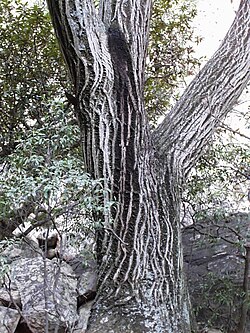
In Cape Town
Scientific classification Edit this classification
Kingdom: Plantae
Clade: Tracheophytes
Clade: Angiosperms
Clade: Eudicots
Clade: Asterids
Order: Lamiales
Family: Oleaceae
Genus: Olea
Species:
O. capensis
Binomial name
Olea capensis
      approximate range
Synonyms[3]
  • Olea laurifolia Lam.

Olea capensis, the black ironwood,[4] is an African tree species in the olive family Oleaceae. It is widespread in sub-Saharan Africa: from the east in Somalia, Ethiopia and Sudan, south to the tip of South Africa, and west to Cameroon, Sierra Leone and the islands of the Gulf of Guinea, as well as Madagascar and the Comoros.[2] It occurs in bush, littoral scrub and evergreen forest.[5]

Other common names in English include ironwood, ironwood olive, East African olive and Elgon olive.[5]

Description

[edit]

The black ironwood is a bushy shrub, or a small to medium-sized tree, up to 10 metres (33 ft) in height, occasionally reaching 40 metres (130 ft).[5]

  • Bark: light grey, becoming dark grey and vertically fissured with age; a characteristic blackish gum is exuded from bark wounds.
  • Leaves: light to dark green and glossy above and paler green below; petiole often purplish, 0.3–1.7 cm long; lanceolate-oblong to almost circular, 3–10 x 1.5–5 cm.
  • Flowers: white or cream and sweetly scented, small and in many flowered axillary or terminal heads, bisexual, 3–15 cm long.
  • Fruit: when ripe they are somewhat succulent purplish drupes; ovoid up to 2 x 1 cm.

Subspecies

[edit]

The species has been divided into 3 subspecies:[5]

Uses

[edit]

Food

[edit]

Olea capensis has masses of sweetly scented bisexual flowers, that produce large edible fruits.[6][7]

Timber

[edit]

The wood of the tree is very hard, fine grained, and heavy, and although difficult to work, it is widely used for art and artifacts.[7]

Gardens

[edit]

Olea capensis is cultivated as an ornamental tree in parks and gardens.

The Guinness Book of World Records lists this tree as the world's heaviest wood, with a specific gravity of 1.49, similar to that of anthracite or dry earth.[8] It is known for its tendency to sink in water, unlike other wood materials. It is also one of the world's hardest woods according to the Janka hardness test. The timber has a good abrasion resistance and is very strong. It is an excellent turnery wood, and is used for a wide range of decorative items.

[edit]

References

[edit]
[edit]
Revisions and contributorsEdit on WikipediaRead on Wikipedia
from Grokipedia
Olea capensis, commonly known as black ironwood or East African olive, is an or species in the , native to tropical and , where it typically grows in humid mountain forests and woodlands at elevations of 600–3,200 meters. It can reach heights of up to 35–40 meters with a straight bole and dense crown, featuring opposite, elliptical leaves that are glossy green and 3–16 cm long, small creamy-white fragrant flowers in axillary panicles, and globose to ellipsoid purple-black drupes measuring 0.5–2 cm. First described by in 1753, Olea capensis belongs to a of about 33 primarily found in eastern and and , and it is divided into three capensis, enervis, and macrocarpa—distinguished by variations in leaf venation, fruit size, and regional adaptations. Its native range spans from and in the west to and in the east, extending south to , including offshore islands such as and the , and it thrives in well-drained, fertile loamy soils under climates with 800–2,500 mm annual rainfall and mean temperatures of 14–18°C. Ecologically, O. capensis is shade-tolerant and acts as a in forest regeneration, supporting in subtropical biomes, though populations face threats from over-exploitation for timber and habitat loss, leading to legal protection in countries like . The species is valued for its high-quality, dense wood (860–1,170 kg/m³), which is durable, termite-resistant, and used in furniture, flooring, , railway sleepers, and as excellent fuelwood or . Additionally, its fruits are occasionally eaten, the bark and roots have medicinal applications for treating , ulcers, and infertility, and it serves as , shade for plantations, and holds cultural significance in ceremonies among groups like the Maasai. Propagation occurs mainly via seeds, which have a rate of about 35% after 2–9 months, supporting limited silvicultural efforts.

Taxonomy

Classification

Olea capensis belongs to the kingdom Plantae, within the clade Tracheophytes, and further classified under the clade Angiosperms, Eudicots, and Asterids. It is placed in the order Lamiales and the family Oleaceae, which comprises about 27 genera and 600 species of mostly woody plants. The species is assigned to the genus Olea, which includes approximately 33 species of evergreen trees and shrubs, predominantly distributed in subtropical and tropical regions of Africa, Asia, and the Mediterranean. The binomial name is Olea capensis L., originally described by Carl Linnaeus in his Species Plantarum in 1753. A notable synonym is Olea laurifolia Lam., published in 1791. The generic name Olea derives from the Latin word for "olive," referring to the resemblance of its fruits to those of the olive tree (Olea europaea). The specific epithet capensis indicates its association with the Cape region of South Africa, where it was first collected. Linnaeus's original description established the species' taxonomic placement, and there have been no major revisions to its classification since 2000, though distinctions have been refined.

Subspecies

Olea capensis is divided into three , differentiated primarily by growth form, characteristics, size and shape, and density. These taxa were established through systematic revisions of the genus, with no additional subdivisions proposed in subsequent studies. The nominate subspecies, O. capensis subsp. capensis, exhibits a shrubby habit with larger, rounder leaves featuring thickened margins and fruits up to 2 cm in diameter. It is endemic to coastal regions of South Africa, occurring from the Western Cape Province to KwaZulu-Natal in subtropical habitats. O. capensis subsp. enervis is adapted to rocky bushveld environments, displaying more slender leaves and smaller fruits. This subspecies forms shrubs or small trees and is restricted to inland areas of South Africa and Eswatini, ranging from Limpopo Province to KwaZulu-Natal. In contrast, O. capensis subsp. macrocarpa produces larger elliptic fruits up to 2 × 1 cm and bears lax inflorescences. It grows as a in sandy desert and seasonally dry tropical regions, with a broad distribution across tropical and , including the Comoros and Madagascar. Key diagnostic traits among the subspecies include variations in fruit dimensions and form, leaf margin thickness, and growth habit, which facilitate their identification in the field.

Description

Morphology

Olea capensis is an evergreen shrub or tree that typically reaches a height of 10 m, though it can grow up to 40 m in forest environments, often exhibiting a bushy form in open areas. The plant displays significant size variation, with subshrub forms measuring 0.5–2 m in scrub habitats contrasting against its role as a canopy tree in forests, where it attains greater stature. The bark is light grey on young stems, darkening and becoming rough and longitudinally fissured with age; it exudes a blackish gum when damaged. Leaves are arranged oppositely, elliptic to lanceolate in shape, with a glossy dark green upper surface and paler underside; they measure 3–10 cm in length by 1.5–5 cm in width and possess a leathery texture. The wood of Olea capensis is usually yellow to light brown with darker to black streaks, straight-grained or interlocked, and oily, with an average specific gravity of 0.74–0.99 (at 12% moisture content); exceptional pieces can reach a specific gravity of 1.49 and sink in water, holding the for the heaviest wood. Its Janka is 2,700 lbf, underscoring its exceptional and . Subspecies such as O. capensis subsp. macrocarpa may show slight variations in shape and branchlet traits, but core morphological features remain consistent across the .

Reproduction

Olea capensis bears small, creamy-white flowers that are sweetly scented and bisexual, arranged in axillary or terminal panicles 3–15 cm long. These flowers typically bloom in summer, from to January in . is primarily achieved by , including bees and flies, which are attracted to the nectar and pollen. The plant produces ovoid drupes as , which are fleshy and turn purplish-black when ripe, measuring 1–2 cm in length and containing a single large seed within a hard endocarp. Fruit size varies by , with subsp. macrocarpa yielding larger drupes up to 2 cm long compared to the smaller of subsp. capensis. Seed dispersal is mainly zoochorous, facilitated by birds such as (Pycnonotidae), turacos (Tauraco spp., or louries), and hornbills that consume the ripe fruits and excrete the seeds away from the parent tree. Additional dispersal occurs through , as endocarps are dropped beneath the canopy, and to a lesser extent by . The reproductive phenology of Olea capensis features flowering in the late or spring, often aligned with the onset of seasonal rains, followed by fruit maturation over 6–8 months.

Distribution and habitat

Geographic range

Olea capensis is native to , with a distribution spanning from the eastern regions including , , and , southward through , , , , , , , and to , and westward to , , , , , , and the , as well as the islands of and . This wide-ranging species occupies diverse landscapes across these areas, primarily in tropical and southern African biomes. The overall extent of its native distribution covers a substantial portion of the continent south of the , with an altitudinal range typically from 800 to 2,600 meters, though it can occur at lower elevations in some western and coastal sites down to around 600 meters and up to 2,800 meters in central and eastern highlands. Within this range, the is found in such as , , , , and , contributing to its broad ecological footprint in forests, scrublands, and montane habitats. The species comprises several subspecies with more restricted distributions. Olea capensis subsp. capensis is limited to , occurring from the Province to , while subsp. enervis occurs in and , found from (formerly Northern Province) to . In contrast, subsp. macrocarpa has a broader range across tropical and southern Africa, including and , and is noted in drier eastern zones such as and . Outside its native range, Olea capensis is occasionally cultivated in gardens in regions like , but there are no established naturalized populations.

Environmental preferences

Olea capensis thrives in a variety of habitats across , including coastal bush, littoral scrub, evergreen forests, and rocky outcrops within bushveld regions, where it often dominates the canopy in South Africa's coastal forests. This species prefers subtropical to tropical climates characterized by mild temperatures with low diurnal fluctuations, typically ranging from 14–18°C annually, and is frost-sensitive in exposed sites. Annual rainfall in its preferred environments falls between 800–1,500 mm, supporting its growth in areas with a distinct but adequate moisture overall. Regarding soil conditions, Olea capensis favors well-drained, sandy to loamy substrates that are deep and fertile for young , though mature individuals tolerate poor, rocky soils effectively. It adapts to a range of neutral to slightly acidic (5.5–7.5), including alkaline conditions in some coastal dune systems. The species exhibits , flourishing under forest canopies or in semi-shaded settings, yet it can also establish in open scrub with full sunlight exposure. In terms of elevation and microhabitats, Olea capensis occurs from up to 2,600 m, with regional variations such as higher altitudes in East and (1,000–2,800 m) and lower in southern regions. It particularly favors sheltered microhabitats like ravines, forest edges, and protected rocky slopes, which provide stability against wind and temperature extremes.

Ecology

Growth patterns

Olea capensis exhibits a protracted life cycle characterized by delayed , rapid initial juvenile growth, and subsequent slow maturation, enabling persistence in diverse environments. Seeds, or stones, remain viable for 1–2 years under suitable storage conditions, such as and at 3°C, though fresh seeds are recommended to maximize success. typically occurs after 2–9 months but can extend up to 2 years, with rates around 35% under optimal conditions; the process often benefits from via bird gut passage, which removes the hard endocarp and enhances emergence. Initial establishment is supported by the species' , allowing growth in conditions. Following , seedlings demonstrate rapid vertical growth, achieving up to 1.1 m per year during the first 4 years, which facilitates escape from herbivory and competition in gaps. After this juvenile phase, growth slows considerably, with adult trees exhibiting annual height increments typically below 30 cm, reflecting adaptation to resource-limited mature canopies. Reproductive maturity is reached around 10–15 years, marked by profuse flowering at irregular intervals of up to 7 years during the late , followed by fruit ripening in approximately 6 months. The species is extremely long-lived, with individuals persisting for several centuries, and some populations forming multi-stemmed shrubs in harsher, exposed sites to enhance resilience against environmental stress. For instance, 31-year-old trees in Tanzanian plantations reach 12–15 m in height with bole diameters of 12.5–14.5 cm, underscoring sustained but incremental development over decades. Regeneration relies on both vegetative and sexual mechanisms, with the species effectively after cutting or disturbance, where approximately 40% of stems resprout in South African trials, aiding recovery in managed forests. In natural forest settings, it draws from a persistent , where fallen stones accumulate on the ground and germinate opportunistically. Post-fire regeneration is supported through these coppice shoots, particularly in fire-prone habitats, though reliance on s predominates in closed-canopy forests. Growth patterns are modulated by environmental factors, with faster rates observed in moist forests (800–1500 mm annual rainfall) compared to slower development in drier scrub or coastal bush, where resistance allows establishment but limits increment once mature. This variability underscores Olea capensis's ecological flexibility across altitudinal gradients from 800–2600 m, where cooler temperatures (14–18°C) and well-drained loamy soils further influence pace.

Biotic interactions

Olea capensis flowers are pollinated primarily by , which are attracted to the produced by the small, white blooms. These generalist pollinators facilitate cross-pollination in the ' forest habitats, contributing to among populations. Seed dispersal in Olea capensis relies heavily on frugivorous birds, such as (Colius spp.) and olive pigeons (Columba arquatrix), which consume the fleshy, purple-black drupes and deposit viable seeds away from the parent tree. Mammals, including bushpigs (Potamochoerus larvatus) and like cercopithecines, occasionally contribute to dispersal by ingesting and excreting undamaged seeds, though birds are the primary agents in most ecosystems. The foliage and fruits of Olea capensis are browsed by herbivores such as bushbuck (Tragelaphus scriptus), a common in southern African forests, which selectively feeds on leaves and twigs. are occasionally browsed by during dry seasons but are not preferred, limiting their value as . Olea capensis forms arbuscular mycorrhizal associations with fungi, which enhance nutrient uptake, particularly , in nutrient-poor forest soils; roots often contain abundant vesicles indicative of these symbiotic structures. The species does not engage in nitrogen-fixing symbioses, relying instead on these mycorrhizal partnerships for improved establishment in competitive woodland environments. As a canopy dominant, Olea capensis plays a key role in ecosystems, providing shade that supports diversity and habitat for epiphytes and arboreal in communities of coastal woodlands. In southern and eastern African forests, it acts as a structural keystone, stabilizing mature stands and facilitating regeneration of associated through its long-lived presence.

Uses

Timber applications

The wood of Olea capensis, known as black ironwood, is exceptionally hard and dense, with a Janka hardness rating of 2,700 lbf (12,010 ) and a density of 860–975 (up to 1,170) kg/m³ at 12% moisture content, causing it to sink in water. Its natural oils contribute to high durability against decay and moderate resistance to , including , while the straight-grained, fine-textured heartwood displays attractive figuring in shades of brown to black. However, the wood's extreme hardness demands sharp tools for machining and has a tendency to surface-check during slow air-drying. In traditional African applications, O. capensis timber has been valued for its strength in crafting tool handles, walking sticks, carvings, furniture, and even boat components, particularly in regions like and where its durability suits demanding uses. Contemporary uses focus on high-end , turnery, veneer, and small specialty items like decorative , with occasional employment in musical instruments due to its tonal qualities and aesthetic appeal; availability remains constrained by the species' scarcity and challenging workability. The timber holds significant economic value in South Africa, where it is sought for artisanal artifacts, though international trade is minimal (50–300 m³ annually via auctions from 2000–2008) and subject to export restrictions to protect wild populations. Supply is further limited by the tree's slow growth rate after an initial phase of up to 1.1 m/year in young seedlings, typically reaching maturity over decades in forest understories.

Culinary value

The fruits of Olea capensis are edible, fleshy drupes that ripen to a purplish color, with an ovoid shape measuring up to 2 cm in length and 1 cm in width. The pulp is occasionally consumed fresh as a snack by rural communities in southern and eastern Africa, including Tanzania and regions of South Africa such as the Eastern Cape, KwaZulu-Natal, Limpopo, Mpumalanga, and Western Cape. These ripe fruits are described as pleasant-tasting and are highly sought after by birds and monkeys, though the hard stone seed is not eaten. Due to sporadic production and low yields, O. capensis fruits have limited commercial culinary application and are primarily gathered for personal or subsistence use rather than as a . No detailed nutritional analyses are widely available, but the fruits contribute modestly to local diets in non-staple contexts. The plant parts, including the fruits, are non-toxic with no known hazards reported.

Ornamental purposes

_Olea capensis is widely cultivated as an ornamental tree in South African gardens and parks, prized for its dense, canopy that provides reliable shade, along with glossy, dark foliage that adds year-round aesthetic appeal. Its attractive , sweetly scented flowers, borne in summer, and persistent berry-like fruits enhance visual interest and support local by drawing in birds and other wildlife. The tree's compact form makes it suitable as a specimen , hedge, or screen in subtropical landscapes, particularly in coastal regions where it thrives in wind-exposed sites. Propagation of Olea capensis is typically achieved through , which should be sown fresh in well-drained medium, achieving 30–40% over 2–3 months, though delays up to two years can occur; semi-hardwood cuttings are also viable with rooting hormones. It prefers deep, well-drained soils with a of 5–7.5 and performs best in full sun to partial shade, tolerating mean annual temperatures of 14–18°C and rainfall of 800–1,200 mm. Once established, the tree exhibits good , requiring minimal supplemental watering in suitable subtropical environments. In , Olea capensis subsp. capensis, endemic to , is favored for coastal due to its shrubby to small habit (up to 10 m tall) and resilience in rocky, hilly terrains, often planted in estates and public green spaces for both ornamental and ecological value. The fruits, present variably throughout the year, provide a colorful display that attracts fruit-eating birds, contributing to garden vibrancy. Challenges in cultivating Olea capensis include its slow overall growth rate—rapid at 1.1 m per year in the first four years but decelerating thereafter, often taking 5–10 years to reach maturity—and moderate sensitivity to severe , though it shows some tolerance in sheltered positions. Optimal establishment involves selecting protected sites to mitigate these limitations.

Conservation

Status assessment

Olea capensis is classified as Least Concern on the of , with the most recent assessment conducted in 2020. This global status is determined by the species' wide distribution across and lack of evidence of . At the national level in , where three occur, O. capensis subsp. capensis, subsp. enervis, and subsp. macrocarpa are all assessed as Least Concern by the South African National Biodiversity Institute (SANBI) Red List. These assessments, originally from 2005 and reaffirmed in subsequent versions, reflect stable population trends and no endangered . Monitoring of O. capensis populations occurs through periodic forest inventories in key range areas, such as those in and , which assess density, regeneration, and structure to confirm stability.

Threats and management

Olea capensis faces primary threats from habitat loss due to and , particularly in coastal forest regions of and , where deforestation has historically reduced its range. Selective logging for its valuable timber has led to over-exploitation and rarity in many areas, driven by high for durable wood products. Additionally, competition from invasive alien species, such as and Pinus taxa, poses risks in southern African forests by altering dynamics and resource availability. Local pressures include overharvesting in , where the species is targeted for timber and crafts, exacerbating depletion in accessible stands. In scrub and forest habitats, Olea capensis exhibits vulnerability to high-severity fires, which negatively impact adult tree survival, though it demonstrates resilience through and vegetative regeneration post-disturbance. Management efforts prioritize protection within reserves, such as in , where indigenous forests containing Olea capensis are monitored for sustainable use. Guidelines for sustainable harvesting, including 10-year felling cycles in natural stands and 75-year rotations in plantations, help regulate extraction. programs in degraded areas, often using nurse trees to aid establishment, support population recovery in and . Ongoing research emphasizes genetic studies to assess variation among , informing targeted conservation. Monitoring of climate change impacts on its altitudinal range is needed to predict shifts in distribution. Community-based conservation initiatives in , such as women's programs in , , promote planting and protection of capensis to counter overharvesting. Despite these pressures, shows no evidence of population crashes, remaining common in southern South African forests due to effective protections and natural resilience.

References

Add your contribution
Related Hubs
User Avatar
No comments yet.