Hubbry Logo
search
logo
2244519

Pennines

logo
Community Hub0 Subscribers
Read side by side
from Wikipedia

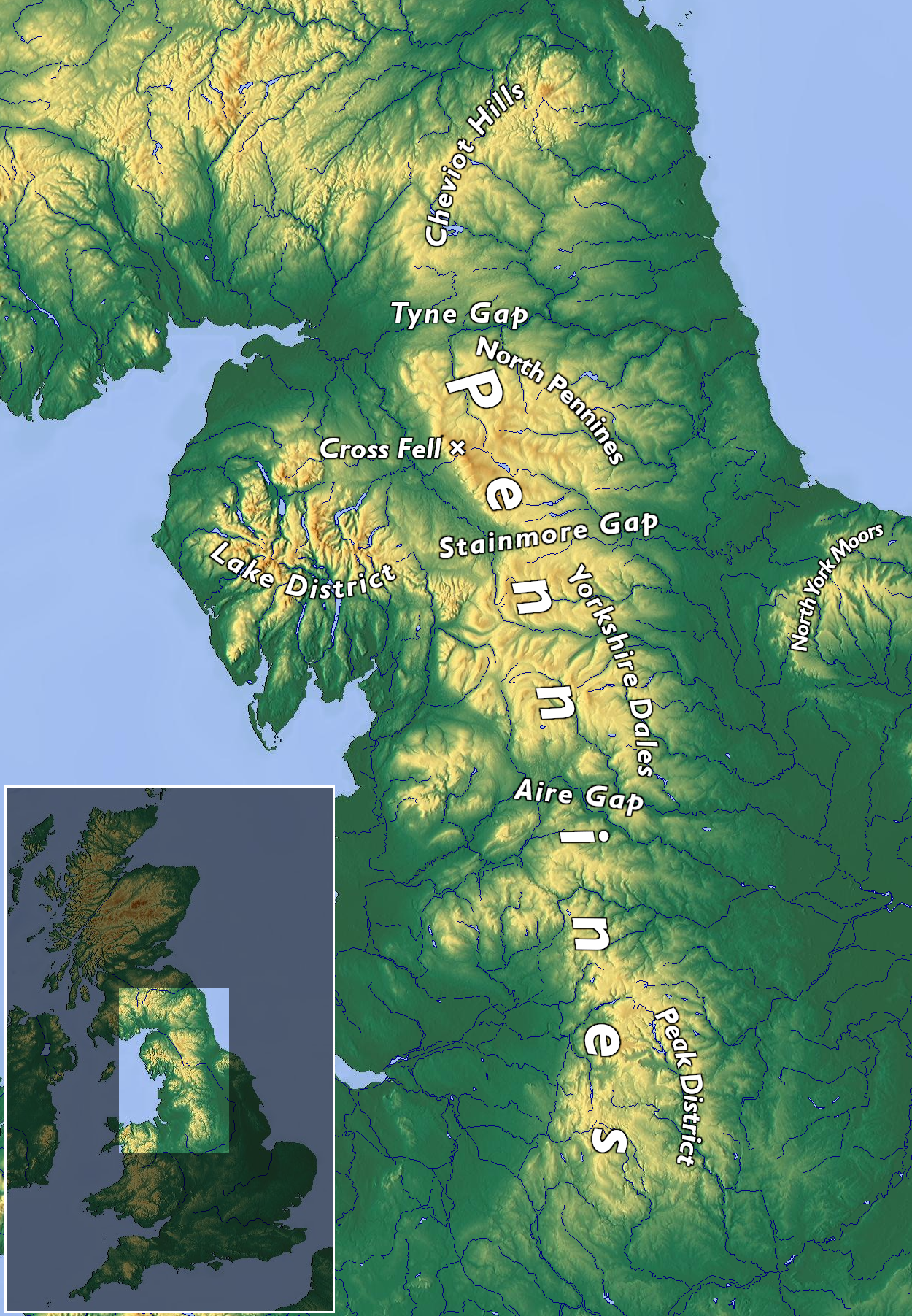
The Pennines (/ˈpɛnnz/), also known as the Pennine Chain or Pennine Hills,[1] are an upland range mainly located in Northern England. Sometimes described as the "backbone of England" because of its length and position, the range runs from Derbyshire and Staffordshire in the north of the Midlands to Northumberland in North East England. From the Tyne Gap in the north, the range extends south through the North Pennines, Yorkshire Dales, South Pennines, and Peak District to end near the valley of the River Trent.[2][3] The Border Moors and Cheviot Hills, which lie beyond the Tyne Gap, are included in some definitions of the range.

Key Information

The range is divided into two by the Aire Gap, a wide pass formed by the valleys of the rivers Aire and Ribble. There are several spurs off the main Pennine range east into Greater Manchester and Lancashire, comprising the Rossendale Fells, West Pennine Moors, and Bowland Fells.[4][5] The Howgill Fells and Orton Fells in Cumbria are also sometimes considered to be Pennine spurs.[6][7] The Pennines are an important water catchment area, with numerous reservoirs in the head streams of the river valleys.

Most of the range is protected by national parks and national landscapes (formerly Areas of Outstanding Natural Beauty). Running north to south, and including the Cheviots, the range is within Northumberland National Park, the North Pennines National Landscape, the Yorkshire Dales National Park, Nidderdale National Landscape, the Forest of Bowland National Landscape, and the Peak District National Park.[8][9] The only significant unprotected area is that between Skipton and Marsden.

Britain's oldest long-distance footpath, the 268-mile (429 km) Pennine Way, runs along most of the Pennines.[10]

Name

[edit]

Various etymologies have proposed treating "Pennine" as a native Brittonic/ Welsh name related to pen- ("head", "top", "chief", etc.).[11] It did not become a common name until the 18th century, and may instead derive from modern comparisons with the Apennine Mountains, which run down the middle of Italy in a similar fashion.[12][dubiousdiscuss]

Following an 1853 article by Arthur Hussey,[13] it has become a common belief that the name derives from a passage in The Description of Britain (Latin: De Situ Britanniæ),[15] an infamous historical forgery concocted by Charles Bertram in the 1740s and accepted as genuine until the 1840s. In 2004, George Redmonds reassessed this, finding that numerous respected writers passed over the origin of the mountains' name in silence even in works dedicated to the topological etymology of Derbyshire and Lancashire.[12] He found that the derivation from Bertram was widely believed and considered uncomfortable.[12] In fact, Redmonds found repeated comparisons with the Italian Apennines going back at least as early as William Camden (1551–1623),[16] many of whose placenames and ideas Bertram incorporated into his work. Bertram was responsible (at most) with popularizing the name against other contenders such as Daniel Defoe's "English Andes".[12] His own form of the name was the "Pennine Alps" (Alpes Peninae), which today is used for a western section of the continental Alps. Those mountains (the area around the St. Bernard Pass) derive their name from the Latin Alpes Pœninæ whose name has been variously derived from the Carthaginians,[17] a local god,[18] and Celtic peninus.[19] The St. Bernard Pass was the pass used in the invasions of Italy by the Gallic Boii and Lingones in 390 BC. The etymology of the Apennines themselves—whose name first referred to their northern extremity and then later spread southward—is also disputed but is usually taken to derive from some form of Celtic pen or ben ("mountain, head").[20][21][22]

Various towns and geographical features within the Pennines have names of at least partly Celtic origin, including Pennington, Penrith, Pen-y-ghent, Pendle Hill, the River Eden, and Cumbria. More commonly, local names result from Anglo-Saxon and Norse settlements. In Yorkshire, Teesdale, and Cumbria, many words of Norse origin, not commonly used in standard English, are part of everyday speech: for example, gill/ghyll (narrow steep valley), beck (brook or stream), fell (hill), and dale (valley).[23] Northumbrian/borders terms are used in South Tynedale, Weardale, and Allendale, such as burn (stream), cleugh (ravine), hope (valley), law (hill) and linn (waterfall).

Geography

[edit]
Rombalds Moor, South Pennines

The northern Pennine range is bordered by the foothills of the Lake District, and uplands of the Howgill Fells, Orton Fells, Border Moors and Cheviot Hills. The West Pennine Moors, Rossendale Valley[4] and Forest of Bowland[5] are western spurs, the former two are in the South Pennines. The Howgill Fells[6] and Orton Fells[7] are sometimes considered to be part of the Pennines, both inside the Yorkshire Dales National Park.[24] The Pennines are fringed by extensive lowlands including the Eden Valley, West Lancashire Coastal Plain, Cheshire Plain, Vale of York, Humberhead Levels and the Midland Plains.

Scenery in the Forest of Bowland

The main range of the Pennines start from its southern end at the Weaver Hills in the Peak District.[25] The southern foothills of the range merge into the valley and basin of the River Trent,[26] separating the range from the Midland Plains to the south. The Pennines continue northwards across the Peak District and adjoin the South Pennines approximately around the Tame Valley, Standedge and Holme Valley. The South Pennines are separated from the Forest of Bowland by the Ribble Valley, and include the Rossendale Valley and West Pennine Moors in the west.[27] The range continues further north into the Aire Gap which separates the Yorkshire Dales from the South Pennines to the south and the Forest of Bowland to the southwest.[28] The main range then continues northwards across the Yorkshire Dales to the Stainmore Gap where it adjoins the North Pennines. The range continues into its northern end at the Tyne Gap,[29] separating it from the Border Moors and Cheviot Hills across the Anglo-Scottish border.

Although the Pennines cover the area between the Peak District and the Tyne Gap, the Pennine Way affects perceptions of the southern and northern extents of the defined area. The southern end of the Pennines is said to be in the High Peak of Derbyshire at Edale, the start of the Pennine Way,[6] but the main range continues south across the Peak District to the Weaver Hills,[25] with its foothills merging into the Trent Valley.[26] This encompasses eastern Cheshire, northern and eastern Staffordshire, and southern Derbyshire.[6][30][31] Conversely, the Border Moors and Cheviot Hills, separated by the Tyne Gap and Whin Sill to the south, along which run the A69 and Hadrian's Wall, and River Tweed to the north,[32] are not part of the Pennines but, perhaps because the Pennine Way crosses them, they are treated as such.[6]

Stanage Edge in the Peak District

Most of the Pennine landscape is characterised by upland areas of high moorland indented by more fertile river valleys, although the landscape varies in different areas. The Peak District consists of hills, plateaus and valleys, divided into the Dark Peak with moorlands and gritstone edges, and the White Peak with limestone gorges.[33] The South Pennines is an area of hills and moorlands with narrow valleys between the Peak District and Yorkshire Dales.[34] Bowland is dominated by a central upland landform of deeply incised gritstone fells covered with tracts of heather-covered peat moorland, blanket bog and steep-sided wooded valleys linking the upland and lowland landscapes.[35] The landscape is higher and more mountainous in the Yorkshire Dales and North Pennines. The Yorkshire Dales are characterised by valleys, moorlands and fells[36] while the North Pennines consist of plateaus, moorlands, fells, edges and valleys, with most of the higher peaks in the west.[29]

Elevation

[edit]
Cross Fell, the highest point of the Pennines

Rising less than 3,000 feet (900 m), the Pennines are fells, with most of the mountainous terrain in the north. The highest point is Cross Fell in eastern Cumbria, at 2,930 feet (893 m) and other principal peaks in the North Pennines are Great Dun Fell 2,782 ft (848 m), Mickle Fell 2,585 ft (788 m), and Burnhope Seat 2,451 ft (747 m). Principal peaks in the Yorkshire Dales include Whernside 2,415 ft (736 m), Ingleborough 2,372 ft (723 m), High Seat 2,328 ft (710 m), Wild Boar Fell 2,324 ft (708 m) and Pen-y-ghent 2,274 ft (693 m). Principal peaks in the Forest of Bowland include Ward's Stone 1,841 ft (561 m), Fair Snape Fell 1,710 ft (521 m), and Hawthornthwaite Fell 1,572 ft (479 m). Terrain is lower towards the south and the only peaks which exceed 2,000 ft (610 m) are Kinder Scout 2,087 ft (636 m) and Bleaklow 2,077 ft (633 m) in the Peak District. Other principal peaks in the South Pennines and Peak District include Black Hill 1,909 ft (582 m), Shining Tor 1,834 ft (559 m), Pendle Hill 1,827 ft (557 m), Black Chew Head 1,778 ft (542 m), Rombalds Moor 1,319 ft (402 m) and Winter Hill 1,496 ft (456 m).

Drainage

[edit]
Ribblesdale, Yorkshire Dales

For much of their length the Pennines are the main watershed in northern England, dividing east and west. The rivers Eden, Ribble, Dane and tributaries of the Mersey (including the Irwell, Tame and Goyt) flow westwards towards the Irish Sea.

On the eastern side of the Pennines, the rivers Tyne, Wear, and Tees all drain directly to the North Sea. The Swale, Ure, Nidd, Wharfe, Aire, Calder and Don all flow into the Yorkshire Ouse, and reach the sea through the Humber Estuary.

The River Trent flows around the southern end of the Pennines and northwards on the eastern side taking water from tributaries, principally the Dove and Derwent. The Trent drains the east and west sides of the southern Pennines, also reaching the North Sea through the Humber Estuary. The Trent and Ouse meet and enter the Humber at Trent Falls. Maximum discharge through the Humber can reach 1,500 m3/s (53,000 cu ft/s).[37]

Climate

[edit]
A snow-covered Whernside, Yorkshire Dales

According to the Köppen classification, the Pennines generally have a temperate oceanic climate (Cfb) like the rest of England, but the uplands have more precipitation, stronger winds and colder weather than the surrounding areas. Some of the higher elevations have a subpolar oceanic climate (Cfc), which may border a tundra (ET) and subarctic climate (Dfc) in areas like Great Dun Fell.[38]

More snow falls on the Pennines than on surrounding lowland areas due to the elevation and distance from the coast; unlike lowland areas of England, the Pennines can have quite severe winters.

The northwest is amongst the wettest regions of England and much of the rain falls on the Pennines. The eastern side is drier than the west—the rain shadow shields northeast England from rainfall that would otherwise fall there.

Precipitation is important for the area's biodiversity and human population. Many towns and cities are located along rivers flowing from the range and in northwest England the lack of natural aquifers is compensated for by reservoirs.

Water has carved out limestone landscapes in the North Pennines, Yorkshire Dales and Peak District, with gorges and caves present in the Yorkshire Dales and Peak District. In some areas, precipitation has contributed to poor soils, resulting in part in moorland landscapes that characterize much of the range. In other areas where the soil has not been degraded, it has resulted in lush vegetation.

For the purpose of growing plants, the Pennines are in hardiness zones 7 and 8, as defined by the USDA. Zone 8 is common throughout most of the UK, and zone 7 is the UK's coldest hardiness zone. The Pennines, Scottish Highlands, Southern Uplands and Snowdonia are the only areas of the UK in zone 7.

Climate data for Great Dun Fell, North Pennines
WMO ID: 03227; coordinates 54°41′02″N 2°27′05″W / 54.68401°N 2.45132°W / 54.68401; -2.45132 (Great Dun Fell 2); elevation: 847 m (2,779 ft); 1991–2020 normals
Month Jan Feb Mar Apr May Jun Jul Aug Sep Oct Nov Dec Year
Mean daily maximum °C (°F) 1.6
(34.9)
1.6
(34.9)
2.8
(37.0)
5.4
(41.7)
8.6
(47.5)
11.0
(51.8)
12.5
(54.5)
12.3
(54.1)
10.1
(50.2)
6.8
(44.2)
4.0
(39.2)
2.1
(35.8)
6.6
(43.9)
Daily mean °C (°F) −0.4
(31.3)
−0.5
(31.1)
0.6
(33.1)
2.7
(36.9)
5.6
(42.1)
8.2
(46.8)
10.0
(50.0)
9.8
(49.6)
7.8
(46.0)
4.8
(40.6)
2.1
(35.8)
0.0
(32.0)
4.2
(39.6)
Mean daily minimum °C (°F) −2.4
(27.7)
−2.6
(27.3)
−1.6
(29.1)
0.0
(32.0)
2.7
(36.9)
5.5
(41.9)
7.5
(45.5)
7.4
(45.3)
5.6
(42.1)
2.8
(37.0)
0.2
(32.4)
−2.1
(28.2)
1.9
(35.4)
Source: Met Office[39]

Geology

[edit]
Limestone scenery at Thor's Cave, Peak District

The Pennines have been carved from a series of geological structures whose overall form is a broad anticline whose axis extends in a north–south direction. The North Pennines are coincident with the Alston Block and the Yorkshire Dales are coincident with the Askrigg Block. In the south the Peak District is essentially a flat-topped dome.

Each of the structures consists of Carboniferous limestone overlain with Millstone Grit. The limestone is exposed at the surface in the North Pennines, Yorkshire Dales and the Peak District. In the Dales and the White Peak, limestone exposure has caused the formation of large cave systems and watercourses. In the Dales the caves or potholes are known as "pots" in the Yorkshire dialect. They include some of the largest caves in England at Gaping Gill, more than 350 ft (107 m) deep and Rowten Pot, 365 ft (111 m) deep. Titan in the Peak District, the deepest shaft known in Britain, is connected to Peak Cavern in Castleton, Derbyshire, the largest cave entrance in the country. Erosion of the limestone has led to geological formations, such as the limestone pavements at Malham Cove.

Between the northern and southern areas of exposed limestone between Skipton and the Dark Peak is a belt of exposed gritstone. Here the shales and sandstones of the Millstone Grit form high hills occupied by moorland covered with bracken, peat, heather and coarse grasses;[40] the higher ground is uncultivable and barely fit for pasture.

History

[edit]
A prehistoric settlement on Harkerside Moor in Swaledale

The Pennines contained Bronze Age settlements, and evidence remains of Neolithic settlement including many stone circles and henges, such as Long Meg and Her Daughters.[41]

The uplands were controlled by the tribal federation of the Brigantes, made up of small tribes who inhabited the area and cooperated on defence and external affairs. They evolved an early form of kingdom. During Roman times, the Brigantes were dominated by the Romans who exploited the Pennines for their natural resources including the wild animals found there.

The Pennines were an obstacle for Anglo-Saxon expansion westwards, although it appears the Anglo-Saxons travelled through the valleys. During the Dark Ages the Pennines were controlled by Celtic and Anglo-Saxon kingdoms. It is believed that the north Pennines were under the control of the kingdom of Rheged.

During Norse times the Pennines were settled by Viking Danes in the east and Norwegian Vikings in the west. The Vikings influenced place names, culture and genetics. When England was unified the Pennines were incorporated. The mix of Celtic, Anglo-Saxon and Viking heritage resembled much of the rest of northern England and its culture developed alongside its lowland neighbours in northwest and northeast England. The Pennines were not a distinct political polity, but were divided between neighbouring counties in northeast and northwest England; a major part was in the West Riding of Yorkshire.

Demography

[edit]

The Pennine region is sparsely populated by English standards. Larger population centres are in the foothills and lowlands fringing the southern Pennine range, such as Barnsley, Chesterfield, Halifax, Huddersfield, Macclesfield, Oldham, Bury, Rochdale, Middleton, and Stockport but most of the northern Pennine range is thinly populated.[42] The cities of Bradford, Derby, Leeds, Manchester, Sheffield, Stoke-on-Trent and Wakefield are also in the surrounding foothills and lowlands. The Pennines contain the highest village in the United Kingdom, Flash, at 1,519 feet (463 m), near the southern end of the range in Staffordshire.[43]

Economy

[edit]
Tunsted Quarry, Peak District

The main economic activities in the Pennines include sheep farming, quarrying, finance and tourism. In the Peak District, tourism is the major local employment for park residents (24%), with manufacturing industries (19%) and quarrying (12%) also being important while 12% are employed in agriculture.[44] Limestone is the most important mineral quarried, mainly for roads and cement, while other extracted materials include shale for cement and gritstone for building stone.[45] The springs at Buxton and Ashbourne are exploited to produce bottled mineral water and there are approximately 2,700 farms in the National Park.[46] The South Pennines are predominantly industrial, with the main industries including textiles, quarrying and mining,[47] while other economic activities within the South Pennines include tourism and farming.[48]

Although the Forest of Bowland is mostly rural, the main economic activities in the area include farming[49] and tourism.[50] In the Yorkshire Dales, tourism accounts for £350 million of expenditure every year while employment is mostly dominated by farming, accommodation and food sectors. There are also significant challenges for managing tourism, farming and other developments within the National Park.[51] The main economic activities in the North Pennines include tourism, farming, timber and small-scale quarrying, due to the rural landscape.[52]

Transport

[edit]
The Pennines are traversed by several passes, mostly aligned with major rivers

Gaps that allow west–east communication across the Pennines include the Tyne Gap between the Pennines and the Cheviots, through which the A69 road and Tyne Valley railway link Carlisle and Newcastle upon Tyne. The A66 road, its summit at 1,450 feet (440 m), follows the course of a Roman road from Scotch Corner to Penrith through the Stainmore Gap between the Eden Valley in Cumbria and Teesdale in County Durham. The Aire Gap links Lancashire and Yorkshire via the valleys of the Aire and Ribble. Other high-level roads include Buttertubs Pass, named from limestone potholes near its 1,729-foot (527 m) summit, between Hawes in Wensleydale and Swaledale and the A684 road from Sedbergh to Hawes via Garsdale Head which reaches 1,100 feet (340 m).[citation needed]

Further south the A58 road traverses the Calder Valley between West Yorkshire and Greater Manchester reaching 1,282 feet (391 m) between Littleborough and Ripponden, while the A646 road along the Calder Valley between Burnley and Halifax reaches 764 feet (233 m) following valley floors. In the Peak District the A628 Woodhead road links the M67 motorway in Greater Manchester with the M1 motorway in South Yorkshire and Holme Moss is crossed by the A6024 road, whose highest point is near Holme Moss transmitting station between Longdendale and Holmfirth.[citation needed]

The Pennines are traversed by the M62 motorway, the highest motorway in England at 1,221 feet (372 m) on Windy Hill near Junction 23.[citation needed]

Three trans-Pennine canals built during the Industrial Revolution cross the range:

A British Rail train about to enter the western portal of Woodhead 3, shortly before closure in 1981

The first of three Woodhead Tunnels was completed by the Sheffield, Ashton-Under-Lyne and Manchester Railway in 1845, engineered by Charles Vignoles and Joseph Locke. At the time of its completion in 1845, Woodhead 1 was one of the world's longest railway tunnels at a length of 3 miles 13 yards (4,840 m); it was the first of several trans-Pennine tunnels including the Standedge and Totley tunnels, which are only slightly longer. The first two tunnels were replaced by Woodhead 3, which was longer at 3 miles 66 yards (4860m). It was bored for the overhead electrification of the route and completed in 1953. The tunnel was opened by the transport minister Alan Lennox-Boyd on 3 June 1954.[54] It was designed by Sir William Halcrow & Partners. The line was closed in 1981.

The London and North Western Railway acquired the Huddersfield and Manchester Railway in 1847 and built a single-line tunnel parallel to the canal tunnel at Standedge with a length of 3 miles, 57 yards (4803 m). Today rail services along the Huddersfield line between Huddersfield and Victoria and Piccadilly stations in Manchester are operated by TransPennine Express and Northern. Between 1869 and 1876 the Midland Railway built the Settle-Carlisle Line through remote, scenic regions of the Pennines from near Settle to Carlisle passing Appleby-in-Westmorland and other settlements, some a distance from their stations. The line has survived, despite difficult times[55] and is operated by Northern Rail.[56]

The Trans Pennine Trail, a long-distance route for cyclists, horse riders and walkers, runs west–east alongside rivers and canals, along disused railway tracks and through historic towns and cities from Southport to Hornsea (207 miles/333 km).[57] It crosses the north–south Pennine Way (268 miles/431 km) at Crowden-in-Longdendale.

National Parks and AONBs

[edit]
National parks and AONBs in Northern England, of which the Pennines mostly cover the middle part.

Considerable areas of the Pennines are protected as UK national parks and Areas of Outstanding Natural Beauty (AONBs). Areas of Outstanding Natural Beauty, also known as "national landscapes", are afforded much the same protection as national parks. The national parks within the Pennines are the Peak District National Park and the Yorkshire Dales National Park with the Northumberland National Park sometimes also included.

The North Pennines AONB just north of the Yorkshire Dales rivals the national park in size and includes some of the Pennines' highest peaks and its most isolated and sparsely populated areas. Other AONBs are Nidderdale east of the Yorkshire Dales, and the Bowland Fells, including Pendle Hill, west of the Yorkshire Dales.

The only significant unprotected section is the area between Skipton and Marsden.

Language

[edit]

The language used in pre-Roman and Roman times was Common Brittonic. During the Early Middle Ages, the Cumbric language developed. Little evidence of Cumbric remains, so it is difficult to ascertain whether or not it was distinct from Old Welsh. The extent of the region in which Cumbric was spoken is also unknown.

During Anglo-Saxon times the area was settled by Anglian peoples of Mercia and Northumbria, rather than the Saxon people of Southern England. Celtic speech remained in most areas of the Pennines longer than it did in the surrounding areas of England. Eventually, the Celtic tongue of the Pennines was replaced by early English as Anglo-Saxons and Vikings settled the area and assimilated the Celts.[58]

During the Viking Age Scandinavian settlers brought their language, Old Norse. The fusion of Norse influences into Old English was important in the formation of Middle English and hence Modern English, and many individual words of Norse descent remain in use in local dialects, such as that of Yorkshire, and in local place names.

Folklore and customs

[edit]

The folklore and customs are mostly based on Celtic, Anglo-Saxon and Viking customs and folklore.[citation needed] Many customs and stories have their origin in Christianised pagan traditions.[citation needed] In the Peak District, a notable custom is well dressing, which has its origin in pagan traditions that became Christianised.[59]

Flora

[edit]

Flora in the higher Pennines is adapted to moorland and subarctic landscapes and climates. The flora found there can be found in other areas of moorland in Northern Europe and some species are also found in areas of tundra. In the Pennine millstone grit areas above an altitude of 900 feet (270 m) the topsoil is so acidic, pH 2 to 4, that it can grow only bracken, heather, sphagnum, and coarse grasses[40] such as cottongrass, purple moor grass and heath rush.[60] As the Ice age glacial sheets retreated c. 11,500 BC trees returned and archaeological palynology can identify their species. The first trees to settle were willow, birch and juniper, followed later by alder and pine. By 6500 BC temperatures were warmer and woodlands covered 90% of the dales with mostly pine, elm, lime and oak. On the limestone soils the oak was slower to colonize and pine and birch predominated. Around 3000 BC a noticeable decline in tree pollen indicates that neolithic farmers were clearing woodland to increase grazing for domestic livestock, and studies at Linton Mires and Eshton Tarn find an increase in grassland species.[61] On poorly drained impermeable areas of millstone grit, shale or clays the topsoil gets waterlogged in winter and spring. Here tree suppression combined with the heavier rainfall results in blanket bog up to 7 ft (2 m) thick. The erosion of peat still exposes stumps of ancient trees.[61]

"In digging it away they frequently find vast fir trees, perfectly sound, and some oaks ..."

— Arthur Young, A Six Months' Tour of the North of England (1770)[62]

Limestone areas of the Pennines in the White Peak,[63] Yorkshire Dales[64] and Upper Teesdale[65] have been designated as nature reserves or Important Plant Areas by the botanical conservation charity Plantlife,[66] and are nationally important for their wildflowers.

Fauna

[edit]
Shooting of red grouse is an economically important activity in the Pennines.[citation needed]

Fauna in the Pennines is similar to the rest of England and Wales, but the area hosts some specialised species. Deer are found throughout the Pennines and some species of animals that are rare elsewhere in England can be found here. Arctic hares, which were common in Britain during the Ice Age and retreated to the cooler, more tundra-like uplands once the climate warmed up, were introduced to the Dark Peak area of the Peak District in the 19th century.

Large areas of heather moorland in the Pennines are managed for driven shooting of wild red grouse. The related and declining black grouse is still found in northern parts of the Pennines. Other birds whose English breeding strongholds are in the Pennines include golden plover, snipe, curlew, dunlin, merlin, short-eared owl, ring ouzel and twite,[67] though many of these are at the southern limit of their distributions and are more common in Scotland.

See also

[edit]

References

[edit]
[edit]
Revisions and contributorsEdit on WikipediaRead on Wikipedia
from Grokipedia
The Pennines are a prominent upland range in northern England, commonly known as the "backbone of England" due to their elongated north-south alignment and central position in the country's topography.[1] Extending from the vicinity of the Scottish border near the Stainmore Gap in the north to the Midlands around the Peak District in the south, the range forms a dissected plateau with summits rising to approximately 600 metres above ordnance datum, featuring a mix of moorlands, valleys, and escarpments that contribute to its status as an area of natural beauty popular among walkers and tourists.[1] The highest point is Cross Fell at 893 metres (2,930 feet), located in the northern section overlooking the Eden Valley.[2] Geologically, the Pennines are dominated by Carboniferous rocks, including thick sequences of limestone, Millstone Grit sandstones, and associated shales and coal measures, which were deposited in a subsiding basin during the Carboniferous period and later uplifted into a broad anticline.[1] This succession gives rise to distinctive landscapes, such as karst features in the limestone dales of the Yorkshire Dales and gritstone moors in the south, with widespread blanket bog on the higher plateaus, particularly in the North Pennine Moors, which represent England's largest expanse of active peat-forming habitat.[3] The range is segmented into key areas, including the North Pennines National Landscape (designated an Area of Outstanding Natural Beauty in 1988 and renamed a National Landscape in 2023; the second largest in England and Wales at approximately 2,000 square kilometres), the Yorkshire Dales National Park, the South Pennines, and the Peak District National Park, each showcasing varied ecology from upland hay meadows to internationally important breeding grounds for birds like golden plover and curlew.[4][5][6] Historically significant for lead and coal mining, the Pennines' industrial legacy is evident in remnants like smelt mills and quarries, while today the region supports diverse rural economies through farming, tourism, and conservation efforts.[7] The 431-kilometre (268-mile) Pennine Way National Trail traverses the entire length, linking these landscapes and drawing users for hiking and cycling.[8] Climate in the Pennines is cooler and wetter than surrounding lowlands, with exposed summits often exceeding 600 metres receiving heavy rainfall that sustains the peatlands and influences regional hydrology.[9]

Geography

Location and Extent

The Pennines constitute a prominent upland area and low mountain range in northern England, often described as the "backbone of England" due to their central role in the regional landscape. They extend southward from the Tyne Gap near the Scottish border and the Cheviot Hills, through a series of elevated blocks and valleys, to the vicinity of the River Trent in Derbyshire, covering a linear distance of approximately 160 miles (260 km). This elongated structure forms a continuous ridge that influences regional geography, with the range's northern limit marked by the low-lying Tyne Gap separating it from the Border Moors and Cheviot Hills.[1][10] The Pennines are typically divided into three main north-south sections: the Northern Pennines, Central Pennines, and Southern Pennines, each encompassing distinct upland terrains across multiple counties. The Northern Pennines primarily occupy parts of Northumberland, Cumbria, and County Durham, forming a broad, high plateau that includes the North Pennines Area of Outstanding Natural Beauty (AONB), designated for its remote and unspoilt character.[4] The Central Pennines traverse North Yorkshire, West Yorkshire, Lancashire, and parts of Greater Manchester, characterized by rolling moors and deep dales such as those in the Yorkshire Dales. The Southern Pennines extend through Derbyshire, Cheshire, and Staffordshire, culminating in the elevated landscapes of the Peak District National Park.[10] Lying to the west of the Pennines is the Lake District National Park, while the North York Moors National Park and the broader Vale of York border the range to the east, highlighting its position as a dividing feature amid varied terrains. Overall, the Pennines act as a natural divider between eastern and western England by serving as the primary watershed for major rivers draining to the North Sea on one side and the Irish Sea on the other.[1]

Topography and Elevation

The Pennines form a dissected upland plateau characterized by undulating hills, broad moorland plateaus, and deeply incised valleys that create a varied terrain across northern England.[1] Elevations generally rise from around 180 m in the eastern lowlands to over 610 m in the western uplands, reflecting the range's structural tilt and fault-controlled margins.[2] This topography results in expansive, open landscapes in the higher plateaus, transitioning to narrower, steeper-sided dales in the dissected southern and central sections.[11] The highest summit in the Pennines is Cross Fell, reaching 893 m in the North Pennines, marking the range's elevated western edge.[12] In the Yorkshire Dales, prominent peaks include Whernside at 736 m, Ingleborough at 723 m, and Pen-y-ghent at 694 m, forming the renowned "Three Peaks" that exemplify the area's rugged hill profiles. These summits rise sharply from surrounding valleys, offering panoramic views and serving as focal points for the plateau's dissection.[13] Glacial and erosional processes have shaped distinctive features across the Pennines, including corries on higher northern slopes, extensive scree slopes accumulating at cliff bases, and unique limestone pavements in the southern dales.[14] Limestone pavements, formed by post-glacial solutional erosion, consist of clint-and-grike patterns exposed on flat-topped outcrops, particularly in areas like Malham Cove.[15] Scree slopes and rocky outcrops are prevalent along limestone scars and steeper gradients, contributing to the dramatic, bare-rock appearance of the terrain.[16] The Pennines exhibit an escarpment profile, with gentler eastern dip slopes giving way to steeper western faces due to major faulting along the range's margins.[2] Cross-sections reveal this asymmetry, where western uplifts along faults like the Pennine Fault create abrupt rises exceeding 300 m, contrasting with the more gradual eastern descent into lowland plains.[17] This fault-driven topography enhances the range's visibility and influences local drainage patterns.[1]

Hydrology and Drainage

The Pennines serve as a primary watershed in northern England, separating the drainage basins flowing eastward to the North Sea via the Humber estuary and westward to the Irish Sea. Eastern rivers, such as the Ouse and its tributaries, drain the eastern flanks into the Humber River Basin District, which encompasses diverse uplands including the Pennines. Western drainage includes basins of the Eden, Lune, and Ribble, with river systems falling into groups like the Mersey, Ribble, Lune, and Eden that channel water toward the Irish Sea. This division results in a radial pattern of rivers originating from the upland core of the Pennines, influenced by the region's topography of dissected plateaus and valleys.[18][19] Several major rivers rise in the Pennines and flow radially outward, shaping regional hydrology. The River Aire, originating near Malham in the Yorkshire Dales, extends 148 km southeastward before joining the Ouse near Goole. The River Calder rises on Heald Moor near Todmorden and flows 72 km eastward to meet the Aire at Castleford. Further north, the River Swale forms from the confluence of Birkdale Beck and Great Sleddale Beck, spanning 118 km before merging with the Ure at Myton-on-Swale. The River Ure sources at Ure Head on Abbotside Common and measures approximately 119 km to its confluence with the River Swale at Swale Nab, where it becomes the Ouse. The River Wharfe begins at the confluence of Oughtershaw Beck and Green Field Beck in Langstrothdale, covering approximately 105 km (65 miles) to the Ouse near Ryther.[20][21][22] These rivers, with their moorland headwaters, contribute to the Pennines' role in supplying water to adjacent lowlands. The Pennines host numerous reservoirs and dams critical for regional water supply, capturing high rainfall from impermeable rocks to serve urban conurbations. In the southern Pennines, structures like Swellands and Black Moss Reservoirs on the moors between Marsden and Diggle store water for distribution, while Winterburn Reservoir, with its 180 m-long and 25 m-high dam opened in 1893, supports the Leeds and Liverpool Canal and broader supply networks. Northern examples include Cow Green Reservoir in the North Pennines, completed in 1971 with a storage capacity of 40.9 million cubic metres for Teesside industries. These impoundments, part of Victorian-era engineering expansions, regulate flows from Pennine catchments to prevent shortages in downstream areas like West Yorkshire and Greater Manchester. Historical connections, such as aqueducts linking upland sources to cities, underscore the range's hydrological importance, though direct ties to distant systems like the Elan Valley are limited to broader national supply frameworks.[23][24][25] Peat bogs in the Pennines play a key role in hydrology, acting as natural sponges for water retention but posing flood risks when degraded by erosion or drainage features like grips. Degraded peat accelerates runoff, increasing downstream flooding in basins like the Ouse and Aire, as seen in historical events exacerbated by rapid moorland drainage. Post-2020 restoration efforts, including the MoorLIFE 2020 project, have blocked grips and reintroduced sphagnum moss across Pennine blanket bogs to enhance water storage and reduce peak flows. The Pennine PeatLIFE initiative (2017–2023) restored over 3,000 hectares, improving hydrological function by slowing water movement and cutting flood peaks by up to 30% in modeled scenarios. As of 2025, ongoing efforts under England's Peat Action Plan continue to monitor and expand restorations, bolstering resilience in upland catchments with reduced erosion and stabilized base flows reported since 2021.[26][27][28][29]

Climate and Weather

The Pennines exhibit a cool, temperate oceanic climate classified as Cfb under the Köppen system, characterized by mild temperatures, high humidity, and significant precipitation throughout the year. Annual rainfall averages between 1,500 mm and 2,500 mm, with the highest amounts—often exceeding 2,000 mm—occurring on the western slopes due to the orographic effect of prevailing westerly winds from the Atlantic, which force moist air to rise and condense over the uplands.[30][31] Eastern areas receive less precipitation, typically around 800–1,200 mm, as the rain shadow effect reduces moisture after crossing the range.[9] Summer temperatures are mild, with July means averaging about 15°C across the region, though maxima can reach 20°C or higher in lower valleys on clear days. Winters are cold and damp, with January means ranging from 2°C to 5°C in the lowlands, dropping below 0°C on higher ground; air frost occurs on over 80 days annually above 500 m elevation, and snowfall is frequent, accumulating to several centimeters on plateaus during colder spells.[30][9] Microclimates vary markedly by elevation and aspect: exposed western moors and plateaus are prone to persistent hill fog and strong winds, reducing visibility and sunshine to as low as 1,200 hours per year, while eastern dales benefit from shelter, fostering slightly warmer, drier conditions that support localized agriculture.[9] Notable extreme events include the widespread flooding in late 2015, when Storm Desmond brought over 300 mm of rain in days to western areas, causing severe inundation in valleys like those around Hebden Bridge.[32][33] Recent trends indicate warming, with UK-wide temperatures rising by approximately 1.2°C since 1980, a pattern evident in the Pennines through milder winters and more variable summers.[34] Climate change has also increased the frequency and intensity of storms, leading to heavier rainfall episodes that exacerbate runoff in this upland setting.[35] In response, efforts to restore peatlands—covering significant portions of the higher Pennines—aim to enhance carbon sequestration, with projects targeting degraded bogs to lock away millions of tonnes of CO₂ and mitigate flood risks.[36] These initiatives, supported by Natural England, underscore the region's role in broader climate adaptation strategies.[37]

Geology

Formation and Structure

The Pennines formed primarily during the Carboniferous period, approximately 358 to 299 million years ago, when thick sequences of limestone, shale, and sandstone were deposited in a subsiding basin within the ancient continent of Laurussia.[1] These sediments accumulated in a tropical marine environment, with periodic deltaic influences from the south and east, setting the stage for later tectonic deformation.[38] The Variscan orogeny, a major mountain-building event spanning the late Carboniferous to early Permian (roughly 320 to 290 million years ago), folded and thrust these Carboniferous strata northward as continents collided to form Pangaea.[39] This compressional phase created broad folds and faults, with the Pennines emerging as an elongated anticlinal structure aligned north-south along its axis, spanning from the Peak District to the Scottish border.[1] Subsequent uplift occurred during the Tertiary period (66 to 2.6 million years ago), driven by regional tectonic forces related to the Alpine orogeny, which reactivated and elevated the structure along the Pennine Fault system—a major northwest-dipping normal fault bounding the western margin.[40] This differential uplift, combined with east-west folding and associated faulting, accentuated the escarpment along the western flank, exposing resistant Carboniferous rocks while eroding softer eastern strata.[41] During the Pleistocene epoch (2.58 million to 11,700 years ago), repeated glaciations profoundly modified the Pennine landscape, particularly through the Devensian stage (the last glacial period, about 115,000 to 11,700 years ago), when ice sheets from Scotland and Scandinavia advanced southward.[14] These ice masses carved U-shaped valleys, such as those in the Yorkshire Dales and Teesdale, deepened existing depressions, and deposited moraines and till across the uplands, smoothing pre-existing tectonic relief.[42] Recent geological surveys by the British Geological Survey in the 2020s indicate ongoing minor uplift in parts of the Pennines due to post-glacial adjustment, alongside minor subsidence from localized karst processes, with low seismic risk as historical events reach up to magnitude 4.7 but larger events are infrequent and rarely exceed magnitude 4.0.[43][44][45] These assessments highlight the region's stability, with no significant active tectonics, though monitoring continues for subtle ground movements.[46]

Rock Types and Features

The Pennines are characterized by a succession of Carboniferous rocks, with much of the exposed surface dominated by Carboniferous Limestone, which forms the backbone of the upland landscape.[1] This limestone, part of the Visean and Brigantian stages, underlies extensive plateaus and scars, particularly in the central and southern regions. Overlying the limestone in many areas are coarser sandstones of the Millstone Grit Group, which cap higher summits and create prominent escarpments due to their resistance to weathering.[1] In the eastern flanks, Coal Measures of the Pennine Coal Measures Group outcrop, consisting of sandstones, mudstones, and coal seams that reflect a deltaic depositional environment.[47] In the northern Pennines, the Yoredale facies of the Yoredale Group prevail, featuring cyclic sequences of thin marine limestones interbedded with shales and sandstones, typically in upward-coarsening cycles up to 30 meters thick.[48] These cycles result from repeated alternations between marine transgressions and deltaic advances, producing a distinctive rhythmite that influences the stepped topography of areas like Wensleydale.[49] The soluble nature of the Carboniferous Limestone has led to pronounced karst landforms across the Pennines, including potholes, caves, and dry valleys formed by subterranean dissolution and surface runoff diversion.[1] A prime example is Gaping Gill, a pothole on the slopes of Ingleborough measuring 98 meters deep, where Fell Beck cascades into an underground chamber before re-emerging lower down.[50] Ingleborough Cave, nearby, exemplifies extensive cave systems developed along joints and bedding planes in the Great Scar Limestone, with passages extending over 4 kilometers and showcasing dissolution-enlarged conduits.[51] Dry valleys, such as those in Malhamdale, occur where former surface streams have been captured underground, leaving barren, steep-sided gullies.[1] Mineral resources within the Pennine limestones and associated veins include significant deposits of lead (galena), fluorite, and baryte (barytes), formed around 290 million years ago from hydrothermal fluids circulating through fractures.[52] These minerals were historically mined from gangue-filled veins, with fluorite and baryte often accompanying lead ores in the Northern Pennine Orefield.[53] Fossil evidence preserved in the limestones reveals a tropical marine environment from approximately 330 million years ago, including coral reefs, crinoids, and brachiopods that indicate warm, shallow seas teeming with reef-building organisms.[54] Superficial Quaternary deposits overlay the solid geology, with till (boulder clay) being the most widespread, deposited by ice sheets during the Devensian glaciation and forming undulating veneers up to several meters thick in valleys.[1] Scree slopes, composed of angular limestone debris from frost shattering, accumulate at the base of scars and pavements, particularly on exposed northern and eastern faces.[55] Recent studies in the 2020s highlight geohazards affecting limestone pavements, such as ongoing erosion through chemical weathering and physical breakdown, exacerbated by vegetation changes that expose clints to greater dissolution rates.[56] Research from 2024 documents shifts in plant cover over 50 years, with some areas showing increased bare rock exposure due to erosion and reduced grike infilling, underscoring the vulnerability of these features to climate-driven processes.[56]

History

Early and Roman Periods

The Pennines region exhibits evidence of human activity dating back to the Mesolithic period, around 9000 BCE, when hunter-gatherer communities occupied upland moors and valleys. Archaeological surveys have uncovered lithic scatters and camp sites, such as those near Warcock Hill in the southern Pennines, indicating seasonal exploitation of resources like game and wild plants in a post-glacial landscape.[57] Further north, a Mesolithic campsite in Upper Teesdale, dated to approximately 7000 BCE, yielded nearly a thousand worked flints, suggesting short-term hunting encampments by mobile groups.[58] These sites reflect adaptive strategies to the Pennines' challenging terrain, with tools crafted from local chert and flint.[59] Neolithic activity, from around 4000 BCE, is attested by ceremonial monuments, including possible stone alignments and burial cairns in the northern Pennines. At Nine Standards Rigg on the Cumbria-North Yorkshire border, a cluster of prehistoric cairns and stone structures hints at ritual or territorial functions, though precise dating remains under investigation through ongoing archaeological projects.[60] Bronze Age evidence builds on this, with prominent cairns serving as burial sites or markers; for instance, excavations in the South Pennines have revealed urns and cremated remains within stone piles, indicating communal ceremonies around 2000–1000 BCE.[61] These features underscore a shift toward settled farming communities utilizing the Pennines' upland pastures.[62] The Iron Age (c. 800 BCE–43 CE) saw the Pennines as part of the territory controlled by the Brigantes, a Celtic tribe dominant in northern Britain. Hillforts like Stanwick, spanning over 300 hectares with extensive ramparts and ditches, functioned as a major political and economic center for the Brigantes, likely under Queen Cartimandua's rule in the 1st century CE.[63] This oppidum-style fortification highlights defensive strategies against rivals and facilitated trade in the region's resources.[64] Roman occupation of the Pennines began after the Claudian invasion in 43 CE and intensified following the conquest of the Brigantes around 71–74 CE, lasting until the early 5th century. Military infrastructure included the Maiden Way, a 20-mile road traversing the Stainmore Pass to link forts and facilitate troop movements between York (Eboracum) and Carlisle (Luguvalium). Key installations comprised Verteris fort at Brough under Stainmore, a 3-acre site housing up to 500 auxiliaries to guard this strategic route from the late 1st century CE.[65] Nearby, Vinovia (modern Binchester) served as an administrative hub on the River Wear, occupied from c. 79 CE with barracks, granaries, and a civil settlement supporting regional control.[66] Economic exploitation focused on lead mining, with operations in the North Pennines supplying imperial demands; inscribed lead pigs from sites like those near Dufton indicate extraction and smelting by the 2nd century CE.[67] Artifacts reveal cultural syncretism, such as altars dedicated to Romano-Celtic deities like Cocidius—equated with Mars as a god of war and hunting—erected by soldiers at forts including Brough, blending Roman military piety with local Brigantian traditions.[68] This integration is evident in hybrid iconography on votive offerings, reflecting the empire's adaptation to indigenous beliefs.[69]

Medieval to Industrial Era

Following the withdrawal of Roman forces in the early 5th century, the Pennines experienced gradual Anglo-Saxon colonization from the 6th to 9th centuries, integrating into the expanding kingdom of Northumbria, which encompassed much of northern England.[70] The region served as a sparsely populated upland frontier within Northumbria during the 7th and 8th centuries, with influences from the kingdom's cultural and ecclesiastical centers, such as the spread of Christianity from monasteries like Lindisfarne, though archaeological evidence indicates limited settlement density compared to lowland areas.[70] Place names and artifacts, including early Christian crosses, reflect this Northumbrian dominance, which fostered a mix of farming communities and transhumance practices suited to the hilly terrain.[70] Viking incursions from the late 8th century onward profoundly shaped the Pennines, particularly through the establishment of the Danelaw in the late 9th century, which extended into Yorkshire and influenced settlement patterns in the eastern and northern dales.[71] Norse settlers introduced Scandinavian farming techniques, such as improved drainage and longhouse designs, evident in sites like the Viking-age settlement remains near Reeth in Swaledale, and left a lasting linguistic legacy in place names ending in -by or -thorpe across the Yorkshire Pennines.[72] The Danelaw's administrative divisions, including the wapentake system, facilitated Viking control over agricultural resources in these uplands until the region's reconquest by the Anglo-Saxon kingdom of Wessex in the 10th century.[71] The Norman Conquest of 1066 marked a period of consolidation and fortification in the Pennines, with the construction of motte-and-bailey castles to assert control over the rugged borderlands.[73] Barnard Castle, founded around 1095 by Norman baron Guy de Balliol on a strategic site overlooking the River Tees, exemplified this effort, serving as a defensive stronghold against potential Scottish incursions and a base for local lordship in Teesdale.[73] By the mid-12th century, the castle had evolved into a stone fortress with a prominent round keep, symbolizing Norman feudal authority amid ongoing Anglo-Scottish tensions.[73] Parallel to military developments, the Norman era saw the rise of monastic estates that drove economic and spiritual life in the Pennines. Fountains Abbey, established in 1132 by dissident Benedictine monks from St. Mary's in York who adopted the Cistercian rule, became a pivotal center in the Nidderdale valley, emphasizing self-sufficiency through granges and sheep farming.[74] Under abbots like Henry Murdac, the abbey expanded its landholdings to over 500 acres by the 13th century, exporting wool and woolen cloth while promoting wool production in the surrounding dales, which bolstered the region's medieval economy.[74] Such Cistercian foundations, including nearby Rievaulx Abbey, integrated the Pennines' pastoral landscape into broader European trade networks.[74] During the Tudor and Stuart eras, the Pennines were embroiled in border reiving conflicts, as lawless clans from both English and Scottish sides conducted raids across the Anglo-Scottish frontier in the 16th century, disrupting upland communities and livestock herding.[75] Reivers, organized into kinship groups like the Graemes and Armstrongs, targeted the northern Pennines for cattle and sheep, exacerbating insecurity until James I's pacification efforts in 1603 through executions and surname bans.[75] Concurrently, the wool trade burgeoned in the Pennine dales, with yeoman farmers in Yorkshire shifting from raw wool exports to cloth production, fueled by Tudor enclosures and market access via packhorse routes through valleys like Wensleydale.[76] By the late 16th century, this domestic industry supported a growing merchant class, with Halifax and surrounding areas emerging as cloth-finishing hubs.[76] The Industrial Revolution from the late 18th to 19th centuries transformed the Pennines into a hub of textile manufacturing and resource extraction, fundamentally altering social structures through urbanization and labor shifts. In the western Pennines of Lancashire, cotton mills proliferated along water-powered sites, with innovations like the spinning mule enabling mass production; Quarry Bank Mill in Cheshire, operational from 1784, exemplified this, employing hundreds in a vertically integrated operation.[77] Eastern Yorkshire Pennines, meanwhile, sustained worsted wool production in mills such as those in Bradford, where steam power from the 1820s mechanized weaving and dyeing, drawing rural migrants into factory work.[77] Coal mining in the eastern coalfields, particularly around Barnsley and Wakefield, intensified to fuel these industries, with output rising from approximately 0.4 million tons in the 1750s to about 8 million tons by 1850, supporting ironworks and steam engines while prompting colliery village development.[78][79] Infrastructure advancements, notably canal construction, facilitated this industrial surge by linking Pennine resources to ports. The Leeds and Liverpool Canal, authorized by Parliament in 1770, crossed the uplands via 91 locks over 127 miles, connecting wool and cotton hubs in Yorkshire and Lancashire to Liverpool's trade routes; sections like the summit pound near Foulridge Tunnel, completed by 1796, enabled bulk coal and textile transport despite engineering challenges from the terrain.[80] By the early 19th century, the canal carried millions of tons yearly, underpinning economic integration until railways supplanted it post-1830.[80]

Modern Developments

During the World Wars, the Pennines served as important military training grounds due to their rugged terrain, with areas in the Yorkshire Dales, such as the remote moorlands of the National Park, used for training since the Second World War.[81] The Catterick Training Area, located on the eastern edge of the Yorkshire Dales, expanded significantly during this period to accommodate troops.[82] Additionally, the region hosted evacuees from urban areas during World War II, including children billeted in rural communities like Horton in Ribblesdale and Skipton, providing safety from bombing campaigns.[83][84] Post-1945, the nationalization of key industries under the Labour government transformed the Pennine economy, with the Coal Industry Nationalisation Act 1946 bringing coal mines in surrounding Yorkshire and Lancashire coalfields under public ownership via the National Coal Board.[85] However, from the 1960s to the 1980s, these sectors faced severe decline, as deep coal mining output fell dramatically due to pit closures and competition, while textile mills in Lancashire and Yorkshire shut at a rate of nearly one per week amid global shifts and recessions.[86][87] By the 1990s, rural regeneration efforts in the Yorkshire Dales and North Pennines emphasized environmental enhancements over production subsidies, supporting traditional farming and landscape preservation through public funding transitions.[88] In the 21st century, pre-Brexit EU funding through programs like LIFE, INTERREG, and LEADER supported upland conservation in the North Pennines and Yorkshire Dales, aiding habitat restoration and community projects until the UK's 2020 departure.[4] The region has also experienced intensified moorland fires, with notable incidents from 2016 to 2025, including the 2018 Saddleworth Moor blaze that scorched over 1,500 hectares near Greater Manchester, prompting evacuations and highlighting climate risks. Notable 2025 incidents included a fire at Dove Stone in April affecting moorland above Oldham and a major blaze in the North York Moors in October, underscoring persistent wildfire threats.[89][90][91] The COVID-19 pandemic shifted tourism patterns, severely reducing international visitors in 2020–2021 but boosting domestic day trips to the Yorkshire Dales, with the visitor economy recovering to exceed pre-pandemic levels by 14% by 2022.[92][93] The Environment Act 2021 marked a key policy milestone, mandating a 10% biodiversity net gain for developments and facilitating peat restoration initiatives across Pennine peatlands, such as the Great North Bog project, targeting restoration of nearly 667,000 hectares (6,670 km²) of upland peat across northern England, including the North Pennines, for carbon sequestration and habitat recovery.[94][95] This legislation has accelerated efforts like the Yorkshire Peat Partnership's restoration of thousands of hectares in the Dales, enhancing ecological resilience.[96]

Human Geography

Demography and Population

The Pennines region, encompassing upland areas across northern England, is surrounded by densely populated counties such as North Yorkshire, Lancashire, and Greater Manchester, with over 8 million people within a 1-hour journey of parts of the range, particularly the South Pennines. However, the upland interior remains sparsely populated, with densities typically below 50 people per square kilometer; for instance, the Yorkshire Dales National Park records just 10.4 people per square kilometer (as of Census 2021).[97][98] This contrast reflects the concentration of residents in lowland fringes and valleys, while the high moors and dales exhibit low settlement due to challenging terrain and historical land use patterns. Demographic profiles in the Pennines highlight an aging population, particularly in rural dales, where around 25% of residents are over 65 years old—higher than the national average of 18.6% (Census 2021). This skew is driven by net out-migration of younger people seeking education and employment opportunities elsewhere, contributing to a higher elderly dependency ratio in isolated communities. For example, in Richmondshire district, which includes much of the Yorkshire Dales, the proportion of those aged 65 and over reached 23.5% in 2021, up significantly from a decade earlier.[99][100][101] Ethnically, the region is predominantly White British, comprising over 95% of the population in rural upland areas such as the Yorkshire Dales. In contrast, former mill towns along the Pennine fringes, like those in West Yorkshire, host small but notable South Asian communities, reflecting historical industrial migration patterns.[102] (Note: Used for context on mill towns; primary data from ONS Census 2021 via Nomis) In the 2020s, demographic trends have shown signs of reversal in rural depopulation, fueled by post-Brexit and COVID-19 shifts toward remote working, which has drawn an influx of urban dwellers to Pennine dales and increased housing pressures. Office for National Statistics data indicate net in-migration to rural areas, with remote workers more likely to relocate to countryside settings like the Yorkshire Dales, straining affordable housing availability and prompting local reversal efforts through planning policies.[103][104][105]

Settlements and Communities

The Pennines host a mix of urban centers and rural settlements, shaped by their upland terrain and historical development. In the southern Pennines, Bradford stands as a prominent urban hub, with a population of 546,400 as recorded in the 2021 UK Census, serving as a key gateway to the surrounding moorlands and valleys.[106] Nearby, the metropolitan influence of Leeds extends into the eastern fringes, fostering interconnected communities across West Yorkshire. Further west, Burnley functions as a central town in the Pennine Lancashire area, anchoring local networks in Lancashire's upland boroughs.[107] In the southern extremities, Buxton emerges as a spa town within the Peak District, while Kendal, on the northwestern edge near the Yorkshire Dales, supports regional connectivity as a market center in Cumbria.[108] Rural villages dot the Pennine dales and moors, often centered around traditional activities and natural features. Hawes, a market town in Wensleydale within the Yorkshire Dales, is renowned as the origin point for Wensleydale cheese production, with the Wensleydale Creamery established there since the late 19th century and continuing as a focal point for local heritage.[109] Grassington, located in Wharfedale, exemplifies former mining villages, where lead extraction began in the 15th century and peaked in the 18th and 19th centuries, leaving a legacy of industrial structures integrated into the landscape.[110] In the northern Pennines, small towns like Alston and Allendale host dispersed communities amid the dales, emphasizing compact rural living.[111] Community structures in the Pennines rely on localized governance and collaborative groups to address upland challenges. Parish councils play a vital role in rural areas, facilitating initiatives like parish clustering to support shared ambitions among isolated settlements.[112] Hill farming cooperatives, such as those in the North Pennines, promote farmer collaboration for sustainable practices, including high nature value farming that integrates environmental stewardship.[113] Tourism boards, including the North Pennines Tourism Forum, coordinate efforts among businesses to enhance visitor experiences while preserving community vitality, though seasonal fluctuations can lead to quieter periods in remote villages, straining year-round services.[114] In the 2020s, sustainable initiatives have revitalized Pennine communities through eco-focused developments. Glamping sites, such as those in the North Pennines Area of Outstanding Natural Beauty, have proliferated, offering low-impact accommodations like shepherd's huts and pods that promote eco-tourism and reduce environmental footprints.[115] Emerging eco-villages and community-led projects in upland areas emphasize renewable energy and regenerative agriculture, aligning with broader efforts for resilient living amid climate pressures.[116]

Economy

Traditional Industries

The traditional economy of the Pennines was deeply intertwined with its upland landscape, where agriculture formed the backbone of rural livelihoods from medieval times through the mid-20th century. Sheep farming dominated due to the suitability of the moorlands and dales for grazing, with hardy breeds like the Swaledale thriving in the harsh conditions of the Yorkshire Dales and North Pennines.[117] In the 18th and 19th centuries, lead miners often supplemented their income by creating small holdings for sheep, contributing to a landscape shaped by enclosures and intake land for pasture.[117] Dairy production complemented this, particularly in the lower dales, where cow's milk supported cheesemaking traditions; Wensleydale cheese originated in the 12th century with Cistercian monks in the Yorkshire Dales, evolving into a farmhouse product using local milk until the early 20th century.[118] Similarly, Lancashire cheese, documented from the 13th century, was produced on Pennine farms, reaching a peak of around 4,800 tons annually from over 200 farms and creameries in the early 1900s.[119] Mining and quarrying exploited the Pennines' mineral-rich geology, particularly in the Peak District and North Pennines, from the 17th to 19th centuries. Lead extraction was a key activity, with the North Pennines orefield yielding approximately 443,000 tons of lead ore between 1700 and 1948, much of it during the peak industrial period.[120] In the Peak District, lead mining supported communities through vein deposits in Carboniferous Limestone, though production declined by the late 19th century due to exhausted seams and competition.[121] Coal mining flourished in the West Yorkshire Pennines, powering the Industrial Revolution, but collieries faced closures in the 1980s amid national strikes and economic shifts.[122] Quarrying of millstone grit sandstone provided durable building stone, extensively used for local architecture, walls, and mills from the 18th century onward, with major extractions in the Yorkshire Pennines.[123] The textile industry transformed the Pennines into an industrial powerhouse during the 19th century, leveraging local wool and proximity to ports. In Bradford, worsted wool combing and weaving boomed, establishing the city as the world's wool capital by the mid-1850s through mechanized mills and global exports.[124] This growth was fueled by the congruence of coal resources, water power, and immigrant labor, processing much of Britain's wool supply.[125] In Pennine Lancashire, cotton milling expanded rapidly, with Burnley emerging as a weaving center during the 19th-century boom, where specialized mills produced calico and other fabrics, supported by canal transport and a shift from wool to cotton production.[126] Early tourism emerged in the 18th century, drawn to the Pennines' natural features and emerging spa facilities, laying the groundwork for later recreation. Harrogate developed as a spa town following the 1770 enclosure of surrounding lands, which preserved commons for public access and promoted its chalybeate and sulfur springs, attracting visitors from the 1770s onward.[127] Packhorse trails, originating in the 17th and 18th centuries, facilitated initial travel across the uplands for trade in lead, wool, and salt, evolving into routes used by early tourists exploring the dales and moors.[128]

Contemporary Sectors

The contemporary economy of the Pennines has diversified beyond traditional industries, emphasizing sustainable tourism, renewable energy development, and high-tech manufacturing while addressing ongoing rural challenges. Tourism and leisure activities form a cornerstone of this shift, drawing visitors to the region's natural landscapes and cultural heritage. The Pennine Way, established in 1965 as the UK's first long-distance national trail, spans 268 miles across the Pennine uplands and attracts thousands of hikers annually, promoting outdoor recreation and supporting local businesses through accommodations and guided tours.[129] Cycling routes, such as those in the South Pennines and North Pennines Areas of Outstanding Natural Beauty, complement hiking by offering scenic paths for leisure and competitive events, while heritage sites like Roman ruins and industrial-era mills enhance cultural appeal. These sectors collectively bolster rural economies by encouraging year-round visitation and fostering sustainable practices, such as low-impact trail maintenance. Renewable energy initiatives represent a growing pillar of the Pennines' modern economy, leveraging the upland terrain for wind and water power while integrating environmental restoration. Wind farms like Ovenden Moor in West Yorkshire, featuring nine modern 2 MW turbines since its repowering in 2017, generate approximately 18 MW of electricity, contributing to the UK's net-zero goals by harnessing consistent Pennine winds.[130] Hydropower projects, including the 405 kW scheme at Nenthead in Cumbria operational since 2004, utilize the region's fast-flowing streams and reservoirs to produce clean energy, with additional micro-hydro installations supporting local grids.[131] Peatland restoration efforts, coordinated through initiatives like the Great North Bog partnership, aim to restore thousands of hectares of degraded upland peat by 2050, targeting at least 50% coverage to cut emissions by up to 5 MtCO2e annually and enhance carbon sequestration across the Pennines.[132] These projects not only generate revenue through energy sales and carbon credits but also align with national sustainability targets. Advanced manufacturing and service sectors have emerged as key drivers, capitalizing on the Pennines' strategic location near urban hubs. In Lancashire's Pennine fringe, BAE Systems' facility at Samlesbury specializes in aerospace design and assembly, producing components for military aircraft like the Eurofighter Typhoon and supporting a supply chain that employs thousands in high-skill roles.[133] Financial services from nearby Leeds spill over into the eastern Pennines, with the "Pennines Cluster" between Leeds and Manchester recognized as a national FinTech hub, fostering innovation in digital banking and payment systems that create jobs and investment opportunities in rural-adjacent communities.[134] Despite these advancements, the Pennines face persistent challenges, including elevated rural poverty and transitions in agricultural support. In 2023/24, poverty rates in the North West region, encompassing much of the Pennines, reached 23% after housing costs, higher than the UK average due to limited job diversity and remoteness.[135] Post-Brexit, the Environmental Land Management Scheme (ELMS), rolled out from 2021, replaces EU subsidies with payments for environmental outcomes like soil health and biodiversity, aiding Pennine farmers in upland areas through pilots in the North Pennines AONB to sustain viable operations amid climate pressures.[136]

Transport and Infrastructure

Road and Rail Networks

The road network across the Pennines has historically relied on turnpike roads established from the late 17th century to improve connectivity between industrial centers in northern England, with trusts maintaining routes like those linking Yorkshire and Lancashire through tolls until the mid-19th century shift to railways and modern highways.[137] The M62 motorway, constructed in the 1960s and 1970s, serves as the primary trans-Pennine route, spanning approximately 107 miles from Liverpool to Hull and crossing the highest point on the UK's motorway network at 1,221 feet near Windy Hill, facilitating east-west freight and passenger movement despite frequent disruptions from severe weather such as high winds and snow.[138] Complementing this, the A66 provides a western trans-Pennine corridor from Penrith to Scotch Corner, but its single-carriageway sections pose challenges including steep gradients up to 1:10 and prolonged closures due to winter weather; in July 2025, the UK government approved dualling of the route to enhance safety and reliability.[139][140] These routes face inherent difficulties from the Pennines' topography, including fog, ice, and rockfalls, which have led to frequent closures on exposed sections.[141] Rail infrastructure in the Pennines developed significantly during the industrial era to support coal and textile transport, with key lines enhancing north-south and east-west links. The Settle-Carlisle Line, opened in 1876 by the Midland Railway, stretches 73 miles through the Yorkshire Dales and North Pennines, featuring 20 viaducts—including the iconic 24-arch Ribblehead Viaduct—and 14 tunnels, renowned for its engineering amid challenging gradients reaching 1:100.[142] The West Coast Main Line (WCML) provides a western route from Manchester to Scotland via Preston, Lancaster, and Carlisle, skirting the Pennines' edge over 400 miles total from London, upgraded in the 2000s for 125 mph speeds to handle growing passenger demand.[143] The TransPennine Route, connecting Manchester to Leeds and York, is undergoing electrification as part of the approximately £11 billion TransPennine Route Upgrade initiated in the 2020s; as of August 2025, 25% of the route is electrified, with full overhead line installation targeted for early 2030 to cut journey times by 10-15 minutes and boost capacity for electric trains.[144][145] Notable engineering feats include the Standedge Tunnels near Marsden, where the 1848 single-bore rail tunnel—measuring 3 miles and 158 yards—forms part of the Huddersfield Line, bored alongside earlier canal and later parallel bores to pierce the Pennine spine.[146] The Woodhead Tunnels, further south, facilitated the Manchester-Sheffield line with the third bore completed in 1954 at 3 miles 66 yards for electric traction, but the route was abandoned in 1981 due to declining freight and high maintenance costs in the waterlogged Pennine geology.[147] Recent developments reflect sustainability priorities, with the UK government's cancellation of HS2's northern leg in October 2023 redirecting £36 billion in savings to regional upgrades, including potential enhancements to Pennine rail links like the TransPennine Route, though critics note persistent capacity gaps for northern connectivity.[148] On roads, National Highways targets net-zero emissions from maintenance and operations by 2040, incorporating low-carbon materials and electric vehicle infrastructure across Pennine routes to align with the UK's 2050 net-zero goal, amid efforts to reduce trans-Pennine traffic emissions by 50% through mode shift incentives.[149]

Trails and Recreation

The Pennines offer extensive opportunities for trails and recreation, emphasizing non-motorized activities that highlight the region's rugged uplands and moorlands. The Pennine Way stands as the premier long-distance footpath, stretching 268 miles (431 km) from Edale in Derbyshire to Kirk Yetholm in the Scottish Borders, and was officially opened in 1965 as England's first National Trail.[129] This challenging route ascends over 11,000 meters in total, traversing peat bogs, limestone dales, and wild plateaus, with waymarking featuring the distinctive acorn symbol and periodic shelters such as bothies at Greg's Hut and Trough of Bowland maintained by National Trails authorities.[150] Complementing this, the Pennine Cycleway, part of National Cycle Network Route 68, provides a parallel cycling experience covering approximately 355 miles from Derby to Berwick-upon-Tweed, utilizing quiet roads, bridleways, and off-road paths through the Peak District, Yorkshire Dales, and North Pennines.[151] Local trail networks further enhance recreational access, including the Dales Way, an 81-mile (130 km) riverside path from Ilkley in West Yorkshire to Bowness-on-Windermere in Cumbria, which weaves through the Yorkshire Dales with gentle gradients suitable for a wider range of walkers.[152] Segments of the Coast to Coast Walk also cross the Pennines, notably the high moorland section from Keld to Reeth via Swaledale, offering dramatic views over the Yorkshire Dales' pastoral valleys and fells.[153] These paths are supported by consistent waymarking and basic infrastructure like stiles and signposts, overseen by Natural England to ensure safe navigation and minimal environmental impact.[154] Recreational facilities cater to diverse activities, with mountain biking prominent at sites like Hamsterley Forest in the North Pennines, where a network of graded trails—including family-friendly greens and technical blacks—spans over 2,000 hectares of woodland and moorland. Orienteering events, organized by clubs such as the East Pennine Orienteering Club, utilize the Pennines' varied terrain for competitive and introductory courses in areas like Calderdale and the Yorkshire Dales.[155] In the 2020s, digital innovations have improved user experience, with apps like the Pennine Way Map providing offline topographic route mapping and GPS integration for precise navigation.[156] Post-COVID-19, access has been bolstered through expansions under the Countryside and Rights of Way Act 2000, including upgraded paths for reduced-mobility users and increased promotion of the network to accommodate heightened visitor numbers.[157]

Protected Areas

National Parks

The Pennines are home to three national parks that encompass significant portions of its upland landscapes, providing stringent protections for natural beauty, biodiversity, and cultural heritage under the UK's National Parks and Access to the Countryside Act 1949. These parks—Peak District, Yorkshire Dales, and Northumberland—were designated in the mid-20th century to safeguard their distinctive geological and ecological features while enabling public enjoyment and sustainable economic activities. Managed by independent National Park Authorities, they prioritize conservation through land-use planning, habitat restoration, and community engagement, aligning with national environmental goals. The Peak District National Park, the first in the UK, was designated in 1951 and covers 555 square miles (1,438 km²) across Derbyshire, Staffordshire, Cheshire, and parts of Yorkshire and Greater Manchester. It features southern gritstone moors in the Dark Peak zone, characterized by rugged heather-dominated plateaus and dramatic edges like Kinder Scout, contrasting with the White Peak's gentler limestone dales, dry stone walls, and karst formations such as caves and gorges. This dual landscape supports diverse ecosystems, from acid grasslands to calcareous grasslands, and attracts over 10 million visitors annually for hiking and wildlife observation.[158][159] The Yorkshire Dales National Park was established in 1954 and now spans 841 square miles (2,179 km²) following a 2016 extension that incorporated additional Pennine areas in Cumbria and Lancashire. Its karst landscapes dominate, with U-shaped valleys (dales) like Wensleydale and Swaledale sculpted by glacial action and river erosion, alongside limestone pavements, scars, and potholes that create a dramatic, fractured terrain. Biodiversity action plans here focus on restoring hay meadows, upland heaths, and wetland habitats to support species such as lapwings and mountain hares, while addressing threats from agricultural intensification and climate change.[160][161] Northumberland National Park, designated in 1956, overlaps with the northern Pennines and covers 405 square miles (1,049 km²), extending from the Cheviot Hills to Hadrian's Wall. Influenced by the Cheviots' rounded granite summits reaching 2,674 feet (815 m) at The Cheviot, its Pennine sections include rolling moors and peatlands that transition into the broader Border uplands. The park integrates Roman heritage, notably the Hadrian's Wall World Heritage Site, which traverses its southern boundary with forts and milecastles amid wild crags, enhancing its appeal for historical and scenic exploration.[162][163][164] National Park Authorities play a central role in managing these areas, exercising planning powers to control development, enforce environmental protections, and promote sustainable tourism while balancing local needs. Under the government's 25 Year Environment Plan launched in 2018, they contribute to broader goals like habitat connectivity and species recovery, with progress toward the 30by30 target—protecting 30% of UK land and sea for nature by 2030—tracked annually; by 2025, national parks have advanced this through initiatives like peatland restoration covering thousands of hectares. Authorities collaborate with landowners on biodiversity net gain and landscape-scale projects, ensuring at least 75% of Sites of Special Scientific Interest within parks achieve favorable condition by 2042.[165][166]

National Landscapes

The Pennines host several National Landscapes, formerly known as Areas of Outstanding Natural Beauty (AONBs), designated under the National Parks and Access to the Countryside Act 1949 to conserve and enhance their natural beauty. In November 2023, these designations were renamed National Landscapes to emphasize their parity with National Parks. Management is focused on advisory influence over land use rather than the executive powers held by national parks.[167] These designations protect upland moors, dales, and valleys from inappropriate development while promoting sustainable practices that support biodiversity and local communities. In the Pennines, key National Landscapes include the Forest of Bowland, Nidderdale, and North Pennines, each encompassing distinct landscapes shaped by geology, climate, and human activity. The Forest of Bowland National Landscape, designated in 1964, spans 803 square kilometers (310 square miles) across Lancashire and North Yorkshire, featuring expansive heather moors, blanket bogs, and traditional farming landscapes.[168] Its upland areas provide vital habitats for red grouse, with moorland management practices such as heather burning and predator control sustaining populations of this iconic game bird.[169] Valley floors support sheep and beef farming alongside dairy production, contributing to the area's patchwork of meadows and hedgerows that enhance its scenic and ecological value.[170] Nidderdale National Landscape, established in 1994, covers 601 square kilometers (232 square miles) in North Yorkshire, characterized by rolling hills, deep valleys, and a mix of wild and cultivated terrain.[171][172] The landscape includes several reservoirs, such as Scar House and Angram, built in the early 20th century to supply water to industrial cities, alongside historic viaducts like the one at Lumbutt that highlight Victorian engineering.[173] These features frame pastoral scenes that inspired the veterinary stories of James Herriot, whose works draw from the broader Yorkshire Dales region encompassing Nidderdale's rural charm.[174] The North Pennines National Landscape, designated in 1988, is England's largest upland National Landscape at 1,983 square kilometers (766 square miles), extending across County Durham, Cumbria, Northumberland, and North Yorkshire.[4] Designated as a UNESCO Global Geopark in 2015, it showcases Carboniferous limestone dales, wild moors, and extensive blanket bogs that store significant carbon and support rare species like hen harriers.[175][4] The area's geodiversity, including lead mining scars and glacial features, underscores its international geological importance. National Landscape management in the Pennines is led by partnerships involving local authorities, landowners, and conservation groups, which develop statutory plans to guide sustainable development and landscape enhancement.[4] In the 2020s, these partnerships have emphasized rewilding initiatives, such as large-scale peatland restoration in the North Pennines—covering over 48,000 hectares to reduce emissions and boost biodiversity—and climate adaptation measures like flood risk management and habitat connectivity across all three National Landscapes.[176][177]

Culture and Heritage

Language and Dialects

The languages spoken in the Pennines reflect a rich historical layering, with roots deeply embedded in Old English and Old Norse influences from Anglo-Saxon and Viking settlements. Place names across the region provide clear evidence of this heritage; for instance, terms like "dale" derive from the Old Norse dalr meaning valley, while "beck" comes from Old Norse bekkr for stream, and "gill" from gil denoting a narrow ravine or valley. These Norse elements are particularly prominent in the western and northern Pennines, where Viking settlers left a lasting imprint on the landscape nomenclature, contrasting with more Anglo-Saxon dominance in the east.[70][178][179] The evolution of Pennine speech continued through the Middle English period (c. 1100–1500), where Northern Middle English dialects developed rapidly, simplifying inflections in nouns and verbs while incorporating both Anglo-Saxon and Norse lexical items into everyday usage. This period saw the blending of regional varieties, with the Pennines' dialects forming part of the broader Northern group, characterized by innovative phonological shifts and vocabulary retention from earlier strata. By the late Middle English era, these features had solidified into distinct local forms, influenced by trade routes and community isolation in the upland terrain.[180] Contemporary Pennine dialects exhibit variation across the range, with the Northern Pennine variety closely aligned to the Yorkshire dialect, featuring the retention of second-person singular pronouns like "thee" and "thou" in informal speech, as in "tha knows" for "you know." Lancastrian variants prevail in the western Pennines, marked by distinct vowel shifts and lexical items shared with broader Northern English, such as "mither" for bother or fuss. In the northern fringes near County Durham, elements of the Geordie dialect appear, including glottal stops and specific intonations, though these are less pervasive in core Pennine areas. Phonological traits include rhotic pronunciation—where the "r" sound is articulated in words like "car"—persisting in some rural Lancastrian communities, alongside unique vocabulary like "beck" and "gill" that endure in local parlance for geographical features.[181][182] In the modern era, Pennine dialects face decline due to mass media, urbanization, and educational standardization, which promote Received Pronunciation and dilute regional markers. However, preservation efforts through local radio stations, dialect societies, and literature—such as works by Yorkshire authors—sustain usage in rural and cultural contexts. A 2022 survey of Northern English speech patterns revealed that dialects remain robust, with many traditional features holding strong against southern influences, particularly among speakers in less urbanized Pennine areas.[183][184][185]

Folklore, Customs, and Literature

The folklore of the Pennines is rich with tales of supernatural beings and omens, particularly in the Yorkshire Dales and surrounding areas. The Boggart, a mischievous spirit akin to a hobgoblin, is a prominent figure in Lancashire and Yorkshire traditions, often depicted as a household or woodland entity that plays pranks or causes misfortune when angered; it is said to inhabit cloughs (narrow valleys) and was particularly noted in 19th-century accounts from the West Riding.[186] Similarly, the Barghest, a spectral black dog with glowing eyes and fiery breath, serves as a harbinger of death in northern folklore, haunting remote spots like Trollers Gill in the Yorkshire Dales and the moors near Whitby, where its appearance foretold doom for those who encountered it.[187] Another traditional element is Knurr and Spell, an ancient bat-and-ball game played across the Pennine moors of Yorkshire and Lancashire since at least the 14th century, involving propelling a wooden or gutta-percha ball (knurr) into the air with a spring-loaded bat (spell) for distance, often as a rural pastime among miners and farmers.[188] Customs in the Pennines reflect a blend of religious and communal celebrations, many originating in the Industrial Revolution era. Wakes Weeks, established in the 19th century, were staggered summer holidays for mill workers in Lancashire and Yorkshire towns like those along the Pennine foothills, featuring fairs, processions, and trips to the coast, allowing entire communities to pause for a week of festivity and rest.[189] Rushbearing, an ecclesiastical tradition dating back to medieval times, involves parading rush-strewn carts decorated with flowers and greenery to churches in Pennine villages such as Sowerby Bridge in Calderdale and Marsden in West Yorkshire, symbolizing renewal and still observed annually with music and dancing. These practices fostered social bonds in the rugged terrain, often coinciding with local saints' days or harvest cycles. The Pennines have profoundly influenced English literature, serving as a dramatic backdrop for works exploring isolation, nature, and human emotion. The Brontë sisters—Charlotte, Emily, and Anne—drew inspiration from their home at Haworth Parsonage in the West Riding, with Emily's Wuthering Heights (1847) vividly capturing the wild moorland's gothic atmosphere and turbulent passions.[190] Poet Ted Hughes, born in 1930 in Mytholmroyd within the Pennine Calder Valley, infused his verse with the region's stark landscapes, as seen in Remains of Elmet (1979), a sequence evoking the industrial decay and ancient myths of the Yorkshire moors.[191] James Herriot's bestselling veterinary memoirs, beginning with If Only They Could Talk (1970), are set in the Yorkshire Dales' rolling hills and farms, portraying the everyday heroism of rural life through humorous and poignant animal tales.[192] In the 2020s, Pennine cultural life saw revivals of folk traditions through festivals like the Hebden Bridge Arts Festival, held annually in the Calder Valley from its inception in 1993 until its closure in July 2025 due to reduced funding, featuring workshops, exhibitions, and performances that celebrated local heritage.[193][194] The Hebden Bridge Folk Roots Festival, active through the decade, features contemporary folk music acts and community events, drawing on Pennine balladry and acoustic traditions to connect modern audiences with the area's oral storytelling legacy.[195]

Natural Environment

Flora and Vegetation

The flora of the Pennines is characterized by a diverse array of habitats shaped by the region's upland terrain, acidic peats, and calcareous substrates, supporting specialized plant communities adapted to cool, wet conditions. Dominant habitats include extensive blanket bogs on the high plateaus, where species such as cotton grass (Eriophorum spp.) and sphagnum mosses (Sphagnum spp.) form dense carpets in waterlogged environments, covering approximately 900 square kilometers in the North Pennines alone.[196] Limestone grasslands thrive on the drier slopes and pavements, featuring wild thyme (Thymus polytrichus) and common rock-rose (Helianthemum nummularium), which contribute to the colorful, herb-rich swards typical of calcareous soils.[4] In the sheltered dales, woodlands dominated by oak (Quercus petraea and Q. robur) and ash (Fraxinus excelsior) provide cooler, moist microclimates, interspersed with birch (Betula spp.) and rowan (Sorbus aucuparia), forming fragmented but ecologically vital stands along river gorges and gills.[197] Rare plant species highlight the Pennines' status as a botanical hotspot, particularly in transition zones between habitats. Blue moor-grass (Sesleria caerulea) is a characteristic indicator of upland limestone grasslands, forming tufted swards on base-rich soils and serving as a key food plant for specialized invertebrates.[4] Mountain everlasting (Antennaria dioica), a low-growing perennial with woolly leaves, persists in dry, acidic grasslands and heaths, while floating water-plantain (Luronium natans) occurs in nutrient-poor, oligotrophic pools and ditches, its rosettes floating on the surface during summer.[198] According to the 2014 Vascular Plant Red List for England, 19.9% of native and archaeophyte vascular plant species is assessed as threatened, with many Pennine endemics or regionally rare taxa facing pressures from habitat fragmentation and climate shifts.[199] A 2025 update for Great Britain assesses 26% as threatened, highlighting ongoing risks to Pennine flora.[200] Vegetation zones in the Pennines transition from lowland meadows to high-altitude moors, with upland heather moorland (Calluna vulgaris-dominated) forming a prominent band across the plateaus, where it creates expansive purple expanses during late summer flowering. Traditionally managed through burning and grazing to favor heather for red grouse habitat, these moors are increasingly shifting toward native rewilding practices to enhance biodiversity and carbon storage, reducing intensive interventions in favor of natural regeneration.[201] Conservation efforts focus on restoring degraded habitats to bolster plant diversity and ecosystem resilience. In woodland areas like Grizedale Forest on the Pennine fringes, initiatives promote mixed native planting of oak and ash to counteract ash dieback and fragmentation, integrating flora monitoring with sustainable forestry. Peatland restoration in the North Pennines, blocking grips to re-wet bogs and revive sphagnum-dominated vegetation, with over 48,000 hectares already restored to support carbon sequestration and rare bog species.[202][176]

Fauna and Wildlife

The Pennines support a diverse array of mammal species adapted to its upland moors, rivers, and woodlands. Red deer (Cervus elaphus) inhabit the higher ground, particularly in areas like the North Pennines where historical populations have persisted alongside modern management efforts to maintain suitable habitats. Mountain hares (Lepus timidus), one of England's few remaining populations outside Scotland, are found on the moors of the Peak District and North Pennines, where they thrive in heather-dominated landscapes but face pressures from habitat changes.[203] European otters (Lutra lutra) have recovered in the region's rivers and reservoirs, with evidence of thriving populations along waterways like those in the North Pennines, aided by improved water quality and reduced pollution.[204] However, water voles (Arvicola terrestris), once widespread along Pennine streams, have declined sharply due to predation by invasive American mink (Neovison vison), with upland areas like the North Pennines now holding significant remnant populations but requiring ongoing protection.[205] Birdlife in the Pennines is particularly rich on the open moors, which serve as key breeding grounds for waders and raptors. The Eurasian curlew (Numenius arquata) finds vital nesting habitat here, with the North Pennines supporting a significant portion of England's breeding population through initiatives like the Curlew LIFE project that address predation and habitat loss.[206] Golden plovers (Pluvialis apricaria) breed in high densities on recently burned heather moors, especially in the North Pennines, where their camouflaged nests blend into the peatlands essential for chick survival.[207] Peregrine falcons (Falco peregrinus) have shown remarkable recovery since the 1970s DDT ban, with breeding pairs now established on Pennine cliffs in areas like the Yorkshire Dales, though illegal persecution remains a threat to their resurgence.[208] Insects and reptiles contribute to the Pennines' biodiversity, particularly in calcareous grasslands and heather moors. The dingy skipper butterfly (Erynnis tages), a priority species, occurs in localized colonies on the limestone edges of the North Pennines, favoring sunny, sparsely vegetated slopes with its larval foodplant, bird's-foot trefoil.[209] Adders (Vipera berus), Britain's only venomous snake, bask in heather moorlands across the region, with projects like Adders Up in the North Pennines monitoring populations vulnerable to road mortality and habitat fragmentation.[210] Wildlife in the Pennines faces ongoing threats, including raptor persecution, as highlighted in the RSPB's 2024 Birdcrime report, which documents persistent illegal killings of birds of prey like peregrines and hen harriers in upland areas such as the North Pennines.[211] Conservation efforts include reintroduction programs, such as the release of over 60 red kites (Milvus milvus) into the Yorkshire Dales since 2000, leading to established breeding pairs across the Pennines.[212] Invasive species control targets American mink to protect water voles, with monitoring and trapping initiatives in the North Pennines helping stabilize vole populations in upland rivers.[213] These measures, supported by organizations like Natural England, aim to safeguard the region's biodiversity amid broader pressures like climate change.[214]

References

User Avatar
No comments yet.