



Community hub
Recent from talks
Knowledge base stats:
Talk channels stats:
Members stats:
Pensacola Dam
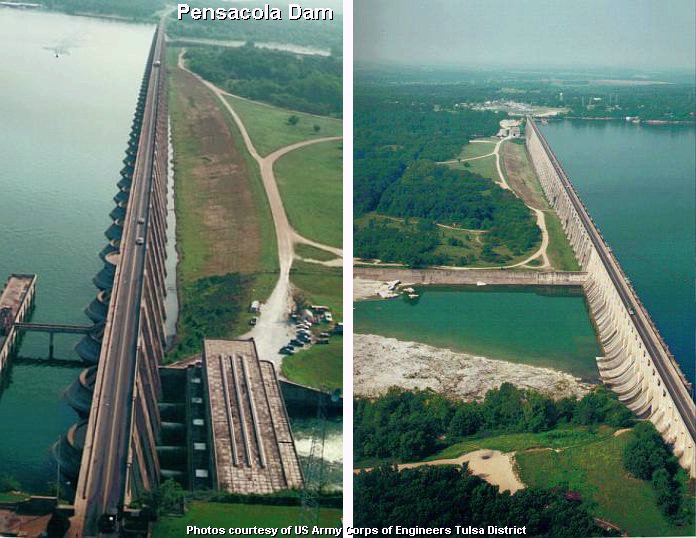
The Pensacola Dam, also known as the Grand River Dam, is a multiple-arch buttress dam located between the towns of Disney and Langley on the Grand River in Mayes County, Oklahoma. The dam is operated by the Grand River Dam Authority and creates Grand Lake o' the Cherokees. After decades of vision and planning, it was constructed between 1938 and 1940 for the purposes of hydroelectric power generation, flood control and recreation. It is Oklahoma's first hydroelectric power plant and is referred to as the longest multiple-arch dam in the world.
The idea to construct a dam on the Grand River originated in the late 1800s with Henry C. Holderman, a Cherokee Nation citizen, who wanted to provide electric power to the Cherokee Nation. Holderman and a few colleagues soon conducted the first survey of the river in 1895 on their own handmade houseboat. Holderman later left the United States at the age of 16 and worked on dam projects in India and Africa before returning to Oklahoma. He sold his land holdings and borrowed money from friends in order to purchase rights to the dam sites he had prospected. Over several decades, Holderman and a group known as the "Rainbow Chasers" tried to secure funding to construct the dam; making several trips to Washington DC.
The dam was almost built in 1914 by British capitalists but plans were halted due to World War I. In 1920, Holderman refused an offer given by Chicago businessmen and in 1929, the Wall Street Crash ended the hopes of Canadian engineers and investors building the dam for Holderman. In DC, supporters of the dam, which later included state and federal officials, argued for the dam as a source of hydroelectric power and that it could stimulate the state's economy but local energy providers opposed the possibility of a state-run electric utility. The onset of the Great Depression would revive and accelerate plans to construct the dam. Just prior in 1928, Oklahoma Representative Everette B. Howard secured $5,000 in funding for the U.S. Army Corps of Engineers to survey the Grand River. The results of the study concluded that it would cost over $6.2 million to construct a dam at the "Pensacola site" for flood control. The name "Pensacola" was derived from the only available means of identifying the site at the time: an old store on a Cherokee plantation. Because of limited state funding and a limited water supply on the Grand River, the project was not proposed at first for federal funding under the scope of hydroelectric power but instead for flood control.
Oklahoma established the Grand River Dam Authority (GRDA) on January 10, 1935. Eventually, on September 18, 1937, with the help of Oklahoma Representative Wesley E. Disney, Senator Elmer Thomas and engineer W. R. Holway, President Franklin D. Roosevelt approved $20 million in funding through the New Deal's Public Works Administration for the dam. The higher cost for the dam was attributed to a project that was approved for additional purposes, including hydroelectric power generation and recreation. Additional costs for the dam were covered by the state government and by GRDA municipal bond auctions which appropriated or raised $11 million. Disney had pushed much of the legislation for the dam, comparing the higher electric utility rates in Oklahoma compared to other states. Senator Thomas helped appropriate additional state and public funding for the dam while also being instrumental in its legislation.
Once approved and funded, Holway, the main engineer on the project and previous engineer of the nearby Spavinaw Dam, began survey and engineering work on October 25, 1937. The multiple-arch buttress design was adopted because materials were expensive at the time of the Great Depression and the limestone and chert foundation was considered "ideal" for the design. John Duncan Forsyth served as the architect for the dam and applied an Art Deco-style to it and the power house. Massman Construction Company out of Kansas City, Missouri was selected to construct the major superstructures, including the dam and power plant. Thousands of workers moved to the area to work on the dam before construction began and 3,000 eventually did, earning about $16 a week.
Initial construction began in February 1938 and included the excavation of over 1,600,000 yd3 (1,200,000 m3) of earth and rock. Workers also constructed the first cofferdam on the east side of the river and left it in place until the arches were above the normal water level. Once this was achieved, workers removed the east cofferdam and constructed another on the west side of the river to divert water from the location of the future power plant. On December 30, 1938, Massman began the first concrete pour. Pouring was conducted 24-hours a day for 20 months, totaling 510,000 yd3 (390,000 m3). A total of 23.9 million pounds of steel and iron were placed into the dam's structure to reinforce it. Major works on the dam were complete on March 21, 1940 and the lake was filled by the end of that year's summer. The dam's power plant, with four original hydroelectric generators, began commercial operation in 1941. The dam was finished in 26 months, ahead of schedule. Much of this was attributed to eastern Oklahoma having its 18 driest months on record during construction which alleviated obstacles from flooding. The federal government took control of the dam in November 1941 to aid in the World War II effort and returned it to the GRDA in 1946.
The construction of the Pensacola Dam resulted in the loss of 1,285 acres (520 ha) of Cherokee land and 802 acres (325 ha) of the Quapaw Indian Agency, most of which belonged to the Seneca-Cayuga Tribe. This land was condemned and later flooded by the reservoir in 1940. Half of the Seneca-Cayuga Elk River ceremonial area was flooded as well. Although losing significant portions of land, some tribe members were forced to find work on the dam project.
In the 1950s, two additional generators were added to the power station, bringing the total to six. Between 1995 and 2003, the dam's six hydroelectric generators were upgraded, bringing the installed capacity of the power plant from 92 MW to 120 MW and increasing its generation 20%. Each autumn, a generator was taken out of service, upgraded and returned to service by spring of the next year. The sixth and final generator upgrade was completed in May 2003. Among the components principally upgraded were the turbine shafts and runners.
Hub AI
Pensacola Dam AI simulator
(@Pensacola Dam_simulator)
Pensacola Dam
The Pensacola Dam, also known as the Grand River Dam, is a multiple-arch buttress dam located between the towns of Disney and Langley on the Grand River in Mayes County, Oklahoma. The dam is operated by the Grand River Dam Authority and creates Grand Lake o' the Cherokees. After decades of vision and planning, it was constructed between 1938 and 1940 for the purposes of hydroelectric power generation, flood control and recreation. It is Oklahoma's first hydroelectric power plant and is referred to as the longest multiple-arch dam in the world.
The idea to construct a dam on the Grand River originated in the late 1800s with Henry C. Holderman, a Cherokee Nation citizen, who wanted to provide electric power to the Cherokee Nation. Holderman and a few colleagues soon conducted the first survey of the river in 1895 on their own handmade houseboat. Holderman later left the United States at the age of 16 and worked on dam projects in India and Africa before returning to Oklahoma. He sold his land holdings and borrowed money from friends in order to purchase rights to the dam sites he had prospected. Over several decades, Holderman and a group known as the "Rainbow Chasers" tried to secure funding to construct the dam; making several trips to Washington DC.
The dam was almost built in 1914 by British capitalists but plans were halted due to World War I. In 1920, Holderman refused an offer given by Chicago businessmen and in 1929, the Wall Street Crash ended the hopes of Canadian engineers and investors building the dam for Holderman. In DC, supporters of the dam, which later included state and federal officials, argued for the dam as a source of hydroelectric power and that it could stimulate the state's economy but local energy providers opposed the possibility of a state-run electric utility. The onset of the Great Depression would revive and accelerate plans to construct the dam. Just prior in 1928, Oklahoma Representative Everette B. Howard secured $5,000 in funding for the U.S. Army Corps of Engineers to survey the Grand River. The results of the study concluded that it would cost over $6.2 million to construct a dam at the "Pensacola site" for flood control. The name "Pensacola" was derived from the only available means of identifying the site at the time: an old store on a Cherokee plantation. Because of limited state funding and a limited water supply on the Grand River, the project was not proposed at first for federal funding under the scope of hydroelectric power but instead for flood control.
Oklahoma established the Grand River Dam Authority (GRDA) on January 10, 1935. Eventually, on September 18, 1937, with the help of Oklahoma Representative Wesley E. Disney, Senator Elmer Thomas and engineer W. R. Holway, President Franklin D. Roosevelt approved $20 million in funding through the New Deal's Public Works Administration for the dam. The higher cost for the dam was attributed to a project that was approved for additional purposes, including hydroelectric power generation and recreation. Additional costs for the dam were covered by the state government and by GRDA municipal bond auctions which appropriated or raised $11 million. Disney had pushed much of the legislation for the dam, comparing the higher electric utility rates in Oklahoma compared to other states. Senator Thomas helped appropriate additional state and public funding for the dam while also being instrumental in its legislation.
Once approved and funded, Holway, the main engineer on the project and previous engineer of the nearby Spavinaw Dam, began survey and engineering work on October 25, 1937. The multiple-arch buttress design was adopted because materials were expensive at the time of the Great Depression and the limestone and chert foundation was considered "ideal" for the design. John Duncan Forsyth served as the architect for the dam and applied an Art Deco-style to it and the power house. Massman Construction Company out of Kansas City, Missouri was selected to construct the major superstructures, including the dam and power plant. Thousands of workers moved to the area to work on the dam before construction began and 3,000 eventually did, earning about $16 a week.
Initial construction began in February 1938 and included the excavation of over 1,600,000 yd3 (1,200,000 m3) of earth and rock. Workers also constructed the first cofferdam on the east side of the river and left it in place until the arches were above the normal water level. Once this was achieved, workers removed the east cofferdam and constructed another on the west side of the river to divert water from the location of the future power plant. On December 30, 1938, Massman began the first concrete pour. Pouring was conducted 24-hours a day for 20 months, totaling 510,000 yd3 (390,000 m3). A total of 23.9 million pounds of steel and iron were placed into the dam's structure to reinforce it. Major works on the dam were complete on March 21, 1940 and the lake was filled by the end of that year's summer. The dam's power plant, with four original hydroelectric generators, began commercial operation in 1941. The dam was finished in 26 months, ahead of schedule. Much of this was attributed to eastern Oklahoma having its 18 driest months on record during construction which alleviated obstacles from flooding. The federal government took control of the dam in November 1941 to aid in the World War II effort and returned it to the GRDA in 1946.
The construction of the Pensacola Dam resulted in the loss of 1,285 acres (520 ha) of Cherokee land and 802 acres (325 ha) of the Quapaw Indian Agency, most of which belonged to the Seneca-Cayuga Tribe. This land was condemned and later flooded by the reservoir in 1940. Half of the Seneca-Cayuga Elk River ceremonial area was flooded as well. Although losing significant portions of land, some tribe members were forced to find work on the dam project.
In the 1950s, two additional generators were added to the power station, bringing the total to six. Between 1995 and 2003, the dam's six hydroelectric generators were upgraded, bringing the installed capacity of the power plant from 92 MW to 120 MW and increasing its generation 20%. Each autumn, a generator was taken out of service, upgraded and returned to service by spring of the next year. The sixth and final generator upgrade was completed in May 2003. Among the components principally upgraded were the turbine shafts and runners.