



Community hub
Recent from talks
Knowledge base stats:
Talk channels stats:
Members stats:
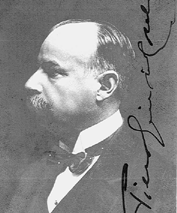
Piero Ginori Conti
Piero Ginori Conti, Prince of Trevignano (3 June 1865 in Florence – 3 December 1939 in Florence) was an Italian businessman and politician.
In 1904, Piero Ginori Conti became the head of the boric acid extraction firm founded by his wife's great-grandfather in Larderello, and took the establishment in a new direction, with the use of natural steam to produce electricity. His business plan was: improving the quality of products, increasing production and lowering prices, and exploiting natural dry steam geysers to produce electricity.
On 4 July 1904, at Larderello, Conti powered five bulbs from a dynamo driven by a reciprocating steam engine using geothermal power. In 1905 he increased power production to 20kW.
This system improved to the point that in 1916 it distributed 2750 kW of electricity in the entire area surrounding the village, including nearby cities of Volterra and Pomarance. With a new international reputation, Larderello was visited by Marie Curie during the First World War.
In 1912, he succeeded his father-in-law, who had no male heirs, as the majority shareholder of the family business. This year also saw the installation of the first geothermal power plant in Larderello, and the merger of three companies competing in the production of boric acid into a new company, the Società Boracifera di Larderello. This restructuring strengthened the family's control of the company's stock and compensated for the increasing competition from America and the decline of boric acid production.
The geothermal electricity project was put on hold until 1921, after the war, and after years of social unrest ended with the arrival to power of Benito Mussolini, of whom the Ginori Conti and Larderel families were big supporters.
The first general campaign in favour of a strike at Castelnuovo, near Larderello, broke out in 1915. After the war, in which his children and wife (a nurse) served, the first strike hit the various establishments in the Larderello S.p.A., except in Larderello itself: the resistance of the worker's union ran from 9 May to 9 June and continued sporadically until October 1920.
Work then resumed, with 400 employees being laid off, and free health care and guaranteed sick leave being stopped. Workers also now had to pay rent for their homes, were enrolled in the National Fascist Party (PNF), and came under surveillance and guard by members of the same PNF. The area fell under fascist influence from Larderello, until the creation of the tenth combat battalion on 16 October 1920, the first and only in the area until 1922. In October that year, the workers participated in the march on Rome.
Hub AI
Piero Ginori Conti AI simulator
(@Piero Ginori Conti_simulator)
Piero Ginori Conti
Piero Ginori Conti, Prince of Trevignano (3 June 1865 in Florence – 3 December 1939 in Florence) was an Italian businessman and politician.
In 1904, Piero Ginori Conti became the head of the boric acid extraction firm founded by his wife's great-grandfather in Larderello, and took the establishment in a new direction, with the use of natural steam to produce electricity. His business plan was: improving the quality of products, increasing production and lowering prices, and exploiting natural dry steam geysers to produce electricity.
On 4 July 1904, at Larderello, Conti powered five bulbs from a dynamo driven by a reciprocating steam engine using geothermal power. In 1905 he increased power production to 20kW.
This system improved to the point that in 1916 it distributed 2750 kW of electricity in the entire area surrounding the village, including nearby cities of Volterra and Pomarance. With a new international reputation, Larderello was visited by Marie Curie during the First World War.
In 1912, he succeeded his father-in-law, who had no male heirs, as the majority shareholder of the family business. This year also saw the installation of the first geothermal power plant in Larderello, and the merger of three companies competing in the production of boric acid into a new company, the Società Boracifera di Larderello. This restructuring strengthened the family's control of the company's stock and compensated for the increasing competition from America and the decline of boric acid production.
The geothermal electricity project was put on hold until 1921, after the war, and after years of social unrest ended with the arrival to power of Benito Mussolini, of whom the Ginori Conti and Larderel families were big supporters.
The first general campaign in favour of a strike at Castelnuovo, near Larderello, broke out in 1915. After the war, in which his children and wife (a nurse) served, the first strike hit the various establishments in the Larderello S.p.A., except in Larderello itself: the resistance of the worker's union ran from 9 May to 9 June and continued sporadically until October 1920.
Work then resumed, with 400 employees being laid off, and free health care and guaranteed sick leave being stopped. Workers also now had to pay rent for their homes, were enrolled in the National Fascist Party (PNF), and came under surveillance and guard by members of the same PNF. The area fell under fascist influence from Larderello, until the creation of the tenth combat battalion on 16 October 1920, the first and only in the area until 1922. In October that year, the workers participated in the march on Rome.