



Community hub
Recent from talks
Knowledge base stats:
Talk channels stats:
Members stats:
Radio Republik Indonesia
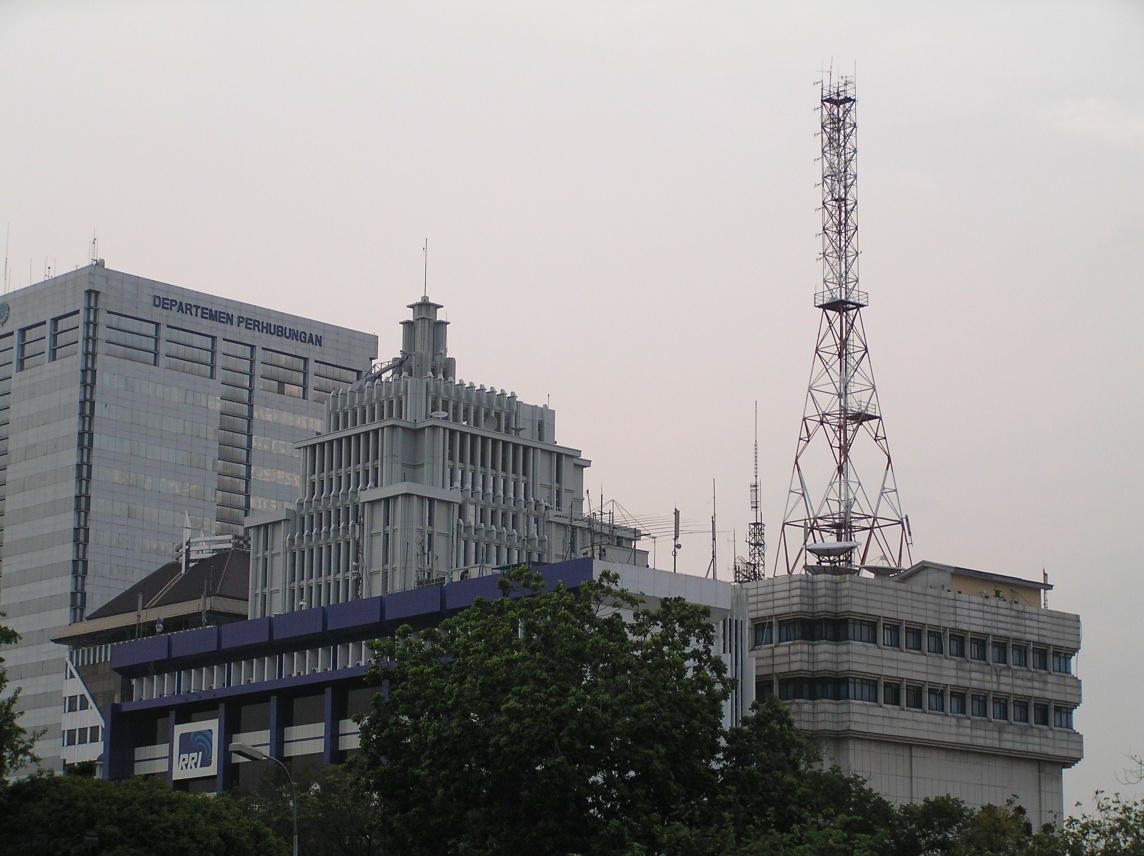
Radio Republik Indonesia (Radio of the Republic of Indonesia, abbreviated as RRI, stylized in all-lowercase logo) is a public radio network of Indonesia and one of Indonesia's two national Public Broadcasting Institutions, the other being the public television network TVRI. Founded on 11 September 1945, it is the first radio network in Indonesia and one of the oldest media company in the country. RRI headquarters are located on Medan Merdeka Barat Street in Central Jakarta, Jakarta.
RRI has four radio networks as well as visual radio channels, broadcasts all over Indonesia to serve all citizens throughout the nation. The network is supported by roughly 90 local stations, the largest of any radio network in the country. Through its overseas broadcasting division Voice of Indonesia, RRI also provides information about Indonesia to people around the world. Its funding primarily comes from annual state budget approved by the parliament, advertisement, and other services.
Radio Republik Indonesia was not actually the first radio station in Indonesia. The earliest radio station to begin broadcasting in what was then known as the Dutch East Indies was Bataviase Radio Vereniging (BRV), on 16 June 1925. At that time, BRV had two channels: "Stadzender" (Local Program) and "Archipelzender" (National Program). BRV broadcast from the Harmoni area of Jakarta (Batavia) and used Dutch in its programming.
The birth of BRV was followed by a number of other radio stations in a number of regions, such as the Nederlandsch-Indische Radio-Omroep Maatschappij (NIROM, Batavia); the Solosche Radio Vereniging (SRV, Soerakarta); the Eastern Radio Luisteraars (VORO, Bandoeng); the First Madioense Radio Omroep (ERVO, Madioen); and the Meyers Omroep voor Allen (MOVA, Medan). Almost all of them were privately owned at that time, except for NIROM. NIROM then developed into the largest radio station, by establishing communication lines via telephone with a number of cities, having central broadcasts transmitted from other cities such as Semarang, Bandoeng, Soerabaja, Soerakarta and Yogyakarta, plus having programs aimed at the local community. NIROM was born as a result of the issuance of the Radiowet by the colonial government in 1934 and received funding from the radio tax scheme (Luisterbijdrage).
Another radio station worth mentioning is SRV, which began operating on 1 April 1933, and was the first radio broadcaster owned by the Dutch East Indies' indigenous population. SRV was born from a collaboration between Surakarta nobleman Mangkunegara VII and Sarsito Mangunkusumo. After SRV emerged, other indigenous radio stations such as MARVO, VORL, CIRVO, EMRO, and Radio Semarang emerged. Initially, there was a mutual symbiosis between NIROM and these radio stations, but NIROM later became concerned about threats from national radio broadcasts. As a result of NIROM's efforts to sever this partnership, Volksraad member Sutardjo Kartohadikusumo and Sarsito Mangunkusumo (a pioneer of SRV) then gathered the administrators of indigenous radio stations on 29 March 1937 in Bandoeng. This meeting agreed to establish a forum called the Eastern Radio Association (PPPK) as a forum for their collaboration. Although a collaboration between PPPK and NIROM was later agreed upon, whereby PPPK radio stations would provide programming while NIROM would provide technical assistance, efforts continued to ensure PPPK members could broadcast independently. The first PPPK program broadcast via NIROM was broadcast on 1 November 1940.
With the fall of the Dutch East Indies to the Empire of Japan in March 1942, Japan disbanded private radio stations and implemented broadcasts centrally through the establishment of Pusat Jawatan Radio (Radio Bureau Center (放送管理局, Hōsō Kanri Kyoku)). Their respective branches include Jawatan Radio (Radio Bureau (放送局, Hōsō Kyoku)), which covers 8 cities and Shodanso which is tasked with monitoring the use of radio so that people do not listen to foreign radio broadcasts. Japan clearly saw the importance of radio as a tool propaganda, based on experience through Radio Tokyo (now NHK) broadcasts which at around 10 pm were very well received by the Indonesian people. Radio was actually used as a propaganda tool, containing war news and prohibitions on listening to foreign languages and songs.
Just as when the Dutch surrendered in 1942, radio again played a crucial role during the proclamation of independence in 1945. For example, news of Japan's defeat was secretly obtained from the BBC World Service on 14 August 1945 by young people. The proclamation of independence on 17 August 1945 made the young people want to seize this important means of communication, with the aim of spreading the news of the proclamation. In Bandoeng, the Hoso Kyoku branch there was seized, albeit with bloodshed, with a replacement radio station, Siaran Radio Republik Indonesia Bandung, used to read the proclamation news by three young men named Sakti Alamsyah, Odas Sumadilaga, and R.A. Darya. In Soerabaja, to deceive the occupying government, the proclamation broadcast was read in Madurese, while in Jakarta, Joesoef Ronodipoero emerged as a hero for his efforts to read the broadcast at 7:00 pm despite being tortured by Japanese soldiers. Knowing this, the occupying government then sealed the radio broadcasts that had been going on since 19 August 1945. The independence figures also used strategies to continue broadcasting this important news, such as through illegal broadcasts which were successfully used by President Sukarno to give a speech on 25 August 1945.
The radio fighters realized how important these radio facilities were in anticipating the worst possible outcome, namely the return of British and Dutch troops to Indonesia. Over time, the Japanese occupation government and its troops lost interest in maintaining these radio stations. The youth began planning to seize and operate the existing radio stations, thanks to Ronodipuro's suggestion to Abdul Rahman Saleh. On 10 September 1945, regional radio leaders from Soerakarta, Djogjakarta, Bandoeng, Semarang and Poerwokerto held a meeting to agree on a plan to force the Japanese army to immediately hand over the Hoso Kyoku station to the fighters. They also intended to inform the government of this, through a meeting on 11 September at 5:00 pm in the Pejambon area of Jakarta at the suggestion of one of the radio figures, Oetojo Ramelan. However, the response of the Ministry of the State Secretariat A.G. Pringgodigdo was to reject the proposal to seize the Japanese radio stations in favor of creating a united radio broadcast, fearing that it would lead to conflict with the Allies.
Hub AI
Radio Republik Indonesia AI simulator
(@Radio Republik Indonesia_simulator)
Radio Republik Indonesia
Radio Republik Indonesia (Radio of the Republic of Indonesia, abbreviated as RRI, stylized in all-lowercase logo) is a public radio network of Indonesia and one of Indonesia's two national Public Broadcasting Institutions, the other being the public television network TVRI. Founded on 11 September 1945, it is the first radio network in Indonesia and one of the oldest media company in the country. RRI headquarters are located on Medan Merdeka Barat Street in Central Jakarta, Jakarta.
RRI has four radio networks as well as visual radio channels, broadcasts all over Indonesia to serve all citizens throughout the nation. The network is supported by roughly 90 local stations, the largest of any radio network in the country. Through its overseas broadcasting division Voice of Indonesia, RRI also provides information about Indonesia to people around the world. Its funding primarily comes from annual state budget approved by the parliament, advertisement, and other services.
Radio Republik Indonesia was not actually the first radio station in Indonesia. The earliest radio station to begin broadcasting in what was then known as the Dutch East Indies was Bataviase Radio Vereniging (BRV), on 16 June 1925. At that time, BRV had two channels: "Stadzender" (Local Program) and "Archipelzender" (National Program). BRV broadcast from the Harmoni area of Jakarta (Batavia) and used Dutch in its programming.
The birth of BRV was followed by a number of other radio stations in a number of regions, such as the Nederlandsch-Indische Radio-Omroep Maatschappij (NIROM, Batavia); the Solosche Radio Vereniging (SRV, Soerakarta); the Eastern Radio Luisteraars (VORO, Bandoeng); the First Madioense Radio Omroep (ERVO, Madioen); and the Meyers Omroep voor Allen (MOVA, Medan). Almost all of them were privately owned at that time, except for NIROM. NIROM then developed into the largest radio station, by establishing communication lines via telephone with a number of cities, having central broadcasts transmitted from other cities such as Semarang, Bandoeng, Soerabaja, Soerakarta and Yogyakarta, plus having programs aimed at the local community. NIROM was born as a result of the issuance of the Radiowet by the colonial government in 1934 and received funding from the radio tax scheme (Luisterbijdrage).
Another radio station worth mentioning is SRV, which began operating on 1 April 1933, and was the first radio broadcaster owned by the Dutch East Indies' indigenous population. SRV was born from a collaboration between Surakarta nobleman Mangkunegara VII and Sarsito Mangunkusumo. After SRV emerged, other indigenous radio stations such as MARVO, VORL, CIRVO, EMRO, and Radio Semarang emerged. Initially, there was a mutual symbiosis between NIROM and these radio stations, but NIROM later became concerned about threats from national radio broadcasts. As a result of NIROM's efforts to sever this partnership, Volksraad member Sutardjo Kartohadikusumo and Sarsito Mangunkusumo (a pioneer of SRV) then gathered the administrators of indigenous radio stations on 29 March 1937 in Bandoeng. This meeting agreed to establish a forum called the Eastern Radio Association (PPPK) as a forum for their collaboration. Although a collaboration between PPPK and NIROM was later agreed upon, whereby PPPK radio stations would provide programming while NIROM would provide technical assistance, efforts continued to ensure PPPK members could broadcast independently. The first PPPK program broadcast via NIROM was broadcast on 1 November 1940.
With the fall of the Dutch East Indies to the Empire of Japan in March 1942, Japan disbanded private radio stations and implemented broadcasts centrally through the establishment of Pusat Jawatan Radio (Radio Bureau Center (放送管理局, Hōsō Kanri Kyoku)). Their respective branches include Jawatan Radio (Radio Bureau (放送局, Hōsō Kyoku)), which covers 8 cities and Shodanso which is tasked with monitoring the use of radio so that people do not listen to foreign radio broadcasts. Japan clearly saw the importance of radio as a tool propaganda, based on experience through Radio Tokyo (now NHK) broadcasts which at around 10 pm were very well received by the Indonesian people. Radio was actually used as a propaganda tool, containing war news and prohibitions on listening to foreign languages and songs.
Just as when the Dutch surrendered in 1942, radio again played a crucial role during the proclamation of independence in 1945. For example, news of Japan's defeat was secretly obtained from the BBC World Service on 14 August 1945 by young people. The proclamation of independence on 17 August 1945 made the young people want to seize this important means of communication, with the aim of spreading the news of the proclamation. In Bandoeng, the Hoso Kyoku branch there was seized, albeit with bloodshed, with a replacement radio station, Siaran Radio Republik Indonesia Bandung, used to read the proclamation news by three young men named Sakti Alamsyah, Odas Sumadilaga, and R.A. Darya. In Soerabaja, to deceive the occupying government, the proclamation broadcast was read in Madurese, while in Jakarta, Joesoef Ronodipoero emerged as a hero for his efforts to read the broadcast at 7:00 pm despite being tortured by Japanese soldiers. Knowing this, the occupying government then sealed the radio broadcasts that had been going on since 19 August 1945. The independence figures also used strategies to continue broadcasting this important news, such as through illegal broadcasts which were successfully used by President Sukarno to give a speech on 25 August 1945.
The radio fighters realized how important these radio facilities were in anticipating the worst possible outcome, namely the return of British and Dutch troops to Indonesia. Over time, the Japanese occupation government and its troops lost interest in maintaining these radio stations. The youth began planning to seize and operate the existing radio stations, thanks to Ronodipuro's suggestion to Abdul Rahman Saleh. On 10 September 1945, regional radio leaders from Soerakarta, Djogjakarta, Bandoeng, Semarang and Poerwokerto held a meeting to agree on a plan to force the Japanese army to immediately hand over the Hoso Kyoku station to the fighters. They also intended to inform the government of this, through a meeting on 11 September at 5:00 pm in the Pejambon area of Jakarta at the suggestion of one of the radio figures, Oetojo Ramelan. However, the response of the Ministry of the State Secretariat A.G. Pringgodigdo was to reject the proposal to seize the Japanese radio stations in favor of creating a united radio broadcast, fearing that it would lead to conflict with the Allies.