


Community hub
Recent from talks
Contribute something
Nothing was collected or created yet.
Rio PMP300
View on Wikipedia
The Rio PMP300 is one of the first portable consumer MP3 digital audio players, and the first commercially successful one. Produced by Diamond Multimedia, it was introduced September 15, 1998[1] as the first in the "Rio" series of digital audio players, and it shipped later that year.
Features
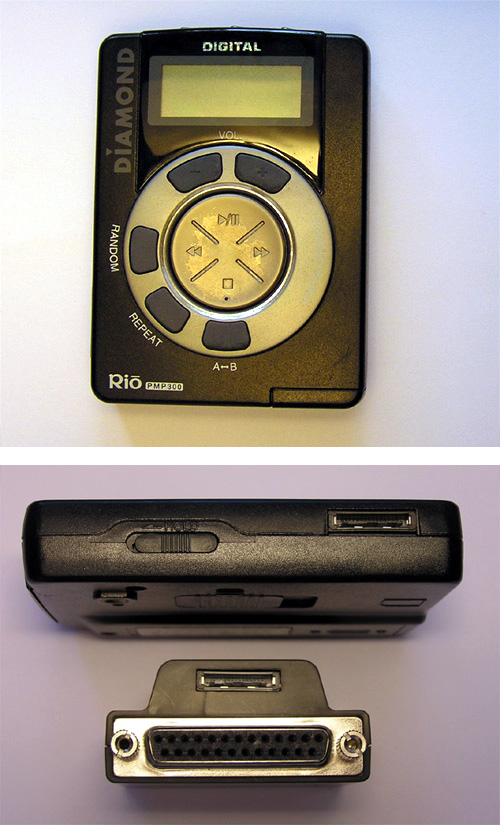
[edit]Roughly the dimensions of a deck of cards (3.5 inches by 2.5 inches and 0.625 inches thick), the Rio is black, and features an LCD screen and a circular pad with control buttons. The device has controls for skipping tracks forwards or backwards, repeat, random play and four preset equalizer settings. The LCD displays the track number being played and the track play time. It can play MP2 and MP3 format audio files, and has support for a variety of bitrates, including MP3 variable-bitrate (VBR) support.
It shipped with 32 MB of internal memory and has a SmartMedia slot, allowing users to add additional memory. It is powered by a single AA battery, which provides between 8 and 12 hours of playback time. Connection to a personal computer is through the computer's parallel port, with a proprietary connector on the Rio's edge.
The Rio retailed for US $200 with the ability to hold around 30 minutes of music at a bitrate of 128 kbit/s. An upgraded version was later released, which is colored translucent green and equipped with a larger 64 MB internal memory, at a cost of $250. The Rio also spawned one of the first Digital Music service providers (ASP or SaaS Cloud Service), RioPort. RioPort was the first digital music service to license secure, single-track commercial downloads from major record labels.[2]
The Rio PMP300 was supplied with a copy of the "Music Match" software for managing the user's MP3 library. A selection of folk/country/blues MP3s were also provided, the metadata for which was in a Music Match specific format rather than as ID3 tags.
Design flaws
[edit]The Rio PMP300 suffered from a few design flaws. The battery compartment door flap is notorious for breaking. The battery cover is difficult to repair due to the stress caused by the spring-loaded battery compartment and the fragile plastic used for the door clips. The metal hinge used to hold the compartment to the base of the unit would put strain on the plastic casing, causing cracks around the SmartMedia slot. The silver colored coating on the main central control button in the original 32 MB unit would often peel and flake off with use. The control disc would commonly fall off.[citation needed]
Legal disputes
[edit]On October 8, 1998, the Recording Industry Association of America, filed suit and asked for a temporary restraining order to prevent the sale of the Rio player in the Central District Court of California, claiming the player violated the 1992 Audio Home Recording Act.
Judge Andrea Collins issued the temporary order on October 16, but required the RIAA to post a $500,000 bond that would be used to compensate Diamond for damages incurred in the delay if Diamond eventually prevailed in court. Diamond then announced that it would temporarily delay shipment of the Rio.
On October 26, Judge Collins denied the RIAA's application.[3][4] On appeal, the Ninth Circuit held that the Rio's space shifting was fair use and not a copyright infringement.[5]
After the lawsuit ended, Diamond sold 200,000 players.[6]
Software support
[edit]Diamond no longer provides support for the Rio, and the last version of Microsoft Windows to work with Diamond's Rio software was Windows 98. Independently produced freeware programs such as "Dreaming of Brazil" or "RIOsitude" can still be used to upload audio files to the player. Similarly, limited Linux command-line based support for the Rio is provided by the "rioutils" package.
Rivals
[edit]Market rivals of the Diamond Rio included the original RCA Lyra and the Creative Nomad.[7]
See also
[edit]- Eiger Labs MPMan F10 – the first portable MP3 player
References
[edit]- ^ "Portable MP3 Player Announced - Harmony Central". Archived from the original on 2013-11-13. Retrieved 2013-11-13.
- ^ King, Brad (April 4, 2001). "MTV Gets Down with Downloads". Wired.com. Archived from the original on April 29, 2008. Retrieved 2010-01-10.
- ^ Starrett, Robert A. (January 1999). "RIAA loses bid for injunction to stop sale of Diamond Multimedia RIO MP3 Player; appeal pending". Emedia Professional. ISSN 1090-946X. Archived from the original on October 18, 2006. Retrieved 2009-03-10.
- ^ Clampet, Elizabeth (June 16, 1999). "Court OKs Diamond Rio MP3 Player". InternetNews.com. Retrieved 2009-03-10.
- ^ RIAA v. Diamond Multimedia, 180 F.3d 1072 (9th Cir. 1999).
- ^ Knopper, Steve (2009). Appetite for Self-Destruction. New York: Free Press. p. 166. ISBN 978-1-4165-5215-4.
- ^ "Mobile-review.com История торговой марки Rio Audio". mobile-review.com.
External links
[edit]- A review of Rio PMP300 at The Adrenaline Vault
- Original Rio PMP300 product page, from Archive.org, mentioning two of the first digital music services: Goodnoise and MP3.com
- Original Rio PMP300 MP3 Music Sampler disc, from Archive.org, containing the selection of songs included with the player
Rio PMP300
View on GrokipediaDevelopment and Release
Origins and Specifications
The Rio PMP300 was developed by Diamond Multimedia, a California-based company founded in 1982 that initially focused on graphics and sound cards, to capitalize on the emerging popularity of MP3 audio compression technology in the late 1990s.[1] Announced on September 15, 1998, it represented the first entry in the Rio series of portable digital audio players and was marketed as a compact device for on-the-go playback of compressed music files stored on flash memory.[7] The player launched amid growing internet file-sharing trends but faced immediate legal scrutiny from the Recording Industry Association of America (RIAA) over potential copyright implications, though this did not halt its commercial release later that year.[8] Diamond Multimedia positioned the PMP300 as the first commercially viable flash-based MP3 player, retailing for $200 and emphasizing ease of use with bundled software for encoding and transferring files via a parallel port connection. Its development drew on advancements in non-volatile memory and digital signal processing to deliver CD-quality audio in a pocket-sized form factor, roughly the size of a deck of playing cards.[9] Key specifications of the Rio PMP300 included:| Feature | Specification |
|---|---|
| Dimensions | 3.5 × 2.5 × 0.625 inches |
| Weight | 70 grams (2.4 ounces) |
| Storage | 32 MB internal flash memory (approximately 60 minutes of MP3 audio at 128 kbps)[4] |
| Audio Formats | MP3, MP2 |
| Battery Life | Up to 12 hours on a single AA alkaline battery[10] |
| Audio Output | Headphone jack; signal-to-noise ratio >90 dB; total harmonic distortion <0.1% |
| Connectivity | 15-pin parallel port cable for PC file transfer |
| Additional Features | LCD display, four equalizer presets, support for variable bit rates |
Launch and Initial Availability
The Rio PMP300 was publicly announced by Diamond Multimedia on September 15, 1998, as a portable MP3 player designed for downloading and playback of compressed audio files via a parallel port connection to Windows PCs.[7] Initially priced at $200, it shipped with 32 MB of onboard flash memory, capable of storing roughly 10 average-length MP3 tracks encoded at 128 kbps, and supported expansion via removable SmartMedia cards up to 64 MB for additional storage. The planned October 1998 shipment was postponed following a temporary restraining order issued by a federal court on October 16 at the request of the Recording Industry Association of America (RIAA), which argued the device facilitated unauthorized copying in violation of the Audio Home Recording Act of 1992.[12][13] Diamond Multimedia contested the order, posting a $500,000 bond to cover potential losses, and shipments resumed later in 1998 after initial legal hurdles were navigated, enabling retail availability by December.[9] Early units were compact, measuring 3.5 by 2.5 by 0.625 inches and weighing 2.4 ounces, positioning it as one of the first mass-market portable digital audio devices amid nascent broadband infrastructure.[4]Technical Features
Hardware Design and Capabilities
The Rio PMP300 featured a compact design measuring 3.5 inches by 2.5 inches by 0.625 inches and weighing 70 grams (2.4 ounces), making it smaller than a deck of playing cards for enhanced portability.[10][4] It incorporated 32 megabytes of internal NAND flash memory, utilizing four Samsung 8 MB packages, sufficient for approximately 60 minutes of MP3 audio at a 128 kbps bitrate.[8][4] An expandable SmartMedia card slot allowed users to increase storage capacity beyond the onboard limit.[11] Power was supplied by a single replaceable AA battery, providing up to 12 hours of continuous playback for music, though voice recording extended runtime to around 16 hours due to lower data rates.[14] The device included a monochrome LCD display for basic track information and status indicators, alongside physical buttons for navigation, including forward/backward skip, play/pause, and mode selection for repeat or random playback.[5] Audio capabilities centered on digital playback of MP3 and MP2 formats, supporting variable bit rates and delivering CD-quality sound with a signal-to-noise ratio exceeding 90 dB and harmonic distortion below 0.1%.[10][8] Four preset equalizer settings enabled basic sound customization, while the output connected via included stereo headphones for portable listening.[8] Data transfer occurred through a parallel port adapter and 15-pin cable, compatible with Windows PCs for loading compressed audio files.[7]Operational Limitations
The Rio PMP300 featured 32 MB of internal flash memory, sufficient for approximately 60 minutes of MP3 playback at 128 kbps bitrate, equivalent to about 8-12 songs depending on compression levels.[4][11] This capacity was expandable via SmartMedia cards up to 32 MB, but the device's flash controller limited compatibility to smaller cards, restricting total storage to under 2 hours of music even with expansion.[11][5] Power was provided by a single AA battery, rated for 8-12 hours of continuous playback under optimal conditions, though real-world duration varied with volume and bitrate.[11][15] A common hardware flaw involved the spring-loaded battery compartment door, constructed from fragile plastic clips prone to breaking under repeated access, often causing the battery to dislodge during use and interrupt playback.[16][17] The monochrome LCD screen displayed only basic information, such as track number and elapsed play time, lacking support for artist, album, or file metadata visualization, which complicated navigation through playlists.[11] File transfer via serial connection was slow, often taking several minutes per song, and the player exhibited intermittent rejection of certain MP3 files due to rudimentary validation checks resembling early DRM attempts, though not full encryption.[8][16] Forward and backward skip controls were occasionally unresponsive, particularly after prolonged use, further hindering usability during active listening.[11] The device supported MP2 and MP3 formats across variable bitrates but omitted features like voice recording, equalization, or folder-based organization, confining operation to linear track sequencing or basic shuffle mode.[4][18]Legal Controversies
RIAA Lawsuit Initiation
The Recording Industry Association of America (RIAA) filed a complaint against Diamond Multimedia Systems, Inc. on October 9, 1998, in the United States District Court for the Central District of California (Case No. CV 98-08247-ABC-RZx).[19] The action targeted the Rio PMP300, Diamond's forthcoming portable MP3 player capable of storing and playing up to 32 minutes of compressed digital audio files downloaded from computers.[19] RIAA contended that the Rio qualified as a "digital audio recording device" under the Audio Home Recording Act of 1992 (AHRA), codified at 17 U.S.C. §§ 1001 et seq., which imposes obligations on manufacturers of such devices to pay royalties to rights holders and incorporate a serial copy management system (SCMS) to prevent successive generations of digital copies.[19][20] The association argued that Diamond's failure to comply with these requirements facilitated the unauthorized reproduction and distribution of copyrighted sound recordings, as the device lacked SCMS and enabled users to transfer MP3 files—often pirated—without technical restrictions on copying.[19][21] Concurrently with the complaint, RIAA submitted an ex parte application for a temporary restraining order (TRO) and order to show cause regarding a preliminary injunction, seeking to enjoin Diamond from manufacturing, importing, distributing, or selling the Rio PMP300 pending resolution of the suit.[19] This move aimed to preempt the device's commercial launch, scheduled for mid-October 1998, amid rising concerns over MP3 file sharing via the internet.[22] The filing reflected broader industry efforts to curb digital piracy, with RIAA representing major record labels holding copyrights to over 90% of sound recordings sold in the U.S. at the time.[20]Court Proceedings and Ruling
The lawsuit, Recording Industry Association of America v. Diamond Multimedia Systems, Inc., was filed by the RIAA in the U.S. District Court for the Central District of California on October 7, 1998, seeking a preliminary injunction to halt Diamond's manufacture and distribution of the Rio PMP300 on grounds that it violated the Audio Home Recording Act (AHRA) of 1992 by failing to incorporate serial copy management technology and pay royalties.[19] The RIAA argued the device qualified as a "digital audio recording device" under the AHRA, enabling unauthorized copying of copyrighted sound recordings.[23] On October 14, 1998, District Judge Ricardo M. Urbina denied the injunction, ruling that the Rio did not meet the AHRA's definition of a digital audio recording device because it required connection to a computer for downloading files and lacked direct analog or digital recording capabilities from standalone audio sources, functioning instead as a computer data storage peripheral akin to a hard drive or floppy disk.[19] The court further noted that even if subject to the AHRA, users' ripping of personal CDs for portable playback constituted fair use "space shifting," protected under precedents like Sony Corp. v. Universal City Studios, Inc. (1984), and that the RIAA failed to demonstrate irreparable harm or likelihood of success on contributory infringement claims absent direct evidence of widespread illegal use.[19] The RIAA appealed to the U.S. Court of Appeals for the Ninth Circuit, which heard arguments in early 1999. On June 15, 1999, a three-judge panel unanimously affirmed the district court's denial of injunctive relief, holding that the Rio's reliance on a computer intermediary for input excluded it from the AHRA's scope, as the statute targeted devices capable of direct serial copying of digital musical works without such mediation.[24] The appeals court rejected the RIAA's broader interpretation of the AHRA, emphasizing Congress's intent to regulate home audio equipment rather than computer peripherals, and reaffirmed space-shifting of lawfully owned recordings as noninfringing fair use, thereby clearing the Rio for continued sale without AHRA compliance.[24][25] The ruling effectively ended the litigation without a full trial on the merits, as the RIAA did not pursue further appeals to the Supreme Court, allowing Diamond to resume Rio production; subsequent settlements in related disputes confirmed no royalties were owed under the AHRA.[26][27]Software and Compatibility
Management Software
The Rio PMP300 relied on proprietary management software called Rio Manager, developed by Brava Software, Inc. in partnership with Diamond Multimedia Systems, Inc., to handle the transfer and organization of MP3 files from a host PC to the device.[4] Installation occurred via the bundled CD-ROM on Microsoft Windows 95 or 98 systems, requiring a Pentium 90 MHz or faster processor, 20 MB of free disk space, a parallel port, CD-ROM drive, and sound card; the setup process auto-launched or ran Setup.exe to install core components including Rio Manager.[4] Rio Manager facilitated file transfers over a parallel port using a 15-pin proprietary cable and adapter, supporting download speeds of approximately 100 Kbps (around 6 MB per minute), with progress indicated by the device's LED changing to Off/Stop upon completion.[4] The interface comprised three primary sections: an integrated MP3 player for previewing tracks on the PC, a playlist editor for sequencing files, and an internal memory editor displaying and managing the device's 32 MB built-in flash storage or compatible external 3.3V flash cards.[10][4] Users selected MP3 files via an Open dialog or drag-and-drop, restricting transfers to personally encoded content to comply with contemporary legal guidelines on copyrighted material.[4] The software package also included MusicMatch Jukebox, licensed from MusicMatch Corporation and optionally installed during setup, for ripping audio CDs into MP3 format at user-selectable bit rates, enabling the preparation of files for device compatibility.[4][7] This encoder supported personal use conversions, integrating with Rio Manager to streamline the workflow from CD to portable playback.[4] Owing to its dependence on parallel port connectivity and Windows 9x exclusivity, Rio Manager proved slow and cumbersome even in its era, with later user reports highlighting compatibility issues on modern hardware absent native parallel ports or without adapters and virtual machine emulation.[5] No official firmware updates or software revisions extended support beyond initial releases, rendering the ecosystem obsolete as USB-based alternatives proliferated by the early 2000s.[4]Connection Methods and End-of-Life Support
The Rio PMP300 connected to personal computers exclusively via the parallel (printer) port, utilizing a provided pass-through adapter that maintained compatibility with attached printers and a proprietary cable with a custom edge connector on the device.[4][10] File transfers required the bundled Rio Manager software, which handled MP3 encoding, track management, and DMA-based data transfer over the parallel interface at speeds sufficient for the era's 32 MB internal flash storage.[4] This method predated widespread USB adoption, reflecting 1998 hardware standards where parallel ports were ubiquitous on Windows PCs.[28] Official support for the PMP300 was confined to Windows 95 and 98 operating systems, with no drivers or updates developed for subsequent versions like Windows 2000 or XP.[11] Diamond Multimedia, the original manufacturer, ceased active development shortly after the device's 1998 launch amid legal challenges from the RIAA, and the Rio brand—acquired by S3 Graphics and later D&M Holdings—discontinued all portable audio player production in August 2005 without provisions for legacy device maintenance.[29] Contemporary users must rely on vintage hardware, such as parallel-port-equipped PCs running emulated Windows 98 environments, or unofficial reverse-engineered tools, as modern systems lack native parallel port support and compatible drivers.[11] No firmware updates were ever released beyond initial shipping versions, limiting compatibility to MP3 files at bitrates up to 128 kbps.[4]Market Reception and Competition
Sales Performance and User Feedback
The Rio PMP300, released in late October 1998 for $199.95, achieved commercial success as one of the earliest portable MP3 players, with sales exceeding 200,000 units worldwide by mid-1999 despite the ongoing RIAA lawsuit.[30] Some reports indicate over 400,000 units sold overall, reflecting strong initial demand that outstripped supply and positioned it as a market pioneer in a nascent category.[31] The lawsuit's publicity may have boosted visibility, though it also created uncertainty for Diamond Multimedia, limiting broader market penetration compared to later devices.[1] User feedback highlighted the device's portability and reliability, with praise for its solid-state flash memory enabling skip-free playback during movement— a significant improvement over contemporary portable CD players—along with lightweight design (70-109 grams) and up to 8 hours of battery life from a single AA cell.[31] [10] Reviewers noted its loud output and ability to handle variable bitrate MP3s, making it a "workhorse" for basic audio playback, especially when expanded via optional SmartMedia cards up to 64 MB total storage.[16] Criticisms centered on hardware and usability limitations inherent to 1990s technology, including the base 32 MB internal storage sufficient for only about 10-12 songs at typical bitrates, the cumbersome parallel port connection requiring proprietary cables and adapters that conflicted with other peripherals like printers, and frequent battery compartment door failures necessitating manual adjustments.[16] [11] Software compatibility issues, such as lack of native Windows 2000 support and slow file transfers, further frustrated users, though third-party tools like RIOsitude later mitigated some problems on modern systems.[16] [11] Overall, while valued for pioneering MP3 portability, feedback emphasized its niche appeal for early adopters tolerant of minimal features like absent resume play, equalizer, or FM radio.[16]Comparison with Contemporaries
The Rio PMP300, released on September 15, 1998, by Diamond Multimedia, entered a nascent market dominated by flash-based players with limited capacity. Its closest predecessor, the SaeHan MPMan F10 launched in March 1998, held a technical primacy as the first commercial portable MP3 player but suffered from restricted distribution outside Asia initially and a higher price point of approximately $250 for the 32 MB model.[32][33] In comparison, the Rio offered similar 32 MB internal flash storage—sufficient for roughly 10-12 average-length MP3 tracks at 128 kbps—yet achieved broader U.S. market penetration at $200, bolstered by aggressive marketing and a more intuitive button layout optimized for one-handed operation during activities like jogging.[8][11] Both devices eschewed expandable storage in base configurations, connecting via parallel ports to PCs for file transfers, and drew power from a single AA battery yielding 8-12 hours of playback, emphasizing portability over longevity. The Rio's edge lay in its sturdier construction and liquid crystal display showing track details, which reviewers noted as superior to the MPMan's rudimentary interface, though neither supported variable bitrate encoding or advanced features like equalization.[11][5] By 1999, competitors like the HanGo PJB-100 shifted paradigms with hard disk drive (HDD) storage, packing 4.8 GB or more to accommodate over 1,000 songs—dwarfing the Rio's constraints—but at the expense of bulk (150 × 80 × 26 mm, 280 g) and vulnerability to shocks from moving parts. The PJB-100's 10-11 hour battery life mirrored the Rio's, yet its higher cost and fragility limited appeal for active use, positioning the flash-based Rio as more reliable for on-the-go scenarios despite the HDD players' capacity advantage.[34]| Feature | Rio PMP300 (1998) | SaeHan MPMan F10 (1998) | HanGo PJB-100 (1999) |
|---|---|---|---|
| Storage | 32 MB flash (base; optional cards) | 32 MB flash (up to 128 MB variants) | 4.8+ GB HDD |
| Capacity (approx. songs) | 10-12 | 10-12 | 1,000+ |
| Price (base) | $200 | $250 | Not widely documented; premium |
| Battery Life | 8-12 hours (1× AA) | Similar (1× AA) | 10-11 hours |
| Connection | Parallel port | Parallel port | PC transfer (details vary) |
| Weight/Portability | Compact, shock-resistant | 62 g, highly portable | 280 g, bulkier |