Hubbry Logo
Robin Wall KimmererRobin Wall KimmererMain
Open search
Robin Wall Kimmerer
Community hub
Robin Wall Kimmerer
logo
8 pages, 0 posts
0 subscribers
Be the first to start a discussion here.
Robin Wall Kimmerer
Robin Wall Kimmerer
from Wikipedia

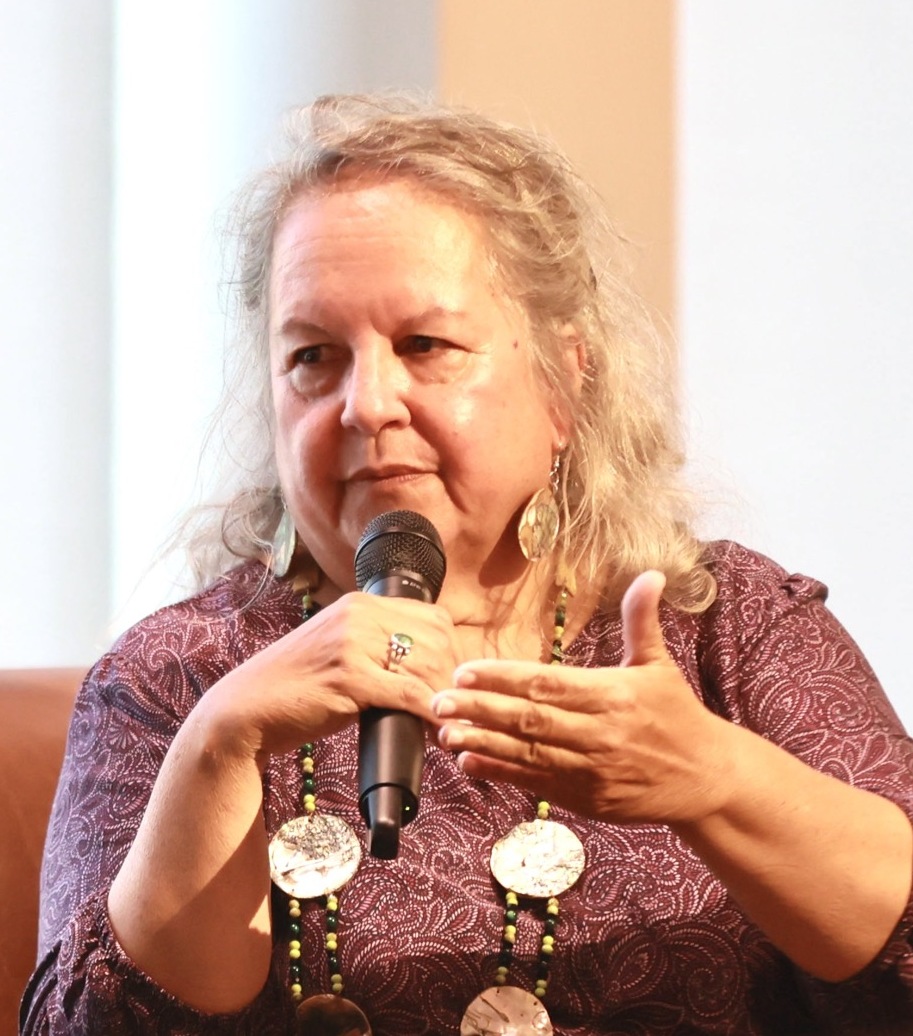
Robin Wall Kimmerer (born September 13, 1953) is a Potawatomi botanist, author, and the director of the Center for Native Peoples and the Environment at the State University of New York College of Environmental Science and Forestry (SUNY-ESF).

Key Information

As a scientist and a Native American, Kimmerer is informed in her work by both Western science and Indigenous environmental knowledge.[1]

Kimmerer has written numerous scientific articles and the books Gathering Moss: A Natural and Cultural History of Mosses (2003), Braiding Sweetgrass: Indigenous Wisdom, Scientific Knowledge, and the Teachings of Plants (2013), The Democracy of Species (2021) and The Serviceberry: Abundance and Reciprocity in the Natural World (2024). She narrated an audiobook version of Braiding Sweetgrass, released in 2016. Braiding Sweetgrass was republished in 2020 with a new introduction.

Early life and education

[edit]

Robin Wall Kimmerer was born in 1953 in upstate New York to Robert and Patricia Wall. Her enthusiasm for the environment was encouraged by her parents and her time outdoors inspired a deep appreciation for the natural environment. Kimmerer is an enrolled citizen of the Citizen Potawatomi Nation.[2]

Kimmerer remained near home for college, attending State University of New York College of Environmental Science and Forestry and receiving a bachelor's degree in botany in 1975. She spent two years working for Bausch & Lomb as a microbiologist. Kimmerer then moved to Wisconsin to attend the University of Wisconsin–Madison, earning her master's degree in botany there in 1979, followed by her PhD in plant ecology in 1983. It was while studying forest ecology as part of her degree program that she first learnt about mosses, which became the scientific focus of her career.[3]

Career

[edit]
Rainforest moss

From Wisconsin, Kimmerer moved to Kentucky, where she briefly taught at Transylvania University in Lexington, before moving to Danville, Kentucky, where she taught biology, botany, and ecology at Centre College. Kimmerer received tenure at Centre College. In 1993, at age 40 Kimmerer returned home to upstate New York and her alma mater, ESF, where she currently teaches.[citation needed]

Kimmerer teaches in the Environmental and Forest Biology Department at ESF. She teaches courses on land and culture, traditional ecological knowledge, ethnobotany, ecology of mosses, disturbance ecology, and general botany. She is the director of the newly established Center for Native Peoples and the Environment at ESF, which is part of her work to provide programs that allow for greater access for Indigenous students to study environmental science, and for science to benefit from the wisdom of Native philosophy to reach the common goal of sustainability.[4]

Kimmerer's grandfather attended Carlisle Indian Industrial School.

Kimmerer is a proponent of the Traditional Ecological Knowledge (TEK) approach, which she describes as a "way of knowing". TEK is an empirical approach based on long-term observation and relationship. The approach also involves cultural and spiritual considerations, often marginalized by the Western scientific community. As a botanist trained and published in Western science, she has high regard for both worldviews and their distinct practices. "Two-eyed seeing" is how she portrays the utilization of both.[5] She also speaks in favor of communication modes unique to each of the two realms. As a university professor, academic papers were essential in the early part of her career. In her elder years she exemplifies the power of orally presented Indigenous stories for an outcome that science makes no attempt to achieve: conveyance and indirect advocacy of values.[5]

Kimmerer's efforts are motivated in part by her family history. Her paternal grandfather, also a Citizen Potawatomi, received an assimilationist education at the Carlisle Indian Industrial School in Carlisle, Pennsylvania. The school was one of the first American Indian boarding schools, which set out to "civilize" Native children, forbidding residents from speaking their language and effectively erasing their Native culture. Knowing how important it is to maintain the Potawatomi language, Kimmerer took Potawatomi language classes to learn how to speak it because "when a language dies, so much more than words are lost".[6][7]

Her current work spans traditional ecological knowledge, moss ecology, outreach to Indigenous communities, and creative writing.

Professional service

[edit]

Kimmerer has helped sponsor the Undergraduate Mentoring in Environmental Biology (UMEB) project, which pairs students of color with faculty members in the enviro-bio sciences while they work together to research environmental biology. Kimmerer is also a part of the United States Department of Agriculture's Higher Education Multicultural Scholars Program. The program provides students with real-world experiences that involve complex problem-solving. Kimmerer is also involved in the American Indian Science and Engineering Society (AISES), and works with the Onondaga Nation's school doing community outreach. Kimmerer also uses traditional knowledge and science collectively for ecological restoration in research. She has served on the advisory board of the Strategies for Ecology Education, Development and Sustainability (SEEDS) program, a program to increase the number of minority ecologists. Kimmerer is also the former chair of the Ecological Society of America Traditional Ecological Knowledge Section.

In April 2015, Kimmerer was invited to participate as a panelist at a United Nations plenary meeting to discuss how harmony with nature can help to conserve and sustainably use natural resources, titled "Harmony with Nature: Towards achieving sustainable development goals including addressing climate change in the post-2015 Development Agenda".[8][9]

Honors and awards

[edit]

Kimmerer received the John Burroughs Medal Award for her book, Gathering Moss: A Natural and Cultural History of Mosses.[10] Her first book, it incorporated her experience as a plant ecologist and her understanding of traditional knowledge about nature. Her second book, Braiding Sweetgrass: Indigenous Wisdom, Scientific Knowledge, and the Teachings of Plants, received the 2014 Sigurd F. Olson Nature Writing Award.[11] Braiding Sweetgrass is about the interdependence of people and the natural world, primarily the plant world. She won a second Burroughs award for an essay, "Council of the Pecans", that appeared in Orion magazine in 2013.[10] Within ten years of its publication, more than two million copies had been sold worldwide.[12] Kimmerer received an honorary M.Phil. degree in Human Ecology from College of the Atlantic on June 6, 2020.[13]

In 2022, Kimmerer was awarded a MacArthur Fellowship.[14] In 2025 she was included on the Time 100 list of influential people.[15]

Books

[edit]
  • Gathering Moss: A Natural and Cultural History of Mosses (Oregon State University Press, 2003) ISBN 0-87071-499-6.
  • Braiding Sweetgrass: Indigenous Wisdom, Scientific Knowledge, and the Teachings of Plants (Milkweed Editions, 2013) ISBN 9781571313355.
  • The Serviceberry (Scribner, November 19, 2024) ISBN 9781668072240 about how the serviceberry by sharing its abundance with its ecosystem embodies interdependence and mutual support
  • Bud Finds Her Gift (HarperCollins, September 30, 2025) ISBN 9780063324428, children s book

References

[edit]

Further reading

[edit]
[edit]
Revisions and contributorsEdit on WikipediaRead on Wikipedia
from Grokipedia

Robin Wall Kimmerer (born 1953) is an American botanist, plant ecologist, and author affiliated with the Citizen Potawatomi Nation, known for integrating empirical ecological research with traditional indigenous knowledge in her writings and teaching. She holds a BS in botany from the State University of New York College of Environmental Science and Forestry (SUNY-ESF), along with MS and PhD degrees in botany from the University of Wisconsin–Madison, and has published peer-reviewed papers on moss ecology, restoration ecology, and the ecological roles of bryophytes. As a SUNY Distinguished Teaching Professor at SUNY-ESF, she directs the Center for Native Peoples and the Environment, which promotes the incorporation of indigenous perspectives into environmental science curricula and research. Her book Braiding Sweetgrass: Indigenous Wisdom, Scientific Knowledge, and the Teachings of Plants (2013) achieved widespread commercial success as a New York Times bestseller, advocating for reciprocal relationships between humans and ecosystems based on both scientific observation and Potawatomi traditions. Earlier work includes Gathering Moss: A Natural and Cultural History of Mosses (2003), which received the John Burroughs Medal for distinguished nature writing. In 2022, she was awarded a MacArthur Fellowship for her contributions to bridging Western science and indigenous ecological stewardship.

Early Life and Background

Family Heritage and Upbringing

Robin Wall Kimmerer was born in 1953 to Robert and Patricia Wall in rural upstate New York. Her family background includes both European and Anishinaabe ancestry, with Kimmerer enrolled as a member of the Citizen Potawatomi Nation, an indigenous group originally from the Great Lakes region. She traces her Potawatomi lineage to the Vieux/Johnson family, noting that her immediate relatives relocated to New York State through historical displacements, including her grandfather's attendance at a Native American boarding school. Kimmerer's upbringing emphasized immersion in the natural environment, as she spent much of her childhood exploring forests and countryside near her home, fostering an early affinity for and . Although not raised in a traditional community, her family maintained elements of indigenous values, with parents and sisters encouraging her curiosity about the natural world. Over time, her household began rekindling traditions and teachings, which later informed her integration of indigenous knowledge with scientific perspectives. This blended heritage—marked by historical fragmentation due to policies like in boarding schools—shaped her worldview without a fully intact cultural enclave during her formative years.

Indigenous Identity and Cultural Influences

Robin Wall Kimmerer is an enrolled member of the , a federally recognized tribe descended from peoples originally from the , with her ancestry including both European and indigenous lineages. She traces her roots to the Vieux/Johnson family line. Her family's history reflects patterns of forced displacement and assimilation common among Potawatomi bands following the 1830s Indian Removal policies, with immediate relatives relocating to New York State after attending U.S. government boarding schools designed to eradicate indigenous languages and customs. Kimmerer's grandfather was sent from to the in around the early , an institution established in to impose Euro-American and labor training on Native children, often through coercive separation from families and cultural suppression; he settled in New York upon leaving. Raised in upstate New York's maple forests amid a predominantly non-Native community, Kimmerer was nonetheless instilled with values through her mother's transmission of traditional stories and ethical principles emphasizing human responsibility toward the land. This upbringing fostered an early attunement to the reciprocal relationships central to cosmology, where humans are seen as kin to plants, animals, and ecosystems, obligating mutual care rather than exploitation. These cultural influences, tempered by her family's assimilation experiences, have driven Kimmerer's efforts to reclaim and disseminate indigenous ecological knowledge, contrasting the extractive legacies of eras with sustainable practices rooted in observation of natural systems over generations. She articulates this synthesis in her scientific work, arguing that indigenous principles like reciprocity—defined as giving back to nature in exchange for its gifts—provide causal mechanisms for , as evidenced in restoration projects where cultural practices enhance .

Education and Early Career

Academic Training

Kimmerer earned a degree in from the College of and (SUNY ESF) in 1975. She then pursued graduate studies at the University of Wisconsin-Madison, obtaining a degree in in 1978 and a degree in , with a focus on , in 1983.

Initial Research and Professional Entry

Following her PhD in from the University of Wisconsin-Madison in 1983, Robin Wall Kimmerer began her professional career as a plant ecologist, focusing on population biology. Her doctoral work and subsequent research emphasized reproduction, vegetative , and community dynamics in non-vascular , contributing empirical data to understanding resilience in disturbed habitats. These studies involved field observations and experiments quantifying factors like substrate preferences and dispersal mechanisms, which informed early models of bryophyte ecology. Kimmerer's entry into academia occurred through initial faculty roles in Kentucky, starting with part-time instruction shortly after her daughter's birth and progressing to positions at and . During this period, she published peer-reviewed papers on topics such as the ecological roles of mosses in forest understories and responses to environmental stressors, establishing her expertise in restoration-relevant . This foundational research bridged descriptive with applied conservation, prioritizing verifiable mechanisms over anecdotal narratives. Her early professional output included analyses of harvesting impacts on , predating broader integration of cultural practices into scientific frameworks, and focused on causal relationships like nutrient cycling mediated by bryophytes. These contributions, drawn from controlled experiments and long-term monitoring, underscored the adaptive strategies of mosses, providing for habitat management without reliance on unsubstantiated traditional claims absent empirical validation. By the late , this work positioned her for tenure-track advancement, emphasizing quantitative metrics over qualitative interpretations.

Academic Career and Research

Teaching and Institutional Roles

Robin Wall Kimmerer holds the position of SUNY Distinguished Teaching Professor of Environmental Biology at the State University of New York College of Environmental Science and Forestry (SUNY ESF) in Syracuse, New York, where she teaches courses integrating plant ecology, botany, and traditional ecological knowledge. This professorial rank, the highest teaching designation within the SUNY system, recognizes sustained excellence in instruction and scholarly pedagogy. Her teaching emphasizes experiential learning, including field-based studies of forest ecology and restoration, drawing on her expertise in bryophyte (moss) ecology and broader environmental biology. Kimmerer founded and directs the Center for Native Peoples and the Environment at SUNY ESF, an institutional initiative established to bridge Indigenous traditional knowledge with Western scientific approaches to and . The center facilitates interdisciplinary collaborations, supports Native student recruitment and retention, and promotes research on Indigenous practices, such as controlled burns and reciprocal harvesting. Under her leadership, it has hosted workshops, fellowships, and partnerships with tribal nations to advance culturally informed ecological . In these roles, Kimmerer has contributed to at SUNY ESF, incorporating modules on ethical reciprocity in human-nature relations and the application of Indigenous to contemporary conservation challenges. Her institutional service extends to mentoring graduate students in theses that examine topics like responses to disturbance and informed by practices. These efforts reflect her career-long commitment to decolonizing by challenging anthropocentric paradigms prevalent in mainstream academia.

Key Scientific Contributions in Botany and Ecology

Kimmerer's botanical research centers on , particularly the dispersal, establishment, and community dynamics of mosses in forest ecosystems. A key study, published in 2005 in The Bryologist, analyzed colonization patterns on natural and experimental treefall mounds in Adirondack forests, identifying distinct community structures and succession trajectories that inform microhabitat roles in forest regeneration. Her work highlights mosses' contributions to nutrient cycling and habitat stability, with over 30 peer-reviewed publications documenting these processes. In restoration ecology, Kimmerer investigates the incorporation of (TEK) to enhance recovery, emphasizing reciprocal practices informed by indigenous stewardship. She has demonstrated through field studies how TEK-guided methods, such as sustainable plant harvesting and controlled burns, align with empirical outcomes in preservation and . Collaborations with tribal communities have yielded evidence-based frameworks for biocultural restoration, where cultural protocols complement western scientific techniques to improve long-term resilience. These efforts, detailed in papers like "Restoration and Reciprocity: The Contributions of ," underscore TEK's utility in addressing gaps in conventional restoration models. Her integration of TEK with experimental extends to validating indigenous harvesting impacts on plant populations, showing minimal long-term depletion when guided by customary limits, thus bridging cultural practices with quantifiable ecological . This body of work, cited over 2,000 times, advances understanding of human-nature interactions in managed ecosystems.

Administrative and Service Positions

Kimmerer holds the position of SUNY Distinguished Teaching Professor of Environmental Biology at the College of Environmental Science and Forestry (SUNY ESF) in , a role that recognizes her contributions to teaching and integrates her expertise in with broader . In 2006, she founded and served as director of the Center for Native Peoples and the Environment (CNPE) at SUNY ESF, an initiative designed to bridge Indigenous traditional ecological knowledge with Western scientific approaches to foster sustainable environmental practices and programs. The CNPE, under her , develops collaborative projects involving Native communities and scientists, including and on topics such as restoration ecology informed by Indigenous perspectives. Kimmerer also directs the Native Earth Environmental Youth Camp, a program conducted in partnership with the Haudenosaunee Environmental Task Force, which provides experiential education for youth on drawing from Indigenous and scientific principles. In professional service, she co-founded and previously served as president of the Section of the Ecological Society of America, promoting the integration of within ecological research and policy. Additionally, she acts as a senior fellow at the Center for Humans and and participates on the steering committee of the National Science Foundation's Research Coordination Network on Facilitating Interdisciplinary Research on and the Terrestrial Environment (FIRST). These roles underscore her efforts to influence institutional frameworks for interdisciplinary environmental scholarship.

Publications and Writings

Major Books and Their Themes

Kimmerer's first major book, Gathering Moss: A Natural and Cultural History of Mosses, was published in 2003 by Press. It combines scientific analysis of biology—such as their ecological roles, adaptations to microhabitats, and symbiotic relationships—with personal essays reflecting on their cultural significance in indigenous traditions. The book employs as metaphors for principles of interconnectedness, patience, and harmonious living, drawing parallels between their resilient, non-dominant growth patterns and sustainable human behaviors. It received the 2005 Medal for distinguished writing. Her most prominent work, : Indigenous Wisdom, Scientific Knowledge, and the Teachings of Plants, appeared in 2013 from Milkweed Editions and has sold over 1.5 million copies as of 2023. Structured as a series of essays blending , , and oral traditions, it argues for reciprocity in human-nature interactions, contrasting extractive with gift-based indigenous economies rooted in and mutual obligation. Key themes include the ethical imperative of returning gifts from the , such as through sustainable harvesting practices, and the complementary value of empirical alongside for addressing . The book critiques anthropocentric dominance while advocating communal stewardship, illustrated through examples like the Three Sisters agricultural system and the lifecycle of strawberries as models of generosity. In these works, Kimmerer consistently emphasizes causal links between cultural worldviews and ecological outcomes, positing that indigenous principles of with foster preservation more effectively than resource-maximizing paradigms, supported by her observations of colonization dynamics and signaling behaviors. Later publications, such as the 2024 essay collection The Serviceberry, extend these motifs to critique scarcity-driven economies via the serviceberry 's role in nutrient cycling and community support.

Other Works and Public Essays

Kimmerer's earlier book, Gathering : A Natural and Cultural History of , published in 2003 by Press, consists of linked personal essays that interweave scientific insights into with reflections on their ecological roles and cultural meanings in Indigenous traditions. The work examines mosses' adaptations, such as their symbiotic relationships and contributions to forest ecosystems, while drawing parallels to human perceptions of humility and persistence in nature. It received the John Burroughs Medal for distinguished in 2005. In 2024, Kimmerer published The Serviceberry: Abundance and Reciprocity in the Natural World through , a concise illustrated volume that expands on themes of gift economies and mutual exchange observed in the life cycle of the serviceberry tree. The book, spanning under 120 pages, critiques human exceptionalism by advocating for societal values rooted in natural reciprocity and gratitude, illustrated to evoke Indigenous perspectives on abundance. Kimmerer has authored several public essays extending her botanical expertise into broader ethical and linguistic discussions. In "Speaking of Nature," published in Orion Magazine on June 12, 2017, she critiques anthropocentric language in environmental discourse, proposing terms like "kin" or "Being" to foster relational views of the nonhuman world grounded in both science and Potawatomi teachings. Similarly, "Two Ways of Knowing," featured in The Sun Magazine, contrasts Western empirical methods with Indigenous reciprocal knowledge systems, using examples from her fieldwork to illustrate their complementary strengths without privileging one over the other. Other essays include "The Serviceberry: An Economy of Abundance" in Emergence Magazine on October 26, 2022, which observes bird-human sharing of serviceberries to model non-exploitative resource use, and "Ancient Green" in the same publication on April 20, 2022, highlighting mosses' ancient resilience as a for contemporary ecological . In a June 4, 2020, piece for Literary Hub, she argues against greed-driven land relations, advocating Indigenous-inspired stewardship as evidenced by sustainable practices in . These writings, appearing in outlets like and Orion, prioritize empirical observations from her research alongside cultural narratives, though they reflect her personal synthesis rather than peer-reviewed data.

Philosophical and Intellectual Framework

Integration of Traditional Ecological Knowledge and Western Science

Robin Wall Kimmerer, a plant ecologist trained in Western scientific methods, advocates for the complementary integration of (TEK)—derived from indigenous observational practices and relational ethics—with the experimental rigor of Western science to enhance environmental understanding and . In her 2013 book : Indigenous Wisdom, Scientific Knowledge, and the Teachings of Plants, she frames this synthesis as a "braiding" of epistemologies, where Western science provides mechanistic explanations of ecological processes, such as nutrient cycling in forests, while TEK offers principles of reciprocity and gratitude that emphasize human obligations to ecosystems. Kimmerer argues that this dual approach addresses limitations in each system: Western science's frequent detachment from ethical considerations and TEK's need for empirical validation through controlled studies. As founding director of for Native Peoples and the Environment at the , established around 2012, Kimmerer has institutionalized this integration by developing programs that incorporate indigenous perspectives into scientific and , such as collaborative restoration projects drawing on land stewardship practices alongside data-driven ecological modeling. The center's mission explicitly seeks to harness both knowledge systems for addressing contemporary challenges like , exemplified in initiatives that blend oral histories of interactions with peer-reviewed studies on recovery. Kimmerer has also co-founded and served as past president of the Section of the Ecological Society of America, promoting interdisciplinary dialogues since its inception in the early to foster evidence-based synergies, such as using TEK-informed hypotheses tested via Western field experiments. In her 2002 publication "Weaving into Biological Education: A Call to Action," Kimmerer urges educators to embed TEK narratives, like indigenous seasonal indicators for , within curricula alongside quantitative analyses to cultivate holistic among students. She illustrates this in practical applications, such as her research on moss , where TEK's emphasis on mutualism informs hypotheses about symbiotic relationships, subsequently verified through laboratory assays and statistical modeling. This framework, Kimmerer posits, yields more robust conservation strategies, as seen in her advocacy for policies that validate TEK through trials rather than dismissing it as non-scientific. However, she acknowledges tensions, noting that full integration requires rigorous scrutiny to distinguish verifiable TEK observations from cultural metaphors, ensuring causal claims align with empirical outcomes.

Core Concepts: Reciprocity, Gratitude, and Environmental Ethics

Kimmerer's environmental ethics emphasize reciprocity as a fundamental principle observed in ecological systems and indigenous traditions, where organisms engage in mutual exchanges to sustain balance. She describes reciprocity as "returning the gift," a process integral to the biophysical world's functioning through loops and interdependent relations, contrasting with extractive human economies rooted in . In her framework, this extends to human duties, such as ecological restoration to heal environmental damage caused by , ensuring that benefits received from nature— like or nutrient cycling—are repaid through . Gratitude, in Kimmerer's view, serves not as passive appreciation but as an active force that acknowledges the of non-human beings and curbs excess consumption. Drawing from practices, she argues that gratitude recognizes unearned gifts from the earth, such as berries or breathable oxygen, fostering self-restraint and ethical responsibility rather than entitlement. This sentiment propels reciprocity by binding recipients to givers in a web of obligations, as seen in examples like thanking a for its while committing to actions that support its propagation, such as or habitat protection. Together, these concepts underpin the Honorable Harvest, a set of indigenous guidelines for ethical interaction with the environment: ask permission before taking, take only what is needed and given, minimize harm, use everything harvested, share with others, express thanks, reciprocate the gift, and sustain the lives of those taken. Kimmerer posits this as an ethic of and abundance, aligning with ecological laws through reciprocal justice, where knowledge of implies moral duties to protect its intelligences and cycles. In practice, it manifests in sustainable harvesting techniques, like selective weeding of sweetgrass patches to promote regrowth, which empirical observations link to healthier plant populations compared to unmanaged exploitation.

Reception and Impact

Awards, Honors, and Recognition

In 2005, Kimmerer received the Medal for outstanding for her Gathering Moss: A Natural and Cultural History of es. In 2013, she was awarded the Award for : Indigenous Wisdom, Scientific Knowledge, and the Teachings of Plants. Kimmerer was named a MacArthur Fellow in 2022, receiving an unrestricted grant of $625,000 over five years in recognition of her contributions as a ecologist, educator, and writer integrating scientific and indigenous perspectives on . She was awarded the 2023 by the , presented in 2024, for inspiring efforts to address environmental threats through her scholarly and public work. In 2024, Kimmerer received the Stone Award for Literary Achievement from , including a $20,000 , honoring her body of critically acclaimed work influencing contemporary thought. That same year, she was named recipient of the Richman Distinguished Fellowship in Public Life at for her ecological, educational, and authorial contributions. Also in 2024, Kimmerer received the Luminary Award from the Wisconsin Alumni Association, recognizing her as a distinguished alumna for bridging cultural and scientific domains. Kimmerer holds the title of SUNY Distinguished Teaching Professor of Environmental Biology at the , a designation reflecting sustained excellence in teaching and scholarship.

Influence on Public Discourse and Environmentalism

Robin Wall Kimmerer's : Indigenous Wisdom, Scientific Knowledge, and the Teachings of Plants, published in 2013, has exerted considerable influence on public discourse surrounding through its promotion of reciprocity and gratitude as foundational ethics for human-nature interactions. The book, which has sold over two million copies worldwide and been translated into twenty languages, emphasizes blending with empirical science to foster sustainable practices. This accessibility has resonated in broader conversations, appearing in outlets like Orion Magazine and Yale Environment 360, where her essays advocate for linguistic and relational shifts toward viewing nature as kin rather than resource. Kimmerer's ideas have permeated environmental advocacy by inspiring movements toward informed by indigenous perspectives, as evidenced by her inclusion in high-profile recognitions such as the 2022 MacArthur Fellowship and the 2023 , awarded for inspiring action against environmental threats. Lectures and panels, including discussions on indigenous knowledge for , have amplified her framework in academic and public forums, encouraging a reevaluation of anthropocentric in favor of mutualistic . Her 2025 designation as one of TIME's 100 Most Influential People underscores this reach, highlighting her role in articulating stewardship grounded in both scientific and indigenous traditions. While her work's popularity—evident in its status as Milkweed Editions' top seller by a factor of three—has popularized concepts like the "gift economy" in , its impact remains primarily cultural and inspirational rather than directly tied to policy shifts or empirical policy outcomes. Indigenous scholars have cited her writings as motivational for integrating into Western academic , though broader adoption in scientific communities varies.

Scientific and Intellectual Criticisms

Critics of Robin Wall Kimmerer's framework have questioned the parity she draws between traditional ecological knowledge (TEK) and Western scientific methods, arguing that TEK's reliance on cumulative, adaptive observations often evades the standardized validation required for broad ecological applicability. A 2023 analysis in Trends in Ecology & Evolution highlights the "TEK conundrum," noting that such knowledge may persist due to socioeconomic constraints like poverty rather than inherent environmental efficacy, and faces erosion from generational disconnects, limiting its reliability without reinforcing cultural feedbacks. This raises concerns about integrating TEK into management practices without rigorous cross-verification, as its holistic nature resists the controlled experimentation that underpins scientific predictions on ecosystem dynamics. Intellectual critiques further contend that conceptualizing TEK as interchangeable with empirical can constitute a form of cultural , stripping indigenous knowledges of their spiritual and contextual depth to align with Western paradigms. A critical review in the Canadian Journal of Native Education distinguishes TEK from broader indigenous knowledges, warning that this conflation fosters misunderstandings in fields like and , where TEK is selectively invoked to bolster scientific narratives rather than preserving original epistemologies. Kimmerer's advocacy for reciprocity—envisioning mutual exchanges between humans and non-human entities—exemplifies this tension, as it embeds ethical imperatives derived from traditions into ecological discourse, potentially prioritizing inspirational narratives over measurable outcomes in conservation strategies. Such integrations, while enriching ethical discourse, have been faulted for insufficient emphasis on ; TEK elements like or , central to Kimmerer's writings, incorporate untestable relational assumptions that diverge from causal mechanisms identifiable through experimentation. These concerns underscore a broader debate on whether blending epistemologies enhances or dilutes evidence-based in addressing quantifiable threats, such as species declines documented in peer-reviewed . Despite Kimmerer's botanical credentials and peer-reviewed research on topics like , her popular works' philosophical extensions invite scrutiny for extending beyond verifiable data into prescriptive without equivalent empirical scrutiny.

Recent Developments and Ongoing Work

Post-Pandemic Activities and New Publications

In the years following the , Robin Wall Kimmerer released an adaptation of tailored for younger readers. Braiding Sweetgrass for Young Adults: Indigenous Wisdom, Scientific Knowledge, and the Teachings of , adapted by Monique Gray Smith with illustrations by Nicole Neidhardt, was published by Zest Books on November 1, 2022. The volume condenses and modifies the original text to emphasize ecological lessons and indigenous perspectives accessible to ages 13 and up, retaining core essays on plant intelligence and reciprocity while incorporating visual aids and discussion prompts. Kimmerer's most recent original publication, The Serviceberry: Abundance and Reciprocity in the Natural World, appeared on November 19, 2024, from Scribner, marking her third major book. Drawing from observations of the serviceberry tree and related ecosystems, it advances arguments for mutual exchange between humans and nature as a basis for sustainable practices, building on empirical botanical data and traditions to critique anthropocentric resource extraction. The book has been positioned as a continuation of her advocacy for ethical amid ongoing decline. Beyond writing, Kimmerer has engaged in extensive public outreach, including speaking engagements at institutions and cultural venues. She addressed audiences at events such as the Museum of Science in , focusing on reciprocity and in ecological relationships, and at the University of Minnesota's Northrop Auditorium, where she discussed indigenous ecological knowledge integrated with scientific inquiry. In 2024, she visited The Cottonwood School in New York for a reading and discussion tied to , engaging students in hands-on explorations of . Upcoming appearances, like "An Evening with Robin Wall Kimmerer" on August 8, 2025, in New York, center on themes from The Serviceberry. Kimmerer has also contributed essays and interviews elucidating her framework. Her piece "Becoming Earth," published in Emergence Magazine on June 26, 2025, examines fungal networks and as models for mortality and ecological continuity, grounded in mycorrhizal . An with Yale Environment 360 on February 18, 2025, elaborated on reciprocity as a counter to exploitative , citing data from restoration ecology projects. These outputs reflect her ongoing role directing the Center for Native Peoples and the Environment at SUNY-ESF, where she integrates fieldwork with public education on .

Current Roles and Future Directions

Kimmerer serves as a SUNY Distinguished Teaching Professor of Environmental Biology at the SUNY College of Environmental Science and Forestry in , where she focuses on and integrates indigenous perspectives into scientific education. She also directs the Center for Native Peoples and the Environment, which she founded to foster collaborations between and western environmental science, aiming to develop programs that address sustainability challenges through reciprocal approaches. In this role, she collaborates with tribal nations on practical environmental problem-solving, emphasizing the application of to contemporary issues like conservation. As of 2025, Kimmerer continues active public engagement through speaking events and writings that promote reciprocity in human-nature relations, including a forthcoming book The Serviceberry: Abundance and Reciprocity in the Natural World released in November 2024, which explores ethical frameworks for . She has participated in discussions on indigenous wisdom's role in climate solutions, such as events at in October 2025 and contributions to publications like an essay on plant intelligence and afterlife concepts in Emergence Magazine in June 2025. Looking ahead, Kimmerer's work through emphasizes training future scientists in hybrid methodologies that combine empirical data from western science with indigenous principles of and mutual flourishing, with ongoing initiatives to expand to native communities and academic programs. Her trajectory includes sustained advocacy for policy-informed , potentially influencing educational curricula and tribal-led restoration projects, though specific long-term projects remain tied to evolving institutional collaborations rather than announced personal initiatives.

References

Add your contribution
Related Hubs
User Avatar
No comments yet.